Tag: Rome

  • What the Fall of Rome Tells Us About the American Oligarchy

    What the Fall of Rome Tells Us About the American Oligarchy

    There are tax farmers squeezing a province dry. There are soldiers fighting for the emperor’s baton. And then there are a few who dread the empire’s fall and dream of the old republic.

    This is not just the story of ancient Rome. It’s also an apt metaphor for the state of contemporary America—a late-stage empire defined by extreme inequality, militarization, and a governing class that clings to power while the social fabric unravels.

    In Rome, the Senate once stood as the heart of the Republic, composed of elite Patrician families who wielded enormous religious, political, and economic influence. But as historian and economist Michael Hudson writes in The Collapse of Antiquity, these elites became entrenched creditors and landlords, a rentier class unwilling to compromise or adapt. They refused debt cancellation, land redistribution, or any reforms that might curb their power—transforming what was once a dynamic, if imperfect, republic into a brittle and parasitic empire.

    This refusal to evolve created an unsustainable system. Wealth concentrated in fewer hands. Small farmers and urban workers were crushed under debts. The rural economy collapsed as latifundia (large estates) displaced independent farmers. Military commanders, frustrated with elite gridlock, seized power for themselves. And the Senate, once a genuine force of governance, became a ceremonial shell. What followed was a long descent: civil wars, authoritarianism, economic stagnation, and eventually the re-feudalization of the West.

    Hudson’s view is clear: the Roman Senate and elite, by prioritizing their creditor rights over the common good, destroyed the economic base that sustained the Empire. In their greed and rigidity, they ensured the fall they feared.

    Now consider the United States. Like Rome, America has become dominated by a professional ruling class: oligarchs, financiers, tenured politicians, credentialed technocrats, and think-tank warriors. Institutions of higher education, once engines of democratic possibility, have increasingly become training grounds for this elite. And like the Roman Senate, they are largely unaccountable—privatizing gains, socializing losses, and suppressing reform.

    Just as Roman tax farmers drained the provinces, today’s student loan servicers, for-profit colleges, and hedge fund–backed housing firms squeeze the public to fund private empires. Just as Roman generals became emperors, today’s billionaires and media moguls wield near-sovereign power over public discourse, elections, and foreign policy. And just as the Roman elite clung to legal fictions while society crumbled, our ruling class insists the republic is healthy—even as inequality soars, infrastructure decays, and democratic norms erode.

    There are still those who long for a return to the “old republic”—to a time when education was a public good, when civic virtue mattered, and when government sought the common welfare. But those voices are increasingly drowned out in a landscape of imperial spectacle, culture wars, and managed decline.

    Hudson reminds us that ancient societies that survived economic collapse—like those in Mesopotamia—did so by recognizing the need for periodic resets. They canceled debts. They redistributed land. They prioritized stability over elite entrenchment. Rome—and perhaps America—refused to learn those lessons.

    In this moment of crisis, the choice is stark: will we continue down the path of empire, ruled by debt and extraction? Or will we recover some measure of republic, with institutions that serve people, not just capital?

    One thing is certain: empires fall. But their people don’t have to fall with them—if they choose to resist.

    Sources:

    • Michael Hudson, The Collapse of Antiquity: Greece and Rome as Civilization’s Oligarchic Turning Point, 2023

    • Mary Beard, SPQR: A History of Ancient Rome, 2015

    • Edward Gibbon, The Decline and Fall of the Roman Empire, 1776–1789

    • Kyle Harper, The Fate of Rome: Climate, Disease, and the End of an Empire, 2017

    • Higher Education Inquirer, ongoing coverage on student debt and elite university structures

    • U.S. Department of Education, data on student debt and institutional concentration of resources
    Source link

  • Top Five Things to Do in Rome |Abbey Road Programs

    Top Five Things to Do in Rome |Abbey Road Programs

    When In Rome…

    While studying abroad in Rome, I not only experienced the super touristy spots, but I also had the opportunity to live like a local and explore the hidden gems of Rome. Here are my top five things to do in Rome (although there are a lot more!).


    Source: https://tinyurl.com/y7837cce

    Explore The Monuments

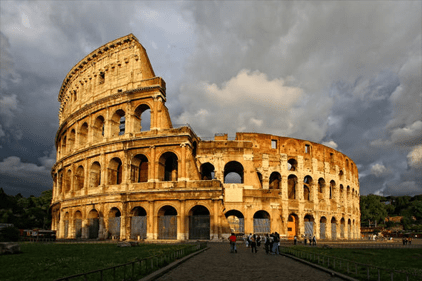
    A trip to Rome isn’t complete without visiting all of the historical Roman landmarks, no matter how touristy – and crowded – they can get. From the Pantheon to the Colosseum, the Roman Forums, and the Spanish steps, there is an abundance of sights to see in Rome, and it never gets old experiencing ancient, Roman history. Make sure to watch your belongings carefully, however, as pickpockets are abundant in crowded, touristy areas.


    Source: https://tinyurl.com/ydf2jb6t

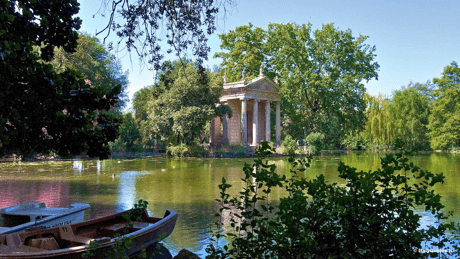
    Bike Around Villa Borghese

    A hidden, Roman gem I learned about – although it is still a bit touristy – is biking in Villa Borghese. You can bike around the gardens, stop for a picnic lunch in the grass, and walking through numerous museums and buildings. It is also close to many of the other monuments in Rome, making it easily accessible.


    Source: https://tinyurl.com/yd6l273b

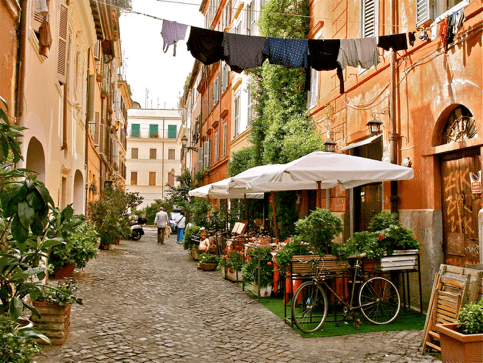
    Visit Trastevere

    One of my favorite places in Rome is the neighborhood of Trastevere. From the cute little shops to the amazing restaurants, this area of a Rome is a must. Although there are many cool, and hidden, neighborhoods in Rome, I am biased as I lived in Trastevere and fell in love. I would highly recommend starting in la Piazza di Santa Maria – which is located right by the famous Santa Maria church – and walk around the area from there. This is a place you don’t want to miss!


    Market

    Source: https://tinyurl.com/kwrwqbb

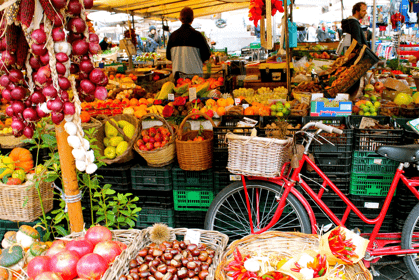
    Travel around the Street Markets

    Another highlight of Rome is the street markets. Food, produce, gifts, and other goods are sold during weekday mornings and on the weekends. One of the most popular tourist markets is in Campo dei Fiori, which has food, any kind of pasta you could think of, and local, fresh produce. It is open every morning except on Sundays. Another amazing market – for fresh veggies, fruit, fish, and meat – is the Piazza San Cosimato market, which is open every morning except on Sundays. My personal market favorite, however, is the flea market located around the Via Portuense area in Trastevere. This market has EVERYTHING you could ever need at great prices! Clothing, toiletries, sunglasses, and other goods are sold here every Sunday morning-afternoon. Again, make sure to keep your belongings close at the markets, as the high volume of people brings out the pickpockets and other petty thieves.


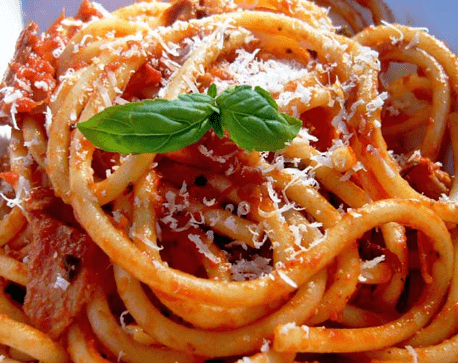
    Spaghetti

    Source: https://tinyurl.com/ya85rk5k

    EAT, EAT AND EAT!!

    Of course, when in Rome you must eat! Here is a – very condensed – list of my favorite restaurants in Rome:

    • La Gelateria Frigidarium – a touristy, but AMAZING, gelato place (near Campo dei Fiori)
    • Dar Poeta – the BEST pizza I have ever had and I still dream about it (located in Trastevere)
    • Pimms – a great place for cheap salads and good risotto (in Trastevere)
    • Donkey Punch – a casual sandwich joint for a quick bite (in Trastevere)
    • Capa Toast – slightly touristy panini place (located in Trastevere)
    • Ristorante Maccheroni – a casual dinner place with some of the best pasta at great prices (in the Piazza delle Coppelle near the Pantheon)


    ABOUT THE AUTHOR: Jolie Blair is a rising senior at Emory University from Sun Valley, Idaho. She is double majoring in Theater Studies and Public Health and has a passion for the arts, writing, and traveling. She studied abroad for the 2016 fall semester in Rome, Italy and had an experience of a lifetime, which she loves to share with those who want to listen (and even those who don’t like her 140lb Great Dane!).


    Source link