
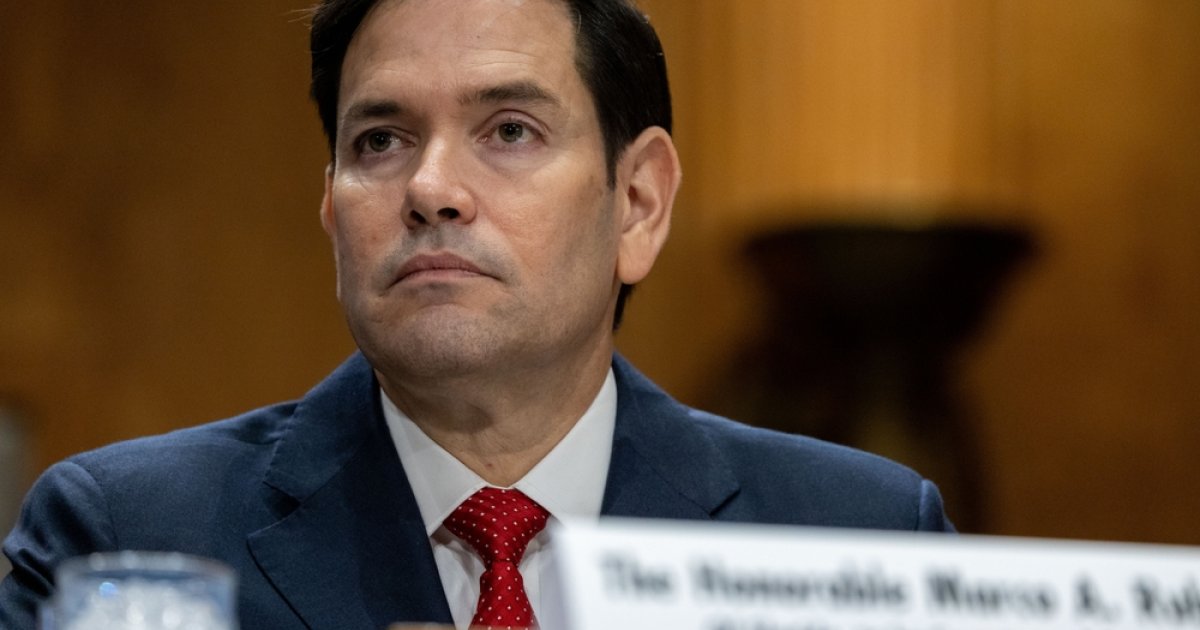
Tag: Rubio

  • Why FIRE is suing Secretary of State Rubio — and what our critics get wrong about noncitizens’ rights

    Why FIRE is suing Secretary of State Rubio — and what our critics get wrong about noncitizens’ rights

    FIRE is suing Secretary of State Marco Rubio to challenge two federal immigration law provisions that give him unchecked power to revoke legal immigrants’ visas and deport them just for speech protected by the First Amendment.

    And yes, we knew full-well we’d get blowback. You don’t exactly file a First Amendment lawsuit against a cabinet member without knowing it will be unpopular with parts of the American public.

    But for nonpartisan free speech defenders, that comes with the job.

    One of our plaintiffs is the student-run paper The Stanford Daily, where writers on student visas are turning down assignments related to the war in Gaza because they fear reporting on it could endanger their immigration status. We are also representing two legal noncitizens who engaged in pro-Palestinian speech and now fear being deported.

    Some of the questions we’ve received have been quite thoughtful. Others, however, are mistaken on the premises. So let’s clear the air.

    Happy to help, Obsequious Deacon. The First Amendment in the Constitution’s Bill of Rights prohibits the government from “abridging the freedom of speech,” without any distinction between citizens and aliens. If the U.S. government is acting against someone on U.S. soil, the Constitution applies.

    Remember, our liberties don’t spring from the kindness of government, but are inherent to each and every individual. The First Amendment presumes there is free speech, and is simply a restriction against government infringement of it. This recognition is what makes the American experiment exceptional and worth defending.

    This has been firmly established by the Supreme Court in a long line of cases. In Bridges v. Wixon (1945), the Court made clear that under the protection of the First Amendment, “Freedom of speech and of the press is accorded aliens residing in this country.”

    Or take it from Justices Antonin Scalia and Ruth Bader Ginsburg, who famously disagreed on a lot! Here they discuss how even immigrants not here legally (which isn’t the case in this lawsuit, where the plaintiffs are here on visas) enjoy the protection of the First Amendment.

    Additionally, in Yick Wo v. Hopkins (1886), the Court said the Equal Protection Clause of the Fourteenth Amendment applies to “all persons” in the country, not just citizens. In Plyler v. Doe (1982), the Court struck down a Texas law that denied public education to undocumented children, explaining that undocumented immigrants are still “persons” under the Constitution.

    The same goes for due-process protections. In Wong Wing v. United States (1896), the Court ruled that noncitizens accused of crimes are entitled to Fifth and Sixth Amendment protections, including due process and the right to a jury trial. And in Zadvydas v. Davis (2001) and Sessions v. Dimaya (2018), the Court has since affirmed that due process applies to everyone in the United States, including noncitizens.
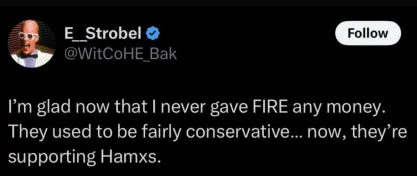
    E_Strobel X post

    We’ve never been conservative, liberal, or any other political label. We’re nonpartisan defenders of the First Amendment.

    Before we expanded our mission to defend free speech everywhere, we focused on college campuses where censorship, in recent decades, has overwhelmingly come from the left of the speaker. As a result, we often found ourselves challenging liberal administrators and defending the rights of conservative and moderate studentsprofessors, and speakers. But we don’t care about the viewpoint involved. FIRE’s motto is, “If it’s protected, we’ll defend it.”

    As for the claim that we support Hamas, defending someone’s right to speak is not the same as endorsing what they say. Defending the speech of ideological allies and opponents is the foundation of any principled defense of free expression.
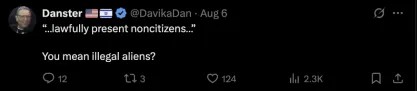
    Danster X post

    No. The terms “lawful” and “illegal” are opposites, of course. The “lawfully present noncitizens” mentioned first are legally allowed to be in the country while the “illegal aliens,” by definition, are not. That said, the First Amendment applies to everyone on U.S. soil. This is America, and you shouldn’t have to prove your citizenship before offering an opinion. 

    Think of it this way, would you be comfortable if a Democratic administration deported Canadian Jordan Peterson for his speech or a European student whose Ph.D. research concentrated on proving the Wuhan lab leak theory of Covid’s origins? We hope not.

    Mark W. Smith/#2A Scholar X post

    The censorship of noncitizens affects Americans, too. If international students and green-card holders have to censor themselves out of fear, we stand to lose many ideas as a result. Should John Oliver have been forced to censor his criticism of the Iraq War on The Daily Show before he became a U.S. citizen? Should British politician Nigel Farage have been prohibited from criticizing Joe Biden during last year’s Republican National Convention? Of course not, and Americans interested in hearing their perspectives would have been all the worse for it. 

    If you’re having a conversation with someone, you deserve to hear their full opinion, not one sanitized to avoid retaliation from government censors. And if the current administration’s actions don’t worry you, just imagine the other side wielding the same power.
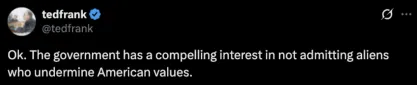
    tedfrank X post

    Bear in mind our lawsuit and this discussion are not about admitting noncitizens, the focus is throwing people who are already here legally out of the country for protected speech. As our preliminary injunction brief explained (check out footnote 7), the law has long distinguished the discretion afforded in determining whom to allow into the country from permissible considerations when attempting to deport someone legally here. Our client The Stanford Daily is suing Rubio because its noncitizen student writers are afraid to practice basic journalism for fear they could be deported. That’s not very American.

    Another problem here is there is not exactly universal agreement on what constitutes “American values.” Quite the contrary, it’s frequently been misused to silence dissent, which is ironic because the most fundamental of American values is to protect dissent in what increasingly seems to be the uniquely American belief that all people should be free to fully speak their minds.
    Source link

  • Rubio sued over international student deportations

    Rubio sued over international student deportations

    The legal challenge takes aim at Rubio’s use of statutes to deport legal noncitizens, namely international students Mahmoud Khalil and Rümeysa Öztürk, for their speech alone. It was filed by the Foundation for Individual Rights and Expression (FIRE) on August 6.  

    “In the United States of America, no one should fear a midnight knock on the door for voicing the wrong opinion,” said FIRE attorney Conor Fitzpatrick: “Free speech isn’t a privilege the government hands out. Under our constitution it is the inalienable right of every man, woman and child.” 

    FIRE, a non-partisan advocacy group, is seeking a landmark ruling that the first amendment trumps the statutes that the government used to deport international students and other lawfully present noncitizens for protected speech earlier this year. 

    It cites the case of Mahmoud Khalil, an international student targeted by the Trump administration for his pro-Palestinian activism, who was held in detention for three months after being arrested by plain clothed immigration officers in a Columbia University building.  

    The complaint also highlights the targeting of Tufts University student Rümeysa Öztürk, detained on the street and held for nearly seven weeks for co-authoring an op-ed calling for Tufts to acknowledge Israel’s attacks on Palestine and divest from companies with ties to Israel.  

    FIRE has said that that Rubio and Trump’s targeting of international students is “casting a pall of fear over millions of noncitizens, who now worry that voicing the ‘wrong’ opinion about America or Israel will result in deportation”.  

    This spring, thousands of students saw their visas revoked by the administration, after a speech from Rubio warning them: “We give you a visa to come and study to get a degree, not to become a social activist that tears up our university campuses”. 

    Free speech isn’t a privilege the government hands out

    Conor Fitzpatrick, FIRE

    Though the students’ statuses have since been restored following a court hearing deeming the mass terminations to be illegal, some students opted to leave the US amid fears of being detained or deported.  

    This summer, international student interest in the US fell to its lowest level since mid-pandemic, with new estimates forecasting a potential 30-40% decline in new international enrolments this fall following the state department’s suspension of new visa interviews.  

    Plaintiffs in the lawsuit include The Stanford Daily – the independent, student newspaper at Stanford University – and two legal noncitizens with no criminal record who fear deportation and visa revocation for engaging in pro-Palestinian speech.  

    “There’s real fear on campus and it reaches into the newsroom,” said Greta Reich, editor-in-chief of The Stanford Daily.  

    “I’ve had reporters turn down assignments, request the removal of some of their articles, and even quit the paper because they fear deportation for being associated with speaking on political topics, even in a journalistic capacity.  

    “The Daily is losing the voices of a significant portion of our student population,” said Reich.  

    The complaint argues that Rubio’s wielding of two provisions of the Immigration and Nationality Act is unconstitutional when used to revoke a visa or deport someone for the first amendment right of free speech. 

    “The first allows the secretary of state to render a noncitizen deportable if he ‘personally determines’ their lawful ‘beliefs, statements, or associations’ ‘compromise a compelling United States foreign policy interest’”, explains the document.  

    “The second allows the secretary ‘at any time, in his discretion, revoke’ a ‘visa or other documentation’”.  

    The complaint argues that both provisions are unconstitutional as applied to protected speech, based on the first amendment promise “that the government may not subject a speaker to disfavoured treatment because those in power do not like his or her message”. 

    In our free country, you shouldn’t have to show your papers to speak your mind

    Will Creeley, FIRE

    According to the claimants, Trump and Rubio’s targeting of international students is evidence of noncitizens not being afforded the same free speech protections as US nationals, which, they say, runs against America’s founding principles.  

    “Every person – whether they’re a US citizen, are visiting for the week, or are here on a student visa – has free speech rights in this country,” said FIRE. 

    “Two lawful residents of the United States holding the same sign at the same protest shouldn’t be treated differently just because one’s here on a visa,” said FIRE legal director Will Creeley.  

    “The First Amendment bars the government from punishing protected speech – period. In our free country, you shouldn’t have to show your papers to speak your mind.” 

    The lawsuit comes amid heightened scrutiny of international students in the US, with the state department ordering consular officers to ramp up social media screening procedures. 

    As of June 2025, US missions abroad will now vet students for instances of “advocacy for, aid, or support of foreign terrorists and other threats to US national security,” as well as any signs of “anti-Semitic harassment and violence” among applicants.  

    Source link

  • LAWSUIT: FIRE challenges unconstitutional provisions Rubio uses in crusade to deport legal immigrants over protected speech

    LAWSUIT: FIRE challenges unconstitutional provisions Rubio uses in crusade to deport legal immigrants over protected speech

    • The First Amendment trumps the statutes that the government is abusing to deport people for speech alone
    • This lawsuit seeks a landmark ruling that the First Amendment forbids the government from deporting lawfully present noncitizens for constitutionally protected speech
    • FIRE attorney: ‘In a free country, you shouldn’t have to show your papers to voice your opinion’

    SAN JOSE, Calif., Aug. 6, 2025 — Today, the Foundation for Individual Rights and Expression sued Secretary of State Marco Rubio, challenging two federal immigration law provisions that give him unchecked power to revoke legal immigrants’ visas and deport them for protected speech.

    “In the United States of America, no one should fear a midnight knock on the door for voicing the wrong opinion,” said FIRE attorney Conor Fitzpatrick. “Free speech isn’t a privilege the government hands out. Under our Constitution it is the inalienable right of every man, woman, and child.” 

    But since March, Rubio and the Trump administration have waged an assault on free speech, targeting foreign university students for deportation based on bedrock protected speech like writing op-eds and attending protests. Their attack is casting a pall of fear over millions of noncitizens, who now worry that voicing the “wrong” opinion about America or Israel will result in deportation.

    Noncitizens in the United States have First Amendment rights. Despite that, Rubio is wielding two provisions of the Immigration and Nationality Act to target lawfully present noncitizens for their opinions.

    • The first allows the secretary of state to initiate deportation proceedings against  any noncitizen for protected speech if the secretary “personally determines” the speech “compromises a compelling foreign policy interest.”
    • The second enables the secretary of state to revoke the visa of any noncitizen “at any time” for any reason. 

    As FIRE’s lawsuit explains, the provisions are unconstitutional when used to revoke a visa or deport someone for speech the First Amendment protects. 

    The Trump administration is proudly using the provisions to revoke the visas of and deport lawfully present noncitizens for their speech if the government deems it anti-American or anti-Israel. Rubio used the first provision to target Columbia University student Mahmoud Khalil for protected pro-Palestinian speech and the second to target Tufts University student Rümeysa Öztürk for coauthoring an op-ed.

    Rubio and the Trump administration claim — as all censors do — that this time is different. They claim that this political speech comes from noncitizens, which therefore warrants setting aside America’s protection of free speech.

    That’s wrong. America’s founding principle is that liberty comes not from the government, but is an inherent right of every individual. Every person — whether they’re a U.S. citizen, are visiting for the week, or are here on a student visa — has free speech rights in this country.

    “Two lawful residents of the United States holding the same sign at the same protest shouldn’t be treated differently just because one’s here on a visa,” said FIRE Legal Director Will Creeley. “The First Amendment bars the government from punishing protected speech — period. In our free country, you shouldn’t have to show your papers to speak your mind.”

    Plaintiffs in FIRE’s lawsuit represent the wide range of groups and individuals whose speech is threatened by the continued assault on noncitizens’ protected speech:

    • The Stanford Daily, the independent, student-run newspaper at Stanford University, where writers with student visas are declining assignments related to the conflict in the Middle East, worried that even reporting on the war will endanger their immigration status
    • Jane Doe and John Doe, two legal noncitizens with no criminal record who engaged in pro-Palestinian speech and now fear deportation and visa revocation because of their expression

    “There’s real fear on campus and it reaches into the newsroom,” said Greta Reich, editor-in-chief of The Stanford Daily. “I’ve had reporters turn down assignments, request the removal of some of their articles, and even quit the paper because they fear deportation for being associated with speaking on political topics, even in a journalistic capacity. The Daily is losing the voices of a significant portion of our student population.”

    There’s also historical context that should give the government pause. Congress passed the Alien and Sedition Acts 225 years ago. One of those acts allowed President John Adams to deport noncitizens if he thought they posed a “danger” to the country. It was one of the most unconstitutional laws in our nation’s history and died a quick death two years later, after the acts contributed to Adams’ resounding loss in the 1800 presidential election to Thomas Jefferson. 

    FIRE aims to stop the government’s use of the two provisions that stand counter to our ideals as a nation: Provisions that — in their expansive scope and unchecked authority — are more at home in countries like China and Russia than in a free America. By defeating these provisions, no administration of any party will be able to weaponize them against individuals for expression disfavored by the government.

    FIRE moved for a preliminary injunction to stop the government from abusing the visa provision while the case is ongoing.

    Marc Van Der Hout, Johnny Sinodis, and Oona Cahill at Van Der Hout LLP are serving as local and advisory counsel on the case.

    From today’s lawsuit: “Our First Amendment stands as a bulwark against the government infringing the inalienable human rights to think and speak for yourself.”

    The Foundation for Individual Rights and Expression (FIRE) is a nonpartisan, nonprofit organization dedicated to defending and sustaining the individual rights of all Americans to free speech and free thought — the most essential qualities of liberty. 

    CONTACT:

    Daniel Burnett, Senior Director of Communications, FIRE: 215-717-3473; [email protected]

    Source link

  • AAUP v. Rubio Reveals Details of Deportation Efforts

    AAUP v. Rubio Reveals Details of Deportation Efforts

    Today is the final day of the American Association of University Professors v. Rubio trial, in which the association, its chapters at Rutgers and Harvard Universities, and the Middle East Studies Association sued to stop the Trump administration from the “ideological deportation” of international students.

    The lawsuit argues that the deportations violate international students’ right to free expression and their Fifth Amendment right not to have laws enforced against them arbitrarily or discriminatorily. It also claims that the arrests of student protesters chilled speech on campuses—something witnesses corroborated.

    The trial, conducted during the last two weeks, revealed new details about the administration’s targeting of international students, including high profile cases like those of graduate students Mahmoud Khalil and Rümeysa Öztürk, who were detained by Immigration and Customs Enforcement in March. (Both have since been released.)

    Here are some of the key takeaways from the trial ahead of the parties’ closing statements.

    1. Dossiers about the targeted students included information about their protest activities.

    On Friday, John Armstrong, the most senior official at the State Department’s Bureau of Consular Affairs, testified that the memos written by state department officials recommending deportation actions and visa revocations contained details about student and faculty members’ activism.

    The memos have been designated as for “attorneys’ eyes only”—the most restrictive possible designation for sensitive information in a trial, which prevents even the plaintiffs and defendants from viewing them. But attorneys and witnesses quoted excerpts of them during the trial.

    The action memo for Öztürk highlighted an op-ed she had co-written supporting a call for her institution, Tufts University, to divest from companies with ties to Israel, Armstrong said, according to trial transcripts published by the Knight First Amendment Institute at Columbia University, which is representing the plaintiffs. But he insisted that the op-ed was not a “key factor” in the decision to revoke her visa and detain her.

    Another memo, regarding Columbia student activist Mohsen Mahdawi, specifically noted that “a court may consider his actions inextricably tied to speech protected under the First Amendment,” according to an excerpt read by Alexandra Conlon, an attorney for the plaintiffs.

    2. Investigators weren’t given guidance about what constitutes antisemitism.

    The State Department hasn’t release any guidance as to what, exactly, should be considered antisemitism, Armstrong acknowledged on Friday. He also stated that, to his knowledge, the officials who have written action memos about protesters haven’t received any training about what constitutes antisemitism.

    That’s significant, because at least one memo, Mahdawi’s, referred specifically to “antisemitic conduct.”

    “I do know that there’s a common understanding in our culture, in our society of what antisemitism is,” Armstrong said.

    When U.S. District Judge William G. Young pushed him to describe that “common understanding,” he responded: “In my opinion, antisemitism is unjustified views, biases, or prejudices, or actions against Jewish people, or Israel, that are the result of hatred towards them.”

    3. ICE officials leaned on the Canary Mission website to find students and professors to target.

    For over a decade, the anonymously operated site Canary Mission has been publishing the identities of students and professors they deem antisemitic. Several of those listed on the website, including Khalil, Mahdawi and Öztürk, have been targeted since the Trump administration began taking aim at student protesters.

    On the third day of the trial, Peter Hatch, a senior ICE official, stated that “many of the names, even most of the names” on a list of noncitizen students presented to ICE’s “Tiger Team” for investigation came from the Canary Mission site.

    Hatch said that other names came from Betar USA, the American chapter of an international Zionist organization, which the Anti-Defamation League has labeled an extremist group.

    4. ICE agents said they prioritized the arrest of activists at the urging of their higher-ups.

    ICE agents who oversaw the arrests of Öztürk, Khalil, Mahdawi, and Badar Khan Suri, a Georgetown University professor, said last Tuesday that the cases were unusual not just because of the legal grounds on which the activists were detained but also because the orders came from high-ranking officials in the organization.

    Patrick Cunningham, an agent with ICE’s Homeland Security Investigations office in Boston, said that the agency’s leaders were “inquiring” about Öztürk’s case, leading his office to prioritize her arrest.

    “I can’t recall a time that it’s come top-down like this with a Visa revocation, um, under my purview anyway,” Cunningham said, according to the transcript. “And so with the superiors that were, you know, inquiring about this, it made it a priority, because we worked for them.”

    5. Students and faculty confirmed they stopped protesting out of fear.

    Over the trial’s first two days, five noncitizen faculty members took the stand to describe how news about activists being targeted had caused them to stop engaging in various political activities. They said they decided not to attend protests or sign statements related to Israel’s war in Gaza after hearing about Khalil’s and Öztürk’s arrests.

    One Brown University professor, Nadje Al-Ali, said she cancelled longstanding plans to travel to Beirut and Baghdad for research into women artists and gender-based violence in the Middle East.

    “Following the arrest and the detention and the threat of deportation of several students, graduate students, and also I think one post-doc—I mean, most prominently Mahmoud Khalil but others as well—I started to think that it is not a good idea,” she said. “I felt that it was too risky for me to do research in the Middle East, come back, and then my pro-Palestinian speech would be flagged. And as a green card holder and also as a prior director for the Center For Middle East Studies that had been under attack, and there are a lot of sort of false allegations about, I felt very vulnerable.”;

    The fear also extended beyond speech related to the Middle East; Al-Ali also refrained from attending a protest on No Kings Day, a massive day of demonstration that opposed President Donald Trump’s policies in his second presidency, including cutting federal government offices, defunding research and social services, and his mass deportation campaign.

    Source link