Tag: rules

  • Energy Department delays multiple rules after public pushback

    Energy Department delays multiple rules after public pushback

    This audio is auto-generated. Please let us know if you have feedback.

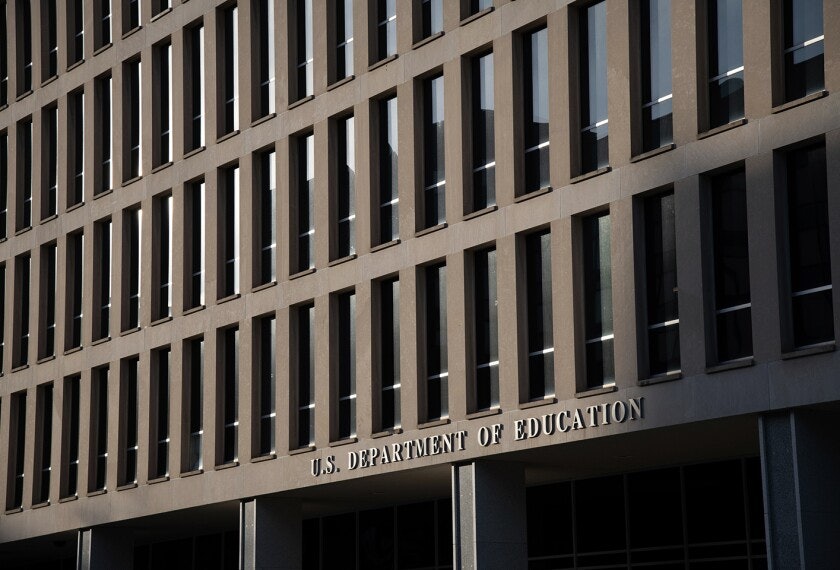
    The U.S. Department of Energy delayed implementation of multiple rules that it had quietly set to go into effect this week for schools that receive funding from the agency. The move comes in response to public pushback to proposed policy changes.

    The department said it was extending the effective dates for several direct final rules from July 15 to Sept. 12, 2025. The proposals would have undone some student protections related to sex discrimination under Title IX, disability discrimination under Section 504, and racial discrimination under Title VI. 

    One direct final rule, for example, would have no longer required schools to offer girls tryouts for boys’ teams in noncontact sports if the school didn’t have an equivalent girls’ team. Another would have removed protections allowing gender-conscious after-school programs or college initiatives to provide women and girls opportunities they have historically been denied, such as in STEM fields or in technical training.   

    Had the public not responded to the direct final rules with “significant adverse comments,” the rules would have undone such protections within a 30-day period — a much shorter timeline than the typical rulemaking process, which requires federal agencies to consider public feedback and make changes to their policy proposals accordingly. 

    The Trump administration’s decision to undo civil rights protections for students using expedited rulemaking — a process usually reserved for rules agencies expect to be uncontroversial — alarmed many civil rights organizations.

    Kel O’Hara, senior attorney for policy and education equity at Equal Rights Advocate, called the move a “backdoor elimination of student protections.”

    “The Trump Administration tried to exploit an obscure regulatory loophole meant only for minor administrative updates to gut fundamental protections for female athletes and transgender students,” O’Hara said in a Wednesday statement.

    Typical rulemaking would require a public notice and comment period, and a second version of the rule that takes into consideration changes based on public feedback. That process also gives school districts more time to prepare for policy changes. 

    The rules were also atypical in that they were released by the Energy Department rather than the U.S. Department of Education — meaning only schools receiving Energy Department funding would have been impacted by this set of changes. The Energy Department gave 28 schools just over $160 million in fiscal year 2025, and provides over $2.5 billion annually to more than 300 colleges and universities to fund research.

    However, had significant adverse comments not been received and delayed these rules’ implementation, and had the Energy Department been successful in its approach, the administration could have replicated the expedited method through other federal agencies to set education policies in many more schools, education policy experts predicted. 

    “This is a paradigm shift on the part of how the federal government articulates and connects some of these tools to their education priorities,” said Kenneth Wong, a professor of education policy at Brown University, when the direct final rules were announced. “Basically every single school, in practically every single school district, has some grants from one of the many agencies in the federal government.” 

    Most schools receive K-12 funding from multiple agencies, such as the Energy Department and the U.S. Department of Agriculture. 

    Because of the opposition to the rules, the Energy Department must now either withdraw them entirely or issue new final rules by September 12 that take the comments into account. 

    The Energy Department did not respond to a request for comment in time for publication.

    Source link

  • NZ’s new study visa rules strike chord with Australian sector

    NZ’s new study visa rules strike chord with Australian sector

    The New Zealand government announced earlier this week that, from November, Immigration New Zealand (INZ) will increase permitted work hours for study visa holders, extend work rights to all tertiary students on exchange or study abroad programs. It may also introduce a short-term work visa of up to six months for graduates not eligible for a post-study work visa.

    While the relaxations are a key part of New Zealand’s push to boost international student numbers by over 40% by 2034, INZ has also clarified that students who change their education provider or lower their study level will need to apply for a new visa, rather than simply requesting a variation of conditions on their existing one.

    The mandate has struck a chord with Australia’s international education sector, where some individuals and associations have been calling for an overhaul of the study visa system, specifically on linking study visas to the institution of initial enrolment.

    Commenting on New Zealand’s recent changes, Ravi Lochan Singh, managing director, Global Reach, wrote in a LinkedIn post that instead of banning agent commissions for onshore student transfers to address attrition, Australia could “just copy” the neighbouring country’s approach. 

    “Australia is currently facing a significant issue where students use higher ranked or low-risk universities (as categorised by Home Affairs) to secure their student visas easily and then after the first semester of studies, the students get moved to private colleges offering higher education degrees,” Singh told The PIE News. 

    According to Singh, while such moves, often made by Indian or Nepali students with the help of onshore immigration agents, may be genuine, they “waste” the efforts of offshore education agents and universities that initially recruited the students.

    “Some policy makers feel that students have a right to choose the correct education provider and if they feel that what they desire as a customer can be met at private colleges, they should be allowed to move,” stated Singh. 

    “However, we also have the situation where students have demonstrated their available funds through an education loan which is issued in the name of a particular university,” he added. If the student does move institutions, the education loan is not valid as a demonstration of funds and thus the argument that the students should be asked to apply for a fresh student visa.”

    According to Singh, many international students, particularly from South Asia, who arrive in Australia on education loans often find themselves without “available” or “accessible” funds when they switch providers and are required to show new financial evidence.

    It would appear that three modern advanced economies who have championed consumer protections and who have established international study destinations believe this measure is not contrary to ‘consumer choice’
    Gareth Lewis, Western Sydney University

    Moreover, a recent report by Allianz Partners Australia revealed that over 61% of international students found daily life in the country “significantly more expensive than expected”, with more than a quarter considering withdrawing from their studies due to financial woes. 

    “While we are discussing attrition and student movements once the student is onshore, we also need to acknowledge that university fees have been increasing and students are beginning to question ROI. Thus there is an argument for more student visa grants for higher education degrees at TAFE and private providers,” said Singh. 

    “The fees of such programs is much lower to what is charged at the universities. If this happens, the students who are more price sensitive will join the TAFE and private providers right in the beginning and universities will have only those students who can afford the degree and likely to complete them at the university itself.”

    While Australia’s Ministerial Direction 111, which replaced MD 107, provides immigration case officers stricter guidance on assessing the Genuine Student requirement, and introduces a two-tier visa processing system that prioritises institutions with strong compliance records and low visa risks, it influences the decision-making process, not the entire visa mechanism unlike New Zealand’s recent move. 

    However, New Zealand is not the only model Australia could look to, according to stakeholders.

    A recent submission by the Association of Australian Education Representatives in India (AAERI) to the ministers for education and home affairs in Australia pointed to examples from the UK and Canada, where students must obtain a new Confirmation of Acceptance for Studies (CAS) and a new study permit, respectively, if they wish to change institutions.

    “Australia’s recent reforms, such as closing the concurrent CoE loophole and requiring CoEs for onshore visa applications, are steps in a similar direction but do not go far enough to address the core issue of unethical student poaching, misuse of student visa and provider switching,” stated AAERI in its submission in May to the Labor government. 

    After New Zealand’s changes were announced, regional director, Western Sydney University, Gareth Lewis also echoed a similar opinion on Australia’s reluctance to do what New Zealand, the UK, and Canada have done. 

    “It would appear that three modern advanced economies who have championed consumer protections and who have established international study destinations believe this measure is not contrary to ‘consumer choice’,” read Lewis’s LinkedIn post

    “Unfortunately Australia believes it is. This needs to change.” 

    Find out more about how Australia can improve its visa system at The PIE Live Asia Pacific 2025 on July 30, during the session “Visa status: MD111 and MD106 mapping – is the current visa system working?”, which will explore the impact of current visa policies on HE, VET, and ELICOS sectors, covering genuine student assessments, onshore switching, and ways to improve the operating environment. Check out more details here – PLAP 2025 agenda.

    Source link

  • U.S. Judge Rules Colleges Can Directly Pay Student Athletes

    U.S. Judge Rules Colleges Can Directly Pay Student Athletes

    Michael Reaves/Getty Images 

    Federal district judge Claudia Wilken granted final approval to a multi-billion-dollar settlement in the yearslong House v. NCAA lawsuit late Friday evening, effectively transforming college sports: Starting July 1, institutions will be allowed to pay student athletes directly.

    In accordance with the settlement, the National Collegiate Athletic Association and colleges in Division I conferences will distribute nearly $2.8 billion in back damages over the next 10 years to athletes who competed any time since 2016, as well as to their lawyers. The case also allows each college that opted in to pay their athletes collectively up to $20.5 million per year, in addition to scholarships. That figure will increase incrementally over time.

    The ruling, which technically resolves three antitrust lawsuits against the NCAA, essentially turns student-athletes from amateurs into professionals. But experts say this isn’t likely to end court battles over athletics. The creation of the revenue-sharing model (where schools distribute money earned from areas such as media rights or merchandise), combined with existing turmoil over the regulation of name, image and likeness (NIL) deals, will only invite more lawsuits, they say. 

    “The judge said, in essence, this is not a perfect settlement that solves everyone’s concerns, but it makes progress towards ‘righting the wrongs’ of higher education’s desire to maintain amateurism status for the players but no one else,” Karen Weaver, adjunct assistant professor in the graduate school of education at the University of Pennsylvania, wrote in an email to Inside Higher Ed.

    Although many colleges began making changes to their programs in anticipation of the settlement’s approval, the timing of the ruling could present logistical challenges as they move to start revenue-sharing with students from the July 1 deadline set out in the suit. 

    Current and former athletes have celebrated the ruling. 

    “It’s historic,” former college basketball star Sedona Prince, a co-lead plaintiff in one of the lawsuits, told ESPN. “It seemed like this crazy, outlandish idea at the time of what college athletics could and should be like. It was a difficult process at times … but it’s going to change millions of lives for the better.”

    Wild West Yet to be Tamed

    Judge Wilken’s ruling comes nearly two months after both parties presented arguments in early April for approving the settlement, and nearly five years after the suit was first filed in 2020. But contentious debates over how to manage paying student athletes really erupted in 2021, when NIL deals were first legalized. 

    Since then, collectives made up of alumni and boosters have paid athletes millions of dollars to play at schools through unregulated NIL partnerships. Top football and basketball players have earned the most.

    College leaders have argued that the collectives could give wealthier institutions an unfair recruiting advantage. The House settlement, which not only allows colleges to pay athletes directly but also gives conferences the power to regulate booster influence, could help solve that problem.

    “For several years, Division I members crafted well-intentioned rules and systems to govern financial benefits from schools and name, image and likeness opportunities, but the NCAA could not easily enforce these for several reasons,” NCAA president Charlie Baker wrote in a statement Friday. “The result was a sense of chaos: instability for schools, confusion for student-athletes and too often litigation.”

    “The settlement opens a pathway to begin stabilizing college sports,” Baker said. “This new framework that enables schools to provide direct financial benefits to student-athletes and establishes clear and specific rules to regulate third-party NIL agreements marks a huge step forward for college sports.”

    The settlement also establishes a new clearinghouse, run by Deloitte, that will vet any endorsement deal between a booster and an athlete worth more than $600, with the goal of ensuring it is for a “valid business purpose.”  

    Still, doubts remain about how the watchdog will work; one commenter on X noted that all it takes for boosters to create an NIL regulatory loophole is to pay athletes in multiple $599 payments rather than one mass sum

    Despite the efforts to regulate NIL payments through the clearinghouse, Weaver said the settlement will create “a feeding frenzy of agents and dealmakers capitalizing on a few athletes wealth while schools scramble to lock down players who could bolt for a better offer at any moment.”

    “I expect to see the first Title IX lawsuits, and requests for an immediate stay, filed as soon as this week,” she said. “It’s important for higher education leaders to understand the far-reaching impact on our industry—it’s only just begun.”

    Source link

  • Department of Education Relaxes Accreditation Change Rules, Raising Quality Concerns

    Department of Education Relaxes Accreditation Change Rules, Raising Quality Concerns


    The U.S. Department of Education announced Thursday it will eliminate the rigorous review process previously required for colleges and universities seeking to change accreditors, a move critics warn could undermine educational quality standards.

    The announcement, which implements parts of President Trump’s Executive Order on “Reforming Accreditation to Strengthen Higher Education,” simultaneously lifts a moratorium on reviewing applications for new accrediting bodies.

    In a statement, Education Secretary Linda McMahon framed the policy change as promoting competition.

    “We must foster a competitive marketplace both amongst accreditors and colleges and universities in order to lower college costs and refocus postsecondary education on improving academic and workforce outcomes for students and families.” she said.

    However, higher education policy experts expressed concerns that the streamlined process could enable institutions to evade accountability by shopping for less stringent accreditors.

    The Department’s new Dear Colleague Letter revokes guidance issued by the Biden administration in 2022 that had established a pre-clearance process for institutional accreditor changes. The new guidance explicitly allows institutions to change accreditors for reasons including finding one that “better aligns with a religious mission,” accommodating shifts in academic programs, complying with state law requirements, or avoiding accreditors that impose “discriminatory Diversity, Equity, and Inclusion (DEI) practices and principles.”

    Education advocates worry the policy shift prioritizes institutional freedom over student protections.

    “When we make it easier for colleges to switch accreditors without thorough vetting, we risk creating a race to the bottom where standards are compromised,” said one higher education researcher. “The students who will suffer most are often those from historically underrepresented groups who depend on accreditation as an assurance of quality.”

    The Department characterized its previous approach as overreaching, stating in the new guidance.

    “It is not the Department’s prerogative to infer any other meanings from the basic requirements or contrive a multi-step investigation. This guidance re-establishes a simple process that will remove unnecessary requirements and barriers to institutional innovation.”

    The policy change also rescinds the October 2024 pause on reviewing applications for new accrediting agencies. At least one prospective accreditor that had its application temporarily paused has now been notified that its review will proceed.

    Critics contend that enabling more accreditors with potentially varying standards could fragment the higher education quality assurance landscape in ways that confuse students and employers.

    “The fundamental question is whether reducing oversight will actually improve educational outcomes or simply make it easier for underperforming institutions to avoid consequences,” said a public university president, who asked to remain anonymous, for fear of retaliation. “History suggests the latter is more likely.”

    The Department has not announced specific metrics to evaluate whether the policy changes lead to improved outcomes for students or institutions.

    Source link

  • The government's money, the government's rules?

    The government's money, the government's rules?

    Our guests today signed onto a statement by a group of 18 law
    professors who opposed the Trump administration’s funding threats
    at Columbia on free speech and academic freedom grounds. Since
    then, Northwestern, Cornell, Princeton, Harvard, and…

    Source link

  • Some Rules for Campus Resistance (opinion)

    Some Rules for Campus Resistance (opinion)

    Given what’s happened at Columbia University (and what is happening now at other Ivies, and beyond), every university leader in the United States ought to be planning in advance what they will do when similar pressures are brought to bear on them. Academics ought to as well; all the citizens of our republics of learning should care about their institutions and be willing to defend them.

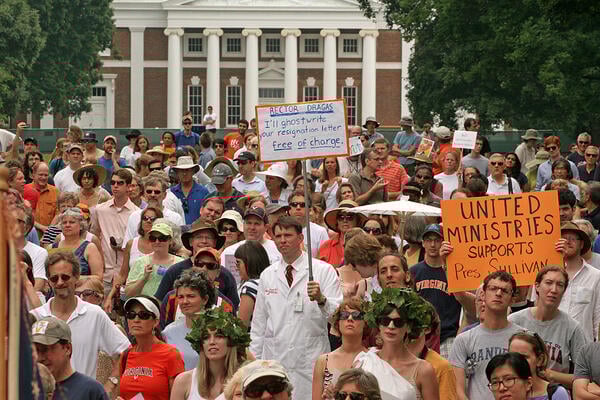
    Over a decade ago, here at the University of Virginia, we had a nasty little fight with our Board of Visitors when they tried to fire President Teresa Sullivan with little more logic or rationale than we’re currently seeing come out of Washington. (The American Association of University Professors produced a pretty good report about it, if you want to read something unsettling.)

    Our opponents in that little pas de deux had a degree of ignorance that amply matched their arrogance, but we were lucky in discovering allies far beyond Charlottesville in our alumni base and other institutions.

    At the time, I recognized that we had learned some smaller, tactical lessons in the whole shindig that might be relatively portable across different universities. I almost published them, but decided that it was better to let my university go forward without adding my two cents.

    Now, however, in our moment, these seem relevant again. So, in the wake of Columbia’s capitulation to Trump’s assault, I dusted them off and polished them up. They didn’t need much polishing, to be honest. Consider this a small pamphlet for thinking about hosting “a little rebellion now and then” on your campus, when such is needful.

    1. Don’t start the fight. Have a prompting event—even if you invite it merely by doing your job. We were lucky to have a “day of infamy” jump-start our events in 2012. It was dropped, gift wrapped, into our lap. We were, from the beginning, in the position of the victim—the one who was wronged. Being the aggrieved party from the start helps. A lot.
    1. Be a big tent, but have one common aim. Because the misdeed was so expansive in its implications, the scope of our “we” was enormously wide. The “we” who was violated included not just the president, but the administration, faculty and staff—and not just them, but the students, and the alumni, and indeed the community of Charlottesville, and possibly all those interested in the future of academia in America and beyond. And anyway, you’re not seeking consensus: You’re seeking alliance. This is hard for us academics, because we are so excellent at invidious distinctions. But remember: World War II was won by an alliance of the British empire, the anticolonialist liberal United States and the definitionally revolutionary U.S.S.R. If those three states could work together, you can say something nice about professors in the business school, or vice versa. The same goes for deans and administrators: They are not the enemy. By coordinating the most expansive community as the community to whom voice could be given, we ensured not just that numbers were on our side, but that the widest set of complaints and grievances were brought to bear on the most precise targets.
    2. Lean into shared governance. No one ever expected the UVA Faculty Senate to be consequential, least of all the Faculty Senate. It was the place where we sent junior faculty “to learn about the university”; given how much import anyone normally gives to learning about the university, that shows you what we thought of it. But, to borrow from Don Rumsfeld, you go to war with the institutions you have, not the institutions you wish you had, and now everyone knows that the Faculty Senate can matter, and matter decisively. I hope we never forget it. I hope you can learn from our example and not your own.
    3. Tenure counts. You know that thing we say about tenure mattering for free expression and for ensuring that you can speak your mind on academic matters without getting fired by administrators who don’t like what you have to say? I used to find it annoying and silly— “of course that’s not going to happen, not today,” I thought; “no one will be so dictatorial.” Well, lookie here—I was wrong. The first and consistently most vocal group in the whole UVA fracas was the faculty. The staff members were behind us (especially the women on the university’s staff, who had felt represented by Sullivan in a powerful way), but obviously they were in the most vulnerable position. And the deans and administrators were by and large ready to accept the coup as a fait accompli. (While the deans of the various schools eventually came around, it took them some time; only after they realized that almost every last one of the faculty were extraordinarily pissed, and shopping their CVs around, did they realize that they were hurting themselves more by not saying anything than they would by saying something.)
    1. “If a problem cannot be solved, enlarge it.” Dwight D. Eisenhower said that, and it’s true here. The prompting event of our crisis was of course the firing of our President Sullivan by our board rector, Helen Dragas, and a few others (let’s be honest about what it was and who did it). But it was clear from the beginning that there were larger issues here—about the disconnect between oversight, management and teachers and researchers, about the creeping “corporatization” of the board (though that does a terrible disservice to wise governance of corporations around the world, which would never be run the way most university boards try to run their institutions), about the failure of faculty to take seriously how the higher levels of the university were operating—matters far larger than simply this act. As the crisis developed, we realized we were reaping the consequences of structural contempt toward the faculty (and the rest of the university, really) by the Board of Visitors and a crisis of apathy about university governance on the part of the faculty. The problem may be larger than you first realize: Get it in focus, first and foremost.
    2. “Do you expect me to talk?” “No, Mr. Bond, I expect you to die.” The idea that disputes of these sorts are amenable most basically to conversation is mistaken. Statements were continually communicated to our Board of Visitors, but we knew almost at once that argument was not our real weapon. Once you decide to dissent, the time for talk is over, at least with opponents such as these; they will not be amenable to conversation—not without a great deal of pressure from other forces and sources. Your aim is not to convince your opponents; your aim is to beat them. To do that, you must persuade potential allies, not actual enemies. That said, it never hurts to be reasonable and produce strong arguments directed at your opponents, so long as you know those arguments are largely valuable because they are overheard by others.
    3. At no point should you demonize or vilify your opponents. It weirdly invests them with power you need not bestow. You’re in a fight with someone who’s like a toddler—do not descend to their level. Speak calmly, as to a toddler having a temper tantrum. You won’t convince them, but you will demonstrate you are not afraid. That will upset them more. If they lose, of course they will say you did demonize and belittle them; they’ll call you “so mean,” “ungracious” and “nasty in tone.” Don’t worry; everyone else knows otherwise. Saying that may be their only consolation prize. Let them have it. You’re walking out with the Benjamins. Or, in our case, the Sullivan.
    1. Time is not your friend, but nonetheless, boil the frog slowly. In a delicious irony, the coup at UVA was reversed “incrementally”—a bad word for Rector Dragas, a good word for President Sullivan. Resistance to the coup began with some immediate disquiet from the faculty and a few students on campus when it was first announced. But the faculty knew from the beginning they wouldn’t be the material cause of any change; they needed more powerful allies. The momentum built slowly, then snowballed at the end. And the momentum built both inside the institution and outside it: inside, mostly by growing outrage at the trickle of information released and the little bit we could discover (or, more properly, the media could discover) over time, and outside, by the gradual but eventually approaching exponential expansion of numbers and kinds of UVA stakeholders who expressed outrage.

    The end of the first week saw the Faculty Senate meeting where 800 faculty and others listened as our provost, John Simon, expressed real and powerful concern, and subtle outrage, over what had happened and how it had happened. By the end of the second week, we had politicians, alumni, other university faculties—and a number of major donors—speaking out in outrage. And then, too, we began to see newspaper editorial boards—and Katie Couric—condemn the firing. Had the Board of Visitors waited a bit longer to reverse its action, no doubt the United Nations, the E.U., the Nature Conservancy, the NBA, al Qaeda and Justin Bieber would have issued statements.

    The lesson here? Don’t try to get everyone on board all at once. Trust the swarm method, but go through your list of stakeholders methodically—moving from the most swayable to the least so. Rank them in their “get-ability,” and then get them, encouraging the ones you already have on your side to increase pressure on the next-most-gettable ones. On day two of a crisis, you probably won’t get The Washington Post and your institution’s major donors to sign on to calling this an outrage; but by day 10, or 14, with a little help, and momentum from other people, you may. And better still, while this is happening, your opponents probably won’t notice the pressure gradually ratcheting up, as they are simply trying to keep responding to different constituencies. By the time they realize that there are a lot of people angry at them, there’s little they can do to quell the anger, except give in.

    1. Have a lousy enemy, and let everyone see that. Maleficence is usually associated with incompetence, and in the case of this episode, that was true. We were extraordinarily fortunate in our foe. The Kremlin-like silence of the Board of Visitors as the shock and anger mounted; the Politburo-like prose when the board decided to speak; the slow uncovering of the incredibly flimsy reasoning behind the decision, revealed in emails over the previous months; the remarkable stubbornness, coupled with utterly no sense of the appearance of absurdity regarding the irrationality of the stubbornness—it’s as if we couldn’t have had a better opponent for this fight.

    But it is important that what gets publicized is your opponents’ badness, not your contempt for them. Academics are really, really skilled at expressing contempt. Few of us realize it doesn’t make us look good, either in faculty meetings or on social media. You never win an argument by judging your opponents. Instead, let your opponents be seen for who they are.

    This is mostly out of your control, but it might be possible to imagine different ways of framing your opponent, so that different profiles of them emerge. In our case it was clear early on that it would be very important not to make this about the entire Board of Visitors but to focus on a small clique inside it so that pressure could be put upon the whole in such a way that some fractures would result; we hoped that such fractures, once they appeared, would quickly cause the whole to shatter. And they did: In the end Sullivan’s reinstatement was a unanimous board decision, the unanimity induced by the fact that the Dragas faction knew they had lost and quickly crumbled.

    Anyway, these are some things I think we learned. Best of luck if you get in a position to need them. You’ll need all the luck you can get. We certainly did. But, you know, luck is what happens when preparation meets opportunity. That was on a motivational poster I saw once. Occasionally such things are useful. If you don’t know what I mean, I fear you will soon.

    Charles Mathewes is a professor of religious studies at the University of Virginia.

    Source link

  • CUPA-HR Joins Amicus Brief in Case Regarding NCAA Eligibility Rules

    CUPA-HR Joins Amicus Brief in Case Regarding NCAA Eligibility Rules

    by CUPA-HR | April 8, 2025

    On March 28, CUPA-HR joined the American Council on Education and other higher education associations in filing an amicus brief in Pavia v. NCAA, which challenges the association’s eligibility rules with respect to the five-year time limits for student-athletes. The brief was filed with the United States Court of Appeals for the 6th Circuit.

    Background

    Pavia filed the lawsuit against the NCAA in November 2024, claiming that the NCAA’s ability to limit eligibility for previous junior college transfers by counting their competition years in junior college towards the number of years they are eligible to compete in NCAA sports restrains labor market forces and thus violates antitrust laws. A federal district court judge agreed on the merits of Pavia’s arguments and issued a preliminary injunction blocking the NCAA from enforcing its eligibility rules and allowing Pavia only to play an additional season. The judge argued that the ability for student-athletes to earn money through name, image and likeness (NIL) deals thus makes the NCAA’s eligibility rules “commercial,” meaning the rules themselves would not survive antitrust scrutiny. The NCAA appealed this ruling to the 6th Circuit Court of Appeals, where the case awaits further litigation.

    Amicus Brief

    The brief, filed by ACE, CUPA-HR, and five other higher education associations, argues that all eligibility rules set by the NCAA, including the five-year time limitations challenged in this case, aim to ensure “the primacy of the educational context for the student-athlete experience.” The brief argues that the preliminary injunction placed by the district court threatens to “shift the formulation and enforcement of the NCAA’s eligibility rules from educators and athletics administrators to federal courts” as any student-athlete disqualified by an eligibility rule could request a court to file an injunction and argue that the eligibility rule restricts their ability to pursue NIL deals. This would ultimately result in a patchwork of waivers granted by judges nationwide, undermining the national system of enforcement already in place through athletic associations like the NCAA and cementing federal judges as the unofficial court of appeals for the NCAA.

    CUPA-HR will continue to monitor for updates related to this court case.


    Source link

  • Education Department Plans to Review Rules for PSLF, IDR

    Education Department Plans to Review Rules for PSLF, IDR

    The Education Department will kick off the lengthy rule-making process later this month with a pair of hearings. 

    The department is planning to consider regulatory changes to the Public Service Loan Forgiveness program, income-driven repayment plans and “other topics that would streamline current federal student financial assistance programs,” according to a Federal Register notice.

    Hearings are just the first step in negotiated rule making, which also includes convening an advisory committee to weigh in on regulatory changes over a series of meetings, proposing draft regulations and then a public comment period. Historically, the whole process takes at least a year.

    The Federal Register notice doesn’t say what specific changes the department is seeking to make aside from “redefining definitions of a qualifying employer.” The department also is planning to revise the regulations for Pay as You Earn and income-contingent repayment plans.

    In early March, President Donald Trump directed the Education Department to change which employers or companies are eligible for the Public Service Loan Forgiveness program. Under the executive order, activities that would disqualify a nonprofit could include aiding or abetting violations of federal immigration laws or what the government considers illegal discrimination. Advocates and Democrats decried the order as “un-American” and argued that it would disrupt borrowers’ lives.

    The department will hold an in-person hearing April 29 and a virtual hearing May 1. More information is available here.

    “This process will focus on how the Department can rightsize Title IV regulations that have driven up the cost of college and hindered innovation,” said Acting Under Secretary James Bergeron in a news release. Bergeron is also leading the Office of Federal Student Aid. (Title IV of the Higher Education Act authorizes federal financial aid programs.)

    He added that “not only will this rulemaking serve as an opportunity to identify and cut unnecessary red tape, but it will allow key stakeholders to offer suggestions to streamline and improve federal student aid programs.”

    Source link

  • Judge Rules Drake Didn’t Defame Des Moines Community College

    Judge Rules Drake Didn’t Defame Des Moines Community College

    A federal judge recently dismissed claims that Drake University defamed Des Moines Area Community College, the latest development in a fraught trademark battle between the two institutions, the Des Moines Register reported.

    Their ongoing legal dispute, which began last summer, is over the letter “D.”

    Drake University sued the community college after it changed its logo to a simple, block-style “D.” The university has used a “D” as its logo for decades and argued the similar branding creates confusion.

    U.S. Chief District Judge Stephanie Rose concluded in November that Drake was likely to prevail, given the logos’ similar color schemes and other details, and issued a preliminary injunction that the community college stop using the new logo. The order led to two pending appeals, one from the community college to reverse the preliminary injunction and one from Drake asserting the ruling didn’t include some older logos. The community college achieved some wins in February when Rose determined DMACC tried in “good faith” to change the logo and Drake should put more money toward helping the college switch the logo if Drake ultimately wins the case.

    Meanwhile, counterclaims from DMACC accused Drake of defamation. The college dropped those claims after Drake asked the court to dismiss them but then brought defamation claims against the university again on behalf of the Des Moines Area Community College Foundation after Drake sent out an email about the case to its alumni in July.

    Rose wrote on Friday that the foundation took “giant interpretive leaps from the content of the email” such that the defamation claims were “untenable.”

    “While zealous advocacy is expected, counsel must ground their pleadings in reasonable factual and legal interpretations,” she chided.

    Drake President Marty Martin said in an email statement to The Des Moines Register that he was pleased by the outcome. But DMACC shows little sign of giving up.

    “DMACC and the DMACC Foundation continue to believe that Drake does not own the letter ‘D’ and the scope of Drake’s rights are now the subject of appeal,” spokesperson Dan Ryan said in a statement.

    Source link

  • Body cams, staff to carry ID, change of culture: TEQSA draft rules for protests, student complaints

    Body cams, staff to carry ID, change of culture: TEQSA draft rules for protests, student complaints

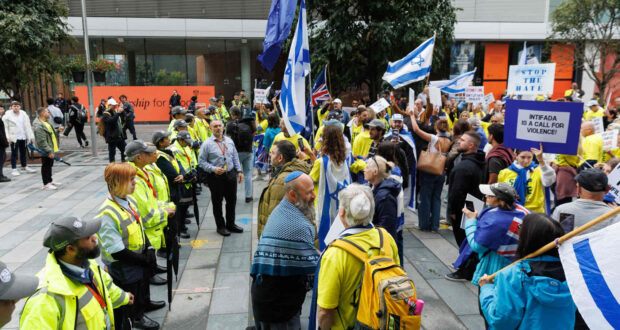
    Security stand in front of a pro-Israel protest at the University of Sydney on May 3, 2024. Picture: David Swift

    Universities will be expected to publish de-identified complaints data publicly, make student complaints processes clearer, and analyse the data twice a year if the university regulator’s interim guidelines for student complaints mechanisms are adopted.

    Please login below to view content or subscribe now.

    Membership Login

    Source link