As per government data, the UK recorded the highest number of Indian student deportations over the past five years, with 170 cases, followed by Australia (114), Russia (82), the US (45), Georgia (17), Ukraine (13), Finland (5), China (4), Egypt (2) and Austria (1).
In a written response in the Rajya Sabha, India’s upper house of parliament, Singh outlined several factors behind immigration authorities’ decisions across countries, most of which related to “violations of visa norms and non-compliance with host country regulations by Indian students”.
“Entry of Indian students had been denied by foreign immigration authorities on account of their carrying incomplete or inappropriate admission documents of their universities, failing to complete the administrative procedures required for enrolment in the universities, or for being unable to answer basic questions about their chosen field of study in foreign academic institutions,” Singh said, adding that common grounds for deportation included breaches of student visa conditions, such as unauthorised work, illegal business activities, or violations of host-country laws and regulations.
“Students have also faced deportation by foreign governments for failing to maintain the requisite financial bank balance in countries where they had been studying, for not paying university fees or for being unable to demonstrate adequate financial capacity to support their stay and studies, for having insufficient attendance in classes or for complete withdrawal from the registered academic programs or universities, etc.”
The data also showed two countries denying entry to Indian students, with the US turning away 62 students over the past year and Kyrgyzstan denying entry to 11 during the same period.
Embassy officials also visit universities and educational institutions in their jurisdictions to interact with Indian students and student associations and to assess any issue concerning the credibility or quality of courses being pursued Kirti Vardhan Singh, MEA
Just this year, the US revoked visas and terminated the legal status of thousands of international students, with two high-profile deportation cases involving Indian students over their alleged pro-Palestinian advocacy amid the Israel–Gaza war also making headlines. Moreover, between January and May 2025, nearly 1,100 Indians were deported from the North American country due to their “illegal status”.
While the UK has stepped up action against international students breaching visa rules, with the Home Office now directly warning students via text and email about overstaying, Canada has long faced issues with Indian students entering on fraudulent documents, with dozens investigated for using fake college acceptance letters in 2023.
High numbers frrom Australia also indicate the impact of the country’s crackdown on cases of fraud and agent misuse, especially from certain states in India, with countries like Russia seeing their universities expel Indian students after “failing to meet curriculum requirements”.
When asked in parliament about steps to protect Indian students from misleading foreign courses and avoid deportations, Singh said the government gives the issue “high priority” and maintains regular contact with students abroad.
“Embassy officials also visit universities and educational institutions in their jurisdictions to interact with Indian students and student associations and to assess any issue concerning the credibility or quality of courses being pursued.
“Several Indian missions also issue formal advisories for Indian students under their jurisdiction aimed towards protecting their interests, welfare and safety in foreign lands,” stated Singh.
While over 1.8 million Indian students are studying abroad in 2025, MEA data shows that 1.254 million are pursuing higher education and a drop in university-level enrolments abroad from India after three years of growth.
The US and Canada still remain the countries with the largest number of Indian students, followed by the UK, Australia, Germany, Russia, Kyrgyzstan, and Georgia.
In the summer of 2025, the CLOP hacking group—operating from Russia—exploited weaknesses at the University of Phoenix, exposing sensitive data on thousands of students and staff. The breach was devastating, yet Russia was not officially condemned as an adversary.
The contrast with U.S. policy toward countries like Venezuela is striking. Venezuela faces crippling sanctions, economic isolation, and constant political pressure under the banner of protecting democracy and human rights. Meanwhile, Russian-based cybercriminals are allowed to inflict real harm on U.S. institutions with little official pushback. The reason, officials say, is a lack of direct evidence tying these attacks to the Russian state. But the discrepancy reveals a deeper hypocrisy: punitive measures are applied selectively, often based on geopolitical convenience rather than consistent principles.
CLOP-style attacks exploit vulnerabilities in U.S. institutions. Universities, especially those operating on outdated IT systems and under private equity pressures, are frequent targets. Students—many already burdened by debt and systemic inequities—bear the brunt when personal data is exposed. Yet the broader conversation rarely extends to foreign actors who take advantage of these weaknesses or to the structural failures within U.S. education.
Venezuela’s citizens suffer sanctions and economic hardship, while Russian cybercriminals operate from the safety of a country that tolerates them, so long as domestic interests remain untouched. This double standard undermines the credibility of U.S. claims to principled leadership and exposes the uneven moral framework guiding foreign policy.
Higher education becomes a battleground in this selective application of power. Cyberattacks, fraud, and systemic negligence converge to threaten students and faculty, revealing the real victims of international hypocrisy. Protecting U.S. institutions requires acknowledging both the foreign actors who exploit weaknesses and the domestic policies and practices that leave them vulnerable.
The CLOP breach is more than a single incident—it is a reflection of a system that punishes some nations for internal crises while tolerating damage inflicted by others on critical domestic infrastructure. Until U.S. policy addresses both sides of this equation, the cost will continue to fall on the most vulnerable: the students, staff, and faculty caught in the crossfire.
Sources: U.S. Department of Education reports; investigative journalism on CLOP and Russian cybercrime; analyses of U.S.-Venezuela sanctions and policy.
One of the consequences of Vladimir Putin’s invasion of Ukraine has been a vast reconfiguring of Russia’s academic and intellectual life. Universities, thought of as a potential hotbed of opposition since the White Ribbon movement of 2011, came under intense control and its personnel placed under even greater scrutiny.
Many faculty fled. Connections with international partners in the West were severed. And then to top it off, the Russian government announced that it would abandon the three degree bachelor’s, master’s doctoral system introduced when the country joined the Bologna Process 20 years earlier.
All this has combined to create what some have called a slow motion collapse in Russian higher education. But to understand what’s been happening in Russian Universities since February 2022, you really need to go back to the dawn of the Putin era in January 2000, and understand how ideological control of institutions has come to rest squarely inside the Kremlin.
Joining the podcast today is Dmitry Dubrovsky. He’s a scholar at the Institute for International Studies at Charles University in Prague, where he has taught ever since being designated as a foreign agent by the Putin regime in early 2022. And he writes primarily about the politics of academic freedom and civil society in Russia.
He’s with us today to talk about this slow motion collapse, the internal governance of Russian institutions, and how the country might one day be put back on a track to integration with European academia. Over to Dmitry.
The World of Higher Education Podcast Episode 4.5 | Undoing Bologna: Russia’s Conservative Turn in Higher Education with Dmitry Dubrovsky
Transcript
Alex Usher (AU): Dmitry, I want to take us back to the year 2000. Vladimir Putin is the new president of the Russian Federation. What was the state of the higher education sector at the time, and how did Putin approach it? How did he view higher education as an instrument of state policy?
Dmitry Dubrovsky (DD): Well, the legacy of the 1990s left Putin with a serious challenge. The system faced underfunding and fragmentation. At the same time, scholars were eager to join the European system. There had been attempts in the 1990s, but the biggest problems were the lack of financing and the absence of international mechanisms or tools to fully integrate into the European system of higher education and science.
Putin saw higher education and science, first and foremost, as a tool to join Europe—to become part of the European family and a prominent member of the global market of ideas. That’s why Russia joined the Bologna Process in 2003 and actively pushed for internationalization.
AU: So in that sense, it’s probably not that different from most other countries in the former socialist bloc, like Poland or Romania—the idea that internationalization would bring about an improvement in higher education. Is that about right?
DD: It is right, with one very important difference. At first it might seem small, but it became a very serious issue. In higher education and science, everywhere in the world, there are always people who believe that their own system is highly advanced—at the very top.
The problem in the late Soviet Union and the Russian Federation was that a substantial number of people survived the collapse of the USSR still believing that Russian and Soviet science was the most advanced in the world. In some cases, for certain disciplines, that might have been true. But in most areas—especially the humanities and social sciences—it wasn’t.
By the late 1990s, there was a substantial group of people who were deeply disappointed in the results of democratic reforms and in what democracy had brought, both to the country overall and to higher education and science in particular.
AU: Okay, now, Putin was president until 2008, and then he switched places for four years with Prime Minister Medvedev. He returns to power as president in 2012. And as you say, it’s a different Putin—a much more authoritarian Putin. How did his approach to higher education change? If we think of “Putin 1.0” around 2000, what does “Putin 2.0” look like after 2012? How does he try to exert greater control over the system?
DD: It’s important to note that before Putin came back to power, there was a very significant period of reform in Russian higher education. Especially around 2007–2008, reforms were focused on improving quality and gaining international recognition. This was the era of what we call “managerialist modernization.”
The idea was to select flagship universities that would drive the rest of the system forward into a brighter future.
AU: And eventually that becomes the 5–100 Project.
DD: Yes, the 5–100, or “5–2020” project. The goal was that at least five Russian universities should appear in the world rankings. It was a very interesting period because it marked a serious transformation in the sociocultural landscape of Russian higher education.
For the first time, the so-called “effective managers” entered the system. From the mid-2000s onward, higher education began receiving serious investment from the state, making it appealing to a new managerial class and their approaches. Internationalization advanced, but it went hand in hand with growing managerial control over universities.
Even before Putin returned in 2012, higher education was already being used as a tool to demonstrate the effectiveness of Russian policy and as an instrument of soft power, particularly through supporting Russian universities in former Soviet countries like Armenia, Azerbaijan, and Tajikistan.
When Putin came back, however, the situation changed dramatically. What I call the “conservative shift” began—not just in politics broadly, but within higher education and science.
AU: And some of that has to do with the broader crackdown at the time. I remember there was a lot of pressure on foreign organizations, which made international cooperation more difficult. For example, the government targeted the Open Society Foundations, George Soros’ network that had been active in supporting the social sciences and humanities. There was also a crackdown on things like gender studies and spaces for LGBTQ students.
Masha Gessen wrote about this in her book The Future is History. Why did that happen at that moment? What was it about Putin that made him say, “This is an area I want to control and push in a more conservative direction”?
DD: First and foremost, we have to remember the protests of 2011–2012. That was the time of the so-called “white ribbon” movement. It came very close to a revolution, though in the end it never happened—we failed. I was a member of that movement myself.
The significant participation of scholars and students in those protests put higher education under special scrutiny from the security services and the political apparatus. They believed that control over the education system could restore their legitimacy and symbolic power in society.
And remember, these leaders were, in many ways, Soviet people. They genuinely believed, “This is how the Soviet Union ruled—through control, especially in education and ideology.” And to some extent, that was true. The Soviet Union consolidated its power in part through universities.
Putin believed the same could work for him—that restoring control over higher education would allow him to strengthen his government, which had been undermined by the events of 2011–2012.
AU: We’ve been talking about the relationship between institutions and the government, but the government also changed the way institutions were run a couple of times, right? How has the exercise of power within Russian universities changed? I’m pretty sure there’s been a change in the process of selecting university leaders. How has that affected Putin’s ability to control universities?
DD: The specificity of Russian universities in the 1990s was that there was an enormous amount of democracy. There was absolutely no money in the system, so it was extremely poor—but at the same time, it was a kind of “poor democracy.” There were numerous elections, and the whole system of university governance was very active in self-governance.
There were real political struggles. People fought for the position of dean, they competed for the position of rector. Even department chairs could be elected. Almost every administrative position within a Russian university could be filled through an election.
When Putin consolidated power, especially during the managerial reforms, there was pressure—particularly on the flagship universities in the 5–100 Project—to amend their charters and replace elections with government appointments.
The official explanation was simple: if the state was providing so much budget support, then the state should also assign the rector rather than leave it to an election.
Even now, some Russian rectors are still technically elected. But in Putin’s Russia, an “election” is not an election in the normal sense. The ministry proposes the candidate, people watch the process, and it ends up looking very much like the way Putin himself is “elected.”
AU: Dmitry, in the early days of the 2022 invasion of Ukraine, one thing that surprised a lot of people in the West—it seemed to come out of the blue—was a letter in support of the invasion signed by several hundred university rectors. Why did they do that? I mean, presumably they were ordered to by Putin, but why did Putin think that would be legitimizing?
DD: In post-Soviet societies there is a very high level of trust in higher education and science. The leaders of higher education were expected to officially support the so-called “hard decision” about the war.
But it’s important to remember—something some of our colleagues abroad seem to forget—that most of these rectors were never democratically chosen. They do not represent the voices of Russian scholars, lecturers, or faculty members. They mostly represent the vision of the presidential administration. Their role was to collect names for a list of support and then sign this shameful document.
And of course, this didn’t start in 2022. Under the “foreign agent” law of 2015, the government began a long anti-Western campaign—searching for “un-American” groups of influence, cutting connections with international centers, and declaring institutions like Central European University or Bard College in New York to be “undesirable organizations.”
This created a climate of fear and anxiety among the leaders of higher education. And there was direct blackmail: if you decided not to sign, that was your choice—but you had to think about your faculty, your team, your colleagues. They would probably be fired soon.
AU: What changed on university campuses after the invasion? Obviously, if I were in Putin’s position, I’d be worried about student unrest. So what happened in terms of surveillance on campus, and how did faculty react? I mean, you were a faculty member at the time, and you’re one of many who left fairly quickly after the invasion. How big a brain drain was there?
DD: Not as big as you might think, for different reasons. Academics can’t move as easily as other people—they need to be sure they’ll have a way to continue working, and for many there simply wasn’t anywhere to settle quickly.
My personal story was different. By coincidence, I had an invitation for a fellowship. Long story short, I relocated quickly from my home city of St. Petersburg to Prague. But for many others, leaving was far more difficult.
As for institutional surveillance—yes, it was there. It looks like Russia had been preparing for war for about two years beforehand. Around two years before the invasion, they started introducing special vice rectors responsible for “youth” whose actual role was to monitor and control loyalty.
At the same time, they established special departments within Russian universities with very long titles—things like “Promoting Civic Consciousness, Preventing Extremism, and Managing Interethnic Relations.” In practice, these were institutions embedded in higher education to control and discipline students and scholars.
Their real work was searching social networks, looking for so-called “betrayal” behaviors among students and faculty, and reporting them to the security services and police. Today, almost every region of the Russian Federation has one of these departments to oversee and report on improper behavior.
AU: After that rectors’ letter, Russia was suspended from the Bologna Process, and in retaliation Putin announced a return to the pre-Bologna system. So, getting rid of the bachelor’s, master’s, PhD framework and bringing back the old Russian model with the second PhD. How is this process unfolding? How easy is it to undo Bologna?
DD: That’s a good question. I don’t think Russia is really going to undo Bologna. They’re not planning a full reversal or trying to recreate the Soviet path.
From one side, there’s direct pressure on the Ministry of Higher Education and its bureaucrats to dramatically change a system that has been built over twenty years. But this system cannot simply be reversed. Legally, if students have already been admitted to a particular program, the state can’t just stop it midstream. At the very least, it would take four or five years to change. It can’t happen overnight.
Secondly, to me this feels like an exercise in mimicry or emulation from the old Soviet-style bureaucratic circles in higher education. I follow what’s happening closely—the statements from the Minister of Education—and they always try to explain what will be different, but they can’t. They have no clear idea what they’re trying to create.
Officially, they say, “This is not Bologna anymore. It has proved to be ineffective. Now we will collect the best achievements of the Russian system of education.” But what does that even mean? It’s absolutely impossible to understand. From my perspective, they are trying more to sabotage the process than to implement something substantial.
AU: Looking ahead, what do you think a post-Putin higher education system in Russia might look like? Is there a path back into the European higher education space, and what would it take to undo the damage that’s been done since 2012?
DD: That’s a good question. Currently, I would describe the situation as a “fourth deglobalization.” We’ve essentially gone back to the conditions of 2003, before joining the Bologna Process.
That doesn’t mean there’s no capacity—many faculty members still working in Russia earned their degrees in Western institutions. There is still substantial expertise within the system. But the fate of Russian higher education is very difficult to predict because it is so closely tied to the political fate of the Russian Federation itself.
If sanctions were to decrease and the war were to end, perhaps things could return to something like “normalcy.” But even that is debatable—what would “normalcy” mean in this context? At best, it might look like the Cold War era, perhaps similar to the late 1970s.
There are already serious restrictions in place: academic sanctions, boycotts, and bans on cooperation imposed by many institutions and countries. These severely limit Russia’s ability to develop visible academic exchanges with Europe. Instead, Russia is turning elsewhere—towards an “alternative globalization,” aligning more closely with countries like China, Iran, South Africa, and Brazil within the BRICS framework, [a political and economic bloc of major emerging economies that positions itself as an alternative to Western-led alliances].
AU: Dmitry, thank you so much for being with us today. It just remains for me to thank our excellent producers, Sam Pufek and Tiffany MacLennan, and you, our listeners, for joining us. If you have any questions or comments on this week’s episode, or suggestions for future ones, please don’t hesitate to get in touch at [email protected].
Join us next week when our guest will be Joshua Travis Brown from Johns Hopkins University’s School of Education. He’ll be joining us to talk about his fascinating new book from Oxford University Press, Capitalizing on College: How Higher Education Went from Mission-Driven to Margin Obsessed. Bye for now.
*This podcast transcript was generated using an AI transcription service with limited editing. Please forgive any errors made through this service.Please note, the views and opinions expressed in each episode are those of the individual contributors, and do not necessarily reflect those of the podcast host and team, or our sponsors.
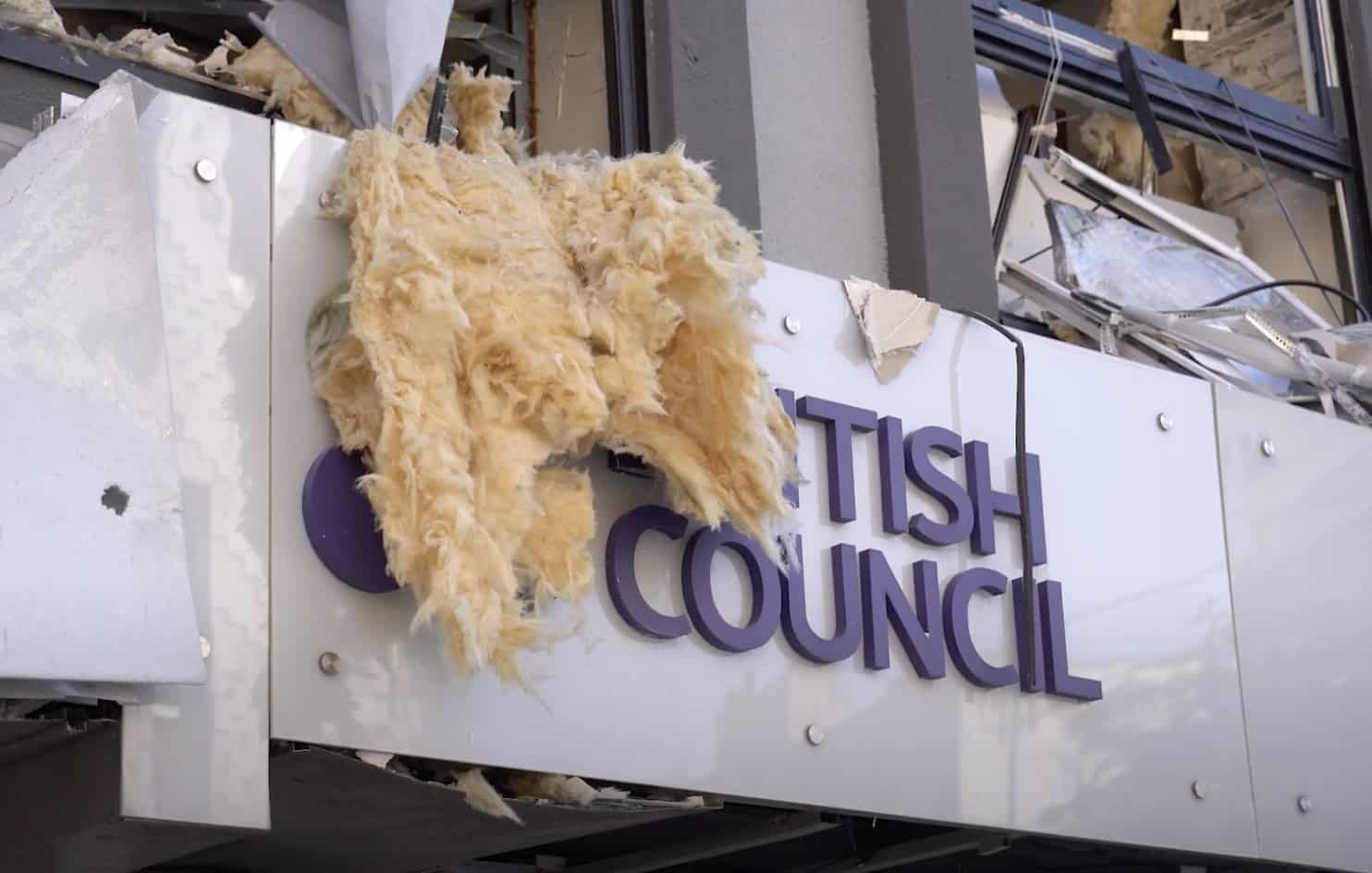
Speaking on August 29, two days after an attack on the Ukrainian capital in which at least 16 people were killed, the British Council’s director for the country, Colm McGivern, laid bare the impact on the organisation’s offices in Kyiv.
Standing outside the ravaged offices, which were severely damaged after Russian forces fired two missiles at it, McGivern said that the building had been “absolutely devastated – it’s been practically obliterated”.
While extending condolences to the families of those who died during the “horrific attack”, McGivern was firm in his resolve that the British Council’s work in Ukraine would continue even as the war with Russia wages on.
“I’d like to tell everyone that the British Council’s resolve is still there,” he said. “We will be here in Ukraine, we’ve been here 30 years. We’ll continue our work.”
He pointed out that the organisation did not stop its work in Ukraine following Russia’s invasion in 2022, and that this will not change. “To the contrary, we’re more determined than ever to make sure that cultural and educational links between the UK and Ukraine can thrive, not just survive,” he said.
He pledged that an upcoming British Council event in Lviv, located in the west of Ukraine, would take place this week as planned, as well as promising young Ukrainians that face-to-face learning would also resume in the coming days.”We will keep those promises. We will start those classes,” he stressed.
McGivern extended best wishes to a British Council colleague who had been injured on the evening of the attack, who he said was recovering in hospital. And he said his team had been overwhelmed by the support they had received from the international education community, as well as the Ukrainian first responders and emergency services who helped in the immediate aftermath of the attack.
There has been an outpouring of support for British Council colleagues in Ukraine by the international education community.
Our work will not stop now because of this horrific attack. To the contrary, we’re more determined than ever Colm McGivern, British Council
Gwen van der Helden, a professor of education reconstruction during/post war, crisis and conflict at the University of Warwick and a visiting professor at V. N. Karazin Kharkiv National University, expressed her shock.
“The BC is hardly of military interest, not a danger to anyone, and the people working there do nothing than trying to contribute to the future of fellow citizens. It is utter codswallop to think that the BC is in any way a reasonable target. But then, so few of the targets that have been hit in this war have been,” she wrote on LinkedIn.
“Furious is how we should all feel at this point. Our colleagues in Kyiv (and yes I do think we should regard BC colleagues as exactly that), deserve better. Sending courage, strength and a large portion of defiance to our British Council colleagues.”
The British Council’s mission in Ukraine offers English language programs and other training or educational programs. In June, Russia made accusations that it was being used as a cover for British intelligence operations in Kyiv.
After the attack, British Council chief executive Scott McDonald confirmed that bombing in the city had damaged its offices.
“Our guard was injured and is shaken but stable. At the insistence of my amazing colleagues, we will continue operations in Ukraine today wherever possible,” he said.
Meanwhile, European leaders have condemned the strike, which saw 629 missiles and drones launched at the city.
President of the European Council, António Costa, confirmed that the British Council’s Ukrainian office “was damaged in this deliberate Russian strike”, while UK Prime Minister Keir Starmer hit out at Vladimir Putin – accusing him of “sabotaging peace”.
The initiative is part of a larger strategy to build a teaching workforce in the United Arab Emirates (UAE) equipped for the demands of modern education. Organised by the UAE Ministry of Education, it reflects a broader strategic commitment in the country to invest in teaching talent and adopt global best practices in education.
The program was held in collaboration with the Talent and Success Educational Foundation within the Sirius Federal Territory. It is part of an ongoing partnership that aims to deepen international cooperation in education and expand the professional capabilities of UAE-based educators.
We value global knowledge exchange and the adoption of innovative, research-driven practices that strengthen our education system Sarah Al Amiri, UAE Minister of Education
The training includes over 60 hours of in-depth instruction focused on modern teaching methodologies, particularly within the STEM fields. Participants are engaged in sessions on activity and project-based learning, educational transitions, and authentic assessment.
While the identities of the participating educators have not been disclosed, officials say the group was selected through a competitive process targeting high-performing teachers with the potential to transform education in the UAE.
Through daily workshops and peer exchange sessions, educators are also encouraged to share experiences and reflect on best practices from diverse educational settings.
Sarah Al Amiri, the UAE’s minister of education, emphasised that the program aligns with the Ministry’s vision of developing a forward-looking education system.
“As the world continues to evolve, we remain committed to equipping our educators with the tools they need to create future-ready learning experiences,” she noted. “We value global knowledge exchange and the adoption of innovative, research-driven practices that strengthen our education system.”
By embedding international standards into local practice, the Ministry aims to enhance the UAE’s educational competitiveness while responding to the country’s specific needs and aspirations. In recent years, it has placed an increasing focus on educators’ mobility and professional development through international partnerships.
The UAE’s engagement with institutions like Sirius reflects a wider regional trend of forging global partnerships to enhance workforce capacity and education systems.
As the sector in the MENA region becomes more globally interconnected, such initiatives are expected to play a critical role in shaping longterm reforms.
Immigration and Customs Enforcement is detaining a Harvard Medical School research associate who’s a Russian native. One of Kseniia Petrova’s lawyers says the government is trying to deport her to Russia, where she faces possible arrest due to her “prior political activism and outspoken opposition to Russia’s invasion of Ukraine.”
Gregory Romanovsky, the lawyer, said in a statement that Petrova was trying to re-enter the U.S. on Feb. 16 at Boston’s Logan International Airport when a Customs and Border Protection officer discovered she “had not completed the required customs paperwork for a non-hazardous scientific sample she was bringing from an affiliated laboratory in France.”
“CBP was authorized to seize the item and issue a fine,” Romanovsky wrote. “Instead, they chose to cancel Ms. Petrova’s visa and detain her.”
Petrova remains in ICE custody in Louisiana. The Boston Globereported earlier on her detention.
Romanovsky wrote that “CBP improperly invoked their extensive immigration authority to impose a punishment grossly disproportionate to the situation. This overreach reflects broader concerns about the treatment of international scholars by U.S. immigration authorities.”
A spokesperson for the Department of Homeland Security, which includes ICE, told Inside Higher Ed in an email that Petrova was “detained after lying to federal officers about carrying biological substances into the country. A subsequent K9 inspection uncovered undeclared petri dishes, containers of unknown substances, and loose vials of embryonic frog cells, all without proper permits. Messages found on her phone revealed she planned to smuggle the materials through customs without declaring them. She knowingly broke the law and took deliberate steps to evade it.”
Harvard spokespeople didn’t provide an interview Friday about the situation or answer multiple emailed questions. In a brief email, the medical school’s media relations arm said, “We are monitoring this situation.”
Romanovsky has sued to restore Petrova’s visa.
“Ms. Petrova’s 1.5-month-long detention has caused significant disruption to both her professional and personal life,” Romanovsky said in his statement. “As a dedicated and highly respected researcher, her work is critical to scientific progress. We strongly urge ICE to release Ms. Petrova while her legal proceedings are ongoing.”