Tag: sale

  • Udacity EOY Sale | 55% Off Nanodegrees

    Udacity EOY Sale | 55% Off Nanodegrees

    (To support my writing, I may use affiliate links in the post. Rest assured, they don’t affect my honest reviews.)

    Looking for Udacity discounts or coupon codes? You’re in luck!

    Udacity is currently offering a massive 55% off (coupon code: FUTURE40) on all course access, bundles, and standalone Nanodegree programs.

    This is the highest discount Udacity is offering right now on its subscription plans, valid in most countries until January 6, 2026.

    If you’re planning to enroll in a Nanodegree program – to learn in-demand tech skills, get expert mentorship, and boost your career – this is the perfect time to save big. Don’t miss out on these huge savings.

    Not sure if this Udacity discount is worth it or how it can benefit your career? Keep reading – I’ll break it all down for you.

    But first, let’s see how much Udacity and its Nanodegree programs will cost you after this discount.

    💰 Udacity Regular Cost vs. 55% Off Discounted Cost”

    In the US (USD)

    • Monthly Subscription
      • Regular Price: $249/month
      • Discounted Price: $113/month
    • Individual Course Bundle (with 15% off based on avg. completion time)
      • Regular Price: Starts at $249/month
      • Discounted Price: Starts at $113/month

    In India (INR)

    • Monthly Subscription
    • Bundle Course / Individual Nanodegree (with 15% off based on avg. completion time)
      • Regular Price: ₹17,911/month
      • Discounted Price: ₹8,050/month

    Note: I’ve listed the monthly subscription discounts here; however, the 55% discount also applies to bundle subscriptions for longer durations.


    Review – Is Udacity 55% Off (January Sale) Worth Grabbing?
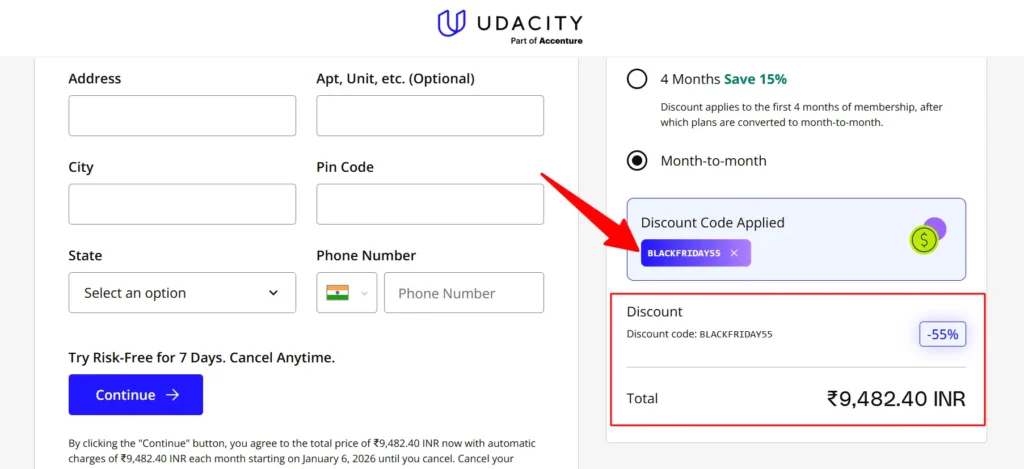
    Udacity 55% Off - Black Friday Sale 2025
    Source: Udacity

    If you’re wondering whether this discount is really worth the investment, my answer is yes.

    Udacity subscriptions and programs aren’t cheap, but this 55% discount on all Udacity pricing plans makes them much more affordable.

    And it’s not just about saving money – this heavy discount unlocks all Nanodegree programs, giving you the freedom to learn whatever you want. It’s a great opportunity if you want to:

    • Enroll in multiple programs at once, from beginner to advanced levels, without worrying about the cost of each individual program.
    • Easily switch between Nanodegree programs if one doesn’t meet your learning goals.
    • Explore new career paths—from programming to data analytics, AI to cybersecurity, Udacity offers a wide range of Nanodegree programs in every major tech domain.

    If you’re concerned about whether Udacity programs provide the right training or help you land a job, let me explain why they’re worth it – especially with the current 55% off sale.

    Why Choose Udacity?

    Udacity is a top-notch online learning platform offering high-quality courses and training programs, mostly in in-demand tech fields.

    These Nanodegree programs are not accredited by any educational institution, but they are developed in collaboration with leading tech companies in their respective industries, and their value comes from these companies themselves.

    For example, the Udacity Digital Marketing Nanodegree is built in collaboration with Google, Meta, and other top tech firms.

    Now, there’s no guarantee that holding a Nanodegree will land you a job at these top companies, as it depends on many factors – your hard skills, soft skills, academic background, and overall work experience. However, I can confidently say that the quality of training you’ll receive is truly worth it.

    Most Udacity Nanodegree programs are taught by industry experts who already work in the field you aspire to enter.

    From real-world projects to hands-on learning and career mentorship, these Nanodegree programs delivers exceptional value.

    If you want to test the quality yourself, start with these free programs I’ve personally taken:

    • AWS Machine Learning Foundations
    • Intro to Python Programming
    • Intro to Data Structures and Algorithms
    • Developing Android Apps with Kotlin

    You won’t need to pay anything – just sign up and start learning. These courses are beginner-friendly, so anyone can enroll. Once you’re satisfied with the quality, you can grab the subscription at 55% off.

    ⚠️ Note: This discount is only valid until January 6, 2026—so don’t wait too long! If finding worth it, claim your 55% Udacity discount.


    How to Get Your 55% Off Udacity Discount: Step-by-Step Guide
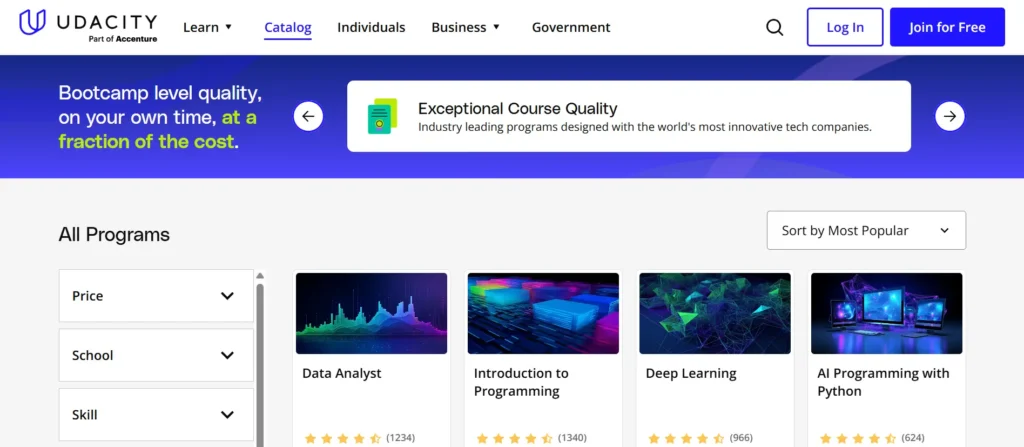
    Udacity

    Follow these steps to get Udacity’s biggest discount on its subscription:

    1. Visit Udacity.com
    2. Find the Nanodegree program you want to enroll in, or select any Nanodegree if you plan to purchase the Udacity subscription.
    3. Scroll down – on the right-hand side, you’ll see the regular pricing plans with the 55% off offer displayed below.
    4. Click the discount button, sign up for a free account, and log in.
    5. Choose your pricing plan- either month-to-month or a bundled course plan (longer duration). Both options include the 55% discount.
    6. Apply coupon code FUTURE40 and review the final cost.
    7. Complete your purchase by entering your payment details and confirming the payment.

    Act fast – this offer expires is only available for a week, valid until January 6, 2026.


    Top Udacity Nanodegree Programs – Access with Udacity 55% Off:

    Udacity is best known for its Nanodegree programs. With the current 55% off offer, you can access some of the most popular ones.

    These programs are featured based on:

    • Verified learner feedback from communities like Reddit, Quora, and Trustpilot
    • Enrollment volume and course completion rates (where available)

    Popular Udacity Nanodegree Programs You Can Get with 55% Off

    • Introduction to Programming – Build a strong foundation in web development and Python programming over four months. This beginner-friendly program includes hands-on projects, making it perfect for newcomers to coding.
    • Business Analytics Nanodegree – Learn SQL, Python, data visualization, and advanced Excel in just two months—no prerequisites required. Ideal for aspiring business, data, or financial analysts.
    • Data Analyst Nanodegree – Gain skills in data cleaning, exploratory analysis, and regression testing. Requires prior knowledge of Python, SQL, and statistics. Perfect for finding patterns in complex datasets.
    • Data Engineering with AWS -Learn to build scalable data infrastructure using AWS tools like S3, Redshift, and Lambda. Covers data modeling, warehousing, and big data technologies. Best for those with programming experience transitioning to data engineering.
    • Digital Marketing Nanodegree – Covers SEO, SEM, social media marketing, email marketing, and online advertising. Beginner-friendly and ideal for launching a digital marketing career.
    • Deep Learning Nanodegree – Master neural networks, NLP, computer vision, and reinforcement learning through hands-on AI and machine learning projects.
    • Programming for Data Science with Python – Start from scratch and learn Python, data visualization, and machine learning using NumPy, Pandas, and Scikit-learn. Includes real-world projects for practical skills.
    • Front-End Web Developer – Learn HTML, CSS, JavaScript, and React to create responsive, interactive websites. Includes hands-on projects for beginner web developers.
    • Data Scientist Nanodegree – An advanced program covering machine learning, data wrangling, and predictive modeling. Requires Python, SQL, and data analysis experience.
    • C++ Nanodegree – Master object-oriented programming, memory management, and multithreading in C++. Great for software, game, and systems development, with mentorship and practical projects.

    Note: All these Nanodegree programs are available at 55% off until January 6, 2025.


    Final Thoughts: Is Udacity’s 55% Off Sale Worth It?

    If you’ve been waiting for the right time to invest in your skills, this is it. Udacity’s 55% off deal is their biggest discount of the year, and it makes their premium Nanodegree programs far more affordable.

    Whether you want to start from scratch, switch careers, or upgrade your current skills, this offer gives you access to all Udacity Nanodegree programs—so you can learn at your own pace, explore multiple career paths, and gain hands-on experience through real-world projects.

    Remember, Udacity’s programs are built in collaboration with leading tech companies like Google, Meta, and AWS, and taught by industry experts who know what it takes to succeed in the field.

    While no certification can guarantee you a job, the skills, mentorship, and project experience you’ll gain from Udacity can put you miles ahead in your career journey.

    ⚠️ Don’t wait too long—this 55% off offer ends on January 6, 2026. If you’re serious about boosting your career, now’s the time to grab it.

    Happy Learning 🙂

    Udacity 55% Off – FAQs

    How long does the 55% off sale last?

    Udacity’s End of Year Sale 55% off sale is valid until January 6, 2026 in most countries. After this date, the offer will expire, and regular pricing will apply. If you’re planning to enroll, it’s best to grab the discount before the deadline.

    Udacity 55% Off – Month-to-Month vs. Bundle Subscription: Which One Should You Choose?

    When using Udacity’s 55% off deal, you have two options: month-to-month or bundle subscription.

    Bundle Subscription – Best for longer-term learning (typically 5–6 months). You lock in the 55% discount for the entire duration of your plan, giving you more time to complete your Nanodegree at your own pace without worrying about renewing each month. This is ideal if you want to take your time or explore more in-depth topics.

    Month-to-Month – Gives you 55% off for the first month only, and then you’ll be billed at the regular monthly price from the second month onward. This option works if you’re confident you can finish your Nanodegree quickly or just want to try it out before committing to a longer plan.

    Recommendation: If you plan to complete your program over several months, the bundle subscription offers better value and long-term savings.

    Can I combine this with other offers or scholarships?

    No — Udacity’s 55% off discount cannot be combined with other promotions, coupon codes, or scholarships. You’ll need to choose either this limited-time same or any other eligible offer, but not both.

    What kind of support do I get with a Nanodegree?

    With a Udacity Nanodegree, you get a range of support to help you succeed, including:

    1-on-1 technical mentor support – Get guidance when you’re stuck or need clarification on course content.
    Personalized project feedback – Industry experts review your projects and provide actionable feedback.
    Career services – Access resume reviews, LinkedIn profile optimization, and interview prep resources.
    Student community – Connect with fellow learners in forums and study groups for motivation and peer support.
    Flexible learning – Learn at your own pace with lifetime access to completed Nanodegree content.

    This combination of technical help, career guidance, and community support ensures you’re not learning alone.

    Read also:

    Source link

  • Roll up roll up for the great higher education fire sale

    Roll up roll up for the great higher education fire sale

    Since the announcement, most eyes interested in “radical transformation” have been on the creation of a new “super-university” – Greenwich and Kent becoming the London and South East University Group.

    But The Times is reporting a very different kind of tie-up – which if it comes to pass could have much more interesting implications.

    It says that the University of Buckingham, the UK’s only “independent” university, is considering a £150 million sale to Global University Systems (GUS).

    It suggests that the potential sale could compromise the university’s Royal Charter, non-profit status, and academic integrity – risking its identity as a “free speech and research-focused institution”.

    Precedented

    If that sounds and feels “unprecedented”, you may not have noticed the extent to which everything from research parks to student accommodation are already (part or fully-)owned by private companies.

    You may also not have noticed any number of mergers, takeovers and fire sales among small private HE providers – many of which specialise in the kinds of franchised provision that have been generating considerable regulatory interest in recent months.

    There’s also Richmond, the American University in London. When founder Sir Cyril Taylor died in 2018, he bequeathed his for-profit company (American Institute for Foreign Study) to his own charitable foundation (Cyril Taylor Charitable Foundation).

    It created what former vice chancellor Lawrence Abeln called a charity “operating like a shell for a commercial company it wholly owns” – allowing commercial interests to control educational decisions through charitable structures while maintaining the appearance of independence.

    Abeln argued that the foundation used funding as leverage to demand governance changes, including his forced resignation, threatening the university’s survival unless commercial interests were satisfied.

    It mirrors concerns about the potential Buckingham sale – that once charitable educational institutions become dependent on private sector funding or ownership, academic independence becomes vulnerable to commercial priorities.

    Even when the charitable structure remains intact, the substance of independent governance can be hollowed out, creating what critics might term a “stealth privatisation” where commercial control operates behind charitable facades.

    Any number of things could be going on behind the scenes that already resemble that in universities that have breached, or are close to breaching, their banking covenants.

    But the wholescale takeover of a university with a Royal Charter? Really?

    We work at supplying HE

    Back in 2020, five men registered a UK company called “GGE UK Newco” in a WeWork near London Fields. Within four months, it had acquired university title, degree awarding powers, and registration with the Office for Students – a process that typically takes years for new higher education providers.

    The company pulled this off by purchasing the assets of the former Regent’s University London charity, including its degree awarding powers (awarded in 2012) and university title (granted in 2013). On September 29th, GGE UK Newco changed its name to “Regent’s University London Limited,” becoming the wholly-owned product of a partnership between the original Regent’s University and Galileo Global Education, a large international education provider with over 110,000 students worldwide.

    The transaction appeared to have bypassed normal regulatory processes entirely. While new providers typically wait around 180 days and must pass a Quality and Standards Review, no such review appeared to have been conducted for Regent’s University London Limited. OfS was largely silent on the specifics, raising real questions about transparency and whether standard due diligence procedures were followed.

    As DK noted at the time, the case was interesting insofar as it suggested that university titles and degree awarding powers can effectively be bought and sold as assets. With some independent providers still waiting on registration decisions, the apparent fast-tracking raised concerns about fairness and regulatory consistency, potentially setting a precedent for more financially-motivated restructuring in the sector.

    And there’s more

    Scroll forward to March 2023, when IU Group acquired the education and training activities of the London Institute of Banking and Finance through a structural split.

    The original Royal Charter charity was renamed “The London Foundation for Banking & Finance (LFBF)” and continues as a charitable foundation, while the commercial education business now operates as “LIBF Limited” (a wholly owned UK subsidiary of IU Group) trading under the original name “The London Institute of Banking & Finance.”

    That preserved the charitable Royal Charter structure while transferring the degree-awarding educational operations to private ownership.

    Then in 2014, struggling Ashridge Business School was acquired by Hult International Business School in what was described as both a merger and acquisition driven by Ashridge’s need for “financial salvation.” Hult provided a £50 million investment, and the schools completed an operational merger in 2015.

    Ashridge now operates as “Hult Ashridge Executive Education” – the executive education arm of Hult International Business School, with the historic Ashridge House estate serving as Hult’s flagship executive education campus. Unlike LIBF, this was a complete absorption rather than a structural split, with Ashridge’s independent existence ending as it became part of Hult’s global network of campuses across Boston, London, Dubai, Shanghai, San Francisco, and New York.

    And then there’s the College of Law.

    It can trace its origins to 1876 with the formation of Gibson & Weldon, a leading tutorial firm. In 1962, The Law Society created The College of Law by merging its own Law Society School of Law (founded in 1903) with Gibson & Weldon, establishing it as a specialist institution for training solicitors.

    It was formally incorporated by Royal Charter on 5 December 1975 and registered as a charity in May 1976, with the stated aim “to promote the advancement of legal education and the study of law in all its branches.” This gave it constitutional status as a chartered institution dedicated to legal education. And in 2006, it was granted degree-awarding powers by the Privy Council.

    So when it was sold to Montagu Private Equity for around £200 million in 2012, the transaction revealed just how valuable degree-awarding powers had become as tradeable assets.

    The deal involved splitting the institution – the original College of Law retained its Royal Charter and charitable status under a new Legal Education Foundation, while the commercial education business, crucially including those 2006 degree-awarding powers, moved to a newly created for-profit company called “The University of Law Limited” (originally incorporated as “Col Subco No.1 Limited”).

    DAPs, it seemed, could now be packaged and sold as part of a commercial education business – degree-awarding powers as an asset class.

    At the time, constitutional lawyers questioned how powers granted to a Royal Charter body could legitimately transfer to what was essentially a separate company. But the then responsible Department for Business, Innovation and Skills (BIS) maintained that the powers remained valid because the “whole education and training business” had moved to the new entity. The precedent was set – and so in 2015, when the University of Law was acquired by GUS, its valuable degree-awarding powers travelled with it as part of the commercial package.

    Or take Arden. Originally founded as Resource Development International (RDI) in 1990 by entrepreneur John Holden, the distance learning provider was sold to US-based Capella Education in 2011 as part of Capella’s international expansion strategy. The timing proved crucial – RDI was granted Taught Degree Awarding Powers in April 2014, gained full university status in August 2015, and was immediately put back on the market when Capella’s international strategy faltered.

    By August 2016, GUS acquired Arden for £15 million – demonstrating how rapidly degree-awarding powers could travel through corporate hands. The transaction showed DAPs functioning specifically as tradeable assets – Capella had effectively acquired a company that later gained valuable regulatory permissions, then sold those permissions onwards as part of a portfolio optimisation. For GUS, acquiring Arden provided another set of degree-awarding powers to add to its growing collection, which already included the University of Law.

    Royal charters

    But the potential Buckingham sale arguably represents a qualitatively different proposition from previous transactions. While ULaw, LIBF, Ashridge, and Richmond were specialist institutions operating in commercial-adjacent sectors – professional training, banking education, executive development, or niche international provision – Buckingham is the UK’s flagship independent university, purpose-built to demonstrate that alternatives to state higher education could thrive.

    Established in 1976 and granted its Royal Charter in 1983, Buckingham has operated successfully for over four decades as Thatcher’s “proof of concept” for educational independence. Unlike the struggling institutions that sought private sector rescue or the professional training providers that already operated in quasi-commercial spaces, in theory the sale of Buckingham would represent the commodification of the university ideal itself.

    It would also signal that even the most symbolically important Charter institutions – those created explicitly to preserve educational independence – could be subject to market forces when financial incentives align.

    Whether structured as a direct sale or following a version of a model of splitting charitable and commercial operations, a Buckingham transaction would force regulators to confront fundamental questions they’ve previously avoided. The Office for Students, the Privy Council and potentially the Charity Commission would need to justify why the commercialisation of Britain’s flagship independent university serves the public interest.

    If it happens, regardless of the technicalities of its legal structure, it would also establish that Royal Charter status provides no meaningful protection against commercialization, making virtually any institution a potential acquisition target – completing the evolution of degree-awarding powers from constitutional privileges into tradeable corporate assets.

    Back to the future

    As Mary Synge demonstrates in her analysis of university charity law regulation, universities are charities whose trustees have a fundamental legal duty to act “in the best interests of the charity” – not commercial interests, and not even student interests – at least as variously defined by politicians.

    When charitable assets and degree-awarding powers become tradeable commodities, this feels like a fundamental breach of charity law principles that have governed universities for centuries. The strategic goals of “maximising growth in income” that might benefit institutional finances are legally distinct from – and potentially in conflict with – acting in the charity’s best interests for public benefit.

    But the regulatory conditions that make the Buckingham sale possible have been deliberately created. Synge’s research shows how OfS has systematically weakened charity law oversight compared to its predecessor HEFCE, removing transparency requirements, diluting governance standards, and abandoning serious incident reporting.

    Where HEFCE demanded universities demonstrate compliance with charity law principles, OfS has reduced this to a mailing list subscription. The regulatory hollowing-out creates the conditions where transactions that should trigger intensive charity law scrutiny can proceed with minimal oversight.

    When the regulator tasked with promoting charity law compliance barely acknowledges charity law exists, constitutional protections become meaningless.

    Back to the future

    As ever, we’ve been here before – or at least the FE sector has. Back in 2016, FE Week got hold of a leaked government document that revealed the Department for Education (DfE) was actively planning for private sector acquisition of failing FE colleges.

    A draft “Framework for due diligence in the FE sector following area reviews” (a process which itself had nudged/inspired/funded a series of mergers and groups) specifically addressed the “acquisition of an FE college by a private sector organisation,” noting that private providers “may have different benchmarks and parameters as to what is acceptable in terms of both curriculum and financial performance.”

    BIS guidance published that March had already unveiled government plans to introduce an insolvency regime for colleges, explicitly stating that following area reviews, government would “no longer bail out colleges in financial trouble, but would instead allow them to go bust.” Sound familiar?

    Critics warned of potential “fire sales” where private equity firms could asset-strip college buildings and facilities, cherry-picking profitable courses while abandoning community obligations. And the University and College Union (UCU) pointed to American examples of private equity involvement leading to “derisory rates of graduation, crushing levels of debt and of course dubious value.”

    The Technical and Further Education Bill (2016) created a “Special Administration Regime” for FE – essentially corporate insolvency procedures for FE colleges with an “education objective” twist. One battle during debate on the Bill came when Labour’s Gordon Marsden attempted to protect publicly-funded college assets from private acquisition.

    Marsden argued that FE colleges represented decades of public investment – from 1950s local authority funding through the multi-billion pound Building Colleges for the Future programme – and warned that defeat would enable private equity “asset stripping” of educational institutions built with taxpayer money.

    But then Minister Robert Halfon rejected the amendment – arguing that student protection must override asset protection, even if it meant transferring publicly-funded infrastructure to private companies. When the division was called, Conservative MPs defeated the amendment 8-5, explicitly authorising education administrators to transfer college assets to private entities if deemed necessary for the “education objective.”

    It established the principle that educational assets, regardless of their public funding history, could be commodified and transferred to private ownership when market logic demanded it.

    Here in 2026, we have a Labour, not Conservative government. It is already “interested” in what’s been going on in the franchised for-profit sector. But it doesn’t seem to have been especially keen to question what’s been going on from a profit/principle point of view. And it’s not clear that what is planned in regulatory terms will be nimble enough to tackle the real questions that surround outcomes or quality.

    As is increasingly clear, the “line” between private and public interest has already been blurred by loans, accommodation, research parks and all sorts of other aspects of HE. What the government does or doesn’t do over a potential sale of Buckingham will tell us whether it’s interested in, or willing to, draw a line before the examples in blogs like this become much less obscure.

    Source link

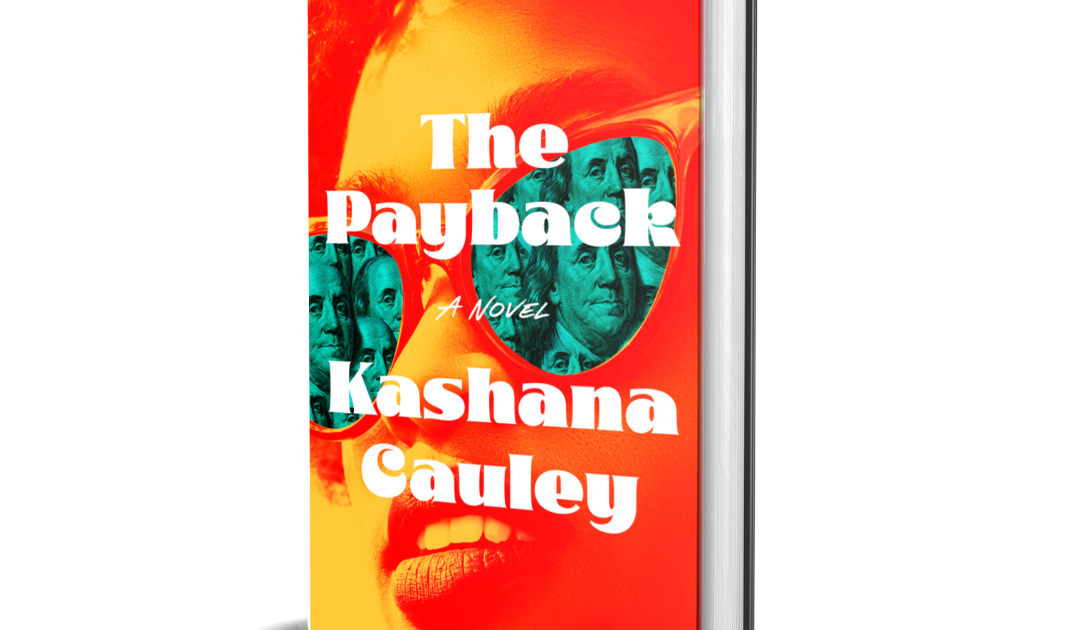
  • Student Loan Thriller “The Payback” On Sale Today

    Student Loan Thriller “The Payback” On Sale Today

    STELLAR
    EARLY PRAISE FOR THE PAYBACK

    “An
    exciting and hilarious heist novel that centers down-on-their-luck older
    millennials who are riddled with debt and decide to take matters into their own
    hands to dismantle the system. Timely and witty, Cauley’s plotting, prose, and
    character development will keep you hooked from start to finish.”
    —Morgan
    Jerkins, New York Times bestselling author of This Will Be Undoing

    “In
    an Afrofuturist world of barbaric debt police and an absurd heist to bring it
    all down, The Payback is a delightfully dark comedy of three
    coworkers-turned-conspirators hell-bent on revenge. This trio of Robin Hoods
    taking matters into their own hands out of grief and desperation will have you
    alternating between raucous laughs and fear for their safety. California strip
    malls, 80s fashion, punk and hacker culture, all combine in a tenacious
    cocktail of sweet justice shared by all.”
    —Xochitl
    Gonzalez, New York Times bestselling author of Olga Dies Dreaming
    and Anita de Monte Laughs Last

    “Like Ocean’s Eleven but no one’s
    famous. The Payback is a love letter to the American mall, the revenge
    of the break room, and a laugh-cry of the gods of retail. The result is
    obsessive truth-telling fun, with zingers, dishy thrills, bodysuits, and a few
    wigs that have seen better days but are hoping to have the best one yet.”
    Alexander Chee, author of How to Write an
    Autobiographical Novel

    The Payback

    A Novel

    Kashana Cauley

    ON SALE JULY 15, 2025 FROM ATRIA BOOKS

    _______________________________________________

    In
    the second novel from television writer and author of the “lethally witty” (The
    New York Times Book Review
    ) The Survivalists, a retail worker is
    relentlessly pursued by the Debt Police and forced to take down her student
    loan company with the help of two mall coworkers.
    The
    Payback
    is a razor-sharp and hilarious dissection of
    race and capitalism from one of the most original and exciting writers at work
    today.


    Jada
    Williams is good at judging people by their looks. From across the mall, she
    can tell not only someone’s inseam and pants size, but exactly what style they
    need to transform their life. Too bad she’s no longer using this superpower as
    a wardrobe designer to Hollywood stars, but for minimum wage plus commission at
    the Glendale mall.


    When Jada is fired yet again, she is forced to outrun the newly instated Debt
    Police who are out for blood. But Jada, like any great antihero, is not going
    to wait for the cops to come kick her around. With the help of two other
    debt-burdened mall coworkers, she hatches a plan for revenge. Together the
    three women plan a heist to erase their student loans forever and get back at
    the system that promised them everything and then tried to take it back.

    About
    Kashana Cauley

    Kashana
    Cauley is the author of The Payback and The
    Survivalists
    , which was named a best book of 2023 by the BBC, TodayVogue,
    and more. Cauley is also a television writer, having worked on The
    Great North
    Pod Save America on HBO, and The
    Daily Show with Trevor Noah
    . Her writing has also appeared in The
    New York Times
    The AtlanticEsquireRolling
    Stone
    The New Yorker, and more. Find out more at
    KashanaCauley.com. 


    MORE
    PRAISE FOR THE PAYBACK

    “A
    stylish, blazingly original take on the heist novel, The Payback is both
    a whip-smart critique of contemporary capitalism and a moving character study
    of the workers most often caught in its clutches.”
    —Grace
    D. Li, New York Times bestselling author of Portrait of a Thief

    “A
    novel of great fun and unforgettable fury, The Payback sharply questions
    the punitive systems we live within, the contradiction between social wellbeing
    and individual wellness,
    and what it means to work toward a decent life.”
    —Megha
    Majumdar, bestselling author of A Burning

    “Smart,
    socio-politically astute, and sidesplitting hilarious, The Payback‘s
    inventive wit solidifies Kashana Cauley’s place among our most entertaining
    social critics and novelists.”
    Camille
    Perri, author of The Assistants and When Katie Met Cassidy


    About the Book


    The Payback
    A Novel
    by Kashana Cauley
    on-sale: July 15, 2025
    Atria Books
    ISBN 9781668075531
    Price: $27.99
    eISBN 9781668075555
    Price: $14.99

    Source link

  • DfE committed to £200m of contracts for loan sale that’s not proceeding

    DfE committed to £200m of contracts for loan sale that’s not proceeding

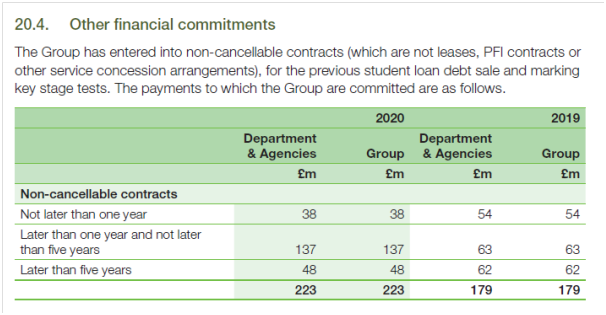
    Page 221 of the Department for Education’s 2019/20 financial statement contains the note reproduced above.

    The sale programme for “pre-2012” student loans was cancelled in March. But DfE looks like it will be paying out over £30million per year for the next few years to financiers anyway. Total liabilities are booked above at over £220million.


    Source link