Tag: School choice

  • Derrick Bell, Critical Race Theory and the Beginnings of School Choice – The 74

    Derrick Bell, Critical Race Theory and the Beginnings of School Choice – The 74


    Get stories like this delivered straight to your inbox. Sign up for The 74 Newsletter

    School choice — the idea that American education would function more efficiently and effectively if parents received public funding to send their children to private and religious schools — is commonly traced to an influential essay written in 1955 by conservative economist and Nobel laureate Milton Friedman. It has provoked animated debate between adversaries on the political right and the political left ever since. Less well known is that school choice also has roots in the work of Derrick Bell, considered by many the father of critical race theory.

    In 1971, Derrick Bell became the first Black man to be awarded tenure at Harvard Law School. As part of his teaching load, he developed a civil rights course that focused on race. In order to meet its topical requirements, Bell wrote an accompanying textbook, Race, Racism and American Law, which is foundational in critical race theory. It holds that racism is an ordinary and permanent feature of American society. His claim was viewed by many colleagues at the time as a radical statement, and it remains so for many today. Yet, it carries forward a certain truth that the history of school choice persuasively illustrates.

    Having served as a federal attorney litigating desegregation cases, Bell had grown skeptical about forced racial integration and whether it would actually improve student learning. The original edition of his 1973 textbook included a chapter outlining “Alternatives to Integrated Schools” by which “black children might receive the long-promised equal educational opportunity — in predominantly black schools.” The chapter included a discussion of tuition vouchers.

    Bell argued that for vouchers to work, poor families would need to receive substantially larger grants than the more fortunate. He also mentioned “free schools.” These were small, private institutions in poor areas supported by foundation grants, fundraising and, sometimes, public dollars. Tuition was charged on a sliding scale, and students whose parents could not pay attended for free. Many of these schools began “deep in the black community.” For example, Bell mentioned a system of schools operated by the Black Muslims that emphasized racial pride, self-discipline and self–sufficiency. He explained that such virtues are not commonly celebrated in the neighborhood public schools Black students attended. He pointed out that students at the Muslim schools performed several grade levels above most Black teenagers who attended public schools. 

    Bell saw school choice as the culmination of a series of disappointments in the fight for educational equality. He understood it as a dramatic manifestation of the ways the Black community was losing confidence in its public schools. After numerous false starts to achieve desegregation and equalized funding, many Black activists turned to demands for community control. In 1968, a group of local parents and residents in Brooklyn’s Ocean Hill-Brownsville neighborhood wrested local control of their school board. When a similar eruption took place in Milwaukee in 1988, those involved issued a call to action — commonly referred to as the Milwaukee Manifesto — demanding that the state allow them to establish an independent school district. 

    To lend a helping hand, Bell traveled to Milwaukee and wrote an op-ed for the Milwaukee Journal. Published under the headline “Control Not Color: The Real Issue in the Milwaukee Manifesto,” it took issue with the better-off liberal activists who condemned the plan. “Can we whose children are not required to attend the inner-city schools honestly condemn the Manifesto writers and their supporters?” Bell wrote. “After all, when middle-class parents — black and white — lose faith in the administration of a public school, we move to another school district or place our children in private schools. Inner-city black parents who can’t afford our options seek as a group a legislative remedy that may after a long struggle enable them to do what we achieve independently by virtue of our higher economic status.” 

    Soon after, in 1990, the same Black activists in Milwaukee joined forces with their white Republican governor, Tommy Thompson, and his conservative legislative colleagues to pass the nation’s first school voucher law. The original Wisconsin vouchers were targeted at low-income students stuck in chronically failing public schools. Five years later, Wisconsin became the first state to expand its voucher program to include religious schools.

    Bell revisited the topic of school choice in Silent Covenants (2004). By then, vouchers had been adopted in Cleveland and Washington, D.C., among other places. He acknowledged that vouchers were “probably the most controversial of educational alternatives to emerge in the last decade,” but that they were also growing in popularity. He understood that many opponents were liberal Democrats with long histories of civil rights activism. These critics alleged that minority parents were being duped, that the real beneficiaries of such programs were private religious schools gaining enrollment. 

    Bell recognized these criticisms but was also sympathetic to arguments by free-market advocates who believed that the competition fostered by choice would incentivize floundering public schools in Black communities to improve. He did not deny that the Catholic Church had become a major player in the choice movement to address its own declining school enrollments. But Bell was more impressed with how many Black and Hispanic parents chose Catholic schools over public schools because of their more disciplined learning environments and better academic outcomes. He cited one particular Catholic school in Milwaukee, where 80% of the students were not Catholic and the voucher covered most of the tuition.

    Silent Covenants also delves into the topic of charter schools. Bell lauded them as innovative institutions that give options to all students, not just the wealthy who can afford private school tuition. He rejected claims by liberals that the institutions would become bastions for middle-class families who were better prepared to work the system, citing evidence that two-thirds of charter students nationwide were nonwhite and more than half were from low-income families. Critics had also raised concerns that charter schools would discriminate, become racially isolated and drain resources from regular public schools. Bell, unmoved by these claims, was more concerned that charters were receiving 15% less funding than other public schools.

    Now, 30 years after the Milwaukee breakthrough, the school choice movement has taken off in a new direction. Republicans who once allied with Black advocates to demand better options for low-income students now rally behind appeals for universal choice, which provides such benefits to all students regardless of family income. Eighteen states have enacted such programs. When awards do not cover the entire cost of tuition, they end up subsidizing better-off families and neglecting those unable to make up the difference. As demands for private and religious schools grow, so does the competition for seats and the incentive to raise tuition. Yielding larger numbers of applications from a stronger pool of students, these initiatives can function more to enhance the choices available to school admissions officers than the most needy students.

    A law that President Donald Trump signed this year allows a tax deduction of up to $1,700 for anyone who donates to an organization that gives scholarships for students to attend private or religious schools. Like the state-level universal choice programs, the federal initiative does not target low-income students. Assistance will be available to any family whose income is below 300% of the average for their area.

    Here is the underlying political irony to the choice debate: For years, when programs were designed to help the most vulnerable students, the major opponents were activists who historically have identified with progressive causes. Now, conservatives are spending with abandon — in many cases, with limited public accountability — on programs that can create opportunities for students who need them the least. In either case, those who get hurt remain the same, and they are disproportionately under-resourced students of color. Derrick Bell would not be surprised. 

    In 1980, Bell wrote an article for the Harvard Law Review advancing a concept referred to in the scholarly literature as the “interest convergence dilemma” that is fundamental to critical race theory. It holds, “The interest of blacks in achieving racial equality will be accommodated only when it converges with the interests of whites.” Not very trusting of white collaborators hailing from either the left or right, it deems political alliances temporary and subject to the competing priorities of all pertinent parties, anticipating eventual abandonment. 

    And so, that’s the way it is.


    Did you use this article in your work?

    We’d love to hear how The 74’s reporting is helping educators, researchers, and policymakers. Tell us how

    Source link

  • Our 13 Most Read, Most Talked-About and Most Powerful Education Essays of 2025 – The 74

    Our 13 Most Read, Most Talked-About and Most Powerful Education Essays of 2025 – The 74

    Republish This Article

    We want our stories to be shared as widely as possible — for free.

    Please view The 74’s republishing terms.


    Source link

  • Charters Gain Power in New Indianapolis Plan – The 74

    Charters Gain Power in New Indianapolis Plan – The 74

    In a move called historic by charter advocates and shameful by opponents, Indianapolis officials reached agreement on a plan to provide all charter students with buses and close struggling schools.   

    The proposal, recommended to the state legislature by a panel of leaders from around the city calls for creating a powerful new government agency, the Indianapolis Public Education Corporation, handing charters a measure of control over citywide education decisions they have never had. 

    The corporation — Indiana’s legal term for a school district — would oversee a unified transportation system for all schools; along with the ability to decide which schools are not serving students. The agency would also oversee a single enrollment system. 

    The plan, which still needs approval by the state legislature, is a big win, in some ways, for charter schools that have grown rapidly in recent years and now educate more than half of Indianapolis’ students. 

    Along with gaining transportation for students, charters will have representatives on the new board with equal standing to district officials for the first time in shaping Indianapolis school policy.

    That power, though, is taken from the Indianapolis Public Schools district, whose schools could be closed by the corporation and which already saw the state legislature shift property taxes away from the district to charters earlier this year. 

    Robert Enlow, CEO of the national charter advocacy group EdChoice, based in Indianapolis, called the recommendation “historic” in its support of charters.

    “It is a bold and courageous direction that represents a groundbreaking pathway,” Enlow said after the vote on Wednesday.

    But the proposal has tradeoffs for all sides, which have already sparked howls of opposition from voters and other charter advocates, as well as worry from the district about how the legislature could change the plan. 

    That more power could go to charters has enraged some residents since leaders started discussing the new plan this summer. Right before the vote, Rev. Clyde Posley, president of the General Missionary Baptist State Convention of Indiana, spoke on behalf of several clergy calling the entire effort a “heavy-handed public overreach” in support of “private agendas.”

    “(It) not only invites scavengers and investors to pillage off the plight of a broken school system,” Posley said. “It is not only wrong, it is vicious.”

    Indianapolis Public Schools Superintendent Aleesia Johnson, who worked on the plan for several months, urged residents to keep fighting as the plan goes to the legislature, but said change is necessary.

    “The proposal tonight is an imperfect solution for a challenging set of realities,” Johnson said before voting in favor of it..

    Those realities include growing pains from the rapid rise of charters in a city with a stagnant population. Many charter schools don’t offer buses, forcing students to use public transport or be driven by parents who have pleaded for buses for their children.

    The city also has about 50,000 school seats for 41,000 students, leaving 9,000 open, while the Indianapolis Public Schools faces a budget deficit that will require a tax increase from voters.

    Whether the plan will pass as is by the Republican-dominated, pro-charter legislature is unclear. State Sen. Jeff Raatz, chairman of the Senate Committee on Education and Career Development, had no immediate comment. 

    Bob Behning, the chairman of the House Education Committee who wrote the bill forcing Indianapolis officials to work out a partnership, said he was “pleased with the decision.” He did not elaborate on details of the plan, some of which he has opposed. 

    The new corporation would move toward mayoral control of schools, which cities across the U.S. have tried with varying success. It would have an executive director and a nine-member board  appointed by the mayor – three chosen from the Indianapolis Public Schools board, three charter school leaders and three others.

    That proposal for a mostly-unelected board immediately drew protest from residents, many with the Central Indiana Democratic Socialists of America. After constant shouts of “Unelected!” and “This is a sham!” residents called for the city’s voters, not the legislature, to approve the new corporation. One climbed onto the platform where the panel was seated and was removed by security. And audience members chanted “Shame!” as the panel ended its meeting.

    Charter schools are also raising opposition, including the recommendation that every charter must share money and participate in the new busing system, even as the overall recommendation would give them more power. 

    One charter school advocacy group, the Indiana Charter Innovation Center, called that an “unfunded mandate.”

    “The proposals put forward would place significant burdens on charter schools without providing funding, would reverse major legislative progress, and would create a structure that pulls decision-making farther from the schools and families most affected,” the center said in a social media post.

    The center also objected to the recommendation to limit charter authorizers — organizations that oversee charters and decide which can open — just to the mayor’s office, the state charter board and, as a recent development, the Indianapolis Public Schools board. 

    Andrew Neal, a member of the panel making the recommendation, said requiring all schools to be part of the plan is “a significant equity issue.”

    “I know there are some individuals out there who fear how that will impact their schools, or how that will impact their systems,” Neal said just before the vote. “But I am telling you, this is an opportunity for students…the ones that because of a fragmented system, continue to fall through the cracks.”

    Stand for Children, an education advocacy group that has led the push for busing, said parents will appreciate the new system.

    One parent, Christa Salgado, has repeatedly asked state and local officials for help with transportation after driving her son to school every day took a toll on her and her son had to move to live with his father.

    “I had to drive across the city about 30 minutes back and forth in the morning, and then in the afternoon to pick him up, as a single mother,” she told the panel just before Wednesday’s vote. “This was unsustainable, and unfortunately, I could only do this for a year.”

    The district still isn’t sure, with the final result still up to the legislature, what impact it will have on its authority and budgets. But superintendent Johnson voted in favor of the recommendations, while urging residents to put pressure on the state legislature to make sure the district doesn’t lose too much to charters.

     “If we continue to have an elected board with just the same oversight as they do today…,” she conceded, “the challenges of incoherence and thinning resources will remain.”


    Did you use this article in your work?

    We’d love to hear how The 74’s reporting is helping educators, researchers, and policymakers. Tell us how
    Source link

  • The Trump administration’s biggest impact on education in 2025 

    The Trump administration’s biggest impact on education in 2025 

    by Nirvi Shah, The Hechinger Report
    December 18, 2025

    Even with a conservative think tank’s blueprint detailing how the second Trump administration should reimagine the federal government’s role in education, few might have predicted what actually materialized this year for America’s schools and colleges. 

    Or what might be yet to come. 

    “2025 will go down as a banner year for education: the year we restored merit in higher education, rooted out waste, fraud and abuse, and began in earnest returning education to the states,” Education Secretary Linda McMahon told The Hechinger Report. She listed canceling K-12 grants she called wasteful, investing more in charter schools, ending college admissions that consider race or anything beyond academic achievement and making college more affordable as some of the year’s accomplishments. 

    “Best of all,” she said, “we’ve begun breaking up the federal education bureaucracy and returning education control to parents and local communities. These are reforms conservatives have championed for decades — and in just 12 months, we’ve made them a reality.” 

    Related: Become a lifelong learner. Subscribe to our free weekly newsletter featuring the most important stories in education. 

    McMahon’s characterization of the year is hardly universal. Earlier this month, Senate Democrats, led by independent Sen. Bernie Sanders, called out some of the administration’s actions this year. They labeled federal changes, especially plans to divide the Education Department’s duties across the federal government, dangerous and likely to cause chaos for schools and colleges. 

    “Already, this administration has cancelled billions of dollars in education programs, illegally withheld nearly $7 billion in formula funds, and proposed to fully eliminate many of the programs included in the latest transfer,” the senators wrote in a letter to Republican Sen. Bill Cassidy, chair of the committee that oversees education. “In our minds, that is unacceptable.” 

    So, what really happened to education this year? It was almost impossible for the average observer to keep track of the array of changes across colleges and universities, K-12 schools, early education and education research — and what it has all meant. This is a look back at how the education world was transformed. 

    Related: Tracking Trump: How he’s dismantling the Education Department and more 

    Higher education

    The administration was especially forceful in the higher education arena. It used measures including antidiscrimination law to quickly freeze billions of dollars in higher education research funding, interrupting years-long medical studies and coercing Columbia, Brown, Northwestern and other institutions into handing over multimillion-dollar payments and agreeing to policy changes demanded by the administration.

    A more widespread “compact” promising preference for federal funding to universities that agreed to largely ideological principles had almost no takers. But in the face of government threats, universities and colleges scrapped diversity, equity and inclusion, or DEI, programs that provided support based on race and other characteristics, and banned transgender athletes from competing on teams corresponding to genders other than the ones they were assigned at birth.

    As the administration unleashed its set of edicts, Republicans in Congress also expanded taxes on college and university endowments. And the One Big Beautiful Bill Act made other big changes to higher education, such as limiting graduate student borrowing and eliminating certain loan forgiveness programs. That includes public service loan forgiveness for graduates who take jobs with organizations the administration designated as having a “substantial illegal purpose” because they help refugees or transgender youth. In response, states, cities, labor unions and nonprofits immediately filed suit, arguing that the rule violated the First Amendment. 

    The administration has criticized universities, colleges and liberal students for curbing the speech of conservatives by shouting them down or blocking their appearances on campuses. However, it proceeded to revoke the visas of and begin deportation proceedings against international students who joined protests or wrote opinions criticizing Israeli actions in Gaza and U.S. government policy there.  

    Meanwhile, emboldened legislatures and governors in red states pushed back on what faculty could say in classrooms. College presidents including James Ryan at the University of Virginia and Mark Welsh III at Texas A&M were forced out in the aftermath of controversies over these issues. — Jon Marcus

    Related: How Trump 2.0 upended education research and statistics in one year  

    K-12 education

    Since Donald Trump returned to office earlier this year, K-12 schools have lost millions of dollars in sweeping cuts to federal grants, including money that helped schools serve students who are deaf or blind, grants that bolstered the dwindling rural teacher workforce and funding for Wi-Fi hotspots

    Last summer, the Trump administration briefly froze billions of dollars in federal funding for schools on June 30, one day before districts would typically apply to receive it. Although the money was restored in late July, some school leaders said they no longer felt confident they’ll receive all expected federal funds next year. And they are braced for more cuts to federal budgets as the U.S. Department of Education is dismembered.

    That process, as well as the end goal of returning the department’s responsibilities to the states, has raised uncertainty about whether federal money will continue to be earmarked for the same purposes. If the state of Illinois is in charge of federal funding for every school in the state, said Todd Dugan, superintendent of a rural Illinois district, will rural schools still get money to boost student achievement or will the state decide there are more pressing needs?  

    As part of layoffs at the Education Department during the government shutdown in the fall, the Trump administration cut loose almost everyone who works in the Office of Special Education Programs, alarming many parents and advocates. About 7.5 million children ages 3 to 21 are served under federal law protecting students with disabilities, and the office had already lost staffers after the Trump administration dismissed nearly half the Education Department’s staff in March. Some worry this additional round of layoffs is a big step toward moving oversight of how states treat students with disabilities to the Department of Health and Human Services.

    Even as the Trump administration attempts to push more control over education to the states, it has aggressively expanded federal power over school choice and transgender student rights in public schools. The One Big Beautiful Bill Act will create a federal school voucher program, allowing taxpayers to donate up to $1,700 for scholarships that families can use to pay for private school. The program won’t start until 2027, and states can choose whether to participate — setting up potentially divisive fights over new money for education in Democratic-controlled states. 

    Already, some Democratic-led states have come to the defense of schools in funding and legal fights with the federal government over transgender athletes participating in sports. The U.S. departments of Education and Justice launched a special investigations team to look into complaints of Title IX violations, targeting school districts and states that don’t restrict accommodations or civil rights protections for transgender students. Legal experts expect the U.S. Supreme Court to ultimately decide how Title IX — a federal law that prohibits sex discrimination in education — applies to public schools.

    The federal government directly runs just two systems of schools — one for military families and the other for children of tribal nations. In an executive order signed in January, the president directed both systems to offer parents a portion of federal funding allocated to their children to attend private, religious or charter schools. 

    And as part of the dismantling of the federal Education Department, the Interior Department — which oversees 183 tribal schools across nearly two dozen states — will assume greater control of Indian education programs. In addition to rolling out school choice at its campuses, the department will take over Indian education grants to public schools across the country, Native language programs, Alaska Native and Native Hawaiian programs, tribally controlled colleges and universities, and many other institutions. — Ariel Gilreath and Neal Morton

    Related: Trump administration makes good on many Project 2025 education goals

    Early education

    Early education was not at the top of Trump’s agenda when he returned to office. On the campaign trail, when asked if he would support legislation to make child care affordable, he gave an unfocused answer, suggesting tariff revenue could be tapped to bring down costs. Asked a similar question, Vice President JD Vance suggested that care by family members was one potential solution to child care shortages. 

    However, many of the administration’s actions, including cuts to the government workforce and grants, have affected children who depend on federal support. In April, the administration abruptly closed five of 10 regional offices supporting Head Start, the free, federally funded early childhood program for children from low-income families. Head Start program managers worried they would be caught up in a freeze on grant funding that affected all agencies. Even though administration officials said funds would keep flowing to Head Start, some centers reported having problems drawing down their money. The prolonged government shutdown, which ended Nov. 12 after 43 days, also forced some Head Start programs to temporarily close

    Though the shutdown is over, Head Start advocates are still worried. Many of the administration’s actions have been guided by the Project 2025 policy document created by the conservative Heritage Foundation. Project 2025 calls for eliminating Head Start, which serves about 715,000 children from birth to age 5, for a savings of about $12 billion a year. 

    The One Big Beautiful Bill Act contained some perks for parents, including an increase in the child tax credit from $2,000 to $2,200. The bill also created a new program called Trump accounts: Families can contribute up to $5,000 each year until a child turns 18, at which point the Trump account will turn into an individual retirement account. For children born between Jan. 1, 2025, and Dec. 31, 2028, the government will provide a $1,000 bonus. Billionaires Michael and Susan Dell have also promised to contribute $250 to the account of each child ages 10 and under who lives in a ZIP code with a median household income of $150,000 or less. 

    That program will launch in summer 2026. — Christina A. Samuels

    Contact staff writer Nirvi Shah at 212-678-3445, on Signal at NirviShah.14 or [email protected].   

    This story about the Trump administration’s impact on education was produced by The Hechinger Report, a nonprofit, independent news organization focused on inequality and innovation in education. Sign up for the Hechinger newsletter.

    This <a target=”_blank” href=”https://hechingerreport.org/how-education-changed-in-one-year-under-trump/”>article</a> first appeared on <a target=”_blank” href=”https://hechingerreport.org”>The Hechinger Report</a> and is republished here under a <a target=”_blank” href=”https://creativecommons.org/licenses/by-nc-nd/4.0/”>Creative Commons Attribution-NonCommercial-NoDerivatives 4.0 International License</a>.<img src=”https://i0.wp.com/hechingerreport.org/wp-content/uploads/2018/06/cropped-favicon.jpg?fit=150%2C150&amp;ssl=1″ style=”width:1em;height:1em;margin-left:10px;”>

    <img id=”republication-tracker-tool-source” src=”https://hechingerreport.org/?republication-pixel=true&post=113955&amp;ga4=G-03KPHXDF3H” style=”width:1px;height:1px;”><script> PARSELY = { autotrack: false, onload: function() { PARSELY.beacon.trackPageView({ url: “https://hechingerreport.org/how-education-changed-in-one-year-under-trump/”, urlref: window.location.href }); } } </script> <script id=”parsely-cfg” src=”//cdn.parsely.com/keys/hechingerreport.org/p.js”></script>

    Source link

  • School Admissions Anxiety Hits Parents of Young Children, Too – The 74

    School Admissions Anxiety Hits Parents of Young Children, Too – The 74

    A few factors have made selecting an elementary school particularly challenging in recent years. For one, there are simply more schools for parents to pick from over the past few decades, ranging from traditional public and private to a growing number of magnet and charter programs. There are also new policies in some places, such as New York City, that allow parents to select not just their closest neighborhood public school but schools across and outside of the districts where they live.

    As a scholar of sociology and education, I have seen how the expanding range of school options – sometimes called school choice – has spread nationwide and is particularly a prominent factor in New York City.

    I spoke with a diverse range of more than 100 New York City parents across income levels and racial and ethnic backgrounds from 2014 to 2019 as part of research for my 2025 book, “Kindergarten Panic: Parental Anxiety and School Choice Inequality.”

    All of these parents felt pressure trying to select a school for their elementary school-age children, and school choice options post-COVID-19 have only increased.

    Some parents experience this pressure a bit more acutely than others.

    Women often see their choice of school as a reflection of whether they are good moms, my interviews show. Parents of color feel pressure to find a racially inclusive school. Other parents worry about finding niche schools that offer dual-language programs, for example, or other specialties.

    Navigating schools in New York City

    Every year, about 65,000 New York City kindergartners are matched to more than 700 public schools.

    New York City kindergartners typically attend their nearest public school in the neighborhood and get a priority place at this school. This school is often called someone’s zoned school.

    Even so, a spot at your local school isn’t guaranteed – students get priority if they apply on time.

    While most kindergartners still attend their zoned schools, their attendance rate is decreasing. While 72% of kindergartners in the city attended their zoned school in the 2007-08 school year, 60% did so in the 2016-17 school year.

    One reason is that since 2003, New York City parents have been able to apply to out-of-zone schools when seats were available. And in 2020, when the COVID-19 pandemic began, all public school applications moved entirely online. This shift allowed parents to easily rank 12 different school options they liked, in and outside of their zones.

    Still, New York City public schools remain one of the most segregated in the country, divided by race and class.

    Pressure to be a good mom

    Many of the mothers I interviewed from 2015 through 2019 said that getting their child into what they considered a “good” school reflected good mothering.

    Mothers took the primary responsibility for their school search, whether they had partners or not, and regardless of their social class, as well as racial and ethnic background.

    In 2017, I spoke with Janet, a white, married mother who at the time was 41 years old and had an infant and a 3-year-old. Janet worked as a web designer and lived in Queens. She explained that she started a group in 2016 to connect with other mothers, in part to discuss schools.

    Though Janet’s children were a few years away from kindergarten, she believed that she had started her research for public schools too late. She spent multiple hours each week looking up information during her limited spare time. She learned that other moms were talking to other parents, researching test results, analyzing school reviews and visiting schools in person.

    Janet said she wished she had started looking for schools when her son was was 1 or 2 years old, like other mothers she knew. She expressed fear that she was failing as a mother. Eventually, Janet enrolled her son in a nonzoned public school in another Queens neighborhood.

    Pressure to find an inclusive school

    Regardless of their incomes, Black, Latino and immigrant families I interviewed also felt pressure to evaluate whether the public schools they considered were racially and ethnically inclusive.

    Parents worried that racially insensitive policies related to bullying, curriculum and discipline would negatively affect their children.

    In 2015, I spoke with Fumi, a Black, immigrant mother of two young children. At the time, Fumi was 37 years old and living in Washington Heights in north Manhattan. She described her uncertain search for a public school.

    Fumi thought that New York City’s gifted and talented programs at public schools might be a better option academically than other public schools that don’t offer an advanced track for some students. But the gifted and talented programs often lacked racial diversity, and Fumi did not want her son to be the only Black student in his class.

    Still, Fumi had her son tested for the 2015 gifted and talented exam and enrolled him in one of these programs for kindergarten.

    Once Fumi’s son began attending the gifted and talented school, Fumi worried that the constant bullying he experienced was racially motivated.

    Though Fumi remained uneasy about the bullying and lack of diversity, she decided to keep him at the school because of the school’s strong academic quality.

    Pressure to find a niche school

    Many of the parents I interviewed who earned more than US$50,000 a year wanted to find specialty schools that offered advanced courses, dual-language programs and progressive-oriented curriculum.

    Parents like Renata, a 44-year-old Asian mother of four, and Stella, a 39-year-old Black mother of one, sent their kids to out-of-neighborhood public schools.

    In 2016, Renata described visiting multiple schools and researching options so she could potentially enroll her four children in different schools that met each of their particular needs.

    Stella, meanwhile, searched for schools that would de-emphasize testing, nurture her son’s creativity and provide flexible learning options.

    In contrast, the working-class parents I interviewed who made less than $50,000 annually often sought schools that mirrored their own school experiences.

    Few working-class parents I spoke with selected out-of-neighborhood and high academically performing schools.

    New York City data points to similar results – low-income families are less likely than people earning more than them to attend schools outside of their neighborhoods.

    For instance, Black working-class parents like 47-year-old Risha, a mother of four, and 53-year-old Jeffery, a father of three, who attended New York City neighborhood public schools themselves as children told me in 2016 that they decided to send their children to local public schools.

    Based on state performance indicators, students at these particular schools performed lower on standard assessments than schools on average.

    Cracks in the system

    The parents I spoke with all live in New York City, which has a uniquely complicated education system. Yet the pressures they face are reflective of the evolving public school choice landscape for parents across the country.

    Parents nationwide are searching for schools with vastly different resources and concerns about their children’s future well-being and success.

    When parents panic about kindergarten, they reveal cracks in the foundation of American schooling. In my view, parental anxiety about kindergarten is a response to an unequal, high-stakes education system.

    Bailey A. Brown, Assistant Professor of Sociology, Spelman College

    This article is republished from The Conversation under a Creative Commons license. Read the original article.

    Source link

  • South Dakota Opts Into Trump’s Education Tax Credit Program – The 74

    South Dakota Opts Into Trump’s Education Tax Credit Program – The 74


    Get stories like this delivered straight to your inbox. Sign up for The 74 Newsletter

    South Dakota is the fourth state in the country to commit to President Donald Trump’s federal education tax credit program, Republican Gov. Larry Rhoden announced Friday in Sioux Falls.

    Under the program, South Dakotans who owe federal income taxes can either send up to $1,700 to the federal government, or they can donate that $1,700 to a government-recognized scholarship granting organization to public, private or homeschool entities in the state. The program starts in 2027.

    Nebraska’s Republican Gov. Jim Pillen announced the state’s commitment in September. Republican governors for North Carolina and Tennessee announced their commitment this summer. Oregon, New Mexico and Wisconsin officials said they do not intend to opt into the program. Some critics nationally have questioned whether there will be proper guardrails, accountability and “quality control” in place.

    Rhoden called the imminent program a “winning situation” for South Dakota taxpayers.

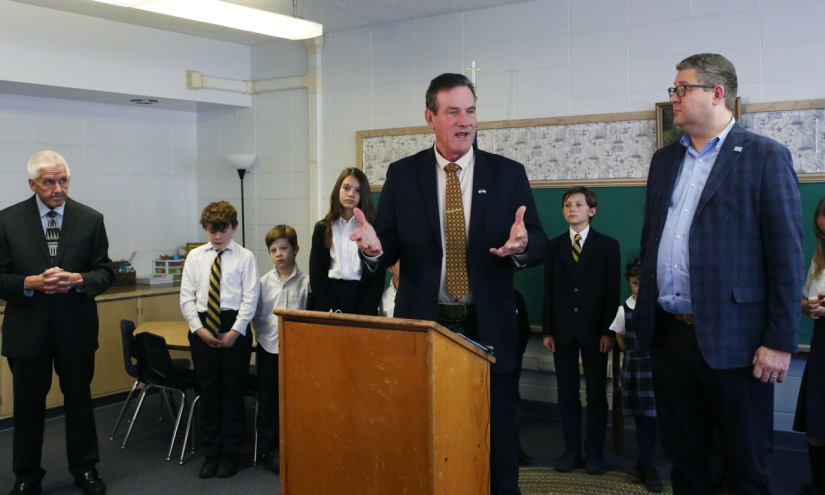
    “I’d just as soon give those dollars to a private school than Uncle Sam,” Rhoden said at the announcement, standing in front of a row of students attending the St. Joseph Academy. “I think they know how to spend it a little wiser than the federal government.”

    Rhoden added that the federal tax credit will “pair well” with South Dakota’s existing tax credit program, which allows insurance companies to donate up to a total of $5 million to a private school scholarship program for students whose families have low incomes.

    South Dakota Gov. Larry Rhoden (left) and First Lady Sandy Rhoden (right) speak to St. Joseph Academy students in Sioux Falls on Nov. 11, 2025. (Photo by Makenzie Huber/South Dakota Searchlight)

    The program will further support the state’s growing alternative instruction movement, Rhoden said, including homeschooling and microschools popping up throughout the state. Alternative instruction enrollment has nearly tripled in South Dakota in the last decade, making up about 7% of school-age children in the state.

    Sara Hofflander, founder of St. Joseph Academy, said the school is “grateful” for the potential extra funding, though she plans to “approach everything cautiously.”

    “Running an independent school obviously requires a heavy commitment from families,” Hoffman said, adding that the extra funding would “lift some of that burden, so we can focus more on the needs of our students.”

    Historically, “school choice” efforts in the state have met resistance from the public school industry.

    Advocates vehemently fought former Gov. Kristi Noem’s effort to introduce Education Savings Accounts, which would have provided public funding for private education and homeschool options during the last legislative session, calling the failed effort an attack on public education. Those same advocates referred to the state’s education tax credit program as “backdoor school voucher program.”

    But Rob Monson, executive director for the School Administrators of South Dakota, said the program will benefit public and private education. South Dakotans can direct their tax credit dollars to organizations representing public schools in the state. The funding could be spent on not only tuition and fees for private schools, but tutoring, special needs services for students with disabilities, transportation (such as busing), afterschool care and computers.

    “That’s a huge win for taxpayers of South Dakota, but also every form of education across the state,” Monson said.

    South Dakota Education Secretary Joe Graves said the program will support education innovations and a “robust competitive system.”

    Graves told lawmakers on Thursday, while presenting lackluster test scores to a committee, that “innovation” would be key to improving student outcomes, especially for Native American students and children living in “education deserts.”

    “We’re not doing well enough, and we need to do better,” Graves said at Friday’s announcement.

    If more students attend private or alternative schooling options, that would mean less state funding for public schools because of decreased student enrollment. Monson told South Dakota Searchlight that state revenues could be impacted by participation in the tax credit program, since it would remove federal tax dollars used to support other programs or go toward states. The federal government would still be obligated to fund some federal education programs, Monson added.

    The scholarship funds would be available to families whose household incomes do not exceed 300% of their area’s median gross income. The U.S. Department of Treasury is expected to issue proposed rules detailing the program’s operation.

    Graves said he assumes there will be reporting “at some level” of how the funds are spent.

    South Dakota Searchlight is part of States Newsroom, a nonprofit news network supported by grants and a coalition of donors as a 501c(3) public charity. South Dakota Searchlight maintains editorial independence. Contact Editor Seth Tupper for questions: [email protected].


    Did you use this article in your work?

    We’d love to hear how The 74’s reporting is helping educators, researchers, and policymakers. Tell us how

    Source link

  • New Jersey Weighs Biggest Update of Charter School Rules in 30 Years – The 74

    New Jersey Weighs Biggest Update of Charter School Rules in 30 Years – The 74


    Get stories like this delivered straight to your inbox. Sign up for The 74 Newsletter

    Senate lawmakers on Monday advanced legislation that would launch the most comprehensive overhaul of New Jersey’s regulation of charter schools in 30 years.

    The bill advanced by the Senate Education Committee on Monday would outright ban for-profit charter schools, require them to post a range of documents online, and impose residency requirements for some charter school trustees.

    “We have not looked at charter schools as a whole legislatively in this committee since the 1990s, so this is an opportunity where we’re trying to do that,” said Sen. Vin Gopal (D-Monmouth), the panel’s chair and the bill’s prime sponsor.

    The bill comes as New Jersey charter schools have faced scrutiny after reporting revealed top officials were paid far more than their counterparts at traditional public schools, including, among others, a Newark charter school CEO who was paid nearly $800,000 in 2024.

    The proposal, which Gopal said was the product of a year of negotiations, would require charter schools to post user-friendly budgets that include the compensation paid to charter school leaders and school business administrators. They must also post existing contracts.

    Charters would be required to post meeting notices, annual reports, board members’ identities, and facility locations online. Some critics have charged that charter schools routinely fail to provide notice of their public meetings.

    The legislation would also require the state to create a dedicated charter school transparency website to host plain language budgets, 990 disclosure forms filed with the IRS, contracts with charter management organizations, and a list of charter schools on probation, among other things.

    It would also ban fully virtual charter schools.

    “We support the bills as a step forward in holding all public schools in our state accountable for fiscal and transparency requirements that will ultimately best serve our students,” said Debbie Bradley, director of government relations for the New Jersey Principals and Supervisors Association.

    The two sides remained at odds over the membership of charter school boards.

    Charter critics argued residency for those positions — which, unlike traditional public school boards, are largely appointed rather than elected — should mirror those imposed on regular public schools.

    In New Jersey, school board members must live in the district they serve. That’s not the case for charter schools, whose trustees face no residency or qualification limits under existing law.

    The bill would only impose a residency requirement on one-third of a charter school’s trustees, and rather than forcing them to live in the district, the bill would require charter trustees to live in the school’s county or within 30 miles of the school.

    That language was criticized by statewide teachers union the New Jersey Education Association, which has called existing law governing charter schools outdated and flawed.

    “School board representation should remain primarily local, and when we mean local, we don’t mean within a 30-mile radius. A 30-mile radius of Newark could include Maplewood, South Orange, communities that don’t necessarily represent what Newark looks like as a community,” said Deb Cornavaca, the union’s director of government relations.

    Charter school supporters said their boards need flexibility because their leadership has broader responsibilities than counterparts in traditional public schools.

    “Running a charter is a little different than running a traditional district. You need experience in school finance. You need to fundraise a bunch of money on the front end because you’re not getting paid on the front end,” said New Jersey Charter School Association President Harry Lee, adding they also needed familiarity with real estate and community experience.

    Amendments removed provisions that would have required charter school board members to be approved by the state commissioner of education, though the commissioner retains sole power over whether to allow the formation of a new charter, a power that gives the commissioner some veto power over a charter’s board.

    Gopal acknowledged the 30-mile residency rule was a sticking point and said legislators would discuss it before the measure comes before the Senate Budget Committee. Earlier, he warned the bill was likely to see more changes as it moved through the Legislature.

    Some argued enrollment in charter schools should be more limited by geography, arguing that out-of-district enrollments that are common at New Jersey charters could place financial strain on the students’ former district.

    Most per-pupil state and local funding follows students who enroll in charter schools, even if their departure does not actually decrease the original district’s expenses because, for example, those schools still require the same number of teachers and administrators.

    Charter operators said that would make New Jersey a national outlier and argued that a separate provision that would bar new charter schools when there are empty seats in existing area charters should come out of the bill.

    “It could be read as a moratorium on charters, so we want to revisit that provision,” Lee said.

    Such vacancies could exist for various reasons, they argued, including student age distributions.

    Alongside that measure, the panel approved separate legislation that would bar charter schools from setting criteria to enroll students, ban them from imposing other requirements on a student randomly selected to attend, and place new limits on how such schools can enroll children from outside their district.

    That bill would also bar charter schools from encouraging students to break with the district. Some opponents have charged that charter schools push out low-performing students to boost their metrics.

    The committee approved the bills in unanimous votes, though Sens. Owen Henry (R-Ocean) and Kristin Corrado (R-Passaic) abstained from votes on both bills, saying they are broadly supportive but need more time to review amendments.

    New Jersey Monitor is part of States Newsroom, a nonprofit news network supported by grants and a coalition of donors as a 501c(3) public charity. New Jersey Monitor maintains editorial independence. Contact Editor Terrence T. McDonald for questions: [email protected].


    Did you use this article in your work?

    We’d love to hear how The 74’s reporting is helping educators, researchers, and policymakers. Tell us how
    Source link

  • At Moms for Liberty summit, parents urged to turn their grievances into lawsuits

    At Moms for Liberty summit, parents urged to turn their grievances into lawsuits

    KISSIMMEE, Fla. — It’s not a rebrand. But the Moms for Liberty group that introduced itself three years ago as a band of female “joyful warriors” shedding domestic modesty to make raucous public challenges to masks, books and curriculum, is trying to glow up.

    The group’s national summit this past weekend at a convention center outside Orlando leaned into family (read: parental rights), faith — and youth. The latter appeared to be a bid to join the cool kids who are the new face of conservatism in America (hint: young, Christian, very male), as well as a recognition of the group’s “diversity,” which includes grandparents, men and kids. 

    But even as the youth — including 20- and 30-something podcasters and social media influencers, as well as student members of the late Charlie Kirk’s Turning Point USA — brought a high-energy vibe, stalwart members got a new assignment. Where past Moms for Liberty attendees were urged to run for school board, this year they were encouraged to turn their grievances into legal challenges. 

    Moms for Liberty CEO and co-founder Tina Descovich acknowledged that while many of them had experienced backlashes as a result of running for school board or publicly challenging books, curricula and policies, they needed to continue the fight. (The more pugnacious co-founder, Tiffany Justice, is now at Heritage Action, an arm of right-wing think tank The Heritage Foundation.) 

    “You have lost family, you have lost friends, you have lost neighbors, you’ve lost jobs, you’ve lost whole careers,” she said. Yet she insisted that it was vital that they “shake off the shackles of fear and stand for truth or we are going to lose Western civilization as a whole.”

    Related: Become a lifelong learner. Subscribe to our free weekly newsletter featuring the most important stories in education. 

    The gathering held up “the free state of Florida” as an example of Republican policies to be emulated, including around school choice and parental rights. The state’s attorney general, James Uthmeier, boasted of having created a state Office of Parental Rights last spring, describing it as “a law firm for parents.” 

    He trumpeted the state’s lawsuit against Target over the “market risks” of LGBTQ+ pride-themed merchandise and encouraged parents to reach out with potential legal actions. “If you’re identifying one of these wrongs that’s violating your rights and then subjecting our kids to danger and evil, then we want to know about it,” he said. “And we’re going to bring the heat in court to shut it down.”

    Tina Descovich, CEO and co-founder of Moms for Liberty, was interviewed on Real America’s Voice, a conservative news and entertainment network that set up a remote studio outside of the Sun Ballroom at the Moms for Liberty national summit. Credit: Laura Pappano for The Hechinger Report

    The shifting legal landscape, not just in Florida but nationally, had speakers gushing about the opportunity to file new challenges, particularly in the wake of the Supreme Court decision in Mahmoud v. Taylor in June. It gives parents broad power to object to school materials, including with LGBTQ+ themes, and the right to remove their children from public school on days when such materials are discussed. 

    “This is where we need to take that big Supreme Court victory and start fleshing it out,” said Matt Sharp, senior counsel at Alliance Defending Freedom, a Christian law firm. He added that they were “needing warriors, joyful warriors, to file cases to start putting meat on the bones of what that does.” 

    The directive to file suit was not just around opt-out policies, which were the basis for the Mahmoud case. (Moms for Liberty has opt-out forms and instructions on its website.) Rather, attendees were also urged to file lawsuits in support of school prayer; against school policies that let students use different names and pronouns without parental consent (what Moms for Liberty terms “secret transitions”); and to give parents access to surveys students take at school, including around mental health.

    “We need people willing to stand up legally and be, you know, named plaintiffs,” Kimberly S. Hermann, president of the Southeastern Legal Foundation, a conservative policy group, said on a panel featuring two moms who sued their school districts. Winning a lawsuit or even just bringing one in one state, said Hermann, can get other school districts and states to adopt policies, presumably to avoid lawsuits themselves. 

    “One offensive litigation can have this amazing ripple effect,” she said. She and others made clear that there is staff to provide support. The legal groups will “stand with you,” said Sharp, “whether you’re passing the law or passing the local policy all the way to litigating these cases.”

    Even as speakers criticized public schools particularly around LGBTQ+ issues, not as a form of inclusion but as foisting views into classrooms, they relished the chance to infuse their values into schools. 

    Filing these lawsuits is more than “just fighting for your role as parents,” Sharp told parents in a breakout session. “You’re ultimately fighting for your kids’ ability to be in their schools and make a difference, to be the salt and light in those classrooms with their friends and to take our message of freedom, of faith, of justice and to really spread it all across the schools.”

    Related: America’s schools and colleges are operating under two totally different sets of rules for sex discrimination 

    Overall, this year’s Moms for Liberty event lacked the obvious drama of recent years. The flood of protesters in 2023 in Philadelphia required a large police presence and barricades around the hotel, along with warnings not to wear Moms for Liberty lanyards on the streets. 

    This year, there were no protests. That was partly because the event was held in a secluded resort convention center that could accommodate 800 (larger than the 500-ish of past hotels). But the group failed to fill the venue or attract much media attention. There was on-location broadcast by Real America’s Voice, a conservative news and entertainment network, from a set outside the Sun Ballroom. (Steve Bannon interviewed Descovich on his show, “The War Room.”)

    It also didn’t draw opposition because protesters had a bigger target. Saturday saw “No Kings” rallies across the country, with thousands decrying what they see as President Donald Trump’s authoritarianism. “I forgot it was happening since they’re mostly ignored these days,” state Sen. Carlos Guillermo Smith, (D-Orlando) and a senior advisor to LGBTQ+ rights group Equality Florida, said in a text message about the Moms for Liberty event. Liz Mikitarian, founder of the national group, Stop Moms for Liberty, which is based in Florida, said the moms “are still a threat” but not worth organizing a protest against. 

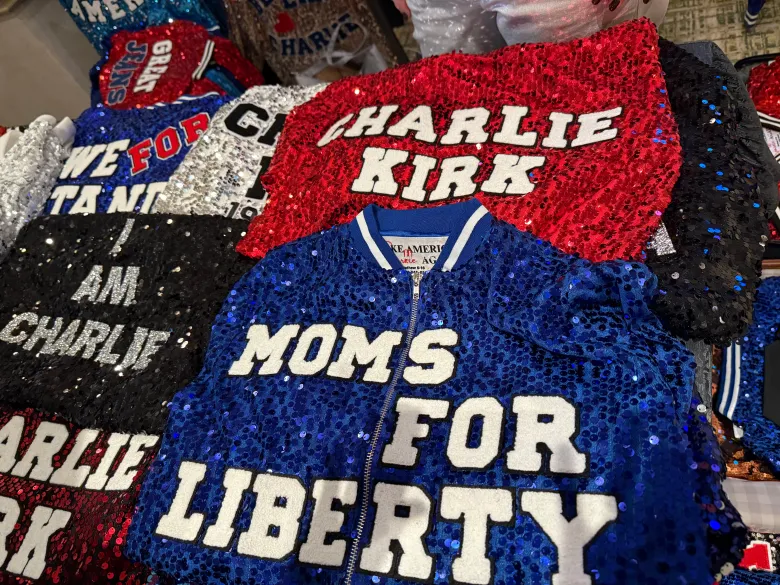
    It was also a quieter affair than last year’s in Washington, D.C. There, Trump’s appearance fed a party atmosphere with Southern rock, sequined MAGA outfits and a cash bar. (This year, Trump appeared, but only in a prerecorded video message.)

    Sequined merchandise for sale at the Moms for Liberty gathering by the company Make America Sparkle Again included tops and jackets that paid tribute to Charlie Kirk, the slain founder of Turning Point USA. Credit: Laura Pappano for The Hechinger Report

    The three-day event, of course, aired familiar grievances in familiarly florid language — conservative school choice activist Corey DeAngelis railed against teacher unions over the “far-left radical agenda that they’re trying to push down children’s throats in the classroom.” Other sessions covered the expected — the alleged dangers of LGBTQ+ policies, in sports, restrooms, school curricula and books — but there was also discussion of concerns (shared on left and right) over youth screen use, online predators and artificial intelligence.

    The event made room for MAHA, the Make America Healthy Again movement led by Robert F. Kennedy Jr., the secretary of Health and Human Services. Descovich interviewed Dr. Joseph Ladapo, the Florida surgeon general who is working to eliminate all vaccine mandates for the state’s schoolchildren.

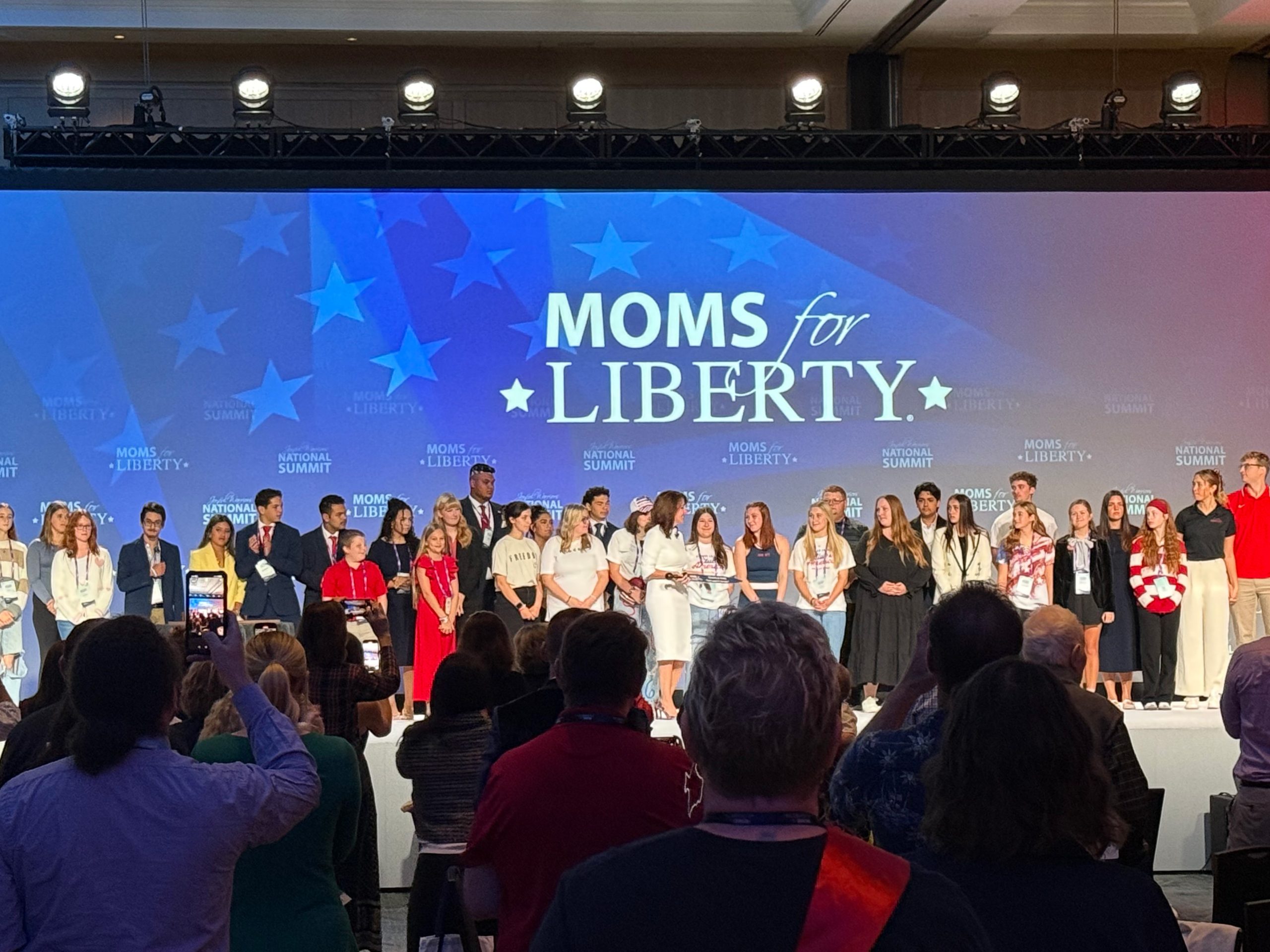
    But the move by Moms for Liberty to attract young conservatives elevated the energy in the room. It was apparent not only in a tribute to Kirk, the slain founder of Turning Point USA, which trains young conservatives on high school and college campuses. About 40 Florida TPUSA members took the ballroom stage to accept the “Liberty Sword,” the group’s highest honor, posthumously awarded to Kirk. 

    Related: Red school boards in a blue state asked Trump for help — and got it

    It also showed up in a breakout session of mostly conservative social media influencers and podcasters who offered tips on using humor and handling online trolls: Lydia Shaffer (aka the Conservative Barbie 2.0), Alex Stein, Gates Garcia, Kaitlin Bennett, Angela Belcamino (known as “The Bold Lib,” who said she was surprised to have been invited), and Jayme Franklin, who in addition to her podcast is the Gen Z founder of The Conservateur, a conservative lifestyle brand that The New Yorker called “Vogue, But for Trumpers.”

    They have built huge followings based on their compulsion to provoke. “We need to go back to biblical values of what it means to be a real man and what it means to be a real woman,” urged Franklin. “People want that guidance, and that needs to begin at church. We need to push people back into the pews.”

    Their inclusion, like that of conservative commentator Benny Johnson, who moderated a panel, “Fathers: The Defenders of the Family,” appeared to recognize a need to expand the base — and be edgier. Johnson charged out on stage and trumpeted that “God’s first commandment to us was, ‘Go, be fruitful, multiply.’ Go make babies!!!!” He quipped that “right-wing moms, they’re happier, right?” and asked the crowd, “Any trad wife moms out there?”

    The phrase is shorthand for a woman who embraces a traditional domestic role, often with an emphasis on fashion and style. Johnson — who credited Kirk for prodding him to find Jesus, get married and become a father (he has four children) — argued that Republicans, especially those in Gen Z, should embrace the traditional nuclear family identity as a winning political move.

    “We are the party of parents. We are the party of children,” he said, adding that traditional values were already dominating culture and politics. “We live in a center-right country. And I’m tired of pretending that we don’t,” he said, and showed a map of red and blue votes in the 2024 presidential election. “This is the shift. You live in a red kingdom.”

    Contact editor Caroline Preston at 212-870-8965, via Signal at CarolineP.83 or on email at [email protected].  

    This story about Moms for Liberty was produced by The Hechinger Report, a nonprofit, independent news organization focused on inequality and innovation in education. Sign up for the Hechinger newsletter.

    The Hechinger Report provides in-depth, fact-based, unbiased reporting on education that is free to all readers. But that doesn’t mean it’s free to produce. Our work keeps educators and the public informed about pressing issues at schools and on campuses throughout the country. We tell the whole story, even when the details are inconvenient. Help us keep doing that.

    Join us today.

    Source link

  • 5 Trends Reshaping K-12 Education Across the U.S. – The 74

    5 Trends Reshaping K-12 Education Across the U.S. – The 74


    Get stories like this delivered straight to your inbox. Sign up for The 74 Newsletter

    Since 2020, interest in homeschooling, microschooling, and other alternatives to conventional education has soared. Entrepreneurial parents and teachers have been building creative schooling options across the U.S. Kerry McDonald, a senior fellow at the Foundation for Economic Education and contributor to The 74, was so inspired by these everyday entrepreneurs that she wrote a book about them: Joyful Learning: How to Find Freedom, Happiness, and Success Beyond Conventional Schooling.The following is an adapted excerpt from McDonald’s book. It is reprinted here with permission from the publisher.

    In 2019, I gave a keynote presentation at the Alternative Education Resource Organization’s (AERO) annual conference in Portland, Oregon. Founded in 1989 by Jerry Mintz, AERO has long supported entrepreneurial educators in launching new schools and spaces, with a particular focus on learner‑centered educational models. It was about a month after my previous book Unschooled was published, and I was talking about the gathering interest in unconventional education. Homeschooling numbers were gradually rising, and more microschools and microschooling networks were surfacing. I predicted that these trends would continue, but I said they would remain largely on the ­edge— as alternative education had for decades. They would offer more choices to some families who were willing to try new things, similar to those of us who eagerly embraced Netflix’s mailed DVDs when they first appeared. But I didn’t think these unconventional models would upend the entire education sector the way Netflix ultimately did with entertainment. I thought they would remain small and niche. I was wrong.

    The COVID crisis catapulted peripheral educational trends into the mainstream, not only creating the opportunity for new schools and spaces to emerge but, more importantly, permanently altering the way parents, teachers, and kids think about schooling and learning. The pre‑pandemic tilt toward homeschooling and microschooling has converged with five post‑pandemic trends that are profoundly reshaping American education for families and founders. Together, these trends are shifting the K–12 education sector from being an innovation laggard to an innovation leader.

    Trend #1: The growth of homeschooling and microschooling

    The nearby microschool for homeschoolers that my children attended before COVID was one of only a sprinkling of schooling alternatives in our area. Now, it’s part of a wide, fast‑growing ecosystem of creative schooling options— both locally and nationally— representing an array of different educational philosophies and approaches. Families today are better able to find an education option that aligns with their preferences. From Maine to Miami to Missouri to Montana, the majority of the innovative schools and spaces I’ve visited have emerged since 2020, and many already have lengthy waitlists, inspiring more would‑be founders. The demand for these options will grow and accelerate over the next ten years, as will the number of homeschooling families, many of whom will be attracted to homeschooling as a direct result of these microschools and related learning models. Indeed, data from the Johns Hopkins University Homeschool Hub reveal that homeschooling numbers continued to grow during the 2023/2024 academic year compared to the prior year in 90 percent of the states that reported homeschooling data, shattering assumptions that homeschooling’s pandemic‑era rise was just a blip. Parents that otherwise wouldn’t have considered a homeschooling option will do so because homeschooling enables them to enroll at their preferred microschool or learning center.

    One particularly striking and consistent theme revealed in my conversations with founders as I’ve crisscrossed the country is that their kindergarten classes are filling with students whose parents chose an unconventional education option from the start. These parents aren’t removing their child from a traditional school because of an unpleasant experience or a failure of a school to meet a child’s particular needs. They are opting out of conventional schooling from the get‑go, gravitating toward homeschooling and microschooling before their child even reaches school age. This trend is also likely to accelerate, as younger parents become even more receptive to educational innovation and change.

    Trend #2: The adoption of flexible work arrangements

    Today’s generation of new parents grew up with a gleeful acceptance of digital technologies and the breakthroughs they have facilitated in everything from healthcare to home entertainment. These parents see the ways in which technology and innovation enable greater personalization and efficiency, and expect these qualities in all their consumer choices. It’s no wonder, then, that parents of young children today are generally more curious about homeschooling and other schooling alternatives. They are often perplexed that traditional education seems so sluggish.

    The response to COVID gave these parents license to consider other options for their children’s education. The school closures and extended remote learning during the pandemic empowered parents to take a more active role in their children’s education. That trend persists, as does the remaking of Americans’ work habits. The number of employees working remotely from home rather than at their workplace has more than tripled since 2019. 

    As more parents enjoy more flexibility in their work schedules, they will seek similar flexibility in their children’s learning schedules. While remote and hybrid work generally remain privileges of the so‑called “laptop class” of higher‑income employees, the growing adoption of flexible work and school arrangements is driving demand for more of these alternative learning models, including many of the ones featured in Joyful Learning that offer full‑time, affordable programming options for parents who don’t have job flexibility. Remote and hybrid work patterns are here to stay, and so is the trend toward more nimble educational models for all.

    Trend #3: The expansion of school choice policies

    The burst of creative schooling options since 2020 is now occurring all across the United States, in small towns and big cities, in both politically progressive and conservative areas, and in states with and without school choice policies that enable education funding to follow students. 

    Education entrepreneurs aren’t waiting around for politicians or public policy to green‑light their ventures or provide greater financial access. They are building their schools and spaces today to meet the mounting needs of families in their communities.

    That said, there is little doubt that expansive school choice policies in many states are accelerating entrepreneurial trends. Founders I talk to who are developing national networks of creative schooling options, are intentional about locating in states with generous school choice policies that enable more parents to choose these new learning models. Other entrepreneurs are moving to these states specifically so that they can open their schools in places that enable greater financial accessibility and encourage choice and variety. Jack Johnson Pannell is one example. The founder of a public charter school for boys in Baltimore, Maryland, that primarily serves low‑income students of color, Jack grew discouraged that the experimentation that defined the early charter school movement in the 1990s steadily disappeared, replaced by an emphasis on standardization and testing that can make many—but certainly not all—of today’s charter schools indistinguishable from traditional public schools. He saw in the choice‑enabled microschooling movement the opportunity for ingenuity and accessibility that was a hallmark of the charter sector’s infancy. In 2023, Jack moved to Phoenix, Arizona, to launch Trinity Arch Preparatory School for Boys, a middle school microschool that families are able to access through Arizona’s universal school choice policies. 

    Trend #4: The advent of new technologies and AI

    New technologies are also accelerating the rise of innovative educational models, while making it harder to ignore the inadequacies of one‑size‑fits‑all schooling. The ability to differentiate learning, personalizing it to each student’s present competency level and preferred learning style, has never been easier or more straightforward. It no longer makes sense to say that all second graders or all seventh graders should be doing the same thing, at the same time, in the same way—and failing them if they don’t measure up. 

    Emerging and maturing technologies help prioritize students over schools and systems, but the widespread introduction of artificial intelligence (AI) tools, and bots like ChatGPT, will hasten this repositioning. New AI bots can act as personal tutors for students, helping them navigate through their set curriculum. The real promise, according to founders focused more on agency‑ based or learner‑directed education, is for AI tools to work for the students themselves, helping them to control their own curriculum.

    “We don’t have a set pathway for our learners. It’s personalized,” said Tobin Slaven, cofounder of Acton Academy Fort Lauderdale, which he launched with his wife Martina in 2021. Part of the global Acton Academy microschool network, Tobin’s school prioritizes student‑driven education in which young people set and achieve individual goals in both academic and nonacademic areas, participate in frequent Socratic group discussions, engage in collaborative problem‑solving and shared decision‑making, and embark on their own “hero’s journey” of personal discovery and achievement. 

    When we spoke in 2024, Tobin had recently founded an educational technology startup building AI companion tools that act as a personal tutor, life coach, and mentor all in one. He sees AI tools like his as being instrumental in helping learners have more independence and autonomy over their learning. Rather than AI bots guiding a student through a pre‑established curriculum, Tobin thinks the truly transformative potential of AI lies in tools that help students lead their own learning—answering their own questions and pursuing their own academic and nonacademic goals.

    “When I hear the visions of some other folks in the education space, their visions are very different from mine,” Tobin said, referring to many of today’s emerging AI‑enabled educational technologies. He offered the example of a device known as a jig, used often in carpentry, to further illustrate his point. “The jig tells you exactly where the curves should be, where the cut should be. It’s like a template. The template that most of the AI folks are using is traditional education. It was broken from the start. It’s a bad jig,” Tobin said.

    Instead, he sees the potential of AI to help reimagine education rather than reinforce a top‑down, traditional model. He is helping to create a new and better educational jig.

    Trend #­ 5: Openness to new institutions

    The final trend that is merging with the others to transform American education is the shift away from established institutions toward newer, more decentralized ones. Some of this is undoubtedly due to emerging technologies that can disrupt entrenched power structures and lead to greater awareness of, and openness to, new ideas, but the trend goes beyond technology. Annual polling by Gallup reveals that Americans’ confidence in a variety of institutions has fallen, with their confidence in public schools at a historic low. Only 26 percent of survey respondents in 2023 indicated that they had a “Great deal/Quite a lot” of confidence in that institution. The good news is that confidence in small business remains high, topping Gallup’s list with 65 percent of Americans expressing a “Great deal/Quite a lot” of confidence in that institution in 2023. The falling favor of public schools occurring at the same time that small businesses continue to be well‑liked creates ideal conditions for today’s education entrepreneurs. Families who are dissatisfied with public schooling may be much more interested in a small school or space operating or opening within their community. 

    For another signal of the shift away from older, more centralized institutions toward newer, more customized options, look at what the Wall Street Journal calls the “power shift underway in the entertainment industry,” as YouTube increasingly draws viewers away from traditional television networks. Individual YouTube content creators, such as the world’s top YouTuber, MrBeast, who has some 300 million subscribers, appeal to more viewers than the legacy media networks with their more curated content. New content creators are particularly attractive to younger generational cohorts like Gen Z, who prefer decentralized, user‑generated content over traditional, top‑ down media models. Consumers today are looking for more modern, responsive, personalized products and services, especially those being developed by individual entrepreneurs who bear little resemblance to legacy institutions. This is as true in education as it is in entertainment and will be an ongoing, indefinite, and transformational trend in both sectors.

    Shortly before completing this manuscript, I spoke again at the annual AERO conference, this time in Minneapolis. Gone was my measured optimism of 2019. In its place was a mountain of evidence showing how popular alternative education models have become since 2020, and how steadily that popularity continues to grow. This isn’t a pandemic- era fad or an educational niche destined for the edges. This is a diverse, decentralized, choice‑filled entrepreneurial movement that is shifting American education from standardization and stagnation toward individualization and innovation.

    We are only at the very early stages of a fundamental change in how, where, what, and with whom young people learn. Over the next decade, homeschooling and microschooling numbers will continue to grow, work flexibility will trigger greater demand for schooling flexibility, expanding education choice policies will make creative schooling options more accessible to all, AI and emerging technologies will help create a new “educational jig” fit for the innovation era, and declining confidence in old institutions will enable fresh ones to arise. The future of learning is brighter than ever. Families and founders are finding freedom, happiness, and success beyond conventional schooling, inspiring the growth of today’s joyful learning models and the invention of new ones yet to be imagined.


    Get stories like these delivered straight to your inbox. Sign up for The 74 Newsletter

    Source link