Patients benefit from a diverse healthcare workforce. Doctors, particularly those from disadvantaged and minoritised backgrounds, play a crucial role in advocating for what is best for their patients.
The NHS recognises this, linking workforce diversity with increased patient satisfaction, better care outcomes, reduced staff turnover, and greater productivity.
A promising start
Efforts to widen participation in higher education began at the turn of the century following the Dearing report. Over time, access to medical schools gained attention due to concerns about its status as one of the most socially exclusive professions. Medical schools responded in 2014 with the launch of the Selecting for Excellence report and the establishment of the Medical Schools Council (MSC) Selection Alliance, representing admissions teams from every UK medical school and responsible for fair admissions to medical courses.
With medical school expansion under government review, institutions face increasing pressure to demonstrate meaningful progress in widening participation to secure additional places. Although medicine programmes still lag in representing some demographic groups, they now align more closely with wider higher education efforts.
However, widening participation policy often follows a deficit model, viewing disadvantaged young people as needing to be “fixed” or “topped up” before joining the profession. Phrases like “raising aspirations” suggest these students lack ambition or motivation. This model shifts responsibility onto individuals, asking them to adapt to a system shaped mainly by the experiences of white, male, middle-class groups.
Beyond access
To create real change, organisations must move beyond this model and show that students from diverse backgrounds are not only welcomed but valued for their unique perspectives and strengths. This requires a systems-based approach that rethinks every part of medical education, starting with admissions. In its recent report, Fostering Potential, the MSC reviewed a decade of widening participation in medicine. Medical schools across the UK have increased outreach, introduced gateway year courses, and implemented contextual criteria into admissions.
Contextual markers recognise structural inequalities affecting educational attainment. Students from low socioeconomic backgrounds often attend under-resourced schools and face personal challenges hindering academic performance. Yet evidence shows that, when given the chance, these students often outperform more advantaged peers at university. Contextual admissions reframe achievements in light of these challenges, offering a fairer assessment of potential.
Despite progress, access remains unequal. Although acceptance rates for students from the most deprived areas have increased, their chances remain 37 per cent lower than those from the least deprived areas. Research indicates that a two-grade A-level reduction is needed to level the playing field—an approach several schools now adopt. Other policies include fast-tracking interviews, test score uplifts, and alternative scoring for widening participation candidates.
Not just special cases
These processes, however, are often opaque and hard to navigate. Many applicants struggle to determine eligibility. With no single definition of disadvantage, medical schools use varied proxy indicators, often poorly explained online. This confusion disproportionately affects the students these policies aim to support; those without university-educated parents, lacking insider knowledge, and attending under-resourced schools.
A commitment to transparency is vital but must go beyond rhetoric. Transparency means all medical schools clearly outline contextual admissions criteria in one accessible place, provide step-by-step guides to applicants and advisors, and offer examples of how contextual data influences decisions. Medical schools could collaborate to agree on standardised metrics for identifying widening participation candidates. This would simplify eligibility understanding, reduce confusion, and promote fairness.
Tools like MSC’s entry requirements platform are a good start but must be expanded, standardised, and actively promoted to the communities that need them most. Genuine transparency empowers applicants to make informed choices, selecting schools best suited to their circumstances and maximising success chances. This also eases the burden on schools, advisors, and outreach staff who struggle to interpret inconsistent criteria.
Ultimately, moving away from the deficit model toward an open, systems-based approach is about more than fairness. It is essential for building a medical workforce that reflects society’s diversity, improving patient care, strengthening the profession, and upholding the NHS’s commitment to equity and excellence.
This audio is auto-generated. Please let us know if you have feedback.
Two children — ages 8 and 10 — are dead and 17 other people injured at a Minneapolis Catholic school after an active shooter opened fire Wednesday morning. Fourteen of the 17 injured are children, two of whom are currently in critical condition, according to the Minneapolis Police Department.
The tragedy took place during the first week of classes for Annunciation School, a private pre-K-8 Catholic school with a little over 390 students, according to the National Center for Education Statistics. It occurred while dozens of children were attending religious mass at Annunciation Church, said Minneapolis Police Chief Brian O’Hara during a Wednesday press briefing.
During the event, the shooter barricaded some doors to the church from the outside to keep students from leaving as he shot at children and churchgoers from outside the building, through the windows. O’Hara said a smoke bomb was found at the scene.
That kind of “frontal assault” style attack at a school is “relatively rare” according to David Riedman, a school shooting expert who manages the K-12 School Shooting Database. A similar style of attack was seen at the Virginia Tech shooting in 2007, he said.
“Most school shootings are insider attacks (current students) who commit a surprise attack when they are already inside the building,” said Riedman in a Wednesday analysis sent via email.
It is unknown whether the shooter — who was in his early 20s and appears to have died by suicide during the attack — was a former employee or student of the school, said O’Hara.
“Don’t just say this is about thoughts and prayers right now. These kids were literally praying.” said Minneapolis Mayor Jacob Frey during the Wednesday press event. “They should be able to go to school or church in peace without the fear or risk of violence, and their parents should have the same kind of assurance.”
The Annunciation Church shooting is the 146th at a K-12 school so far in 2025, according to Riedman’s count.
“These school shootings happen in all sizes of communities and in rural, suburban, and urban areas,” he said.
School shootings reached all-time highs three years in a row between the 2021-22 to 2023-24 school years, according to Riedman’s K-12 School Shooting Database, which tracks anytime a gun is brandished with intent or when a bullet hits school property. The 2024-25 school year then saw a 22.5% decrease in school shootings compared to the prior school year.
There were 254 total school shooting incidents in 2024-25, compared to the nearly 330 school shooting incidents in each of the school years between 2021-22 and 2023-24.
From the start, Na’Siah Martin and H’Sanii Blankenship’s July trip to Washington, D.C., was destined to be a riveting stop on the teenagers’ passage to adulthood. There were the scheduled meetings with lawmakers, the monuments, the reflecting pool near where Martin Luther King Jr. broadcast his dream for racial equality 62 summers ago.
For years, the pair have been involved in the Boys and Girls Clubs of the Austin Area, the revered summer and after-school program that was now making it possible for the two blossoming leaders to meet with Texans in Congress and present their game plan for tackling mental health challenges among student-athletes, a struggle both were deeply familiar with.
But two weeks before their arrival on Capitol Hill, President Donald Trump’s administration threw one of many curveballs lobbed during the first months of his second term. The U.S. Department of Education notified state education officials on the last day of June that it would pause the disbursement of nearly $7 billion in funds for teacher development, support for students learning English, and before- and after-school programs predominantly serving low-income families, pending a review of how schools had put the money to use. That notice went out a day before states expected to begin receiving the money.
For Texas, it meant a potential loss of nearly $670 million. For Martin and Blankenship, it potentially meant losing the Boys and Girls Club, a space that has aided their growth as both leaders and individuals. Martin, 18, graduated from Navarro Early College High School in June and has participated in the club since elementary school. Blankenship, a 17-year-old incoming senior at the same school, has participated in the club for about as long as Martin.
The focus of their trip immediately broadened: They now wanted to convince federal lawmakers that cutting the funds would harm Texas kids.
“These programs aren’t just for fun,” Blankenship said. “They actually give us resources, help us grow into adults instead of just coming here and just goofing around and stuff like that. These programs, they help us cope with things we need to cope with.”
The education funding freeze was typical of the Trump administration. In recent months, it has also cut billions of dollars in food assistance and health care for families in poverty; frozenbillions in grants and contracts financially supporting universities; canceled billions for foreign aid and public broadcasting stations; laid off thousands of employees working in critical federal agencies; and sought to overhaul the U.S. immigration landscape through actions like attempting to end birthright citizenship.
Those cuts and changes have often been sweeping and abrupt, disrupting federally funded services and programs serving large swaths of people of color, people with disabilities, low-income families, LGBTQ+ Americans and immigrants. And they have come at the same time the administration has moved to lower taxes for some of America’s wealthiest households.
“We can’t look at just the cuts to education in isolation,” said Weadé James, senior director of K-12 education policy at the Center for American Progress. “I think what we’re witnessing is really the undoing of a lot of progress, and also actions that are really going to keep a lot of families trapped in cyclical and generational poverty.”
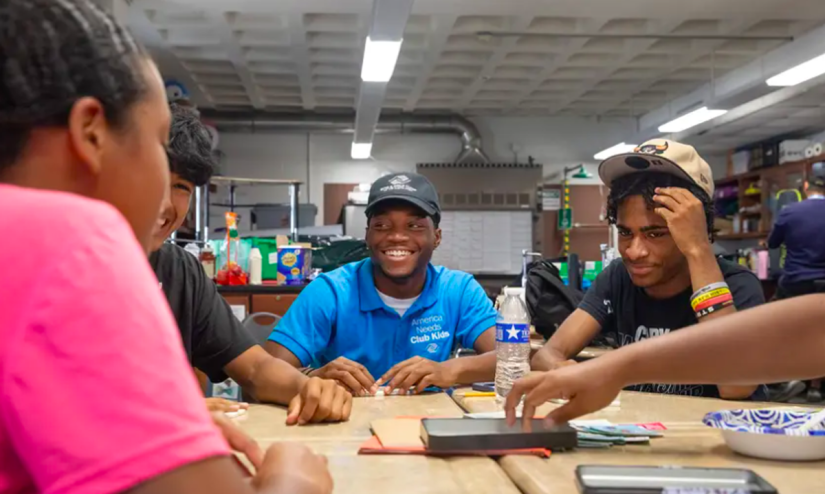
Boys and Girls Club director Jacob Hernandez watches club members play spades at Navarro Early College High School. Credit: Montinique Monroe for The Texas Tribune
Ongoing changes to the country’s educational landscape are only one part of Trump’s larger goals to eliminate what the second-term president has deemed “wasteful” spending and crack down on anything he views as diversity, equity and inclusion initiatives. A large piece of his efforts involve closing the Department of Education and sending “education back to the states,” though most decisions about education and public school funding already happen at the state and local levels.
“Teachers will be unshackled from burdensome regulations and paperwork, empowering them to get back to teaching basic subjects. Taxpayers will no longer be burdened with tens of billions of dollars of waste on progressive social experiments and obsolete programs,” Trump Secretary of Education Linda McMahon said in a statement earlier this year. “K-12 and college students will be relieved of the drudgery caused by administrative burdens—and positioned to achieve success in a future career they love.”
The disarray has resulted in profound consequences for Texas, one of the largest and most diverse states in the nation, home to more than 9,000 school campuses and 5.5 million students — the majority of whom live in low-income households and come from Hispanic and Black families. Public schools serve as a safety net for many of them. They are one of the few places where some children have consistent access to meals, where working-class parents know their kids will be taken care of.
The prospect of federal cuts to school programs triggered a wave of concern across the state. For 44-year-old Clarissa Mendez, it jeopardized the after-school program her two daughters attend while she works as a nurse in Laredo.
“I’m on shaky grounds right now because I don’t know what I’m going to do,” Mendez said last month. “I understand there has to be cuts. I understand the government needs to find out how to save money. But why does it have to affect us and our kids?”
For Gay Hibbitts, a 57-year-old trying to become a certified teacher in rural Throckmorton, the worries began months earlier.
Earlier this year, the federal government cut roughly $400 million from a program that helps teaching candidates like her pay for their education as they gain hands-on classroom experience. That left participating rural districts with one of two options: cover the costs at a time when schools are financially struggling to make ends meet, or get rid of their preparation programs during a teacher shortage.
In both scenarios, Hibbitts said, children would pay the price.
“They’re the main ones that are going to suffer,” she said.
For as long as Martin and Blankenship can remember, they have each helped raise their younger siblings, a responsibility that has been rewarding but stressful. On the one hand, Martin said, her siblings look up to her, and her academic success has motivated them to do well in school. On the other hand, Blankenship said, taking on adult responsibilities at an early age meant missing out on the type of exhilarating childhood experiences many kids desire.
Since joining the Boys and Girls Club, the program has provided them the space to be kids.
They receive tutoring and time to finish homework. They go to live sporting events, watch movies and listen to music — SZA some days, Lauryn Hill on others. They play sports, cards and board games. They can earn scholarships. They find mentorship.
“We’re the future adults, so I feel like if you help us now with programs like this, that make us happy, that give us stress relief, that let us be kids, because we can’t be kids at home, I feel like that’ll equate to happier adults,” Martin said.
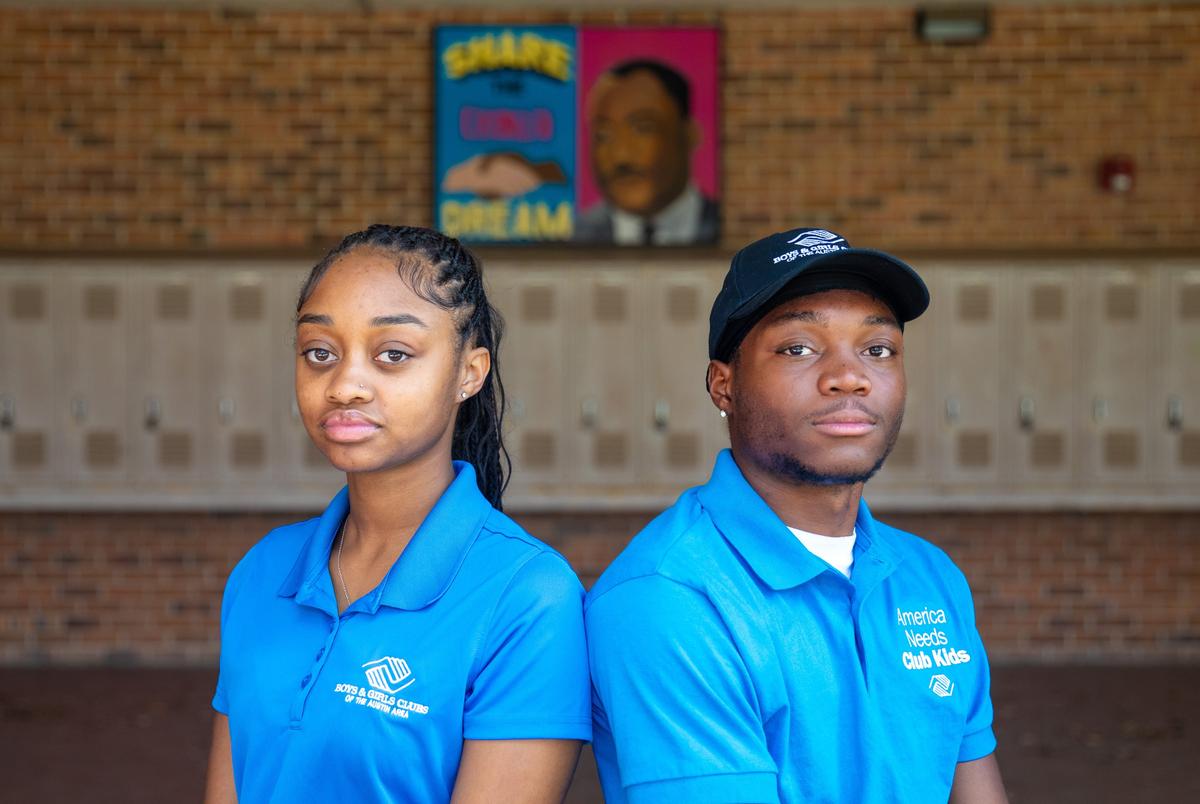
Na’Siah Martin, left, and H’Sanii Blankenship traveled to Washington, D.C., in July and had a chance to discuss with lawmakers the Trump administration’s pause on roughly $7 billion in federal funding, which threatened to shutter the Boys and Girls Club. Credit: Montinique Monroe for The Texas Tribune
Neither Martin nor Blankenship enjoys public speaking. Martin actually fears it. But with the Austin Boys and Girls Club’s future in jeopardy, they decided to lean into the discomfort and use the face time with lawmakers and their staffers to make a case for the after-school program.
The pair and several other clubmates sat down with the staff of Texas Republican Sens. John Cornyn and Ted Cruz. They also met with Rep. Greg Casar, an Austin Democrat. The kids wore blue polo shirts with the words “America Needs Club Kids” etched in white. Martin, rocking a black one-button blazer, led the way.
“I gotta let these people know,” she thought.
Erica Peña is responsible for taking care of about 400 kids as she coordinates Hebbronville Elementary’s summer and after-school programs. Working with an assistant and about 25 paid volunteers, the 37-year-old often stays after hours — sometimes as late as 7 p.m. — depending on when parents can leave work to get there.
Peña breaks the after-school schedule into blocks. The first hour is for tutorials and worksheets, the later hours are usually for more fun activities like arts and crafts, kickball and cooking.
But shortly after the federal education funds were paused, the district notified Peña that it could no longer afford to keep her or the program.
“I cried, to be honest,” Peña said. “I was very upset, because I love my job, I love my students, and a lot of it is about them.”
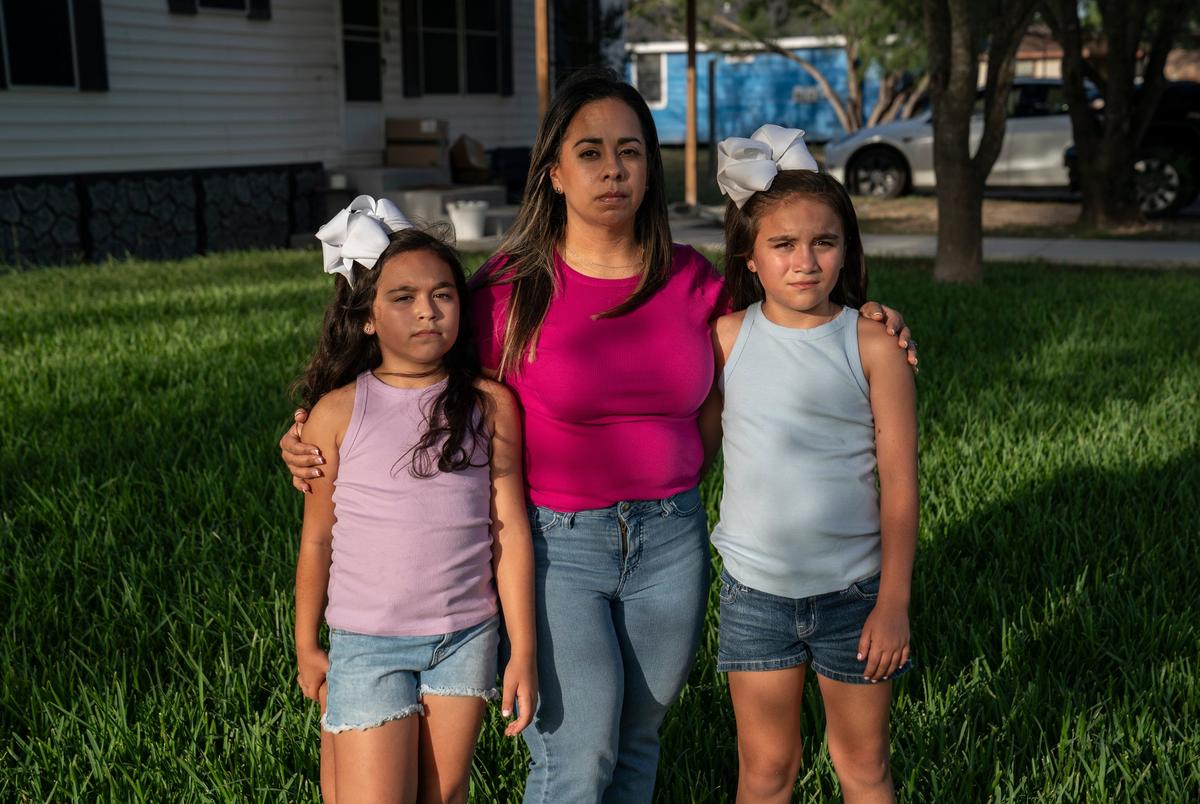
Clarissa Mendez and her daughters Catiana Ester Mendez, left, and Catalaya Avaneh Mendez pose for a photo at their home in Hebbronville on July 30, 2025. Credit: Gabriel V. Cárdenas for The Texas Tribune
Hebbronville, in far South Texas, is home to about 4,300 mostly Hispanic Texans, one-third of whom live below the poverty line. The town has no H-E-B or Walmart. The local health clinic is often busy. The town has a few day care centers, but they can get pricey.
For the average Texas family, child care is financially out of reach. The median annual cost sits at $10,706 a year — or $892 each month. That’s more than one-fourth of the average cost for in-state tuition at a four-year public college, according to the Economic Policy Institute. Access to no-cost options, like the Hebbronville after-school program, has positive effects on student attendance, behavior and learning, multiplestudies have found over the years. Such programs also keep families from having to choose between leaving their children unattended or taking time off work to stay home.
“That has a direct impact on future economic prospects for that entire family,” said Jenna Courtney, CEO of the Texas Partnership for Out of School Time, a youth advocacy organization.
Mendez, the 44-year-old Hebbronville mother with two daughters, commutes about an hour to and from Laredo every weekday to make it to her job as a nurse. She goes in at 9 a.m. and gets out at 5 p.m. Her husband operates heavy equipment and has an unpredictable work schedule.
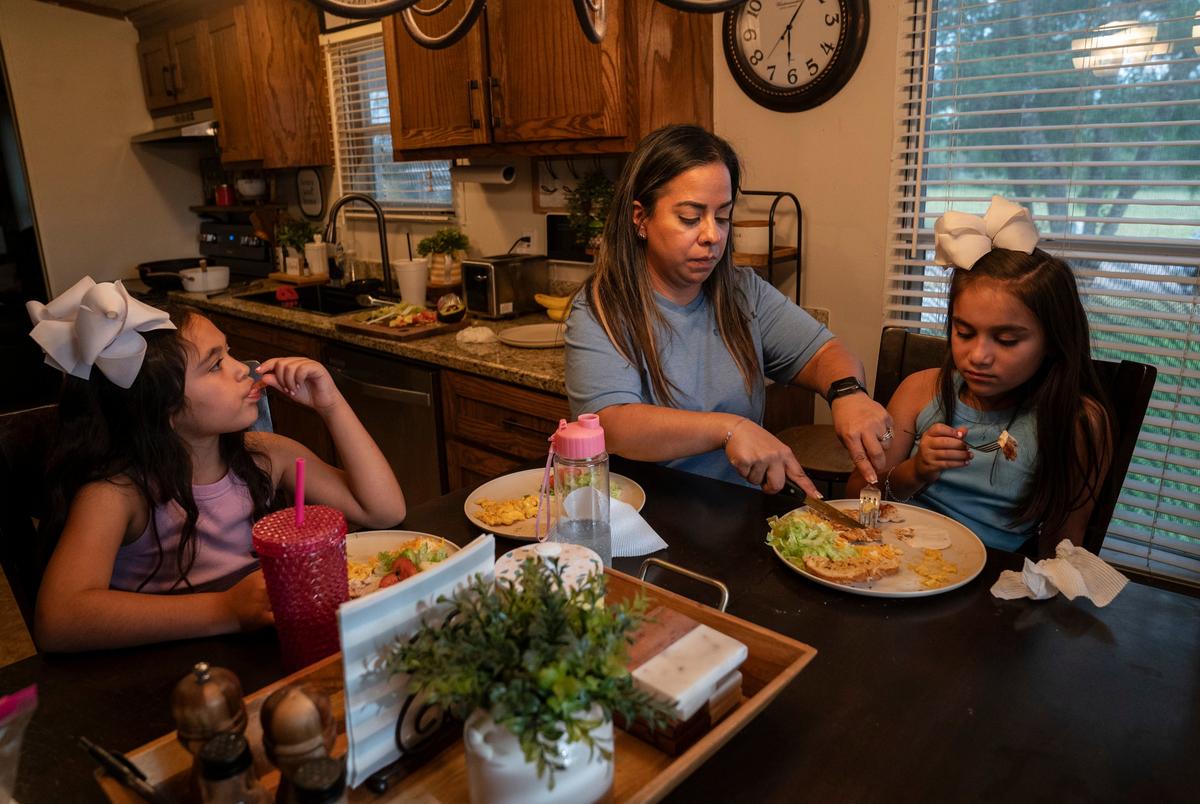
After picking up her daughters, Mendez cooks for them and spends some time with them before she starts working from home for an additional three to four hours. The after-school program Mendez’s daughters attend allows her to save some money on daycare costs. Credit: Gabriel V. Cárdenas for The Texas Tribune
The after-school program “gives me enough time to get to town to pick them up,” she said. But with the district planning to shutter operations, Mendez needed to find care providers who could look after her children until 6-6:30 p.m., when she gets home. She pays about $1,000 a month for that service during the summer when the school program is out of session. It would likely cost her another $800 per month during the academic year.
“That’s a big chunk of our money,” Mendez said.
Without the program, she would need to find a second job.
“We’ll do what we gotta do,” she added. “But I don’t understand.”
Catalaya Avaneh Mendez plays with her sister Catiana Ester Mendez as their mother watches them at her home. The Trump administration recently froze funding that benefits after-school programs, placing financial stress on parents such as the Mendez. They would have to find and pay for daycare for their children if those programs ended. Credit: Gabriel V. Cárdenas for The Texas Tribune
Hibbitts, the 57-year-old from Throckmorton, recently joined a federally funded program that would allow her to support students in her rural hometown between Abilene and Wichita Falls. It places aspiring full-time teachers in classrooms under the supervision of more seasoned teachers and provides financial assistance for their education and living expenses.
In exchange, the district gets to retain educators familiar with the community and eager to teach.
Based on her own experience as a Throckmorton student in the 1970s, Hibbitts knows the monumental role teachers can play in a child’s life.
“They were almost like your second mother,” she said.
Texas has the largest rural population of any state in the country. Of its roughly 5.5 million students, 13% attend class on a rural campus. Those schools often have to educate their students with less: Less access to the internet and technology, less staffing, and less money to pay and retain teachers.
Educator Gay Hibbitts, left, speaks with her mentor, Amy Dick, a secondary social studies teacher, inside a classroom at Throckmorton Collegiate ISD on July 29, 2025. Hibbitts was part of a federally funded educator preparation program serving about 30 participants across 11 rural Texas districts. Credit: Desiree Rios for The Texas Tribune
Texas lawmakers have acknowledged that rural teachers often do not make as much as their urban and suburban counterparts, and that many have left the profession because of a lack of support. Public schools over time have also grown more reliant on hiring unlicensed educators, a trend playing out more profoundly in the rural parts of Texas.
In response, state officials recently passed laws aimed at raising teacher pay, particularly in rural schools, and enhancing teacher preparation programs.
During her first year in the Throckmorton program, Hibbitts learned how to incorporate state learning standards into lesson plans. She learned how to keep students engaged. She helped a child who struggled academically and acted out at the beginning of the school year become a “model student” who thrived in reading by the year’s end.
Then, one Sunday afternoon in April, her superintendent called her.
The Trump administration had abruptly cut the federal dollars that helped schools fund educator preparation initiatives like the one she was participating in. It would affect about 30 people across 11 rural districts in Texas.
Hibbitts was one of them.
Hibbitts participates in a safety training at Throckmorton Collegiate ISD. The funding for Hibbitts’ educator preparation program, which covered her two years of college and training costs, was cut on April 25 under the Trump administration, leaving her uncertain about her future. Credit: Desiree Rios for The Texas Tribune
In Hebbronville, Mendez and Peña each had to confront their own harsh realities. Mendez would have to search for child care in a community with few affordable options. Peña, the after-school program coordinator, would have to find a new job.
In Austin, Martin and Blankenship had trouble picturing life without the Boys and Girls Club.
Club leaders began preparing a memo to notify parents about the funding uncertainty and what it could mean for their kids. Nothing had come of the Republican, Democratic and legal efforts seeking the release of the frozen funds. The Texas kids who spoke with congressional lawmakers and staff at the U.S. Capitol hadn’t heard anything either. When the administration would make a decision about the funds was anyone’s guess.
When Blankenship got the news, he sprinted out of his room in excitement and told his mom. The moment was just as surreal for Martin.
“Knowing that it could have been me, my story, or any other club kids’ story,” Martin said, “it made me happy. But it was like, ‘Dang. I was a part — we were a part of that.’”
Peña, the Hebbronville Elementary program coordinator, was relieved. The mood in her group chat with people from the district’s after-school programs was “pretty ecstatic.” They all cried. Getting the funds meant they no longer had to look for new jobs, and parents like Mendez wouldn’t have to go searching for a place to take care of their kids after school.
Hibbitts is pursuing a bachelor’s degree in general studies with an emphasis in education and a minor in psychology at West Texas A&M. Credit: Desiree Rios for The Texas Tribune
Hibbitts, meanwhile, wasn’t immediately able to bask in the good news, as it did not restore the federal funds for her district’s teacher preparation program. But in early August, her supervisor notified her that the program was officially back up and running for the 2025-26 school year. The news cleared the way for the 57-year-old to graduate at the end of the year and to start teaching full time by the next.
“This has been life changing for somebody of my age, to be able to step up and to step into the world of education,” Hibbitts said. “I’m finishing my dream. And as my kids like to say, ‘Mom, you’re going to be 58 years old walking the stage.’”
Still, she recognizes that so much uncertainty around federal funding means there is no guarantee others will get the same chance.
Uncertainty is what Peña also keeps coming back to.
“It just gets me upset with the administration, because, why? What was the purpose of the freeze? Why did you do that? You’re hurting people, not just adults, but children,” Peña said. “It’s like in a divorce, you don’t want to put the children in the middle. If something were to happen between parents, you never put children in the middle. And by doing that, you put children in the middle.”
This article originally appeared in The Texas Tribune, a member-supported, nonpartisan newsroom informing and engaging Texans on state politics and policy. Learn more at texastribune.org.
Despite the summer heat, Toyia Diab came out to the Summer on the Block at Pulaski Elementary-Middle School to learn what it had to offer the four grandchildren she had in tow.
The family made their way to about a dozen tables snaking around the lawn on the side of the school. Diab listened to staff from the Detroit school district detail all of its resources over the pulsing base of loud music.
Diab’s family was one of many the Detroit Public Schools Community District courted this summer as part of its efforts to retain families and boost enrollment. With the loss of more than 92,000 students in the last 20 years, district officials devote some of the summer break each year to getting word out about what the city’s schools have to offer.
This year, the districtramped up efforts. It sent 40 people to canvas communities and held 19 events to create excitement about the start of school — nearly double that of previous years. It also started new initiatives, such as putting up billboards around the city. In all, the school system budgeted around $3.5 million for marketing this year. School starts Aug. 25.
Though the district has “done a fairly good job” of recruiting new students in previous years, Superintendent Nikolai Vitti told school board members at a meeting earlier this month that the main challenge is keeping them.
As a result, this year the school system also has focused on reenrollment rates. Those numbers have become a metric the district uses to “hold schools accountable,” Vitti said, though he didn’t share how many students the district typically loses during the school year.
“We have emphasized … the need to improve customer service and parent engagement, so that parents feel more welcome,” he said. “And we fight harder to keep students at the schools that they’re at, rather than having more of an attitude of, ‘Well, if you don’t like it here, then you can find another school.’”
Sharlonda Buckman, assistant superintendent of family and community engagement, told Chalkbeat the district has seen a lot of “good signs” for this school year because of the number of people her office reached in the summer.
“It’s noticeable for me, and I’ve been at this for a long time,” she said. “We’ll see what that boils down to, in terms of enrollment.”
This year, Buckman said nearly 5,000 people went to the Summer on the Block events, parties held at schools that both serve as a vehicle to sell families on sending their kids to the district and connect them with free resources.
“As a parent, you have to bring your kids to school every day in order to get the education that they need,” Diab said at the Pulaski back-to-school event. “But then you’ll find some schools, they just don’t have enough resources to keep them interested to come to school, to stay in school.”
All of the district’s summer efforts produced 532 leads on parents interested in enrolling their kids by mid-August. Around 80 of those students completed enrollment, according to the district.
Though initial enrollment numbers are up, officials say, the full impact of the district’s efforts won’t be known until the end of the 2025-26 school year.
Myriad factors have affected enrollment in DPSCD
Boosting student numbers has been among the district’s top priorities for years.
The numbers of students attending schools are crucial for districts in Michigan, where school funding is tied to enrollment.
High student mobility rates, or the rate at which kids move to different homes, contribute to the district’s difficulty in keeping children enrolled. Chronic absenteeism rates also have a direct impact on enrollment.
When DPSCD was created and the school system began being phased out of emergency management in the 2017-18 school year, enrollment shot up to more than 50,800 from 45,700 during the 2016-17 school year.
The district has struggled to move the needle much since, especially after drops during pandemic-era school closures and the years that followed.
At the beginning of this month, there were 50,890 students enrolled in the district, Vitti said at the board meeting.
“We have about 1,400 more students than we did at the end of the year enrolled in DPSCD as of today, and about 500 more as compared to the first day of school,” he said, adding that “ “enrollment is trending in a positive direction.”
Early enrollment numbers for the district are usually higher than official headcounts made in October. The number of students recorded on “Count Day” is used by the state to calculate funding for districts.
Making the case for DPSCD face-to-face
Three days before the Summer on the Block at Pulaski, more than 20 people squeezed into a sun-filled classroom at the Detroit School of Arts.
The group was contracted by the district to canvas homes in areas where attendance is low compared to the number of school-aged children living there.
This summer, the district sent canvassers to more than 78,000 homes to inform families about its schools and programs.
The group at the School of Arts was gathered to get their assignments for the day. They waited to pick up hand-out materials, including fliers listing Summer on the Block dates and pamphlets highlighting programs at application schools.
To get the energy up in the classroom before they headed out, the canvassers stood up to form a circle. Buckman, the assistant superintendent, asked them to share what they heard door-knocking.
“We’re getting a good response in terms of some of those students coming back to the district,” said one woman.
Others expressed residents’ hesitations to open their doors or to give their contact information for the district to follow up with them.
Laura Gomez, who has been canvassing for three years, said through a translator that this summer has been different in southwest Detroit, which is home to many immigrant and newcomer families.
“There are some people that are really happy we’re going out to the houses because that way they don’t have to leave their home because they don’t feel safe,” she said.
After the canvassers broke out into teams, they drove to the areas they were assigned to for the day.
Tanya Shelton and her son, David, arrived in the Crary St. Mary’s neighborhood in the northwest corner of the city.
“We’ll ask them what school district are they in, and if they are interested in DPSCD, we give some information on it,” she said as she made her way down a long block adjacent to the Southfield Freeway.
In her conversations with families, Shelton said the district’s free school lunches piqued their interest. Other canvassers said parents were interested in learning more about the academic interventionists available to students.
Most of the doors Shelton knocked on that day, though, went unanswered. She left the district’s literature at dozens of houses.
Families weigh programming, academics, and transportation in selecting schools
At Pulaski’s Summer on the Block Alexa Franco-Garcia saw more students signing up to attend the school than she has in past years.
“Right now, I have three enrollment packets in my hand, so that means they’ve completed enrollment,” she said during a break from talking with families.
Another three parents left their contact information and said they would return the paperwork the next day.
Considering it was about 30 minutes into the event, that was a strong number, said Franco-Garcia, who works in the Office of Family and Community Engagement.
In her time working in the district, Franco-Garcia has learned what kinds of questions families ask: They want to know about the curriculum, extracurricular activities, and class sizes. They wonder whether their children will be supported in special education and if they will get a bus ride to school.
Most of the sign-ups at the Pulaski event were for kindergartners who were new to the district, Franco-Garcia said.
There were 457 students enrolled in prekindergarten by the beginning of August, according to the district, up about 10 compared to the same time last year.
Diab, the grandmother, brought four kids ages 5 to 12 out to learn more about the school. They heard about the district’s community health hubs, parent academy, and mental health resources.
Teachers from the school gathered around a welcome table ready to answer questions as Principal Tyra R. Smith-Bell floated around talking with parents.
The fresh produce boxes, ice cream truck, free books, and kids’ activities also enticed more than 350 people to come – many more than in previous years, Buckman said.
Linn Flake was the first second-grader of the day to enroll at Pulaski, said Franco-Garcia. It would be his first experience at a neighborhood school, she added.
His mom, Roxanne Flake, chose DPSCD over the charter school Linn went to last year.
“I just wanted a different start,” she said.
The charter school didn’t provide transportation, said Flake, which was an inconvenience because she doesn’t currently have a car. But the Detroit school district offered bus service for Linn to Pulaski, the mother said.
Diab said she had more research to do before her family committed to Pulaski.
“We’re gonna come here and we’re gonna figure everything out – ask questions, all of that stuff, and then if it’s the right fit for them, then we’re gonna put them in,” she said.
Chalkbeat is a nonprofit news site covering educational change in public schools. This story was originally published by Chalkbeat. Sign up for their newsletters at ckbe.at/newsletters.
The departure and replacement of school principals represents one of the most significant organizational changes within educational institutions, creating ripple effects that permeate every aspect of school operations. This phenomenon, increasingly prevalent in contemporary education systems, deserves thorough examination for its profound impact on institutional effectiveness, academic achievement, and organizational stability.
When a principal exits an educational institution, the immediate effects reverberate throughout the entire school system. The administrative vacuum extends far beyond mere personnel changes, as new principals invariably bring distinct leadership philosophies, strategic priorities, and management approaches that can fundamentally reshape the school’s operational framework. Current research in educational leadership suggests that schools typically require between three to five years to fully stabilize following leadership transitions, indicating that frequent turnover can trap institutions in continuous cycles of adjustment and reorganization.
The principal’s role transcends traditional administrative leadership, functioning as the cultural architect of the school community. During leadership transitions, the delicate fabric of established relationships between administration, faculty, and staff enters a period of uncertainty and realignment. The school’s cultural identity, carefully constructed through years of shared experiences and mutual understanding, often undergoes substantial transformation as new leadership implements alternative approaches to community building and professional collaboration. This cultural shift can significantly impact teacher motivation, student engagement, and overall school climate.
Academic program integrity and student achievement metrics frequently experience fluctuations during principal transitions. New leaders typically introduce fresh perspectives on curriculum implementation, instructional methodologies, and resource allocation strategies. While innovation and new approaches can catalyze positive change, frequent shifts in academic direction may disrupt educational continuity and student progress. Empirical studies have consistently demonstrated that schools experiencing frequent principal turnover often exhibit temporary declines in student achievement metrics, with particularly pronounced effects in high-poverty areas where stability serves as a crucial factor for student success.
The impact extends deep into stakeholder relationships and community partnerships. Parents, community organizations, and local partners must adapt to new leadership styles, communication protocols, and institutional priorities. The critical process of building and maintaining trust, essential for effective school-community partnerships, frequently requires renewal with each leadership change. This cyclical process can affect various aspects of school operations, from volunteer program effectiveness to community support for school initiatives and funding proposals.
Professional development trajectories and staff retention patterns often undergo significant changes during principal transitions. Different leaders may emphasize various areas of professional growth or implement modified evaluation systems, directly affecting teacher satisfaction and career advancement opportunities. Research indicates a strong correlation between principal turnover and increased teacher attrition rates, creating compound effects on institutional stability and educational continuity. This relationship suggests that leadership stability plays a crucial role in maintaining a consistent and experienced teaching staff.
The challenges of strategic planning become particularly acute in environments characterized by frequent leadership changes. Multi-year improvement initiatives risk interruption or abandonment as new principals implement different priorities and approaches. This instability can affect various aspects of school development, from technology integration plans to curriculum development initiatives, potentially compromising the institution’s ability to achieve long-term educational objectives and maintain consistent progress toward established goals.
Educational institutions can implement various strategies to minimize the negative impacts of principal turnover, including developing comprehensive transition protocols, maintaining detailed documentation of ongoing initiatives, creating strong distributed leadership teams, establishing clear communication channels during transitions, and building robust institutional memory through systematic record-keeping. These mitigation strategies prove essential for maintaining organizational stability and educational effectiveness during periods of leadership change.
The implications of principal turnover extend throughout the educational ecosystem, influencing everything from daily operations to long-term strategic initiatives. Understanding these complex dynamics becomes increasingly crucial for educational stakeholders, policymakers, and administrators in developing effective strategies to maintain institutional stability and educational quality during leadership transitions. As educational institutions continue to evolve in response to changing societal needs and expectations, the ability to manage leadership transitions effectively becomes paramount for ensuring consistent, high-quality education for all students.
This comprehensive analysis of principal turnover effects provides valuable insights for educational professionals, administrators, and policymakers working to create more stable and effective learning environments. The ongoing challenge lies in balancing the potential benefits of new leadership perspectives with the fundamental need for institutional stability and continuous educational improvement, all while maintaining focus on the ultimate goal: providing optimal learning opportunities for students in an ever-changing educational landscape.
Dr. Jason Richardson, Garden City Elementary School & the International University of the Caribbean
Dr. Jason Richardson is a Teacher Leader at the Garden City Elementary School in Savannah, Georgia and a Professor of Graduate Studies at the International University of the Caribbean (Jamaica). He holds a Diploma in Principalship from the National Leadership College of Jamaica, Bachelor of Education from the International University of the Caribbean, Master of Science in Counseling and Consulting Psychology from the International University of the Caribbean, Educational Specialist Degree and a Doctor of Education Degree in Leadership and Management from the William Howard Taft University.
Latest posts by eSchool Media Contributors (see all)
Each call pulls officers from genuine emergencies, disrupts classrooms, and leaves students and staff shaken. While emergency protocols are essential, when swatting becomes routine, it’s clear that response plans alone won’t solve the problem.
Unpacking the early signals
Swatting rarely emerges out of thin air. It’s often the final act following a series of compounding behaviors, such as:
Online harassment
Peer conflicts
Risky social media challenges
Unaddressed behavioral concerns
These warning signs exist, but are typically scattered across multiple school departments.
Counselors might log escalating incidents. Teachers may notice changes in student behavior, and school resource officers (SROs) might track repeated visits involving the same individuals. Without a unified way to connect these observations, critical warning signs go unnoticed.
Operationalizing early intervention
Districts are reimagining how they capture and coordinate behavioral data. The goal isn’t surveillance or punitive action. It’s about empowering the right people with the right context to align and intervene early.
When schools shift from viewing incidents in isolation to seeing behavior patterns in context, they are better positioned to act before concerns escalate. This can mean initiating mental health referrals, alerting safety teams, or involving families and law enforcement partners at the appropriate moment with comprehensive information.
Technology that enables teams
The process requires tools that support secure, centralized documentation and streamline communication across counselors, administrators, safety staff, and other stakeholders. These systems don’t replace human judgment, but create conditions for clearer decisions and more timely coordination.
Swatting is just one example of how fragmented behavioral data can contribute to high-risk outcomes. Other incidents, such as escalating bullying, persistent mental health concerns, or anonymous threats often follow recognizable patterns that emerge over time. When schools use a centralized system to document and track these behaviors across departments, they can identify those patterns earlier. This kind of structured coordination supports proactive interventions, helping prevent larger issues before they unfold and reinforcing a culture of safety and awareness.
Consider Washington State, whereswatting affected more than 18,000 students last year, costing schools over $270,000 in lost instructional time. These figures illustrate the operational and human costs when coordination breaks down.
Reducing risk, not just reacting to it
Swatting is a symptom of a larger issue. Building safer schools means moving upstream from reactive emergency response to proactive coordination. It requires shared insight across teams, strengthened behavioral threat assessment protocols, and the right supports in place well before crisis calls occur.
Early intervention isn’t about adding complexity. It’s about reducing risk, improving situational clarity, and equipping school communities to act with confidence–not simply responding when harm is imminent.
Amanda Lewis, Versaterm
Amanda Lewis is a product manager at Versaterm.
Latest posts by eSchool Media Contributors (see all)
This audio is auto-generated. Please let us know if you have feedback.
The American Lung Association is urging K-12 schools to prioritize indoor air quality and to test for radon, the second-leading cause of lung cancer in the U.S.
The naturally occurring, odorless, tasteless and colorless radioactive gas can accumulate indoors, entering through cracks in floors, walls and foundations. The only way to determine if a facility has elevated radon levels is through testing, according to the organization. “There is no known safe level of radon exposure,” it says.
“Radon … can accumulate inside schools without anyone knowing,” Harold Wimmer, president and CEO of the American Lung Association, said in a statement. “The good news is that testing for radon is simple and affordable — and schools can take action to fix the problem if levels are high.”
Young children are especially vulnerable to indoor air pollutants like radon because they spend more time indoors and breathe more air relative to their body size than adults, according to a working paper by the Center on the Developing Child at Harvard University.
ALA recommends short-term, charcoal-based radon test kits. In its announcement, it shares two national standards facility managers can follow:
The Radon Mitigation Standards for Schools and Large Buildings (RMS-LB 2018), released jointly by the American National Standards Institute and the American Association of Radon Scientists and Technologists. The standards address specialized techniques and quality assurance processes to mitigate radon in buildings with complicated designs and specialized airflow, which is typical of schools.
The Radon in Schools standards, developed by the U.S. Environmental Protection Agency, recommend that building operators take action if radon levels are at 4.0 picocuries per liter or higher and consider taking action if levels are as low as 2.0 pCi/L.
To assess radon levels during normal conditions, testing must take place while the building’s HVAC system is running, the ALA says in a fact sheet. For the most accurate test results, HVAC maintenance and filter changes must be current, it says.
If testing finds radon levels under 4.0 pCi/L, schools don’t need to test again for five years, according to the ALA fact sheet. But changes that affect the school HVAC system or changes to the building foundation or the surrounding soil could warrant sooner testing because those events can affect radon levels, the organization says.
Many states offer training for school facility managers on how to conduct radon testing, or schools can hire licensed professionals to conduct the tests, according to National Radon Proficiency Program information.
The EPA requires states that are receiving indoor radon grants to maintain and provide the public with a list of radon testing service providers credentialed through their own state programs or through two national radon proficiency programs.
A new DESSA screener to be released for the Fall ‘25 school year–designed to be paired with a strength-based student self-report assessment–accurately predicted well-being levels in 70 percent of students, a study finds.
According to findings from Riverside Insights, creator of research-backed assessments, researchers found that even students with strong social-emotional skills often struggle with significant mental health concerns, challenging the assumption that resilience alone indicates student well-being. The study, which examined outcomes in 254 middle school students across the United States, suggests that combining risk and resilience screening can enable identification of students who would otherwise be missed by traditional approaches.
“This research validates what school mental health professionals have been telling us for years–that traditional screening approaches miss too many students,” said Dr. Evelyn Johnson, VP of Research & Development at Riverside Insights. “When educators and counselors can utilize a dual approach to identify risk factors, they can pinpoint concerns and engage earlier, in and in a targeted way, before concerns become major crises.”
The study, which offered evidence of, for example, social skills deficits among students with no identifiable or emotional behavioral concerns, provides the first empirical evidence that consideration of both risk and resilience can enhance the predictive benefits of screening, when compared to strengths-based screening alone.
In the years following COVID, many educators noted a feeling that something was “off” with students, despite DESSA assessments indicating that things were fine.
“We heard this feedback from lots of different customers, and it really got our team thinking–we’re clearly missing something, even though the assessment of social-emotional skills is critically important and there’s evidence to show the links to better academic outcomes and better emotional well-being outcomes,” Johnson said. “And yet, we’re not tapping something that needs to be tapped.”
For a long time, if a person displayed no outward or obvious mental health struggles, they were thought to be mentally healthy. In investigating the various theories and frameworks guiding mental health issues, Riverside Insight’s team dug into Dr. Shannon Suldo‘s work, which centers around the dual factor model.
“What the dual factor approach really suggests is that the absence of problems is not necessarily equivalent to good mental health–there really are these two factors, dual factors, we talk about them in terms of risk and resilience–that really give you a much more complete picture of how a student is doing,” Johnson said.
“The efficacy associated with this dual-factor approach is encouraging, and has big implications for practitioners struggling to identify risk with limited resources,” said Jim Bowler, general manager of the Classroom Division at Riverside Insights. “Schools told us they needed a way to identify students who might be struggling beneath the surface. The DESSA SEIR ensures no student falls through the cracks by providing the complete picture educators need for truly preventive mental health support.”
The launch comes as mental health concerns among students reach crisis levels. More than 1 in 5 students considered attempting suicide in 2023, while 60 percent of youth with major depression receive no mental health treatment. With school psychologist-to-student ratios at 1:1065 (recommended 1:500) and counselor ratios at 1:376 (recommended 1:250), schools need preventive solutions that work within existing resources.
The DESSA SEIR will be available for the 2025-2026 school year.
This press release originally appeared online.
eSchool Media staff cover education technology in all its aspects–from legislation and litigation, to best practices, to lessons learned and new products. First published in March of 1998 as a monthly print and digital newspaper, eSchool Media provides the news and information necessary to help K-20 decision-makers successfully use technology and innovation to transform schools and colleges and achieve their educational goals.
When I became principal of Grant Elementary a decade ago, I stepped into a school community that needed to come together. Family involvement was low, staff morale was uneven, and trust between school and home had to be rebuilt from the ground up.
Early on, I realized the path forward couldn’t start and end in the classroom. We needed to look outward to families. Our goal wasn’t just to inform them. We needed to engage them consistently, with care and transparency.
That meant changing how we communicated.
A shift toward authentic partnership
We made a schoolwide commitment to open up communication. That included using a digital platform to help our team connect with families more frequently, clearly, and consistently.
With our platform, we could share classroom moments, highlight student growth, reinforce positive behavior, and build relationships, not just exchange information. Importantly, it also supported two-way communication, which was key to creating real partnership.
The impact was visible right away. Families felt more connected. Teachers felt more supported. And students were proud to share their progress in ways that resonated beyond school walls.
That foundation has become central to how we approach culture-building today.
5 ways better communication deepened engagement
A decade later, we’ve learned a lot about what it takes to build a strong school-home connection. Here are five strategies we’ve used to increase trust and engagement with our families:
1. Strengthen student-teacher relationships Real communication depends on a two-way dialogue, not one-way blasts. It’s about building relationships. During the pandemic, for example, students submitted photos of artwork, short reflections, or voice notes through the platform we use. Even in isolation, they could stay connected to teachers and classmates and feel seen. That continuity gave them a sense of belonging when they needed it most.
2. Reinforce positive behavior in real time Our school uses a digital point system tied to schoolwide expectations. Students can earn points and use them at our “Dojo Store,” a reward system named by our students themselves. From spirit week participation to classroom challenges, this approach helps students stay motivated while reinforcing a culture of positivity and pride.
3. Build trust through direct, personal updates Many of our families speak different home languages or come from diverse cultural backgrounds, so building trust is something we focus on every day. One of the most impactful ways we’ve done that is by using ClassDojo, which is both direct and secure, while feeling personal–not formal or distant. When families receive messages in a language they understand, and know they’re coming straight from our school team, it helps them feel connected, informed, and valued.
4. Share classroom stories, not just grades One of the most powerful changes we made was giving families a window into classroom life. Teachers regularly post photos, lesson highlights, and messages recognizing growth, not just achievement. Kids go home excited to show what was shared. And even those parents who can’t attend in-person events still feel part of the learning experience.
5. Keep communication simple and accessible Ease of use matters. Even staff members hesitant about technology embraced our system once they saw how it strengthened connections. It became part of our school’s rhythm, like a digital bulletin board, messaging app, and family newsletter all in one. And because everything lives in one place, families aren’t scrambling to find information.
What we gained
This shift didn’t require an overhaul. We didn’t start from scratch or invest in a complex system. We just chose one easy-to-use platform families already loved, committed to using it consistently, and focused on relationships first.
Today, that platform is still part of our daily practice. But the tool was never the end goal–we were trying to build connections.
What we’ve gained is a more unified school community. We’ve seen more proactive family involvement, stronger student ownership, and a deeper sense of belonging across our campus.
Families are informed. Teachers are supported. Students are celebrated.
Looking ahead
As we continue to evolve, we’ve learned that consistent, authentic communication isn’t a “nice to have.” It’s a foundational part of any school culture built on trust.
If you’re leading a school or district and looking to increase family engagement, my biggest advice is this: Pick an accessible platform families are already familiar with and enjoy using. Use it consistently. And let families in–not just when it’s required, but when it matters.
That’s where trust begins.
Farnaz Heydari, Grant Elementary School
Farnaz Heydari is principal of Grant Elementary School in the West Contra Costa Unified School District in Richmond, CA.
Latest posts by eSchool Media Contributors (see all)
For schools, colleges, and universities, social media has become more than just a communications tool. It’s now a primary stage for community engagement, student recruitment, and institutional storytelling. It’s where prospects discover programs, parents check updates, and alumni stay connected. But here’s the challenge: opportunity without clear guidelines can quickly lead to risk. Without a social media policy, schools leave themselves vulnerable to privacy breaches, inconsistent messaging, blurred boundaries between staff and students, misinformation, accessibility oversights, and even regulatory non-compliance.
That’s why a strong, modern school social media policy is essential. It empowers your team with a clear mandate, sets guardrails for professional and ethical use, and establishes workflows that make social platforms a strategic advantage rather than a liability. Done right, a policy doesn’t stifle creativity; it gives staff, faculty, and student ambassadors the confidence to represent your institution authentically, safely, and effectively.
This guide will walk you through a step-by-step, practical framework for building a school social media policy from the ground up. Drawing on Canadian legal requirements like PIPEDA, MFIPPA, and FOIP/FOIPPA, as well as accessibility standards such as AODA and WCAG, we’ll highlight best practices you can adapt to your own institutional context. We’ll also pull in examples from reputable policies and toolkits already in use across the education sector, so you can see how schools of all sizes, from K-12 districts to large universities, are tackling this challenge.
The goal? To help you design a policy that protects your institution, builds trust with your community, and unlocks the full potential of social media as a driver of engagement and recruitment.
Struggling with enrollment?
Our expert digital marketing services can help you attract and enroll more students!
Step 1: Scope and Objectives (Set the Mandate)
The first step in building a school social media policy is setting its scope and objectives. In other words, define exactly what the policy will and won’t cover, and establish its purpose. Without a clear mandate, policies can easily become either too vague to be useful or so broad they’re unenforceable.
Start with the scope. Your policy should outline the types of accounts and activities it governs. This typically includes:
Official institutional accounts (the main school, college, or university channels).
Department, program, and athletics accounts are managed under the institutional brand.
Professional use of social media by staff when tied to their role at the institution.
Personal accounts only when they intersect with professional responsibilities, for example, when an employee references their school role in a bio or shares institutional content.
It’s equally important to clarify who the policy applies to. Most schools extend it beyond full-time employees to include contractors, volunteers, trustees or board members, and student workers. That ensures consistency across every voice representing the institution.
Next, define platforms in scope. Policies usually include public-facing social networks (Facebook, Instagram, TikTok, YouTube, X/Twitter, LinkedIn) and messaging apps when used for school business (e.g., WhatsApp, Slack, or Teams). Learning management systems (LMS) or academic collaboration tools like Brightspace or Google Classroom may be excluded if they’re already governed by separate policies.
Finally, tie the scope to objectives. A strong policy should:
Support institutional values and brand consistency.
Protect privacy and data security.
Ensure compliance with laws and regulations.
Safeguard professional boundaries between staff, students, and the public.
Promote accessibility and inclusivity.
Provide clear guidance for staff and students so they can engage with confidence.
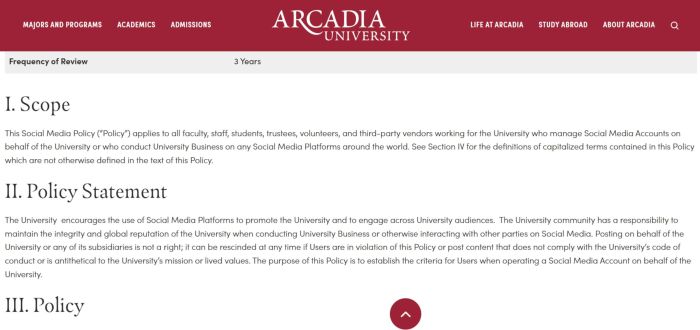
Example: Arcadia University’s social media policy explicitly applies to “all faculty, staff, students, trustees, volunteers, and third-party vendors” who manage accounts on behalf of the university. In other words, anyone handling an official or work-related social media presence is within the policy’s scope, not just employees. This breadth ensures a consistent standard across all channels and individuals associated with the school’s online presence.
Step 2: Risk and Needs Assessment (Ground It in Reality)
Before drafting rules, you need a clear picture of how social media is currently used across your institution. Start with an audit: which accounts exist, who manages them, what devices they use, and what level of access is granted? This mapping exercise not only shows how sprawling your social presence may be but also reveals immediate risks.
Categorize those risks clearly:
Privacy: posting student names, images, or personal data without consent.
Reputational: off-brand messaging, unmoderated comments, or negative publicity.
Operational: lost passwords, shadow accounts, or inactive pages damaging credibility.
Compliance: failures in records retention, accessibility (AODA/WCAG), or anti-spam legislation.
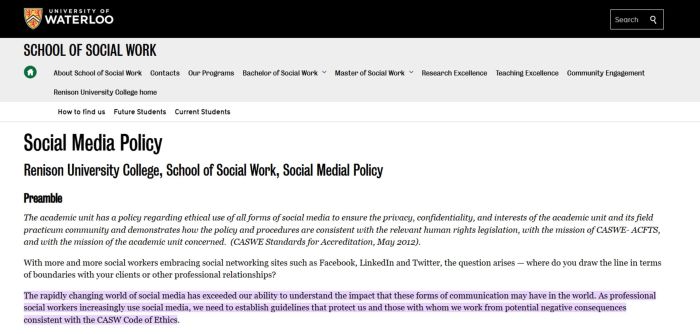
Example: University of Waterloo (Renison University College) – The School of Social Work’s social media policy begins with a frank acknowledgment of the rapidly changing social media landscape and the challenges it poses (e.g. blurred boundaries between students and professionals). It emphasizes the need for guidelines to protect everyone involved from “potential negative consequences,” directly addressing the risks and needs that prompted the policy. This reality-grounded preamble shows the policy was built in response to actual issues observed in practice.
Go further by interviewing principals, faculty, coaches, and IT/security staff. These conversations often uncover grey areas, like student leaders running unofficial team accounts or staff using messaging apps for school business.
For inspiration, review policies like the Toronto District School Board’s Procedure PR735, which provides clear guidance on professional use and compliance (TDSB PR735 PDF).
Finally, create a simple risk register (spreadsheet) listing each risk, its likelihood, potential impact, current controls, and planned mitigations. Revisit this quarterly to keep your policy grounded in reality, not theory.
Step 3: Core Legal and Policy Foundations (Canada-Specific)
Schools and their social media policy must be anchored in the laws and standards that govern privacy, access to information, and accessibility. In Canada, the framework varies depending on the type of institution.
For universities, colleges, and many independent schools in the private sector, PIPEDA applies. Its consent principles require that personal information be collected and shared only with meaningful consent that is specific, informed, and easy to withdraw (Office of the Privacy Commissioner of Canada).
Public institutions must look to provincial laws. In Ontario, MFIPPA governs how student information is collected, used, and disclosed (IPC Guide for Schools). In British Columbia, FOIPPA applies to boards, colleges, and universities, supported by practical guidance like the province’s social media tip sheet (BC FOIPPA Social Media Guide). In Alberta, FOIP covers public school authorities, with resources from the OIPC and universities.
What is an example of a social media policy? In higher education,Mohawk College’s Social Media Policy ties online activity directly to Canadian privacy laws, accessibility requirements, and internal codes of conduct, while also setting expectations for official accounts. For K–12,Greater Victoria School District Policy 1305 offers a concise framework rooted in district values and professionalism.
Accessibility is equally critical. In Ontario, the AODA requires that all digital communications be accessible, aligned with WCAG 2.0 levels A/AA.standards (Ontario Accessibility Guidance). Federally, the Treasury Board recommends WCAG 2.1 AA and EN 301 549 adoption (Government of Canada Digital Accessibility Toolkit).
Anchoring your policy in these laws ensures your institution not only reduces risk but also demonstrates accountability and inclusivity from the outset.
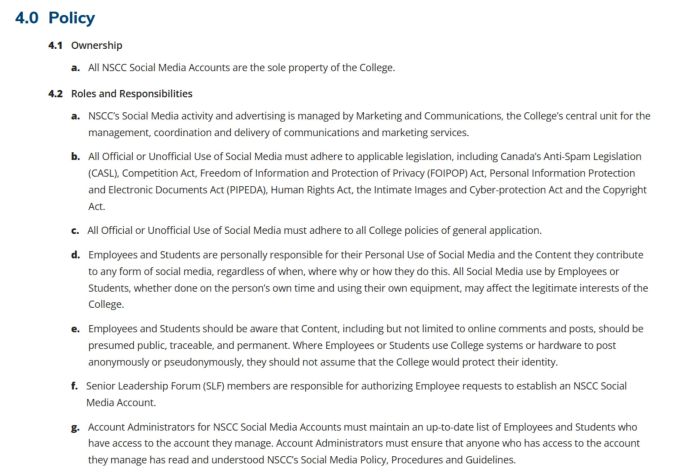
Example: Nova Scotia Community College (NSCC): NSCC’s Social Media Policy explicitly lists the Canadian laws and regulations that underpin acceptable social media use. It requires adherence to legislation such as Canada’s Anti-Spam Law (CASL), privacy laws like FOIPOP (provincial Freedom of Information and Protection of Privacy) and PIPEDA, the Human Rights Act, the Intimate Images and Cyber-protection Act, the Copyright Act, etc., as well as relevant college policies. By doing so, NSCC ensures its policy is grounded in national and provincial legal frameworks, providing a clear legal context for users.
Strong governance is the backbone of any school’s social media policy. Start by maintaining a central registry of all official accounts, whether institutional, departmental, or program-specific. For each, assign three roles: an accountable owner, a backup owner, and a communications/marketing lead. This ensures continuity when staff change roles. Require two-factor authentication across platforms, prohibit credential sharing, and centralize credential storage where possible.
Visual consistency matters, too. Borrow from UBC Brand’s social media guidelines on avatars, logos, and naming conventions to maintain a unified institutional identity (UBC Brand Guidelines).
Before any new account launches, establish an approval workflow. Require an application form documenting the account’s purpose, audience, staffing plan, and moderation strategy. This prevents “shadow accounts” and ensures new initiatives align with institutional priorities.
Finally, don’t overlook records management. Communications conducted through official accounts may constitute institutional records under provincial law. Align your policy with your school’s records retention framework, clarifying who is responsible for archiving social content.
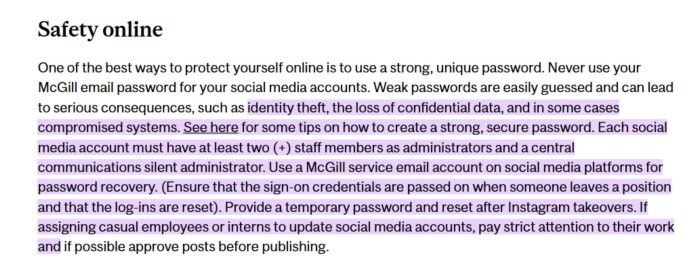
Example: McGill’s guidelines require each institutional account to have at least two staff administrators plus a “central communications” administrator, and that accounts be tied to a departmental email (not an individual’s email) for password recovery. These practices ensure accounts are not “personal fiefdoms,” they belong to the institution, and records (including login info and content archives) are managed responsibly.
For inspiration, look at NYC Public Schools’ staff social media guidance, which requires registration of official accounts and outlines monitoring expectations (NYCPS Guidelines). While U.S.-based, the governance structures translate well to Canadian contexts.
Step 5: Privacy, Consent, and Student–Staff Boundaries
Protecting personal information is one of the most important functions of a school’s social media policy. Define clearly what counts as personal data: names, images, video, voice recordings, and any identifiable details. As the Office of the Privacy Commissioner of Canada advises, consent should always be obtained before posting content involving others online (OPC Guidance).
In Ontario, boards must ensure alignment with MFIPPA. For example, Abbotsford School District’s AP 324 media consent policy demonstrates best practices, including clear parental consent forms and proper recordkeeping (Abbotsford AP 324 PDF). Such models can guide how to design workflows that balance opportunity with privacy protection.
Equally critical are staff–student boundaries. Your policy should mandate the use of approved channels only, no personal phone numbers, no personal accounts, and no “friend” connections with students online. Communication must remain professional and transparent. NYC Public Schools provide a helpful benchmark, with explicit staff guidance and even age-specific student social media guidelines (NYCPS Staff Guidelines).
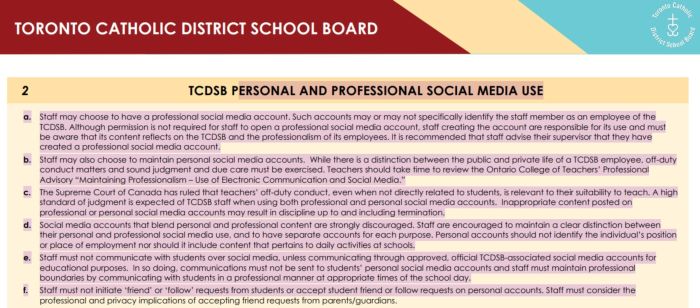
Example: Toronto Catholic District School Board (TCDSB): TCDSB’s social media guidelines draw very clear lines to protect privacy and maintain professional boundaries. Staff are forbidden from “friending” or privately messaging students on personal social media – all communication with students must occur through official, school-sanctioned accounts and only for educational purposes. The policy also enforces strict consent rules: no student’s name, photo, or any identifying information may be posted on social media without written parental consent, and the use of student images on official accounts must follow the board’s annual consent process in compliance with Ontario privacy law (MFIPPA).
✅ Do use only approved institutional channels for all communication.
✅ Do secure and store consent forms before posting student content.
✅ Do respect privacy by default. When in doubt, leave it out.
❌ Don’t use personal accounts, texts, or private messaging apps with students.
❌ Don’t post identifiable student content without explicit, recorded consent.
❌ Don’t blur professional boundaries (e.g., friending or following students on personal profiles).
Are teachers allowed to post their students on social media? Yes, but only with appropriate consent and in full compliance with privacy legislation. In the private sector, PIPEDA requiresmeaningful consent. Ontario’s public boards must follow MFIPPA, with guidance from theIPC’s education resources. By embedding privacy safeguards and clear boundary rules, schools protect students, staff, and their reputation while still enabling authentic digital engagement.
Step 6: Content Rules, Moderation, Accessibility, and Contests
A strong social media policy must tell people what to post, how to post it, and how to manage responses. Start with standards for tone, accuracy, and brand alignment. Require respectful, inclusive language and clear disclosures (e.g., partnerships, sponsorships).
Next, define moderation. Borrow from BC’s corporate moderation policy (BC Gov Guidelines): state what comments are removed (hate speech, spam, off-topic promotions), how warnings are issued, and when accounts are blocked. Make moderation workflows transparent to staff and users.
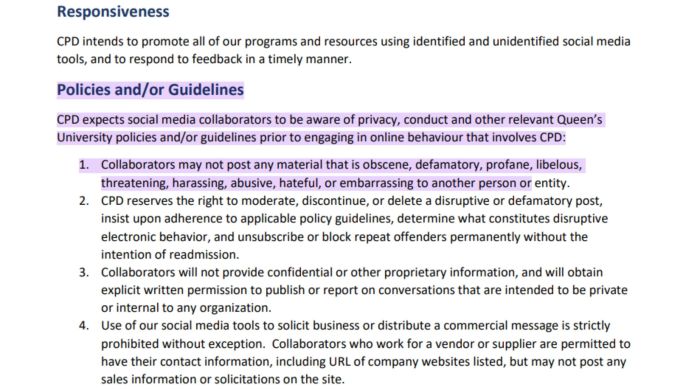
Example: Queen’s University underscores the importance of moderation rights: they reserve the right to delete disruptive or defamatory posts, and to remove or block users who repeatedly violate guidelines. Like other schools, they want to allow dialogue but will intervene if someone is, for instance, spamming the page or attacking others. The guidelines mention that collaborators (i.e., those who contribute to Queen’s social media) must “obtain explicit permission to publish or report on conversations intended to be private or internal”. In other words, don’t take a private email or a closed meeting discussion and post it publicly without consent – doing so could breach confidentiality. Similarly, no confidential or proprietary info about the university or its partners should be shared on social media.
Accessibility is non-negotiable. Every post should follow WCAG 2.0 levels A/AA and AODA requirements: alt text for images, captions for videos, no text-only graphics, and accessible hashtags (#CapitalizeEachWord). See Ontario’saccessibility guide and Canada’sDigital Accessibility Toolkit.
Contests or giveaways add another layer. Do social media contests require special rules? Yes. Schools must comply with Canada’s Anti-Spam Legislation (CASL) when running promotions involving commercial electronic messages or online entries. TheCRTC’s CASL guide andFAQs explain consent and identification requirements. For drafting contest rules, see legal overviews byBLG (2025) andGowling WLG (2023).
Checklist for Staff:
✅ Post accurate, respectful, branded content
✅ Add alt text, captions, and accessible formatting
✅ Moderate comments against clear rules
✅ Secure consent before promotions/contests
❌ Don’t post text-in-images without alternatives
❌ Don’t run contests without legal review
Step 7: Training, Launch, Metrics, and Continuous Improvement
Even the strongest policy fails without training. Translate your guidelines into practice by building role-specific training modules for account owners, moderators, coaches, and student ambassadors. Incorporate Canadian digital literacy resources like MediaSmarts’ Digital Literacy Framework (overview;full PDF) to reinforce safe, ethical, and effective online engagement. Support staff with PD sessions, publish an internal FAQ, and run scenario-based exercises, such as managing a doxxing attempt or handling a viral misinformation post.
When launching, stagger the rollout: pilot in one department, gather feedback, and expand with adjustments. Communicate the policy widely so every stakeholder understands their role. Schedule quarterly refreshers to ensure compliance as platforms, tools, and threats evolve.
Example: University of British Columbia (UBC): UBC provides a detailed Social Media Playbook and Project Planning Tips to guide training and content planning for account managers. They recommend auditing capacity before launch, building content calendars, and using analytics for continuous improvement. UBC also sets platform-specific tips (e.g., mobile-first design, proper hashtag use) to elevate training beyond policy to practice.
Success requires measurement. Track metrics that matter: audience reach, engagement quality, average response time, accessibility compliance (captioning/alt-text rates), harmful content removal time, and incident frequency. Pair this with annual policy reviews against your risk register and evolving legal obligations. Document revisions and circulate them across the institution so no one is left behind.
Checklist for Staff:
Complete mandatory training before account access
Use MediaSmarts or similar frameworks for student modules
Run tabletop exercises annually
Measure engagement, accessibility, and incident response
Review/update policy yearly
How to Use This Checklist
Policies can sometimes feel abstract, but implementation lives in the details. To make your school or institution’s social media policy actionable, translate the principles into operational steps your teams can follow every day.
The following checklist is designed as a drop-in appendix: administrators can copy it directly into their policy, while communications teams and account owners can use it as a quick reference. It consolidates the essentials, governance, privacy, accessibility, moderation, and security into a single, practical tool. Review it regularly, update it as laws and platforms evolve, and use it as both a compliance safeguard and a training guide.
Operational Checklist (Copy-Paste into Your Policy)
Action
Reference / Example
Maintain a central registry of all official accounts, owners, and backups; enforce two-factor authentication on every account.
Creating a modern, compliant, and effective school social media policy isn’t just about managing risk. It’s also about empowering your institution to communicate with confidence. The right framework balances opportunity and responsibility, ensuring your teams can build authentic connections with students and families while safeguarding privacy, accessibility, and professionalism.
At Higher Education Marketing (HEM), we help schools, colleges, and universities do exactly that. From developing policies rooted in Canadian legal standards to training staff and student ambassadors on best practices, our team specializes in building digital strategies that drive engagement and enrollment. Whether you need support crafting your first policy, auditing existing processes, or integrating governance into a broader digital marketing strategy, HEM provides the expertise to make it happen.
In a digital-first world, trust and clarity are everything. By partnering with HEM, your institution can move forward with a social media policy that not only protects your community but also amplifies your brand in the right way.
Struggling with enrollment?
Our expert digital marketing services can help you attract and enroll more students!
Frequently Asked Questions
Question: What is an example of a social media policy? Answer: In higher education,Mohawk College’s Social Media Policy ties online activity directly to Canadian privacy laws, accessibility requirements, and internal codes of conduct, while also setting expectations for official accounts. For K–12,Greater Victoria School District Policy 1305 offers a concise framework rooted in district values and professionalism.
Question: Are teachers allowed to post their students on social media? Answer: Yes, but only with appropriate consent and in full compliance with privacy legislation. In the private sector, PIPEDA requiresmeaningful consent. Ontario’s public boards must follow MFIPPA, with guidance from theIPC’s education resources.
Question: Do social media contests require special rules? Answer: Yes. Schools must comply with Canada’s Anti-Spam Legislation (CASL) when running promotions involving commercial electronic messages or online entries. TheCRTC’s CASL guide andFAQs explain consent and identification requirements. For drafting contest rules, see legal overviews byBLG (2025) andGowling WLG (2023).