In January, the Department of Education released a shocking number: it now costs nearly $9 to produce a school lunch in Hawaiʻi. Lawmakers and advocates — after they recovered from the sticker shock — responded with a reasonable question: Why are school meals so expensive?
Eight months later, the public still doesn’t have an answer. Despite pressure from lawmakers, the department has yet to publish detailed information about why it costs so much to feed students.
The department doesn’t share — and may not even collect — campus-level data on how much individual schools are spending on meals. It has provided no breakdown of how much the state spends on items like milk or fresh produce that go into lunches.
But lawmakers say schools need to explain what’s driving up the costs, especially since the DOE is struggling to make ends meet with its lunch program and has requested an additional $40 million from the Legislature over the past two years on top of the state and federal funds it already receives for its meal program.
Hawaiʻi law requires the education department to charge families half the cost of producing school meals, although current lunch prices fall far below that threshold. In January, the DOE proposed gradually raising meal prices over the next four years, but state lawmakers stepped in with funds to avoid increasing costs for families.
Under the DOE’s proposal, lunch for elementary and middle school students would cost $4.75 by 2028. High schoolers would pay $5 for meals.
Breaking Down The Numbers
The DOE serves more than 18 million meals every year to students across 258 campuses. This spring, lawmakers set aside roughly $50 million to fund the school meal program over the next two years.
The department publishes quarterly financial reports for its food services branch, but the online reports only track the total amount of money coming in and out of the meals program. Through the third quarterof the 2024-25 school year, the program brought in $108 million in student payments and state and federal funds, but spent roughly $123 million on meals, salaries and other expenses.
In response to a Civil Beat public records request for school and state-level spending on lunches this spring, a representative from the superintendent’s office shared a one-page financial report breaking down the meal program’s spending and revenue in more detail. Roughly 40% of the 2023-24 budget went toward the salaries and benefits of workers, and the department spent roughly $81 million on food.
But there was little information explaining what goes into a $9 school meal — for example, how much the department spent on specific ingredients or juice, or what cafeteria supplies cost the department more than $5.6 million in 2024. The department provides more detailed estimates of its purchase of local ingredients in its annual report to the Legislature, but this spending makes up only 5% of the school meal budget.
In response to Civil Beat’s request, the DOE also said it didn’t have records of schools’ annual financial reports for campus meal programs. The department did not respond to requests for interviews about the availability of school meal data and the rising costs of lunches.
Jesse Cooke, vice president of investments and analytics at Ulupono Initiative, said he’s concerned about a lack of consistent tracking and reporting from schools. He said he hasn’t seen any data breaking down the costs of meal programs at individual schools on a regular basis, which makes it harder for the department and lawmakers to identify what’s driving up the costs of meals and understand how programs can operate more efficiently.
“When you’re trying to make decisions, trying to make something more efficient, you need pretty quick numbers,” Cooke said. “They’re not looking at specific schools and their numbers.”
The education department has also come under fire from the federal government for its lack of data collection. When Hawaiʻi sought an increase in federal funds for school meals in 2015, officials denied the request because the department wasn’t able to provide enough details on the costs of its lunches, said Daniela Spoto, director of food equity at Hawaiʻi Appleseed Center for Law and Economic Justice.
“Historically, the only thing they could provide is what they provided here,” Spoto said. “Here’s our cost, and here’s the total number of meals we provide.”
Lawmakers passed two resolutions this spring asking the department to produce a detailed breakdown of its meal programs, including the cost of ingredients, beverages and supplies. The DOE currently has no process of reporting and publishing such costs, the resolutions stated.
“It is essential to ensure that proper reporting processes are in place to provide transparency as to the costs of producing school meals,” one resolution said.
DOE leaders argued they publish enough information to justify rising lunch costs, but they’ve given lawmakers mixed messages on the data that’s readily available.
In one hearing, Interim School Food Services Branch Administrator Sue Kirchstein said the DOE already collects and publishes data on the costs of ingredients and other factors going into school meals. But another official said the DOE doesn’t collect data with the level of detail lawmakers were requesting, and the department’s communications team was unable to provide the report Kirchstein mentioned during the hearing.
Besides looking at rising inflation rates, the department hadn’t completed a detailed analysis of what’s increasing the costs of meals, former Deputy Superintendent Dean Uchida said in another hearing this spring, drawing strong criticism from lawmakers.
“You should be looking at it, and maybe there’s a different way that you can do things,” Sen. Troy Hashimoto said during the hearing. “But you won’t know that unless you do the analysis.”
The department has not said if it’s working on a cost analysis for the Legislature. Any report DOE submits to lawmakers won’t be published until late 2025 or early 2026 in the lead-up to the new legislative session.
We’re looking forward to covering US higher education this fall, whether it’s college closings. strikes, protests on and off campus, or stealing the rival school’s mascot. We encourage folks to have good clean fun. And by all means do it all peacefully.
P.S. Download this image and post it in dorms and around campuses!
Exam scores always seem to go up. Whether it’s the SAT when applying for college or an AP score to earn college credit, competitive scores seem to be creeping up. While faculty are invaluable, students who recently completed classes or exams offer insight that bridges the gap between the curriculum and the exam. I believe students who recently excelled in a course should be allowed and encouraged to serve as teaching assistants in high school.
Often, poor preparation contributes to students’ disappointing exam performance. This could be from not understanding content, being unfamiliar with the layout, or preparing the wrong material. Many times, in courses at all levels, educators emphasize information that will not show up on a standardized test or, in some cases, in their own material. This is a massive issue in many schools, as every professor has their own pet project they like to prioritize. For example, a microbiology professor in a medical school may have an entire lecture on a rare microbe because they research it, but nothing about it will be tested on the national board exams, or even their course final exams. This was a common theme in high school, with history teachers loving to share niche facts, or in college, when physics professors loved to ask trick questions. By including these things in your teaching, is it really benefiting the pupil? Are students even being tested correctly over the material if, say, 10 percent of your exam questions are on information that is superfluous?
Universities can get around this issue by employing teaching assistants (TAs) to help with some of the confusion. Largely, their responsibilities are grading papers, presenting the occasional lecture, and holding office hours. The lesser-known benefit of having and speaking with TAs is the ability to tell you how to prioritize your studying. These are often older students who have been previously successful in the course, and as a result, they can give a student a much better idea of what will be included on an exam than the professor.
When I was a TA as an undergrad, we were required to hold exam prep sessions the week of a big test. During these sessions, students answered practice questions about concepts similar to what would show up on the exam. All the students who showed up to my sessions performed extremely well on the tests, and they performed well because they were prepared for the exam and knew the concepts being tested. As a result, they would finish the course with a much higher grade because they knew what they should be studying. It is much more effective to give a student a practice question that uses similar concepts to what will be on their exam than it is for a professor to give a list of topics that are covered on a test. For example, studying for a math test is more impactful when answering 50 practice questions versus a teacher handing you a list of general concepts to study, such as: “Be able to manipulate inequalities and understand the order of operations.”
Universities seem to know that professors might not provide the best advice, or at the least, they have used TAs as a decent solution to the problem. It is my opinion that having this style of assistance in high school would be beneficial to student outcomes. Having, say, a senior help in a junior-level class may work wonders. Teachers would have a decrease in their responsibilities based on what they trust their TA to do. They could help grade, run review sessions, and make and provide exam prep materials. In essence, all the unseen work in teaching that great teachers do could be done more efficiently with a TA. Every student has had an amazing teacher who provides an excellent study guide that is almost identical to the test, making them confident going into test day. In my experience, those guides are not completed for a grade or a course outcome, and effectively become extra work for the educator, all to help the students who are willing to use them effectively. Having a TA would ease that burden–it would encourage students to consider teaching as a profession in a time when there is a shortage of educators.
There are many ways to teach and learn, but by far the best way to be prepared for a test is by talking to someone who has recently taken it. Universities understand that courses are easier for students when they can talk to someone who has taken it. It is my opinion that high schools would be able to adopt this practice and reduce teacher workload while increasing the student outcomes.
Samuel M. Baule, U.S. Army & Marian University
Sam Baule is a third-year medical student at Marian University and a lieutenant in the U.S. Army. He graduated in May 2023 with a bachelor’s degree in biomedical engineering from the University of Iowa.
Latest posts by eSchool Media Contributors (see all)
In Alpine School District, we serve a wide range of students, from Title I to highly affluent communities. While our population has traditionally been predominantly white and middle income, that’s changing. In response to this growing diversity and shifting needs, one of my missions as professional learning and curriculum director for secondary schools has been to provide needs-based professional learning, just in time for educators, and to give them a real voice in what that looks and feels like.
I lead a team of full-time educator equivalents across every discipline: math, science, social studies, ELA, the arts, health, and PE. Together, we guide professional learning and instructional support. Over the past several years, we’ve had to take a hard look at how we teach, how we engage students, and how we prepare educators for long-term success.
Where we started: Tier 1 challenges and high turnover
When I first became curriculum director, I noticed in our data that our schools were not making much progress, and in some cases had stagnated in growth scores. We were leaning heavily on Tier 2 interventions, which told us that we needed to shore up our Tier 1 instruction.
At the same time, we were hiring between 400 and 500 teachers each year. We’re located near several universities, so we see a continuous flow of new educators come and go. They get married, they relocate, or a spouse gets into medical school, which translates to a constant onboarding cycle for our district. To meet these challenges, we needed professional learning that was sound, sustainable, and meaningful, especially early in a teacher’s career, so they could lay a strong foundation for everything that would come after.
Teacher clarity and engagement by design
Several years ago, we joined the Utah State Cohort, doing a deep dive into the Teacher Clarity Playbook. That experience was a real turning point. We were the only team there from a district office, and we took a train-the-trainer approach, investing in our strongest educators so they could return and lead professional learning in their content areas. Since then, we’ve used Engagement by Design as the framework behind much of our PD, our classroom walkthroughs, and our peer observations. It helped us think differently: How do we support teachers in crafting learning intentions and success criteria that are actually meaningful? How do we align resources to support that clarity? We’ve embedded that mindset into everything.
Coming out of the pandemic, Alpine, like many districts around the country, saw decreased student engagement. To focus deeply on that challenge, we launched the Student Engagement Academy, or SEA. I co-designed the Academy alongside two of our content specialists, Anna Davis and Korryn Coates. They’re both part-time teacher leaders at the district office and part-time visual arts teachers in schools, so they live in both worlds. That was important because we believe professional learning should always be contextualized. We don’t want teachers burning extra bandwidth trying to translate strategies across subject areas.
SEA is a yearlong, job-embedded learning experience. Teachers participate in PLCs, conduct peer observations, and complete a personalized learning project that showcases their growth. Our PLC+ coaches work directly with our lead coach, Melissa Gibbons, to gather and analyze data that shapes each new round of learning. We also included classroom observations, not for evaluation, but to help teachers see each other’s practice in action. Before observations, Anna and Korryn meet with teachers in small groups to talk through what to look for. Afterward, they debrief with the teachers: What did we see? What evidence did we see of student engagement? What did we learn? What are we still wondering? As we answer these questions about teaching, we’re also asking students about their experience of learning.
Learning from student surveys
Hearing from our students has been one of the most powerful parts of this journey. With the support of our Director of Student and Educator Well-eing, we created a student survey. We asked a random group of students questions such as:
What are you learning?
How are you learning it?
How do you know how you’re doing?
Why does it matter?
The responses were eye-opening. Many students didn’t know why they were learning something. That told us our teachers weren’t being as clear or as intentional as they thought they were. One specific question we asked was based on the fact that attendance in world language classes stayed high during the pandemic, while it dropped in other subjects. We asked students why. The answer? Relationships, expectations, and clarity. They said their world language teachers were clear, and they knew what was expected of them. That led other disciplines to reflect and recalibrate.
Today, teachers across subjects like ELA, math, and social studies have participated in a SEA cohort or aligned learning. We’re seeing them plan more intentionally, better target skills, and align instruction with assessment in thoughtful ways. They’re starting to see how mirroring instruction with how learning is measured can shift outcomes. It’s been truly exciting to witness that change. Engaging students through improved teacher clarity, positive classroom relationships (with each other, the teacher, and the content), and providing the students with appropriate levels of rigor has been a game changer.
Building teacher leadership teams
Next year, we’re focusing on developing teacher leadership skills, knowledge, and dispositions across the full geographic area of our district. We’re building professional capacity through leadership teams using the PLC+ model, with an emphasis on facilitation skills, research-based practice, and advocacy for strong instruction in every discipline.
If you’re a district leader looking to boost student engagement through professional development, my advice is simple: You can’t do it alone. You need a team that shares your values and your commitment to the work. You also have to be guided by research–there’s too much at stake to invest in strategies that don’t hold water. Finally, this is a marathon, not a sprint. Aim for small, incremental changes. There’s no silver bullet, but if you stay the course, you’ll see real transformation.
Dr. Mari Braithwaite, Alpine School District
Dr. Mari Braithwaite is the professional learning & curriculum director at Alpine School District in American Fork, Utah. She can be reached at [email protected].
Latest posts by eSchool Media Contributors (see all)
As K-12 leaders look for ways to strengthen trust, engagement, and belonging, a growing number of districts are turning to a key partner in the work: their students.
A new national report from the National School Public Relations Association (NSPRA) and SchoolStatus reveals that districts that incorporate student voice into their communication strategies–through videos, messaging, and peer-created content–are seeing real results: stronger family engagement, increased student confidence, and more authentic school-community connection.
The report, Elevating Student Voice in School Communications: A Data-Informed Look at Emerging Practices in School PR, is based on a spring 2025 survey, which received 185 responses from K-12 communications professionals. It includes real-world examples from school districts to explore how student perspectives are being incorporated into communication strategies. It highlights the growing use of first-person student storytelling, direct-to-student messaging, and student internships as strategies to build trust, improve engagement, and strengthen school-community relationships.
“School communicators do more than share information. They help build connection, trust, and belonging in our communities,” said Barbara M. Hunter, APR, Executive Director of NSPRA. “Elevating student voice is not just a feel-good initiative. It is a powerful strategy to engage families, strengthen relationships, and improve student outcomes.”
Key findings include:
Video storytelling leads the way: 81 percent of districts using student voice strategies rely on video as their primary format.
Direct communication with students is growing, but there is room for improvement in this area: 65 percent of districts report at least some direct communication with students about matters that are also shared with families, such as academic updates, behavioral expectations or attendance
However, just 39 percent of districts copy students on email messages to families, and just 37 percent include students in family-teacher conferences, allowing them to be active participants
Internships on the rise: 30 percent of districts now involve students as interns or communication ambassadors, helping create content and amplify student perspectives
Equity efforts around student storytelling vary significantly. While some districts say they intentionally recruit students with diverse perspectives, fewer encourage multilingual storytelling or provide structured support to help students share their stories
Early results are promising: Districts report improved engagement, stronger student confidence, and more authentic communication when students are involved.
61 percent of districts that track comparisons report student-led content generates higher engagement than staff-created communications
80 percent of respondents observe that student voice positively impacts family engagement
A majority (55 percent) said direct communication with students improves academic outcomes
Building Inclusive Student Voice Strategies The report outlines a three-part approach for districts to strengthen student voice efforts:
Start with student presence by incorporating quotes, videos, and creative work into everyday communications to build trust and visibility
Develop shared ownership through internships, ambassador programs, and student participation in content creation and feedback
Build sustainable systems by aligning student voice efforts with district communications plans and regularly tracking engagement
The report also highlights inclusive practices, such as prioritizing student consent, offering mentorship and support for underrepresented students, featuring diverse stories, involving student panels in review processes and expanding multilingual and accessible communications.
“When districts invite students to take an active role in communication, it helps create stronger connections across the entire school community,” said Dr. Kara Stern, Director of Education for SchoolStatus. “This research shows the value of giving students meaningful opportunities to share their experiences in ways that build trust and engagement.”
The report also explores common challenges, including limited staff time and capacity, privacy considerations and hesitancy around addressing sensitive topics. To address these barriers and others, it offers practical strategies and scalable examples to help districts start or expand student voice initiatives, regardless of size or resources.
eSchool Media staff cover education technology in all its aspects–from legislation and litigation, to best practices, to lessons learned and new products. First published in March of 1998 as a monthly print and digital newspaper, eSchool Media provides the news and information necessary to help K-20 decision-makers successfully use technology and innovation to transform schools and colleges and achieve their educational goals.
Austin Independent School District in Texas is weighing school consolidations that could go into effect as soon as the 2026-27 school year, amid challenges with prolonged declining enrollment, Superintendent Matias Segura told families in a letter this week.
The district also released a data rubric scoring each of its schools based on size, condition, student enrollment and operational costs. The scores will help inform any changes that might be necessary, including boundary adjustments, transfer policies, or school closures and consolidations, according to the district.
Austin ISD lost over 10,000 students within the past decade — resulting in about 21,000 empty seats districtwide. And it’s likely that enrollment will continue to decrease, the district said.
Dive Insight:
“Right now, we’re serving fewer students than we did nearly 30 years ago, but we’re operating more schools than ever. That spreads us too thin and limits what we can offer each campus,” Segura said in the Aug. 11 letter to families.
“Consolidation is one piece of a bigger plan to reinvest in what matters most — strong academic programs, outstanding teachers, modern facilities and the wraparound supports that help every student succeed,” the superintendent said.
District officials said they would make a draft plan available to the community before presenting proposed changes to the board of trustees on Oct. 9. The board is then to vote on a final consolidation plan on Nov. 20.
The rubric released Monday measures how aligned a school building is in serving students’ needs. It is not, however, a list of schools that are closing, Segura told families.
The district said on its consolidation planning website that it will aim to minimize impact on students and families, balance enrollment among the remaining schools, create clear feeder patterns as students move from elementary to middle to high school, and focus on long-term stability for the district.
During the 2024-25 school year, Austin ISD enrolled 72,700 students across 113 schools, according to district data.
Austin ISD’s planning reflects a broader national trend as many districts reckon with declining enrollment, straining already uncertain school budgets.
The Austin announcement follows similar news from other large urban districts.
Last week, Atlanta Public Schools said it was in the early stages of looking at school consolidation and merger plans in the face of significant enrollment drops. Additionally, St. Louis Public Schools in July proposed shuttering over half, or 37 of its 68 schools, within the next two school years due to declining enrollment and buildings running under capacity.
Researchers foresee districts having to close and consolidate more schools in the coming months and years, with student enrollment unlikely to rebound. A recent analysis from Bellwether, an education nonprofit, estimates declining enrollment may have cost the nation’s 100 largest districts $5.2 billion in total lost revenue based on 2023-24 enrollment.
Public school enrollment changes nationally seemed to have persisted after the COVID-19 pandemic when parents increasingly explored alternatives to the traditional public school model and pivoted to private schools and homeschooling, according to a July study by Education Next.
Moving forward, public schools will need to continue navigating not only those shifts, but also declining birth rates and expanding school choice policies at both the state and federal levels.
After graduating from Knox College in Illinois with a bachelor’s degree, Stephanie Martinez-Calderon’s plans were upended by the pandemic. She hadn’t planned on becoming a teacher but found an opportunity to tutor remotely for the year after college.
Tutoring helped her build confidence and develop instructional skills, and today she’s a middle school teacher in the Washoe County School District in Nevada.
Tutoring can be a powerful training ground for future educators, providing hands-on experience, confidence and a bridge into the classroom. And what might begin as a temporary opportunity can become a career path at a time when teachers are needed more than ever: A recent report noted that nearlyone in five K-12 teachers plan to leave teaching or are unsure if they’ll stay.
Turnover remains a crisis in many districts, one that can be solved by a ready-made pipeline of young future educators with instructional experience and relationship-building skills they’ve gained from tutoring.
How school districts think about tutoring should evolve. Rather than seeing it as a short-term response to pandemic-interrupted learning, they should view it as part of the fabric of school design and future educator development. This requires including tutoring in strategic plans, forming community partnerships and creating a structure to sustain programs that cultivate tutors for careers in education. To fund these programs and pay tutors, districts can redirect Title I funds, use federal work-study and create apprenticeship programs.
Starting as a tutor allows aspiring educators to build core teaching skills in a supportive, lower-stakes environment. Tutors learn to navigate student relationships and adapt lessons to individual needs. Without having to manage an entire classroom, they can practice asking questions that get students thinking and selecting problems to help students learn. This early practice eases the transition into teaching.
Tutors from Generation Z, born between 1996 and 2012, often bring fresh energy to the profession. As digital natives, they are reimagining how to engage and inspire students, leverage technology and foster creativity and new approaches to learning.
They are alsothe most ethnically and racially diverse generation yet: Many come from backgrounds historically underrepresented in the teaching force; over half of undergraduates identify as first-generation college students. Their engagement broadens the prospects for a more diverse teacher pipeline.
Gen Z’s emphasis on flexibility and remote opportunities is one of the most significant workforce changes since the pandemic. They value mental health, stability and mission-driven work. Part-time, hybrid and wellness benefits help recruit young talent.
At our nonprofit, recruiters hear from education candidates that Gen Z appreciates the chance to try out industries, and that tutoring provides them with a window into the world of teaching.
Public schools could better meet the evolving needs of young professionals entering education by reimagining tutor roles to include hybrid options, mental health supports and collaborative teaching pathways for professional growth. For instance, a tutor might start off working in a part-time online tutoring role, but after interacting with students virtually and gaining more experience, they may be more excited to take on a full-time teaching role on-site.
For school districts, tutoring programs can serve as effective recruitment pipelines. By offering recent graduates a low-barrier entry point into education — one that doesn’t require immediate certification — districts can spark interest in teaching among candidates who may not have previously considered it.
When tutors step into teaching roles, they bring valuable continuity — familiarity with the students and insight into progress and school culture. This seamless transition supports both student learning and district staffing needs.
The idea that tutoring should be built into future educator pipelines is spreading. For example, since the launch of its Ignite Fellowship in 2020, Teach for America says that 550 of its former tutors have become full-time teachers. The program has proven to be especially effective at drawing in nontraditional candidates — those who may not have initially envisioned themselves in the classroom. In Washington, D.C., the school district launched a tutor-to-teacher apprenticeship program after success with high-impact tutoring. In Texas, teacher residents are required to work as tutors and in other support roles while co-teaching with a mentor.
By offering flexible, purpose-driven opportunities, districts can attract Gen Z professionals and give them a meaningful entry point into teaching. And tutoring programs can become more than academic support — they can serve as strategic talent pipelines that strengthen the future of the teaching workforce.
Alan Safran is co-founder, CEO and chair of the board ofSaga Education; Halley Bowman is senior director of academics.
This story about tutoring was produced byThe Hechinger Report, a nonprofit, independent news organization focused on inequality and innovation in education. Sign up for Hechinger’s weekly newsletter.
The Hechinger Report provides in-depth, fact-based, unbiased reporting on education that is free to all readers. But that doesn’t mean it’s free to produce. Our work keeps educators and the public informed about pressing issues at schools and on campuses throughout the country. We tell the whole story, even when the details are inconvenient. Help us keep doing that.
ELKHART, Ind. — The numbers were discouraging, and in some cases getting worse. Nearly 30 percent of Indiana’s high schoolers were chronically absent in 2022. Only about 52 percent of students in the state enrolled in collegein 2023, a 12-percentage-point drop in seven years. Fewer students were pursuing other paths, too: The share of students enlisting in the military, for example, declined by 41 percent from 2018 to 2022.
When Katie Jenner toured the state after becoming education secretary in 2021, she heard from many students who said they simply didn’t value high school or see how it would help them.“That was really hard to hear,” Jenner said. “We had to look in the mirror and say, ‘OK, this is the reality. Let’s do better.’”
Jenner and her team began redesigning what high school looks like in Indiana, in an effort to make it more relevant to young people’s futures and help them gain a better grasp of career paths. For too long, she and others argued, kids had been pushed to plan for four-year college, yet only about half of seniors actually enrolled, and those who did go often dropped out before graduating.
When a draft of the plan was released in early 2024, it drew fierce protest from many parents and educators who worried the state was prioritizing workforce learning over academics. Jenner and her staff reworked the proposal, eventually crafting a plan that alleviated some, though not all, of the concerns.
The “New Indiana Diploma” — which was signed into law in April and goes into effect for all incoming first-year students this academic year — gives students the option to earn different “seals” in addition to a basic diploma, depending on whether they plan to attend college, go straight to work or serve in the military. Jenner describes it as an effort to tailor the diploma to students’ interests, expose students to careers and recognize different forms of student achievement.
Experts said the template is something of a model nationally, at a time when more states are reconsidering how to help students prepare for careers and the federal government is also pushing alternatives to four-year college. Elements of that effort have earned bipartisan support: Presidents from both parties have advocated for expanding work-based learning, and President Donald Trump recently called for the creation of 1 million new apprenticeships.
“The basic architecture of American high school is being questioned and challenged,” said Timothy Knowles, president of the Carnegie Foundation.* Indiana is at the forefront of an effort to incorporate more experiential learning instead of restricting education to school buildings, he said: “Indiana is really breaking ground.”
The initial proposal Jenner’s agency drafted would have created two high school diplomas, “Graduates Prepared to Succeed” and “Graduates Prepared to Succeed Plus.” Both would have scaled back math and science requirements and loosened recommendations for world languages and other electives. Meanwhile, they would have encouraged all students to participate in work-based learning in apprenticeships, internships or job shadowing, with at least 75 hours in such activities required for the “plus” diploma.
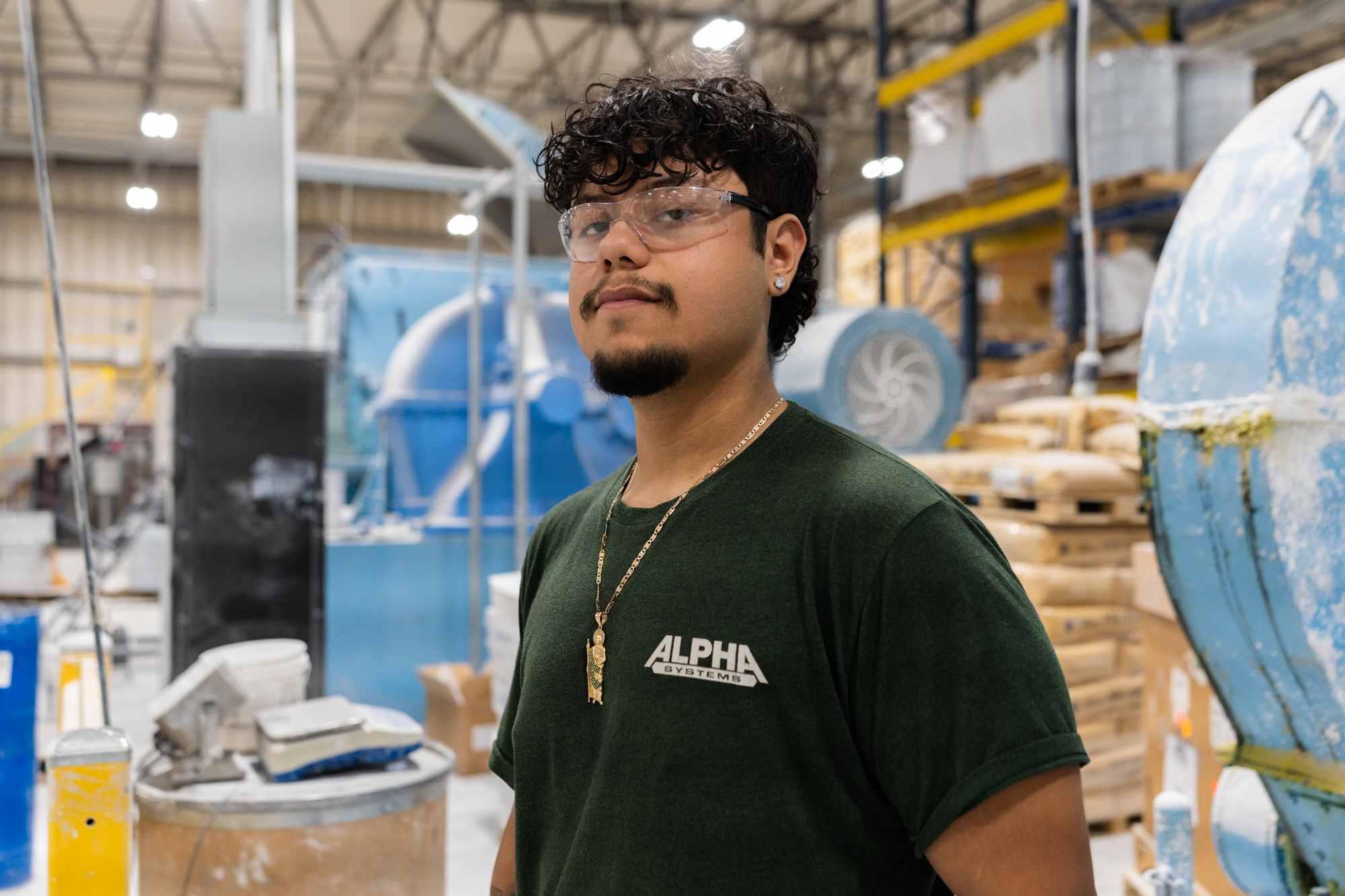
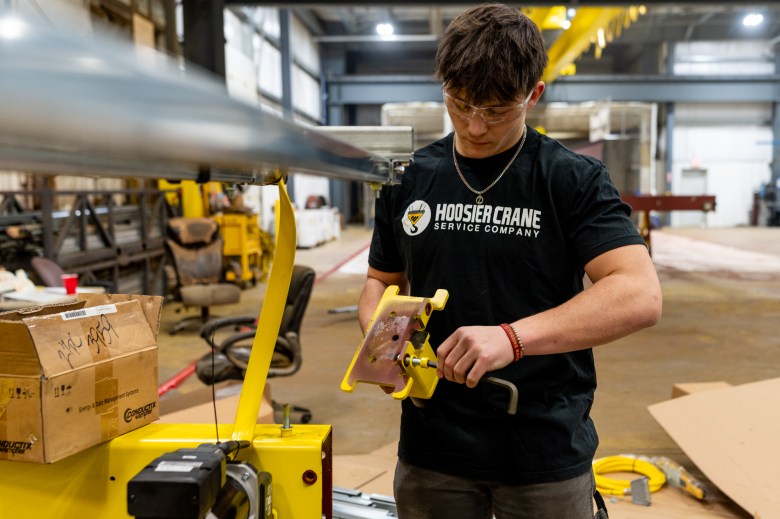
Indiana hopes that work-based learning opportunities at companies like Alpha Systems and Hoosier Crane Service Company, in Elkhart, Indiana, can flourish under the new diploma system. Credit: Camilla Forte/The Hechinger Report
In 2024, the state board of education held dozens of meetings to gather feedback on the proposal for the revamped diplomas — and the backlash was intense. Leaders of higher education institutions, including the state’s flagship schools, Indiana and Purdue universities, said students graduating under the new system would not meet minimum requirements for admission. Purdue’s president, Mung Chiang, wrote a letter to Jenner showing that the proposed diploma system required too few credits in every subject except English.
Hoosier parents were furious that their children might have to sacrifice more challenging courses to fulfill the mandatory work experience requirement under the “plus” option. At an Indiana Department of Education hearing in June 2024, parent Michelae Hill was among dozens who criticized the proposal, calling it “intentionally dumbing down our population” and warning that “what will happen is that we are ensuring a permanent underclass, we are ensuring cheap workers.” There were also questions about the logistics of workplace learning, including transportation and possible safety issues on job sites.
State education policy makers went back to the drawing board. The revised version, adopted last December, establishes one basic diploma that all graduates earn, plus the seals students can pursue depending on their post-high-school plans. Even within each seal, students have several ways of meeting the requirements.
For example, to receive the “enrollment” seal — meant primarily for college-bound students — high schoolers can choose from more advanced classes in math, science, social studies and world languages, and may earn additional credits in Advanced Placement, International Baccalaureate or other such college-level courses. An “enrollment honors plus” seal requires that students concurrently obtain a credential such as an associate’s degree or technical certificate and complete 75 hours of work-based learning in apprenticeships, internships or other such programs.
“We wanted rigor and flexibility and less cookie cutter,” said Jenner.
Even the updated system has critics, though. For the basic diploma, students must earn a minimum of 42 credits, two more than before. But how students reach that threshold is different: Economics, geometry and Algebra II are no longer required, while courses in financial literacy and communication are. Physical education is one credit instead of two, and world languages and fine arts are no longer recommended electives.
Professor Michael Hicks, who runs the Center for Business and Economic Research at Ball State University in Indiana, said he worries about the reduced mathematics rigor in particular. While most states do not require Algebra II for graduation, the class is often seen as a necessity for admission to selective colleges and for certain careers. Hicks said high-achieving, well-resourced students may benefit from the flexibility of the new diploma, as could students committed to the military. But many other students could be harmed, he said, if they are left with the impression that the basic diploma alone will prepare them well for college when it does not.
“It is essentially funneling children away from academic opportunity very early at a time when we really needed to have more kids pushed into the academic options that would get them into college,” he said, arguing that people with college degrees outearn those with only a high school education and have also fueled the state’s and country’s economic growth of the past several decades. “This curriculum will cause the Indiana economy to stall and potentially go into reverse.”
At public meetings last winter, some parents and educators raised concerns that the new system amounted to an unfunded mandate for school districts and would put a huge burden in particular on counselors, who would be working closely with students to help chart their diploma paths. Critics also objected to the de-emphasis of other classes like music and foreign languages. Megan Worcester, the president of the Indiana Foreign Language Teachers Association, said the reduced emphasis on foreign language would hurt the state’s economy; she cited a study in which nearly 1 in 4 employers surveyed said they had lost or couldn’t pursue a business opportunity because of language barriers.
Jenner, a former high school teacher, said the new diploma allows students greater flexibility to choose electives depending on their goals, which could include language and music study. While Algebra II is no longer required, students must take four math credits beyond the required Algebra I and personal finance, she said. Jenner also said the state had allocated a portion of $50 million in discretionary funding to train counselors in helping students navigate the new diploma system. In addition, it dedicated up to $10 million in grants to help students pay for transportation, equipment and certifications related to work-based learning, and also provided financial assistance to companies that take on apprentices. Each school that offers work-based learning will receive an extra $500 per participating student.
The new plan eventually quieted the concerns of many education leaders. Several universities, including Indiana and Purdue, released letters of support. “We appreciate the thoughtful adjustments to the work based learning requirements, AP testing and transferability of dual credits,” wrote Pamela Whitten, president of Indiana University. (Neither university agreed to an interview with its leaders.) All major education groups in the state, including the Indiana State Teachers Association, Indiana School Boards Association and the Indiana Association of Public School Superintendents, endorsed the plan.
Ty Zartman, a student apprentice at Hoosier Crane Service Company in Elkhart, Indiana, decided to go straight to work after graduating high school, despite being a straight A student. Parents and educators objected to Indiana’s first proposal for a new high school diploma system, arguing that the emphasis on workplace experience would crowd out academic learning. Credit: Camilla Forte/The Hechinger Report
In April, Gov. Mike Braun announced that beginning this year, students who earn the state’s “enrollment honors plus” seal will be automatically accepted into the state’s public colleges and universities, including Purdue and Indiana, potentially persuading more students to enroll.
Parent Chantee Eldridge said she believes the new diploma will make higher education more affordable and help students sharpen their career plans at an earlier age. Her son, Micah, is a 16-year-old senior at Brownsburg High School, near Indianapolis, and has already taken dual credit courses through a partnership with Vincennes University. College credits can be expensive, she said, so earning them at no cost in high school can be a big money saver.
Micah, who has a 3.7 GPA and plays semi pro soccer, said he’s always enjoyed challenging classes and plans to go to college. “When things get repeated, that’s when I get bored and start to tap out mentally,” he said. In college, he anticipates studying psychology — a surprise to his mother, who expected him to pursue math or physics, two topics he’s always excelled in. She likes the idea of him doing an internship with a psychologist, so he can learn more about the field and gain practical work experience before he goes to college; that’s the sort of opportunity that will become more common under this new diploma system.
“Very rarely do you know exactly what you want to do between 16 and 18,” Eldridge said. “That will help students and their families make an informed decision.”
For students who want to go straight into the workforce, the employment seals are designed to provide exposure to career options and work experience that boost students more quickly into higher-paying roles. Under the “employment honors” seal, students must: take coursework or earn a credential aligned to a specific occupation; complete 150 hours of work-based learning; and demonstrate communication, collaboration and work ethic skills. The “employment honors plus” seal requires that students also earn an associate’s degree or advanced industry certificate and complete 650 hours of work-based learning.
Matt Mindrum, president and CEO of the Indy Chamber, said that most of the 150,000 vacant jobs in Indiana right now don’t require a four-year degree. “And yet 100 percent of our high school students are pushed through a college preparatory path. That makes no sense,” he said. He believes an alternate path is critical for driving economic growth in the state, by helping to fill existing jobs and attract new businesses.
Edgar Soto, a senior at Concord High School in Elkhart, is the kind of student Mindrum has in mind. Soto said he has never wanted to attend a four-year college. To get workforce experience, he enrolled in an apprenticeship through his school and is up before dawn each morning to start work with manufacturing technology company Alpha Systems. “It’s something new every day. I love it,” he said. He earns $17 an hour and gives half his paycheck to his mom for family expenses. When school is in session, he spends his afternoons taking classes back at Concord High.
Indiana’s Elkhart County has been at the forefront of expanding apprenticeships to high schoolers, but it’s had trouble recruiting companies — a challenge for the state as it tries to expand work-based learning. Credit: Camilla Forte/The Hechinger Report
Working has motivated him to study harder at school, he said; he’s never cared for math, but when he realized it was important for his job, he began asking his teacher for extra help. “I got a taste of the real world and I want to be that type of person who does things right,” he said.
Alpha Systems pays for him to take classes in industrial systems through the state community college system, Ivy Tech, and has promised to pay for any further postsecondary education if he stays with the company. In just a few years, company executives said, he could easily make more than $40 an hour, approximately $80,000 a year.
Mindrum is working with employers around the state to try to increase work-based learning opportunities so they match student demand, a particular challenge in rural areas. Communities that have already made a commitment to work-based learning have had trouble recruiting enough employers: For example, in Elkhart County, only 1 in 3 high schoolers who apply for an apprenticeship gets one. Schools will also have to reorganize class schedules and overcome transportation challenges to ensure students can complete the necessary work-based learning under the various seals. The state has a goal of 50,000 apprenticeships by 2030. “It’s an aggressive but achievable target,” Mindrum said.
Supporters hope the revamped diploma will also encourage more students to enlist in military service. Nationally, the military is struggling to recruit, and according to Army data, just 23 percent of 17- to 24-year-olds who apply to the U.S. military meet its medical fitness and academic requirements. In Indiana, the number of students enlisting in the National Guard dropped by 38 percent between 2018 and 2022, the sharpest decline of any state.
Retired Maj. Gen. Dale Lyles, who led the Indiana National Guard and helped create the “enlistment” seal criteria, said students often don’t know much about enlisting and the benefits of military service. In Indiana, for example, serving in the National Guard unlocks free tuition to state colleges.
The new diploma options are meant to fix that: Students in the “enlistment honors” and “enlistment honors plus” seals are taught about each branch of service, what it means to swear an oath to your country and the many different job opportunities available. They also must take a public service course or complete a year of Junior ROTC and receive a certain score on the military’s aptitude test, the Armed Services Vocational Aptitude Battery, among other requirements. Students can receive coaching for the test and have the opportunity to visit Camp Atterbury-Muskatatuck, a nearly 35,000-acre military post, for hands-on learning opportunities.
“Today’s military is much different than it was even five years ago, just because of the high degree of technology,” said Lyles, citing the Indiana National Guard’s platoon that flies automated aerial drones and its cyber warfare battalion. “We are in a battle for talent.” He added that the pathway emphasizes that there are other ways to serve, including as a firefighter, as a police officer or in the Department of Homeland Security.
Nicholas Purdy, a 17-year-old from Marion, has three grandparents who served in the military and said he’s always been interested in enlisting. In his first year of high school, he signed up for JROTC, and he said he loves traveling to other states for competitions and leadership camps where students participate in activities such as rappelling, water operations and land navigation. “It doesn’t matter what your background is, how much money you have, your looks,” he said of the experience. “The only thing that matters is your character.”
His mother, Stephanie Purdy, said she’s seen his confidence deepen as a result of his experiences with JROTC. Nicolas has won ribbons and pins for marksmanship and leadership that he wears on his uniform, and he likes the idea that under the new seals, those accomplishments would be reflected on his high school transcript. Nicholas wants to become a combat medic in the army. “The training set me up for really good opportunities, and it’s all paid for,” he said.
Jenner’s work continues — with a pressing deadline, as schools roll out these changes for first-year students this year. Her office is working on an online advising tool, a pilot program to help communities identify solutions to transportation challenges, guidance for educators on the new diploma options and courses, and incentives for school districts to measure skills like communication, collaboration and work ethic, not just academic outcomes.
It’s a big task. “This is new terrain for our country when you think about the level of scale we’re trying to accomplish,” said Jenner. “We don’t have a model to just copy and paste, so we’re going to learn some lessons along the way.”
*Due to an editing error, an earlier version of this story included an inaccurate description of the Carnegie Foundation.
Contact editor Caroline Preston at 212-870-8965, via Signal at CarolineP.83 or on email at [email protected].
The Hechinger Report provides in-depth, fact-based, unbiased reporting on education that is free to all readers. But that doesn’t mean it’s free to produce. Our work keeps educators and the public informed about pressing issues at schools and on campuses throughout the country. We tell the whole story, even when the details are inconvenient. Help us keep doing that.
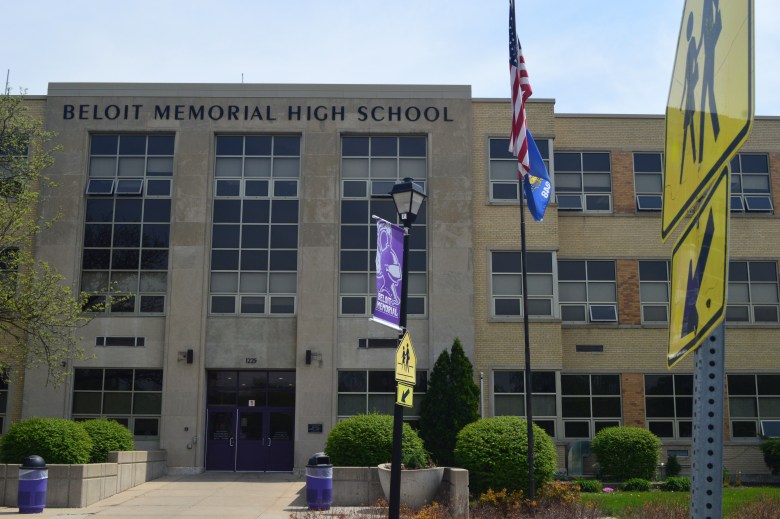
BELOIT, Wis. — As Chris Hooker eyed a newly built piece of ductwork inside Beloit Memorial High School, a wry smile crept over his face. “If you worked for me,” he told a student, considering the obviously crooked vent, “I might ask if your level was broken.”
Hooker, the HVAC manager of Lloyd’s Plumbing and Heating Corp. in nearby Janesville, was standing inside a hangar-sized classroom in the school’s advanced manufacturing academy, where students construct full-size rooms, hang drywall and learn the basics of masonry. His company sends him to the school twice a week for about two months a year to help teach general heating, venting and air conditioning concepts to students.
“I cover the mountaintop stuff,” he said, noting that at a minimum students will understand HVAC when they become homeowners.
But the bigger potential payoff is that these students could wind up working alongside Hooker after they graduate. If his firm has an opening, any student recommended by teacher Mike Wagner would be a “done deal,” Hooker said. “Plus, if they come through this class, I know them.”
Manufacturing and construction dominate the business needs inside Beloit, a small city of 36,000 just minutes from the Illinois border. Sitting at the nexus of two major highways, and within 100 miles of Chicago, Milwaukee and Madison, Beloit is home to a range of businesses that include a Frito-Lay production plant, an Amazon distribution center and a Navy subcontractor. In the next two years, a $500 million casino and hotel complex is scheduled to open.
But staffing these companies into the future is a major concern. Across the country, the average age of manufacturing workers is increasing, and one in four of these workers is age 55 or older, according to U.S. Bureau of Labor Statistics’ 2021 figures, the most recent available. In many other jobs the workforce is aging, too. Wisconsin is one of several states looking to boost career and technical education, or CTE, as a possible solution to the aging and shrinking workforce.
Having industry standard machines is a key part of Beloit Memorial High School’s manufacturing program; here a student uses a JET metalworking machine to create precise cuts for his project. Credit: Wayne D’Orio for The Hechinger Report
While the unemployment rate of Rock County, which includes Beloit, is 3.6 percent, only slightly higher than the state’s 3.2 percent, there’s a worker mismatch in the city, according to Drew Pennington, its economic development director.
Every day, 14,000 city residents travel outside of Beloit to work, while the same number commute into the city to fill mostly higher-paying jobs, said Pennington.
So when Beloit decided to revamp its public high school in 2018, CTE and work-based learning were at the forefront of the transformation.
The 1,225-student school now has three academies that cover 13 different career paths. After ninth grade, students choose to concentrate in an area, which means taking several courses in a specific field. Students also have the option to do work-based learning, which can mean internships, a youth apprenticeship or working at high-end simulated job sites inside the school.
“This creates not just a pipeline to jobs but also to career choices,” said Jeff Stenroos, the district’s director of CTE and alternative education.
“There are a lot of really good-paying jobs in this area. Students don’t need to leave, or go earn a four-year degree,” Stenroos said. An auto mechanic can “earn six figures by the age of 26 and that’s more than an educator with a master’s degree,” he said.
Beloit’s effort is a shift in high school emphasis similar to the extensive CTE programs being run in other places, notably Indiana, Kentucky and Alabama. In 2024, 40 states enacted 152 CTE-related policies, the biggest push in five years, according to Advance CTE, a nonprofit group that represents state CTE officials. Nationwide, about 20 percent of high school students take a concentration of CTE courses, it says, adding that the high school graduation rate for students who concentrate in CTE is 90 percent, 15 percentage points higher than the national average.
Three years ago, Wisconsin called for 7 percent of its high school students to be in workplace learning programs by 2026. Beloit’s progress puts it far ahead of that target. In Beloit Memorial, nearly 1 in 3 students meet this designation today, Stenroos said.
The high school features a cavernous construction area where students build full-scale rooms, learn masonry and complete plumbing and electrical wiring projects. The metal shop offers 16 welding stations and a die-cutter machine that allows students to create customized pieces to fit projects. Down the street, the school runs an eight-bay car repair center, a space it took over when a Sears autobody shop left town.
These spaces are “better than a lot of technical colleges,” Stenroos said.
In addition to their high school courses, Beloit Memorial students pile up industry-recognized certifications, Stenroos said. More than 40 percent of its students graduate with at least one certification, and 1 in 4 of them has multiple certifications.
While some simple certifications, such as OSHA Workplace Safety, can be accomplished in just 10 hours, others, such as those for the American Welding Society, require up to 500 hours of student work, he added. The state has called for 9 percent of graduating high school students to have earned at least one certification by next year. To incentivize schools to offer these opportunities, the state’s Department of Workforce Development pays schools for each student who earns a certification; in 2024, Beloit received $85,000 through this program, Stenroos said.
One of the school’s best automotive students, Geiry Lopez, graduated this year with five Automotive Service Excellence certifications. Standing less than 5 feet tall, Lopez said she is not bothered that she might not look like a typical mechanic. “I know I can do this,” she said, adding that she hopes to work on heavy machinery such as tractor trailers after she graduates.
She’s worked on her own car, with some fellow students, replacing the brakes, a front axle, rotors and wheel bearings at the school’s garage, she said, although she still hasn’t been able to drive it.
“My dad is taking forever to teach me how to drive,” she said.
The garage operates like an actual business, but the only customers are teachers and other Beloit staffers and students. Students estimate work costs, order parts and communicate with customers before any repairs take place. While oil changes and brake replacements are common, some students are totally rebuilding an engine in one car.
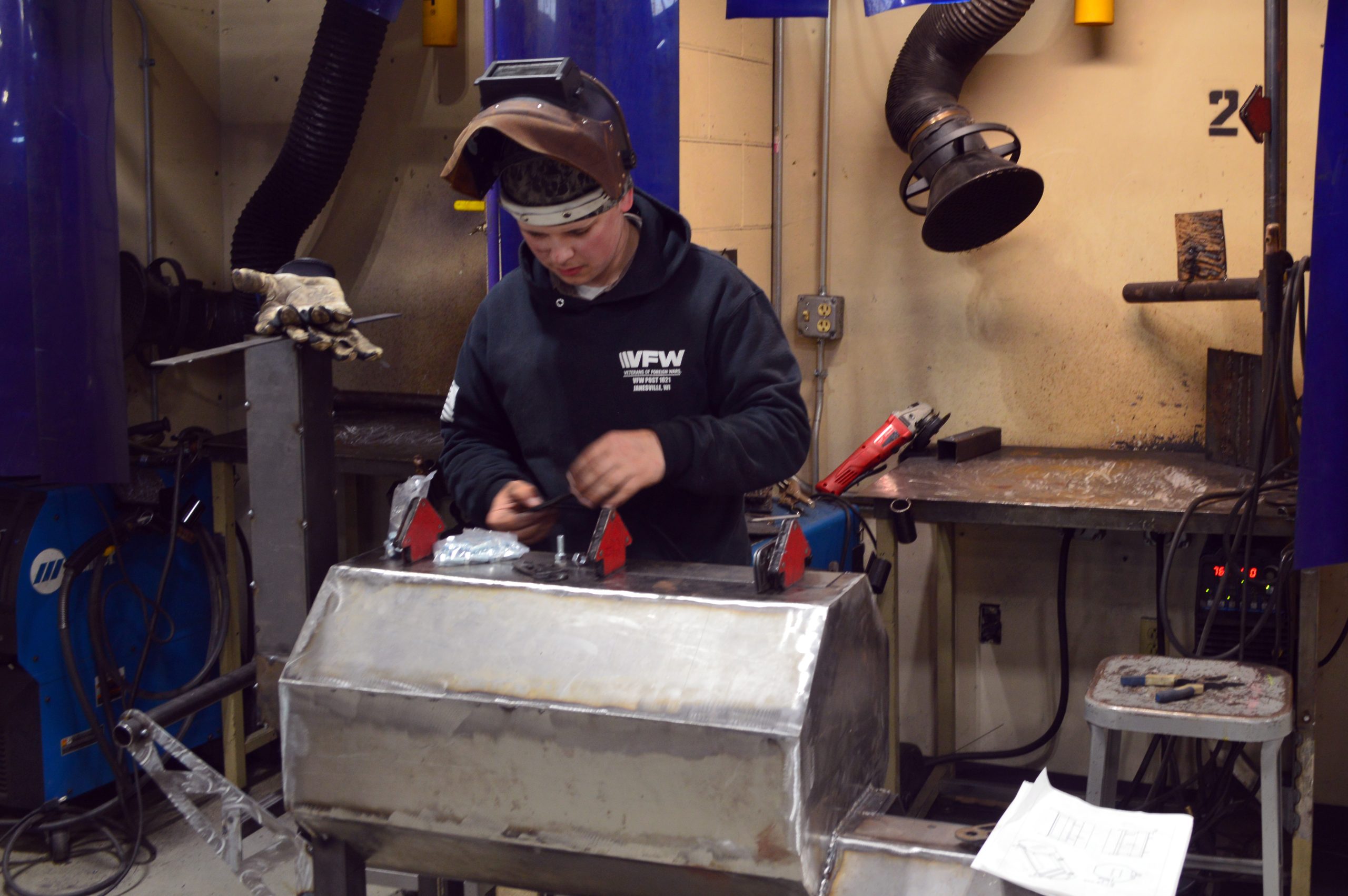
Over in the welding room, rising senior Cole Mellom was putting the finishing touches on a smoker he built in less than a month’s time. He said he loved the creativity of finding a plan, cutting the metal and building something that he could sell, all while in school. Plus, he knows that welding is a key skill needed for his dream job, race-car fabrication.
Officials revamped the Beloit Memorial High School in 2018 to funnel students into academies that are connected to jobs in the area and the state. Credit: Wayne D’Orio for The Hechinger Report
In the past, students created a custom-made protective plate that the city’s police use on a bomb squad vehicle.
The welding program has 125 students this year and had to turn away 65 more because of space limitations, Stenroos said; last year, 17 of the school’s welding academy graduates enlisted in the armed forces to specialize in welding.
These programs are designed to help meet the future needs of the state’s workforce. More than one-third of Wisconsin jobs will require education beyond high school but less than a bachelor’s degree by 2031, according to the Association for Career and Technical Education. For the last four years, the state has had more job openings than people on unemployment.
“There’s more jobs than there are people to fill them right now,” said Deb Prowse, a former career academy coach at Beloit Memorial who now works at Craftsman with Character, an area nonprofit that helps train students for careers in skilled trades.
Hooker, the Lloyd’s Plumbing HVAC manager, agreed. “Every project we work on has a delay, from a multimillion-dollar mansion to a three-bedroom spec,” he said. “There aren’t enough workers.”
The main reason Beloit Memorial has been able to zoom past state and national goals for both CTE and work-based learning is the school’s single-minded focus since 2018 on helping to ensure that its graduates will understand what businesses need and giving them a head start toward gaining those skills.
High school officials actually pared back the program from 44 pathways to 13, Stenroos said, part of an effort to tie each pathway to specific jobs. About 75 percent of pathways target area jobs, with the remaining quarter highlighting prominent professions within the state, he added.
Even though three straight budget referendum defeats have left the district with a $6.2 million funding gap, Stenroos said he’s been able to keep the CTE equipment modernized through donations and strategic allocation of the school’s federal Perkins grant and the state reimbursement for student certifications. In one instance, the school recently bought a $20,000 scanner for its automotive program; the machine can not only help diagnose a car problem, but also connect students to garages throughout the country that have successfully fixed the specified problem.
“It’s an expensive piece of equipment,” Stenroos said, “but it’s industry-certified and will give students real-life experience.”
Each of the three academies has an advisory board of teachers and industry professionals who work out how to embed practical lessons in classroom curriculum. “We ask business people, ‘What do you need, and how can we help our kids get there?’” said Stenroos.
“It’s really cool how receptive the school is to feedback,” said Heather Dobson, the business development manager at Corporate Contractors, Inc., a 200-person general contracting firm.
She explained that the district has incorporated small changes over the years, such as having students work in Microsoft programs instead of Google Classroom apps and teaching them how to write a professional email.
“Rarely is there an idea presented that they don’t embrace,” said Celestino Ruffini, the CEO of Visit Beloit, a nonprofit that promotes tourism of the city. The school is expanding its hospitality program because of the expected influx of jobs connected to the new casino and hotel, he said.
All the changes aren’t at the high school, however. In order to employ Beloit Memorial students, Frito-Lay had to alter its corporate policy of not allowing anyone under 18 to work in its plants, according to Angela Slagle, a supply chain manager there. The company now hires Beloit Memorial students for its career exploration youth apprenticeship program, she added.
The connection to area businesses goes beyond the school’s leaders. Each year, about 10 teachers complete an externship in which they spend one week of their summer at a local business. Teachers are paid $1,000 for the 20 hours, and they not only learn about what jobs a company may have but also find ways to incorporate real-world problems into their classroom lessons.
A few summers back, math teacher Michelle Kelly spent a week at Corporate Contractors. She was searching for different ways to use construction-based math problems with her students. In addition to using math to estimate a bid for a project or calculate the surface area of a job, she realized that complex math is needed to build a truss, the framework used to support a roof or bridge.
Because the triangular truss is supported by different lengths of wood inside its structure, Kelly said, building one requires the calculation of angles, total area, how much wood is needed and more. Since all her algebra students were in the school’s construction academy, she partnered with those teachers to go beyond blueprints and have the 10th graders build trusses, a collection of which sit in the back of her classroom.
A student’s detailed outline for creating a truss in Michelle Kelly’s 10th grade algebra class at Beloit Memorial High School, which is embracing career and technical education. Credit: Wayne D’Orio for The Hechinger Report
She sees this work as one way to help counter the chronic absenteeism that has existed since Covid. Teaching with this kind of hands-on work makes students see the relevance of algebra, she said. “Would it be easier to just have them take a test? Yes.”
Beloit Memorial Principal Emily Pelz said the school’s work is paying off. In the last four years, the school’s four-year graduation rate has ticked up slightly, from 83.4 percent in 2021-22 to 85.2 percent in 2024-25, while its attendance went from 78.5 percent to 84.8 percent in the same period, Pelz said.
Rik Thomas, a rising senior who already has his own business repairing and modifying cars, said this work has definitely made him more interested in school. While he thought the academy would merely explain what a construction career might include, “It’s nice to find out how to do the work.” His father works in construction and, Thomas added, “He loves that I take this program.”
Thomas and his classmates built a wooden shed earlier this year and were able to sell it for $2,500, with the money going to pay for more materials. Likewise, the first smoker created in the welding class was bought by Stenroos; the students are looking forward to posting the second one for sale after they determine how much they should charge.
While the school’s construction and other trade-related fields have drawn the most attention, its three academies also offer career paths in healthcare, education, business, the arts, hospitality and more.
For example, rising senior Tayvon Cates said he hopes to study pre-med at a historically Black college or university on his way to becoming a cardiology radiologist. Cates, who is in the school’s health and education academy, said, “If you want to do something, the school can help you do it.”
The Hechinger Report provides in-depth, fact-based, unbiased reporting on education that is free to all readers. But that doesn’t mean it’s free to produce. Our work keeps educators and the public informed about pressing issues at schools and on campuses throughout the country. We tell the whole story, even when the details are inconvenient. Help us keep doing that.
North Carolina is taking bold steps to democratize college access with the expansion of its NC College Connect program, which will offer direct admission to more than 62,000 public high school seniors this fall. The initiative represents a significant shift toward equity-focused admissions practices that prioritize accessibility over traditional application barriers.
The program targets students who complete their junior year with a weighted GPA of 2.8 or higher. By eliminating the often overwhelming application process, NC College Connect removes financial and procedural obstacles that disproportionately affect first-generation college students and those from underrepresented communities.
“NC College Connect represents a fundamental shift in how we approach college admissions in North Carolina,” said Peter Hans, President of the University of North Carolina System. The initiative reflects growing national recognition that traditional admissions processes can perpetuate educational inequities.
Maurice “Mo” Green, State Superintendent of Public Instruction, praised the collaborative nature of the effort.
“When our entire education community works together like this, students win. NC College Connect removes barriers and creates clear pathways to college for thousands of our students,” he said.
The program’s inclusive design addresses systemic challenges that have historically limited college access for students from diverse backgrounds. By providing direct admission letters and eliminating complex application requirements, the initiative particularly benefits students who might otherwise be deterred by navigating multiple institutional processes.
Participating institutions span the full spectrum of North Carolina’s higher education landscape, including UNC System universities, independent colleges and universities, and community colleges. This comprehensive approach ensures students have pathways to various types of post-secondary education that align with their academic goals and financial circumstances.
Dr. Jeff Cox, President of the North Carolina Community College System, highlighted the program’s potential to transform access to affordable education.
“By removing barriers and simplifying the process, we’re helping more students access the life-changing opportunities our community colleges provide—close to home and at a price they can afford,” he said.
Community colleges have long served as crucial entry points for students from diverse socioeconomic backgrounds, offering both career preparation and transfer pathways to four-year institutions. The inclusion of community colleges in NC College Connect recognizes their vital role in democratizing higher education access.
The program’s commitment to equity extends beyond admissions to address affordability concerns through targeted financial aid initiatives. The Next NC Scholarship and NC Need-Based Scholarship specifically support students from households earning $80,000 or less, covering tuition and fees at participating institutions.
Additionally, students attending Elizabeth City State University, Fayetteville State University, University of North Carolina at Pembroke, and Western Carolina University benefit from the NC Promise plan’s $500 per semester tuition rate. These historically Black institutions and regional universities serve particularly diverse student populations, making the affordable tuition structure especially impactful for underrepresented students.
Hope Williams, President of North Carolina Independent Colleges and Universities, noted the unique value proposition of smaller institutions: the personalized attention and specialized programs that can be particularly beneficial for students who might struggle in larger university environments.
The program builds on a successful pilot year that served more than 70,000 students, demonstrating the demand for streamlined college access. The expansion indicates that initial outcomes validated the approach’s effectiveness in connecting students with higher education opportunities.
Students can verify their eligibility through the NCCollegeConnect.com portal or by consulting with high school counselors, ensuring multiple touchpoints for information and support. Eligible seniors will receive official admission letters this fall for the 2026-27 academic year, providing ample time for planning and preparation.
NC College Connect positions North Carolina as a leader in reimagining college admissions to prioritize access and equity. As higher education institutions nationwide grapple with declining enrollment and questions about traditional admissions practices, North Carolina’s comprehensive approach offers a replicable model for other states.
The initiative’s success will likely be measured not just in enrollment numbers, but in its ability to diversify the state’s college-going population and create pathways for students who might otherwise forego higher education. By removing procedural barriers and addressing financial constraints, NC College Connect represents a holistic approach to educational equity that extends well beyond the admissions office.