Senator Bernie SandersSenator Bernie Sanders introduced legislation last Thursday requiring all public school teachers to earn at least $60,000 annually, calling America’s teacher pay crisis a “national emergency” during a Capitol Hill town hall with more than 200 educators.
The Pay Teachers Act, co-sponsored by eight Democratic senators including Elizabeth Warren and Ed Markey, would establish the first federal mandate for teacher salaries and represents the most ambitious federal intervention in educator compensation in decades.
“Just four hedge fund managers on Wall Street make more money in a single year than every kindergarten teacher in America combined—over 120,000 teachers,” Sanders said. “No public school teacher in America should make less than $60,000 a year.”
The legislation comes as schools nationwide face unprecedented staffing shortages, with nearly 200,000 teaching positions either vacant or filled by underqualified educators. According to the bill’s findings, 38% of teachers nationwide earn less than $60,000 annually, with starting teachers averaging $44,530.
Maria Gonzalez, a third-grade teacher from Arizona who testified at the town hall, said she drives for Uber on weekends and tutors after school to pay rent.
“My students ask why I look tired. How do I tell them their teacher can’t afford to live in the community where she teaches?”
The crisis extends beyond low pay. Twenty-one percent of elementary and middle school teachers’ families rely on public assistance programs including Medicaid, food stamps, and the Earned Income Tax Credit, according to a University of California, Berkeley study cited in the legislation. Additionally, 44% of public school teachers quit within five years, and 17% worked multiple jobs during the 2020-2021 school year.
The comprehensive bill would cost approximately $400 billion over five years, funded through mandatory appropriations. Beyond the $60,000 minimum salary requirement, the legislation would triple Title I funding, provide teachers with at least $1,000 annually for classroom supplies, and mandate that paraprofessionals and education support staff earn at least $45,000 annually or $30 per hour.
States would have four years to implement the salary requirements, with extended timelines available for states demonstrating substantial financial need. The bill also includes $50 billion annually for career ladder programs allowing teachers to advance without leaving the classroom.
The teacher shortage disproportionately affects schools serving students of color and low-income communities, which are four times more likely to employ uncertified teachers than schools with low minority enrollment, according to federal civil rights data cited in the legislation.
James Williams, a high school mathematics teacher from North Carolina, told the town hall that his salary purchased “a decent life” 15 years ago but now forces him to choose between car repairs and classroom supplies.
The legislation faces significant political obstacles with Republicans controlling the House. GOP lawmakers have criticized the massive federal spending, while some education policy experts question federal involvement in traditionally state and local compensation decisions.
Major education unions endorsed the proposal. American Federation of Teachers President Randi Weingarten called it “a crucial federal investment to help sustain the teaching profession,” while National Education Association Vice President Princess Moss praised it as legislation that “invests in our students, educators, and public schools.”
Sanders criticized recent Republican legislation that he said provides “$900 billion in tax cuts to large, profitable corporations and a $1 trillion tax cut to the top 1%” while cutting over $300 billion in education funding. The Trump administration is also withholding nearly $5.5 billion in congressionally appropriated education funding, according to Sanders and his colleagues.
“If we can provide over a trillion dollars in tax breaks to the top 1% and large corporations, please don’t tell me that we cannot afford to make sure that every teacher in America is paid at least $60,000 a year,” Sanders said.
The anticipation of a new school year brings a complex mix of emotions for both students and teachers in K-12 education. As the 2025-2026 academic year approaches, experiencing anxiety about returning to the classroom is a natural response to change that affects everyone differently.
From elementary students facing new classroom environments to high school teachers preparing for curriculum changes, these feelings manifest uniquely across age groups. Young children often worry about making new friends or adjusting to new teachers, while older students grapple with academic performance pressures and social dynamics. Teachers face their own challenges, including meeting diverse student needs, implementing new edtech tools and digital resources, and maintaining high academic standards while supporting student well-being.
Early identification of anxiety symptoms is crucial for both educator and student success. Young children might express anxiety through behavioral changes, such as becoming more clingy or irritable, while older students might demonstrate procrastination or avoidance of school-related topics. Parents and educators should remain vigilant for signs like changes in sleeping patterns and/or eating habits, unusual irritability, or physical complaints. Schools must establish clear protocols for identifying and addressing anxiety-related concerns, including regular check-ins with students and staff and creating established pathways for accessing additional support when needed.
Building strong support networks within the school community significantly reduces anxiety levels. Schools should foster an environment where students feel comfortable expressing concerns to teachers, counselors, or school psychologists. Regular check-ins, mentor programs, and peer support groups help create a supportive school environment where everyone feels valued and understood. Parent-teacher partnerships are essential for providing consistent support and understanding students’ needs, facilitated through regular communication channels, family engagement events, and resources that help parents support their children’s emotional well-being at home.
Practical preparation serves as a crucial anxiety-reduction strategy. Teachers can minimize stress by organizing classrooms early, preparing initial lesson plans, and establishing routines before students arrive. Students can ease their transition by visiting the school beforehand, meeting teachers when possible, and organizing supplies. Parents contribute by establishing consistent routines at home, including regular sleep schedules and homework times, several weeks before school starts. Schools support this preparation through orientation events, virtual tours, welcome videos, and sharing detailed information about schedules and procedures well in advance.
The importance of physical and emotional well-being cannot be overstated in managing school-related anxiety. Schools should prioritize regular physical activity through structured PE classes, recess, or movement breaks during lessons. Teaching age-appropriate stress-management techniques, such as deep breathing exercises for younger students or mindfulness practices for older ones, provides valuable tools for managing anxiety. Schools should implement comprehensive wellness programs addressing nutrition, sleep hygiene, and emotional regulation, while ensuring ready access to counselors and mental health professionals.
Creating a positive classroom environment proves essential for reducing anxiety levels. Teachers can establish predictable routines, clear expectations, and open communication channels with students and parents. Regular class meetings or discussion times allow students to express concerns and help build community within the classroom. The physical space should consider lighting, noise levels, and seating arrangements that promote comfort and focus. Implementing classroom management strategies that emphasize positive reinforcement and restorative practices rather than punitive measures helps create a safe space where mistakes are viewed as learning opportunities.
Technology integration requires careful consideration to prevent additional anxiety. Schools should provide adequate training and support for new educational technologies, introducing digital tools gradually while ensuring equitable access and understanding. Regular assessment of technology needs and challenges helps schools address barriers to effective use. Training should encompass basic operational skills, digital citizenship, online safety, and responsible social media use. Clear protocols for technology use and troubleshooting ensure that both students and teachers know where to turn for support when technical issues arise.
Professional development for teachers should focus on managing both personal and student anxiety through trauma-informed teaching practices and social-emotional learning techniques. Schools must provide regular opportunities for skill enhancement throughout the year, incorporating both formal training sessions and informal peer learning opportunities. Creating professional learning communities allows teachers to share experiences, strategies, and support, while regular supervision and mentoring provide additional support layers.
Long-term success requires commitment from all stakeholders–including administrators, teachers, support staff, students, and families–working together to create a supportive educational environment where everyone can thrive in the upcoming 2025-2026 school year.
Dr. Jason Richardson, Garden City Elementary School & the International University of the Caribbean
Dr. Jason Richardson is a Teacher Leader at the Garden City Elementary School in Savannah, Georgia and a Professor of Graduate Studies at the International University of the Caribbean (Jamaica). He holds a Diploma in Principalship from the National Leadership College of Jamaica, Bachelor of Education from the International University of the Caribbean, Master of Science in Counseling and Consulting Psychology from the International University of the Caribbean, Educational Specialist Degree and a Doctor of Education Degree in Leadership and Management from the William Howard Taft University.
Latest posts by eSchool Media Contributors (see all)
How effective are Snapchat school campaigns? Snapchat may no longer be the “shiny new toy” in the social media landscape, but it continues to offer something few platforms can match: authentic, ephemeral connection with Gen Z. While platforms like TikTok, Instagram, and YouTube dominate the headlines, Snapchat remains deeply embedded in the daily lives of many teens and young adults, especially in North America, Europe, and parts of the Middle East.
For education marketers targeting younger demographics, Snapchat’s low-friction, high-engagement environment makes it a powerful, if often underutilized, channel. From personalized outreach and peer-led takeovers to geofilter-powered event promotion, Snapchat school digital marketing campaigns meet students on their terms with content that feels spontaneous, creative, and real.
This blog post explores how different types of institutions: business schools, language schools, career colleges, K–12 schools, and universities, can use Snapchat strategically to support their enrollment goals, community engagement, and brand building.
Why Snapchat Still Matters
Globally, Snapchat’s active user base tops 850 million. In key recruitment markets like North America, parts of Europe, and the Middle East, teens and young adults continue to use Snapchat as a daily communication hub. What makes it especially powerful for education marketing is the way it enables institutions to meet students where they are in their preferred format, tone, and space.
How does Snapchat college work? Snapchat’s college features, like School Communities, offer institutions a way to foster peer-to-peer engagement within a verified, digital campus environment. It strengthens school spirit, encourages student interaction, and creates new touchpoints for community-building in a format Gen Z prefers.
Snapchat offers unique features that make it a great tool for engaging students and supporting education marketing. Its main appeal is that content, like photos and 10-second videos, disappears after being viewed, which makes it feel immediate and personal, unlike traditional social media. Some key features include:
Stories: Stories allow users to string together multiple snaps (photos or videos) that are viewable for 24 hours. This feature helps schools showcase campus life, events, and student takeovers in a way that feels immediate and engaging. Schools can post regular updates, highlights of campus activities, and even have students take over the account for a day to give a personal perspective on student life.
Snapchat School Communities: In 2024, Snapchat introduced School Communities, which let students join private groups for their school. Members can view and contribute to shared Campus Stories visible only to classmates. These communities help students connect with peers in a secure, school-specific space, making it easier to share experiences, participate in group chats, and discuss common interests. Snapchat verifies members using their official school email addresses and gives them a special badge on their profiles.
Geofilters and AR Lenses: Geofilters are custom-designed overlays available to users in a specific location. Schools use geofilters for events like campus tours, admitted student days, or graduations, turning these moments into shareable, branded experiences. Augmented reality (AR) lenses, which add fun virtual elements to photos, can also be used to promote school spirit and engagement. User-Generated Content (UGC): Snapchat thrives on content created by its users. Schools encourage UGC through activities like account takeovers, contests, and Q&As. These features allow students to contribute their own content, giving a more authentic, behind-the-scenes view of campus life.
Example: NYU (Snapchat username: nyuniversity) has leveraged Snapchat’s geofilter feature to welcome and engage prospective students. In 2016, NYU introduced a custom Snapchat geofilter for its Admitted Students Day event, even running a student design contest to create the filter. The winning filter gave visiting admits a fun way to announce their presence at NYU on Snapchat. NYU’s official news release also encouraged the community to “Add us on Snapchat” for behind-the-scenes campus glimpses and student takeovers.
Snapchat Ads and Discover: In addition to organic content, Snapchat offers a robust ads platform and a Discover media section. While Discover is mostly for professional media partners, schools can utilize Snapchat Ads Manager to run targeted ad campaigns for recruitment. From short video ads to swipe-up web forms, Snap ads can reach users by age, location, interests, and more, crucial for enrollment marketing.
What does putting your school on Snapchat do? Listing your institution on Snapchat enables a digital community where students connect, share, and engage under your brand. While not managed by the school, this community becomes a valuable extension of campus life and student culture.
How does Snapchat verify your school? Snapchat confirms membership by requiring students to use their institutional email address for verification. This automated system ensures only enrolled individuals access the community, minimizing moderation needs while maintaining student privacy and authenticity.
With expertise in education marketing, agencies like HEM help schools navigate these ad tools as part of an integrated digital marketing strategy, ensuring Snapchat campaigns align with enrollment goals and complement efforts on other platforms.
To learn more about crafting cross-platform campaigns, see HEM’s digital marketing services specifically for education organizations, which cover social media, paid ads, content, and more.
With this foundation, let’s examine how various types of educational institutions are using Snapchat in practice, from the tech-savvy prep school to the global MBA program.
K–12 Schools: Building School Spirit With Caution and Creativity
K–12 schools, particularly high schools, face a unique challenge when it comes to Snapchat. While teens are highly active on the platform, schools must balance the need for engagement with a duty of care, especially considering their minor student populations. Despite these concerns, some schools have found creative ways to use Snapchat to build school spirit, communicate with students, and engage parents and alumni, all while ensuring privacy and safety.
One common use of Snapchat in schools is to share quick glimpses of campus life and events, offering a more personal and immediate connection than traditional communications like newsletters.
Schools also leverage Snapchat’s geofilters for major events like prom, graduation, or sports games, encouraging students to use school-branded filters. These geofilters, often featuring the school name or mascot, help increase visibility and pride as students share their celebratory moments with their networks.
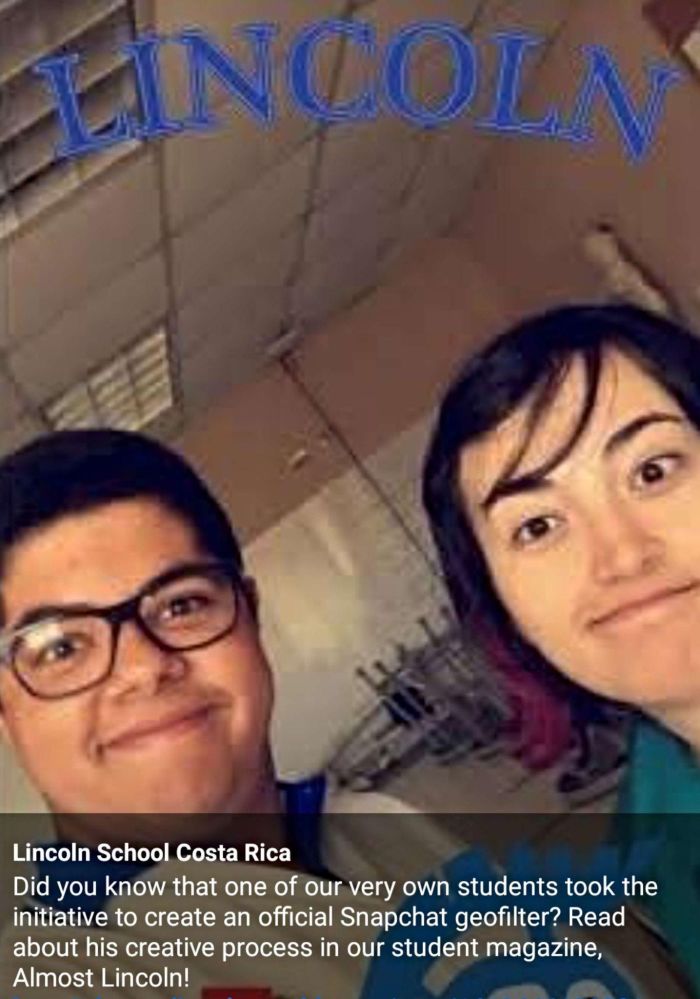
Example: At Lincoln School in Costa Rica, a student designed an official Snapchat geofilter for the campus, enabling students to overlay a custom school graphic on their snaps. Geofilters like this rally school spirit during events and make it easy for students to share branded moments from school.
While Snapchat offers numerous opportunities for engagement, schools must exercise caution. Privacy concerns are paramount, and schools typically avoid following students back on the platform. They also direct more serious inquiries to email or in-person discussions.
Ultimately, Snapchat can be a powerful tool for K–12 schools when used thoughtfully with clear goals, safety protocols, and creative student involvement. However, schools should evaluate their resources and decide if the platform aligns with their communication strategy.
For those who are unsure about how to get started, education marketing consultants HEM can offer guidance to help schools develop effective, safe social media strategies.
Language Schools: Capturing Culture, Fun, and Learning in Real Time
Language schools, including ESL institutes, immersion camps, and university pathway programs, serve a naturally youthful audience: students who are eager to share their cultural and educational experiences. For this reason, Snapchat is a fitting addition to their marketing strategy. With over 38% of Snapchat’s users aged 18 to 24, it offers a great opportunity to reach teen learners who are already on the platform.
Snapchat’s popularity among this age group makes it ideal for language schools looking to connect with students where they spend their time. While platforms like Facebook may be better suited for reaching parents, Snapchat helps schools tap into the social, youthful energy of their student base.
Language schools use Snapchat in several ways to engage their audience. One key strategy is showcasing student life and local culture in real-time. By giving students control of the school’s Snapchat account, schools allow them to share their experiences, from excursions to daily activities.
Example: CEA ran a campaign called “10 Stages of Study Abroad,” where students shared their personal journeys through Snapchat, from arrival to cultural experiences. This user-generated content, filled with emojis and candid moments, felt real and approachable, making it an ideal way to engage teens considering studying abroad.
Additionally, language schools use Snapchat for quick-hit teaching and engagement. Posting a “word of the day” with a fun illustration or running mini-quizzes encourages interaction and reinforces learning. These spontaneous, playful posts not only engage current students but also expand reach as followers share and respond.
Finally, Snapchat can be used for international recruitment, particularly in regions where the platform is popular. Snapchat school campaigns can target specific countries where teens are heavy Snapchat users and run geo-targeted ads to promote their programs.
While Snapchat offers valuable engagement opportunities, not every language school may have the resources to manage it. If maintaining a regular presence is challenging, schools may choose to focus on other platforms like Instagram or YouTube.
However, if Snapchat aligns with your target demographic and storytelling style, it can be a powerful tool in your marketing mix, provided you post consistently and keep the tone light and authentic. Language learning is filled with fun and cultural moments, making Snapchat’s informal style the perfect vehicle for sharing these experiences.
Colleges: Bringing Practical Learning to Life
Colleges, ranging from community colleges to vocational institutes, serve a diverse audience, from recent high school grads to working adults seeking new skills. To connect with these students, platforms like Snapchat offer a unique opportunity.
Although adoption has been slow, career colleges that have embraced Snapchat report high engagement and significant benefits. Snapchat allows these institutions to showcase hands-on learning experiences and workforce outcomes in a way that feels authentic and immediate, which resonates with prospective students, particularly those focused on practical skills and career outcomes.
One major way career colleges leverage Snapchat is by giving students the platform to share real-time glimpses of their training. For instance, technical institutes may use Snapchat Stories to offer behind-the-scenes looks into workshops or classrooms. This content provides a dynamic, visually engaging alternative to traditional brochures, showcasing students’ day-to-day experiences in fields like auto mechanics or culinary arts.
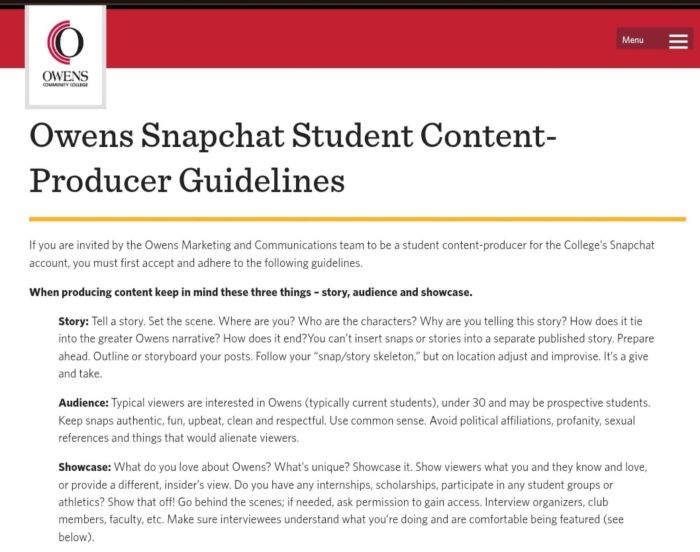
Example: Owens Community College empowers student content producers to share everything from welding sparks to nursing students practicing IVs. This hands-on, visual storytelling appeals directly to prospective enrollees, giving them a taste of life in their chosen field.
In addition to showcasing student life, career colleges use Snapchat to bring workforce outcomes to life. Through alumni takeovers, schools can give prospective students a “day in the life” of a graduate, showing how their programs led to real career success. This adds a personal, relatable touch that resonates more than statistics alone.
Snapchat’s advertising tools also play a pivotal role in recruitment. Career colleges can use Snapchat Ads to target specific age groups or demographics, promoting relevant programs or seasonal events. For example, a cosmetology school could run an ad campaign targeting local teens to promote an open house, encouraging immediate sign-ups through Snapchat’s lead-gen feature.
While Snapchat offers clear benefits, career colleges must be cautious about the content they share, especially when dealing with sensitive or confidential aspects of certain programs. Social media policies must be in place to protect privacy and ensure safety protocols are not compromised. Additionally, moderation is crucial to maintain professionalism, particularly when engaging with prospective students via interactive features like Q&As.
Despite these considerations, career colleges that embrace Snapchat can build a modern, relatable brand, connect with a younger audience, and showcase their unique offerings. With the right strategy, Snapchat can be a powerful tool to attract the next generation of students. For colleges unsure where to start, digital marketing specialists can help create a strategy that includes content planning, staff training, and targeted ad campaigns to maximize impact.
Universities: Scaling Engagement With Personalization
Universities have been early adopters of Snapchat in the education space, using it to engage prospective students and strengthen their campus communities.
The platform’s youth-driven, real-time, and personal nature makes it a perfect fit for engaging 17–18-year-old prospects and meeting them where they already spend their time. Universities have utilized Snapchat for everything from personalized admissions outreach to virtual campus tours, showcasing the immediate and authentic experiences that Gen Z craves.
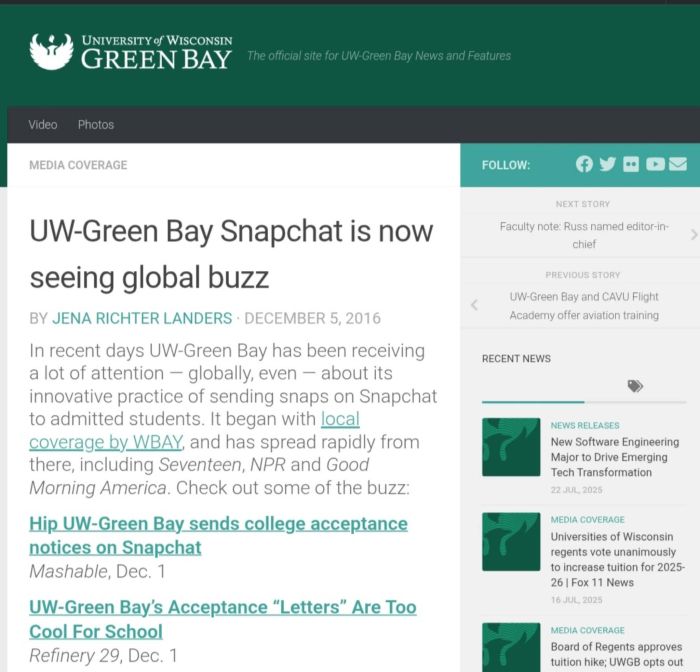
One standout use of Snapchat is personalized admissions and outreach. The University of Wisconsin–Green Bay gained attention by notifying hundreds of accepted students through Snapchat, offering a personal touch with fun campus photos and a message like “Welcome to the Phoenix family!” This creative approach made a lasting impression, fostering a sense of connection with incoming students. Many other universities have followed suit, using Snapchat to welcome students or remind them about key deadlines, creating an interpersonal feel that’s hard to achieve with traditional email.
Example: UW–Green Bay’s Snapchat notifications let students engage by snapping selfies back, creating an interactive and memorable admissions experience.
Another common strategy is virtual campus tours and Q&As. Before virtual tours became widespread, universities like UW–Green Bay were already using Snapchat to show prospective students around campus, from dorms to dining halls, answering questions along the way. These casual, behind-the-scenes tours are an engaging way to help students envision themselves on campus, giving them a more authentic and intimate view of student life. This approach also allows universities to reach thousands of potential students in a relaxed, informal way.
Example: UW–Green Bay used Snapchat to host Q&A sessions on topics like financial aid and study abroad, allowing students to ask questions privately, making the experience feel more personal and accessible.
In addition to these strategies, many universities leverage student takeovers and ambassador programs, where students take over the Snapchat account for a week to share their day-to-day experiences. This approach humanizes the institution, allowing prospective students to connect with real students in an authentic way. Universities like UNC–Chapel Hill have seen success with this model, using cross-platform promotion to ensure maximum visibility for the takeovers.
Example: At UNC–Chapel Hill, Snapchat takeovers are often cross-promoted on Twitter, with students sharing everything from campus life to personal milestones.
For contests and user-generated campaigns, universities often run engagement initiatives like Snapchat scavenger hunts or spirit photo contests. These campaigns incentivize students to engage with the platform and promote the school while integrating online interaction with offline connections. Such contests increase visibility and drive student participation, making them a fun, interactive way to build community.
Example: Princeton’s “Snap as You Pack” contest encouraged incoming students to send snaps of their packing process, with winners receiving prizes at a campus event, turning digital interactions into real-world connections.
Universities also utilize Snapchat ads for recruitment and yield campaigns, with many seeing impressive returns. Finally, community building and retention is a growing area for Snapchat. With features like School Communities, universities are creating digital spaces for current students and alumni to share experiences and connect.
In conclusion, universities have effectively integrated Snapchat into their recruitment and engagement strategies. The key takeaway is the importance of authenticity and timeliness—students respond far more to real, relatable content than polished marketing. With careful planning, universities can use Snapchat not just as a novelty but as a core element of their digital strategy, driving awareness, engagement, and ultimately, enrollment.
Business Schools: Elevating Outcomes With Authentic Storytelling
Business schools, though often catering to older students focused on career advancement, are increasingly turning to Snapchat to humanize their brand and engage digital-native prospects. Snapchat’s bite-sized, authentic content resonates with younger audiences, offering business schools a unique opportunity to showcase their community and career outcomes in a dynamic, engaging way.
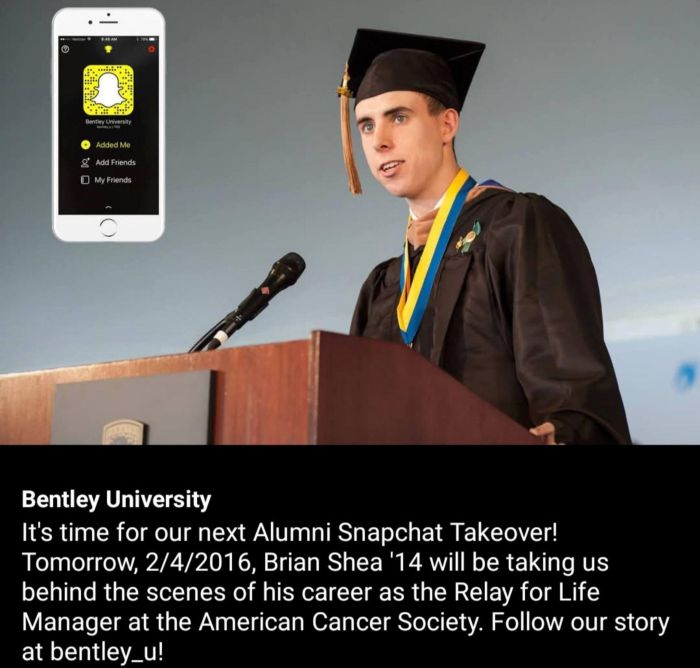
One of the most effective strategies employed by business schools is Snapchat alumni takeovers. Bentley University, for example, hosts monthly takeovers where alumni share “a day in the life” from their workplace, whether it’s at a Big Four accounting firm or a tech startup. These takeovers provide prospective students with a candid, behind-the-scenes look at life after graduation, helping them envision themselves in similar roles. This strategy not only promotes outcomes but also activates the alumni network, turning graduates into ambassadors for the school.
Example: Bentley University’s alumni takeovers offer a real-life glimpse into successful careers, showcasing alumni in cities across the country working for top companies.
Business schools also use Snapchat’s interactive features to engage prospects during admissions events. NYU’s Stern School of Business, for instance, leveraged geofilters during its admitted students’ day, allowing attendees to personalize their snaps with an NYU-themed graphic. This not only built excitement among admitted students but also turned their snaps into organic promotion for the school, reaching their personal networks and marking a milestone moment.
Example: NYU Stern’s geofilter campaign allowed admitted students to broadcast their campus visit excitement, effectively turning their posts into branded, organic promotions.
In addition to these strategies, Snapchat offers a platform for student-driven content. Schools use Snapchat Stories to share authentic glimpses of student life, from MBA orientation week to team-building exercises. This unfiltered, real-time content helps prospective students connect with current students, creating a peer-to-peer relationship that traditional marketing cannot replicate.
Example: The University of Michigan has used Snapchat to show prospective students what the school is truly about, with current students or young alumni sharing experiences directly with their peers.
Although Snapchat may play a supplementary role in business school marketing, especially with slightly older audiences who might prefer platforms like LinkedIn or YouTube, it offers a way to engage younger undergraduate prospects and keep them connected. As more Gen Z students enter graduate programs, Snapchat will likely become a more central tool in business school marketing strategies.
The key takeaway from early adopters like Bentley and NYU Stern is that authenticity sells. By letting students and alumni take the lead, business schools create meaningful, relatable content that stands out. Snapchat’s interactive elements, like geofilters, contests, and Q&As, add another layer of engagement, making it a valuable tool for creating memorable touchpoints that differentiate a school’s brand.
For business schools looking to implement these strategies, HEM offers expert support in crafting campaigns that resonate with younger audiences without compromising the professional brand. From structuring alumni takeover series to designing custom Snapchat filters, professional guidance ensures that schools’ Snapchat campaigns remain on-message and platform-appropriate.
Best Practices for Schools Using Snapchat
To use Snapchat effectively in education marketing:
Set Clear Goals: Whether you’re aiming for inquiries, event sign-ups, or community engagement, define what success looks like.
Assign Resources: Content doesn’t make itself. Designate staff, interns, or ambassadors. Even 1–2 days per week of content can be enough if it’s consistent.
Cross-Promote Aggressively: Share your Snapcode on all channels. Post reminders when live sessions or takeovers happen.
Encourage Participation: Ask students to snap their dorm move-ins, study setups, or event moments. Share user-submitted content with consent.
Use Native Features: Stickers, polls, doodles, filters; these keep your content aligned with Snapchat’s playful vibe.
Set Policies and Respect Privacy: Create a short social media usage policy. Don’t follow students back. Don’t show private info. Always get permission.
Measure Performance: Monitor views, screenshots, swipe-ups, and conversions. Define KPIs like “50 open house signups” and track accordingly.
Stay Flexible: Social trends shift fast. Listen to your students. If they say they love takeovers and ignore admin posts, adjust your campaign accordingly.
Snapchat is not a magic bullet. But as the examples show, with strategy, creativity, and the right guardrails, it can drive measurable results.
Snapchat: A Platform for the Brave and Strategic
Snapchat isn’t right for every school. But when used strategically, it can yield exceptional engagement and even tangible ROI. From intimate glimpses into student life to full-funnel recruitment campaigns, the platform gives institutions a way to be authentic, relatable, and modern.
Schools that embrace Snapchat thoughtfully, backed by clear goals, content planning, and a dose of Gen Z creativity, can stand out in a crowded market. And for schools unsure of how to begin, partnering with Higher Education Marketing can accelerate results, providing campaign support, creative strategy, and platform-specific training.
Snapchat may be temporary by design, but its impact on student perception can last much longer.
Frequently Asked Questions
Question: How does Snapchat college work? Answer: Snapchat’s college features, like School Communities, offer institutions a way to foster peer-to-peer engagement within a verified, digital campus environment. It strengthens school spirit, encourages student interaction, and creates new touchpoints for community-building in a format Gen Z prefers.
Question: How does Snapchat verify your school? Answer: Snapchat confirms membership by requiring students to use their institutional email address for verification. This automated system ensures only enrolled individuals access the community, minimizing moderation needs while maintaining student privacy and authenticity.
Question: What does putting your school on Snapchat do? Answer: Listing your institution on Snapchat enables a digital community where students connect, share, and engage under your brand. While not managed by the school, this community becomes a valuable extension of campus life and student culture.
Seventeen years after Suzanne Collins first introduced us to The Hunger Games, the world is still captivated by Panem. The latest installment, Sunrise on the Reaping, dives into Haymitch’s backstory and has been called a “propulsive and heart-wrenching addition” to the series by The New York Times. For many of us, books like these aren’t just stories–they’re cultural moments.
I remember reading the original trilogy on my iPad while training for a half-marathon. Katniss’ fight against the Capitol powered me through some of my longest runs. That’s the magic of books: They meet us where we are and carry us somewhere else entirely. They become part of our personal history, woven into our memories and milestones.
But the power of books goes far beyond personal nostalgia. When a major title drops, it’s not just a release date–it’s a shared experience. Readers rush to get their hands on it. Social media lights up with reactions. Libraries field waitlists. These moments remind us why books matter. They connect us, challenge us, and inspire us.
This fall, we’re about to experience two more of these moments. On October 21, Diary of a Wimpy Kid: Partypooper hits shelves. Jeff Kinney’s beloved series has become a rite of passage for young readers, and this latest installment–centered around Greg Heffley’s attempt to throw himself the ultimate birthday bash–is already generating buzz. It’s funny, relatable, and perfectly timed for a generation that’s grown up with Greg’s awkward, hilarious adventures.
Just a few weeks later, on November 11, Dog Man: Big Jim Believes arrives. Dav Pilkey’s Dog Man series has redefined what it means to be a children’s book phenomenon. With its blend of humor, heart, and comic-style storytelling, Dog Man has helped countless kids fall in love with reading. This new title promises to be no different, offering a story about belief, friendship, and finding strength within.
These books aren’t just for kids–they’re cultural touchstones. They bring generations together. Parents read them with their children. Teachers use them to spark classroom discussions. Librarians build displays around them. And kids? They devour them and talk about them with the kind of passion usually reserved for blockbuster movies or viral games.
And yes, there’s a business side to books. Pricing, distribution, marketing strategies–they all matter. Behind every book on a shelf is a network of people working to make that moment possible. Publishers, authors, illustrators, binders, warehouse teams, sales reps, marketers, and more. It’s easy to forget that when you’re holding a finished book, but every title is the result of countless decisions, collaborations, and passions.
In a world dominated by screens, short-form content, and constant notifications, books offer something different. They ask us to slow down. To focus. To imagine. To empathize. And that’s more important than ever.
Literacy isn’t just about reading words on a page–it’s about understanding the world. It’s about critical thinking, emotional intelligence, and the ability to engage with complex ideas. Books help build those skills. They give kids the tools to navigate life, not just school.
Because in a world that’s constantly changing, books remain one of our most powerful tools for understanding it–and each other. The world needs stories. And stories need us.
A fifth-generation family member, Britten Follett is CEO at Follett Content Solutions, which has long been the No. 1 provider of content and technology solutions to school libraries at more than 70,000 schools and school districts. She has led Follett’s PreK-12 business since September 2019 and is responsible for providing leadership, strategic direction, and business development. In September 2020, Publishers Weekly named her a “PW Star Watch” honoree, one of 40 professionals singled out from the North American publishing industry.
Kurt Micklo lost interest in academics after he failed to make the basketball team as a sophomore at Chapin High School. Soon after, he fathered a son and began to work full time, which put him further behind in his studies.
A counselor finally advised him during his junior year that he should withdraw and try to earn a GED. He dropped out and – through hard work – found professional success as a general manager of a subcontracting logistics company. However, the lack of a high school diploma haunted him. He wants one to give his family – especially his mother – another reason to be proud of him.
A busy work and family schedule have kept him from returning to school, but the flexibility of a new state program aimed at people aged 18 and older without a high school diploma will allow him to earn a diploma and a college career and technical education, or CTE, credential for programs such as health care, welding or computer science at the same time.
The concept of Opportunity High School Diploma was part of House Bill 8, which the state Legislature passed in 2023. The state funneled about $2 million into this program to help the approximately 4.3 million Texans as of 2023, including about 30,000 adult El Pasoans, without a diploma to earn the academic credits most of them will need to acquire higher-paying jobs. The program is scheduled to launch in spring 2026.
“If I could juggle it, I’d be pretty interested” in the program, said 34-year-old Micklo, a father of three ages 15, 10 and 5. He is the general manager of three warehouses, two in El Paso and one in Laredo, Texas, as well as four sites near the international ports of entry with Mexico in El Paso, Tornillo and Santa Teresa, New Mexico, were commodities are offloaded.. “It would make my stepfather (a retired educator) and my mother happy if I earned my high school diploma.”
El Paso Community College is one of five community college districts in the state selected for the design and implementation phases of this program. The other institutions in the design phase are Alamo Colleges District, Austin Community College, Dallas College and San Jacinto College near Houston.
They work under the direction of the Texas Higher Education Coordinating Board. The board will review the instructional outcomes and performance expectations that the college collaborators created during an October meeting. Once finalized, the college faculty will begin to work with school districts to design the curriculum.
The program is flexible for students who probably work full time and have family obligations. Courses would have suggested timelines, but students would turn in assignments as their schedule allowed through the end of the term.
Micklo, a Northeast resident, said the promised flexibility is the only reason he might consider the program. As for his credential, he said he would need to review EPCC’s career and technical education options. The college offers more than 100 career programs such as HVAC, or heating, ventilation and air conditioning, and electrical, automotive or diesel technologies.
Students will be co-enrolled in competency-based high school curriculum such as math, civics, sciences and communication, and a career and technical workforce program. Competency based courses are focused more on a students’ mastery of a skill or subject than the amount of time spent in a classroom.
Isela Castañón Williams
Isela Castañón Williams, professor and coordinator of EPCC’s teacher preparation programs, is in charge of the college’s 13-member team. She called the project a “monumental task” because of its scope and uniqueness. She said her team, and its counterparts, played a critical role in the design phase.
“Faculty at EPCC are very innovative,” she said. “I think that my colleagues have approached this process with a great deal of enthusiasm. We’re always looking to provide better services and educational experiences to the community we serve.”
EPCC faculty advocated for the program to be designed to accommodate English Second Language and English Language Learner populations, a THECB spokesman said in a July 1 statement. He said last year that the board selected EPCC for the project’s design phase because of its border insights, and because its CTE degrees and credentials are in line with the program.
While the state wants to attract students aged 18 and older, EPCC officials will aim for people 25 and older so as to not compete with K-12 school districts that have their own dropout recovery programs. EPCC, which will offer the program at its five campuses, expects some of the program’s younger students to come from rural areas outside El Paso.
Steven E. Smith
Steven E. Smith, vice president of Instruction and Workforce Education at EPCC, said the state will provide funds to the colleges to cover tuition for initial cohorts. He expects the first groups will range from 30 to 50 students and scale up from there.
“We think this is a big market in El Paso, and I think once the word starts to get out, that will grow tremendously,” Smith said.
The administrator said that he would work on ways to market the program later this month with the college’s External Relations, Communication & Development Division. He said the college would work with school district partners to build lists of potential OHSD students.
“As you might imagine, that is a pretty difficult population to identify and reach out to because they are not in the system anymore,” Smith said.
This summer, Washington, D.C., parents were notified that they’d no longer be able to hold their child back from starting kindergarten if the student turned 5 years old before Sept. 30. Previously, the decision on so-called redshirting had been left up to families, with advice from pediatricians and child psychologists.
In New York City, America’s largest school district, the birthday cut-off is even later: Dec. 31. One-third of children are required to begin kindergarten prior to turning 5. This is a cause of concern for many families.
The city Department of Education doesn’t see it as a problem. In an email, a spokesperson told me its official stance is, “We work to provide all families access to a world-class education, and we work closely with families to ensure students’ placements are academically and developmentally appropriate, in alignment with state guidelines. Our policies allow for flexibility, our kindergarten curriculum is responsive to the needs of our younger learners, and our dedicated educators are prepared to support every student.”
Not all are appeased.
“I have a 4-year-old who will start kindergarten this fall but doesn’t turn 5 until after Thanksgiving,” worried mom CK told me. “I think it’s a big disservice to these kids. The amount of sitting isn’t developmentally appropriate, and the lack of free play is concerning.”
Parents are justified in their concerns. As the Child Mind Institute summarized in June:
Several studies have concluded that kids who are youngest in their class are disproportionately diagnosed with ADHD. A Michigan study found that kindergartners who are the youngest in their grade are 60% more likely to be diagnosed with ADHD than the oldest in their grade. And it doesn’t affect just kindergarteners: A North Carolina study found that in fifth and eighth grade, the youngest children were almost twice as likely as the oldest to be prescribed medication for ADHD.
The research didn’t sit well with some teachers. One blasted my social media inquiry seeking views on redshirting by writing, “ADHD is a very serious IEP (Individualized Education Plan) and we don’t hand them out like candy.”
Others, however, agreed.
“My daughter was one of the youngest in her class,” wrote an anonymous mother. “The teacher and school counselor mislabeled her with psychological disorders that both NY special education testing and private neurological tests did not support.”
“More of my students with an IEP have a birthday in the second half of the calendar year,” confirmed Mary C., who has been a special ed teacher for 12 years. “I understand where an incoming K parent would be concerned that their December baby is much younger than a June baby.”
That was the case with Upper West Side parent KE’s son. “He is the youngest and smallest boy in the grade,” she wrote. “He started kindergarten at 4 years old, still sucking his thumb. The physical, emotional, social, psychological and other developmental differences between a 5-year-old born in January and a 4-year-old born in December impacts everything from holding a pencil to kicking a ball, to the length of time one can sit and concentrate. It was too early, too soon and too young, but we literally had no choice in the matter in order to enroll him.”
Pree Kaur lamented that her daughter “is always the younger one and is not as mentally developed as her peers, so she always feels as if something is wrong with her.”
The Riverdale dad of a son born in November wrote, “He had some difficulty following his teacher’s instructions in first grade, and his teacher repeatedly pointed out that he has difficulty sitting still, staying focused, etc. We had him evaluated by a pediatric developmental specialist and he was diagnosed with ADHD. I really struggle with the whole situation, as I believe if we were able to get him to go to school a year later, matters may have been different.”
“My daughter attended a citywide gifted program. She was doing great, but it came with a price,” confessed Annie Tate. “She was high-functioning until high school, where she was overwhelmed and was diagnosed with ADHD, a diagnosis I believe she wouldn’t have received if I didn’t send her to school at 4 years, 8 months. She would have matured emotionally and physically to be a healthier, happier child.”
Pediatric occupational therapist KJL sees this situation frequently: “Children with ADHD have a 30% delay in executive function compared to their peers. Combine that with young ages, and these children are set up to fail.”
When I posed the question of allowing parents to hold back their children on my mailing list, the most frequent response I received was, “SOMEONE has to be the youngest.”
That’s true. But the situation can still be ameliorated.
Grades with multiple classes can be broken up into three- or four-month bands, so students are learning with a narrower-aged peer group.
Repeating a year should be a more acceptable option, unlike the situation faced by mom Heather Hooks: “My son was very behind academically in first grade. The school refused to hold him back and cited studies on ‘retention’ being not good for kids in the long run. I found these didn’t take into consideration that this was not straight retention, but redshirting an ADHD kid. Other studies were significantly different, and suggested these kids have better outcomes and are less likely to be medicated.”
Another mom was told her daughter “wasn’t behind enough,” despite the child’s pleas that “it’s too much for my head.”
Any steps taken to help New York City’s youngest learners would provide the largest experimental sample size in the country, making those results potentially beneficial for students across America.
Based on what happens in NYC, the educational system can stop treating children as developmentally identical and schools as one-size-fits-all, giving families more options.
As Maureen Yusuf-Morales, who has worked at public, charter and independent schools, suggests, “Parents with children born after September should be allowed choice with guidance based on developmental milestones, as opposed to birthdays being the only hard-and-fast rule.”
As school districts continue to seek new ways to enhance learning outcomes, Madison County School District represents an outstanding case study of the next-level success that may be attained by centralizing IT governance and formalizing procedures.
When Isaac Goyette joined MCSD approximately seven years ago, he saw an opportunity to use his role as Coordinator of Information Technology to make a positive impact on the most important mission of any district: student learning. The district, located in northern Florida and serving approximately 2,700 students, had made strides towards achieving a 1:1 device ratio, but there was a need for centralized IT governance to fully realize its vision.
Goyette’s arrival is noted for marking the beginning of a new era, bringing innovation, uniformity, and central control to the district’s technology infrastructure. His team aimed to ensure that every school was using the same systems and processes, thereby advancing the students’ access to technology.
Every step of the way, Goyette counted on the support of district leadership, who recognized the need for optimizing IT governance. Major projects were funded through E-rate, grants, and COVID relief funds, enabling the district to replace outdated systems without burdening the general fund. MCSD’s principals and staff have embraced the IT team’s efforts to standardize technology across the district, leading to a successful implementation. Auto rostering and single sign-on have made processes easier for everyone, and the benefits of a cohesive, cross-department approach are now widely recognized.
To successfully support and enable centralization efforts, Goyette recognized the need to build a strong underlying infrastructure. One of the key milestones in MCSD’s technology journey was the complete overhaul of its network infrastructure. The existing network was unreliable and fragmented in design. Goyette and his team rebuilt the network from the ground up, addressing connectivity issues, upgrading equipment, and logically redoing district systems and processes, such as the district’s IP network addressing scheme. This transformation has had a positive impact on student learning and engagement. With reliable connectivity, students no longer face disruptions.
The implementation of an enterprise-grade managed WAN solution has further transformed the educational experience for MCSD’s students and educators, serving as the backbone for all other technologies. Goyette’s innovative co-management approach, coupled with his deep understanding of network topology, has enabled him to optimize the resources of an experienced K-12 service provider while retaining control and visibility over the district’s network.
New School Safety Resources
Another significant milestone MCSD has achieved is the successful deployment of the district’s voice system. This reliable phone system is crucial for ensuring that MCSD’s schools, staff, and parents remain seamlessly connected, enhancing communication and safety across the district.
Goyette’s innovative leadership extends to his strategies for integrating technology in the district. He and his team work closely with the district’s curriculum team to ensure that technology initiatives align with educational goals. By acting as facilitators for educational technology, his team prevents app sprawl and ensures that new tools are truly needed and effective.
“Having ongoing conversations with our principals and curriculum team regarding digital learning tools has been critical for us, ensuring we all remain aligned and on the same page,” said Goyette. “There are so many new apps available, and many of them are great. However, we must ask ourselves: If we already have two apps that accomplish the same goal or objective, why do we need a third? Asking those questions and fostering that interdepartmental dialogue ensures everyone has a voice, while preventing the headaches and consequences of everyone doing their own thing.”
MCSD’s IT transformation has had a profound impact on student learning and engagement. With reliable connectivity and ample bandwidth, students no longer face disruptions, and processes like single sign-on and auto account provisioning have streamlined their access to educational resources. The district’s centralization efforts have not only improved the educational experience for students and educators but have also positioned Madison County School District as a model of success and innovation.
###
Jesus Peña, UDT
Jesus Peña serves as Executive Vice President and Chief Experience Officer (CXO) at UDT, where he leads customer-focused innovation and strategic growth initiatives. With a career spanning leadership roles in sales, service delivery, and executive management, he brings a proven ability to align technology with business outcomes. Prior to joining UDT, Jesus held senior positions at leading technology firms including Cisco, Modcomp, R2 Technologies, and Dimension Data, and co-founded Davocom One. Known for his people-first leadership and passion for delivering meaningful experiences, he consistently drives value for clients across public and private sector organizations. He may be reached at [email protected].
Latest posts by eSchool Media Contributors (see all)
Atlanta, Georgia,(GLOBE NEWSWIRE) — Savvy Cyber Kids, a 501(c)(3) non-profit organization, appointed new members to the Board of Directors starting July, 1, 2025.
Joining the Board of Directors for Savvy Cyber Kids are James Azar, Anne-Marie Brockwell, Jason Cenamor, Nelson Soares, and Dr. Jasyn Voshell.
Savvy Cyber Kids enables youth, families and school communities empowerment through technology by providing age-appropriate cyber safety, cyber ethics and digital parenting resources and education starting at three years old.
———-
“As a father, cybersecurity practitioner, and advocate for creating a safer digital environment for all children, I was compelled to join the board of Savvy Cyber Kids,” states James Azar, CISO and Host, CyberHub Podcast. “The organization’s mission, under the leadership of Ben Halpert, deeply resonates with me. Promoting responsible internet use begins at home, and Savvy Cyber Kids equips parents with the guidance and talking points they need to raise digitally aware and cyber-safe children.”
James Azar is a dedicated cybersecurity practitioner and CISO in industries like FinTech, Banking, Energy and Oil and Gas with over 20 years of experience. He has a passion for aligning security and business goals, believing that innovation and creative thinking are key to solving today’s security challenges. As the host of the CyberHub Podcast, James enjoys sharing insights and fostering conversations around cybersecurity, technology, and business. He’s had the privilege of speaking at industry-leading events like RSA and CyberTech Israel and contributing to well-known publications. When not immersed in security, James enjoys espresso, good food, and a fine whiskey.
———-
“I’m thrilled to join the board of Savvy Cyber Kids, where I can further my commitment to empowering families, educators, and students with the knowledge to navigate the digital world safely and responsibly,” states Anne-Marie Brockwell, Account Executive, Microsoft. “Through my advocacy for proactive digital learning and community engagement, I aim to expand awareness and foster a more inclusive, ethical online future. I look forward to using my network to amplify this vital mission.”
Anne-Marie Brockwell is a seasoned Account Executive and strategic education leader with a deep commitment to empowering learners and advancing digital citizenship. At Microsoft, she leads partnerships with premier higher education institutions across New England, helping them accelerate AI innovation, modernize infrastructure, transform data strategies, and strengthen cybersecurity postures—all in service of their ultimate stakeholders: the students. With over a decade of experience spanning education technology and enterprise sectors, Anne-Marie brings a global, cross-industry perspective shaped by leadership roles at Rosetta Stone, Sanofi/Genzyme, Imagine Learning, and Deloitte. Her career has consistently focused on consulting selling, strategic partnerships, and operational excellence, underpinned by a passion for equity, access, and innovation in education.
———-
“As technology becomes increasingly more prominent in our everyday lives, so does the need for increased education around cybersecurity,” states Jason Cenamor, Founder, Confide Group and The CISO Society. “Like all important things, cybersecurity education starts at the grassroots, and organizations like Savvy Cyber Kids will ensure cyber safety becomes as natural as looking both ways before you cross the road. Witnessing so many people fall victim to bad actors every day, I could not be more passionate about ensuring the next generation is prepared to navigate the new world equipped with the knowledge and tools to avoid the same fate.”
Jason is the Founder and CEO of Confide Group – a cybersecurity advisory firm, and the Founder and Chief Community Officer of The CISO Society – a private community where members collaborate and share expertise on security strategy, project roadmaps, technology partners, CISO jobs, talent acquisition, industry news, and more. As a community figurehead and advocate, Jason possesses a passion for relationship building, networking, events, and providing an environment for security leaders to connect and learn from one another.
———-
“As a father, cybersecurity advocate, and entrepreneur passionate about digital education, I’m honored to join the Board of Directors at Savvy Cyber Kids,” states Nelson Soares, Founder & CEO, C-Vision International and CEO, NS Advisory Group Inc. “Today’s children are growing up in a world shaped by rapid technological change—one that demands both awareness and resilience. I’ve spent my career helping organizations navigate innovation responsibly, and I believe there’s no greater mission than empowering our youth to do the same. I look forward to contributing to this critical cause and supporting Savvy Cyber Kids in building a safer digital future for families everywhere.”
Nelson Soares is a dynamic entrepreneur and executive with deep expertise in leadership, consulting, and go-to-market strategy. As the Founder & CEO of C-Vision International, he has played a pivotal role in producing global thought leadership experiences for C-suite executives. He is also the CEO of NS Advisory Group Inc., where he advises startups and enterprise technology providers on scale, sales, and strategic growth. Nelson’s work bridges innovation and executive influence, particularly in cybersecurity and enterprise software, and his network spans the U.S., EMEA, LATAM, and APAC. He also serves on the board of Pocket Security, a nonprofit. A proud husband and father of two daughters, Nelson brings a personal and professional commitment to helping the next generation thrive in the digital age.
———-
“I’ve had the privilege of knowing and working with Ben Halpert for over 20 years, including some of his earliest projects in cybersecurity education,” states Dr. Jasyn Voshell, Senior Director, Products and Solutions Security, Zebra Technologies. “Joining the Savvy Cyber Kids Board is especially meaningful to me as an uncle to nieces and nephews who are growing up in a world where digital technology is ever-present. Being part of an organization that empowers families to navigate the online world safely and confidently is both a personal passion and professional commitment I hold close to my heart.”
Dr. Jasyn Voshell is the Senior Director of Products and Solutions Security at Zebra Technologies, where he leads the global Product & Solutions Security Program. He is responsible for the strategy, planning, and execution of Zebra’s enterprise-wide security initiatives across all products and solutions. Jasyn works closely with engineering and business teams to ensure security is embedded throughout the product lifecycle—secure by design, secure in use, and secure through trust. Jasyn was instrumental in establishing the Product Security Organization at Zebra, significantly reducing risk exposure while reinforcing customer trust in Zebra’s solutions. Under his leadership, the organization has delivered measurable improvements in secure software development practices, vulnerability management, and risk governance across the product portfolio. He holds bachelor’s degrees in Mathematics and Physics, a master’s degree in Applied Mathematics and Computer Information Systems, and a doctorate in Civil Law and Cybersecurity. Jasyn also maintains numerous industry-recognized certifications in cybersecurity and audit.
———-
“Our children are frontline warriors pitted against threats delivered by today’s latest technology they can’t even comprehend,” states Ben Halpert, Founder, Savvy Cyber Kids. “Parents and schools unwittingly place the children they are responsible for up against harms they are not equipped to triumph over in their daily battles, both physically and mentally.”
Making meaningful, long term, generational change for the world’s most vulnerable population which is young children, takes dedication. “In today’s reality of youth sextortion related suicide, AI suicide encouragement, 24/7 cyberbullying, and the realization of harms against our children delivered through technology, educating young children starting at age three is paramount,” said Ben Halpert.
“Most people want to believe quick fixes will work; when it comes to shaping human behaviors to build individual resilience, that is not the case. Our dedicated team looks forward to expanding our reach for the benefit of the world’s children,” said Ben Halpert.
Savvy Cyber Kids is grateful for the ongoing support of its sponsors: CISO Horizon, C-Vision International, VIPRE Security Group, PWC US, Yass Partners, Jodi Fink Halpert Berkshire Hathaway HomeServices Georgia Properties, Vercel,and SecurityScorecard.
About Savvy Cyber Kids
Savvy Cyber Kids (SCK), a 501(c)(3) nonprofit organization whose mission is to enable youth, families, and school communities to be empowered by technology, recognizes that children may be Digital Natives but are also “Digital Naives”, who, without intervention, completely lack understanding of the implications of their digital actions. Founded in 2007 by noted speaker and author Ben Halpert, Savvy Cyber Kids resources are used in 50 states and 54 countries around the world to help parents and teachers educate today’s youth on cyber safety and cyber ethics topics of cyberbullying, digital reputation, technology and screen-time balance, mental health, body and self-image, physical safety, sexting, privacy, gaming, child sexual predators, and more starting at 3 years old.
eSchool Media staff cover education technology in all its aspects–from legislation and litigation, to best practices, to lessons learned and new products. First published in March of 1998 as a monthly print and digital newspaper, eSchool Media provides the news and information necessary to help K-20 decision-makers successfully use technology and innovation to transform schools and colleges and achieve their educational goals.
Indianapolis, IN — Project POTUS, a national middle school history initiative from the Benjamin Harrison Presidential Site, has named winners for this year’s competition.
Since the founding of our nation, there have been nearly half a billion American citizens. Of those, over 12,000 of us have served in Congress. Just 115 have become Supreme Court Justices. Only 45 citizens have become President of the United States. There’s something exceptional about each POTUS — good, bad, or otherwise. Project POTUS? challenges students in middle school to research an American president and create a video, 60 seconds or less, representing the POTUS chosen in a way that is creative, supported by good history research, and fun. A Citizen Jury made up of nearly 100 people reviewed all qualifying submissions and selected this year’s winners.
Grand Jury’s Grand Prize and Spotlight Award Selections
Grand Prize Winner ($500 award)
6th grader Peter Gestwicki from Muncie, Indiana won grand prize for his video about Theodore Roosevelt. Watch his winning video here.
Spotlight Award Winners ($400 award winners)
8th grader Grace Whitworth from St. Richard’s Episcopal School in Indianapolis, Indiana won for her video about President Thomas Jefferson. Watch her winning video here.
8th grader Izzy Abraham from Sycamore School in Indianapolis, Indiana for her video about President Calvin Coolidge. Watch his winning video here.
8th grader Clara Haley from St. Richards Episcopal School in Indianapolis, Indiana for her video about President George W. Bush. Watch his winning video here.
8th graders Delaney Guy and Nora Steinhauser from Cooperative Middle School in Stratham, New Hampshire for their video about President James Polk. Watch their winning video here.
37 students throughout the country each won their Presidential Category and received $100 awards. Check out all of their videos here.
The 2026 Project POTUS competition begins Election Day, November 4, 2025 and all submissions must be entered by Presidents Day, February 16, 2026. Learn more here.
Project POTUS is made possible by the generous support from Russell & Penny Fortune.
About the Benjamin Harrison Presidential Site
The Benjamin Harrison Presidential Site is the former home of the 23rd U.S. President. Now celebrating its 150th anniversary, it is a stunningly restored National Historic Landmark that shares the legacy of Indiana’s only President and First Lady with tens of thousands of people annually through guided tours, educational programs, special events and cultural programs. Rated “Top 5 Stately Presidential Homes You Can Visit” by Architectural Digest, the Harrison’s 10,000 square foot Italianate residence in downtown Indianapolis houses nearly 11,000 curated artifacts spanning more than two centuries of American and presidential history. Recently expanded and restored through a $6 million campaign, the Benjamin Harrison Presidential Site is also consistently ranked a Top 5 Thing To Do in Indianapolis by TripAdvisor. Signature programs and initiatives include: Future Presidents of America; Project POTUS, Candlelight Theatre; Juneteenth Foodways Festival; Wicket World of Croquet; and Off the Record. Founded in 1966 as a private 501c(3) that receives no direct federal support, the Benjamin Harrison Presidential Site is dedicated to increasing public participation in the American system of self-government through the life stories, arts and culture of an American President. Find out more at PresidentBenjaminHarrison.org.
eSchool Media staff cover education technology in all its aspects–from legislation and litigation, to best practices, to lessons learned and new products. First published in March of 1998 as a monthly print and digital newspaper, eSchool Media provides the news and information necessary to help K-20 decision-makers successfully use technology and innovation to transform schools and colleges and achieve their educational goals.
Restrooms don’t have to be showpieces — but they also shouldn’t be an afterthought.
Across campuses, every space tells a story. The student center. The admissions office. The lecture hall. Each one reflects the institution’s priorities, personality and pride. But too often, the restroom is left out of that story — treated as a utility rather than a touchpoint.
That’s starting to change.
Forward-thinking colleges and universities are reimagining what restrooms can contribute to the campus experience. Whether they blend quietly into the background or become a branded statement — they’re being designed with intention.
To reinforce school spirit. To align with campus standards. To simplify operations across varied facilities. And most of all, to support a seamless experience for students, staff and guests.
Because the restroom may not be the centerpiece of campus life — but it still reflects the care behind it.
A Daily Experience That Deserves Design
Restrooms are among the most frequently visited and most visibly judged spaces on campus by prospective students, visiting families, faculty, alumni, donors and staff. Their condition, look and functionality can either reinforce the university’s values…or quietly undermine them.
In fact, nearly 60% of people say a poorly maintained restroom negatively affects their perception of an organization.¹ And while universities don’t compete on toilet paper, they do compete on experience, reputation and pride.
That makes restrooms more than a maintenance checklist — they’re part of the brand.
One Standard. Many Spaces.
From dorms to arenas to academic halls, no two campus buildings are exactly alike. But consistency still matters for both the brand and the teams behind it.
A welcome center might feature subtle brand cues or custom faceplates. A student union might highlight school spirit or student accomplishments. An admin wing may favor quieter design that blends in. The point isn’t sameness; it’s cohesion.
So how do universities achieve that without adding complexity?
They’re working from a flexible foundation — systems that adapt to each building’s needs while maintaining a cohesive experience across campus.
That might mean:
High-capacity towel systems in athletic centers to reduce servicing during peak hours
Touchless, ADA-compliant dispensers in classrooms and libraries to support accessibility
Customizable faceplates in front-facing spaces to reflect branding or student life
Smart technology that tracks supply levels and helps janitorial staff focus where it’s needed most
By choosing tools that support both visual customization and operational ease, campuses are creating restrooms that feel thoughtful, consistent and easy to maintain — no matter the setting.
It’s not one-size-fits-all. It’s one strategy applied intentionally.
Built to Work — and Work Hard
Restrooms can look great — but if they’re hard to service, the system breaks down fast. On a busy campus with lean facility teams, every efficiency matters.
Elevated doesn’t mean complex. In fact, the best elevated solutions simplify operations with:
Refill systems designed to reduce changeouts and user error
Configurations that match space and capacity without overloading custodial teams
Soft-close and touchless features that create quieter, more seamless experiences
The result: less downtime, fewer complaints, smoother campus operations. And all of it happening behind the scenes — just as it should.
A restroom shouldn’t steal the spotlight. But it should reflect your standards.
Whether you’re reimagining a flagship student space or refreshing legacy buildings, intentional restroom design can help bring your brand and your operations into better alignment — and create a more consistent experience, one space at a time.
Because small details send big signals — to students, staff and everyone who walks your halls.