NEW YORK — The fish, glassy-eyedand inert, had been dead for decades. Yet its belly held possible clues to an environmental crisis unfolding in real time.
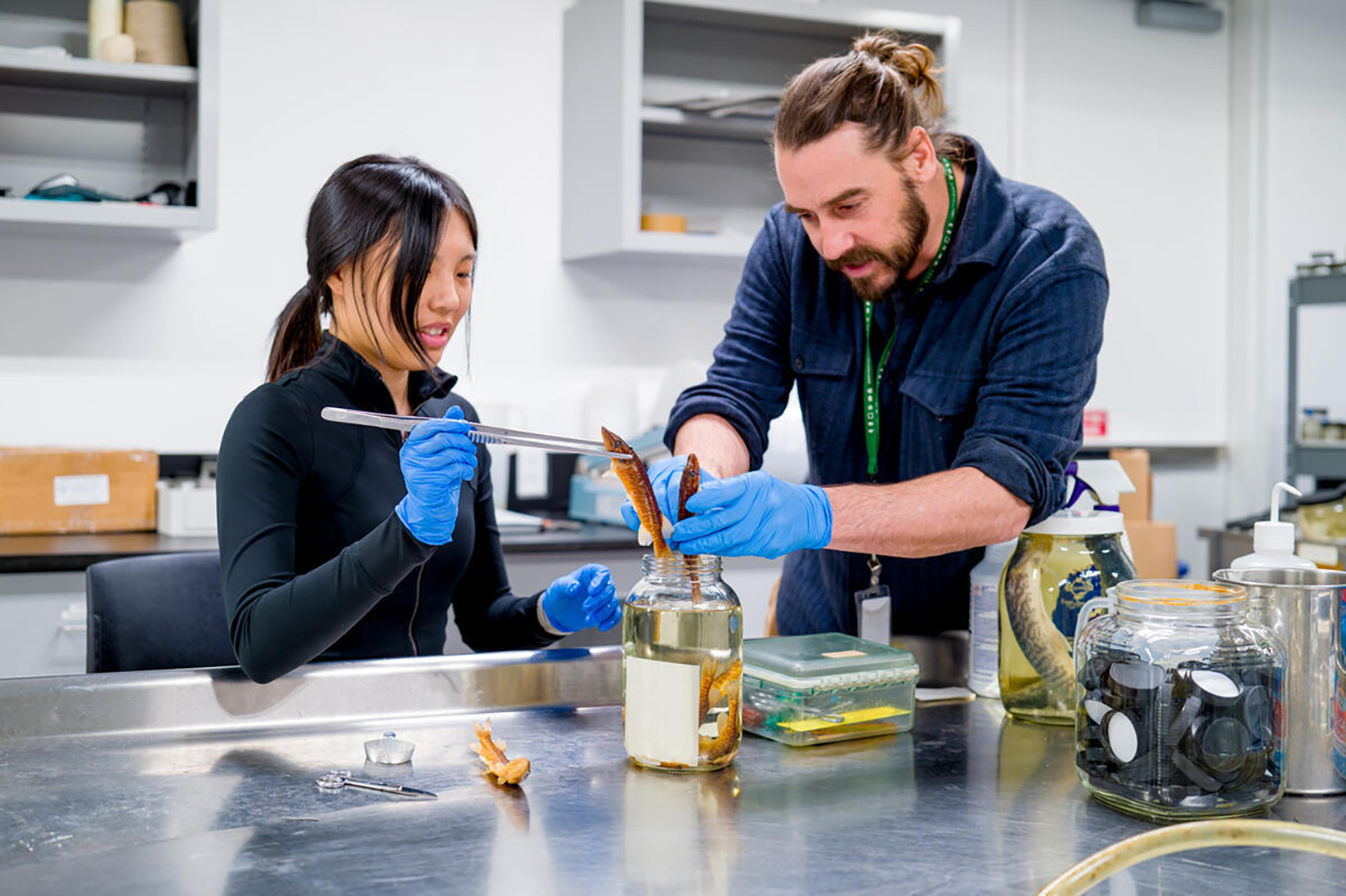
Forceps in hand, Mia Fricano, a high school junior, was about to investigate. She turned over the fish, a bluegill, and slid in a blade, before extracting its gastrointestinal tract. Then, she carried the fish innards to a beaker filled with a solution that would dissolve the biological material, revealing if there were any tiny particles of plastic — known as microplastics — inside.
Mia and two other high schoolers working alongside her in a lab this spring were part of a program at the American Museum of Natural History designed to give young people hands-on experience in professional science. Called the Science Research Mentoring Program, or SRMP (pronounced “shrimp”), the program enrolls roughly 60 high school juniors and seniors each year who collaborate with scientists on a research project.
Mia and her peers were matched with Ryan Thoni, an ichthyologist and curatorial associate in the museum’s division of vertebrate zoology. Thoni’s project to gather information on when and how microplastics began to enter the environment relied on the museum’s vast collection of fish specimens dating from more than a century ago — some 3.2 million in total.
Concern about the tiny pieces of plastic debris has grown in the last few years, along with early-stage research on the health risks they pose. The particles are found in human blood, breast milk and even the brain — and in animals, including, as it turned out, nearly all the fish in Thoni’s lab.
“It was kind of shocking to see just how many we did find,” Mia said later. “We weren’t expecting to find more than two to three per fish but in some fish, we would find over 15.” Specimens from the 1970s or earlierwere less likely to contain high levels of microplastic, more than three or so pieces, and fish near urban centers seemed to have more of the plastics, on average, than fish from less populated areas.
“It really does make you realize just how much the environment has been affected,” said Mia. “There hasn’t been a lot of research on it yet,” she added. “Our project might be able to help future people who are also doing research on microplastics.”
Related: Want to read more about how climate change is shaping education? Subscribe to our free newsletter.
SRMP, started in 2009, is operating at a time when the federal government is eliminating fellowships and other support for early career scientists, and defunding scientific research broadly. That both amplifies the need for, and complicates the work of, programs like this one, said Amanda Townley, executive director of the nonprofit National Center for Science Education. Over the last 15 years in particular, such programs have played a big role in giving students a chance to do the kind of applied science that is rarely available in K-12 classrooms because of money and time constraints, she said.
“Museums, university extensions, sometimes libraries, have really done this tremendous job of creating spaces for high school and younger students to engage with scientists doing science,” said Townley. “Those museums, libraries and universities are all under attack.” She added: “We’re going to see a generational impact.”
While the American Museum of Natural History has received some federal government funding, the SRMP program’s money comes from private foundations and individual donors, with additional support from the New York City Council. Students in SRMP participate in a summer institute in August, when they learn basics like how to investigate research questions. Then they spend two afternoons a week during the school year on their projects.
Each student receives a stipend, $2,500 over the course of the year. “It’s really important for high school students to know their time is valuable,” said Maria Strangas, the museum’s assistant director of science research experiences. “They are doing something here that is really useful for the researchers; it’s an education program, but they aren’t the only ones who are benefiting.”
Students from New York City schools that partner with the museum can apply, as well as those who have participated in programs with the museum in the past. SRMP has also spawned a network of about 30 similar programs across the city, with institutions including Brooklyn College, Bronx River Alliance and many others participating.
In the lab on the sixthfloor of the museum, Mia, who attends the New York City Museum School, cleaned out a beaker, while Yuki Chen, a senior at Central Park East High School, sat at a metal table, dissecting a pike. Thoni inserted a slide containing material harvested from one of the fish under a microscope, and pointed out a few microplastics, which looked like threads.
Ryan Thoni of the American Museum of Natural History, right, with high schoolers Mia Fricano (center) and Freyalise Matasar. Credit: Caroline Preston/The Hechinger Report
Freyalise Matasar, a junior at the Ethical Culture Fieldston School in the Bronx, plucked a white sucker fish from a jar. She said SRMP had altered her career trajectory. Before the program, she was considering studying journalism in college, but her experience this year persuaded her to focus on engineering and data science instead.
“I have totally fallen in love with science,” she said. “It’s been an amazing experience to see what professional science looks like — and more than just see it, to be a part of it.”
Freyalise said she wanted to build those skills in order to help fight climate change, perhaps by working on weather models to predict climate risks and ideally spur people to action. “It’s the biggest problem faced by our generation. It’s inescapable and unignorable, no matter how much people try,” she said. “It’s everyone’s responsibility to do what they can to fight it.”
Microplastics contribute to climate change in several ways, including by potentially disrupting oceans’ ability to sequester carbon and by directly emitting greenhouse gases.
Interest in climate science among young people is growing, even as the federal government tries to zero out funding for it. Other climate-related topics SRMP students explored this year included the climate on exoplanets, the ecology of sea anemones and aquatic wildlife conservation in New York City.
Sometimes the fish dissections were gross: Mia, who plans to study biology and machine learning in college, sliced into one large fish to find poorly preserved, rotten innards — and a major stink. Sometimes they provided a lesson beyond pollution: Yuki identified a small pickerel inside a larger one. (Pickerels prey even on members of their own species, the students learned.)
The scientists in the program, most of whom are postdoctoral fellows, are trained on how to be effective mentors. “Scientists are often not trained in mentorship; it’s something that people pick up organically seeing good or bad examples in their own lives,” said Strangas. “A lot of it comes down to: ‘Think about the impact you want to have, think about the impact you don’t want to have, think about the power dynamic at play, and what this student in front of you wants to get out of it.’”
Thoni earned rave reviews from the students, who said he ensured they understood each step of the research process without being patronizing.
Thoni’s next steps include working to publish the microplastics research, which could earn the students their first co-authorship in a scientific journal. “Aside from forgetting to put on gloves,” he said in a playful jab at one student, “they can operate this machine on their own. They do science.”
Contact editor Caroline Preston at 212-870-8965, via Signal at CarolineP.83 or on email at [email protected].
This story about science careers was produced by The Hechinger Report, a nonprofit, independent news organization focused on inequality and innovation in education. Sign up for the Hechinger newsletter on climate and education.
The Hechinger Report provides in-depth, fact-based, unbiased reporting on education that is free to all readers. But that doesn’t mean it’s free to produce. Our work keeps educators and the public informed about pressing issues at schools and on campuses throughout the country. We tell the whole story, even when the details are inconvenient. Help us keep doing that.
In Florida, a bill that bans cellphone use in elementary and middle schools, from bell to bell, recently sailed through the state Legislature.
Gov. Ron DeSantis signed it into law on May 30, 2025. The same bill calls for high schools in six Florida districts to adopt the ban during the upcoming school year and produce a report on its effectiveness by Dec. 1, 2026.
We are experts in media use and public health who surveyed 1,510 kids ages 11 to 13 in Florida in November and December 2024 to learn how they’re using digital media and the role tech plays in their lives at home and at school. Their responses were insightful – and occasionally surprising.
Adults generally cite four reasons to ban phone use during school: to improve kids’ mental health, to strengthen academic outcomes, to reduce cyberbullying and to help limit kids’ overall screen time.
But as our survey shows, it may be a bit much to expect a cellphone ban to accomplish all of that.
What do kids want?
Some of the questions in our survey shine light on kids’ feelings toward banning cellphones – even though we didn’t ask that question directly.
We asked them if they feel relief when they’re in a situation where they can’t use their smartphone, and 31% said yes.
Additionally, 34% of kids agreed with the statement that social media causes more harm than good.
And kids were 1.5 to 2 times more likely to agree with those statements if they attended schools where phones are banned or confiscated for most of the school day, with use only permitted at certain times. That group covered 70% of the students we surveyed because many individual schools or school districts in Florida have already limited students’ cellphone use.
How students use cellphones matters
Some “power users” of cellphone apps could likely use a break from them.
Twenty percent of children we surveyed said push notifications on their phones — that is, notifications from apps that pop up on the phone’s screen — are never turned off. These notifications are likely coming from the most popular apps kids reported using, like YouTube, TikTok and Instagram.
This 20% of children was roughly three times more likely to report experiencing anxiety than kids who rarely or never have their notifications on.
They were also nearly five times more likely to report earning mostly D’s and F’s in school than kids whose notifications are always or sometimes off.
Our survey results also suggest phone bans would likely have positive effects on grades and mental health among some of the heaviest screen users. For example, 22% of kids reported using their favorite app for six or more hours per day. These students were three times more likely to report earning mostly D’s and F’s in school than kids who spend an hour or less on their favorite app each day.
They also were six times more likely than hour-or-less users to report severe depression symptoms. These insights remained even after ruling out numerous other possible explanations for the difference — like age, household income, gender, parent’s education, race and ethnicity.
Banning students’ access to phones at school means these kids would not receive notifications for at least that seven-hour period and have fewer hours in the day to use apps.
Phones and mental health
However, other data we collected suggests that bans aren’t a universal benefit for all children.
Seventeen percent of kids who attend schools that ban or confiscate phones report severe depression symptoms, compared with just 4% among kids who keep their phones with them during the school day.
This finding held even after we ruled out other potential explanations for what we were seeing, such as the type of school students attend and other demographic factors.
We are not suggesting that our survey shows phone bans cause mental health problems.
It is possible, for instance, that the schools where kids already were struggling with their mental health simply happened to be the ones that have banned phones. Also, our survey didn’t ask kids how long phones have been banned at their schools. If the bans just launched, there may be positive effects on mental health or grades yet to come.
In order to get a better sense of the bans’ effects on mental health, we would need to examine mental health indicators before and after phone bans.
To get a long-term view on this question, we are planning to do a nationwide survey of digital media use and mental health, starting with 11- to 13-year-olds and tracking them into adulthood.
Even with the limitations of our data from this survey, however, we can conclude that banning phones in schools is unlikely to be an immediate solution to mental health problems of kids ages 11-13.
Grades up, cyberbullying down
Students at schools where phones are barred or confiscated didn’t report earning higher grades than children at schools where kids keep their phones.
This finding held for students at both private and public schools, and even after ruling out other possible explanations like differences in gender and household income, since these factors are also known to affect grades.
There are limits to our findings here: Grades are not a perfect measure of learning, and they’re not standardized across schools. It’s possible that kids at phone-free schools are in fact learning more than those at schools where kids carry their phones around during school hours – even if they earn the same grades.
We asked kids how often in the past three months they’d experienced mistreatment online – like being called hurtful names or having lies or rumors spread about them. Kids at schools where phone use is limited during school hours actually reported enduring more cyberbullying than children at schools with less restrictive policies. This result persisted even after we considered smartphone ownership and numerous demographics as possible explanations.
We are not necessarily saying that cellphone bans cause an increase in cyberbullying. What could be at play here is that at schools where cyberbullying has been particularly bad, phones have been banned or are confiscated, and online bullying still occurs.
But based on our survey results, it does not appear that school phone bans prevent cyberbullying.
Overall, our findings suggest that banning phones in schools may not be an easy fix for students’ mental health problems, poor academic performance or cyberbullying.
That said, kids might benefit from phone-free schools in ways that we have not explored, like increased attention spans or reduced eyestrain.
Roughly half of middle and high schoolers report losing interest in math class at least half the time, and 1 in 10 lack interest nearly all the time during class, a new study shows.
In addition, the students who felt the most disengaged in math class said they wanted fewer online activities and more real-world applications in their math classes.
Feeling bored in math class from time to time is not an unusual experience, and feeling “math anxiety” is common. However, the RAND study notes that routine boredom is associated with lower school performance, reduced motivation, reduced effort, and increased rates of dropping out of school.
Perhaps unsurprisingly, the study found that the students who are the most likely to maintain their interest in math comprehend math, feel supported in math, are confident in their ability to do well in math, enjoy math, believe in the need to learn math, and see themselves as a “math person.”
Dr. Heather Schwartz, a RAND researcher and the primary investigator of the study, noted that the middle and high school years are when students end up on advanced or regular math tracks. Schwartz said that for young students determining their own sense of math ability, “Tracking programs can be a form of external messaging.”
Nearly all the students who said they identified as a “math person” came to that conclusion before they reached high school, the RAND survey results show. A majority of those students identified that way as early as elementary school. In contrast, nearly a third of students surveyed said they never identified that way.
“Math ability is malleable way past middle school,” Schwartz said. Yet, she noted that the survey indicates students’ perception of their own capabilities often remains static.
The RAND study drew on data from their newly established American Youth Panel, a nationally representative survey of students ages 12-21. It used survey responses of 434 students in grades 5-12. Because this was the first survey sent to members of the panel, there is no comparable data on student math interest prior to the pandemic, so it doesn’t measure any change in student interest.
The RAND study found that 26% percent of students in middle and high school reported losing interest during a majority of their math lessons. On the other end of the spectrum, a quarter of students said they never or almost never lost interest in math class.
There weren’t major differences in the findings across key demographic groups: Students in middle and high school, boys and girls, and students of different races and ethnicities reported feeling bored during a majority of math class at similar rates.
Dr. Janine Remillard, a professor at the University of Pennsylvania Graduate School of Education and expert in mathematics curriculum, said that in many math classes, “It’s usually four or five students answering all the questions, and then the kids who either don’t understand or are less interested or just take a little bit more time — they just zone out.”
Over 50% of students who lost interest in almost all of their math classes asked for fewer online activities and more real-world problems, the RAND study shows. Schwartz hypothesizes that some online math programs represent a “modern worksheet” and emphasize solo work and repetition. Students who are bored in class instead crave face-to-face activities that focus on application, she said.
During Remillard’s math teacher training classes, she puts students in her math teacher training class into groups to solve math problems. But she doesn’t tell them what strategy to use.
The students are forced to work together in order to understand the process of finding an answer rather than simply repeating a given formula. All of her students typically say that if they had learned math this way, they would think of themselves as a math person, according to Remillard, who was not involved in the RAND study.
Chalkbeat is a nonprofit news site covering educational change in public schools.
For more news on STEM learning, visit eSN’s STEM & STEAM hub.
Norah Rami, Chalkbeat
Norah Rami is a Dow Jones education reporting intern on Chalkbeat’s national desk. Reach Norah at [email protected].
Latest posts by eSchool Media Contributors (see all)
In one of his all-too-frequent rants on Truth Social last month, President Trump posted, “I am considering taking Three Billion Dollars of Grant Money away from a very antisemitic Harvard, and giving it to TRADE SCHOOLS all across our land.” It’s a transparent and cynical ploy: pit one segment of the education community against another—rich Harvard versus poor “trade schools”—and watch the divisions take hold. But make no mistake: This strategy only works if institutions, elite or otherwise, fall for the bait.
We’re not sure what the president means by “trade schools” but suspect he’s referring to the nation’s 1,000-plus community and technical colleges— institutions that educate about a third of all U.S. undergraduates. We’ve both spent our careers making the case for greater investment in these colleges, including through the Project on Workforce, the cross-Harvard initiative we helped found six years ago to forge better pathways between education and good jobs.
(And for the record: Trump’s accusation that Harvard is “very antisemitic” rings hollow coming from the man who hosted a Holocaust-denying white nationalist at Mar-a-Lago. It’s certainly unrecognizable to us—two Jews who, between us, have spent more than 40 years as Harvard students, staff and faculty.)
If Trump actually cared about funding “trade schools,” he would start by telling congressional leaders to strip the provision in his so-called Big Beautiful Bill that raises the credit-hour threshold for Pell Grant eligibility. Community colleges serve the bulk of low-income students, and most of them have to work while in school. This proposed change proffered by the House, which was not included in the Senate version of the reconciliation bill, could cut off aid for 400,000 students a year and force many to drop out.
But the threat isn’t just in proposed legislation: Community colleges are already the targets of Trump’s politically motivated grant cancellations. For example, just last month, his administration revoked awards from six Tech Hubs, created by bipartisan legislation to boost innovation, job creation and national security. These included projects in Alabama, where a community college would expand biotech training; in Idaho, where a community college planned to train aerospace workers; and in Vermont, where a community college was preparing a new semiconductor workforce.
And the cuts don’t stop there. If the president was really serious about supporting the U.S. skilled technical workforce, he would expand, not gut, programs like the National Science Foundation’s Advanced Technological Education initiative, which has provided $1.5 billion to more than 500 community and technical colleges to develop cutting-edge training in fields like advanced manufacturing and robotics. Instead, his budget proposes cutting NSF by 55 percent, including deep reductions to education and workforce programs. The president’s budget also proposes eliminating all Perkins Act funding for community colleges (approximately $400 million), limiting the funding to middle and high schools and thereby cutting off a key source of federal support for technical training beyond secondary school.
If by “trade schools” Trump means education for trades jobs, his hostility toward immigrants undermines the very students he claims to support. Eight percent of community college students are not U.S. citizens, with much higher shares on some campuses. They are just as vital to America’s future as the researchers in Harvard’s labs. In 2024, immigrants made up more than 30 percent of construction trades workers and 20 percent of U.S. manufacturing workers. Closing America’s doors won’t just harm colleges: It will weaken our ability to build, make and compete.
Last week, we joined more than 12,000 Harvard alumni in signing an amicus brief to pledge our commitment to defend not only Harvard but the broader higher education enterprise from the Trump administration’s bullying attacks. Over the past month, we also spoke with community college leaders from around the country whose work we profiled in our 2023 book, America’s Hidden Economic Engines. Without exception, these leaders expressed deep concern, understanding that if Harvard, with all of its resources, could be forced to bend to the will of a tyrannical government, what chance would less resourced institutions have to defend academic freedom and maintain independence from governmental intrusion?
If elite universities and community and technical colleges stand together, we can defend not just education, but democracy itself. Challenging as it will be for Harvard to weather this unprecedented assault on its independence, and that of higher education, it has no choice but to stand firm. Unlike many more vulnerable victims of Trump’s bullying—immigrants, civil servants, USAID grantees, the trans community—Harvard has the resources to fight back. Ultimately its rights, along with the rights of others targeted, will likely be vindicated by the courts. But in the interim, a lot of needless damage will be done to the lives of affected people and institutions. Most Americans may not speak often of such abstractions as academic freedom, due process and the fate of democracy. But they know a bully when they see one.
Rachel Lipson, a co-founder of the Harvard Project on Workforce, was a senior adviser on workforce at the CHIPS Program Office at the U.S. Department of Commerce. She recently returned to Harvard Kennedy School as a research fellow.
Robert Schwartz is a professor of practice emeritus at Harvard Graduate School of Education.Before joining the Harvard faculty in 1996, he had a long career in education and government.
New York, NY –Counslr, a leading B2B mental health and wellness platform, announced today that it has expanded its footprint into the State of Texas starting with a partnership with Colorado Independent School District (ISD) in Colorado City, TX. This partnership will empower students and staff to prioritize their mental health by enabling them to access unlimited live texting sessions with Counslr’s licensed and vetted mental health support professionals, who are available on-demand, 24/7/365 and also utilize the app’s robust and curated wellness resources. By increasing accessibility to Counslr’s round-the-clock support, Colorado ISD aims to empower those silent sufferers who previously did not or could not access care, whether due to cost, inconvenience, or stigma.
Texas is facing a critical mental health care crisis, with over 95% of its counties officially designated as Mental Health Professional Shortage Areas. This alarming statistic underscores the severe lack of access to mental health services across the state, particularly in rural, border, and frontier communities. This resource scarcity underscores the urgent need for additional resources and innovative solutions to bridge this critical care gap for school communities.
“We’re excited to partner with Counslr to bring innovative, accessible mental health resources to our school community,” said Alison Alvarez, Family and Community Engagement Coordinator, of Colorado ISD. “This partnership empowers our 6-12 grade students and staff with the support they need to thrive—both in and out of the classroom.”
As factors such as academic pressures, social media influence, burnout and world events contribute to an increase in mental health challenges for young people, schools throughout the country are recognizing the growing need to offer more accessible, prevention-focused resources. A recent study found that digital mental health apps like Counslr can play an important role in expanding access to mental health support, especially for school communities. Most users turned to Counslr through on-demand sessions, showing just how valuable it is to have someone available in the moment when support is needed most. Interestingly, more than 80% of sessions happened between 7 PM and 5 AM, a time when traditional counseling services are usually unavailable. This suggests that Counslr helps fill a critical gap, offering students and school community members a reliable way to talk to licensed counselors around the clock. The app was also used for a wide range of concerns, highlighting its potential to meet diverse mental health needs through both immediate and scheduled support.
“As we expand across the country, we’re proud to partner with new school communities to ensure that every student, regardless of location or background, has access to the mental health support they deserve,” said Josh Liss, Counslr CEO. Adding that, “With most of Counslr’s users being first-time care seekers, we’re excited to help reach those traditionally unreachable, who need help but do not or cannot access it, no matter where they are located.”
ABOUT COUNSLR
Counslr is a text-based mental health support application that provides unlimited access to robust wellness resources and live texting sessions with licensed professionals, 24/7/365. Users can access support on-demand within two minutes of opening the app, or by scheduled appointment. Through real-time texting, users enjoy one-on-one, private communication with a licensed counselor that can be conducted anytime, anywhere. Counslr was designed to help individuals deal with life’s day-to-day issues, empowering individuals to address concerns while they are “small” to help ensure that they stay “small”. Counslr partners with organizations of all shapes and sizes (companies, unions, nonprofits, universities/colleges, high schools, etc) so that these entities can provide Counslr’s services to their employees/members/students at no direct cost. For more information, please visit www.counslr.com.
eSchool Media staff cover education technology in all its aspects–from legislation and litigation, to best practices, to lessons learned and new products. First published in March of 1998 as a monthly print and digital newspaper, eSchool Media provides the news and information necessary to help K-20 decision-makers successfully use technology and innovation to transform schools and colleges and achieve their educational goals.
Harvard Medical School’s decision to rename its Diversity, Inclusion and Community Partnership office has sparked significant reaction from students and observers, marking Harvard’s latest move to reshape its diversity infrastructure amid shifting political pressures.
The medical school will now call the unit the Office for Culture and Community Engagement, according to a letter from Dr. George Daley, dean of Harvard Medical School. The announcement comes as Harvard continues to navigate criticism over its earlier decision to rename its main “Office for Equity, Diversity, Inclusion & Belonging” to “Community and Campus Life” — a move that drew considerable backlash when the university also eliminated funding and support for affinity graduations.
“I hope it is abundantly clear that while we continue to adapt to the ever-evolving national landscape, Harvard Medical School’s longstanding commitment to culture and community will never waver,” Daley wrote in his letter to the medical school community.
The renamed office will emphasize “opportunity and access” along with “collaboration and community-building,” according to Daley’s announcement. Additionally, the Office of Recruitment and Multicultural Affairs will be absorbed into the Office of Student Affairs as part of the restructuring.
Harvard’s moves come as the Trump administration has intensified pressure on higher education institutions over diversity, equity and inclusion programming. An executive order signed by President Trump characterizes many DEI programs as “unlawfully discriminatory practices” and threatens to revoke accreditation from colleges and universities that maintain such initiatives.
The timing has also created tension for Harvard, which became the first major institution to legally challenge the Trump administration when it filed a lawsuit in response to federal threats to withdraw billions in funding. However, the DEI office renaming has been viewed by some as contradictory to that stance of resistance.
“It’s signaling that if they’re willing to capitulate on some demands, then they’re likely to capitulate in the future. This kind of sends confused, mixed signals to students,” Harvard junior and LGBTQ student Eli Johnson said about the university’s broader DEI changes.
Harvard Medical School’s decision follows similar moves by other prominent institutions. Dr. Sally Kornbluth, MIT’s president, announced plans in late May to “sunset” the university’s Institute Community and Equity Office and eliminate its vice president for equity and inclusion position, though core programs will continue under other offices. Northeastern University has also renamed its diversity office.
As part of the medical school’s transition, Daley announced the creation of a committee to “review and recommend updates” to the “principles and statements that guide our community and our values.”
A Harvard spokesperson declined to provide additional comment on the medical school’s decision or the broader reaction it has generated.
The developments highlight the challenging position many higher education institutions find themselves in as they attempt to balance longstanding commitments to diversity and inclusion with mounting political and potential financial pressures from the federal government.
Central vision loss–a condition that impairs the ability to see objects directly in front of the eyes–can have profound academic and social impacts on K-12 students. Because this type of vision loss affects tasks that require detailed focus, such as reading, writing, and recognizing faces, students with central vision impairment often face unique challenges that can affect their overall school experience.
In the classroom, students with central vision loss may struggle with reading printed text on paper or on the board, despite having otherwise healthy peripheral vision. Standard classroom materials are often inaccessible without accommodations such as large print, magnification devices, or digital tools with text-to-speech capabilities. These students might take longer to complete assignments or may miss visual cues from teachers, making it difficult to follow along with lessons. Without appropriate support, such as assistive technology, students may fall behind academically, which can affect their confidence and motivation to participate.
As a result, they may be perceived as aloof or unfriendly, leading to social isolation or misunderstanding. Group activities, games, and unstructured time like lunch or recess can become sources of anxiety if students feel excluded or unsafe. Moreover, children with vision loss may become overly dependent on peers or adults, which can further affect their social development and sense of independence.
While this may seem daunting, there are assistive technologies to help students navigate central vision loss and have fulfilling academic and social experiences.
One such technology, eSight Go from Gentex Corporation’s eSight, uses an advanced high-speed, high-definition camera to capture continuous video footage of what a user is looking at. Algorithms optimize and enhance the footage and share it on two HD OLED screens, providing sharp, crystal-clear viewing. The user’s brain then synthesizes the images to fill any gaps in their vision, helping them to see more clearly, in real time.
“The ability to have central perception brought back into your set of tools for education is critically important,” said Roland Mattern, eSight’s director of sales and marketing. “Ease of reading, ease of seeing the board, using tablets or computers–all of these things [lead to] the ability to complete an academic task with greater ease.”
One key feature, Freeze Frame, lets the user capture a temporary photograph with the device’s camera, such as an image on an interactive whiteboard, a textbook page, or a graphic. The student can magnify the image, scan and study it, and take what they need from it.
“This eases the ability to absorb information and move on, at a regular pace, with the rest of the class,” Mattern noted.
Socially, central vision loss can create additional barriers. A major part of social interaction at school involves recognizing faces, interpreting facial expressions, and making eye contact–all tasks that rely heavily on central vision. Students with this impairment might have difficulty identifying peers or teachers unless they are spoken to directly. The glasses can help with these social challenges.
“There’s a huge social aspect to education, as well–seeing expressions on teachers’ and fellow students’ faces is a major part of communication,” Mattern said.
What’s more, the glasses also help students maintain social connections inside and outside of the classroom.
“Think of how much peer-to-peer communication is digital now, and if you have central vision loss, you can’t see your phone or screen,” Mattern said. “The educational part is not just academic–it’s about the student experience that you want to enhance and optimize.”
Educators, parents, and school staff play a crucial role in fostering inclusive environments–by educating classmates about visual impairments, encouraging empathy, and ensuring that students with central vision loss are supported both academically and socially. With the right accommodations and social-emotional support, these students can thrive in school and build strong connections with their peers.
“If we can make daily living, hobbies, and education easier and facilitate participation, that’s a win for everybody,” Mattern said.
Laura Ascione is the Editorial Director at eSchool Media. She is a graduate of the University of Maryland’s prestigious Philip Merrill College of Journalism.
This audio is auto-generated. Please let us know if you have feedback.
More adults recommend trade school for new high school graduates than those who recommend college, according to a June 5 report from the American Staffing Association.
When considering the “ideal post high school path” for today’s graduates, 33% of U.S. adults advocated for a vocational or trade school, followed by 28% who encouraged a four-year college or university, 13% who advised entering the workforce and 11% who supported apprenticeships.
“The time has come to radically rethink how we’re preparing America’s future workforce,” said Richard Wahlquist, CEO of ASA. “Americans are clearly concerned that colleges and universities are failing to equip students with the workplace-relevant skills that employers need.”
In the survey of more than 2,000 U.S. adults, opinions varied by generation. Vocational and trade school careers were most supported by baby boomers (41%), Generation X (37%) and millennials (31%), as compared to 22% of Generation Z.
On the other hand, Gen Z was the only generation to recommend a four-year degree (36%) over a vocational or trade school (22%). Members of Gen Z were most likely to say graduates should pursue a traditional degree, followed by entering the workforce or attending a trade school.
“These results underscore the importance of educators, policymakers and parents coming together now to develop, fund and support programs designed to prepare young people for the jobs of today and the future world of work,” Wahlquist said.
More than 40% of Gen Z adults are working in or pursuing a blue-collar or skilled trade job, according to a Resume Builder report. Workers said they’re choosing these jobs for better long-term options, higher pay and a lower risk of being replaced by artificial intelligence tools.
Although many Gen Z workers want to pursue skilled trades careers, they face challenges when trying to access critical training, according to a Dewalt report. Half of the students surveyed said they were placed on training waitlists, but once enrolled, they participated in internships, mentorship programs and real-world work experiences.
This audio is auto-generated. Please let us know if you have feedback.
More adults recommend trade school for new high school graduates than those who recommend college, according to a June 5 report from the American Staffing Association.
When considering the “ideal post high school path” for today’s graduates, 33% of U.S. adults advocated for a vocational or trade school, followed by 28% who encouraged a four-year college or university, 13% who advised entering the workforce and 11% who supported apprenticeships.
“The time has come to radically rethink how we’re preparing America’s future workforce,” said Richard Wahlquist, CEO of ASA. “Americans are clearly concerned that colleges and universities are failing to equip students with the workplace-relevant skills that employers need.”
In the survey of more than 2,000 U.S. adults, opinions varied by generation. Vocational and trade school careers were most supported by baby boomers (41%), Generation X (37%) and millennials (31%), as compared to 22% of Generation Z.
On the other hand, Gen Z was the only generation to recommend a four-year degree (36%) over a vocational or trade school (22%). Members of Gen Z were most likely to say graduates should pursue a traditional degree, followed by entering the workforce or attending a trade school.
“These results underscore the importance of educators, policymakers and parents coming together now to develop, fund and support programs designed to prepare young people for the jobs of today and the future world of work,” Wahlquist said.
More than 40% of Gen Z adults are working in or pursuing a blue-collar or skilled trade job, according to a Resume Builder report. Workers said they’re choosing these jobs for better long-term options, higher pay and a lower risk of being replaced by artificial intelligence tools.
Although many Gen Z workers want to pursue skilled trades careers, they face challenges when trying to access critical training, according to a Dewalt report. Half of the students surveyed said they were placed on training waitlists, but once enrolled, they participated in internships, mentorship programs and real-world work experiences.
Good call. A well-run open house can be one of the most powerful tools in your enrollment and engagement strategy. Whether you’re welcoming new elementary parents, high school prospects, or college hopefuls, this is your chance to make an unforgettable first impression. An open house in school is important because it helps build a sense of community, foster parent involvement, and drive enrollment.
But a memorable open house doesn’t happen by accident. It requires careful planning, creative ideas, and attention to detail. From initial promotions to day-of execution and follow-up, every step counts.
So, how do you make it count?
Let’s walk through ten practical (and proven) tips to take your school’s open house from good… to exceptional.
Struggling to stand out in a crowded market?
Boost enrollment with tailored open house strategies!
1. Start Planning Early And Promote Like a Pro
Here’s the truth: If no one shows up, nothing else matters.
That’s why promotion is the first step, and it’s a big one. First, get clear on your goals. Are you looking to boost applications? Showcase new facilities? Strengthen relationships with current families? Your goals will shape everything from the schedule to who you invite.
How do you prepare for an open house at school? Start by setting clear goals and selecting a date that works for your audience. Plan the schedule, secure staff and student volunteers, and prepare promotional materials. Promote the event across multiple channels (website, email, social media), tidy up the campus, and organize signage, welcome tables, and printed resources to ensure a smooth, welcoming experience.
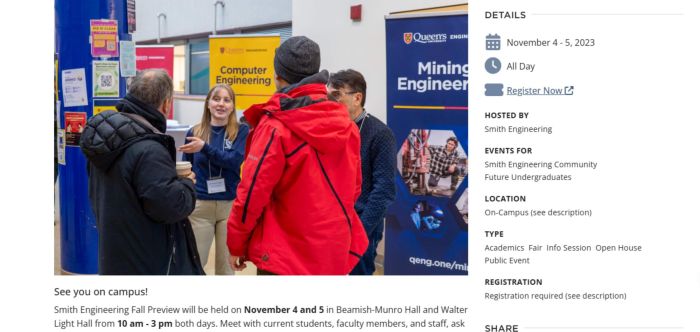
Example: Queen’s University (Canada) demonstrated advanced planning by creating a dedicated “Fall Preview” Open House webpage months ahead. The page provided key details (date, schedule, location) and prominently featured a call-to-action for prospective students to register, ensuring maximum visibility and early sign-ups.
Then, plan your outreach. Don’t wait until the last minute. Get your date on the calendar months in advance, and begin promoting it strategically across various online channels:
A dedicated landing page on your school’s website (with RSVP).
A short email series to build awareness and excitement.
Countdown posts, teaser videos, and stories on social media.
Text reminders or personal phone calls to those most likely to attend.
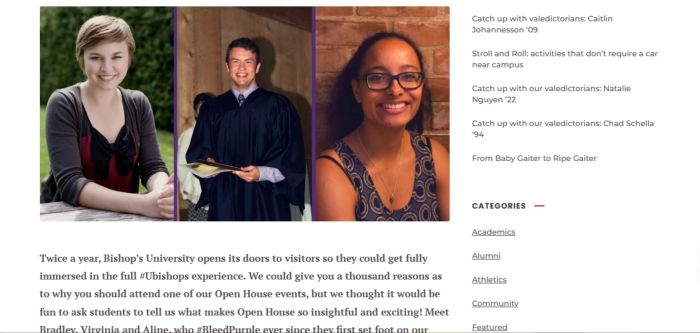
Example: Bishop’s University (Canada) boosted promotion by publishing a blog post prior to their Open House that walked readers through what to expect at the event. This preview-style post generated excitement and informed prospective students and parents about the Open House experience in detail.
Still want more attendees? Consider offering a virtual option. Whether it’s a livestream, a digital campus tour, or a short webinar, giving families more than one way to experience your school expands your reach.
2. Make Arrival Smooth and the Welcome Unforgettable
Let’s face it, no one enjoys showing up somewhere and feeling lost.
That’s why the moment guests arrive at your open house, the experience should feel seamless and friendly.
Start with signage. Make sure every guest knows exactly where to park and where to go. Have greeters ready: staff, student leaders, or enthusiastic parent volunteers. A welcome table with a map, a friendly smile, and a short overview of what’s ahead can work wonders.
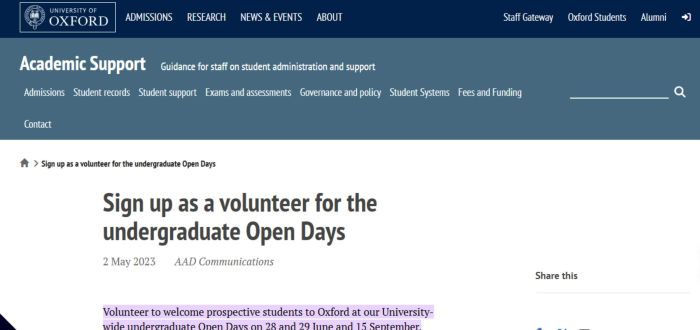
Example: University of Oxford (UK): For its 2023 undergraduate Open Days, Oxford enlisted staff volunteers as greeters and guides. These volunteers welcomed visitors, helped with directions around campus, and served as friendly points of contact at entrances and info tables, ensuring guests felt comfortable and never lost.
Don’t stop there. Decorate with banners, student art, or a slideshow of school activities. Create a warm and exciting vibe the moment families step inside. You’re not just showing them the campus, you’re showing them the community they could be a part of.
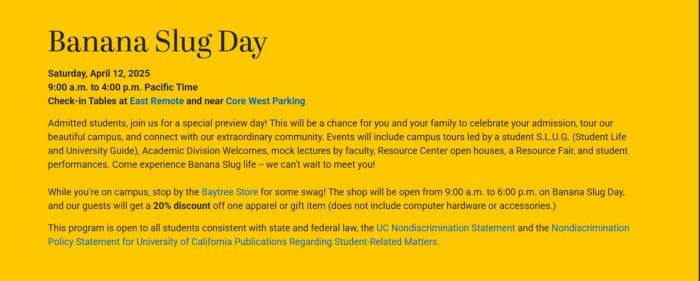
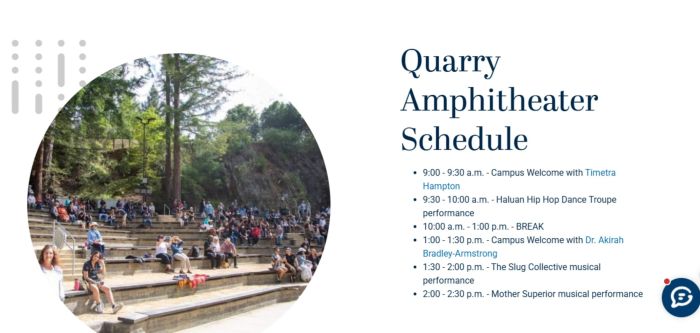
Example: UC Santa Cruz (USA): At its “Banana Slug Day” admitted-students open house in 2025, UC Santa Cruz set up check-in tables at key parking areas and deployed student guides (the “S.L.U.G.” ambassadors) throughout campus. Visitors were greeted at these welcome points and guided by the student ambassadors, making navigation easy and the arrival experience warm and organized.
3. Spotlight the People Who Make Your School Special
The facilities are nice. Programs are great. But what really wins hearts?
Your people.
That’s why teachers, support staff, coaches, and counselors need to be front and center during the open house. Make sure they’re not just present but prepared. Equip them with key talking points and FAQs so they feel confident answering questions and reinforcing your school’s values.
What should teachers do for open house? Teachers should prepare a welcoming classroom with student work on display, provide a brief overview of their curriculum, and have handouts with contact information and expectations. During the event, they should greet families warmly, answer general questions, and encourage follow-up meetings for individual concerns.
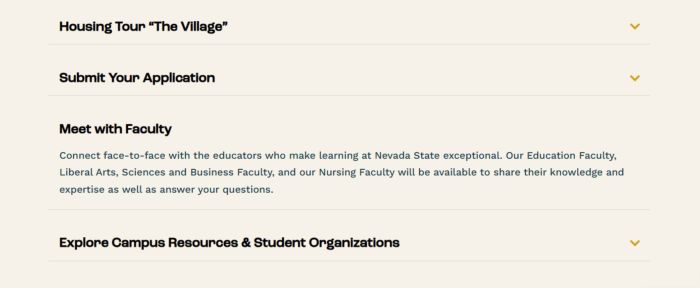
Example: During Nevada State’s Open House, faculty participation was a centerpiece. The event agenda included “Meet with Faculty” sessions where professors from various departments (Education, Liberal Arts & Sciences, Nursing, etc.) were on hand to chat and answer questions. This gave visitors a chance to connect face-to-face with the educators and get a feel for the academic community.
Encourage classroom displays that show what day-to-day learning looks like. And while teachers should be warm and approachable, remind them this isn’t the time for parent-teacher conferences. Keep it general, upbeat, and informative.
Want to go the extra mile? Kick off the event with a welcome from your school leader, followed by a quick intro to the key staff attendees. Let families know who’s who, and who they can talk to about specific interests like arts, athletics, or academics.
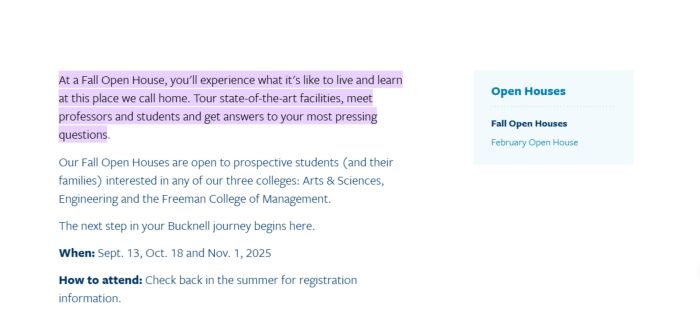
Example: Bucknell’s Fall Open House actively involved faculty and staff in mingling with prospects. Visitors could tour facilities and meet professors and current students to ask questions about programs and campus life, rather than only hearing formal presentations. This personal professor-student engagement at Open House helped put a human face on the university’s academics.
Your current students and parents are your school’s best spokespeople. Hearing about the school’s strengths from an administrator or teacher is valuable, but hearing it from a peer can be even more persuasive. In marketing terms, it’s social proof, and it carries a lot of weight. In fact, one study found that 93% of people trust recommendations from friends and family, while only 38% trust advertising.
Applying this to an open house, a prospective student is likely to trust the words of a current student, and parents will trust the perspectives of other parents, more than any brochure or formal presentation.
That’s why student ambassadors and parent advocates are some of your most valuable open house lead generation assets.
Hand-pick current students who represent the best of your school; friendly, positive, and articulate. Let them lead tours, greet visitors, or share their experience during a short panel. Their enthusiasm is contagious. As one education marketing expert put it, hearing directly from current students and parents can be one of the most powerful ways to engage prospective families.
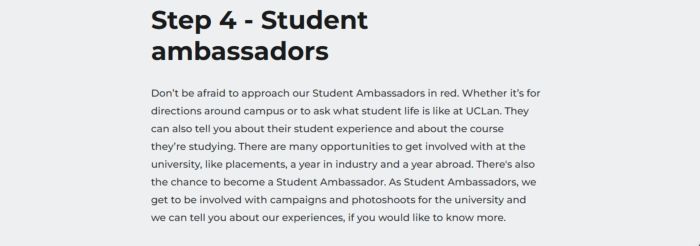
Example: University of Central Lancashire (UK) : At UCLan’s Open Days, current students act as official ambassadors (identifiable in special red attire). These student ambassadors welcome visitors at entrances, give campus directions, and share honest insights about student life and their courses. Attendees are encouraged to approach them with any questions, making the experience peer-guided and relatable.
Similarly, invite a few involved parents to chat with prospective families. Their personal stories, why they chose the school, how their child has grown, carry a weight that even the best marketing can’t match.
You’re not just saying, “We’re great.” You’re showing it.
5. Make the Event Fun, Interactive, and Memorable
Let’s be honest: No one wants to sit through a two-hour lecture.
So here’s your mission: Turn your open house into an experience.
How do you make an open house at school fun? Incorporate interactive elements like hands-on activities, themed scavenger hunts, live demonstrations, or student performances. Offer refreshments, set up a photo booth, and keep presentations short and engaging. The goal is to create an energetic, memorable experience that showcases school spirit.
Instead of a long presentation, create a rotating itinerary. Let families move through classrooms, labs, and activity spaces at their own pace. Throw in a scavenger hunt or “passport” that gets stamped at each stop. Offer a prize at the end for completing the journey.
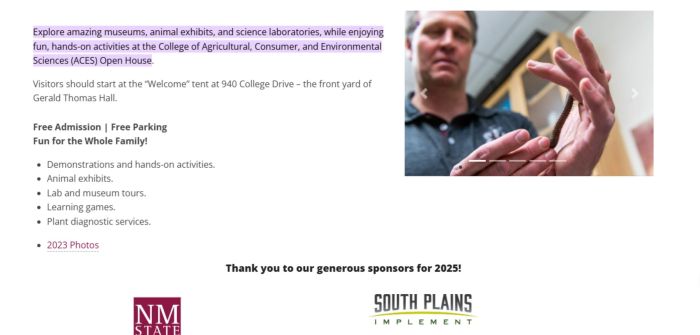
Example: New Mexico State (USA): The College of ACES Open House 2025 at NMSU was designed as a family-friendly, interactive event. Visitors could roam through animal exhibits, science labs and museums with hands-on demonstrations and learning games at each stop. From petting zoo stations to chemistry experiments, attendees of all ages were invited to actively engage, making the Open House both educational and fun.
What else works? Hands-on demos. Let students try a science experiment, play with robots, sample the art room, or participate in a music warm-up. The more your visitors can do, not just see, the more they’ll remember.
Don’t forget the snacks. Coffee, cookies, or treats from the culinary class add comfort and create natural mingling moments. Bonus points if they’re decorated with school colors or logos.
And yes, music, performances, or even a visit from your mascot can energize the space and give families that “wow” moment.
Example: UC Santa Cruz (USA): The Banana Slug Day Open House combined campus exploration with fun activities. Prospective students and families joined student-led tours, watched student performances, visited a resource fair, and even sat in on mock mini-lectures by faculty. These interactive elements (plus chances to snag some UC Santa Cruz swag at the bookstore) turned the day into an immersive campus experience rather than a passive info session.
You’ve got a lot to say, but that doesn’t mean you should say it all at once.
Keep any formal presentations concise and dynamic. Ten to fifteen minutes max is ideal. Focus on the core message: What makes your school stand out? What are the values driving your mission?
Break up speeches with visuals; videos, photos, and student voices make everything more relatable. If you can, include a current student or alum to co-present. Their stories add authenticity and emotion.
Whatever you do, rehearse in advance. A confident, polished delivery makes all the difference.
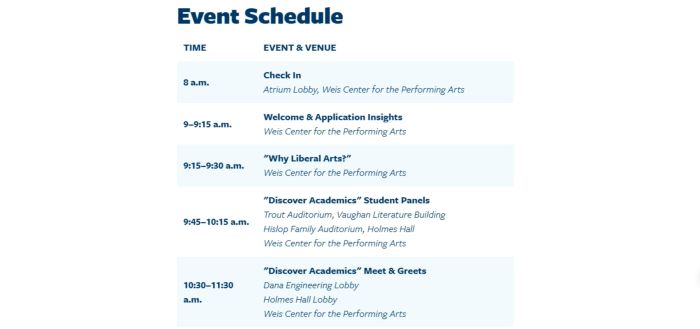
Example: Bucknell keeps Open House presentations brief and purposeful. Its Fall Open House schedule is broken into short sessions: for example, a 15-minute welcome and admissions overview followed by a 15-minute “Why Liberal Arts?” talk. Instead of long lectures, Bucknell offers multiple bite-sized talks and student panels, which keep visitors engaged and allow them to sample various topics without fatigue.
Before the event, ask registrants about their interests: academics, sports, arts, etc. Use this intel to tailor their visit. Match them with the right teacher, program head, or club coordinator. Let them know you were expecting them.
Even on the fly, personalization is powerful. Train ambassadors and staff to ask questions and respond accordingly: “You’re interested in robotics? You’ve got to meet Mr. Jackson. Let me introduce you.”
Name tags, interest-specific packets, or a simple, “Hi Sarah, we’re so glad you’re here,” can go a long way in helping families feel seen.
And yes, be mindful of accessibility needs, language support, and dietary restrictions. Every thoughtful detail adds up.
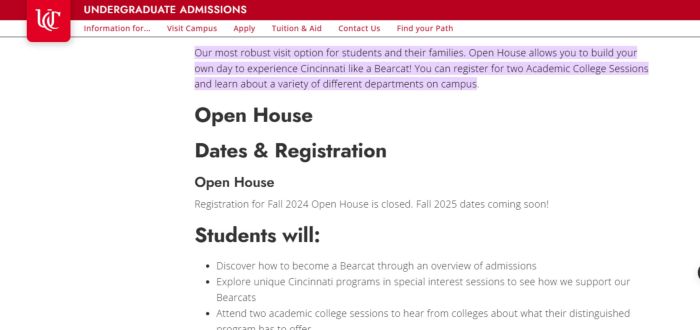
Example: University of Cincinnati (USA): Cincinnati’s Open House model allows each guest to “build your own day.” Attendees register for the specific academic sessions and special topics that interest them most. For example, a student could choose two different college info sessions (say, Engineering and Business) and several niche interest workshops. The itinerary is flexible – with options like honors program talks, campus tours, residence hall tours, etc. – so each visitor crafts a personalized schedule aligned with their goals.
Before families leave, hand them something to take home, whether that’s a branded folder with your materials, a printed photo from a photo booth, or even just a small keepsake like a sticker or magnet.
More importantly, give them the info they need to take the next step. Include your admissions contact, an FAQ sheet, key dates, and a personalized thank-you letter from the principal.
A friendly goodbye, a handshake, and a “We hope to see you again soon” can seal the deal emotionally. People remember how you made them feel. Make it good.
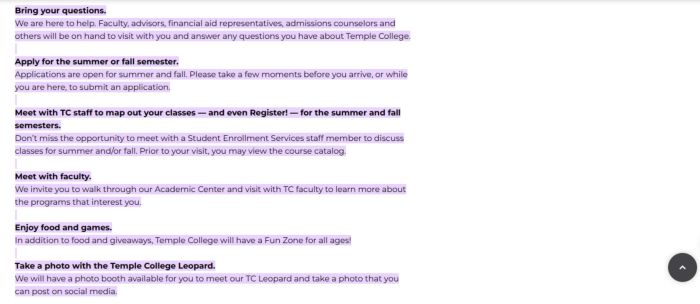
Example: Temple College (USA): This community college makes sure guests leave with smiles (and photos). At its Open House, Temple College set up a fun photo booth with their mascot, “TC Leopard.” Students and families could snap pictures with the mascot – a keepsake to post on social media – and even win prizes. This lighthearted closing activity gave attendees a lasting memory and positive vibe to associate with the school.
Send a thank-you email the next day. Personalize it if you can. Include links to the application page, upcoming deadlines, and photos from the event. Invite further questions and make it easy to get in touch.
If a family asks about something specific, say, learning support or scholarship details, make sure someone follows up with a personalized message.
Want to keep the momentum going? Enroll attendees in a short email series spotlighting your programs, alumni, or events. Nurturing that relationship can turn a visitor into an applicant.
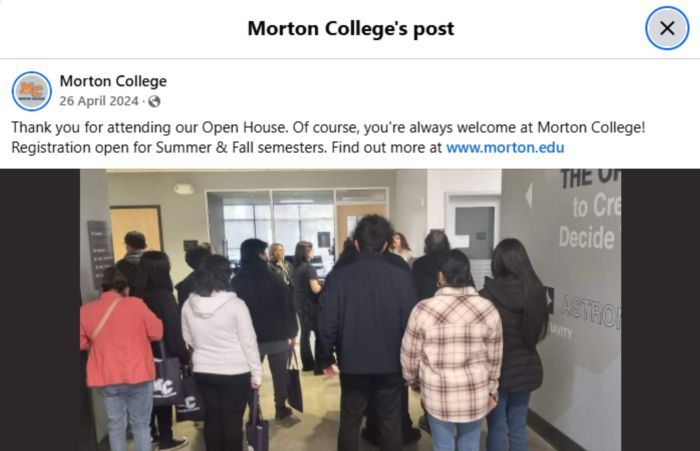
Example: Morton College (USA): After the Open House, Morton College immediately followed up with attendees and the broader community on social media. They posted a thank-you message to everyone who came, reinforcing that visitors are always welcome on campus. Importantly, the message included a next-step call-to-action, a reminder that registration was open for upcoming semesters, nudging interested students to take the next practical step toward enrollment.
10. Debrief, Reflect, and Get Ready to Do It Even Better Next Time
One last tip, and it’s a game changer.
After the event, take time to evaluate. Meet with your team and ask: What worked? What didn’t? What feedback did families share?
Review your numbers: RSVPs, attendance, applications started. Be sure to look for patterns. Did most families come from a certain neighborhood? Were particular sessions packed while others lagged?
Use this insight to adjust your strategy for next time. Update your checklists. Refine your flow. Keep evolving.
Oh, and don’t forget to celebrate your wins. Share event highlights in a post or newsletter. Thank your team. Show appreciation.
Final Thoughts
An open house is more than just an event, it’s an invitation.It’s your chance to say, “Here’s who we are. Here’s why we care. Here’s how your family fits in.”
When you plan with intention, create moments of connection, and follow through with heart, your open house becomes more than a tour. It becomes a story families want to be part of.
So get planning, and get ready to make your next open house your best one yet.
Would you like to receive tailored open house school ideas for your institution?
Contact Higher Education Marketing for more information.
Struggling to stand out in a crowded market?
Boost enrollment with tailored open house strategies!
Frequently Asked Questions
Question: How do you prepare for an open house at school?
Answer: Start by setting clear goals and selecting a date that works for your audience. Plan the schedule, secure staff and student volunteers, and prepare promotional materials. Promote the event across multiple channels (website, email, social media), tidy up the campus, and organize signage, welcome tables, and printed resources to ensure a smooth, welcoming experience.
Question: What should teachers do for open house?
Answer: Teachers should prepare a welcoming classroom with student work on display, provide a brief overview of their curriculum, and have handouts with contact information and expectations. During the event, they should greet families warmly, answer general questions, and encourage follow-up meetings for individual concerns.
Question: How do you make an open house at school fun?
Answer: Incorporate interactive elements like hands-on activities, themed scavenger hunts, live demonstrations, or student performances. Offer refreshments, set up a photo booth, and keep presentations short and engaging. The goal is to create an energetic, memorable experience that showcases school spirit.