Tag: School

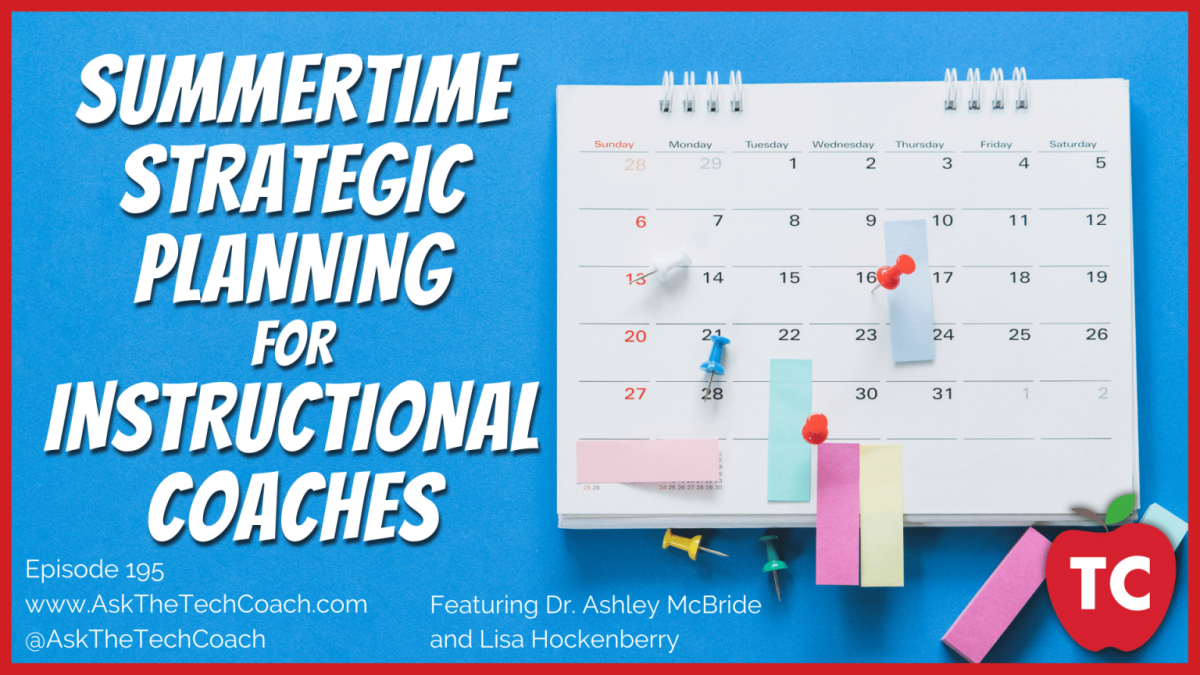
  • Summertime Strategic Planning To Jumpstart The New School Year

    Summertime Strategic Planning To Jumpstart The New School Year

    Welcome to “Ask the Tech Coach,” a podcast for Instructional Coaches and Technology Integration Specialists.

    In this episode of “Ask the Tech Coach,” Jeff and Susan welcome Instructional Coaches Dr. Ashley McBride and Lisa Hockenberry on the program to discuss a variety of ways that we can support both our districts and school buildings in their summertime strategic planning.

    If you would like to be a part of future podcasts and share your thoughts, please contact the podcast.  We would love to have you join the show.

    Join the TeacherCast Tech Coaches Network!

    • Are you a Tech Coach or looking to become one this year?
    • Are you searching for support in your position?

    The TeacherCast Tech Coaches Network, is a dynamic Professional Learning Network designed specifically for Tech Coaches and designed to provide weekly support for all Instructional Coaches.

    Our favorite part of recording a live podcast each week is participating in the great conversations that happen on our live chat, on social media, and in our comments section.

    This weeks question is:How can Instructional Coaches be used to support strategic growth both at the school and district level?Weekly Topic

    • ISTELIVE22
    • What is happening at this year’s conference for Instructional Coaches?
    • Networking with other Coaches
    • Creating something for coaches to have when they leave a session to use for the beginning of the school year
    • Great Sessions for Instructional Coaches
    • Coaching for Creativity: Conversation Strategies and Activities to Support Reimagining the Classroom
    • Creating Design Thinking Routines to Reimagine and Deepen Multimodal Lesson Delivery
    • Using a Flexible Edtech-Focused Coaching Cycle to Provide Personalized Support
    • ISTE Playground Session – How students can use their voice through audio and video podcasts.
    • Strategically planning professional learning for the upcoming new school.
    • What is the vision/end goal?
    • Gather data / Where are there gaps?
    • Backwards mapping of skills needed
    • How will I put coaching cycles in place around the needs?
    • How do we accomplish this?
    • Conversations with administrators and get them on board.
    • Develop a team via PLC meetings to begin the strategic plan and decide how it will get carried out.
    • Write common goals for the teachers / teams to move in a similar direction
    • What if I don’t have support as a coach to accomplish this?
    • Have a plan written out of your own ideas of where the school/district might be going to help give direction and opportunity for conversation and planning.
    • How do we be sure our plans are put into motion in the new school year?
    • Continue to re-visit in regular meeting and updates with administrators and teacher meetings.

    About our Guests

    Lisa Hockenberry

    This is my 11th year in Frisco ISD. I’ve been a DLC for last 3 years at 2 elementary campuses. I previously taught 2nd for 6 years and 3rd for one year at another campus. I received my degree from Texas Woman’s University. I am excited to be presenting again at ETC 2022 this summer.

    I love everything future ready! I love to collaborate with teachers to find new and innovative ways to implement technology and curriculum together.

    Twitter: @TechieCoach303

    Dr. Ashley McBride

    Dr. Ashley McBride is currently the Digital Learning Initiative Consultant for the North Carolina Department of Public Instruction. Prior to taking on this role, she spent her career working with students and other educators as a secondary English teacher, instructional technology facilitator, and director of technology. In her work, she has designed and implemented professional learning that supports educators and their understanding of digital teaching and learning practices. Additionally, she has led district-wide initiatives that help promote the effective integration of technology for students. McBride is a COSN Certified Educational Technology Leader and in 2020 earned her doctorate in educational technology from Central Michigan University. She also serves as a board member for the North Carolina Technology in Education Society (NCTIES) and is an adjunct professor in Central Michigan University’s Masters in Learning, Design, and Technology program. You can connect with her on Twitter through her handle @aplusedtech.

    Links Of Interest (Ashley Social Links)

    About The Book

    The edtech coaching role is often misunderstood. This leads to edtech coaches being underutilized or being pulled into various tasks that are not aligned with the ISTE Standards for Coaches. The Edtech Coaching Primer provides a clear way of implementing this role in K-12 education and offers resources for not only those who are edtech coaches, but also for those who support the role at the school or district level.

    About ISTE

    The International Society for Technology in Education (ISTE) is home to a passionate community of global educators who believe in the power of technology to transform teaching and learning, accelerate innovation and solve tough problems in education. ISTE inspires the creation of solutions and connections that improve opportunities for all learners by delivering: practical guidance, evidence-based professional learning, virtual networks, thought-provoking events and the ISTE Standards. ISTE is also the leading publisher of books focused on technology in education. For more information or to become an ISTE member, visit iste.org. Subscribe to ISTE’s YouTube channel and connect with ISTE on Twitter or Facebook.

    ISTE BOOKS

    ISTE books and jump-start guides address both established and emerging industry topics, and are aligned with the ISTE Standards, providing clear, practical guidance to help educators meet the standards. Whether you’re a classroom teacher, librarian, district leader or teacher educator, ISTE books are your answer to effective districtwide PD and professional learning to meet your goals or tech initiatives.

    Become An ISTE Books Insider!

    Subscribe to the ISTE Books Update newsletter for exclusive savings and updates on books, author events and more.



    Source link

  • The Bill Barr School of Law School Deaning

    The Bill Barr School of Law School Deaning


    BOOO Bill Barr, you unprincipled Trump sycophant. You rascal. All of us, (well  not all, there are a couple of numbskulls who admire you ) principled law professors and administrators think you are an awful example of the profession.

    But wait Billy Boy! There is a job for you. It’s even better than Trump University. You open a school for wannabe Law school administrations. You know, Bill, the number one goal  of any law school dean on the make is to climb the USnews ranking.

    So that’s what you teach. Some Units of the course would be:

    1. Hire your own graduates to do something, anything, so you can report high post graduate employment rates.

    2, Lower first year admissions but increase the number of transfers because the transfer LSAT and GPAs will not count against you.

    3. Oh, what the hell. Just do what UF Law has perfected, However qualified a student, do not admit him or her unless he or she improves your ranking.

    4, If a student is admitted and it looks like he or she, in hindsight, might lower your scores, pay them not to come.

    5. Make sure all law school employees are called faculty. This will raise your teacher to student ratio.

    6. Throw every cent you can get your grubby hands on to pay high scoring students to come to your school whether they need the money or not. 

    7, And Bill, here is what you can bring to the course your specialty.  Just lie. What the fuck, you are not hurting anyone so it’s not like a real lie.

    But Bill, there is one catch,  All of these things have already been done. Yes by the same people who say that  you are the crook, not them.

    So you will have to be imaginative. Your primary mission is to stay one scam ahead of what USnews is onto and cares about. This should be easy, They don’t really care if they get it right as long as it sells,  

    Source link

  • EdTech Roundup Going on Extended Hiatus, edCircuit Taking Over in the Meantime!

    EdTech Roundup Going on Extended Hiatus, edCircuit Taking Over in the Meantime!


    Hi Everyone – 

    I will be taking an extended break from the blog.  My current workload and new responsibilities as a father have left me with not enough time to devote to the site.  I hope things balance back out in the future, but currently, I will be on break from the site until further notice. 

    In the meantime, our good friends over at edCircuit will be taking over the site and sharing some excellent posts and resources each week!  So even though I’ll be on break, we will still be sharing new material on a regular basis. 

    Thanks for understanding,

    Mike

    Source link

  • Reviews | Genially: Create Presentations, Infographics, and Visuals in Seconds

    Reviews | Genially: Create Presentations, Infographics, and Visuals in Seconds


    Genial.ly is a presentation creation platform that offers a wide range of possibilities for what teachers and students can create.  From excellent templates to interactive visuals, there are some really fun and exciting ways to easily create visuals of all kinds.  Plus, it’s a freemium resource, so teachers and students can get started creating completely for free. Continue reading on our Review’s Page.

    Source link

  • Why every school district needs a Head of Remote Learning

    Why every school district needs a Head of Remote Learning

    Why every school needs a Head of Remote Learning (and yes, we should talk about this during a crisis)

    Most schools are facing multiple transformations. These range from digital transformation, to future-skills transformation, to the most important and urgent right now, which is distant-teaching and learning transformation.

    Whilst the corporate world has innovated with new roles from chief digital officers to agile coaches to futurists to attempt to capture value from these transformations — the roles we have in schools are still operating within the legacy mindset and systems, ranging from Math teacher, English teacher, PE teacher, and Art teacher, representing probably 90% of the roles that exist in any school.

    Leaving the titles aside, if we look at it from a skillset point of view, we know ‘subject’ teachers are more than the purveyors of subject knowledge. They are counselors, data analysts, advisors, experimenters, storytellers, investors (with their time), relationship builders, technologists, and today they are required to be remote teaching specialists.

    Teachers are more than the purveyors of subject knowledge. They are counselors, data analysts, advisors, experimenters, storytellers, investors (with their time), relationship builders, technologists, and now they are required to be remote teaching specialists.

    There’s never been a better case to be made for a Head of Remote Learning in schools and districts.

    With 70,000 students told to stay at home and over half the schools closed across the country as of March 18, 2020, for COVID19 prevention measures. With some schools potentially not opening until after summer break, teachers are scrambling to remotely continue the academic learning for students.

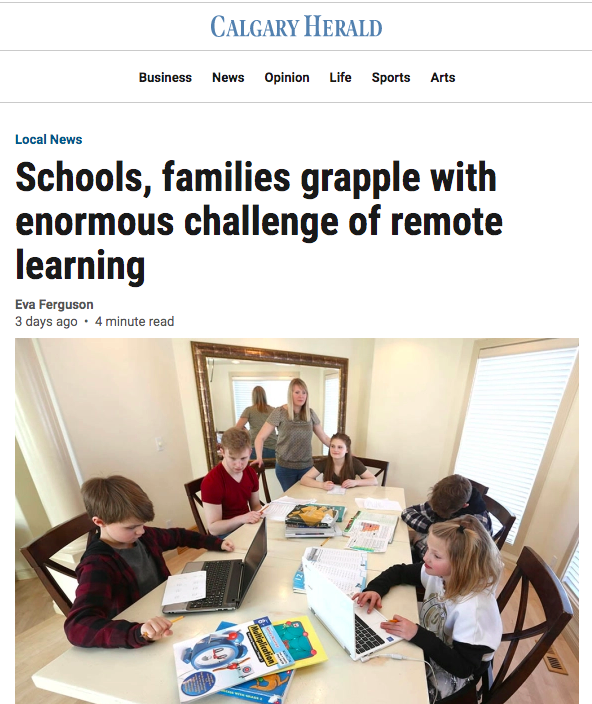
    Headlines like this one from the Calgary Herald describe the last-minute scramble.

    Before we go on, it’s important to state that this role can be taken on by more than one person in any school, and needn’t have to be a full-time role in the initial instance. First, by experimenting and creating value in the role, it can be used to justify the hiring-case to the wider district to fund this position.

    First, let’s discuss why this role is a must-have.

    Aside from once-in-a-lifetime (we hope) global pandemics, there are many reasons why schools should now have a remote learning role. Just take examples from the past two years, when schools closed for fires in California and the polar vortex in Wisconsin. Each region has different susceptibilities that threaten the continuation of the education of our children for periods of time.

    Remote learning doesn’t only have to occur for school-wide closures. Take, for example, the student with lice or Strep throat who’s out of class for a week who undergoes significant stress on top of their illness due to the difficulty of catching up on missed learning. What if some of those absent days can instead be counted due to remote learning plans?

    Never has there been a better time for remote learning than now. The confluence of fast internet capability and quality education technologies, both curricular and administrative, leads to the power to produce high-quality Remote Learning experiences. The considerations of equitable access, student (and home) privacy, screen-time, routine and movement management, and social isolation all need to be addressed. We can look to online high schools, like Stanford K-12 online schools and homeschooling experts, that likely have addressed many of these challenges as a starting point.

    March 19th’s article in Politico describes how lack of planning has led to last-minute efforts like how a “school sent home a paper survey Friday for parents to asses their technological access and received 114 responses — 92 percent have smartphones and 94 percent have internet access, but only 58 percent have computers and laptops. There are six different languages spoken at the school, with more than 60 percent of families on the poverty line.” Having someone who is responsible for processing this data in advance would result in better outcomes for the community.

    The role of Head of Remote Learning is essential for bridging the gap between school and home. A gap that has existed since the invention of schools. The role includes 3 focus areas, to ultimately create shared-knowledge, skills, mindsets, and behaviors between teachers and teachers, between teachers and parents, and between teachers and children.

    Between teachers and teachers

    • Professional development of teachers to convert to remote learning, including training on the various product platforms and how to integrate technology into learning design, such as with the SAMR Model.
    • Communication guidelines and templates to make life easier for all teachers to convert to remote learning plans rather than each teacher inventing their own solutions.
    • Sourcing of products to fulfill the role of communication, curriculum continuity, and emotional support.
    • Implementation plan for administrators, teachers, students, and parents, whether it’s for a single student or the whole school.

    Between teachers and parents

    • Parent support for difficult conversations with their children to ease anxieties by sharing resources and discussion questions.
    • Equipment planning, including devices and Wi-Fi hotspots for students’ homes. Why? 10% of students in the U.S. don’t have internet access at home. In these circumstances, the burden falls on parents who aren’t able or confident to take up their child’s education — things have changed so much since we were at school.
    • Equip parents with the resources to effectively use educational technology, not just to supplement curriculum learning, but also as a way to engage kids in subjects beyond the classroom.

    Between teachers and students

    • There are endless technology options that need to be experimented on, and where there is efficacy of the use-cases they then need to be scaled fast. Creative new technologies that can enhance the learner’s journey, include audio learning tools for connection, communication, and learning. For example, remote learning plans may include podcast tools for students to submit work to teachers and interactive voice technology apps, like Ask My Kid, with social-emotional support, movement breaks, and short academic practice sessions. Unlike most remote learning technology, audio technologies can be screen-free, helping parents stay within the American Pediatric Association’s screen time guidelines.
    • Show students how to use educational technology to become resilient, independent learners who are capable of organizing their own learning and educational objectives.

    A final benefit of remote learning is that they facilitate increased connection to the home. Healthy levels of parent engagement in their child’s education have long been coveted by educators. With children at home, whether due to sickness or catastrophic events, parents can reliably feel connected, and even contribute to the learning, with good remote learning plans.

    The most important part of this role is becoming an expert in keeping students calm and on-track. There are sudden isolation and disconnection from classmates, disruption of precious routines, uncertain parents, and distracting home learning environments. Direct daily communication and connection through hearing the teacher’s voice are essential. Students need to know the plan each day and hear it from their own teacher.

    Learning in social environments is critical. There will never be a complete substitute for physical togetherness, from the informal play at recess to the smell of the art room and science lab, but quality remote learning plans will only add resilience to our system of education. The role of Head of Remote Learning is central to strengthening the resilience of our schools and the continuity of learning for our children.

    Before you go, there are 3 immediate next steps:

    • If you found value in this article, we would love for you to share with your network to start a robust conversation and spread this thinking.
    • Everyone is time-poor and dealing with massive change right now. It is natural to think that this conversation should be put on hold, but now is the right time to start documenting what’s difficult so we can define this role with more fidelity when students return to school.
    • We are working with school, district, and foundation leaders to onboard the Head of Remote Learning role into the education system. Please reach out to us if you are interested to learn more at [email protected].

    by Dr. Aparna Ramanathan, CEO and Co-Founder, AskMyClass

    Aparna Ramanathan is the CEO and co-founder of AskMyClass. Aparna worked for over a decade as a medical doctor in Australia. After moving to the U.S., she coached professional women in practical stress management techniques, using a data-driven approach. That work led to the development of the first mental health games and programs using voice technology for parents and then the classroom — which lead to the founding of AskMyClass, a Silicon Valley-based Y Combinator-backed startup that creates classroom-specific activities to help students build essential social-emotional skills while increasing their classroom engagement.


    Source link