We’re approaching the end of a year that was at various times frightening, difficult and downright ridiculous. We hope that, despite the struggles higher education faced this year, you can still find something to be thankful for this holiday season, whether it’s generous donors making big differences for small campuses, colleges striving to improve cost transparency, or institutions supporting their communities through tough times.
If not, maybe you can take some inspiration from the videos below.
Here are Inside Higher Ed’s favorite holiday greetings, from the wacky to the artsy to the classy, showcasing the talents and holiday spirit of students, staff and faculty across the country.
Quinnipiac University, Hamden, Conn.
This slapstick sketch depicts Quinnipiac’s mascot, Boomer the Bobcat, messily preparing to welcome community members to his abode for Christmas dinner. Despite mishaps like spilling a bowl of assorted vegetables all over the floor and whisking what looks like mashed potatoes so feverishly they go flying, Boomer ends up putting out a beautiful spread—roast turkey, green beans, deviled eggs and more—for his delighted guests.
University of Louisiana at Monroe
The ULM Chamber Singers bring us a stirring adaptation of the 12 Days of Christmas entitled, no surprise, the 12 Days of Finals. Among the listed gifts is “ten paddlers paddling,” referring to the campus’s unique access to Bayou DeSiard, where students can borrow a kayak for free and paddle around to their heart’s delight.
Salt Lake Community College, Salt Lake City, Utah
Salt Lake Community College brings us another musical video, this time in the form of a tribute to Mister Rogers’ Neighborhood. President Greg Peterson takes on the titular role, singing: “We’ve made the most of this beautiful year, full of big hopes and holiday cheer. It’s education for you—it’s SLCC.edu. Will you join us next year?” Fuzzy video filters take the viewer back to old-school PBS, making the homage all the more nostalgic.
The University of Texas, Dallas’s Harry W. Bass Jr. School of Arts, Humanities, and Technology
This video highlights an annual tradition in an animation business development course at UT Dallas. The students are asked to design a holiday card and their peers then vote on the 10 best cards in the class. The winners’ cards are then printed and sold to fundraise for the school’s Student Emergency Fund. “I’m glad that our class is helping people have the reassurance that they need that they’re safe on campus and that somebody’s looking out for them if something does happen,” one of this year’s participants said.
Gonzaga University, Spokane, Wash.
College holiday greetings love to get a little bit meta. In this greeting, Gonzaga president Katia Passerini realizes she has forgotten to write a poem for this year’s holiday video. Luckily, student Alexis Sandoval just so happens to have a Christmas poem prepared, saving the day. Different members from the campus community, from a security leader to the university chaplain, recite the poem, bidding viewers to “rejoice in faith, carry peace and love into a happy New Year.”
Moraine Valley Community College, Palos Hills, Ill.
In this feel-good sketch, President Pamela Haney tries to bake a sweet treat for the college’s leadership team, but is missing a few key ingredients, including kindness and dedication. Luckily, teams from across the campus come to the rescue, bringing Haney everything she needs to finish making the cake. As one administrator says, “it’s amazing what we can do when we all work together.”
Wellesley College, Wellesley, Mass.
This year, the women’s liberal arts college celebrated 150 years since it welcomed its first class in 1875. As part of that celebration, the holiday video this year compiled archival footage and images submitted by alumni of winters on campus over the past century-and-a-half. The video, which features students sledding, ice skating, skiing and playing in the snow, is set over a song composed for the Class of 1948’s junior class show, which bemoans leaving Wellesley’s campus behind.
Community College of Philadelphia
“My Favorite Things” from The Sound of Music is everyone’s favorite non-Christmas Christmas song. Why has it entered the holiday songs zeitgeist? Who can say for sure, but I think we’re all glad it has. This particular rendition by CCP students and faculty sets the classic tune against a hip-hop beat and features a sick guitar solo.
University of Alabama, Tuscaloosa, Ala.
Uh-oh—President Peter Mohler is supposed to be helping write Christmas cards, but he’s nowhere to be found! This cheeky sketch shows that he’s shirking his responsibilities to do much cooler and more fun things, like play video games with students or shoot hoops with Big Al, the institution’s elephant mascot. Luckily, when his colleagues finally find him, he’s already finished the holiday cards. Crisis averted!
Tulane University, New Orleans, Louisiana
“What’s one Tulane memory you hope never melts away?” this video asks a gaggle of sweater-clad Tulane students. More than one note a once-in-a-lifetime Gulf Coast blizzard that shocked and delighted Tulane students this past January, with one saying it was “like a dream.” Others mention friends, sports championships and exploring the city of New Orleans.
As states continue to launch and expand private school choice programs, one of their biggest challenges is building online platforms that meet the overwhelming demand.
Tennessee families experienced a bottleneck earlier this year as they waited hours online to submit applications for the state’s new Education Freedom Scholarship program. In July, the state told 166 parents that they had received a scholarship, only to alert them a few days later that the notification was a mistake.
“It wasn’t the most ideal user experience,” said Heide Nesset, a senior fellow for the Beacon Center of Tennessee, a right-leaning think tank. But there was a “tight runway,” about three months, to get the program off the ground.
With state leaders hoping to serve up to 70,000 students next year, they’re now searching for a new vendor. Proposals are due Friday.
But the rough start in Tennessee wasn’t an anomaly. All states with education savings accounts have struggled to some extent with ensuring smooth transactions for families, whether that’s paying a school on time or ordering a homeschool curriculum. Some say the solution lies in picking more than one company to handle the increasing demand and improve customer service.
“If it’s one contract, I think the vendor is inherently trying to ensure that the state department has a really fantastic experience,” said Nesset, who is also the vice president of
implementation at the Yes. Every Kid. Foundation, a school choice advocacy organization. “If you have more than one [vendor], then they start competing, and families have the opportunity to make choices.”
Tennessee’s current vendor is Student First Technologies, which won a contract in 2023 to run a smaller ESA program in three counties. Earlier this year, the state expanded the contract with the Indiana-based company to manage the new statewide program, despite its problems in other states.
In West Virginia, where Student First still operates the Hope Scholarship program, an ESA, homeschool families complain that they can’t access the platform on their phones and that approvals and denials for purchases are inconsistent. Arkansas canceled its contract with Student First last fall after it failed to deliver a “fully operational” system on time. The company paid the state a $300,000 fine.
‘Get what they need’
Eighteen states now have at least one ESA program. With a new federal tax credit scholarship system beginning in 2027, the demand for organizations to manage them will surely grow. The trick is delivering a system that runs smoothly for families while ensuring that they’re using the money the way the state intended.
In a recent interview, Michael Horn, cofounder of the Clayton Christensen Institute, a think tank, talked with Jamie Rosenberg, the founder of ClassWallet. Still the biggest player in the market, the Florida-based company manages nine ESA programs.
Prior to platforms like his, states had two options, he explained. They either issued debit cards, which made it hard to ensure parents spent the money on allowable purchases, or expected them to pay up front and request reimbursement — a significant obstacle for families on a tight budget.
State policymakers and civil servants administering Education Savings Accounts have a potentially difficult logistical challenge on their hands.
They need to get hundreds of millions of dollars to tens of thousands families and ensure that money is spent in compliance with a… pic.twitter.com/IRRUfQZZpt
ESA vendors, he said, give families the “agency to get what they need but also the ease of knowing that what they’re doing and what they’re buying [complies with] program rules.”
Adding more than one vendor to the mix could make the companies work harder to reach lower-income and minority families who are less likely to use the programs, said Lisa Snell, a senior fellow at Stand Together Trust, which funds school choice initiatives.
“Family outreach and satisfaction become the goal rather than the government as the customer to one vendor,” she said.
Texas had the option to choose multiple vendors for its new ESA program, which launches next fall. The law allows the comptroller’s office to contract with up to five companies. But officials opted against it and awarded a two-year, $26 million contract to New York-based Odyssey, which currently runs programs in four other states.
Joe Connor, Odyssey’s CEO declined to comment on the state’s decision and referred The 74 to the state comptroller’s office. The office did not respond, but Amar Kumar, CEO of KaiPod Learning, a large national network of microschools, said the state likely felt multiple vendors would further complicate the process.
“There was this huge question of the complexity of doing that,” he said. “How do you tell families which portal to go to or how will they decide who manages which part of the program?”
‘Send a quarterly check’
The vendor platforms include built-in tools to prevent misuse. Student First Technologies has an AI feature, called QuinnIQ, that reviews each expense, “assigns a confidence score” and flags anything that’s new or that the state hasn’t approved in the past.
But Katie Switzer, a West Virginia parent using the state’s Hope Scholarship to homeschool her children, said it’s unreliable, sometimes approving purchases for some families and rejecting the same items for others. She thinks states should focus more on monitoring students’ academic progress than tracking every purchase.
“It’s stupid in my opinion to micromanage down to like the $20 workbook level,” she said. “Honestly, I think it would be more cost effective to send a quarterly check to families.”
That’s unlikely with such programs constantly under the microscope, and critics, especially in Arizona, pointing to high-end purchases, like diamonds and plane tickets, as examples of misuse. The state education department says it takes steps to prevent fraud and has referred cases to the attorney general’s office that have led to convictions.
West Virginia officials said they’re pleased with Student First’s progress since October, when parents complained that delayed orders caused students to fall behind on lessons. Orders are now “generally” processed within two business days, said Assistant Treasurer Carrie Hodousek, and the company has added and trained staff to prepare for peak order times.
Providers like Kaipod have their own concerns. School founders in the network have sometimes gone to the brink of eviction from their leased space because of late tuition payments, said CEO Kumar.
“There should be a predictable schedule, but sometimes it can take weeks extra to get paid,” he said. “If you’re running a small business and you owe rent, you owe payroll and your state payment is delayed, that creates a huge amount of stress for founders.”
For now, rebidding contracts for vendors is the strongest form of accountability, he said.
“They ought to not feel safe once they’ve won a contract,” he said.
Disclosure: Stand Together Trust provides financial support to The 74.
Did you use this article in your work?
We’d love to hear how The 74’s reporting is helping educators, researchers, and policymakers. Tell us how
This audio is auto-generated. Please let us know if you have feedback.
Federal Republican lawmakers on Tuesday suggested that increasing students’ access and participation in sports could help stem school and gun violence, as Democrats pushed back on whether that’s a viable solution. The disagreement came on the heels of a fatal mass shooting at Brown University that occurred on the eve of Sandy Hook Elementary School massacre’s 13th anniversary.
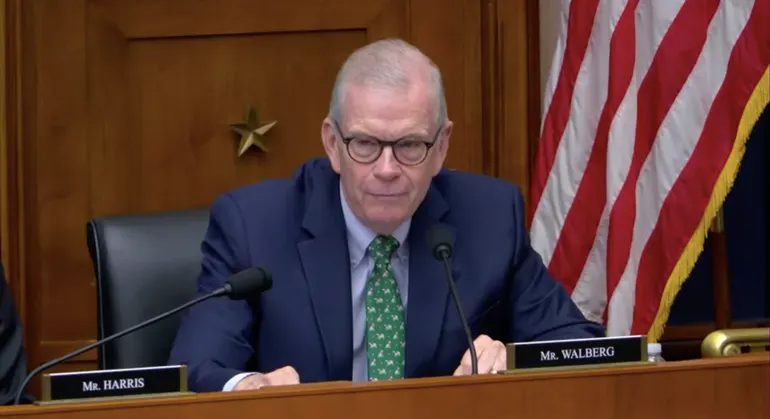
“This is a hearing on school safety,” said House Education and Workforce Committee Chair Tim Walberg, R-Mich. Walberg spoke during a hearing titled “Benched: The Crisis in American Youth Sports and Its Cost to Our Future,” held by the subcommittee on Early Childhood, Elementary and Secondary Education Subcommittee. Walberg chairs the full committee.
“If we did this right again, we would have less violence in schools,” Walberg said. “These are the types of things that will change [the] perspective of kids and what they do in life itself. So this is a hearing on gun violence.”
While Democrats and witnesses agreed that access and affordability are barriers to youth sports participation,they disagreed with Republicans over its potential to address school shootings. Studies have shown that youth sports participation is linked to better attendance, graduation rates, and academic performance.
“As important as sports participation is for kids, there is a much more pressing crisis at hand that the majority needs to recognize,” said subcommittee ranking member Rep. Suzanne Bonamici, D-Ore. “We know what happened over the weekend.”
Saturday’s shooting at Brown University killed two students and injured nine others. In K-12, there have been 230 school shootings in 2025 as of Dec 16, according to the K-12 School Shooting Database, which tracks anytime a weapon is brandished with intent to harm on school grounds.
That number puts this year on track to fall well below last year’s 330 school shootings. Last year became the first year since 2020 that school shootings hadn’t broken a record high. Still, however, the 330 school shootings recorded in 2024 marked the second-highest number since 1966 and fell only 19 below the all-time high of 349 recorded in 2023.
“This subcommittee has held several hearings this year, but we have not had a single hearing related to gun violence,” nor has the committee marked up a bill this year on school gun violence, said Bonamici. “We can talk about the other issues as much as we want — reading, math, CTE, screentime, student privacy, sports. None of that matters if children are shot and killed.”
Witnesses at the hearing, however, stressed that better access to school sports could help improve student mental health, academics and outcomes. They reported anecdotes of students being less likely to engage in violence or commit crimes when after-school time is filled with sports activities.
“If you can calm yourself down when you’re in an anxious state, you’re a better athlete. If you can calm your anger down when you’re hypercompetitive, you’re a better athlete,” said Steve Boyle, co-founder and executive director of 2-4-1 Care, Inc., a nonprofit organization that partners with school districts to provide sports opportunities.
John O’Sullivan, another witness and founder and CEO of the Changing the Game Project, said, “We have to keep as many kids as possible, as long as possible, in the best environment possible. ” His organization advocates for parents and coaches to become better participants in kids’ sports.
Democrats remained doubtful and pushed for a hearing specifically on gun violence.
“While sports are important for school safety, we have to have a hearing on this committee to address school shootings and the safety of our children in American schools,” said Rep. Jahana Hayes, D-Conn. “I know that my constituents expect something more than to just normalize school shootings and teach our children how to shelter in place.”
Hayes and other lawmakers on Sept. 12 sent a letter to Walberg and full committee ranking member Bobby Scott, D-Va., seeking a hearing before the end of the year on school shootings, and she said she received a response saying her concerns were “noted.” The letter was sent in wake of shootings at a Catholic school in Minnesota and a Colorado high school.
“We need meaningful action to keep our students, teachers, and schools safe and a plan to address the underlying causes of gun violence,” the letter said. “This Committee has the ability to bring together experts and individuals with firsthand experience to help develop federal legislation that implements school security upgrades, invests in mental health services, creates evidence-based crisis and threat assessments, and fosters a positive and trusting school environment.”
The subcommittee has no hearings currently scheduled on gun violence or school safety, according to its calendar.
Congress in 2022 passed theBipartisan Safer Communities Act in the wake of the Uvalde, Texas, mass shooting, the first significant gun safety legislation that also included school-based mental health measures in nearly three decades.
The funding provided to district mental health programs by that legislation, however, was put on pause and in many cases revoked by the Trump administration as it reviewed grants for potential diversity, equity and inclusion initiatives. The administration revoked about $1 billion in grants related to mental health earlier this year as a result, according to court documents.
Last week, the administration distributed a lesser amount — $208 million — to recipients who applied under a new grant application with updated requirements. These grants limit funding to the training of school psychologists only, instead of also funding school counselors and social workers, who often provide student mental health supports.
This blog was kindly authored by Jack Harrington, CEO, Emma Parry, Chair and Katy Mason, President, British Academy of Management.
Chartered ABS recently published its Business Schools as Engines of Growth report. This work provides a much needed look at the social and economic value of Business Schools. It paves the way for likely changes in the policy landscape.
Here, we focus on why Business Schools are so well placed to deliver on so many policy priorities. Among other things, Business Schools are a channel through which social science research can change lives for the better.
Business Schools across the UK are situated in very different kinds of regional economy. At a time of immense disruption – from climate shocks to technological transformation – our business schools must reimagine their role in helping shape the future of regional economies. The ‘Business Schools as Engines of Growth, Opportunity and Innovation’ report, published as a supplement to Universities UK’s 2024 Blueprint for Change, rightly positions business schools as more than excellent educators. Crucially, they are also strategic collaborators in place-based transformation, driving a new kind of socio-economic growth.
The report calls to deepen research partnerships between business schools, local businesses, and policymakers. This is not just a question of economic necessity (though the productivity gap between UK regions remains stark). It is, most importantly, a question of social responsibility. We must place people and planet at the heart of our research agendas, building new understandings of inclusive, sustainable growth that reflect the urgent challenges of our time.
From knowledge to impact: research that makes a difference
Business and management research is often undervalued in national Research & Development debates. This is surprising, given it plays such a pivotal role in enabling the adoption and use of technical innovations as viable, scalable, and ethical elements of our everyday organisational practices and social lives. Research insights from UK business schools are already helping local firms adopt digital tools, improve leadership, decarbonise operations, and engage communities more inclusively.
Programmes such as the Help to Grow: Management course, delivered by Small Business Charter-accredited schools, demonstrate how research-informed education can empower SME leaders to drive digital adoption and productivity. IPSOS evaluation shows 91% of participants report improved leadership and growth capabilities.
This is just the tip of the iceberg. Research conducted through Knowledge Transfer Partnerships (KTPs), place-based innovation catalysts, accelerator and labs offers a roadmap for changing the way business schools can act as “anchor institutions” in their regions to drive positive change.
A new narrative for business research
If we are serious about creating a fairer economy and a more inclusive society, then the UK’s business schools and their research must be seen as essential infrastructure for inclusive and sustainable regional development.
Fortunately, this is largely a matter of valuing what we already have. As the white paper shows, Business Schools often provide the most visible way in which the social sciences inform decision-making and operational life in organisations across the UK. Business Schools offer the networks, the expertise, and the commitment to act as coordinators between science, society, and markets, and the skills to drive the co-production of new kinds of knowledge and imaginaries for a better future.
There is still more that business schools can do. We need to be much better at enabling and valuing interdisciplinary, engaged research that supports public and private sector leaders navigating complexity. We need to help early-career researchers to collaborate beyond the academy. And we need to rethink impact, not just as ‘REF returns’, but in terms of supporting the development of better jobs, fairer systems, and stronger communities.At a time when the Higher Education is in financial crisis, and the economy is struggling to grow, investment has never been so urgent.
Between kindergarten and second grade, much of the school day is dedicated to helping our youngest students master phonics, syllabication, and letter-sound correspondence–the essential building blocks to lifelong learning.
Unfortunately, this foundational reading instruction has been stamped with an arbitrary expiration date. Students who miss that critical learning window, including our English Language Learners (ELL), children with learning disabilities, and those who find reading comprehension challenging, are pushed forward through middle and high school without the tools they need. In the race to catch up to classmates, they struggle academically, emotionally, and in extreme cases, eventually disengage or drop out.
Thirteen-year-old Alma, for instance, was still learning the English language during those first three years of school. She grappled with literacy for years, watching her peers breeze through assignments while she stumbled over basic decoding. However, by participating in a phonetics-first foundational literacy program in sixth grade, she is now reading at grade level.
“I am more comfortable when I read,” she shared. “And can I speak more fluently.”
Alma’s words represent a transformation that American education typically says is impossible after second grade–that every child can become a successful reader if given a second chance.
Lifting up the learners left behind
At Southwestern Jefferson County Consolidated School in Hanover, Ind., I teach middle-school students like Alma who are learning English as their second language. Many spent their formative school years building oral language proficiency and, as a result, lost out on systematic instruction grounded in English phonics patterns.
These bright and ambitious students lack basic foundational skills, but are expected to keep up with their classmates. To help ELL students access the same rigorous content as their peers while simultaneously building the decoding skills they missed, we had to give them a do-over without dragging them a step back.
Last year, we introduced our students to Readable English, a research-backed phonetic system that makes English decoding visible and teachable at any age. The platform embeds foundational language instruction into grade-level content, including the textbooks, novels, and worksheets all students are using, but with phonetic scaffolding that makes decoding explicit and systematic.
To help my students unlock the code behind complicated English language rules, we centered our classroom intervention on three core components:
Rhyming: The ability to rhyme, typically mastered by age five, is a key early literacy indicator. However, almost every ELL student in my class was missing this vital skill. Changing even one letter can alter the sound of a word, and homographic words like “tear” have completely different sounds and meanings. By embedding a pronunciation guide into classroom content, glyphs–or visual diacritical marks–indicate irregular sounds in common words and provide key information about the sound a particular letter makes.
Syllabication patterns: Because our ELL students were busy learning conversational English during the critical K-2 years, systematic syllable division, an essential decoding strategy, was never practiced. Through the platform, visual syllable breaks organize words into simple, readable chunks that make patterns explicit and teachable.
Silent letter patterns: With our new phonics platform, students can quickly “hear” different sounds. Unmarked letters make their usual sound while grayed-out letters indicate those with a silent sound. For students frustrated with pronunciation, pulling back the curtain on language rules provided them with that “a-ha” moment.
The impact on our students’ reading proficiency has been immediate and measurable, creating a cognitive energy shift from decoding to comprehension. Eleven-year-old Rodrigo, who has been in the U.S. for only two years, reports he’s “better at my other classes now” and is seeing boosts in his science, social studies, and math grades.
Taking a new step on a nationwide level
The middle-school reading crisis in the U.S. is devastating for our students. One-third of eighth-graders failed to hit the National Assessment of Educational Progress (NAEP) benchmark in reading, the largest percentage ever. In addition, students who fail to build literacy skills exhibit lower levels of achievement and are more likely to drop out of school.
The state of Indiana has recognized the crisis and, this fall, launched a new reading initiative for middle-school students. While this effort is a celebrated first step, every school needs the right tools to make intervention a success, especially for our ELL students.
Educators can no longer expect students to access grade-level content without giving them grade-level decoding skills. Middle-school students need foundational literacy instruction that respects their age, cognitive development, and dignity. Revisiting primary-grade phonics curriculum isn’t the right answer–educators must empower kids with phonetic scaffolding embedded in the same content their classmates are learning.
To help all students excel and embrace a love of reading, it’s time to reject the idea that literacy instruction expires in second grade. Instead, all of us can provide every child, at any age, the chance to become a successful lifelong reader who finds joy in the written word.
Kim Hicks, Southwestern Jefferson County Consolidated School
Kim Hicks is the Director ESL Program at Southwestern Jefferson County Consolidated School in Hanover, Indiana.
Latest posts by eSchool Media Contributors (see all)
This blog was kindly authored by Melissa Bowden, Senior Content Writer and Editor at Kortext.
Artificial intelligence (AI) is no longer a distant concept in higher education. It’s here, and it’s already transforming the way institutions are delivering learning.
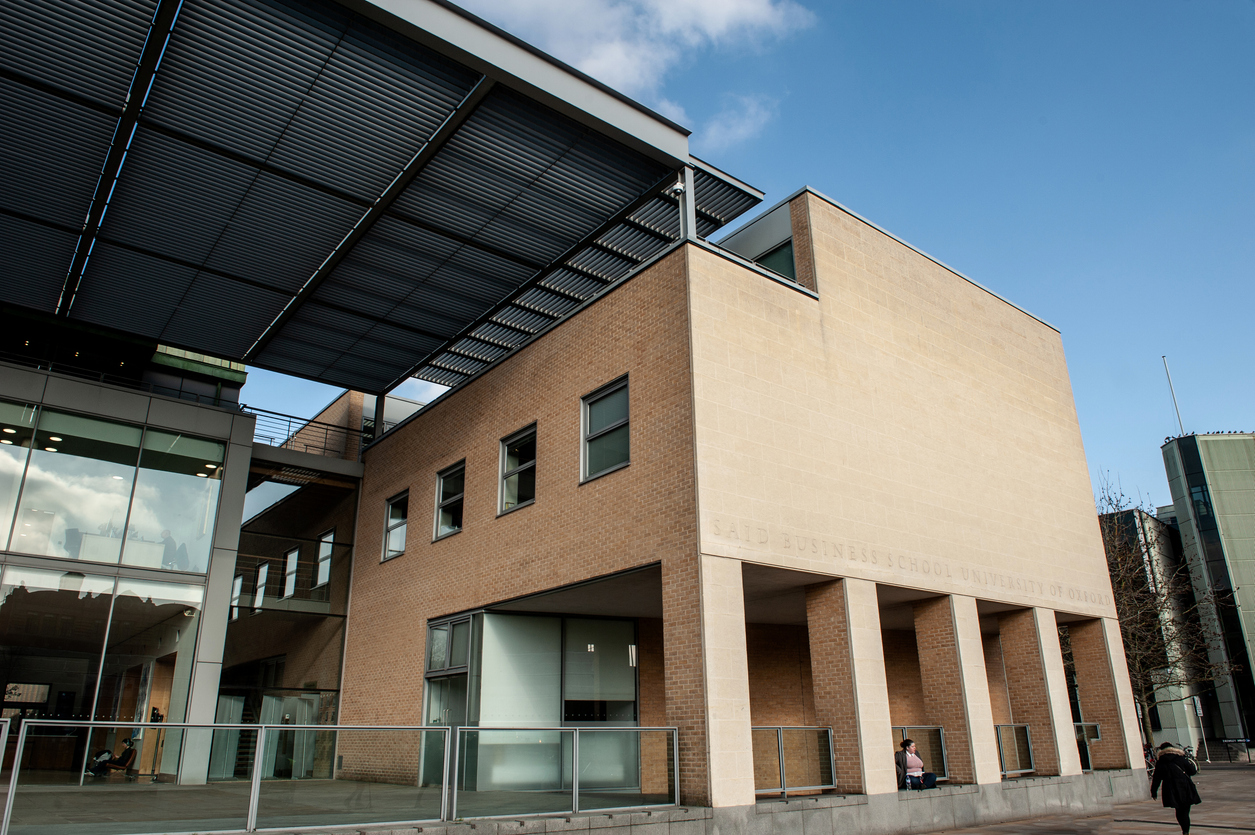
At Oxford University’s Saïd Business School, an exciting new pilot is underway: a VLE-integrated AI assistant developed in collaboration with Kortext, Microsoft and Instructure. This initiative is more than a technology trial; it’s a strategic step towards realising Oxford’s ambitious AI vision.
Starting the transformation journey
The University of Oxford is a complex, devolved organisation with 26,500 students and 16,500 staff. The potential applications of AI across this ecosystem are vast – from accelerating research and processing data to enhancing student engagement and streamlining staff workflows. But with so many possibilities, the question is: where do you start?
For Mark Bramwell, Chief Digital & Information Officer at Saïd Business School and Director of Strategic Digital Partnerships at the University of Oxford, one answer lies in the VLE. Integrating an AI assistant into their Canvas instance is a practical first step in a broader digital transformation strategy focused on agility, data and world-leading innovation.
As Mark explains:
AI will be core to our future. We need to equip our faculty, researchers, students and staff with the latest technologies – not just to make them more efficient today, but to also ensure they’re fully prepared with essential skills they’ll need in the workplace.
The power of partnership
Saïd Business School has been working in collaboration with Kortext, Microsoft and Instructure on the Canvas-integrated AI assistant pilot as part of its existing partnership.
When establishing the pilot, there were three non-negotiables for Bramwell. The AI assistant must be seamlessly integrated into a student’s learning journey, use a ring-fenced secure data environment, and be interoperable with existing technologies at Oxford.
With Canvas as the delivery platform, the AI assistant is available to students and faculty within their existing learning environment. All data is stored safely within the university’s domain and tenancy, complying with regulatory requirements. Finally, the pilot builds on Oxford’s long-standing strategic partnership with Microsoft as a natural evolution of its digital ecosystem.
The pilot will span 1,200 students across all degree programmes, alongside faculty and instructional designers. For Bramwell, this project is:
an exciting extension of our digital strategy and AI activities, leveraging the synergies that exist between our three tech collaborators.
Data-driven insights for smarter course design
It’s early days, but the pilot’s outcomes are greatly and positively anticipated. For Bramwell, one of the most beneficial aspects is the AI assistant’s ability to capture granular engagement data.
Which content are students interacting with? Where are they disengaging? These insights can inform continuous improvement in course design and content strategy, enabling faculty to create responsive programmes relevant to student needs. They can also accelerate course development, with staff expertise complemented by AI-enabled tools and recommendations.
Competitive advantage in a global market
Higher education is an increasingly competitive sector, both in the UK and globally. Within this context, one of Saïd Business School’s ambitions is clear: to extend its reach through online learning and deliver an experience that reflects the name, brand and value of the University of Oxford.
For Bramwell, personalised learning, enriched by data and analytics, is central to that differentiation.
Our job is to make every learner better equipped for the world and the future of work than when they joined us.
If we can do that, we’re doing our job.
Looking ahead: the future of AI-enabled education
The vision doesn’t stop there. Bramwell imagines a future where AI supports a student from ‘cradle to grave’, guiding their learning at every stage of their life.
The possibilities are endless,but must be delivered within responsible, ethical frameworks.
He also sees possibilities for global accessibility: ‘giving us the opportunity to take Oxford to learners, geographies and regions that may not have previously been possible’.
By replicating faculty expertise globally, AI can help make education more inclusive and impactful than ever before.
What happens next?
The pilot’s impact will be measured through engagement metrics, content interaction and tangible efficiency gains for both students, instructional designers and faculty. Examples here might include learners using the AI assistant to summarise reading materials and save time, or staff asking the AI assistant for content recommendations to make the student experience more engaging.
Bramwell is confident this is just the beginning. The next phase of AI-enabled learning at Oxford could involve developing truly personalised learning experiences, where learners construct and consume courses on their own terms – anytime, anywhere.
A message for higher education leaders
For other institutions, Bramwell offers a clear message:
Don’t let governance and risk paralyse innovation. Experiment, innovate and play – but do it safely. Architect your approach within secure frameworks so you can learn without compromising data or trust.
This is a pivotal moment for higher education. AI isn’t a future trend, it’s a present reality. The question now is whether institutions will embrace it proactively or be left behind.
Kortext is a HEPI Partner. Mark Bramwell is speaking at Kortext LIVE on 11 February 2026 in London. Join Mark at this free event to hear more about the pilot’s progress, the long-term vision, and why Kortext was selected as a key project partner. Find out more and secure your seat here.
Creating consistency between classrooms and ensuring curriculum alignment school-wide can be challenging, even in the smallest of districts. Every educator teaches–and grades–differently based on their experience and preferences, and too often, they’re forced into a solution that no longer respects their autonomy or acknowledges their strengths.
When Superior Public Schools (SPS), a district of 450 students in rural Nebraska, defined standards-referenced curriculum as a priority of our continuous improvement plan, bringing teachers in as partners on the transition was essential to our success. Through their support, strategic relationships with outside partners, and meaningful data and reporting, the pathway from curriculum design to classroom action was a smooth one for teachers, school leaders, and students alike.
Facing the challenge of a new curriculum
For years, teachers in SPS were working autonomously in the classroom. Without a district-wide curriculum in place, they used textbooks to guide their instruction and designed lesson plans around what they valued as important. In addition, grading was performed on a normative curve that compared a student’s performance against the performance of their peers rather than in relation to a mastery of content.
As other educators have discovered, the traditional approach to teaching may be effective for some students, but is inequitable overall when preparing all students for their next step, whether moving on to more complex material or preparing for the grade ahead. Kids were falling through the cracks, and existing opportunity gaps only began to grow.
SPS set out to help our students by instituting standards-referenced instruction at both the elementary and secondary levels, allowing us to better identify each child’s progress toward set learning standards and deliver immediate feedback and intervention services to keep them on the path toward success.
Take it slow and start with collaboration
From day one, school leaders understood the transition to the new curriculum needed to be intentional and collaborative.
Rather than demand immediate buy-in from teachers, administrators and the curriculum team dedicated the time to help them understand the value of a new learning process. Together, we took a deep dive into traditional education practices, identifying which set students up for success and which actually detoured their progress. Recognizing that everyone–teachers included–learns in different ways, administrators also provided educators with a wide range of resources, such as book studies, podcasts, and articles, to help them grow professionally.
In addition, SPS partnered with the Curriculum Leadership Institute (CLI) to align curriculum, instruction, and assessment practices across all content areas, schools, and grade levels. On-site CLI coaches worked directly with teachers to interpret standards and incorporate their unique teaching styles into new instructional strategies, helping to ensure the new curriculum translated seamlessly into daily classroom practice.
To bring standards-referenced curriculum to life with meaningful insights and reporting, SPS integrated the Otus platform into our Student Information System. By collecting and analyzing data in a concise manner, teachers could measure student performance against specific learning targets, determining if content needed to be re-taught to the whole class or if specific students required one-on-one guidance.
With the support of our teachers, SPS was able to launch the new curriculum and assessment writing process district-wide, reaching students in pre-K through 12th grade. However, standards-reference grading was a slower process, starting with one subject area at a time at the elementary level. Teachers who were initially uncomfortable with the new grading system were able to see the benefits firsthand, allowing them to ease into the transition rather than jump in headfirst.
Empowering educators, inspiring students
By uniting curriculum and data, SPS has set a stronger foundation of success for every student. Progress is no longer measured by compliance but by a true mastery of classroom concepts.
Teachers have become intentional with their lesson plans, ensuring that classroom content is directly linked to the curriculum. The framework also gives them actionable insights to better identify the skills students have mastered and the content areas where they need extra support. Teachers can adjust instruction as needed, better communicate with parents on their students’ progress, and connect struggling students to intervention services.
Principals also look at student progress from a building level, identifying commonalities across multiple grades. For instance, if different grade levels struggle with geometry concepts, we can revisit the curriculum to see where improvements should be made. Conversely, we can better determine if SPS needs to increase the rigor in one grade to better prepare students for the next grade level.
While the road toward standards-referenced curriculum had its challenges, the destination was worth the journey for everyone at SPS. By the end of the 2024-2025 school year, 84 percent of K-5 students were at or above the 41st percentile in math, and 79 percent were at or above the 41st percentile in reading based on NWEA MAP results. In addition, teachers now have a complete picture of every student to track individual progress toward academic standards, and students receive the feedback, support, and insights that inspire them to become active participants in their learning.
Tricia Kuhlmann and Jodi Fierstein, Superior Public Schools
Tricia Kuhlmann is the Curriculum Director and Jodi Fierstein is the Elementary Principal and Director of Special Services at Superior Public Schools in Superior, NE.
Latest posts by eSchool Media Contributors (see all)
In today’s highly competitive education landscape, schools at every level, from K–12 academies to public universities, must embrace modern, digital-first marketing strategies to attract and retain students. The era of relying solely on word-of-mouth or physical brochures is long gone. Today’s families and prospective students are browsing school websites, scrolling through social media, and watching virtual campus tours before they fill out an inquiry form or attend an open house.
To stay relevant and competitive in 2025 and beyond, schools need to meet their audiences where they are: online. That means showing up with targeted, compelling content and a clearly articulated value proposition. This is especially true for private and independent institutions, where high tuition fees and rising parental expectations demand a more persuasive, proactive approach to enrollment marketing.
So, how can your school stand out in an increasingly crowded space?
In this article, we break down 10 of the most effective marketing strategies for schools, with a strong emphasis on digital tactics. From strengthening your web presence to leveraging alumni stories and optimizing for SEO, these proven approaches help build awareness, trust, and engagement. Each strategy includes real-world examples from schools and colleges around the world to inspire your next campaign.
Whether you’re marketing a small language institute or a large university, these strategies are adaptable to your goals and designed to drive results.
Struggling with enrollment and retention?
Our innovative marketing strategies can help you generate more leads.
1. Understand Your Audience and Craft Your Message
A strong school marketing strategy begins with clarity: who exactly are you trying to reach, and what do they need to hear from you? Whether you’re a K–12 school or a higher ed institution, knowing your audience inside and out is essential. That means digging deeper than just age or location. Consider their priorities, concerns, motivations, and communication preferences.
Creating audience personas helps bring these insights to life. Is your ideal family looking for academic rigor, a supportive community, or flexible scheduling? Are your prospective students career changers seeking fast-track credentials, or teens drawn to innovation and student life? When you define who you’re speaking to, you can tailor your messaging to resonate and avoid generic outreach that falls flat.
Your next step is to articulate your school’s unique value proposition. What makes you different? Highlight that core message consistently across all channels. For some schools, it might be small class sizes and a nurturing environment. For others, it could be career outcomes, cutting-edge labs, or global learning opportunities.
Finally, data can deepen your understanding of your audience. Track behavior, segment leads, and personalize your outreach accordingly. The more relevant your message, the more likely it is to convert.
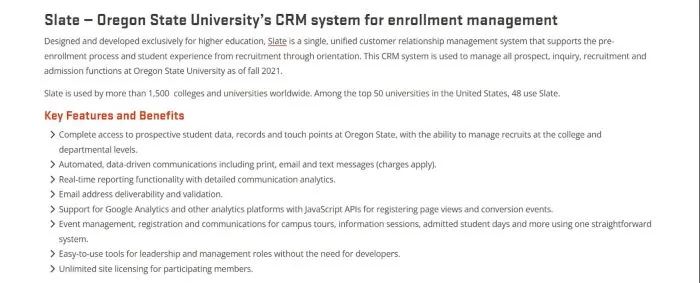
Example:Oregon State University (OSU). OSU’s enrollment team uses a CRM (Slate) to segment prospective students by factors like academic interests, intended majors, and geographic location. This lets OSU deliver tailored messages to each audience segment. For example, sharing engineering content with STEM-interested prospects or inviting nearby students to local events. By defining clear audience personas and emphasizing OSU’s unique offerings (like its “Beaver Nation” community and research opportunities) in communications, OSU ensures its outreach resonates more and converts better than one-size-fits-all marketing.
In a nutshell, how do you create a marketing strategy for a school? A strong school marketing strategy starts by defining your goals and audience, then clarifying your unique value proposition. Choose the right channels: website, SEO, social media, email, events, etc., all while keeping messaging consistent. Implement your plan, track performance with analytics, and adjust as needed to improve enrollment results.
2. Turn Your Website into a Top-Performing Recruiter
Your school’s website is more than just a digital brochure. It’s your hardest-working recruiter, available 24/7. In most cases, it’s the first real impression you make on prospective students and their families. If it’s outdated, hard to navigate, or slow to load, visitors may bounce before they ever reach your inquiry form. On the other hand, a fast, intuitive, and compelling site can drive real results: inquiries, campus visit bookings, and applications.
To make your website enrollment-friendly, focus on these key areas:
Navigation and user experience: Make it easy for visitors to find what matters most: admissions, tuition, programs, and deadlines, within one or two clicks. Prioritize clarity and mobile optimization, since the majority of users now browse on their phones.
Engaging content: Use vibrant photos, student stories, and program highlights to showcase your school’s personality and value. Don’t just state facts; tell stories that build emotional connection.
Clear CTAs: Every page should lead users to the next step, whether it’s “Book a Tour” or “Start Your Application.” Make buttons visible, and forms short and intuitive.
SEO and visibility: Build search-friendly content using keywords like “STEM high school Toronto” or “MBA in Montreal.” This boosts your visibility when families search online.
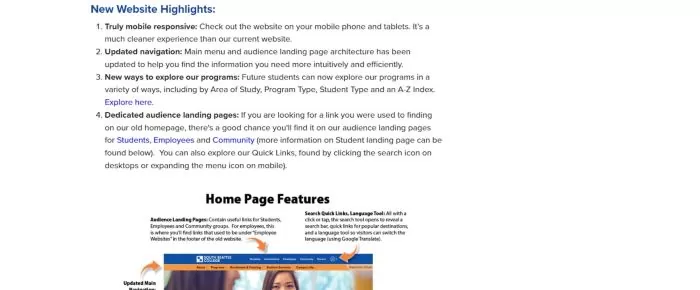
Example:South Seattle College. This college launched a fully redesigned, mobile-responsive website to serve as a “24/7 digital front door” for prospective students. The new site features simplified navigation (with intuitive menus and audience-specific landing pages), fast load times, and engaging content like student stories and virtual tour videos. Key information: admissions steps, programs, costs etc., is now accessible within one or two clicks. After the revamp, South Seattle College saw improved user engagement and more inquiries, validating that an optimized website can effectively guide visitors from interest to application.
3. Meet Students Where They Scroll: Social Media Engagement
If you’re wondering how to effectively reach today’s students, social media is your answer. Teenagers, young adults, and even their parents spend hours every day scrolling through platforms like Instagram, TikTok, Facebook, YouTube, and LinkedIn. That’s why a modern marketing strategy for schools must go beyond occasional polished posts. It also requires consistent, authentic, and engaging content that brings your school community to life online.
Social media allows prospective students to virtually experience your school before they set foot on campus. They can witness student life, explore your values, and interact with your team through comments and DMs. It’s a space where schools can showcase achievements, run virtual events, answer questions, and create lasting impressions, all within the platforms students already use. Social media engagement fosters emotional connection, builds trust, and nudges prospective students closer to applying.
Here are some proven tactics to strengthen your social media presence:
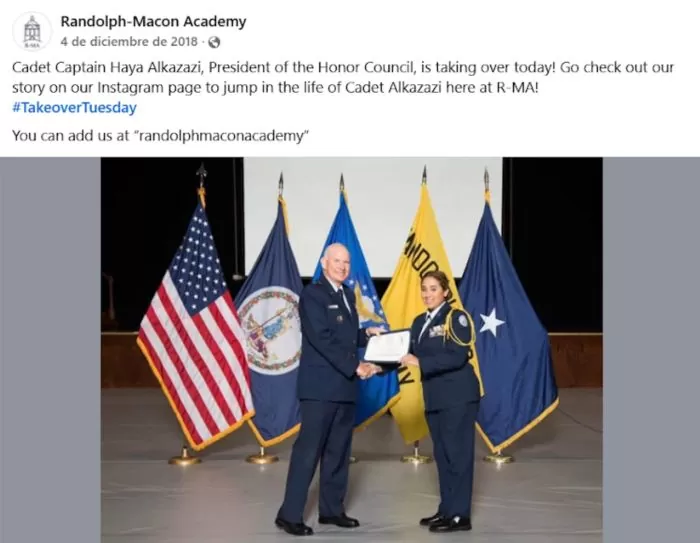
Student Takeovers: Give students the reins of your Instagram or TikTok for a day to showcase a “real life” perspective of your campus.
Interactive Campaigns: Launch challenges, quizzes, or hashtag contests to generate user content and boost engagement.
Alumni & Academic Outcomes: Share stories of success to inspire and build credibility with prospective students and their families.
Paid Targeted Ads: Reach niche audiences with specific messaging using Facebook, YouTube, or TikTok ad campaigns.
Responsive Community Management: Monitor comments and messages daily. Prompt, friendly responses go a long way in reinforcing your school’s reputation.
Above all, be authentic. Today’s students crave realness. A spontaneous student dorm tour recorded on a phone often outperforms a high-production video. Showcasing your campus culture in a way that’s natural and not overly scripted can drive stronger connections and higher conversions.
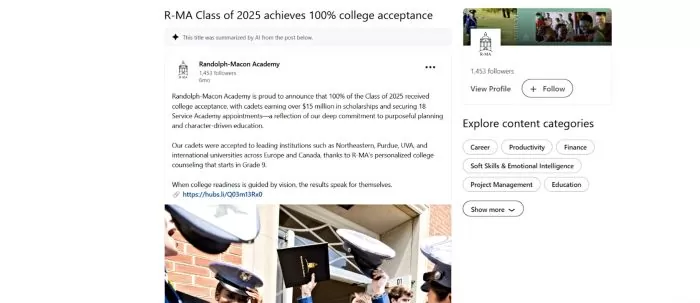
Example:Randolph-Macon Academy (R-MA). This college-prep boarding school brings campus life directly to student prospects through interactive social media campaigns. On Instagram, R-MA runs “Takeover Tuesday” events where a student cadet literally “takes over” the school’s Story for the day, posting candid glimpses of classes, dorm life, and activities. This unfiltered, student-eye view generates high engagement from peers. R-MA also leverages LinkedIn to celebrate outcomes with a recent post that 100% of its senior class earned college acceptances and over $15 million in scholarships. By showcasing real student experiences and achievements on the platforms teens (and their parents) already use, R-MA humanizes its brand and builds trust.
4. Bring Your Campus to Their Couch: Virtual Tours and Online Events
For many families, a campus visit is a pivotal moment in the school decision process. It’s their chance to imagine themselves in your hallways, dorms, and classrooms. But not every prospective student can visit in person, whether due to distance, cost, or scheduling. This is where virtual tours and online events come into play, offering an immersive, flexible way to connect with your audience.
Virtual campus tours can now offer interactive 360° experiences that let students “walk” the grounds from their laptop or phone. These tours help build familiarity and emotional connection, especially for international or out-of-state students who might otherwise never see your campus. To boost engagement, add clickable info points, video testimonials, or even voiceover guides.
Online events like virtual open houses or themed webinars allow families to meet admissions teams, ask questions, and hear directly from current students, all from home. They not only replicate key elements of in-person experiences but also allow for on-demand access after the event.
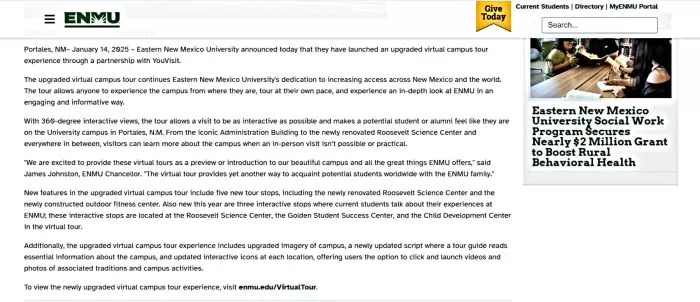
Example:Eastern New Mexico University (ENMU). ENMU launched an upgraded 360° virtual tour that lets prospective students explore the campus from anywhere in the world. This immersive tour includes interactive 360° views of key locations (from dorms to labs), pop-up info points with photos/videos of traditions, and even student-narrated segments sharing personal stories. A voiceover guide leads viewers through the experience, making it feel like an actual guided tour. ENMU’s chancellor noted the virtual tour “makes a potential student feel like they are on campus” and has become invaluable for out-of-state and international recruits. The tour’s engaging features (clickable videos, student testimonials embedded at certain stops) have driven higher web engagement and helped ENMU widen its reach beyond those able to visit in person.
5. Let Video Tell Your Story: Content Marketing That Connects
There’s a reason platforms like YouTube, Instagram Reels, and TikTok dominate attention spans. Video provides an immersive, emotional, and memorable experience. For schools trying to reach prospective students and families, video marketing is one of the most powerful tools available. Whether it’s showcasing campus energy, highlighting academic strengths, or sharing personal student journeys, video content brings your story to life in a way text and photos simply can’t.
To make the most of this format, consider these video types:
Campus Tour Highlights: Condense your full tour into a 2–3 minute walkthrough with student narration. Post it on your homepage and YouTube channel for first-time visitors.
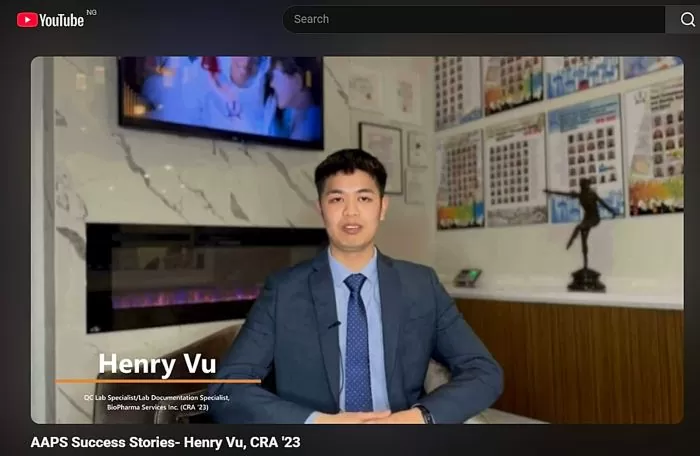
Student Testimonials and Success Stories: Capture authentic, unscripted interviews with students or alumni. These peer voices create trust and make your school’s impact tangible.
Faculty and Program Spotlights: Let your passionate educators shine. A quick feature on a robotics project or an art studio session can attract students with similar interests.
Event Recaps: Turn school events into fast-paced highlight reels for Instagram and Facebook. It shows your community is vibrant and active.
Explainer Videos: Break down complex topics, like admissions or financial aid, into short, helpful animations or on-camera guides.
Authenticity beats polish. Videos filmed on smartphones by students or “vlog ambassadors” can feel more relatable than professional productions. Consistent content, especially when optimized with keywords on YouTube, also improves discoverability in search.
Example: Academy of Applied Pharmaceutical Sciences (AAPS, Canada). AAPS relies heavily on short-form video content to showcase student life and outcomes viscerally. The college regularly produces “Student Success Story” videos – for example, a 2-minute clip of an alum describing how AAPS training led to their new career in clinical research. It also shares behind-the-scenes footage of lab sessions and student projects on its YouTube channel and Instagram. These authentic clips (often featuring actual students and instructors) put a human face on AAPS’s programs and build credibility.
In short, video marketing allows your school to connect emotionally and visually with prospective students, meeting them where they already spend time. If you want to advertise in a way that engages and inspires, video is essential.
6. Be There 24/7 with Smart Chatbots and Live Chat
Imagine a student browsing your website at midnight, wondering, “Does this college offer scholarships for international students?” If no one’s there to answer, that potential lead might bounce and never return. This is where chatbots and live chat tools step in, transforming your website into a 24/7 support hub.
Modern AI-powered chatbots go far beyond basic FAQ responses. They’re now capable of delivering personalized answers based on user input, guiding visitors to the right pages, and capturing lead information in real time. In fact, some bots can handle up to 80% of standard inquiries, freeing your admissions team to focus on complex cases or high-touch prospects.
Schools use chatbots to address questions about tuition, program options, campus life, deadlines, and more. Better still, if a query goes beyond the bot’s programming, it can prompt a human follow-up, keeping the conversation going instead of losing the lead.
Live chat is another powerful layer. Having staff available during business hours to chat in real time, whether on your site or via Messenger, feels like having a front-desk greeter online. Quick answers build trust and reduce friction in the inquiry process.
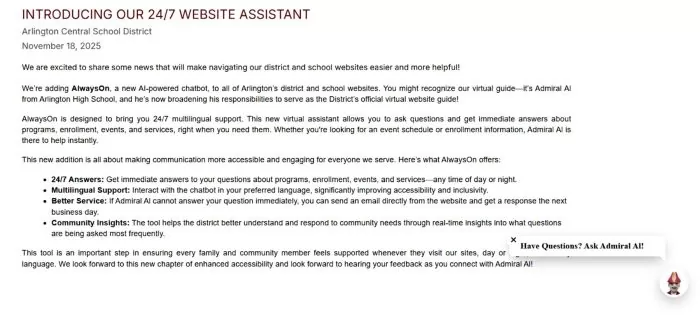
Example:Arlington Central School District (New York). This K–12 district rolled out an AI virtual assistant named “AlwaysOn – Admiral Al” across all its school websites to ensure families can get information anytime. The friendly chatbot (branded with the high school’s mascot) offers 24/7 multilingual support, answering common questions about programs, enrollment procedures, event schedules, and more in English or Spanish. If the question is too specific, “Admiral Al” even lets the user submit an email query right within the chat, guaranteeing a human follow-up by the next business day. The district implemented this tool to improve customer service for busy parents and saw immediate benefits – families could instantly find out, say, how to register a new student or the date of graduation, without calling the office.
To make your chatbot successful, keep it friendly and transparent (let users know it’s a virtual assistant), program it with up-to-date FAQs, and offer a handoff to a real person when needed. For international recruitment, consider a multilingual bot to expand your global accessibility.
Ultimately, integrating chatbot and live chat tools into your school’s marketing strategy ensures you never miss a lead because of timing. Today’s students expect immediate answers. With the right tools, your school can be ready.
7. Leverage Testimonials and Reviews (Let Your Community Do the Talking)
Word-of-mouth has long been a trusted marketing strategy for schools, and in today’s digital world, it has taken on new forms, testimonials, reviews, and social proof. These are powerful tools that lend credibility to your school’s messaging by showing that real families and students have had positive experiences.
Start by gathering testimonials from students and parents. A few genuine quotes or short videos can build trust quickly. Display these across your website, especially on admissions pages and brochures. A heartfelt statement like, “After enrolling here, my daughter blossomed academically and socially,” resonates more than polished ad copy.
In parallel, encourage online reviews on platforms like Google or Facebook. Higher ratings improve visibility and ease prospective families’ doubts. Politely prompt current families to share feedback after positive experiences, such as school events or parent meetings.
Social media also plays a role. Repost authentic student or alumni praise, and consider launching hashtags to gather testimonials organically.
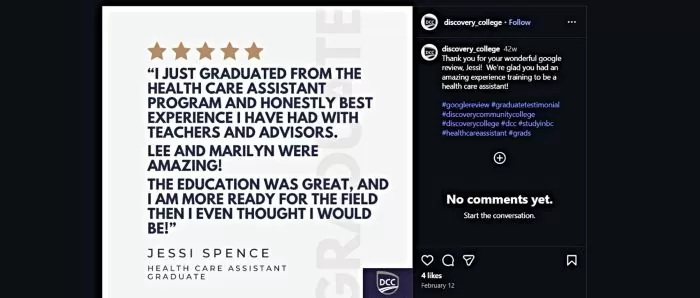
Example:Discovery Community College (Canada). This career college amplifies positive word-of-mouth by actively sharing student reviews on social media. For example, Discovery CC monitors its Google Reviews, and when a 5-star review comes in, the marketing team creates an Instagram post thanking the student by name and highlighting their feedback. One such post reads: “Thank you for your wonderful Google review, Jessi! We’re glad you had an amazing experience training to be a health care assistant!” – accompanied by a screenshot of the review. By publicly celebrating real student voices, the college not only boosts morale but also provides authentic social proof to prospective students scrolling by.
Letting your community advocate for you builds trust faster than any ad campaign, and it costs nothing.
8. Nurture Leads with Email Marketing and Personal Touches
What is the best marketing for independent schools? Independent schools succeed with targeted, budget-friendly inbound marketing. The best approach is a strong online presence: a content-rich, search-optimized website, active social media that highlights student life, and helpful emails or blogs that build trust. These tactics attract the right families and strengthen community engagement.
Once an inquiry is made, the follow-up becomes mission-critical. One of the most effective marketing strategies for schools includes consistent, personalized nurturing, especially through email and SMS.
Email remains a powerful tool when tailored. Instead of generic blasts, use segmentation to send relevant content. For instance, a prospect interested in Nursing should receive a series featuring faculty profiles, student success in healthcare, and clinical placement details. Someone focused on Athletics? Highlight sports facilities, team achievements, and balancing academics with sports.
Drip campaigns work best: Day 1, a welcome email; Day 3, value-focused content; Day 7, a testimonial or event invite. Marketing automation tools like HubSpot or Mailchimp make this scalable and adaptive based on user behavior.
Complement email with timely SMS reminders for events or deadlines. Use sparingly for impact.
Finally, add a personal touch. A call or handwritten note after a campus visit or audition can leave a lasting impression. These gestures build trust and demonstrate care, key ingredients in a family’s final decision. Effective nurturing turns interest into action and inquiries into enrollments.
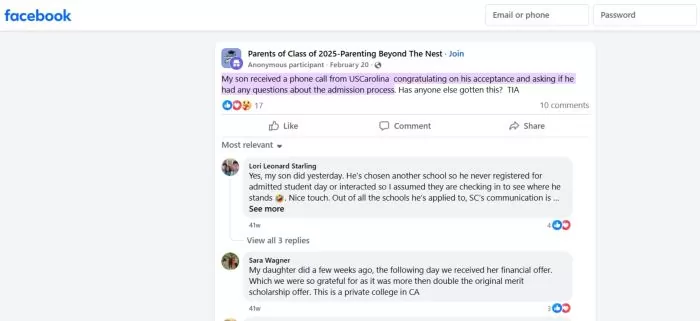
Example:University of South Carolina (USC). USC’s admissions team adds a decidedly personal touch to lead nurturing by picking up the phone to congratulate admitted students. These informal chats help admitted students feel valued and give them a chance to voice any concerns. USC also involves faculty and current students in the follow-up process; for instance, an admitted engineering major might get an email or call from an engineering professor or student ambassador.
9. Host Events (On-Campus and Virtual) That Educate and Inspire
Hosting well-crafted events is one of the most effective ways to turn interest into enrollment. On-campus events like open houses and shadow days allow families to experience your community firsthand. Keep them interactive, offer student-led tours, informal chats with faculty, and performances to showcase school spirit. These real-world interactions make your school more memorable.
Virtual events also carry weight, especially for international or out-of-town prospects. Live webinars, themed Q&A panels, and online workshops let families connect from anywhere. Consider sessions like “How to Write a Great Application Essay” or alumni panels sharing career outcomes.
Each event is also a content opportunity. Record webinars, collect quotes, and share visuals across your channels. Personalized follow-ups (“Thanks for attending, here’s what’s next”) help nurture those leads further.
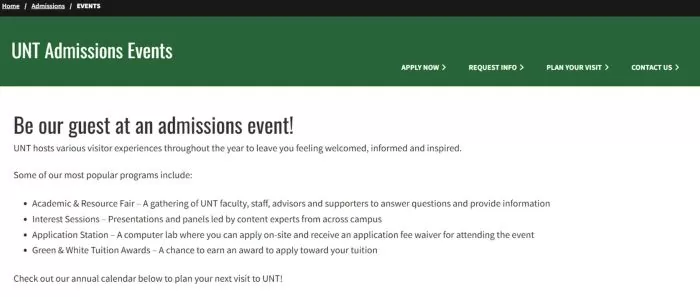
Example:University of North Texas (UNT). UNT offers an array of admissions events designed to welcome and inform prospective students, including both in-person programs and online sessions. One flagship initiative is the UNT Admissions Webinar Series – live virtual information sessions “designed just for students who haven’t applied yet.” These free webinars walk attendees through what makes UNT unique, tips on the application process, and key deadlines, all from the comfort of home. Admissions counselors appear on camera to answer questions in real time, so participants leave with personalized info and confidence about next steps. For those who can visit campus, UNT also hosts large open-house events like “UNT Preview,” a conference-style open day with academic fairs, tours, and even an on-site Application Station where students can apply and get the fee waived.
10. Showcase Outcomes and Alumni Success (Paint the Long-Term Picture)
When families invest in an education, whether paying private tuition or college fees, they want proof that it leads to success. That’s why one of the most compelling marketing strategies for schools is to showcase outcomes. You’re not just selling a school experience; you’re selling what it makes possible.
For K–12 and college-prep institutions, highlight metrics like college acceptance rates and scholarship totals. Randolph-Macon Academy (R-MA), for example, proudly advertises a 100% college acceptance rate and over $15 million in scholarship offers for its 2025 graduates. That kind of evidence quickly signals ROI to prospective families.
Example:Randolph-Macon Academy (R-MA). R-MA prominently advertises its student outcomes to give families confidence in the long-term ROI of its program. For example, the academy proudly announced that 100% of its Class of 2025 earned college acceptances, collectively securing over $15 million in scholarships and 18 appointments to prestigious U.S. Service Academies. This kind of outcome data is highlighted on R-MA’s website and social media, signaling to prospective parents that an R-MA education leads to tangible success. The school also regularly publishes lists of colleges and universities its graduates attend (Ivies, top public universities, military academies, etc.), and shares alumni spotlights – like profiles of graduates who have become pilots, doctors, or entrepreneurs. By showcasing these results, R-MA helps future students (and their parents) visualize their own potential trajectory and trust that the tuition investment will pay off in opportunities.
Vocational or language schools should spotlight relevant results: job placement rates, certifications earned, or skill development gains.
Don’t just rely on stats. Share alumni stories that reflect diverse paths: scientists, entrepreneurs, activists, artists. Feature them on your blog or social channels, and invite them to participate in webinars or info sessions.
On your website, dedicate a section to “Success After Graduation,” including employer logos, testimonials, or infographics. And use social media to celebrate alumni news. These stories build credibility, trust, and vision, which help future students imagine their path through your school.
Turning Strategy into Enrollment Success
In today’s dynamic and competitive education landscape, schools can no longer rely on traditional tactics or word-of-mouth alone. To thrive, they need a strategic, student-centric marketing approach that speaks to modern families across digital platforms. The ten strategies outlined in this article, from optimizing your website and leveraging social media to showcasing alumni outcomes, offer a blueprint for schools to increase visibility, build trust, and convert interest into enrollment.
Whether you’re a K–12 academy, career college, language school, or university, the key is to meet prospective students where they are, communicate your unique value clearly, and guide them confidently through their decision-making journey. When implemented with authenticity and consistency, these strategies not only help fill seats, they strengthen your school’s brand and foster lasting relationships with students and families. In short, great marketing helps the right students find their right-fit school.
Struggling with enrollment and retention?
Our innovative marketing strategies can help you generate more leads.
Frequently Asked Questions
Question: How do you create a marketing strategy for a school?
Answer: A strong school marketing strategy starts by defining your goals and audience, then clarifying your unique value proposition. Choose the right channels: website, SEO, social media, email, events, etc., all while keeping messaging consistent. Implement your plan, track performance with analytics, and adjust as needed to improve enrollment results.
Question: What is the best marketing for independent schools?
Answer: Independent schools succeed with targeted, budget-friendly inbound marketing. The best approach is a strong online presence: a content-rich, search-optimized website, active social media that highlights student life, and helpful emails or blogs that build trust. These tactics attract the right families and strengthen community engagement.
Greenville, Wis – December 8, 2025 – School Specialty®, a leading provider of learning environments, supplies and science curriculum to the preK-12 education market, today announced the acquisition of Nasco Education U.S., a trusted name in specialized, curated education solutions for K-12 schools. This strategic acquisition enhances School Specialty’s ability to serve its core customers by enhancing its value proposition to schools across the country.
“We estimate that nearly two-thirds of Nasco Education U.S.’s customers are already School Specialty buyers,” said Ryan Bohr, CEO of School Specialty. “Like School Specialty, Nasco Education U.S. has been an industry fixture of supplying schools for decades. Combining our companies will bring procurement efficiencies to our customers and expand the scope of products available to them.”
School Specialty has more than 60 years of leadership in transforming classrooms into future-ready learning spaces for preK-12 educational institutions, serving five in every six school districts nationwide and curating products from hundreds of trusted brands. Nasco Education U.S. offers a broad selection of specialized products, including hands-on, activity-based resources that support instruction across subjects like science, math, and the arts. Both companies share a deep commitment to providing high-quality, relevant resources that empower teachers and students.
Both organizations will operate independently for the near term. School Specialty expects to integrate the businesses gradually to ensure a seamless experience for the longstanding customers of both organizations.
“Together, we will be able to provide even greater support, innovation, and value to schools nationwide, helping them deliver the best possible learning experiences for their students,” said Ryan Bohr, CEO of School Specialty.
About School Specialty, LLC
With a 60-year legacy, School Specialty is a leading provider of comprehensive learning environment solutions for the pre-K12 education marketplace in the U.S. and Canada. This includes essential classroom supplies, furniture and design services, educational technology, sensory spaces featuring Snoezelen, science curriculum, learning resources, professional development, and more. School Specialty believes every student can flourish in an environment where they are engaged and inspired to learn and grow. In support of this vision to transform more than classrooms, the company applies its unmatched team of education strategists and designs, manufactures, and distributes a broad assortment of name-brand and proprietary products. For more information, go to SchoolSpecialty.com.
About Nasco Education U.S.
Nasco Education U.S. is a leading developer and distributor of instructional materials, offering a wide range of hands-on learning products for the preK-12 education market with 80+ years of experience. Nasco Education U.S. provides schools and educators with the educational materials needed to create impactful classroom experiences that enhance student engagement and academic performance. For more information, go to NascoEducation.com.
eSchool Media staff cover education technology in all its aspects–from legislation and litigation, to best practices, to lessons learned and new products. First published in March of 1998 as a monthly print and digital newspaper, eSchool Media provides the news and information necessary to help K-20 decision-makers successfully use technology and innovation to transform schools and colleges and achieve their educational goals.
Some families enrolled in the Idaho Home Learning Academy public virtual charter school used state funding to pay for virtual reality headsets, hoverboards, hunting equipment, video games and video game controllers, paddleboards, smart watches, admission tickets to water parks and subscriptions to streaming services like Netflix and Hulu, according to a new state watchdog report released Tuesday.
OPE released the evaluation report after multiple Idaho legislators signed a March 5 letter requesting the office study the Idaho Home Learning Academy’s finances, expenditures, policies, contracts and student achievement results.
The Idaho Home Learning Academy, or IHLA for short, is a rapidly growing public virtual charter school authorized by the small, rural Oneida School District.
There were about 7,600 online students enrolled at Idaho Home Learning Academy during the 2024-25 school year, many of which do not live within the traditional geographic boundaries of the Oneida School District.
New report raises questions about how supplemental learning funds are used by some families
As part of Idaho Home Learning Academy’s contract, its education service providers administer supplemental learning funds of $1,700 to $1,800 per student to families enrolled in IHLA that were paid for by Idaho taxpayer dollars, the report found. The money is intended to help pay families for education expenses, and the OPE evaluators found that the largest share of the funds were spent on technology expenses, such as computers, printers and internet access. Other significant sources of supplemental learning fund expenses went for physical education activities and performing arts expenses, the OPE report found.
However, OPE evaluators found that some families used their share of funding for tuition and fees at private schools and programs. Some families also used their funds for noneducational board games, kitchen items like BBQ tongs, cosmetics, a home theater projector screen, video games, Nintendo Switch controllers, a Meta Quest virtual reality headset, movie DVDs, weapons, sights lasers, shooting targets, remote controlled cars, hoverboards, action figures, smartwatches, water park tickets and the cost of registering website domain names, the OPE report found.
Families with students enrolled at Idaho Home Learning Academy are able to access the funds though both direct ordering programs and reimbursements. The OPE report found that Idaho Home Learning Academy’s three service providers (Braintree, Home Ed and Harmony) spent about $12.5 million providing supplemental learning funds for IHLA families during the 2024-25 school year. Service providers said that some families did not spend any or all of their supplemental learning funds, and the money was retained by the service providers, not returned back to the state or school district, the OPE report found.
Idaho governor, superintendent of public instruction respond to OPE report’s findings
Idaho Gov. Brad Little called the report’s findings “troubling” in a letter released with the report Tuesday.
“We also have an obligation to be responsible stewards of taxpayer dollars,” Little wrote. “The OPE report on IHLA is troubling, especially as it pertains to supplemental learning fund expenses, academic performance, supplemental curriculum and the funding formula that enables virtual programs to receive more funding than brick-and-mortar public schools. The OPE report reveals that statutory safeguards are insufficient, oversight is inconsistent and accountability measures have not kept pace with the fast expansion of the IHLA program.”
The OPE evaluation report findings come at a time when every dollar of state funding in Idaho is being stretched further amid a revenue shortfall. All state agencies outside of the K-12 public school system are implementing 3% mid-year budget holdbacks, and the state budget is projected to end fiscal year 2026 and fiscal year 2027 in a budget deficit, the Idaho Capital Sun previously reported.
Idaho Superintendent of Public Instruction Debbie Critchfield said the report raised concerns for her as well.
“(The OPE report) also raises important questions about whether direct and indirect payments to families are a proper and legal use of funds appropriated for public schools,” Critchfield wrote in a Nov. 26 letter to OPE leadership.
The OPE evaluation report found that limited oversight and accountability create uncertainty about how supplemental learning funds paid for with state taxpayer dollars are used and whether students’ curriculum choices align with state standards and transparency requirements.
Idaho state laws and administrative rules do not specifically allow or prohibit the use of supplemental learning funds, the OPE report found. That finding was one of several “policy gray areas” that the OPE evaluation report documented.
Little concluded his letter by saying he is ready to work with the Idaho Legislature, the Idaho State Department of Education and the Idaho State Board of Education to restore meaningful accountability for the use of taxpayer dollars.
“I have carefully reviewed the recommendations provided in this report and strongly encourage the Legislature to address the loopholes in state statute,” Little wrote.
Oneida School District superintendent stresses Idaho Home Learning Academy did not break state law
In response to the OPE report, Oneida School District Superintendent Dallan Rupp, who is also a member of the Idaho Home Learning Academy School board, emphasized that the report did not find that IHLA was guilty of any misconduct.
“Importantly, the OPE report did not identify any misconduct at IHLA,” Rupp said during a meeting Tuesday at the Idaho State Capitol in Boise. “This outcome underscores the effectiveness of Oneida School District’s oversight and reflects IHLA’s consistent compliance with Idaho’s laws, statutes, rules, regulations and procedures, as well as its cooperative relationship with the Idaho State Department of Education. We remain fully committed to operating within all established guidelines, just as we have in the past.”
Idaho Sen. James Ruchti, D-Pocatello, said it was beside the point that the school didn’t break any laws.
“I’m extremely concerned,” Ruchti said during Tuesday’s meeting at the Idaho State Capitol in Boise. “This is public money – public taxpayer money – and we have an obligation to make sure that it’s spent appropriately and with oversight. And so, yes, it may not have violated any statutory requirements at this point. But what I’m saying is that what I saw in that presentation caused me serious concerns about how IHLA and other online teaching institutions are able to spend public dollars in a way that was not intended.”
Idaho watchdog report found most online virtual teachers were part-time employees
OPE also found that most Idaho Home Learning Academy teachers were part-time, unlike traditional schools, and the Idaho Home Learning Academy spends much less on salaries and benefits than it receives from the state’s salary apportionment formula.
The report found IHLA was able to use the savings it realized in state funding provided to pay for staff salaries and health benefits to instead use at IHLA’s discretion or to pay its education service providers.
The OPE report found that most of IHLA’s teachers are part-time employees and do not provide full-time direct instruction to students. Instead, the report found that Idaho Home Learning Academy’s kindergarten through eighth grade instructional model relied heavily on parent-directed learning and that IHLA teachers typically offered feedback and oversight instead of direct instruction.
According to the report, IHLA reported $46.3 million in total expenditures from state funds during the 2024-25 school year. While traditional brick-and-mortar public schools’ largest expenditures are for staff salaries and benefits, the report found that only 36% of IHLA’s expenditures went to staff. A larger portion – 45% of IHLA’s total expenditures, or $20.6 million – went to paying education service providers.
The OPE report also found that Idaho Home Learning Academy’s students lagged behind statewide averages for scores on Idaho Standards Achievement Test, or ISAT. The OPE report found 42% of IHLA students were proficient in English language arts during the 2024-25 school year, compared to the statewide average of 52% of Idaho students.
The report also found just 25% of IHLA students were proficient in math during the 2024-25 school year, compared to the Idaho statewide average of 43%.
However, the OPE report highlighted that some IHLA families interviewed for the report said they do not believe statewide standardized tests are a good measure of student learning. The report also noted that many Idaho Home Learning Academy families identified themselves as homeschoolers and said they were using IHLA by choice because they were unhappy with the quality of education in traditional brick-and-mortar schools or felt that their child’s educational needs were not being met by more traditional public schools.
Idaho Capital Sun is part of States Newsroom, a nonprofit news network supported by grants and a coalition of donors as a 501c(3) public charity. Idaho Capital Sun maintains editorial independence. Contact Editor Christina Lords for questions: [email protected].
Did you use this article in your work?
We’d love to hear how The 74’s reporting is helping educators, researchers, and policymakers. Tell us how