Getting an internship in law while you’re still in high school is a great way to learn about the field, get better at your job, and make your college applications stronger. The College Planning Center helps high school students find law internships for high school students at law firms, government offices, and other legal opportunities. This guide will show you how to find, apply for, and succeed in summer law internships for high school students, FBI internships for high school students, or even international programs such as United Nations high school internships.
The Benefits of Law Internships
High school legal internships give students hands-on experience working in law offices, courts, government agencies, or international organizations. Interns gain:
Exposure to legal jobs and responsibilities
Opportunities to network with professionals
Enhancement of college applications
Improvement of research, writing, and communication skills
The College Planning Center has seen how law internships for high school students help students clarify career goals and build confidence in professional settings.
Different Types of Law Internships for High School Students
Law Office Internships for Teens
Some law firms have shadowing or internship programs where students assist with research, attend court sessions, and learn about legal procedures. Paid and unpaid opportunities are often available in metropolitan areas.
Government Internships for High Schoolers
Sometimes, high school students can work as interns in government offices, district attorneys’ offices, and public defenders’ offices. These programs teach students about making laws, public policy, and how courtrooms work.
Summer Law Internships
High school students can engage in summer law internships for high school students lasting 6–10 weeks. Most programs have mentoring, workshops, and chances to do legal research and casework.
Internships with the FBI for High School Students
The FBI has programs that teach students about law enforcement, criminal investigations, cybersecurity, and how federal law enforcement works.
White House Internships for High School Students
Some White House programs take high school interns who are interested in law, government, and public policy. Interns do policy briefs, research projects, and administrative work.
International Law Internships
Students can learn about human rights and global law through programs like the United Nations High Commissioner for Refugees internship or United Nations high school internships.
How to Help High School Students Get Law Internships
Resources for Schools and Communities
Students can get internships at local law firms, courts, and government offices through their high school counselors, law clubs, and community groups. The College Planning Center works with other organizations to connect students with real opportunities.
Websites That Can Help You Find Internships
Websites like Idealist, InternshipPrograms.com, and GoAbroad list internships in the US and internationally. Use these along with The College Planning Center’s internship finder to locate legal internships for high school students.
Getting Help and Meeting New People
Parents, mentors, and community members can help uncover opportunities. Attending workshops, law camps, and pre-college programs increases your chances of securing a law internship.
Conclusion
High school students who participate in law internships for high school students gain hands-on legal experience, develop transferable skills, and strengthen their academic and professional profiles. Programs offered through the College Planning Center make it easier to locate legitimate opportunities, refine applications, and connect with mentors.
The first step toward a future career in law is securing your first internship. Start early, stay organized, and leverage resources like the College Planning Center to make it happen.
ALLOWAY TOWNSHIP, N.J., Nov. 20, 2025 — A local school board member’s Facebook post to community members about a tax hike should have started a conversation — instead, it led to censorship.
The Foundation for Individual Rights and Expression is suingthe commissioner of New Jersey’s Department of Education and members of the state’s School Ethics Commission to stop them from abusing a law to chill the speech of an elected school board member who used social media to seek her constituents’ input.
“I didn’t join the school board to be told to shut up,” said Gail Nazarene, an elected school board member, Navy veteran, and grandma in Alloway Township. “New Jersey officials claim the authority to punish me simply for asking folks questions about important issues, particularly when it affects their wallets. I should be free to communicate with constituents and get their views without being censored by state officials.”
In April, Gail used Facebook to discuss tax increases and other school issues with constituents. In one post, she asked, “As a resident of Alloway, I am wondering what other residents think about a 9-15% school tax increase?” She clarified in her later posts that she was asking in her personal capacity. But another school board member saw the posts and filed a complaint against her, claiming Gail had violated New Jersey’s School Ethics Act because she allegedly had spoken on the board’s behalf. The complaint is pending before the state’s School Ethics Commission.
“Americans deserve to know what their elected officials think about important issues,” said FIRE attorney Daniel Zahn. “New Jersey is muzzling elected officials and preventing them from talking with their community, the very people they were elected to represent.”
The state broadly interprets the School Ethics Act to bar elected officials from discussing issues relating to schools on social media. And this isn’t the first time it’s done so. The School Ethics Commission has previously warned elected officials against engaging with constituents on social media and previously interpreted the act to prevent elected school board members from discussing matters of public concern on social media and in op-eds.
But the First Amendment protects Gail’s right to speak freely on such issues.
Gail has stopped soliciting constituent feedback online. She fears any posts about school board issues will lead to punishment, including reprimand, censure, suspension, or removal. But she also is concerned about the loss of First Amendment freedoms for her and her constituents.
“When the state silences school board members, parents and taxpayers are kept in the dark,” said FIRE attorney Greg Greubel. “The School Ethics Act can’t be turned into an unconstitutional gag rule.”
Today’s federal lawsuit asks the court to declare New Jersey’s School Ethics Act unconstitutional as interpreted by the state and stop its use against elected officials speaking out about public issues.
The Foundation for Individual Rights and Expression (FIRE) is a nonpartisan, nonprofit organization dedicated to defending and sustaining the individual rights of all Americans to free speech and free thought — the most essential qualities of liberty. FIRE educates Americans about the importance of these inalienable rights, promotes a culture of respect for these rights, and provides the means to preserve them.
When I first stepped into my role overseeing student data for the Campbell County School District, it was clear we were working against a system that no longer served us.
At the time, we were using an outdated platform riddled with data silos and manual processes. Creating school calendars and managing student records meant starting from scratch every year. Grade management was clunky, time-consuming, and far from efficient. We knew we needed more than a patchwork fix–we needed a unified student information system that could scale with our district’s needs and adapt to evolving state-level compliance requirements.
Over the past several years, we have made a full transition to digitizing our most critical student services, and the impact has been transformational. As districts across the country navigate growing compliance demands and increasingly complex student needs, the case for going digital has never been stronger. We now operate with greater consistency, transparency, and equity across all 12 of our schools.
Here are four ways this shift has improved how we support students–and why I believe it is a step every district should consider:
How centralized student data improves support across K-12 schools
One of the most powerful benefits of digitizing critical student services is the ability to centralize data and ensure seamless support across campuses. In our district, this has been a game-changer–especially for students who move between schools. Before digitization, transferring student records meant tracking down paper files, making copies, and hoping nothing was lost in the shuffle. It was inefficient and risky, especially for students who required health interventions or academic support.
Now, every plan, history, and record lives in a single, secure system that follows the student wherever they go. Whether a student changes schools mid-year or needs immediate care from a nurse at a new campus, that information is accessible in real-time. This level of continuity has improved both our efficiency and the quality of support we provide. For districts serving mobile or vulnerable populations, centralized digital systems aren’t just convenient–they’re essential.
Building digital workflows for student health, attendance, and graduation readiness
Digitizing student services also enables districts to create customized digital workflows that significantly enhance responsiveness and efficiency. In Campbell County, we have built tools tailored to our most urgent needs–from health care to attendance to graduation readiness. One of our most impactful changes was developing unified, digital Individualized Health Plans (IHPs) for school nurses. Now, care plans are easily accessible across campuses, with alerts built right into student records, enabling timely interventions for chronic conditions like diabetes or asthma. We also created a digital Attendance Intervention Management (AIM) tool that tracks intervention tiers, stores contracts and communications, and helps social workers and truancy officers make informed decisions quickly.
These tools don’t just check boxes–they help us act faster, reduce staff workload, and ensure no student falls through the cracks.
Digitization supports equitable and proactive student services
By moving our student services to digital platforms, we have become far more proactive in how we support students–leading to a significant impact on equity across our district. With digital dashboards, alerts, and real-time data, educators and support staff can identify students who may be at risk academically, socially, or emotionally before the situation becomes critical.
These tools ensure that no matter which school a student attends–or how often they move between schools–they receive the same level of timely, informed support. By shifting from a reactive to a proactive model, digitization has helped us reduce disparities, catch issues early, and make sure that every student gets what they need to thrive. That’s not just good data management–it’s a more equitable way to serve kids.
Why digital student services scale better than outdated platforms
One of the most important advantages of digitizing critical student services is building a system that can grow and evolve with the district’s needs. Unlike outdated platforms that require costly and time-consuming overhauls, flexible digital systems are designed to adapt as demands change. Whether it’s integrating new tools to support remote learning, responding to updated state compliance requirements, or expanding services to meet a growing student population, a digitized infrastructure provides the scalability districts need.
This future-proofing means districts aren’t locked into rigid processes but can customize workflows and add modules without disrupting day-to-day operations. For districts like ours, this adaptability reduces long-term costs and supports continuous improvement. It ensures that as challenges evolve–whether demographic shifts, policy changes, or new educational priorities–our technology remains a reliable foundation that empowers educators and administrators to meet the moment without missing a beat.
Digitizing critical student services is more than a technical upgrade–it’s a commitment to equity, efficiency, and future readiness. By centralizing data, customizing workflows, enabling proactive support, and building scalable systems, districts can better serve every student today and adapt to whatever challenges tomorrow may bring.
Sara Douglas, Campbell County Schools
Sara Douglas is the District Data Leader for Campbell County Schools in Jacksboro, Tennessee.
Latest posts by eSchool Media Contributors (see all)
Artificial Intelligence is reshaping how school administrators, from K–12 principals to university registrars, manage operations, make decisions, and communicate with stakeholders. As resources tighten and expectations rise, AI tools for school administrators offer a powerful opportunity to do more with less. In the 2023–24 school year, a growing majority of K–12 staff are now using AI tools in their work. In a recent Ellucian survey, 61% of higher ed respondents said they’re already using AI, and about 80% cited productivity and efficiency as their main reasons for adopting it.
This isn’t just a tech trend. It’s a real shift in how schools function. AI can automate repetitive tasks, surface data-driven insights, and generate personalized communications. For busy administrators, that means less time on paperwork and more time supporting students and staff.
In this article, we’ll break down how AI is transforming educational management. You’ll see practical use cases, benefits like faster decision-making and streamlined workflows, and what to watch out for when it comes to ethics and implementation. Whether you’re running a district office or managing a registrar’s team, this guide will help you lead smarter and work more efficiently, with AI as your partner.
Are you ready to improve visibility, engagement, and enrollment?
Partner with HEM for solutions designed to help your institution stand out.
How AI Enhances Decision-Making for Administrators
How does AI help school administrators make better decisions? AI’s greatest strength in school management lies in transforming raw data into clear, actionable insights. Administrators regularly face overwhelming volumes of information, grades, attendance, budget reports, and surveys that can be difficult to parse manually. AI tools help by quickly identifying patterns that support evidence-based decisions.
Predictive analytics, for example, can forecast enrollment trends or flag early warning signs. A high school principal might spot which student groups are at risk of chronic absenteeism, while a registrar could project staffing needs for upcoming semesters based on historical data.
AI dashboards make this analysis easy to interpret. They can highlight underused programs, suggest reallocating resources, or model different outcomes to support strategic planning. If an extracurricular activity shows consistently low participation, the system might recommend shifting resources to better-performing initiatives.
The result is faster, more informed decision-making. With AI as a planning partner, administrators gain a sharper view of their institution and can act with confidence and precision.
Automating Routine Administrative Tasks with AI
What routine administrative tasks can AI automate in schools? From attendance logs to class schedules, school administrators are buried in repetitive tasks that sap time and focus. AI is stepping in to take care of the busywork, streamlining operations and giving staff space to lead more strategically.
Take attendance tracking. Instead of manual entry, AI-powered systems can log student presence through smart ID cards or facial recognition check-ins. These tools don’t just record absences; they spot trends. A sudden drop in attendance? The system flags it, prompting early intervention. Some schools now pair attendance with performance data to identify at-risk students before grades slip or disengagement deepens.
Scheduling is another pain point. Building a timetable involves balancing staff availability, room assignments, student choices, and course caps. AI algorithms solve this puzzle fast. In Boston, a genetic algorithm optimized school bus routes in under an hour, cutting 50 buses and saving $5 million annually. That same principle applies to class scheduling, resource allocation, and beyond.
Report generation also gets a boost. AI tools for school administrators can pull data and format it into accurate, ready-to-send reports, such as monthly summaries, performance dashboards, and compliance logs, without human input. Even tedious data entry tasks like processing forms or invoices are simplified through OCR-powered automation.
Need to review a long policy or school social media policy? AI tools now scan, summarize, and highlight what matters. Post-meeting? Transcription services like Otter.ai generate action items and summaries within minutes.
The impact is clear: by automating the everyday, AI frees up time for what truly matters, strategic thinking, collaboration, and student support.
AI for Communication and Writing in School Administration
Strong communication is central to effective school leadership. Yet writing everything from newsletters to policy updates can eat up an administrator’s already busy schedule. That’s where AI can step in, not to replace the human voice, but to support it.
Generative AI tools like Grammarly, ChatGPT, and Jasper are helping school leaders draft clearer, more consistent communications. Do you need to send a monthly update to parents? AI can suggest section headers, polish grammar, and help set the right tone. Drafting a memo to staff? AI can create a first version that administrators can refine for local context. These tools are especially helpful when writing in a non-native language or tailoring content to a specific reading level.
They also save time on summarizing. AI can distill a lengthy school board report into a concise briefing in seconds, or help craft sensitive messages with more precision. One district principal used AI to write a winter holiday letter. The tone was spot on, but the AI mistakenly referenced sledding, forgetting the school was in a warm climate. The principal simply edited it. This type of human oversight ensures accuracy while significantly reducing drafting time.
AI’s reach extends beyond written documents. Many schools and universities now use chatbots to handle FAQs around enrollment, deadlines, and policies. Georgia State’s “Pounce” chatbot reduced summer melt by 21 percent by keeping students engaged. CSUN’s “CSUNny” improved retention by providing 24/7 support. In K–12, chatbots answer parent questions or send automated reminders, freeing staff from phone call overload.
In short, AI acts as a communication partner, speeding up writing, strengthening clarity, and helping administrators stay connected without burning out.
Key Benefits of AI in School Management
When thoughtfully implemented, AI can significantly improve how schools are run, especially for administrators balancing limited resources, increasing demands, and time-sensitive responsibilities. Here are five key advantages that AI brings to school management.
Greater Efficiency and Time Savings AI handles repetitive, time-consuming tasks such as data entry, attendance tracking, report generation, and scheduling. Automating these processes minimizes errors and frees up valuable hours for principals and support staff to focus on more impactful activities, like supporting teachers, engaging with parents, and driving instructional improvements. According to the McKinsey report, AI tools can help educators and administrators reclaim 20 to 40 percent of their time previously spent on routine tasks.
Cost Savings and Better Use of Resources Schools often operate on tight budgets. AI helps by identifying operational inefficiencies and suggesting cost-saving alternatives. AI also helps in allocating resources more wisely, whether adjusting staffing based on predicted needs or identifying underutilized facilities to repurpose. These efficiencies help schools manage tight budgets. Schools can avoid unnecessary expenditures by relying on AI analysis to guide decisions.
Smarter, Data-Driven Decisions AI systems analyze student performance, behaviour trends, and resource utilization far more quickly than a human could. For instance, if data shows that a particular grade level is struggling in math, school leaders can intervene early with targeted support. Having these insights readily available leads to stronger decisions grounded in real evidence.
Stronger, Personalized Communication AI-powered tools like chatbots and automated messaging platforms allow schools to provide timely, personalized updates to parents and students. From attendance alerts to event reminders, these systems ensure important information gets delivered and acted on, without staff needing to make dozens of phone calls or send multiple emails.
Strategic Focus and Innovation By handling operational tasks in the background, AI gives administrators more bandwidth to focus on long-term priorities. Whether that’s improving school culture, mentoring educators, or piloting new programs, leaders can spend less time buried in paperwork and more time driving change.
Challenges of Implementing AI for School Administrators
What challenges do schools face when implementing AI tools? The potential of AI in education is vast, but unlocking it requires more than just installing a new tool. For school administrators, adopting AI often brings a mix of excitement and logistical complexity. Here are the key implementation challenges leaders should be prepared to navigate.
Upfront Costs and Infrastructure Needs Launching AI systems can involve steep initial costs. Schools may need to purchase licenses, upgrade hardware, or improve network connectivity. Basic requirements like reliable internet and compatible devices can be hurdles, especially in underfunded or rural districts. While grants or partnerships may offset expenses, planning for these investments is essential.
Staff Training and Resistance to Change AI adoption means changes in workflows. Teachers, clerical staff, and leadership teams must learn how to use new tools effectively. Resistance often stems from fear of job displacement or lack of familiarity. Providing professional development, starting with small pilots, and showing quick wins are all important steps in gaining staff buy-in.
Data Integration and Quality Issues AI is only as good as the data it works with. Many schools operate with siloed or inconsistent data systems. AI needs clean, well-integrated data to function properly. If attendance, grades, or behaviour logs aren’t standardized, outputs can be skewed or misleading. Administrators may need to revamp data practices and work closely with IT teams to ensure accuracy and consistency.
Ongoing Maintenance and Oversight AI tools aren’t set-it-and-forget-it. They require regular updates, monitoring, and occasional recalibration. Schools without dedicated IT support may struggle to sustain them. Assigning responsibility for AI upkeep and budgeting for long-term maintenance are key to success.
Human Trust and Role Clarity Some staff may worry that automation threatens their jobs. Others may be skeptical of the AI’s accuracy. Administrators should communicate clearly that AI augments human work, not replaces it, and maintain human oversight to ensure outputs are reviewed and contextualized.
Addressing these challenges proactively can turn early hurdles into long-term advantages.
Ethical and Privacy Considerations with AI in Schools
Alongside technical and logistical challenges, school administrators must carefully consider the ethical implications of using AI. Because education involves minors and sensitive data, ethical missteps can have lasting consequences. From student privacy to algorithmic bias, it’s essential to put safeguards in place that prioritize safety, equity, and transparency.
Data Privacy and Security AI systems often require access to student records, health information, and sometimes even biometric data. Feeding this information into cloud-based tools or algorithms increases the risk of misuse or breaches. Administrators must ensure that all systems meet rigorous data protection standards, and that families are informed about what data is collected and how it’s used. Best practices include strong encryption, regular audits, transparent data policies, and opt-out or deletion options when appropriate. Over-surveillance, like constant monitoring or facial recognition, can also undermine trust. Schools must strike a balance between data-driven insights and preserving a respectful learning environment.
Bias and Fairness AI systems trained on historical data can unintentionally reinforce existing inequalities. Predictive models used to identify at-risk students, allocate resources, or evaluate staff must be tested for fairness across race, gender, and socioeconomic status. If unchecked, biased outputs could deepen disparities instead of correcting them. Administrators should work with vendors to ensure diverse training data and conduct regular audits of AI decisions. Involving stakeholders, teachers, parents, and even students in reviewing AI use helps bring community accountability into the process.
Transparency and Accountability Schools should avoid “black box” tools that make recommendations without clear reasoning. Any AI system used to inform decisions, like admissions or discipline, should offer interpretable outputs and allow for human oversight. Clear policies must be in place to define who is responsible if the AI makes a mistake. Human judgment should always remain central.
Academic Integrity and Human Development Generative AI tools raise new questions about cheating, originality, and learning. Administrators must set clear guidelines on acceptable and unacceptable use, emphasizing that AI should support learning, not replace it. Over-reliance on AI for writing or problem-solving can weaken essential student skills. Responsible use requires balancing innovation with the core educational mission of developing thinkers and communicators.
Equity of Access AI should not become a new driver of inequality. If only well-funded schools can afford effective AI tools, achievement gaps will widen. Public institutions, nonprofits, and policymakers must work together to promote equitable access through shared resources, training, and support. Every student deserves the benefits of smart technology, not just those in the most resourced districts.
In short, the power of AI for school management must be matched with principled leadership. Ethical implementation demands vigilance, humility, and transparency, qualities that define the best
How to Implement AI in School Administration
Bringing AI into school administration is a strategic process, not a quick plug-and-play solution. To maximize its benefits and minimize disruption, education leaders need to approach AI adoption methodically. Here’s a roadmap for successfully implementing AI in school operations.
Assess Needs and Define Goals Start with a clear-eyed look at current workflows. What drains staff time? Where are inefficiencies or bottlenecks? Pinpoint specific areas where AI could make a meaningful difference, such as automating repetitive data entry or improving enrollment forecasting. From there, define measurable goals, like reducing schedule conflicts or increasing the speed of report generation. These targets will shape your entire implementation and help evaluate success.
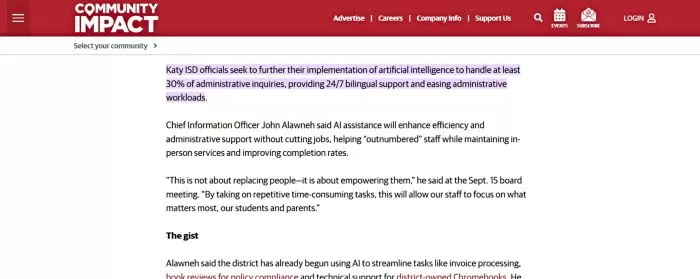
Example: Katy Independent School District (Texas, USA): Facing a growing administrative burden, Katy ISD recognized that its support staff were “outnumbered” by high volumes of repetitive tasks (answering routine inquiries, data entry, etc.). District leaders set a concrete goal for their AI initiative: have AI handle roughly 30% of routine administrative inquiries – with 24/7, bilingual support – so that human staff can focus on high-value interactions. This target was born from a needs assessment of where staff time was being drained. By defining this goal (30% automation of inquiries), Katy ISD created a clear metric for success and a focused vision: use AI as a virtual assistant to improve responsiveness to families while freeing staff for more complex student and parent needs.
Research and Select the Right Tools Not all AI tools are created equal. Once you’ve identified priorities, explore tools designed for education. Look for platforms that integrate easily with your existing systems (SIS, LMS, HR) and are user-friendly for staff. Prioritize solutions with strong vendor support and a track record in the education sector. Talking to peer institutions or reviewing relevant case studies can offer valuable insights.
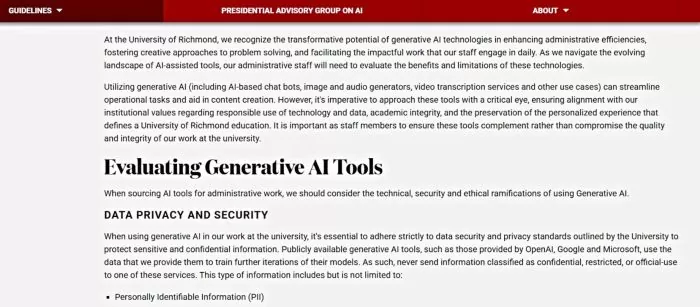
Example: University of Richmond (Virginia, USA): In higher education, institutions are also methodical in choosing AI for administrative use. The University of Richmond explicitly notes the “transformative potential of generative AI…in enhancing administrative efficiencies”, but pairs that excitement with careful evaluation criteria. In official staff guidelines, the university directs its administrative teams to critically vet AI tools for technical fit, security, and ethical considerations. Staff are encouraged to pilot new AI-based services (from chatbots to transcription tools) in a controlled manner – checking that any chosen tool aligns with data privacy policies and the university’s values.
Start with a Pilot Choose a small-scale pilot to test your chosen tool. This might mean introducing a scheduling AI in one department or using a chatbot for financial aid inquiries. Track outcomes closely—are tasks being completed faster? Are users more satisfied? Gather feedback and refine the approach before expanding. A strong pilot builds confidence and creates internal champions.
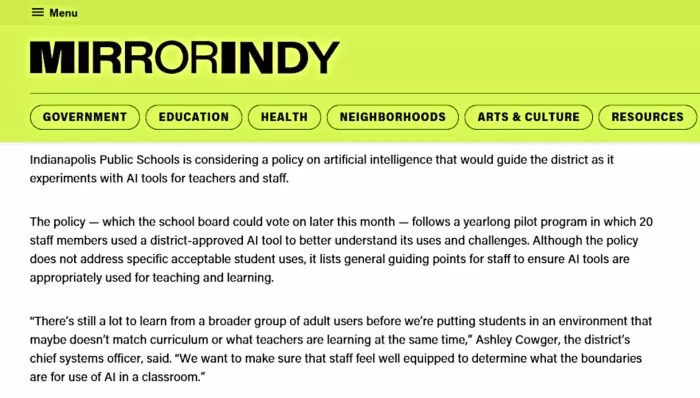
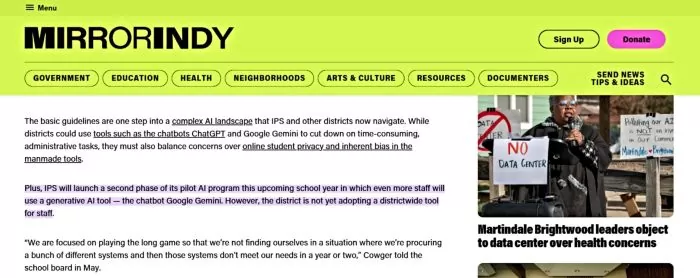
Example: Indianapolis Public Schools (Indiana, USA): IPS illustrates the wisdom of beginning AI adoption on a small scale. In the first year of its AI initiative, the district ran a pilot with just 20 staff members using a district-approved AI tool to handle some of their tasks. This limited pilot let IPS observe real-world uses and challenges (e.g., how an AI writing assistant might help draft reports) without impacting all schools. District leaders gathered feedback and saw improvements, which informed an official AI policy in development. This phased pilot approach gave IPS the chance to refine guidelines and train users in between phases.
Train Staff and Build Buy-In Training is critical. Provide hands-on sessions, user guides, and a forum for questions. Explain how the AI will support, not replace, staff, and share early successes. Framing AI as a helpful assistant rather than a threat makes adoption smoother. Emphasize the time-saving potential and how it frees up staff for more meaningful work.
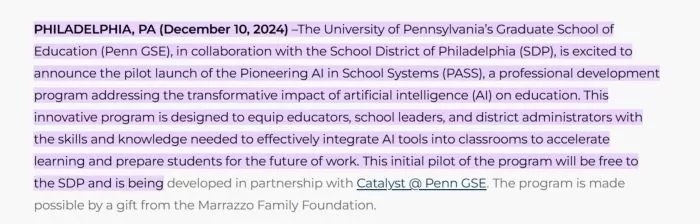
Example: School District of Philadelphia (Pennsylvania, USA): Philadelphia’s public school system, in partnership with the University of Pennsylvania, launched a first-of-its-kind AI training pilot to ensure educators and administrators were on board and prepared. The program, called PASS (Pioneering AI in School Systems), was announced in late 2024 and offers multi-tiered professional development free to a pilot group of district staff. Crucially, PASS explicitly targets mindset and skill-building: it trains district administrators on strategic planning for AI, guides school leaders on implementing AI tools in their schools, and coaches teachers on using AI to enhance (not replace) instruction.
Scale Gradually and Integrate Thoughtfully With a successful pilot in hand, plan for phased implementation. Avoid overwhelming staff by rolling out AI features in stages: first attendance, then scheduling, then reporting. Make sure each step integrates well with existing workflows. Be prepared to revise outdated processes to accommodate the new tool, and keep communication open throughout the transition.
Example: Indianapolis Public Schools (Indiana, USA): After its initial small-scale pilot, IPS is deliberately not rushing into a district-wide rollout – exemplifying thoughtful integration. The district is entering a second pilot year with more staff and a new tool (Google’s Gemini chatbot), but has held off on immediately procuring a permanent, system-wide AI platform. This restraint is intentional: IPS leaders want to ensure any AI tool is truly effective and fits their needs before integrating it into all schools. They are also developing an AI Advisory Committee (including administrators, teachers, tech, and legal experts) to guide integration and update usage policies as the pilot expands. By scaling usage gradually – first 20 staff, now a larger cohort, still not yet student-facing – IPS can adjust its data integration, security settings, and training materials in parallel.
Monitor, Measure, Improve Implementation doesn’t stop at rollout. Regularly assess whether the AI is meeting your goals. Track KPIs like time saved, error rates, or satisfaction levels. Use this data to fine-tune the system and report outcomes to stakeholders. AI platforms often improve with use, especially those built on machine learning. Feeding back your school’s data will make them more effective over time.
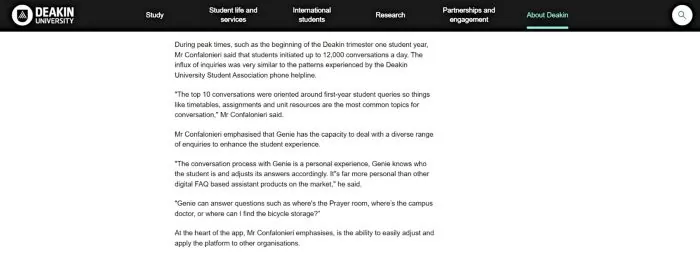
Example: Deakin University (Victoria, Australia): Deakin’s IT and administrative teams exemplify continuous improvement with their AI-powered student services. The university’s digital assistant “Genie” was rolled out in stages and is closely monitored for usage and performance. Since launching across campus, Genie’s user base has more than doubled within a year over 25,000 students having downloaded the app, a metric the university tracks to gauge adoption. Deakin’s Chief Digital Officer noted they analyze conversation data: at peak times, Genie handles up to 12,000 conversations a day, and they review the top categories of student questions (e.g., timetable info, assignment deadlines). By identifying the most common inquiries, the team continuously updates Genie’s responses and adds new features. This ongoing measurement extends to quality checks – the university monitors whether Genie’s answers resolved students’ issues or if human staff had to follow up, informing further training of the AI.
Foster a Culture of Innovation Successful AI integration requires a mindset shift. Leaders should create an environment where staff feel empowered to try new approaches and share feedback. Celebrate wins, learn from setbacks, and reinforce that AI is a tool to enhance human capacity, not replace it.
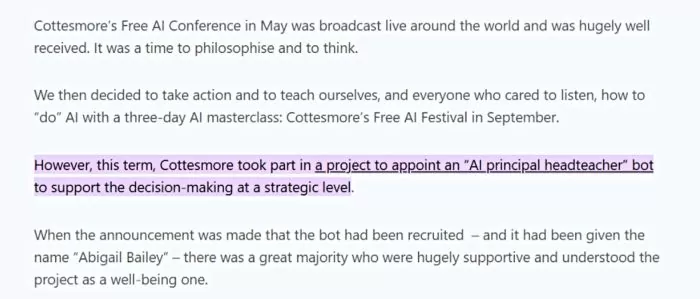
Example: Cottesmore School (West Sussex, UK): This independent boarding school has embraced an innovation-first culture in its administration, particularly with AI. Headmaster Tom Rogerson gained international attention in 2023 for appointing an AI chatbot as an “assistant headteacher” – named “Abigail Bailey” – to support strategic decision-making. The move was less about the tech itself and more about signaling to staff and students that experimenting with new ideas is welcome. Rogerson frames the project as a well-being and innovation initiative: the AI assistant serves as a “strategic leadership mentor,” providing impartial insights, while human leaders remain in charge. In addition to this high-profile experiment, Cottesmore has hosted free AI conferences and masterclasses for educators. For example, the school ran an “AI Festival” where staff from Cottesmore and other schools tried out AI tools and shared ideas in a collaborative environment. By openly discussing both the opportunities and challenges of AI, and even inviting outside experts to weigh in, the headmaster created a safe space for his team to be curious and creative.
Implementing AI in school administration is an ongoing journey, but with a clear strategy and commitment to collaboration, schools can unlock new levels of efficiency, insight, and impact. The result is a smarter, more responsive administrative operation that supports the broader mission of education.
Final Thoughts
AI is transforming education management by enhancing, not replacing, the work of school administrators. It takes on time-consuming tasks, delivers faster insights from data, and strengthens communication with students, families, and staff. The result is more time for leaders to focus on strategy, mentorship, and school culture.
At HEM, we view AI as a vital part of a modern, responsive education strategy. Schools that adopt AI thoughtfully are better prepared to navigate enrollment shifts, budget pressures, and rising expectations. The key is clear planning, ethical use, and keeping people at the centre.
AI gives administrators the support they need to lead more effectively. With the right approach, it can elevate the quality and impact of school leadership.
Are you ready to improve visibility, engagement, and enrollment?
Partner with HEM for solutions designed to help your institution stand out.
Frequently Asked Questions
Question: How does AI help school administrators make better decisions?
Answer: AI’s greatest strength in school management lies in transforming raw data into clear, actionable insights. Administrators regularly face overwhelming volumes of information, grades, attendance, budget reports, and surveys that can be difficult to parse manually. AI tools help by quickly identifying patterns that support evidence-based decisions.
Question: What routine administrative tasks can AI automate in schools?
Answer: From attendance logs to class schedules, school administrators are buried in repetitive tasks that sap time and focus. AI is stepping in to take care of the busywork, streamlining operations and giving staff space to lead more strategically.
Question: What challenges do schools face when implementing AI tools?
Answer: The potential of AI in education is vast, but unlocking it requires more than just installing a new tool. For school administrators, adopting AI often brings a mix of excitement and logistical complexity.
This audio is auto-generated. Please let us know if you have feedback.
Dive Brief:
Higher hourly wages are credited for modest growth in the number of school bus drivers over the past year, but employment in the field remains down 9.5% compared to 2019 staffing levels, according to a recent analysis from the Economic Policy Institute.
The median hourly wage for school bus drivers was $22.45 on Aug. 1, a 4.2% increase year over year when accounting for inflation.
Nonetheless, the K-12 staffing outlook overall shows instability as school systems continue adjusting to the end of federal COVID-19 emergency funding and as changes implemented by the Trump administration put more fiscal pressures on state and local school systems, EPI said.
Dive Insight:
Employment for all K-12 positions is up 1.4% from August 2019 to August 2025, EPI found. Custodian positions dropped 12.4%, joining school bus drivers among those seeing the largest decreases. Slots for paraprofessionals, on the other hand, increased 16.5% during the same period, according to EPI.
The recent wage growth for school bus drivers is not the typical pattern seen over the past 15 years, EPI said. In fact, from Nov. 1, 2012, through June 1, 2015, school bus drivers saw negative year-over-year wage growth. Negative growth also occurred for this role in July 2018, November 2018 and September 2019.
EPI said the split-shift schedule required for the beginning and end of school days makes it difficult to recruit bus drivers. Moreover, school bus drivers — along with paraprofessionals, custodians and food service workers — tend to receive low pay. These jobs also are disproportionately held by women, Black and brown workers, and older employees, according to a 2024 EPI report.
School bus driver employment has grown by about 2,300 jobs over the past year. This growth is due to state and local government school bus driver employment, which saw an increase of nearly 9,900 drivers since the fall of 2024. Private-sector school bus employment fell by 8,200 jobs over the same period.
The institute’s most recent report said it’s hard to draw meaningful conclusions about the school bus driver wage growth over the last few years due to COVID-influenced changes in the labor market, as well as difficulty collecting labor data during the pandemic.
Still, EPI said “the wage growth for school bus drivers in the last year stands out as a much-needed investment in this critical segment of the education workforce.”
Several schools in Pennsylvania and one school system in Ohio closed for at least a day this school year due to school bus driver shortages, according to local news reports. Other localities have consolidated bus routes or made other adjustments to respond to driver shortages.
Far too many students enter math class expecting to fail. For them, math isn’t just a subject–it’s a source of anxiety that chips away at their confidence and makes them question their abilities. A growing conversation around math phobia is bringing this crisis into focus. A recentarticle, for example, unpacked the damage caused by the belief that “I’m just not a math person” and argued that traditional math instruction often leaves even bright, capable students feeling defeated.
When a single subject holds such sway over not just academic outcomes but a student’s sense of self and future potential, we can’t afford to treat this as business as usual. It’s not enough to explore why this is happening. We need to focus on how to fix it. And I believe the answer lies in rethinking how we teach math, aligning instruction with the way the brain actually learns.
Context first, then content
A key shortcoming of traditional math curriculum–and a major contributor to students’ fear of math–is the lack of meaningful context. Our brains rely on context to make sense of new information, yet math is often taught in isolation from how we naturally learn. The fix isn’t simply throwing in more “real-world” examples. What students truly need is context, and visual examples are one of the best ways to get there. When math concepts are presented visually, students can better grasp the structure of a problem and follow the logic behind each step, building deeper understanding and confidence along the way.
In traditional math instruction, students are often taught a new concept by being shown a procedure and then practicing it repeatedly in hopes that understanding will eventually follow. But this approach is backward. Our brains don’t learn that way, especially when it comes to math. Students need context first. Without existing schemas to draw from, they struggle to make sense of new ideas. Providing context helps them build the mental frameworks necessary for real understanding.
Why visual-first context matters
Visual-first context gives students the tools they need to truly understand math. A curriculum built around visual-first exploration allows students to have an interactive experience–poking and prodding at a problem, testing ideas, observing patterns, and discovering solutions. From there, students develop procedures organically, leading to a deeper, more complete understanding. Using visual-first curriculum activates multiple parts of the brain, creating a deeper, lasting understanding. Shifting to a math curriculum that prioritizes introducing new concepts through a visual context makes math more approachable and accessible by aligning with how the brain naturally learns.
To overcome “math phobia,” we also need to rethink the heavy emphasis on memorization in today’s math instruction. Too often, students can solve problems not because they understand the underlying concepts, but because they’ve memorized a set of steps. This approach limits growth and deeper learning. Memorization of the right answers does not lead to understanding, but understanding can lead to the right answers.
Take, for example, a third grader learning their times tables. The third grader can memorize the answers to each square on the times table along with its coordinating multipliers, but that doesn’t mean they understand multiplication. If, instead, they grasp how multiplication works–what it means–they can figure out the times tables on their own. The reverse isn’t true. Without conceptual understanding, students are limited to recall, which puts them at a disadvantage when trying to build off previous knowledge.
Learning from other subjects
To design a math curriculum that aligns with how the brain naturally learns new information, we can take cues from how other subjects are taught. In English, for example, students don’t start by memorizing grammar rules in isolation–they’re first exposed to those rules within the context of stories. Imagine asking a student to take a grammar quiz before they’ve ever read a sentence–that would seem absurd. Yet in math, we often expect students to master procedures before they’ve had any meaningful exposure to the concepts behind them.
Most other subjects are built around context. Students gain background knowledge before being expected to apply what they’ve learned. By giving students a story or a visual context for the mind to process–breaking it down and making connections–students can approach problems like a puzzle or game, instead of a dreaded exercise. Math can do the same. By adopting the contextual strategies used in other subjects, math instruction can become more intuitive and engaging, moving beyond the traditional textbook filled with equations.
Math doesn’t have to be a source of fear–it can be a source of joy, curiosity, and confidence. But only if we design it the way the brain learns: with visuals first, understanding at the center, and every student in mind. By using approaches that provide visual-first context, students can engage with math in a way that mirrors how the brain naturally learns. This shift in learning makes math more approachable and accessible for all learners.
Nigel Nisbet, Mind Education
Armed with a mathematics degree and early success as a rock musician, Nigel Nisbet moved to the US to teach mathematics, AP Physics and AP Computer Science at Van Nuys Senior High, where he pioneered integrating technology into the classroom. After a spell in district mathematics leadership at the Los Angeles Unified School District, Nisbet joined the nonprofit Mind Education team as the vice president of content creation. To continue reading about how the brain learns, visit https://www.mindeducation.org/.
Latest posts by eSchool Media Contributors (see all)
Senate lawmakers on Monday advanced legislation that would launch the most comprehensive overhaul of New Jersey’s regulation of charter schools in 30 years.
The bill advanced by the Senate Education Committee on Monday would outright ban for-profit charter schools, require them to post a range of documents online, and impose residency requirements for some charter school trustees.
“We have not looked at charter schools as a whole legislatively in this committee since the 1990s, so this is an opportunity where we’re trying to do that,” said Sen. Vin Gopal (D-Monmouth), the panel’s chair and the bill’s prime sponsor.
The bill comes as New Jersey charter schools have faced scrutiny after reporting revealed top officials were paid far more than their counterparts at traditional public schools, including, among others, a Newark charter school CEO who was paid nearly $800,000 in 2024.
The proposal, which Gopal said was the product of a year of negotiations, would require charter schools to post user-friendly budgets that include the compensation paid to charter school leaders and school business administrators. They must also post existing contracts.
Charters would be required to post meeting notices, annual reports, board members’ identities, and facility locations online. Some critics have charged that charter schools routinely fail to provide notice of their public meetings.
The legislation would also require the state to create a dedicated charter school transparency website to host plain language budgets, 990 disclosure forms filed with the IRS, contracts with charter management organizations, and a list of charter schools on probation, among other things.
It would also ban fully virtual charter schools.
“We support the bills as a step forward in holding all public schools in our state accountable for fiscal and transparency requirements that will ultimately best serve our students,” said Debbie Bradley, director of government relations for the New Jersey Principals and Supervisors Association.
The two sides remained at odds over the membership of charter school boards.
Charter critics argued residency for those positions — which, unlike traditional public school boards, are largely appointed rather than elected — should mirror those imposed on regular public schools.
In New Jersey, school board members must live in the district they serve. That’s not the case for charter schools, whose trustees face no residency or qualification limits under existing law.
The bill would only impose a residency requirement on one-third of a charter school’s trustees, and rather than forcing them to live in the district, the bill would require charter trustees to live in the school’s county or within 30 miles of the school.
That language was criticized by statewide teachers union the New Jersey Education Association, which has called existing law governing charter schools outdated and flawed.
“School board representation should remain primarily local, and when we mean local, we don’t mean within a 30-mile radius. A 30-mile radius of Newark could include Maplewood, South Orange, communities that don’t necessarily represent what Newark looks like as a community,” said Deb Cornavaca, the union’s director of government relations.
Charter school supporters said their boards need flexibility because their leadership has broader responsibilities than counterparts in traditional public schools.
“Running a charter is a little different than running a traditional district. You need experience in school finance. You need to fundraise a bunch of money on the front end because you’re not getting paid on the front end,” said New Jersey Charter School Association President Harry Lee, adding they also needed familiarity with real estate and community experience.
Amendments removed provisions that would have required charter school board members to be approved by the state commissioner of education, though the commissioner retains sole power over whether to allow the formation of a new charter, a power that gives the commissioner some veto power over a charter’s board.
Gopal acknowledged the 30-mile residency rule was a sticking point and said legislators would discuss it before the measure comes before the Senate Budget Committee. Earlier, he warned the bill was likely to see more changes as it moved through the Legislature.
Some argued enrollment in charter schools should be more limited by geography, arguing that out-of-district enrollments that are common at New Jersey charters could place financial strain on the students’ former district.
Most per-pupil state and local funding follows students who enroll in charter schools, even if their departure does not actually decrease the original district’s expenses because, for example, those schools still require the same number of teachers and administrators.
Charter operators said that would make New Jersey a national outlier and argued that a separate provision that would bar new charter schools when there are empty seats in existing area charters should come out of the bill.
“It could be read as a moratorium on charters, so we want to revisit that provision,” Lee said.
Such vacancies could exist for various reasons, they argued, including student age distributions.
Alongside that measure, the panel approved separate legislation that would bar charter schools from setting criteria to enroll students, ban them from imposing other requirements on a student randomly selected to attend, and place new limits on how such schools can enroll children from outside their district.
That bill would also bar charter schools from encouraging students to break with the district. Some opponents have charged that charter schools push out low-performing students to boost their metrics.
The committee approved the bills in unanimous votes, though Sens. Owen Henry (R-Ocean) and Kristin Corrado (R-Passaic) abstained from votes on both bills, saying they are broadly supportive but need more time to review amendments.
New Jersey Monitor is part of States Newsroom, a nonprofit news network supported by grants and a coalition of donors as a 501c(3) public charity. New Jersey Monitor maintains editorial independence. Contact Editor Terrence T. McDonald for questions: [email protected].
Did you use this article in your work?
We’d love to hear how The 74’s reporting is helping educators, researchers, and policymakers. Tell us how
In the world of K-12 education, teachers are constantly making decisions that affect their students and families. In contrast, administrators are tasked with something even bigger: making decisions that also involve adults (parents, staff culture, etc.) and preventing conflicts from spiraling into formal complaints or legal issues. Therefore, decisions and actions often have to balance two competing values: truth and risk management.
Some individuals, such as teachers, are very truth-oriented. They document interactions, clarify misunderstandings, and push for accuracy, recognizing that a single misrepresentation can erode trust with families, damage credibility in front of students, or most importantly, remove them from the good graces of administrators they respect and admire. Truth is not an abstract concept–it is paramount to professionalism and reputation. If a student states that they are earning a low grade because “the teacher doesn’t like me,” the teacher will go through their grade-book. If a parent claims that a teacher did not address an incident in the classroom, the teacher may respond by clarifying the inaccuracy via summarizing documentation of student statements, anecdotal evidence of student conversations, reflective activities, etc.
De-escalation and appeasement
In contrast, administrators are tasked with something even bigger. They have to view scenarios from the lens of risk management. Their role requires them to deescalate and appease. Administrators must protect the school’s reputation and prevent conflicts or disagreements from spiraling into formal complaints or legal issues. Through that lens, the truth sometimes takes a back seat to ostensibly achieve a quick resolution.
When a house catches on fire, firefighters point the hose, put out the flames, and move on to their next emergency. They don’t care if the kitchen was recently remodeled; they don’t have the time or desire to figure out a plan to put out the fire by aiming at just the living room, bedrooms, and bathrooms. Administrators can be the same way–they just want the proverbial “fire” contained. They do not care about their employees’ feelings; they just care about smooth sailing and usually softly characterize matters as misunderstandings.
To a classroom teacher who has carefully documented the truth, this injustice can feel like a bow tied around a bag of garbage. Administrators usually err on the side of appeasing the irrational, volatile, and dangerous employee, which risks the calmer employee feeling like they were overlooked because they are “weaker.” In reality, their integrity, professionalism, and level-headedness lead administrators to trust the employee will do right, know better, maintain appropriate decorum, rise above, and not foolishly escalate. This notion aligns to the scripture “To whom much is given, much is required” (Luke 12:48). Those with great abilities are judged at a higher bar.
In essence, administrators do not care about feelings, because they have a job to do. The employee with higher integrity is not the easier target but is easier to redirect because they are the safer, principled, and ethical employee. This is not a weakness but a strength in the eyes of the administration and that is what they prefer (albeit the employee may be dismissed, confused, and their feelings may be hurt, but that is not the administration’s focus at all).
Finding common ground
Neither perspective (truth or risk management) is wrong. Risk management matters. Without it, schools would be replete with endless investigations and finger-pointing. Although, when risk management consistently overrides truth, the system teaches teachers that appearances matter more than accountability, which does not meet the needs of validation and can thus truly hurt on a personal level. However, in the work environment, finding common ground and moving forward is more important than finger-pointing because the priority has to be the children having an optimal learning environment.
We must balance the two. Perhaps, administrators should communicate openly, privately, and directly to educators who may not always understand the “game.” Support and transparency are beneficial. Explaining the “why” behind a decision can go a long way in building staff trust, morale, and intelligence. Further, when teachers feel supported in their honesty, they are less likely to disengage because transparency, accuracy, and an explanation of risk management can actually prevent fires from igniting in the first place. Additionally, teachers and administrators should explore conflict resolution strategies that honor truth while still mitigating risk. This can assist in modelling for students what it means to live with integrity in complex situations. Kids deserve nothing less.
Lastly, teachers need to be empathetic to the demands on their administrators. “If someone falls into sin, forgivingly restore him, saving your critical comments for yourself. You might be needing forgiveness before the day’s out. Stoop down and reach out to those who are oppressed. Share their burdens, and so complete Christ’s law. If you think you are too good for that, you are badly deceived” (Galatians 6:1-3). This scripture means that teachers should focus less on criticizing or “keeping score” (irrespective of the truth and the facts, and even if false-facts are generated to manage risk), but should work collaboratively while also remembering and recognizing that our colleagues (and even administrators) can benefit from the simple support of our grace and understanding. Newer colleagues and administrators are often in survival mode.
Dr. Yuvraj Verma, Bessemer City Middle School and William Howard Taft University
This audio is auto-generated. Please let us know if you have feedback.
School choice advocates and public school supporters are eagerly awaiting details of the nation’s first federally funded tax credit scholarship — a program that could accelerate private school choice participation while funneling taxpayer dollars to private schools.
Approval of the first nationwide private school choice program came in the Republican-led “One Big, Beautiful Bill” signed by President Donald Trump on July 4.
The U.S. Department of Treasury is expected to issue proposed rules detailing how the program will operate, including how states can opt in and what guardrails will be put on managing the scholarships. However, it’s unclear where this work stands and whether the prolonged federal government shutdown has delayed this work.
The Treasury Department did not immediately respond to an inquiry from K-12 Dive on Wednesday about the status of the rule.
The new law allows any taxpayer to donate up to $1,700 annually to a scholarship-granting 501(c)(3) organization, or SGO. That donor would then be eligible for a 100% federal income tax credit for their contribution. The contributions could then be used toward private school tuition at secular and religious schools, homeschooling materials, and expenses at public or private schools.
The money generated from contributions could add up to $101 billion per year if all 59 million taxpayers chose to claim the credit, according to a July analysis from the Institute on Taxation and Economic Policy. However, the institute predicts not all taxpayers would participate.
Taxpayers can begin making contributions to scholarship-granting organizations beginning Jan. 1, 2027. States need to opt in to participate.
Advocating for and against federal scholarships
Since the omnibus budget was signed into law, supporters and critics of the tax credit scholarship provision have been voicing concerns and questions. For instance, a coalition of more than 200 national and state organizations that support education freedom wrote to the Treasury Department on Oct. 24 to offer their recommendations as the agency begins to write proposed regulations, according to the letter posted by Tax Analysts, a nonprofit tax publisher.
The group suggested that there be consistent requirements for scholarship-granting organizations and clarity on the timeline for when states submit lists of qualified SGOs.
“We believe the three guiding principles for rulemaking are to make it: as easy as possible for as many families as possible to access scholarships for their children; as easy as possible for scholarship-granting organizations (SGOs) to participate and provide scholarships; and, as easy as possible for taxpayers to contribute to SGOs,” the letter said.
ACE Scholarships, a Denver-based nonprofit scholarship-granting organization that operates in 13 states, is part of that coalition.Jackie Guglielmo, vice president of services, said ACE has been busy fielding inquiries from SGOs, families and schools about the new program. It has also worked to help Treasury Department staff understand how current SGOs support private school choice programs.
The Treasury Department is “really looking to us to understand the operations,” said Guglielmo, who anticipates proposed regulations will be released early next year.
The organization is also meeting with state leaders to discuss their potential participation, Guglielmo said. “I think a very, very important part of this initiative that’s sometimes overlooked is that both private and public students are eligible to receive the scholarship, and that’s something that’s really exciting.”
Arne Duncan, who served as U.S. education secretary in the Obama administration, recently co-wrote an opinion piece in The Washington Post urging states to participate. “Opting in doesn’t take a single dollar from state education budgets. It simply opens the door to new, private donations, at no cost to taxpayers, that can support students in public and nonpublic settings alike,” the op-ed said.
Meanwhile, organizations critical of the fledgling program are urging states not to opt-in. Although the program includes taxpayer contributions to public schools, people should be aware of the “potential ramifications of opening the door to a voucher scheme that is ultimately designed to benefit private and religious schools,” according to a Sept. 15 fact sheet from Public Funds for Public Schools and the Education Law Center.
Public school supporters are concerned the program will lead to reduced funding for public schools and worry about educational equity and accountability at private schools.
Research into existing private school voucher programs shows negative impacts on academic outcomes, as well as high participation rates from students who already attend private schools, said Kevin Welner, director of National Education Policy Center, during an Oct 14 webinar hosted by the public school advocacy group Public Funds for Public Schools.
There’s a “huge amount of money shifting to subsidize people to go to private school,” Welner said.
Consider the work of a personal trainer. They can explain and model a workout perfectly, but if the athlete isn’t the one doing the lifting, their muscles won’t grow. The same is true for student learning. If students only copy notes or nod along, their cognitive muscles won’t develop. Cognitive lift is the mental work students do to understand, apply, and explain academic content. It’s not about giving students harder problems or letting them struggle alone. It’s about creating space for them to reason and stretch their thinking.
Research consistently shows that students learn more when they are actively engaged with the material, rather than passively observe. Learners often forget what they’ve “learned” if they only hear an explanation. That’s why great tutors don’t just explain material clearly–they get students to explain it clearly.
Tutoring, with its small group format, is the ideal space to encourage students’ cognitive lift. While direct instruction and clear explanations are essential at the right times in the learning process, tutorials offer a powerful opportunity for students to engage deeply and productively practice with support.
The unique power of tutorials
Small-group tutorials create conditions that are harder to foster in a full classroom. Having just a few students, tutors can track individual student thinking and adjust support quickly. Students gain more chances to voice reasoning, test ideas, and build confidence. Tutorials rely on strong relationships, and when students trust their tutor, they’re more willing to take risks, share half-formed thoughts, and learn from mistakes.
It’s easier to build space for every student to participate and shine in a tutorial than in a full class. Tutors can pivot when they notice students aren’t actively thinking. They may notice they’re overexplaining and can step back, shifting the cognitive responsibility back to the students. This environment gives each learner the opportunity to thrive through cognitive lift.
What does cognitive lift look like?
What does cognitive lift look like in practice? Picture two tutorials where students solve equations like they did in class. In the first, the tutor explains every step, pausing only to ask quick calculations like, “What’s 5 + 3?” The student might answer correctly, but solving isolated computations doesn’t mean they’re engaged with solving the equation.
Now imagine a second tutorial. The tutor begins with, “Based on what you saw in class, where could we start?” The student tries a strategy, gets stuck, and the tutor follows up: “Why didn’t that work? What else could you try?” The student explains their reasoning, reflects on mistakes, and revises. Here, they do the mental heavy lifting–reaching a solution and building confidence in their ability to reason through challenges.
The difference is the heart of cognitive lift. When tutors focus on students applying knowledge and explaining thinking, they foster longer-term learning.
Small shifts, big impact
Building cognitive lift doesn’t require a complete overhaul. It comes from small shifts tutors can make in every session. The most powerful is moving from explaining to asking. Instead of “Let me show you,” tutors can try “How might we approach this?” or “What do you notice?” Tutoring using questions over explanations causes students to do more work and learn more.
Scaffolds–temporary supports that help students access new learning–can support student thinking without taking over. Sentence stems and visuals guide thinking while keeping responsibility with the student. Simple moves like pausing for several seconds after questions (which tutors can count in their heads) and letting students discuss with a partner also create space for reasoning.
This can feel uncomfortable for tutors–resisting the urge to “rescue ” students too quickly can be emotionally challenging. But allowing students to wrestle with ideas while still feeling supported is where great learning happens and is the essence of cognitive lift.
The goal of tutoring
Tutors aren’t there to make learning easy–they’re there to create opportunities for students to think and build confidence in facing new challenges. Just like a personal trainer doesn’t lift the weights, tutors shouldn’t do the mental work for students. As athletes progress, they add weight and complete harder workouts. Their muscles strengthen as their trainer encourages them to persist through the effort. In the same way, as the academic work becomes more complex, students strengthen their abilities by wrestling with the challenge while tutors coach, encourage, and cheer.
Success in a tutorial isn’t measured by quick answers, but by the thinking students practice. Cognitive lift builds independence, deepens understanding, and boosts persistence. It’s also a skill tutors develop, and with the right structures, even novices can foster it. Imagine tutorials where every learner has space to reason, take risks, and grow. When we let students do the thinking, we not only strengthen their skills, we show them we believe in their potential.
Dr. Halley Bowman, Saga Education
Dr. Halley Bowman is the Senior Director of Academics at Saga Education. She draws on years of teaching and high-impact tutoring experience to help new educators create learning spaces where students thrive.
Latest posts by eSchool Media Contributors (see all)