With the new school year now rolling, teachers and school leaders are likely being hit with a hard truth: Many students are not proficient in reading.
This, of course, presents challenges for students as they struggle to read new texts and apply what they are learning across all subject areas, as well as for educators who are diligently working to support students’ reading fluency and overall academic progress.
Understanding the common challenges students face with reading–and knowing which instructional strategies best support their growth–can help educators more effectively get students to where they need to be this school year.
Understanding the science of learning
Many districts across the country have invested in evidence-based curricula grounded in the science of reading to strengthen how foundational skills such as decoding and word recognition are taught. However, for many students, especially those receiving Tier 2 and Tier 3 interventions, this has not been enough to help them develop the automatic word recognition needed to become fluent, confident readers.
This is why coupling the science of reading with the science of learning is so important when it comes to reading proficiency. Simply stated, the science of learning is how students learn. It identifies the conditions needed for students to build automaticity and fluency in complex skills, and it includes principles such as interleaving, spacing practice, varying tasks, highlighting contrasts, rehearsal, review, and immediate feedback–all of which are essential for helping students consolidate and generalize their reading skills.
When these principles are intentionally combined with the science of reading’s structured literacy principles, students are able to both acquire new knowledge and retain, retrieve, and apply it fluently in new contexts.
Implementing instructional best practices
The three best practices below not only support the use of the science of learning and the science of reading, but they give educators the data and information needed to help set students up for reading success this school year and beyond.
Screen all students. It is important to identify the specific strengths and weaknesses of each student as early as possible so that educators can personalize their instruction accordingly.
Some students, even those in upper elementary and middle school, may still lack foundational skills, such as decoding and automatic word recognition, which in turn negatively impact fluency and comprehension. Using online screeners that focus on decoding skills, as well as automatic word recognition, can help educators more quickly understand each student’s needs so they can efficiently put targeted interventions in place to help.
Online screening data also helps educators more effectively communicate with parents, as well as with a student’s intervention team, in a succinct and timely way.
Provide personalized structured, systematic practice. This type of practice has been shown to help close gaps in students’ foundational skills so they can successfully transfer their decoding and automatic word recognition skills to fluency. The use of technology and online programs can optimize the personalization needed for students while providing valuable insights for teachers.
Of course, when it comes to personalizing practice, technology should always enhance–not replace–the role of the teacher. Technology can help differentiate the questions and lessons students receive, track students’ progress, and engage students in a non-evaluative learning environment. However, the personal attention and direction given by a teacher is always the most essential aid, especially for struggling readers.
Monitor progress on oral reading. Practicing reading aloud is important for developing fluency, although it can be very personal and difficult for many struggling learners. Students may get nervous, embarrassed, or lose their confidence. As such, the importance of a teacher’s responsiveness and ongoing connection while monitoring the progress of a student cannot be overstated.
When teachers establish the conditions for a safe and trusted environment, where errors can occur without judgment, students are much more motivated to engage and read aloud. To encourage this reading, teachers can interleave passages of different lengths and difficulty levels, or revisit the same text over time to provide students with spaced opportunities for practice and retrieval. By providing immediate and constructive feedback, teachers can also help students self-correct and refine their skills in real time.
Having a measurable impact
All students can become strong, proficient readers when they are given the right tools, instruction, and support grounded in both the science of learning and the science of reading. For educators, this includes screening effectively, providing structured and personalized practice, and creating environments where students feel comfortable learning and practicing skills and confident reading aloud.
By implementing these best practices, which take into account both what students need to learn and how they learn best, educators can and will make a measurable difference in students’ reading growth this school year.
Dr. Carolyn Brown, Foundations in Learning
Dr. Carolyn Brown is the co-founder and chief academic officer of Foundations in Learning, creator of WordFlight. Dr. Brown has devoted her career to ongoing research and development that targets underlying learning processes to optimize language and literacy development for all students.
Latest posts by eSchool Media Contributors (see all)
A Practical Framework for Admissions Leaders to Reach More Students, More Meaningfully
College fairs and high school visits have long been the bread and butter of admissions outreach. But are they still relevant in a digital age saturated with webinars, virtual tours, and TikTok campus tours?
The answer is a resounding yes! The 2025 E-Expectations survey of college-bound high school students shows they rate these experiences as helpful and impactful, with fairs standing out as one of the most widely used resources in the college search (RNL, Halda, & ModernCampus, 2025).
Here is the catch: just showing up is not enough. The latest research tells us that the true impact of fairs and visits depends on how thoughtfully they are designed, where institutions decide to spend their travel dollars, and, maybe most importantly, whether the students and families who need access the most are actually being reached (Huerta, 2020; Institute for Higher Education Policy [IHEP], 2021).
This blog brings together three key perspectives, each offering a piece of the puzzle:
The student voice: What the latest E-Expectations data reveals about how students use and value fairs and visits.
Practice-level insights: What enrollment professionals and researchers like Huerta (2020) have learned about structuring these events so they support, rather than overwhelm, students.
Policy and systems view: How institutional budgets, recruitment, travel, and school selection practices shape which communities are included, or left out (IHEP, 2021; Niche, 2023).
By weaving these perspectives together, my goal is simple: to offer admissions leaders a practical framework, a clear and actionable checklist, for designing and delivering college fairs and high school visits that truly serve the full range of students and families you want to reach.
What students say about fairs and visits
In the 2025 E-Expectations survey, 80% of respondents attended a college fair, and 85% of those found it helpful (RNL, Halda, & ModernCampus, 2025). Helpfulness peaks in 10th grade but stays strong from 9th (82%) through 12th (85%). First-generation students also find fairs helpful (86%).
High school visits tell a similar story. Niche (2023) reports that over 70% of students say meeting an admissions representative at their school influenced their decision to consider a college. Campus visits are even more powerful: 85% said a visit nudged them to apply or enroll. The message is clear: students want in-person engagement even in the digital age.
However, college recruiters visit suburban and affluent schools more often, leaving rural, urban, and first-generation students with fewer recruiter visits (Niche, 2023). If your travel schedule seems stuck on the same comfortable zip codes year after year, you are seeing this problem play out firsthand. The right students are not always getting the right opportunities.
Reimagining college fairs for equity
College fairs and campus visits are only helpful when they reach the students who actually need them. Huerta (2020) does not sugarcoat the gaps: “traditional college fairs often disproportionately serve White and affluent students, while low-income, first-generation, and students of color are left out of these critical opportunities for exposure and access” (p. 3).
How can fairs and visits have a greater impact? Preparation is everything, especially for first-generation students. The right support before the fair can make all the difference. Huerta (2020) says it plainly: “Pre-fair activities such as setting up professional emails, preparing questions, or even taking short career tests equip students to maximize the limited time they have with recruiters” (p. 5). With a plan, the fair is less overwhelming and more empowering.
What about addressing affordability questions during these activities? Huerta (2020) is clear: “Workshops on financial aid, scholarships, and affordability should be at the center of college fair programming, not optional add-ons” (p. 6). Put cost and aid front and center, and you not only build trust, you tackle one of the biggest barriers families face. If you have ever watched a parent’s shoulders relax after a frank talk about financial aid, you know this is not just theory—it is practical, high-impact work.
Now picture a fair that feels like a true community event, a place where everyone belongs. Huerta (2020) recommends an equity checklist: multilingual resources, childcare, transportation, and intentional outreach. Suddenly, the fair is not just another recruitment event; it is a space where families actually feel welcome (p. 7). You are not just handing out brochures, you are opening doors.
Enrollment and admissions implications
Go beyond the usual feeder and affluent schools and make a conscious effort to reach overlooked students.
Prepare students and families with guides and resources before the visit.
Strengthen access with multilingual support, childcare, and transportation options.
Measure success by engagement of underserved groups of students, not just attendance.
Rethinking recruitment policies through the institutional lens
Zooming out, let us talk about how big-picture policies and budgets shape everything from your team’s travel routes to who gets a seat at the table.
Travel budgets shape access
Recruitment travel is costly and eats up a large chunk of resources. Public institutions report spending a median of $536 per recruited student and close to $600,000 a year on enrollment management vendors (IHEP, 2021). Almost one-fifth of recruitment budgets go toward travel for high school visits and college fairs (p. 9). Every travel dollar is a map, deciding which schools and communities get face time with colleges.
Over-investment in feeder and affluent schools
IHEP (2021) does not mince words: colleges target suburban and affluent schools, reinforcing privilege, while rural, low-income, Black, Latinx, Indigenous, and AAPI students are left seeing fewer recruiters (p. 11). Nearly nine million students live in rural areas, but cost and assumptions about mobility keep colleges away (IHEP, 2021, p. 11). If you have ever skipped a rural or urban school because “it is too far” or “students from there do not enroll anyway,” you are not alone, but the pattern has real consequences.
The “iron triangle” of prestige, revenue, and access
IHEP (2021) calls the balancing of academic profile, revenue, and access the “iron triangle” of recruitment. Too often, access gets squeezed out by prestige or dollars. One example? The out-of-state recruitment push for higher tuition, which can crowd out in-state, low-income, and racially diverse students—the very populations public institutions were built to serve (IHEP, 2021, p. 10). There is a real tension here: the pressure to chase rankings and revenue versus the public mission to expand access.
Enrollment and admissions implications
Audit travel strategies so you don’t overlook rural, urban, and high first-generation schools. Resist the urge to chase rankings or revenue at the cost of access. Measure equity ROI to look at who you reached and not just enrollment numbers. Honor the public mission—for public institutions, especially, recruitment travel should put in-state, underrepresented, and transfer students first.
The “Comprehensive Equity Checklist” for college fairs and high school visits
(Adapted from Huerta, 2020; IHEP, 2021; Niche, 2023)
If you are looking for a place to start, here is a checklist you can use to make sure your next fair or visit is as equitable and impactful as possible:
Access and Inclusion
Provide multilingual materials (flyers, signage, applications, financial aid guides).
Offer live interpretation services for families with limited English proficiency.
Ensure transportation options (buses, metro passes, shuttles) for students and families.
Provide childcare or family-friendly spaces so parents and guardians can attend.
Make fairs and visits physically accessible (ADA-compliant venues, inclusive spaces).
Student and Family Preparation
Equip students with pre-fair tools: professional email setup, question prompts, résumé templates, and career interest surveys.
Offer prep sessions for families on navigating fairs, admissions language, and understanding financial aid.
Provide clear expectations before high school visits (e.g., topics covered, documents to bring).
Financial Aid and Affordability Resources
Make financial aid and scholarship workshops central, not optional, at fairs.
Ensure recruiters can clearly explain the cost of attendance, aid packages, scholarships, and ROI.
Share state aid and local scholarship resources during visits.
Provide simple, multilingual financial aid guides for families to take home.
Recruiter Diversity and Training
Send representatives who reflect racial, ethnic, and linguistic diversity.
Train recruiters in cultural competency, equity, and family engagement strategies.
Encourage authentic, student-centered conversations rather than scripted pitches.
Pair senior admissions leaders with feeder schools while ensuring new schools also receive attention.
Event and Visit Design
Avoid overwhelming “information overload” by structuring fairs with breakout sessions (e.g., Paying for College 101, Essay Writing Tips, Navigating Campus Visits).
Set up reflection areas where students can take notes and debrief.
Schedule visits that reach all grade levels, not just seniors, to build early awareness (9th–10th grade especially).
Balance large-scale fairs with smaller, targeted events for first-generation and underserved students.
Travel Strategy and School Selection
Audit recruitment travel annually: which schools are visited and which are left out (rural, urban, high first-generation, under-resourced)?
Intentionally expand beyond feeder and affluent schools to reach underserved communities.
Balance in-state versus out-of-state recruitment to honor institutional missions and equity commitments.
Use hybrid and virtual visits to reach schools where travel is limited.
Data, Metrics and Accountability
Collect and analyze participation data disaggregated by race, income, geography, and first-generation status.
Track equity ROI: not just attendance numbers, but who was reached and how engagement expanded access.
Report back annually to leadership with both quantitative metrics (schools visited, demographics reached) and qualitative feedback (student and counselor satisfaction).
Equitable recruitment means more than showing up. It requires intentional design, inclusive practices, and accountability. This checklist can help you ensure that your fairs and visits open doors, instead of reinforcing barriers.
The bottom line: Opportunity by design
College fairs and high school visits remain powerful entry points for students exploring higher education. The data is clear: students find them helpful, and when done well, these moments spark interest, build trust, and create momentum in the college search process. But as the research shows, the true impact depends on how these events are implemented and who gets to participate. Fairs that overwhelm students or focus only on affluent schools, and travel that bypasses rural or first-generation communities, risk narrowing opportunity rather than expanding it.
Admissions leaders hold both the keys and the responsibility to change this. Rethink what success looks like. Expand your travel map beyond traditional feeder schools. Center on affordability and preparation on every visit. Use a comprehensive checklist to plan. If you do, you will reach more students, more meaningfully. Measure the value of college fairs and high school visits by the quality of the student and family experience, the strength of your partnerships with counselors, and the breadth of the communities you serve. In doing so, you will not just make the most of fairs and visits, you will reaffirm your mission to open doors of opportunity for every student who is ready to walk through them.
Talk with our marketing and recruitment experts
RNL works with colleges and universities across the country to ensure their marketing and recruitment efforts are optimized and aligned with how student search for colleges. Reach out today for a complimentary consultation to discuss:
School leaders are under constant pressure to stretch every dollar further, yet many districts are losing money in ways they may not even realize. The culprit? Outdated facilities processes that quietly chip away at resources, frustrate staff, and create ripple effects across learning environments. From scheduling mishaps to maintenance backlogs, these hidden costs can add up fast, and too often it’s students who pay the price.
The good news is that with a few strategic shifts, districts can effectively manage their facilities and redirect resources to where they are needed most. Here are four of the most common hidden costs–and how forward-thinking school districts are avoiding them.
How outdated facilities processes waste staff time in K–12 districts
It’s a familiar scene: a sticky note on a desk, a hallway conversation, and a string of emails trying to confirm who’s handling what. These outdated processes don’t just frustrate staff; they silently erode hours that could be spent on higher-value work. Facilities teams are already stretched thin, and every minute lost to chasing approvals or digging through piles of emails is time stolen from managing the day-to-day operations that keep schools running.
A centralized, intuitive facilities management software platform changes everything. Staff and community members can submit requests in one place, while automated, trackable systems ensure approvals move forward without constant follow-up. Events sync directly with Outlook or Google calendars, reducing conflicts before they happen. Work orders can be submitted, assigned, and tracked digitally, with mobile access that lets staff update tickets on the go. Real-time dashboards offer visibility into labor, inventory, and preventive maintenance, while asset history and performance data enable leaders to plan more effectively for the long term. Reports for leadership, audits, and compliance can be generated instantly, saving hours of manual tracking.
The result? Districts have seen a 50-75 percent reduction in scheduling workload, stronger cross-department collaboration, and more time for the work that truly moves schools forward.
Using preventive maintenance to avoid emergency repairs and extend asset life
When maintenance is handled reactively, small problems almost always snowball into costly crises. A leaking pipe left unchecked can become a flooded classroom and a ruined ceiling. A skipped HVAC inspection may lead to a midyear system failure, forcing schools to close or scramble for portable units.
These emergencies don’t just drain budgets; they disrupt instruction, create safety hazards, and erode trust with families. A more proactive approach changes the narrative. With preventive maintenance embedded into a facilities management software platform, districts can automate recurring schedules, ensure tasks are assigned to the right technicians, and attach critical resources, such as floor plans or safety notes, to each task. Schools can prioritize work orders, monitor labor hours and expenses, and generate reports on upcoming maintenance to plan ahead.
Restoring systems before they fail extends asset life and smooths operational continuity. This keeps classrooms open, budgets predictable, and leaders prepared, rather than reactive.
Maximizing ROI by streamlining school space rentals
Gymnasiums, fields, and auditoriums are among a district’s most valuable community resources, yet too often they sit idle simply because scheduling is complicated and chaotic. Paper forms, informal approvals, and scattered communication mean opportunities slip through the cracks.
When users can submit requests through a single, digital system, scheduling becomes transparent, trackable, and far easier to manage. A unified dashboard prevents conflicts, streamlines approvals, and reduces the back-and-forth that often slows the process.
The payoff isn’t just smoother operations; districts can see increased ROI through easier billing, clearer reporting, and more consistent use of unused spaces.
Why schools need facilities data to make smarter budget decisions
Without reliable facilities data, school leaders are forced to make critical budget and operational decisions in the dark. Which schools need additional staffing? Which classrooms, gyms, or labs are underused? Which capital projects should take priority, and which should wait? Operating on guesswork not only risks inefficient spending, but it also limits a district’s ability to demonstrate ROI or justify future investments.
A clear, centralized view of facilities usage and costs creates a strong foundation for strategic decision-making. This visibility can provide instant insights into patterns and trends. Districts can allocate resources more strategically, optimize staffing, and prioritize projects based on evidence rather than intuition. This level of insight also strengthens accountability, enabling schools to share transparent reports with boards, staff, and other key stakeholders, thereby building trust while ensuring that every dollar works harder.
Facilities may not always be the first thing that comes to mind when people think about student success, but the way schools manage their spaces, systems, and resources has a direct impact on learning. By moving away from outdated, manual processes and embracing smarter, data-driven facilities management, districts can unlock hidden savings, prevent costly breakdowns, and optimize the use of every asset.
Shane Foster, Follett Software
Shane Foster is the Chief Product & Technology Officer at Follett Software.
Latest posts by eSchool Media Contributors (see all)
Competition for students has never been tougher. With rising parent expectations and limited budgets, school marketing ideas need to do more than get attention. They have to inspire trust and drive enrolment.
At its core, school marketing includes every effort your institution makes to strengthen brand visibility and attract families. Today’s parents research online, compare schools carefully, and look for authenticity at every touchpoint.
That’s why the most successful private schools are shifting toward creative, data-driven marketing strategies that meet families where they are. The goal isn’t just to promote your programs; it’s to tell your story in a way that highlights your school’s true value, whether that’s academic excellence, a close-knit community, or innovative extracurriculars.
So how can your school stand out? Through inbound marketing, strategies that pull families in rather than push messages out. Inbound marketing builds trust by being genuinely helpful: answering parents’ questions, showcasing real student stories, and creating an online experience that feels personal and sincere.
Even with modest resources, schools that use inbound methods see stronger engagement and higher enrolment.
In this guide, we’ll break down 10 proven school marketing ideas to help boost private school enrolment, from optimizing your website and social channels to using testimonials, events, and storytelling that connect on an emotional level.
Struggling with enrollment?
Our expert digital marketing services can help you attract and enroll more students!
1. Create a High-Quality, SEO-Optimized Website
Your school’s website is your digital front door, the first real impression most families will have of your community. It’s where curiosity turns into consideration, so design and usability matter. A great school website should feel both professional and personal: clean visuals, simple navigation, and all the essentials easy to find, such as tuition, programs, admissions steps, and contact details.
But here’s where many schools fall short: visibility. Even the most beautiful site won’t help if parents can’t find it on Google. That’s where search engine optimization (SEO) comes in. Most families begin their search online, typing things like “best private schools near me” or “bilingual schools in Toronto.” To show up for those queries, your site needs relevant keywords, descriptive titles and meta tags, and fast load times.
Localization also helps. If your school attracts families across regions, tailor content by geography. And don’t stop at information. Your website should engage visitors visually and emotionally. Use dynamic photos and videos of real students, candid campus moments, and parent or alumni testimonials to bring your story to life. Clear calls to action: Book a Tour,Request Info,Apply Now, guide families naturally toward the next step.
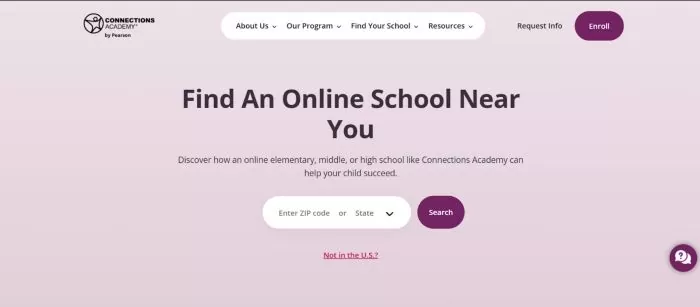
Example: Connections Academy (K–12 Online Public Schools): This online school network uses a geo-targeted approach on its site to connect families with their nearest program. A “Find Your School” tool routes visitors to state-specific pages based on ZIP code, ensuring that parents quickly find relevant information like curricula and enrolment steps for their locality. By organizing content by region and using local keywords (e.g., Georgia Connections Academy), the school boosts its presence in local search results.
Finally, make sure it’s mobile-first. Parents are browsing between meetings or from the car. A responsive, regularly updated website signals not only professionalism but also vitality, proof that your school is active, thriving, and ready to welcome new families.
2. Develop Valuable Blog Content and Resources
If your website is the front door, your blog is the conversation that happens once families walk in. It’s your chance to build trust, show expertise, and let your school’s personality shine.
Content marketing works because it educates while it engages. Blog posts, news stories, or downloadable guides can position your school as a thought leader on topics parents actually care about. From how to choose the right private school to how your teachers nurture student confidence. Every post is also an SEO opportunity: each new article gives Google another reason to show your site to searching parents.
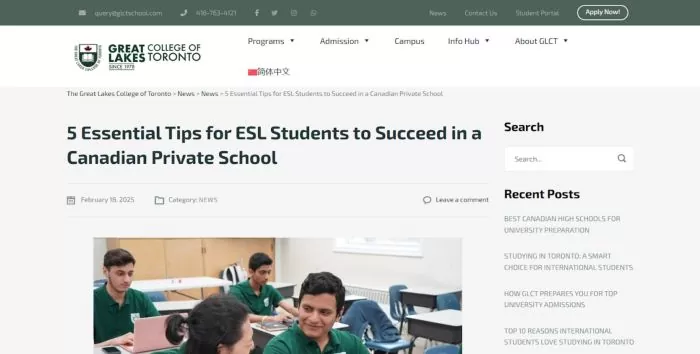
Example: Great Lakes College of Toronto (Private High School, ON): GLCT’s blog targets the needs of international students and parents. The school regularly publishes practical articles, from “5 Essential Tips for ESL Students to Succeed in a Canadian Private School” to guides on university admissions. Each post provides valuable advice (e.g., study strategies, application how-tos) while naturally highlighting GLCT’s supportive programs. By answering real questions (like how to improve English or navigate applications) in its content, GLCT attracts the right audience via SEO and builds trust.
Here’s the key: write content that answers parents’ real questions and reflects your school’s strengths. End each post with a next step: Book a Tour,Download Our Admissions Guide, or Join Our Mailing List.
The result? A blog that informs while also converting curiosity into connection.
3. Leverage Social Media to Build Community
In 2025, a strong social media presence is essential. Parents (especially millennials) and students spend hours every day scrolling through platforms like Facebook, Instagram, YouTube, and TikTok. The majority of students say they use social media when researching schools. For K–12 families, these platforms are often their first window into your community, and leveraging them effectively is one of the most effective school marketing ideas.
Here’s the thing: social media is where your school’s story comes alive. Share moments that reflect your culture: a championship win, a robotics project, a candid classroom laugh. Posts with real photos and videos consistently outperform text-only updates, and they help families visualize what life at your school feels like.
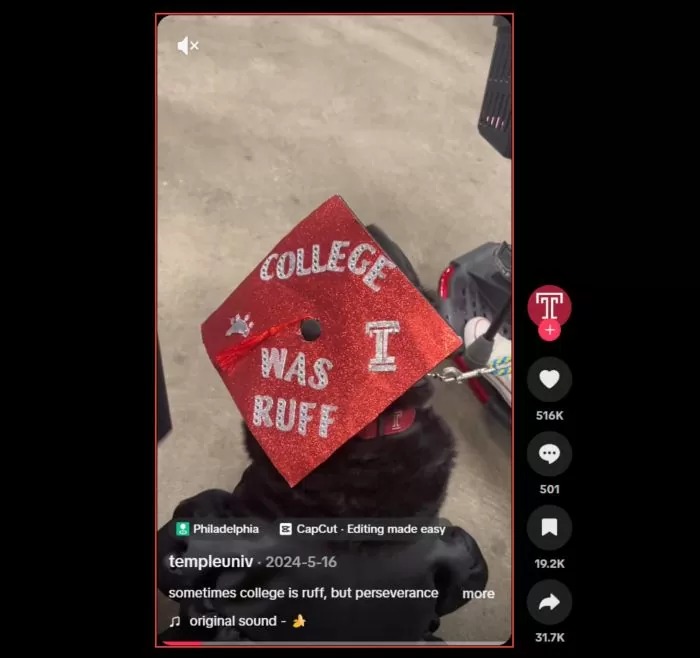
Example: Temple University (Higher Ed, PA): Temple’s social media team has achieved award-winning success by sharing vibrant, authentic content that resonates with students and parents alike. One viral example was a TikTok video of a service dog at graduation, which garnered 3.2 million views and helped Temple achieve a top TikTok engagement rank. More importantly, Temple treats social media as a storytelling and outreach platform: posts across TikTok, Instagram, Facebook, and YouTube showcase campus life and student achievements in ways that help prospective students “see themselves” at Temple.
Consistency and tone matter just as much as creativity. Keep your voice genuine and community-driven, never overly promotional. Use a content calendar to maintain regular posting and highlight diverse voices from your community. Finally, don’t overlook targeted ads. Platforms like Meta and TikTok let you reach local parents by age, location, or interests, which makes them perfect for promoting open houses or admissions deadlines.
But above all, remember this: social media isn’t just about reach, it’s about connection. When families see a living, breathing community on your feeds, they’re provided the opportunity to imagine being part of it.
4. Implement Email Marketing & Lead Nurturing Campaigns
How do you market a private school? By combining digital strategies like SEO, email nurturing, and social media with in-person tactics like open houses and community events. Tailor messaging to families’ needs, use authentic storytelling, and provide clear calls-to-action to drive inquiries and enrolment.
When a prospective family fills out an inquiry form, downloads a guide, or subscribes to your newsletter, they’ve taken the first step, but they’re not ready to apply yet. That’s where email marketing and lead nurturing come in.
Most families need five or more touchpoints before they decide to apply or enrol. The key is staying in touch consistently, offering value each time, not just reminders to “apply now.”
Start by segmenting your email list. Group families by grade level, interests, or where they are in the admissions process, from first inquiry to scheduled tour. This allows you to send messages that actually matter. A parent curious about scholarships will appreciate updates about financial aid or payment plans. Another, interested in athletics, will engage more with stories about your latest championship or coaching philosophy. Modern CRM tools make this kind of personalization simple.
Effective lead nurturing happens through a drip campaign, a planned series of emails spaced over several weeks. The sequence might look like this:
A thank-you email and link to your virtual tour.
A week later, a student or parent testimonial.
Then, an update about upcoming events or key deadlines.
Track metrics like open and click-through rates to see what resonates. If engagement dips, tweak your subject lines or timing.
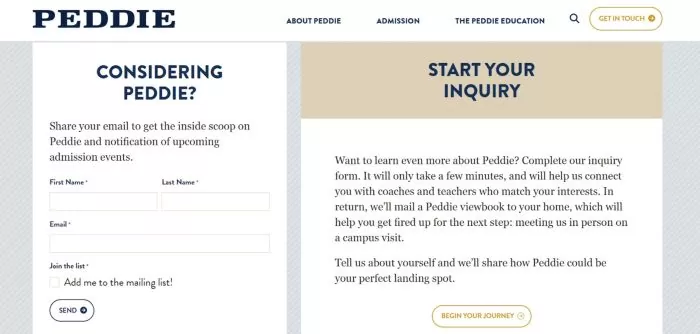
Example:Peddie School (Boarding High School, NJ): Peddie personalizes its follow-up emails based on each family’s interests. When inquiries come in, the admissions CRM captures details like academic or athletic interests. The school then connects prospects with relevant community members (coaches, teachers) and sends tailored content. For instance, a family noting interest in basketball might receive an email invite to a game and a note about Peddie’s sports facilities. This segmented approach (made clear on Peddie’s inquiry form, which promises to “connect you with coaches and teachers who match your interests”) makes families feel understood and keeps them engaged. A series of drip emails: thank-yous, student stories, deadline reminders, then nurtures each lead from initial inquiry to campus visit to application.
Finally, make your emails two-way. Encourage replies, invite questions, and link to live chats or calls. When families feel heard and guided rather than “marketed to,” they’re far more likely to see your school as their future community.
5. Use Video Marketing to Showcase Your School’s Culture
If a picture is worth a thousand words, a video can tell the whole story. Video marketing gives prospective families an inside look at your school, its energy, community, and heart, in a way that text simply can’t. A great video captures what it feels like to be on campus, walking through halls, meeting teachers, or cheering at a game. It builds an emotional bridge between your school and the viewer, and harnessing it properly is another of the more impressive marketing ideas for schools.
Video doesn’t have to be flashy to work. Start small. Create short, story-driven clips: student testimonials, “day in the life” vlogs, quick faculty interviews, or highlight reels from school events. Keep them engaging and under three minutes when possible. Post across platforms: your website, YouTube, Instagram, even TikTok. Videos with strong storytelling and emotional authenticity consistently build trust and drive inquiries.
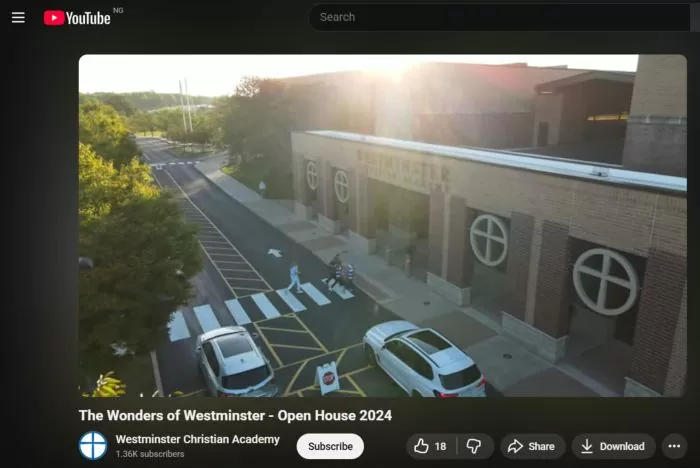
Example: Westminster Christian Academy (Day School, MO): Westminster created a cinematic short film called “The Wonders of Westminster” to encapsulate its school spirit. Premiered at an open house event to 550+ attendees, this nine-minute video weaves together stunning visuals of campus life with heartfelt student and teacher narratives. Beyond this feature film, Westminster produces numerous short clips: alumni testimonials, “day in the life” vlogs, and event highlight reels, all shared on YouTube and social media. These videos let viewers virtually walk the halls and imagine themselves as part of the community.
Authenticity is what matters. Even a smartphone-shot interview can outperform a high-budget ad if it’s real, relatable, and human. Use live streams, student-led content, and candid storytelling to show your school’s true culture, and let families see themselves as part of it.
6. Optimize Your Local Presence (Google Profile & Reviews)
When parents search “private schools near me,” your school should be one of the first names they see, complete with photos, reviews, and all the right details. That’s where your Google Business Profile (formerly Google My Business) comes in. Think of it as your school’s digital front door.
Here’s what to do: claim your profile, verify it, and fill out every field: address, phone number, website, hours, and category. Upload high-quality photos of your campus, classrooms, and events. An optimized Google profile gives prospects “an easily digestible snapshot of your institution and makes it much easier for your target audience to find you” online. Schools that post regularly and add fresh visuals tend to appear more prominently in local search results and get more clicks.
Next, turn your attention to reviews. Parents trust other parents. Encourage satisfied families to share their experiences on Google, and respond to every review (good or bad) with professionalism and gratitude. It shows transparency and genuine care.
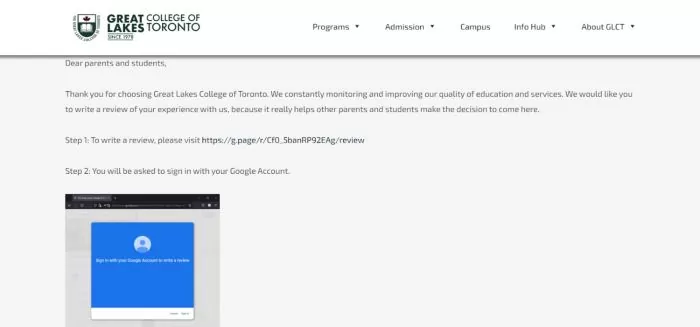
Example: Great Lakes College of Toronto (ON): GLCT leverages its happy families to boost local and global reputation. On its site, GLCT prominently links to external review platforms and showcases testimonials from international graduates. In fact, GLCT encourages parents to share their experiences on Google and Facebook, knowing that “parents trust other parents.” The school provides step-by-step instructions (via a dedicated page) on writing a Google review for GLCT, making it easy for busy parents to post feedback. By managing its online presence through accurate info on Google, active responses to every review, and abundant testimonials, GLCT ensures that when families search “best international high school Toronto,” they not only find GLCT but also see proof of its quality through peer reviews.
In short, managing your local presence is one of the simplest, most powerful enrolment tools you have. When families see accurate information, warm reviews, and vibrant imagery, your school instantly feels credible and worth exploring.
7. Host Open Houses and Community Events (Virtual & In-Person)
There’s nothing quite like seeing a school in action. Open houses, school tours, and community events let families feel what your school is really about. The energy in classrooms, the warmth of the community, the values that guide every interaction. That experience often does more to drive enrolment than any ad campaign ever could.
Today, the most effective schools blend in-person and virtual options. A well-run virtual open house allows busy or distant parents to attend from anywhere, while in-person events create the emotional connection that seals decisions. The key is to make every visit interactive, structured, and personal.
Start with a short welcome presentation from your head of school, followed by Q&A panels with teachers and students. Offer guided tours — physical or via livestream — and create themed “stations” where families can explore specific programs like arts, athletics, or STEM. Virtual attendees? Use breakout rooms or session links so they can choose what interests them most.
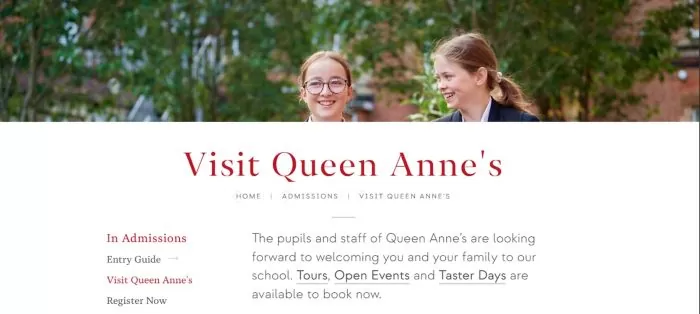
Example:Queen Anne’s School (Boarding, UK): Queen Anne’s offers a wide range of visit opportunities to fit every family’s needs. They host large Open Morning events each term (e.g., a Friday or Saturday with campus tours, student panels, and the Head’s welcome) and personal “bespoke” tours by appointment. For students, Queen Anne’s runs Taster Days: full school days where prospective girls join real classes, meet future classmates, and even try boarding for a night. This flexibility ensures that whether a family is local or overseas, busy weekdays or only free on weekends, they can experience the school. The Queen Anne’s website makes it easy to book tours or taster days online, and even features a 360° Virtual Tour so families can explore facilities remotely.
Finally, don’t limit yourself to admissions events. Sponsor local fairs, host workshops, or open performances to the community. Every event is a brand moment. Capture contact info, follow up with thank-you messages and next steps, and keep the conversation going.
When families walk away feeling welcomed and informed, they’re already picturing themselves and their children as part of your school’s story.
8. Invest in Targeted Online Advertising (Including Retargeting)
Organic marketing builds awareness over time, but sometimes you need an extra push to reach the right families fast. That’s where targeted digital advertising comes in. Platforms like Google Ads, Facebook, and Instagram let you put your school in front of parents who are actively researching options, not just scrolling aimlessly.
Think of it this way: when someone searches “private schools in [Your City]” or browses parenting and education pages on Facebook, you can show them a perfectly timed ad for your next open house. These platforms let you narrow by location, age of children, and interests, ensuring your message hits families most likely to engage. Even a few hundred dollars can make a measurable impact when ads are well-targeted and optimized.
How much should a school spend on marketing? Most schools allocate 1–10% of their overall budget to marketing, depending on goals and enrolment needs. Competitive schools aiming to grow or reach new markets may invest more, especially in digital advertising, content, and lead-nurturing systems.
Make every ad count. Use inviting visuals, happy students, engaging classrooms, welcoming teachers, paired with clear headlines (“Discover [School Name]”) and direct CTAs (“Schedule a Tour,” “Join Our Open House”). Test two or three variations at once to see which version gets more clicks, then double down on the winner.
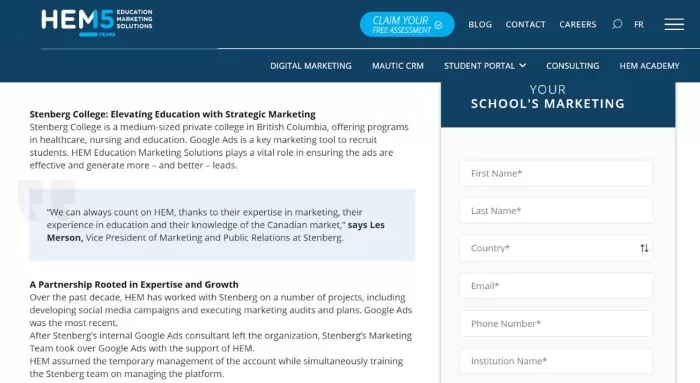
Example: Stenberg College (Private College): Stenberg partnered with HEM to elevate its Google Ads campaigns for student enrolment, ensuring the ads attracted more and higher-quality student leads. With HEM’s support in restructuring and managing these paid search campaigns, Stenberg’s marketing saw “record-breaking enrolments and lead flow” beyond previous levels. The refined advertising strategy also achieved a 28% reduction in cost per lead, demonstrating the efficiency of targeted online ads.
Beyond new audiences, retargeting helps you reconnect with families who already visited your site or clicked on an earlier ad but didn’t inquire. Maybe they browsed your tuition page or watched your virtual tour. A gentle reminder later that week (“Still exploring schools? Visit us this fall!”) can bring them back.
Pro tip: segment retargeting by behavior. Parents who downloaded your admissions guide might see an ad about financial aid, while those who viewed athletics pages could get one about campus life. The more relevant your messaging, the better your conversion rates.
According to Google, every $1 spent on search advertising can generate up to $8 in value. For schools, that often means more inquiries, more tours, and more applications, without overspending. In short: targeted ads aren’t about throwing money at the problem; they’re about placing your story in front of the right families, right when they’re ready to listen.
9. Create Downloadable Guides and Lead Magnets
Want a steady stream of new inquiries from your website? Offer something valuable first. Downloadable resources like e-books, checklists, or planning guides give parents useful information and give your admissions team qualified leads to nurture.
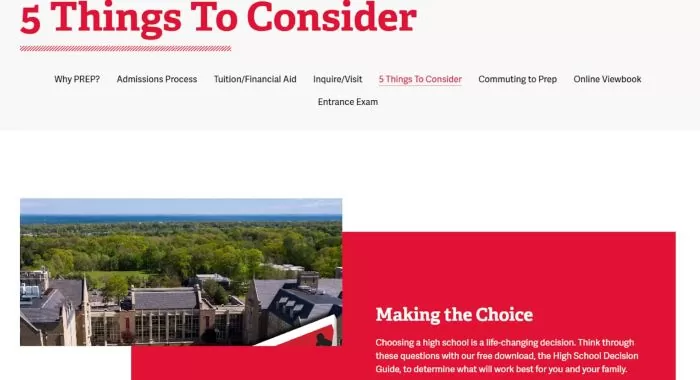
Here’s how it works: you create a helpful resource (“5 Things to Consider When Choosing a Private School,” for example), place it behind a short form asking for a name and email, and voilà, you’ve started a conversation. It’s a win-win: parents get expert advice, and you get insight into who’s exploring your school.
Example:Fairfield Prep (High School, CT): Fairfield Prep entices prospective families with a free e-book called the “High School Decision Guide.” On its admissions page, a prompt acknowledges that “choosing a high school is a life-changing decision” and invites visitors to download the guide to help them weigh their options. To get the guide, parents simply fill out a short form (name, email, child’s grade), providing Prep with a valuable lead. The guide itself, “5 Things to Consider When Choosing a High School,” offers general tips on factors like academics, community, and fit – not a pure advertisement, but a genuinely useful resource for any 8th-grade parent.
The best lead magnets solve real questions: a “School Visit Checklist,” a “Private vs. Public Comparison Chart,” or a “Financial Aid Planning Worksheet.” Even quizzes like “What’s Your Child’s Learning Style?” can engage parents while introducing your school’s philosophy.
Design matters too. Make your guide visually appealing, branded, and easy to read. Include a final call-to-action inviting families to take the next step, like booking a tour or contacting admissions.
Finally, promote your downloads across your website, blog posts, and pop-ups. Each new subscriber is a potential applicant, and your content positions your school as the trusted expert helping them get there.
10. Encourage Reviews, Testimonials, and Word-of-Mouth
At the end of the day, no marketing tool is more powerful than a happy parent or student sharing their story. Families trust real voices over polished ads. It’s why word-of-mouth remains one of the strongest enrolment drivers for private schools.
Start by collecting testimonials from your most satisfied families, students, and alumni. These can take many forms: written quotes, short videos, or casual social posts. Display them prominently. Sprinkle parent quotes across your website, include testimonial snippets in your newsletters, or dedicate a full webpage or YouTube playlist to success stories. The goal is to help prospects think, “That could be us.”
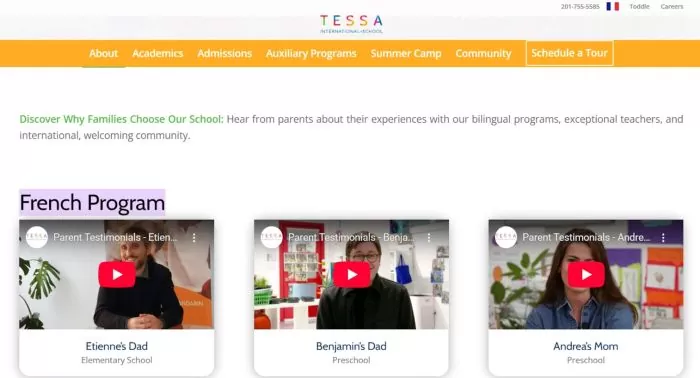
Example:Tessa International School (Preschool & Elementary, NJ): Tessa turns its parent community into its best ambassadors. The school’s website features a dedicated Testimonials page with dozens of short parent videos and quotes. Each testimonial is labeled with the family’s name and program (e.g., “Etienne’s Dad – Elementary”, “Zoe & Sophia’s Mom – Preschool & Elementary”), adding a warm personal touch. Tessa promotes these stories on social media as well, regularly sharing “Thank you” posts to parents who give shout-outs on Facebook. Additionally, the school links to external reviews on Niche.com and invites new parents to talk to veteran parents. This open celebration of parent voice not only builds trust with prospects (they see real satisfaction) but also fuels a virtuous cycle: Tessa’s parents feel valued and are even more likely to spread the word.
Encourage satisfied families to leave Google and Facebook reviews after positive milestones such as a great report card or a successful event. Monitor those reviews and respond thoughtfully. An active, appreciative reply tells others that your school listens and cares.
Don’t stop there. Turn your current community into ambassadors. Offer small referral incentives or create shareable moments, photo days, spirit challenges, and alumni shoutouts that naturally spark pride and conversation.
The result? A thriving network of advocates. When people talk about your school with genuine enthusiasm, it builds credibility and attracts families who already believe in what you stand for.
Partner with HEM to Build Momentum That Lasts
Attracting new families is about consistency, connection, and authenticity. Every piece of your marketing matters: a clear website that tells your story, social media posts that capture daily life, thoughtful emails that guide parents, and real voices from your community that build trust. When all of these elements work together, they create something powerful: a lasting impression.
Schools that commit to steady, strategic communication see results that compound over time. Keep testing, refining, and listening to what families respond to. When your marketing reflects the real experience, your students and parents love, it shows, and it resonates.
If you’re ready to take your private school marketing to the next level, Higher Education Marketing (HEM) can help. We specialize in crafting digital strategies that combine creativity, data, and storytelling to boost visibility, engagement, and enrolment.
From SEO and content creation to paid ads and automation, we’ll help you connect with families who are searching for exactly what your school offers. Because when your marketing feels genuine, families don’t just notice, they believe. And that’s what turns interest into enrolment.
Struggling with enrollment?
Our expert digital marketing services can help you attract and enroll more students!
Frequently Asked Questions
Question: What is school marketing?
Answer: At its core, school marketing includes every effort your institution makes to strengthen brand visibility and attract families. It involves branding, outreach, and communications across channels like websites, ads, email, social media, and events to connect with prospective families.
Question: How do you market a private school?
Answer: By combining digital strategies like SEO, email nurturing, and social media with in-person tactics like open houses and community events. Tailor messaging to families’ needs, use authentic storytelling, and provide clear calls-to-action to drive inquiries and enrolment.
Question: How much should a school spend on marketing?
Answer: Most schools allocate 1–10% of their overall budget to marketing, depending on goals and enrolment needs. Competitive schools aiming to grow or reach new markets may invest more, especially in digital advertising, content, and lead-nurturing systems.
New York City’s troubled yellow school bus system is in the spotlight once again, with threats of a service disruption and looming mass layoffs due to a contract dispute with the city.
The city’s largest school bus companies notified the state Department of Labor that they are preparing to shut down operations and lay off employees on Nov. 1 if they don’t receive a contract extension, the New York Post first reported Monday.
Lawmakers, advocates, and city officials immediately condemned the bus companies’ threat, with schools Chancellor Melissa Aviles-Ramos calling the move “deeply upsetting and an act of bad faith.”
The timing of the bus company’s push, just before November’s mayoral election, for a five-year extension that would outlast the incoming mayor’s first term, “effectively bypassed the oversight of voters and elected officials who manage these vital services,” Aviles-Ramos said.
Mayoral frontrunner Zohran Mamdani agreed, telling reporters at an unrelated Tuesday press conference that the oversight panel in charge of approving the contract “is right to not give in to the threats.”
The bus companies argue they have no choice because their temporary contract is expiring and they can no longer operate without a longer-term agreement.
The episode is the latest in a long history of conflicts over how to manage the sprawling yellow bus system, which relies on a patchwork of largely for-profit companies to ferry some 150,000 students across nearly 19,000 routes each day. All told, the city spent nearly $2 billion on school busing last year.
“There’s this tug of war over the money,” said Sara Catalinotto, the executive director of the advocacy group Parents for Improving School Transportation. “But this is a service, and without it these kids are discriminated against.”
What’s the history behind these bus contracts?
The current dispute springs from a disagreement over how to handle the city’s “legacy” school bus contracts, which date back to the 1970s and are typically renewed every five years. They most recently expired in June.
In the months before the contracts expired, city Education Department officials signaled they were interested in rebidding the contracts, or soliciting offers from a new set of companies to more efficiently modernize buses, increase service, and strengthen sanctions for contract violations.
Simply renewing the existing contracts gives the city “far less negotiating ability … because we have to continue with this same set of vendors,” Emma Vadehra, the Education Department’s former deputy chancellor, told the City Council in May.
But city officials say they can’t move forward with rebidding without the option to offer something called the “Employee Protection Provision,” or EPP.
That protection — built into the legacy contracts for decades — ensures unionized bus workers laid off by one company are prioritized for hiring by other companies, at their existing wages. Drivers and union officials consider the provision a dealbreaker — and would almost certainly strike without it.
But city officials say a 2011 state court decision prohibits them from inserting EPP into new contracts if they rebid — and only allows them to keep EPP if they extend existing contracts. The only fix, city officials say, is changing state law — an effort that has so far stalled in Albany.
Without that state legislation, city officials faced a choice: inking another five-year extension or pushing for a shorter-term contract in the hopes state lawmakers quickly clear the way for a rebid.
Who is opposed to a five-year contract renewal?
While the city moved ahead with negotiations for a five-year extension, a growing number of advocates, parents, and lawmakers flooded meetings of the Panel for Educational Policy, or PEP — the body that approves Education Department contracts — to push for a shorter-term contract.
“Do not vote yes to extend for some long period of time,” said Christi Angel, a parent leader in District 75, which serves students with significant disabilities who disproportionately rely on busing, at the September PEP meeting. Roughly 43% of students who ride school buses have disabilities. “Don’t reward bad behavior,” Angel said. “This is a broken system.”
Their arguments quickly gained traction in the PEP, where multiple members expressed their opposition to a five-year extension at September’s meeting.
The panel is expected to vote on the five-year extension next month, after the mayoral election, said PEP Chair Greg Faulkner, though he would prefer to wait until the new mayor takes office in January.
“Shouldn’t the mayor-elect have some say in a billion dollar contract?” said Faulkner. “I just think that’s sound governance.”
Why are the city and bus companies at odds right now?
Over the summer, the city and bus companies agreed to two emergency extensions to keep service running, the second of which expires on Oct. 31.
Without a guarantee of an active contract after that date — since the PEP is not voting this month — the bus companies claim they have no choice but to consider layoffs.
The city, however, had “long planned” to offer an emergency extension for November and December, and officials delivered the agreement to the bus companies on Monday, Aviles-Ramos said.
The PEP only votes on those extensions after they’ve already taken effect, Faulkner noted.
The bus companies, he said, are attempting to “create confusion in order to hold us hostage for a longer term agreement.”
The bus companies reject that assertion and say they simply cannot survive any longer on emergency extensions, which don’t allow them the kind of long-term certainty they need to operate their businesses.
“Banks will not finance 30-day extensions, buses can’t be bought, payroll cannot be paid,” said Sean Crowley, a lawyer representing several companies. “Enough is enough!”
The companies claim that they have already worked out the contours of a new five-year contract extension with the city and are just awaiting the PEP’s approval, though Faulkner said the Education Department hasn’t yet presented the PEP with the contract.
What happens from here?
A spokesperson confirmed that several bus companies had received the city’s offer for another emergency contract extension and were reviewing the documents.
Aviles-Ramos said the city is working to get “alternative transportation services” in place if that falls through.
But even if the bus companies and city do manage to avoid a service shutdown Nov. 1, the episode raises larger questions about how to make lasting improvements in the troubled system. Ongoing driver shortages make that task even harder.
The bus companies argue that the five-year contract agreement they sketched out with the city would achieve many of those goals, including stricter accountability to ensure drivers use GPS tracking, more staffing to field parent complaints, and monetary penalties for companies that underperform, according to testimony submitted to the PEP in September.
But critics continue to push for a shorter-term extension to give the state legislature time to pass EPP legislation, and clear the way for a rebid.
Mamdani has not offered specifics about how he would manage the school bus system, but said Tuesday that given the many concerns about yellow bus service, any contract extension deserves a “hard look.”
Matt Berlin, the CEO of that nonprofit, called NYCSBUS, and former director of the city’s Office of Pupil Transportation, believes the nonprofit model has “a lot to offer the city” and could expand.
Chalkbeat is a nonprofit news site covering educational change in public schools. This story was originally published by Chalkbeat. Sign up for their newsletters at ckbe.at/newsletters.
Did you use this article in your work?
We’d love to hear how The 74’s reporting is helping educators, researchers, and policymakers. Tell us how
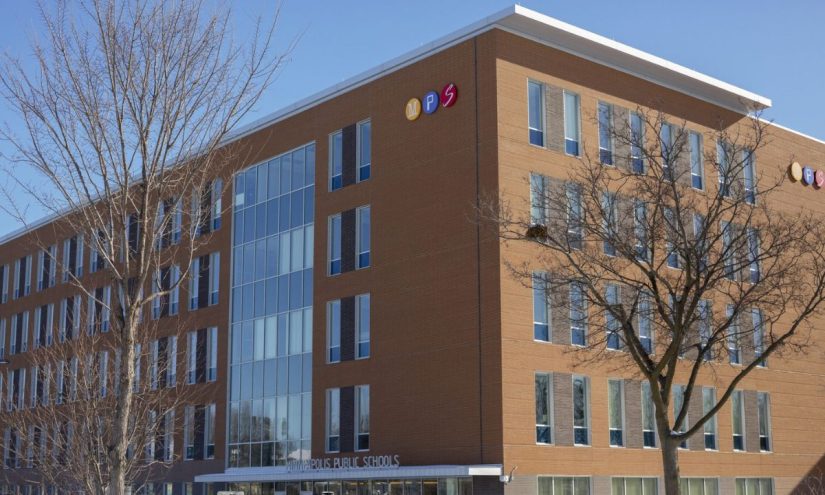
The Minneapolis school board has formally asked Superintendent Dr. Lisa Sayles-Adams for information that could lead to school closures. They passed a resolution to the effect at a recent meeting.
The board first drafted the directive —which asks for an initial report to the board by April 2026 — at two day-long meetings in June and August. The planning follows years of discussion about closing schools in a district with 29,000 students but the capacity for 42,000 and thus a bevy of half-empty schools.
Even as enrollment declines at a school building, the fixed expenses for building staff — like principals, secretaries, nurses, librarians, culinary workers, custodians and social workers — stay the same or go up. With so many buildings below capacity, a big portion of each Minneapolis student’s funding has to go toward covering these fixed building-level costs, draining money away from instruction and extracurricular activities.
The board resolution comprises topics for district administrators to investigate, including efficient use of current buildings, potential changes to magnet programs, and ways to increase enrollment in the district.
Years-long discussion about the financial burden of operating small enrollment schools
The process for downsizing the district’s footprint has been long and circuitous.
In October 2022, the district prepared a comprehensive financial assessment forecasting that without significant cost cutting, the district would end up draining its reserves, while expenses would exceed revenues by the end of fiscal year 2026. The district has avoided that fate by cutting services and raising class sizes, but it is still unable to balance its budget without relying on reserves and other one-time funds.
The 2022 memo did not prescribe closing schools, but it did present an analysis showing enrollment growth alone could not overcome the district’s structural inefficiencies resulting from operating many schools with small enrollments. At the time of the analysis, Anoka-Hennepin was operating 37 school buildings while enrolling about 37,000 students. Minneapolis was operating 61 buildings while enrolling about 29,000 students. Minneapolis had about half as many students per building as Anoka-Hennepin.
The board first publicly discussed reducing the number of schools in March 2023, when then-board Chair Sharon El-Amin asked Rochelle Cox, the then-interim superintendent, to develop a draft plan for “school transformation.” Neither Cox nor the board took action.
Two months before current Superintendent Dr. Lisa Sayles-Adams started at the district in early 2024, the School Board passed a “transformation resolution” that directed the district to do an accounting of physical space but stopped short of calling for a timeline on school closures.
Low enrollment schools require more funding per student for building-level staff
The district is contending with rising costs and operating a significant number of small buildings, as well as buildings operating below capacity. Given the rising fixed costs of operating these buildings, that leaves less money for everything else, from class size reduction to teacher pay and programs commonly found in most school districts like world languages, art, music and athletics.
Across the district, as building-level enrollment has declined, students have lost access to services like academic support if they’re struggling; staff to address student behavior; and community liaisons to help parents connect with schools. Small elementary schools have difficulty funding full-time positions for electives like art, music and gym, while hiring part-time staff for these positions is challenging. Some elementary students have gone without these electives, or only have music or art for part of the school year.
Enrollment declines at middle and high schools have meant fewer elective options, like world languages, dance, theater and orchestra, as well as extracurriculars. Students also lose access to advanced coursework — like AP or IB classes — when there are too few students in the school who want to enroll. Many of the district’s high schools are now sharing athletic teams because individual schools lack enough students and funding to support a robust athletics program.
The decline in services drives some families to schools outside the district that have the services and programs they desire, compounding the enrollment declines.
Declines in enrollment mitigated by new-to-country students
Minneapolis Public Schools lost about 15% of its enrollment in the wake of the COVID-19 pandemic, due to a combination of factors including implementing a controversial plan redrawing school boundaries, and keeping its schools closed longer during the pandemic than any other Minnesota district, which was followed in March 2022 by a three week educator strike.
The district has enjoyed a small enrollment increase both last year and this year. Although the district does not track the immigration status of students, the increase has been attributed almost entirely to students newly arrived to the United States from Central America. Since the 2021-22 school year, English learner students have increased from 17% of the district’s students to 23% in the 2024-25 school year, according to Minnesota Department of Education data.
This year, the district expects to spend at least $17 million more on English learner services than it receives in funding from state and federal sources. Although the Legislature increased state aid for English learners during the 2023 legislative session, the district’s funding is insufficient to cover the cost of providing the intensive services needed by students with the lowest levels of English proficiency.
Many of the newcomer students are also unhoused, which has led to growing costs for the district to transport students from shelters outside district boundaries, as required under the federal McKinney-Vento law. The state has started to pay the cost of this transportation under a law passed in 2023.
It is not clear whether changes to federal immigration policy will impact the district’s ability to continue to rely on newcomers to stabilize or grow enrollment in the future.
Future enrollment expected to decline, limiting district’s funding
Hazel Reinhardt, a demographer hired by the district, says enrollment is likely to continue to decline in the coming years because of lower birth rates, fewer families choosing to raise children in the city, and the state’s favorable laws around charter schools and open enrollment, allowing parents to send their children to St. Paul or suburban schools.
Reinhardt told the board in June that once parents leave for charter and private schools or open enrollment options, “precious few” districts are able to bring them back.
Most of the district’s funding is based on enrollment, so declining enrollment has created a ballooning fiscal crisis. Growing costs for both labor and services have outpaced increases in state and local funding.
The district continues to cut services, increase class sizes and pull from its dwindling reserve funds to balance its annual budget. The district is expected to use $25 million from its reserves this school year after using $85 million from reserves last school year.
The district’s enrollment woes and related financial distress are not unique to Minneapolis, with similar challenges facing large urban districts like Oakland, San Francisco, Denver, Seattle and Portland. Denver and Oakland have closed a small number of schools in recent years, but not enough to stabilize district finances. And school boards in Seattle and San Francisco have walked away from closure plans after significant public pressure, leaving both districts with growing budget deficits.
Minnesota Reformer is part of States Newsroom, a nonprofit news network supported by grants and a coalition of donors as a 501c(3) public charity. Minnesota Reformer maintains editorial independence. Contact Editor J. Patrick Coolican for questions: [email protected].
Did you use this article in your work?
We’d love to hear how The 74’s reporting is helping educators, researchers, and policymakers. Tell us how
By now, the 2025-2026 school year is well underway. The glow of new beginnings has faded, and the process of learning has begun in earnest. No doubt there is plenty to do, but I recommend that educators take a moment and check in on their teaching toolkit.
The tools of our trade are always evolving, and if our students are going to get the most out of their time in class, it’s important for us to familiarize ourselves with the newest resources for sparking curiosity, creativity, and critical thinking. This includes the latest AI programs that are making their way into the classroom.
Here are five AI tech tools that I believe are essential for back-to-school success:
ChatGPT: ChatGPT has quickly become the all-in-one tool for generating anything and everything. Many educators are (rightly) concerned about ChatGPT’s potential for student cheating, but this AI can also serve as a built-in assistant for creating welcome letters, student-friendly syllabi, and other common documents for the classroom. If it’s used responsibly, ChatGPT can assist teachers by cutting out the busy work involved when planning and implementing lessons.
ClassroomScreen: ClassroomScreen functions as a modern-day chalkboard. This useful tool lets teachers project a variety of information on screen while simultaneously performing classroom tasks. Teachers can take straw polls, share inspiring quotes, detail the morning schedule, and even monitor volume without opening a single tab. It’s a simple, multipurpose tool for classroom coordination.
SchoolAI: SchoolAI is a resource generator that provides safe, teacher-guided interactions between students and AI. With AI becoming increasingly common, it’s vital that students are taught how to use it safely, effectively, and responsibly. SchoolAI can help with this task by cultivating student curiosity and critical thinking without doing the work for them. Best of all, teachers remain at the helm the entire time, ensuring an additional layer of instruction and protection.
Snorkl: Snorkl is a feedback tool, providing students with instant feedback on their responses. This AI program allows students to record their thinking process on a digital whiteboard using a variety of customizable tools. With Snorkl, a teacher could send students a question with an attached image, then have them respond using audio, visual tools such as highlighting, and much more. It’s the perfect way to inject a little creativity into a lesson while making it memorable, meaningful, and fun!
Suno: Suno is unique in that it specializes in creative song generation. Looking for an engaging way to teach fractions? Upload your lesson to Suno and it can generate a catchy, educational song in the style of your favorite artist. Suno even allows users to customize lyrics so that the songs stay relevant to the lesson at hand. If you need a resource that can get students excited about learning, then Suno will be the perfect addition to your teaching toolkit!
The world of education is always changing, and today’s technology may be outdated within a matter of years. Still, the mission of educators remains the same: to equip students with the skills, determination, and growth mindset they need to thrive in an uncertain future. By integrating effective tools into the classroom, we can guide them toward a brighter tomorrow–one where inquiry and critical thinking continue to flourish, both within the classroom and beyond.
Jamie MacPherson, Van Andel Institute for Education
Jamie MacPherson is a Learning Specialist at Van Andel Institute for Education, a Michigan-based education nonprofit dedicated to creating classrooms where curiosity, creativity, and critical thinking thrive.
Latest posts by eSchool Media Contributors (see all)
As digital learning continues to evolve, K-12 districts are under pressure to deliver connectivity that’s as fast, secure, and flexible as the learning it supports. Outdated infrastructure can’t keep up with the growing demands of cloud-based instruction, data-heavy applications, and connected devices across campuses, buses, and beyond.
In this can’t-miss webinar, you’ll hear how forward-thinking school systems are building future-ready networks–combining 5G, LTE, Wi-Fi-as-WAN, and hybrid solutions to power learning anywhere, protect sensitive data, and stretch limited budgets even further with strategic E-rate funding.
In just one session, you’ll walk away with actionable insights on how to:
Modernize district and campus networks with hybrid WAN architectures that keep uptime consistent and students connected
Extend connectivity beyond the classroom–to buses, portables, athletic fields, and events–with mobile Wi-Fi, POS tools, location services, and security integrations
Simplify network management and strengthen protection through centralized cloud control, out-of-band alerts, and zero-trust security principles
Whether you’re upgrading your network or rethinking your entire connectivity strategy, this session will help you turn today’s infrastructure challenges into tomorrow’s opportunities.
Don’t fall behind–learn how leading K-12 IT professionals are future-proofing their districts and powering digital learning at scale.
Register now to reserve your spot and secure your district’s digital future!
Laura Ascione is the Editorial Director at eSchool Media. She is a graduate of the University of Maryland’s prestigious Philip Merrill College of Journalism.
When I asked my executive assistant to proof my first superintendent’s report for the public board packet, she came back and said that she was surprised that I gave so much credit to others for the work being completed by the district. A simple leadership lesson I learned from David Fridlington, my favorite battalion commander in the military, was to use your position to take care of your people and support them. He told everyone that when he presided over a promotion ceremony, he said: “Use this rank to take care of your soldiers.”
One basic concept is that when things go well, give credit to those who did the work, even if you provided the direction. Your board or other supervisors should understand that success requires leadership. The opposite is true as well. When things do not go well, the leader needs to step in and accept the blame. Even if a subordinate was negligent and their performance needs to be addressed, there is never justification for doing it in a public forum.
The traditional leadership trap
For decades, educational leadership has often mirrored the corporate world’s focus on individual achievement and personal branding. Superintendents, principals, and department heads have felt pressure to position themselves as the architects of every success, the faces of every initiative, and the voices behind every innovation. This approach, while understandable given the accountability pressures facing education leaders, creates a dangerous dynamic that undermines both team morale and long-term organizational success.
When leaders consistently claim credit for achievements, they inadvertently signal to their teams that individual contributions are less valuable than executive oversight. Faculty members, administrators, and support staff begin to feel invisible, their efforts overshadowed by leadership’s need for recognition. This dynamic is particularly damaging in educational environments, where collaboration and shared ownership of student success are essential.
Smart educational leaders understand that their primary role is not as the star of the show, but to direct in such a way that every cast member shines. When a high school’s test scores improve dramatically, the effective principal doesn’t schedule interviews to discuss their leadership philosophy. Instead, they organize a celebration highlighting the innovative teaching strategies developed by their faculty, the dedication of support staff, and the hard work of the students.
This approach accomplishes several critical objectives simultaneously. First, it builds tremendous goodwill and loyalty among team members who feel genuinely appreciated and recognized. Teachers who see their principal celebrating their classroom innovations in district newsletters or community presentations develop a deeper commitment to the school’s mission. They feel valued as both implementers of directives and as creative professionals whose expertise helps drive student success.
Building trust through recognition
Education leaders who consistently spotlight their teams create an atmosphere of trust that permeates the entire organization. When a superintendent highlights individual schools’ achievements without inserting themselves into the narrative, principals and teachers recognize that their leader is secure enough in their own position to share credit freely. This security translates into psychological safety throughout the organization, encouraging innovation and risk-taking that leads to better educational outcomes.
Consider the university department chair who, when presenting research achievements to the dean, leads with faculty accomplishments rather than departmental management strategies. Graduate students and professors in that department understand that their work will be recognized and celebrated, not appropriated by administrative oversight. This recognition culture attracts top talent and retains valuable team members who might otherwise seek environments where their contributions receive proper acknowledgment.
The ripple effect of recognition
When leaders consistently elevate their teams, they create a cascade of positive behaviors throughout the organization. Teachers who feel appreciated by their principals are more likely to recognize and celebrate their students’ achievements. Support staff who see their contributions highlighted become more invested in finding innovative solutions to operational challenges. The entire educational community benefits when recognition flows freely rather than accumulating at the top of the organizational chart.
This dynamic is particularly powerful in educational settings because it models the same growth mindset we want to instill in students. When young people see adults in their schools celebrating each other’s successes and sharing credit generously, they learn valuable lessons about collaboration, humility, and community building that extend far beyond academic subjects.
Strategic communication for team-focused leaders
Educational leaders might worry that stepping back from the spotlight will make them appear weak or uninvolved. The reality is quite the opposite. Stakeholders, from school board members to parents to community partners, are sophisticated enough to recognize that strong leaders create environments where others can excel. A principal who consistently highlights teacher innovations demonstrates their ability to recruit, develop, and retain talent. A superintendent who celebrates individual school achievements shows their skill at creating systems that enable success across diverse environments.
The key is strategic communication that makes the leader’s supporting role visible without overshadowing team members. When presenting achievements, effective leaders briefly acknowledge their role in creating conditions for success before diving deep into team member accomplishments. They might say, “We’ve worked hard to create an environment where innovation can flourish, and I’m excited to share what our incredible faculty has accomplished.”
Practical implementation strategies
Educational leaders can begin implementing this philosophy immediately through simple but powerful changes in communication habits. Instead of using “I” language when discussing successes, they can shift to “we” and “they” language that emphasizes team contributions. Rather than accepting speaking engagements about leadership strategies, they can recommend team members as presenters on innovative practices.
Internal communications offer rich opportunities for team recognition. Weekly newsletters, staff meetings, and board presentations become venues for celebrating individual and group achievements. Social media platforms allow leaders to amplify team member successes to broader audiences, creating positive publicity for both individuals and the organization. Two of the deans I currently work with are excellent examples of such active supporters of their faculty. Informal leaders can participate as well by highlighting their colleagues’ accomplishments via posting congratulatory notes on LinkedIn or other social media sites.
The long-term leadership legacy
Education leaders who consistently spotlight their teams create lasting legacies that extend far beyond their tenure. They build cultures of recognition and collaboration that persist even when leadership changes. More importantly, they develop future leaders among their team members who understand that true leadership means elevating others.
In an era when educational institutions face unprecedented challenges, from funding constraints to political pressures to rapidly changing technology, leaders who can inspire and retain talented teams have a significant competitive advantage. These leaders understand that their success is measured not by their personal recognition, but by their ability to create environments where others can achieve their highest potential.
The most effective leaders recognize that the spotlight is not a zero-sum game. When they illuminate their teams’ achievements, they don’t diminish their own leadership; they demonstrate it in its most powerful form. In education, where the ultimate goal is developing human potential, leaders who model this philosophy create ripple effects that benefit students, staff, and communities for years to come.
Dr. Steve Baule is a faculty member at Winona State University (WSU), where he teaches in the Leadership Education Department. Prior to joining WSU, Baule spent 28 years in K-12 school systems in Illinois, Indiana, and Iowa, and two years teaching in the University of Wisconsin System. For the 13 years prior to moving to the university level, Baule served as a public -school superintendent. He has written 10 books on a variety of educational and historical topics and has served on the editorial boards for two journals. Baule earned an advanced diversity and equity certificate while in the UW system. He holds a doctorate in instructional technology from Northern Illinois University and a doctorate in educational leadership and policy studies from Loyola University Chicago.
Baule’s scholarly interests focus on online student engagement, educational technology– particularly the impact of 1:1 implementations, social-emotional learning, and the history of education. Baule led several efforts to improve student emotional health and reduce discipline issues prior to moving into higher education. He also writes on aspects of early American history.
Baule has held memberships in the American Association of School Administrators, the American Library Association, the American Association of School Librarians, the Association for Supervision and Curriculum Development, the Consortium for School Networking, the International Association of School Librarians, the National Association of Secondary School Principals, the National Staff Development Council, and many of their state affiliates. He has served as a consultant in the areas of educational technology, facilities design, library program development, team building, and communications.
Latest posts by Steven M. Baule, Ed.D., Ph.D. (see all)
State funding of private-school vouchers is primarily being used for students attending religious institutions, with nearly 98% of funding going toward Catholic, Christian, Jewish and Islamic schools.
This year, state lawmakers passed a budget that included a request from Gov. Mike Kehoe to supply the state-run K-12 scholarship program, MOScholars, with $50 million of general revenue. Previously, the impact to the state’s bottom line was indirect, with 100% tax-deductible donations fueling the program.
Donations are still part of MOScholars’ funding, but the state appropriation has more than doubled the number of scholarships available.
During the 2024-25 school year, MOScholars awarded $15.2 million in scholarships.
In August alone, the State Treasurer’s Office received invoices for scholarships totaling $15.6 million, according to documents obtained by The Independent under Missouri’s open records laws.
The invoice process is unique to the direct state funding of the program. The nonprofits that administer scholarships, called educational assistance organizations, were the sole keepers of scholarship funds. But now, the State Treasurer’s Office holds scholarship money derived from general revenue in an account previously only used for program marketing and administration.
The invoices contained data on which schools MOScholars students are attending and the scholarship amount.
Of the 2,329 scholarships awarded in August, only 59 went to students in nonreligious schools.
This number did not surprise Democratic lawmakers, who for years have warned that state revenue was going to be siphoned into religious schools.
“We are simply subsidizing, with tax dollars, parents who would already choose to send their kids to a private school,” state Sen. Maggie Nurrenbern, a Kansas City Democrat, told The Independent. “And now we are using public dollars to pay for schools that are not transparent whatsoever in choosing who to educate and who not.”
Some schools have been criticized for admission requirements that push a moral standard.
Christian Fellowship School in Columbia, which received scholarships for 63 MOScholars students in August, requires “at least one parent of enrolled students professes faith in Christ and agrees with the admission policies and the philosophy and doctrinal statements of the school,” according to its handbook.
These statements include disapproval of homosexuality.
“The school reserves the right, within its sole discretion, to refuse admission of an applicant or to discontinue enrollment of a student,” the handbook continues.
With around 430 K-12 students enrolled at Christian Fellowship School, according to National Center for Educational Statistics survey data, MOScholars makes up a sizable portion of its funding. But it is not the only school with a large number of scholarship recipients.
Torah Prep School in St. Louis had 229 K-12 students during the 2023-24 school year. And in August, 197 MOScholars students received funding to attend the school. Torah Prep did not respond to a request for comment.
The high number of students attending religious schools with MOScholars funding is somewhat incidental, somewhat by design.
The MOScholars program allows its six educational assistance organizations to choose what scholarships they are willing to support.
Religious organizations stepped into the role to help connect congregants with affiliated schools. Only two of the six educational assistance organizations partner with schools unaffiliated with religion.
The Catholic dioceses of Kansas City-St. Joseph and Springfield-Cape Girardeau run the educational assistance organization Bright Futures Fund, which administered nearly half of the scholarships awarded in August.
The educational assistance organization Agudath Israel of Missouri focuses on Jewish education, partnering with four Jewish day schools.
The organization’s director Hillel Anton told The Independent that students are attracted to the program for more than just religious reasons.
“(Parents’) first and foremost concern is where their child is going to be able to be in the best learning environment,” Anton said. “And you may have a faith-based school that is fantastic and is able to provide that.”
The demand for the program has long exceeded funding availability. Going into August, organizations had waitlists of students eligible for a scholarship but without funding secured.
Agudath Israel of Missouri couldn’t guarantee scholarships for all of the returning students, Anton said, until the state funding was official.
“Because a lot of the funding is done towards the end of the year… we had everyone on a wait list,” he said. “Because we didn’t know necessarily how much funding we were going to have, we weren’t awarding anyone (the funding).”
Because the program was previously powered by 100% tax-deductible donations, the majority of funds poured in around December. But families need the money months sooner, with tuition due at the start of the school year.
Some educational assistance organizations prefunded scholarships, dipping into their savings to front expenses in the fall. Others had schools that would accept students and wait for payment.
The funding from the state, though, has resolved the backlog and allowed organizations to give scholarships to everyone on their wait list.
“Everyone who qualified for a scholarship this year received one,” Ashlie Hand, Bright Futures Fund’s director of communications, told The Independent.
Bright Futures Fund nearly doubled the number of students it serves, from 1,050 to 1,909.
Agudath Israel of Missouri is growing, too. The new funding helped the organization expand from 175 scholarships last year to 277 this year.
Some expect the state funding to continue next year to support this year’s windfall of scholarships. State Treasurer Vivek Malek told The Independent in May that if donations fall short, he will request state funds to support the new students through graduation.
Missouri Independent is part of States Newsroom, a nonprofit news network supported by grants and a coalition of donors as a 501c(3) public charity. Missouri Independent maintains editorial independence. Contact Editor Jason Hancock for questions: [email protected].