Nearly 92% of Indiana’s high school seniors graduated in 2025, setting the highest graduation rate on record, the Indiana Department of Education announced Monday.
“Today’s record-high graduation rate is a testament to the hard work of Indiana’s students, families, and educators,” Gov. Mike Braun said in a news release.
“While high school graduation marks the end of a student’s K-12 journey, our schools play an essential role in preparing students for all that comes next, whether that’s going to college, starting a career, or joining the military,” he continued. “This strong improvement in our state’s graduation rate shows that when we focus on academic excellence and establish clear, personalized pathways, our students thrive.”
The 91.83% graduation rate bested the 90.23% record set in 2024 by 1.6 percentage points.
It represents the third straight year of post-pandemic improvement kicked off in 2023, when 88.98% graduated. Seniors recorded a decade-low graduation rate of 86.65% in 2022.
“As we continue to scale the new Indiana diploma and readiness seals statewide, we will not only strengthen the value of high school and help more students graduate, we will ensure that they are prepared to succeed in whatever path they choose for their future,” state Education Secretary Katie Jenner said.
Numerous student populations improved in the results released Tuesday.
Almost 87% of Black students graduated in 2025, up 3 percentage points from the previous year, along with nearly 90% of Hispanic students, in a boost of 2 percentage points. White students improved to 93%, or by about 1.5 percentage points, and their multiracial classmates logged a graduation rate of 88%, up by 1 percentage point.
Seniors learning English, receiving free and reduced-price meals, and in special education also graduated at higher rates than the year prior — but still lagged their native speaker, paid lunch and general education peers.
The rate of students who graduated without waivers additionally cleared 90%. Students who do not complete or pass some graduation requirements can still qualify for a diploma if they demonstrate knowledge or skill.
The waivers are intended to help students with special circumstances, like those who’ve transferred to a new school or who have attempted to pass competency tests at least three times.
State education and policy leaders have for years sought to lower dependence on waivers, including by setting caps on the percentage of graduation waivers that can be counted toward a school’s state and local graduation rate. They took effect with the 2024 cohort.
Non-public schools outperformed their public counterparts by about 1 percentage point — 93% versus 92% — but the differences between traditional public and public charter schools were not reported. In the 2024 results, about 93% of students at traditional public schools graduated as opposed to just 59% of students at public charter schools.
Indiana’s federal graduation rate increased, almost hitting 90% compared to 2024’s 89%. The rates are calculated differently because of differences between state and federal accountability models, according to IDOE.
Indiana Capital Chronicle is part of States Newsroom, a nonprofit news network supported by grants and a coalition of donors as a 501c(3) public charity. Indiana Capital Chronicle maintains editorial independence. Contact Editor Niki Kelly for questions: [email protected].
Did you use this article in your work?
We’d love to hear how The 74’s reporting is helping educators, researchers, and policymakers. Tell us how
Like their peers nationwide, students at Crawford County Middle School in southern Indiana struggled academically in the pandemic’s wake. Principal Tarra Carothers knew her students needed help to get back on track.
So two years ago, she decided to double instructional time for math and English. Students now spend two periods per day in these critical subjects. Carothers believes the change has been a success, and a key trend backs her up: Crawford’s ILEARN scores in English language arts increased by over 8 percentage points from 2024 to 2025.
But overall, Indiana middle schools are heading in the opposite direction when it comes to English. In fact, despite gains in math, middle schoolers are struggling more than students in other grade levels in English, state test scores show. Since 2021, ILEARN English proficiency rates in seventh and eighth grades have fallen, with the dip particularly pronounced for seventh graders. And while their scores are up slightly compared with four years ago, sixth graders’ performance fell over the past year.
Indiana has made significant and much-publicized investments in early literacy, relying heavily on the science of reading, as many states have in the last few years. But that instructional transformation has come too late for current middle schoolers. Meanwhile, ILEARN English scores for third and fourth graders have risen by relatively small levels since the pandemic, although this improvement has been uneven.
The Board of Education expressed specific concerns about middle schoolers’ performance at a July 16 meeting. “We’ve gotta pick it up and make sure all of our middle school kids are reading, provide those additional supports,” said Secretary of Education Katie Jenner.
Some middle school leaders say strategies they’ve used can turn things around. In addition to increasing instructional time for key subjects, they point to participation in a pilot that allows students to take ILEARN at several points over the school year, instead of just once in the spring. Educators say relying on these checkpoints can provide data-driven reflection and remediation for students that shows up in better test scores.
Middle school an ‘optimum time’ for students’ recovery
Katie Powell, director for middle level programs at the Association for Middle Level Education, said she often asks teachers if middle schoolers seem different since the pandemic and “heads nod,” she said. These post-pandemic middle schoolers are harder to motivate and engage, self-report more stress, and are less likely to take risks academically, Powell said.
When the pandemic hit, “they were young, at the age of school where they’re developing basic reading fluency and math fact fluency,” she said. Current eighth graders, for example, were in second grade when the pandemic shut down schools and many learned online for much of their third grade year. Third grade is when students are supposed to stop learning to read and start “reading to learn,” Powell said.
Powell noted that middle schoolers are in the stage of rapid development with the most changes for the brain and body outside of infancy.
“This is actually an optimum time to step in and step up for them,” she said. “It is not too late. But it’s critical that we pay attention to them now.”
Crawford County Middle School has nine periods every day, and students spend two periods each in both math and English. While many schools have some version of block scheduling, many have a model in which students only go to each class every other day. But at Crawford, students attend every class every day. Their version of block scheduling results in double the amount of instructional time in math and English.
To make this switch, sacrifices had to be made. Periods were shortened, resulting in less time for other subjects. Carothers worried that student scores in subjects like science and social studies would decrease. But the opposite occurred, she said. Sixth grade science scores increased, for example, even though students were spending less time in the science classroom, according to Carothers.
“If they have better math skills and better reading skills, then they’re gonna perform better in social studies and science,” she said.
Meanwhile, at Cannelton Jr. Sr. High School, on the state line with Kentucky, the first three periods of the day are 90 minutes, rather than the typical 45. Every student has English or math during these first three periods, allowing for double the normal class time.
Cannelton’s sixth through eighth grade English language arts ILEARN scores increased by nearly nine percentage points last year.
Schools use more data to track student performance
Cannelton Principal Brian Garrett believes his school’s reliance on data, and its new approach to getting it, is also part of their secret.
Students take benchmark assessments early, in the first two or three weeks of school, so that teachers can track their progress and find gaps in knowledge.
This year, the state is adopting that strategy for schools statewide. Rather than taking ILEARN once near the end of the year, students will take versions of the test three separate times, with a shortened final assessment in the spring. The state ran a pilot for ILEARN checkpoints last school year, with over 70% of Indiana schools taking part.
The Indiana Department of Education hopes checkpoints will make the data from the test more actionable and help families and teachers ensure a student is on track throughout the year.
Kim Davis, principal of Indian Creek Middle School in rural Trafalgar, said she believes ILEARN checkpoints, paired with reflection and targeted remediation efforts by teachers, “helped us inform instruction throughout the year instead of waiting until the end of the year to see did they actually master it according to the state test.”
The checkpoints identified what standards students were struggling with, allowing Indian Creek teachers to tailor their instruction. Students also benefitted from an added familiarity with the test; they could see how questions would be presented when it was time for the final assessment in the spring.
“It felt very pressure-free, but very informative for the teachers,” Davis said.
The type of data gathered matters too. In the past, Washington Township middle schools used an assessment called NWEA, taken multiple times throughout the year, to measure student learning, said Eastwood Middle School Principal James Tutin. While NWEA was a good metric for measuring growth, it didn’t align with Indiana state standards, so the scores didn’t necessarily match how a student would ultimately score on a test like ILEARN.
Last year, the district adopted ILEARN checkpoints instead, and used a service called Otis to collect weekly data.
It took approximately six minutes for students to answer a few questions during a class period with information that educators could then put into Otis. That data allowed teachers to target instruction during gaps between ILEARN checkpoints.
“Not only were they getting the practice through the checkpoints, but they were getting really targeted feedback at the daily and weekly level, to make sure that we’re not waiting until the checkpoint to know how our students are likely going to do,” Tutin said.
Both Davis and Tutin stressed that simply having students take the checkpoint ILEARN tests was not enough; it had to be paired with reflection and collaboration between teachers, pushing each other to ask the tough questions and evaluate their own teaching.
“We still have a fire in us to grow further, we’re not content with where we are,” Davis said. “But we’re headed in the right direction and that’s very exciting.”
This story was originally published by Chalkbeat. Chalkbeat is a nonprofit news site covering educational change in public schools. Sign up for their newsletters at ckbe.at/newsletters.
ELKHART, Ind. — Ever since Ty Zartman was little, people told him he had to go to college to be successful. “It was engraved on my brain,” he said.
But despite earning straight A’s, qualifying for the National Honor Society, being voted prom king and playing on the high school football and baseball teams, the teen never relished the idea of spending another four years in school. So in fall 2023 he signed up through his Elkhart, Indiana, high school for an apprenticeship at Hoosier Crane Service Company, eager to explore other paths. There, he was excited to meet coworkers who didn’t have a four-year degree but earned good money and were happy in their careers.
Through the youth apprenticeship, Ty started his day at the crane manufacturing and repair business at 6:30 a.m., working in customer service and taking safety and training courses while earning $13 an hour. Then, he spent the afternoon at his school, Jimtown High, in Advanced Placement English and U.S. government classes.
In June, the 18-year-old started full-time at Hoosier Crane as a field technician.
“College is important and I’m not dissing on that,” Ty said. “But it’s not necessarily something that you need.”
Elkhart County is at the forefront of a movement slowly spreading across Indiana and the nation to make apprenticeships a common offering in high school.
In 2019, as part of a plan to boost the region’s economic prospects, county leaders launched an effort to place high schoolers in apprenticeships that combine work-based training with classroom instruction. About 80 students from the county’s seven school districts participated this academic year, in fields such as health care, law, manufacturing, education and engineering. In April, as part of a broader push to revamp high school education and add more work-based learning, the state set a goal of 50,000 high school apprentices by 2034.
Tim Pletcher, the principal of Jimtown High, said students are often drawn first to the chance to spend less time in class. But his students quickly realize apprenticeships give them work-based learning credits and industry connections that help them after graduation. They also earn a paycheck. “It’s really causing us to have a paradigm shift in how we look at getting kids ready for the next step,” he said.
Related: Become a lifelong learner. Subscribe to our free weekly newsletter featuring the most important stories in education.
This “earn and learn” model is taking hold in part because of deepening disillusionment with four-year college, and the fact that well-paying jobs that don’t require bachelor’s degrees are going unfilled nationally. The past three presidential administrations invested in expanding apprenticeships, including those for high schoolers, and in April, President Donald Trump signed an executive order calling for 1 million new apprentices. In a recent poll, more than 80 percent of people said they supported expanding partnerships between schools and businesses to provide work-based learning experiences for students.
Yet in the United States, the number of so-called youth apprenticeships for high schoolers is still “infinitesimally small,” said Vinz Koller, a vice president at nonprofit group Jobs for the Future. One estimate suggests they number about 20,000 nationally, while there are some 17 million high school students.By contrast, in Switzerland — which has been praised widely for its apprenticeship model, including by U.S. Education Secretary Linda McMahon — 70 percent of high schoolers participate. Indiana is among several states, including Colorado, South Carolina and Washington, that have embraced the model and sent delegations to Switzerland to learn more.
Elkhart, Indiana, known as the “RV capital of the world,” saw widespread unemployment during the Great Recession. That led community leaders to focus on apprenticeships as a way to diversify their economy. Credit: Camilla Forte/The Hechinger Report
Experts including Ursula Renold, professor of education systems at the Swiss Federal Institute of Technology (ETH) Zurich, note that importing the model to the United States at a large scale won’t be simple. Most businesses aren’t accustomed to employing apprentices, parents can be resistant to their students trading four-year college aspirations for work, and public transportation to take students to apprenticeships is limited, especially in rural areas. Many high schoolers don’t have a driver’s license, access to a car or money for gas. School districts already face a shortage of bus drivers that makes transporting students to apprenticeships difficult or impossible.
Still, Renold, who is known as the “grande dame of apprenticeships,” said Indiana’s commitment to apprenticeships at the highest levels of state government, as well as the funding the state has invested in work-based learning, at least $67 million, seem to be setting the state up for success, though it could take a decade to see results.
“If I had to make a bet,” said Renold, “I would say it’s Indiana who will lead the way.”
Elkhart County’s experiment with apprenticeships has its roots in the Great Recession. Recreational vehicle manufacturing dominates the local economy, and demand for the vehicles plummeted, contributing to a regional unemployment rate at that time of nearly 20 percent. Soon after, community leaders began discussing how to better insulate themselves from future economic instability, eventually focusing on high school education as a way to diversify industries and keep up with automation, said Brian Wiebe, who in 2012 founded local nonprofit Horizon Education Alliance, or HEA, to help lead that work.
Elkhart County, Indiana, was the first community in Indiana to encourage businesses to employ high school students as apprentices, where they can earn work-based learning credits and make industry connections that help them, even if they decide to go on to college. Credit: Camilla Forte/The Hechinger Report
That year, Wiebe and two dozen local and state political, business, nonprofit and education leaders visited Switzerland and Germany to learn more about the apprenticeship model. “We realized in the U.S., there was only a Plan A, a path to college,” he recalled. “We were not supporting the rest of our young people because there was no Plan B.”
HEA partnered with Elkhart County school districts and businesses, as well as with CareerWise, a youth apprenticeship nonprofit that works nationally. They began rolling out apprenticeships in 2019, eventually settling on a goal of increasing participation by 20 percent each year.
In 2021, Katie Jenner, the new secretary of education for Indiana, learned about Elkhart’s apprenticeships as she was trying to revamp high school education in the state so it better prepared students for the workforce. Elkhart, as well as six other apprenticeship pilot sites funded by Indianapolis-based philanthropy the Richard M. Fairbanks Foundation, provided a proof of concept for the apprenticeship model, said Jenner.
In December, the state adopted a new diploma system that includes an emphasis on experiential and work-based learning, through apprenticeships, internships and summer jobs.
On a weekday this winter, 17 sophomores at Elkhart’s Concord High School were sitting at computers, creating resumes they planned to use to apply for apprenticeships. The students were among some 50 sophomores at the high school who’d expressed interest in apprenticing and met the school’s attendance and minimum 2.5 GPA requirements, out of a class of roughly 400. They would receive coaching and participate in mock interviews before meeting with employers.
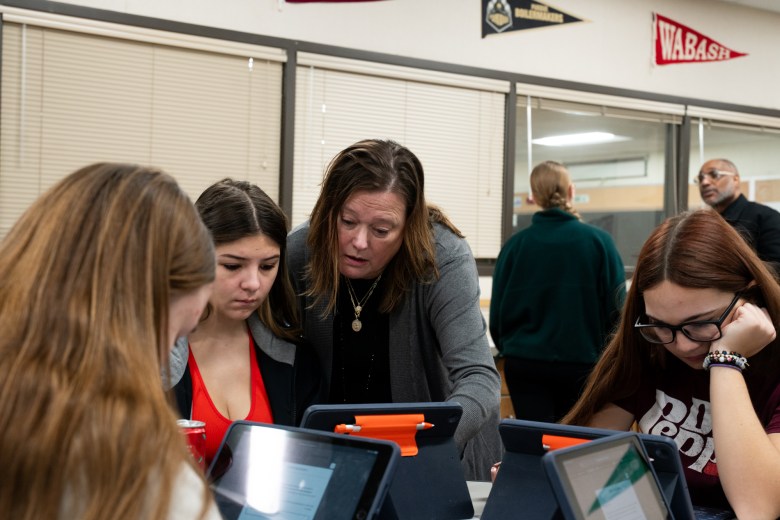
Becca Roberts, a former English teacher who now oversees the high school’s college and career programs, said apprenticeships help convince students of the importance of habits like punctuality, clear communication and regular attendance. “It’s not from a book,” she said. “They’re dealing with real life.”
Becca Roberts, who oversees college and career programs at Concord High School in Indiana, helps students research different companies offering apprenticeships, including job descriptions, work schedules and commuting distances. Credit: Camilla Forte/The Hechinger Report
One student, Ava Cripe, said she hoped for an apprenticeship of some sort in the health care field. She’d only been a pet sitter and was nervous at the thought of having a professional job. “You’re actually going out and working for someone else, like not for your parents or your grandma, so it’s a little scary,” she said.
CareerWise Elkhart has recently beefed up its support for students and businesses participating in apprenticeships. It employs a business partnership manager and customer success managers who help smooth over issues that arise in the workplace — an apprentice who isn’t taking initiative, for example, or an apprenticeship that isn’t sufficiently challenging. “Before, if an issue came up, a business would just fire a student or a student would leave,” said Sarah Koontz, director of CareerWise Elkhart County. “We’re now more proactive.”
In Elkhart and across the state, the embrace of work-based learning has worried some parents who fear it will limit, not expand, their children’s opportunities. In previous generations, career and technical programs (then known as vocational education) were often used to route low-income and Black and Hispanic students away from college and into relatively low-paying career paths.
Anitra Zartman, Ty’s mother, said she and her husband were initially worried when their son said he wanted to go straight to work. They both graduated from college, and her husband holds a master’s degree. “We were like, ‘Don’t waste your talent. You’re smart, go to college.’” But she says they came around after seeing how the work experience influenced him. “His maturity has definitely changed. I think it’s because he has a responsibility that he takes very seriously,” she said. “He doesn’t want to let people down.”
Her eldest daughter, Senica Zartman, also apprenticed during her final two years of high school, as a teacher’s assistant. She is now in college studying education. “The apprenticeship solidified her choice,” Anitra Zartman said, and it helped her decide to work with elementary students. Anitra Zartman said she would encourage her two youngest children to participate in apprenticeships too.
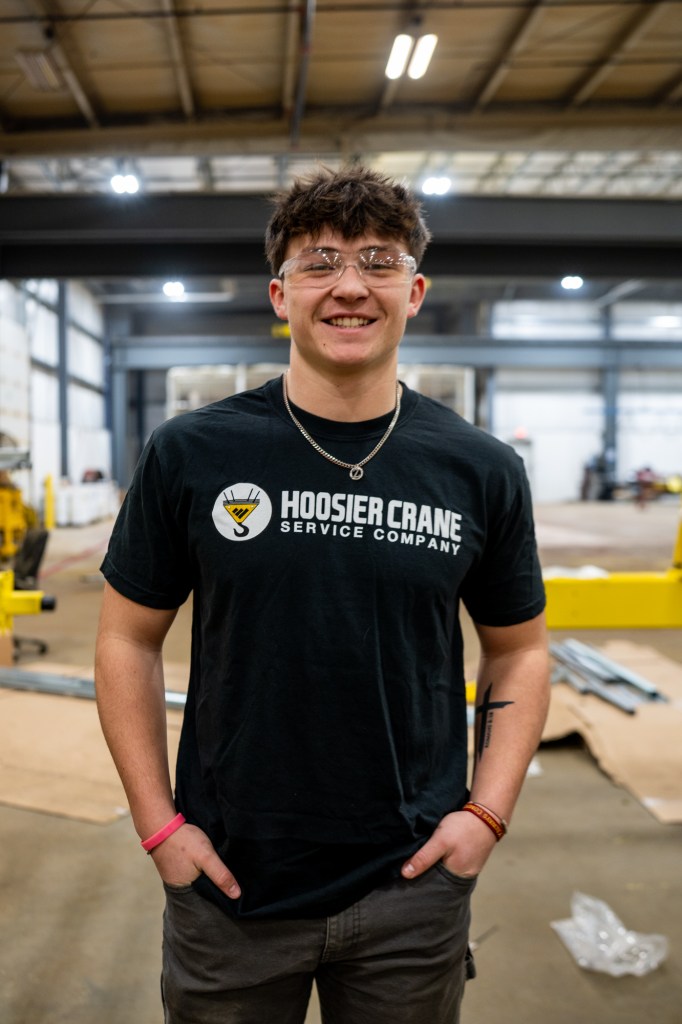
Ty Zartman works from 6 a.m. to noon at his apprenticeship at Hoosier Crane Service Company before he goes to school for afternoon classes. Credit: Camilla Forte/The Hechinger Report
Sarah Metzler, CEO of the nonprofit HEA, said apprenticeships differ from the vocational education of the past that tended only to prepare students for relatively low paid, entry-level jobs. With apprenticeships, she said, students must continually learn new skills and earn new licenses and industry certifications as part of the program.
Litzy Henriquez Monchez, 17, apprentices in human resources at a company of 50 people, earning $13.50 an hour. “I deal with payroll, I onboard new employees, I do a lot of translating. Anything that has to do with any of the employees, I deal with,” she said. She’s also earning an industry-recognized certification for her knowledge of a human resources management system, and says the company has offered to pay for her college tuition if she continues in the position.
Koontz said most companies pay for their apprentices to attend Ivy Tech, a statewide community college system, if they continue to work there. One is even paying for their apprentice’s four-year degree, she said.
Attracting employers has proven to be the biggest challenge to expanding youth apprenticeships — in Elkhart and beyond. In total, 20 companies worked with the Elkhart school districts last year, and 28 have signed on for this coming school year — only enough to employ about a third of interested students.
The obstacles, employers say, include the expense of apprentices’ salaries, training and other costs.
Metzler and others, though, point to studies showingbenefits for employers, including cost savings over time and improved employee loyalty. And in Indiana, the Fairbanks foundation and other organizations are working on ways to reduce employer costs, including by developing a standard curriculum for apprenticeships in industries like health care and banking so individual companies don’t bear the costs alone.
Business leaders who do sign on say they are happy with the experience. Todd Cook, the CEO of Hoosier Crane Service Company, employs 10 high schoolers, including Ty Zartman, as engineering and industrial maintenance technician apprentices, approximately 10 percent of his staff. He said the pipeline created by the apprenticeship program has helped reduce recruiting costs.
“We’re starting to build our own farm system of talent,” he said. Students initially earn $13 an hour, and finish their apprenticeship earning $18. If they continue with the company, he said, they can earn up to $50 an hour after about five years. And if they go on to become trainers or mentors, Cook said, “Honestly, there is no ceiling.”
Transportation has been a limiting factor too. There’s no public transit system, and students who can’t rely on their parents for rides are often out of luck. “We’d love to offer a bus to every kid, to every location, but we don’t have people to run those extra bus routes,” said Principal Pletcher.
The state has tried to help by investing $10 million to help students pay for costs such as transportation, equipment and certifications. Each school that provides work-based learning opportunities also receives an additional $500 per student.
Indiana has a goal to employ 50,000 high school students as apprentices by 2034. State leaders in business, education, government and nonprofits are working closely with Swiss experts to adopt a youth apprenticeship program similar to the one in that country. Credit: Camilla Forte/The Hechinger Report
Trump’s executive order called for the secretaries of education, labor and commerce to develop a plan by late August for adding 1 million new apprenticeships. The order does not set a date for reaching that milestone, and it applies to apprentices of all ages, not just high schoolers. Vinz Koller of Jobs for the Future said the goal is modest, and achievable; the number of youth apprenticeships has doubled just in the past few years, he said, and California alone has a goal of reaching 500,000 apprenticeships, across all ages, by 2029.
Still, the order did not include additional funding for apprenticeships, and the Trump administration’s proposed budget includes major cuts to workforce development training. In an email, a White House spokesperson said the administration had promoted apprenticeships through outreach programs but did not provide additional information including on whether that outreach had a focus on youth apprenticeships.
Back in Elkhart, Ty Zartman, the Hoosier Crane apprentice, has begun his technician job with the company after graduating in early June. He is earning $19 an hour. He is also taking a class at the local community college on electrical work and recently received a certificate of completion from the Department of Labor for completing 2,000 hours of his apprenticeship.
Anitra Zartman said she wishes he’d attended more school events like pep rallies, and sometimes worried he wasn’t “being a kid.” But Ty said his supervisor is “super flexible” and he was able to go to the winter formal and prom. “I think I still live a kid life,” he said. “I do a lot of fun things.”
Of his job, he said, “I love it so much.”
Contact editor Caroline Preston at 212-870-8965, via Signal at CarolineP.83 or on email at [email protected].
The Hechinger Report provides in-depth, fact-based, unbiased reporting on education that is free to all readers. But that doesn’t mean it’s free to produce. Our work keeps educators and the public informed about pressing issues at schools and on campuses throughout the country. We tell the whole story, even when the details are inconvenient. Help us keep doing that.
This story was originally published by CalMatters. Sign up for their newsletters.
Students tap on their keyboards as a professor lectures at the front of the room. It looks like any other college course, except that it’s taking place at a high school. This year, more than 150,000 California teens are earning college credit in dual enrollment courses.
Dual enrollment offers high schoolers the chance to attend community college, typically for free, often without having to leave their campuses. By helping students tackle the college academic experience, the programs increase the likelihood that students attend college after graduating high school.
About 80% of California’s dual enrolled high school students go on to a community college or university, compared to 66% of California 12th grade students in general, the Public Policy Institute of California found. More than a third of California’s dual enrolled students go on to attend the same community college they attended while in high school after they graduate, according to the Community College Research Center.
Many college and high school administrators have pushed to increase students’ college attainment rates, and the state has invested more than $700 million in dual enrollment, leading to a significant expansion. The number of students in these courses tripled between spring 2015 and spring 2024, according to state data. The Public Policy Institute of California found that about 30% of California’s high school graduating class of 2024 took at least one dual enrollment course.
The growth of high schoolers is a bright spot in overall student totals at the state’s community colleges, which have struggled to fully rebound after enrollment tanked during the pandemic. However, some community college faculty have pushed back against widespread dual enrollment due to concerns about academic rigor and working conditions for educators.
Furthermore, data shows that some of California’s rural students, as well as males and students of color, don’t enroll in and complete these courses at the same rate as others. Some experts and administrators say they’re not just missing out on a couple of college credits, they’re not getting the same opportunities to envision themselves as future college students.
“When high schoolers complete these courses, they are able to fulfill requirements that help them access associate degrees and bachelor’s degrees,” said Daniel Payares-Montoya, a PPIC research associate. “The students benefit, but so do the community colleges, because it helps them enroll more students.”
Rural schools and colleges face dual enrollment hurdles
In Siskiyou County, at the northern tip of California, the only community college serves a sprawling region that covers mountains, forests and rural towns. Although the county has a population of just 43,000, it is the fifth largest county in California by area, meaning that often the hardest part of supporting dual enrolled students isn’t the actual teaching — it’s having the right technology and transportation to reach them in the first place.
“The personal interaction is a challenge, because we have high schools that are two hours away,” said Kim Peacemaker, a counselor and dual enrollment coordinator at College of the Siskiyous. The college currently has about 230 dual enrolled high school students and about 2,390 students total, based on state data.
Peacemaker said the college has worked to make dual enrollment accessible by allowing professors to meet virtually with students in their high school classrooms. However, she added that some students don’t have reliable internet access at home for homework or tutoring. In Siskiyou County, 13.7% of households don’t have broadband internet.
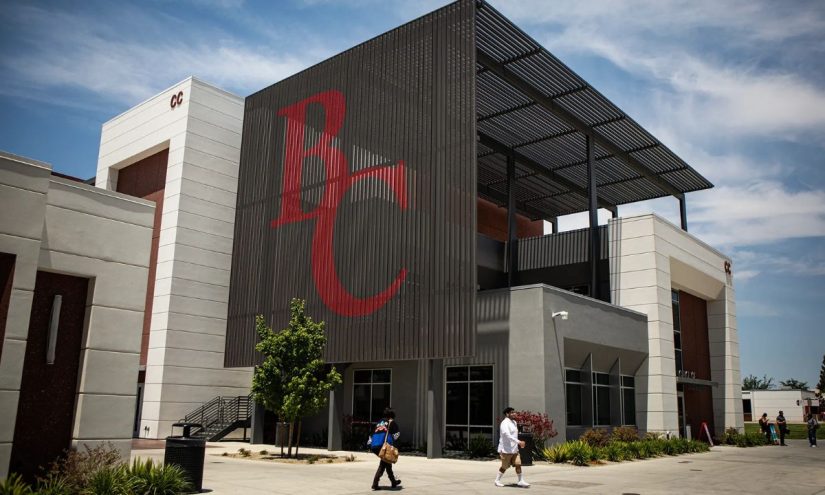
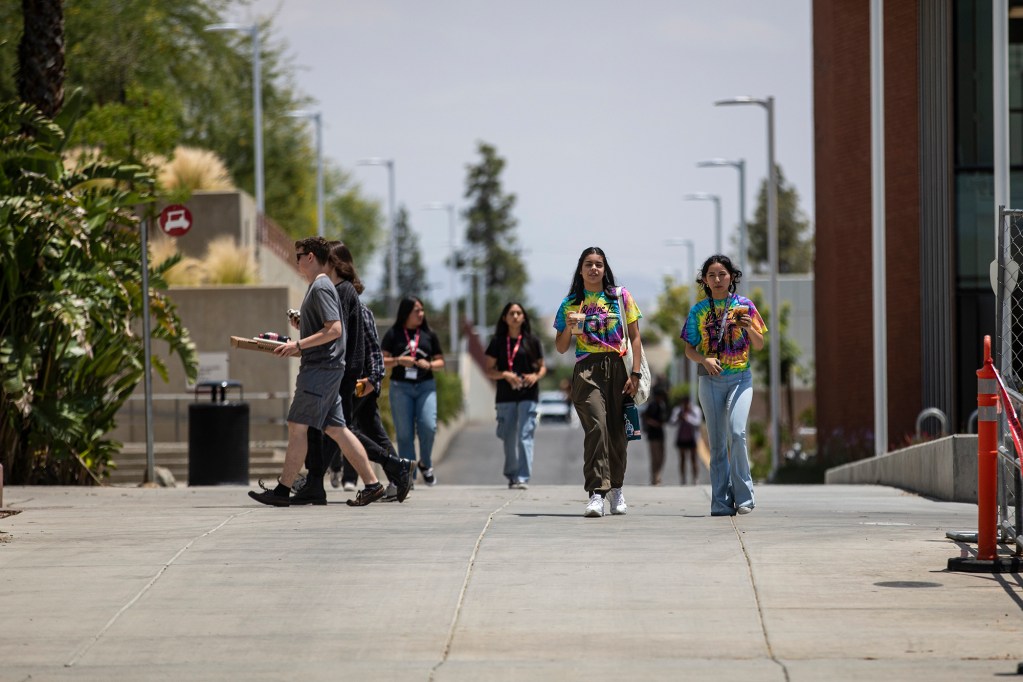
Students walk through one of the main walkways onto Bakersfield College on June 14, 2023. (Larry Valenzuela, CalMatters/CatchLight Local)
California’s rural colleges generally lag behind urban colleges in dual enrollment. Kern Community College District in the southern Central Valley and the Compton Community College District near Los Angeles had the two highest percentages of high school students in 2024, at 41% and 36% respectively, based on state data. In comparison, 9.7% of students at College of the Siskiyous are dual enrolled high schoolers, and this drops to about 5% in some other parts of the state.
Sonya Christian, the chancellor of the California Community College system, previously led the Kern Community College District, spearheading its expansion of dual enrollment. Now, dual enrollment in the district is “one of the most successful models in the state,” Christian said in an emailed statement to CalMatters.
“I prioritized dual enrollment because I saw it as a potential pathway to increase college-going rates, accelerate degree completion and provide students — especially those in rural and low-income communities — with early exposure to college-level coursework,” Christian said in the statement.
For many high school students in the small city of Blythe, which sits along California’s border with Arizona, the only people they know with bachelor’s degrees are their teachers. That’s why Clint Cowden, the vice president of instruction and student services at Palo Verde College, said the exposure to college that dual enrollment provides these students can be transformative.
“It’s really a win-win for the community,” Cowden said.
A recent alumnus of Palo Verde College’s dual enrollment program, Manuel Milke earned his high school diploma and his associate degree simultaneously, while juggling varsity soccer and football. Now Milke, who is 19, is set to graduate in the fall from San Diego State with a bachelor’s degree in kinesiology. Milke said he chose to attend San Diego State to stay close to his family in Blythe, and aspires to work as a physical therapist somewhere nearby.
“Everyone should do dual enrollment,” said Milke. “It saved me time, it saved me money and it made me feel more prepared for college.”
Student gaps remain in dual enrollment
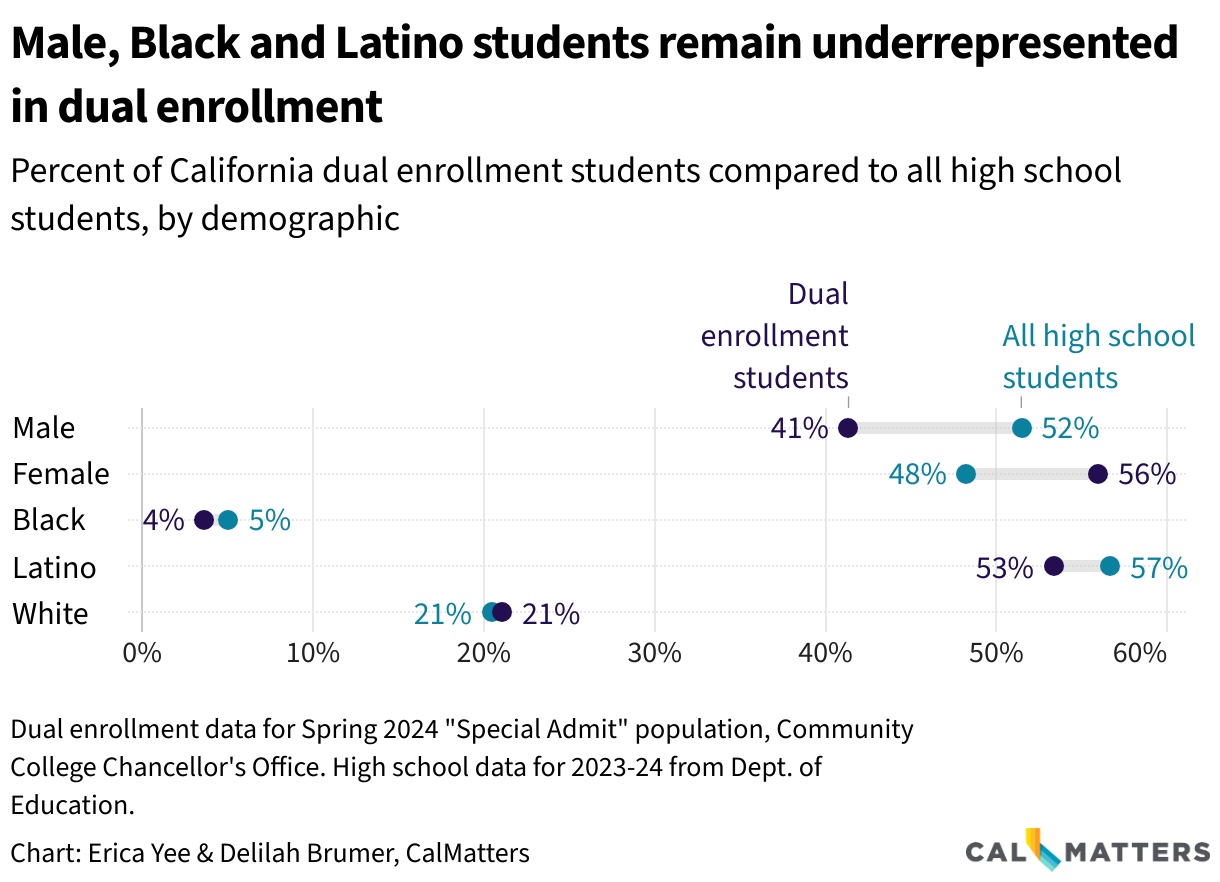
As a Latino male, Milke is in the minority for dual enrollment. Based on state data, Black and Latino students are both underrepresented in dual enrollment courses. In the spring 2024 semester, 41% of dual enrollment students were male, while 56% were female. According to Payares-Montoya, these gaps in access to dual enrollment can make it so Black, Latino and male students are less likely to see higher education as an option, compared to their dual enrolled peers.
For Jesse Medrano, an 18-year-old senior at Daniel Pearl Magnet High School in the Los Angeles Unified School District, dual enrollment has provided “a good outline of what college is like.” His high school first placed him in dual enrollment in ninth grade, and since then he has taken five classes, covering topics including economics and political science.
“I didn’t have the drive to seek these courses out, so the fact that they put me in them set this standard for me, and now I’m meeting it,” said Medrano, who is Latino and plans to study accounting at Cal State Northridge. “I didn’t have the motivation, but now I do, and I’m able to succeed.”
At Compton College more than a third of the current students are still in high school, according to state data. Latino and Black students comprise 75% and 9% of dual enrollees, respectively, which are significantly higher than state averages. Keith Curry, the college’s president, said that when students of color complete dual enrollment courses, this gets them comfortable with college academics and leads to better representation at colleges and universities.
Some faculty push back against expansion
Some community college faculty have raised concerns about the process by which dual enrollment partnerships are established, the level of readiness of high school students for college courses, and who teaches these classes. In many districts across the state, some dual enrollment courses are not taught by community college faculty, but by existing high school teachers who hold the credentials required to teach at a college level. In the Kern Community College District, about 60% of dual enrollment courses held on high school campuses are taught by high school teachers who meet the college qualifications, according to district spokesperson Norma Rojas.
Tim Maxwell, an English professor at College of San Mateo, is a “conscientious objector” to California’s expansion of dual enrollment. Maxwell said he is concerned about what he sees as a focus to get as many students to graduate and earn college credits as quickly as possible, sacrificing college-level rigor and evaluation.
“Completion is important, but our primary responsibility is for students to learn something along the way,” said Maxwell, who has taught community college courses for about 30 years.
Maxwell has taught creative writing courses on his college campus with several dual enrolled students, one as young as 15 years old, and he said these students are “phenomenal.” But, he added, there’s a difference between a handful of proactive high schoolers going to a community college campus and a high school classroom that “switches to a college class during fifth period.” He said he is concerned about poor working conditions for professors, primarily adjunct faculty, who have to travel to high schools and teach without the proper background or support.
“We need to resist this, and we need lawmakers who understand something about education and not just spreadsheets,” Maxwell said.
Wendy Brill-Wynkoop, the president of the Faculty Association of California Community Colleges, said dual enrollment is beneficial for students, but that she has “heard grumblings” about a need for faculty to have a more active role in setting standards and policies for dual enrollment.
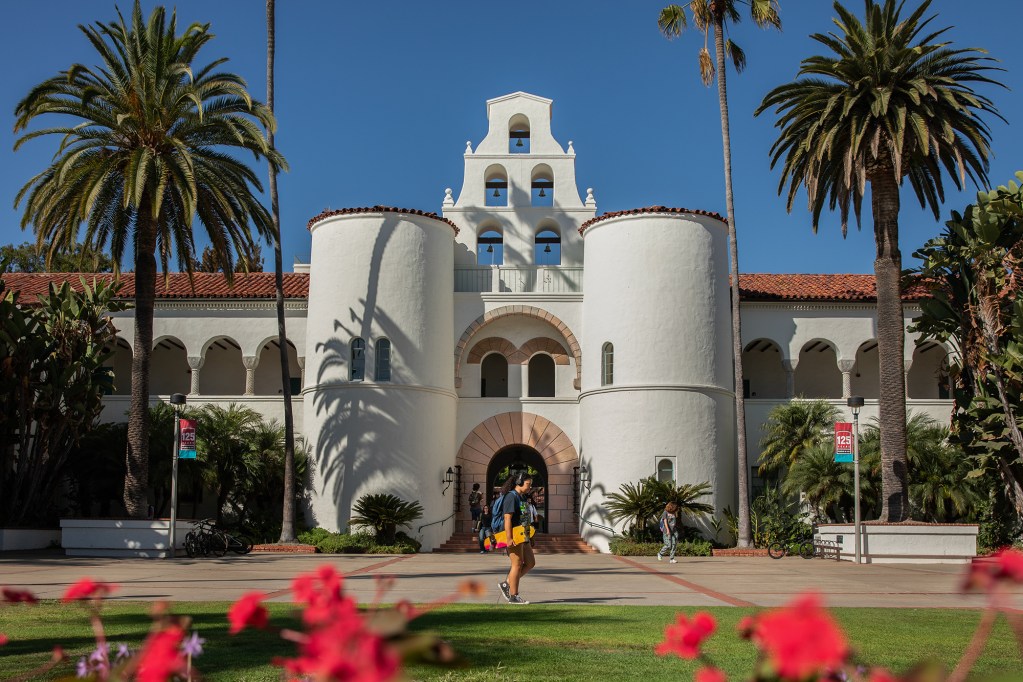
Students walk near Hepner Hall at San Diego State University in San Diego on Oct. 10, 2024. (Adriana Heldiz/CalMatters)
While in high school in Blythe, Milke said his dual enrollment courses were generally easier than the courses he takes at San Diego State. But they still challenged him and prepared him for a college-level workload, he said.
Lawmakers work to continue growth
Several state laws have been enacted in the past decade to expand dual enrollment in California. In 2015, Assembly Bill 288 established the College and Career Access Pathways program, allowing community colleges and high schools to enter into dual enrollment partnerships. These institutions bring the courses to students, as opposed to those students having to seek them out. The state streamlined the pathways program with the passage of Assembly Bill 30 in 2019, allowing students to submit fewer forms to enroll. Assembly Bill 731, which is currently in committee, would, among other changes, increase the number of units that students in the program can take.
Based on PPIC research, students in the College and Career Access Pathways program now account for about 37% of dual enrollees. This program has a higher percentage of underrepresented students compared to other dual enrollment programs, in part because it eliminates some of the restrictions that can make it hard for schools to offer broad and barrier-free dual enrollment.
As dual enrollment continues to expand, it increases costs to California beyond the more than $700 million that the state has already invested. That’s because both community colleges and high school districts are typically both able to receive state funding for dual enrolled students, according to the Legislative Analyst’s Office.
According to the statement from Christian, state leaders are working to increase dual enrollment access by expanding partnerships between high schools and colleges.
“My vision is to make dual enrollment a standard opportunity for all California students, not just an option for a select few, increasing equitable access to higher education and workforce-aligned learning,” Christian said in the statement.
Alana Althaus-Cressman, who runs the dual enrollment program at Golden Eagle Charter School, a K-12 school in Siskiyou County, markets the program to all students, not just those who already have a record of high achievement. She studied dual enrollment access for rural students for her graduate school dissertation at Sacramento State University, and started the early college high school program at Golden Eagle Charter in 2024. Students in the program take dual enrollment courses for part of the school day, and high school courses for the rest.
Althaus-Cressman said that because dual enrollment offers students a glimpse of college, it’s important that the classes aren’t only filled with students who already plan to attend college. Some high schools require minimum grade point averages or have other barriers to entry for dual enrollment, which Althaus-Cressman said can perpetuate inequalities.
The early college high school program enrolls about a third of Golden Eagle Charter’s ninth graders. Althaus-Cressman attributes this level of participation to extensive outreach, which included working with school staff to call the families of every incoming high school student to invite them to a dual enrollment orientation.
“We don’t want students to think that they aren’t the type of student for this program,” Althaus-Cressman said. “It’s for everybody.”
Free speech is more than just a constitutional right — it’s the cornerstone of democracy and social progress. In today’s divided political climate, defending this right has never been more important. That’s why FIRE’s Free Speech Forum is bringing together passionate young leaders who are ready to become tomorrow’s defenders of free speech.
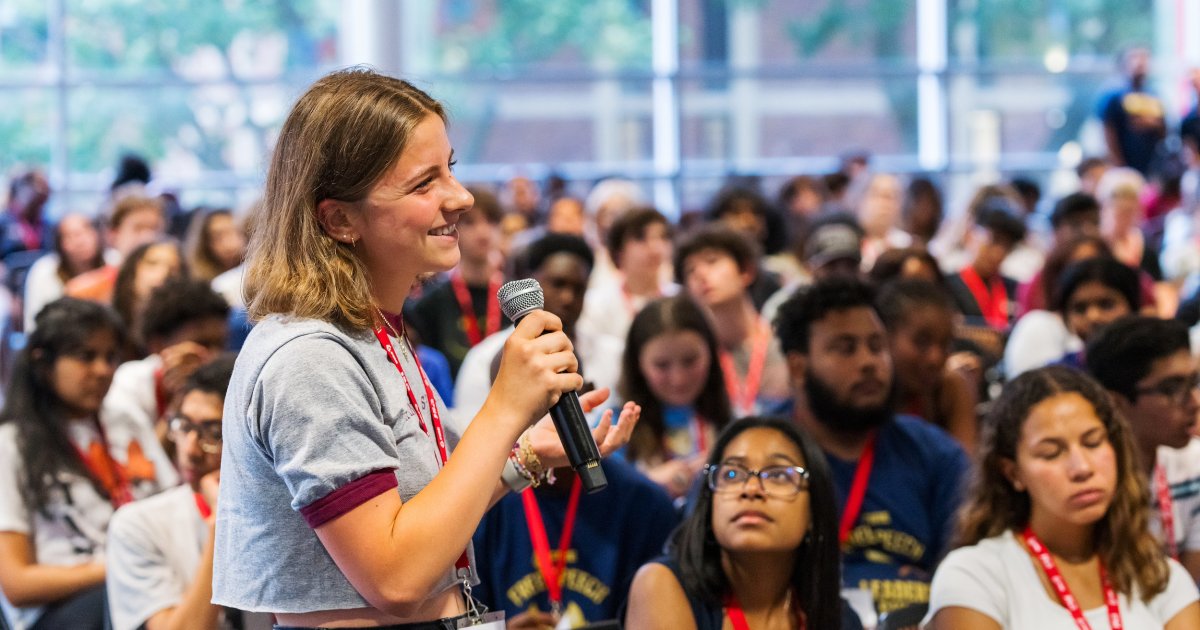
The Free Speech Forum isn’t just another high school summer camp. It’s an immersive, week-long experience designed for rising 10th through 12th graders who are passionate about free speech and learning about the First Amendment. Held at American University in Washington, D.C. from June 22-28, this unique forum is a launchpad for students eager to learn from experts, connect with like-minded peers, and build the skills needed to advocate for these vital democratic values — on campus and beyond.
Free Speech Forum
Page
FIRE is bringing together the next generation of free speech leaders at American University in Washington D.C. from June 22 to 28.
Skill-building activities to help you better advocate for free speech in your community
Networking opportunities with advocates, policymakers, and fellow students
This is a chance to join 200 student leaders for an unforgettable week of learning and career development, all right in the heart of one of America’s greatest cities.
Who should apply? The forum is open to college-bound students who:
Have a passion for free speech and advocacy
Rising 10th to 12th graders at the time of application
Are able to attend the entire program
What does it cost? It’s completely free! FIRE covers registration, housing in the American University dormitories, and meals.Students are responsible for their own travel arrangements to and from Washington, D.C., but FIRE will provide free transportation between Ronald Reagan National Airport or Union Station and the university.
What if I can’t afford the cost of travel? A limited number of need-based scholarships are available to help with travel expenses to and from Washington, D.C. Students will be notified about the scholarship application process after they are accepted into the program.
How do I apply? Applications are now open! The application deadline is March 30, 2025. Due to the competitive nature of the program, we recommend applying early.
This is your chance to dive deep into the First Amendment, explore the history of free speech, learn from the experts, and develop the skills you need to become an advocate for free expression.