This audio is auto-generated. Please let us know if you have feedback.
Dive Brief:
Denver Public Schools has issued the latest salvo in the battle over the Trump administration’s controversial new policy allowing immigration raids on school grounds with a lawsuit filed Wednesday in federal court.
In the interim, Denver Public Schools is asking for a temporary restraining order to prohibit U.S. Immigration and Customs Enforcement and Customs and Border Protection enforcement of the policy.
Dive Insight:
The new Trump policy lifted the practice of avoiding immigration enforcement activities at places where students gather. Versions of the protected areas guidance have been in place for more than 30 years, according to the Denver system’s 25-page lawsuit, which was filed in the U.S. District Court for the District of Colorado.
According to the lawsuit, school attendance has dropped “noticeably” across all schools in the Denver district — and particularly in schools with “new-to-country families and where ICE raids have already occurred” — since announcement of the new policy.
The suit alleges that the policy is hurting the district’s ability to provide education and life services to children who aren’t attending school out of fear of immigration enforcement action. Colorado’s largest district, Denver Public Schools enrolls more than 90,000 students across 207 schools.
In rescinding 2021 Biden administration language on the topic, the U.S. Department of Homeland Security said in a press release that the reversal would empower Customs and Border Patrol and Immigration and Customs Enforcement agents to enforce immigration laws and catch criminals who are in the country illegally.
“Criminals will no longer be able to hide in America’s schools and churches to avoid arrest,” the statement read. “The Trump Administration will not tie the hands of our brave law enforcement, and instead trusts them to use common sense.”
In its lawsuit, however, Denver Public Schools alleges that the new policy “gives federal agents virtually unchecked authority to enforce immigration laws in formerly protected areas, including schools. As reported to the public, the sole restraint on agents is that they use their own subjective ‘common sense’ to determine whether to carry out enforcement activities at formally safeguarded locations such as schools.”
The lawsuit further claims that the DHS directive has not been backed up with formal written guidance and seeks for such a policy to be made “available for public inspection.”
In a Thursday statement to CBS News Colorado, Tricia McLaughlin, assistant secretary of public affairs at DHS, said officers “would need secondary supervisor approval before any action can be taken in locations such as a church or a school. We expect these to be extremely rare.”
The Denver Public Schools lawsuit comes the same week as a challenge filed by 27 religious groups — including the Mennonite Church, Episcopal Church and Central Conference of American Rabbis — that accuses the new immigration policy of infringing upon their congregations’ religious freedoms. Another lawsuit filed in January and led by the Philadelphia Yearly Meeting of the Religious Society of Friends, a Quaker organization, also alleges the policy infringes upon religious freedoms.
This story was produced by the Associated Press and reprinted with permission.
Math is the subject sixth grader Harmoni Knight finds hardest, but that’s changing.
In-class tutors and “data chats” at her middle school in Compton, California, have made a dramatic difference, the 11-year-old said. She proudly pulled up a performance tracker at a tutoring session last week, displaying a column of perfect 100 percent scores on all her weekly quizzes from January.
Since the pandemic first shuttered American classrooms, schools have poured federal and local relief money into interventions like the ones in Harmoni’s classroom, hoping to help students catch up academically following COVID-19 disruptions.
But a new analysis of state and national test scores shows the average student remains half a grade level behind pre-pandemic achievement in both reading and math. In reading, especially, students are even further behind than they were in 2022, the analysis shows.
Compton is an outlier, making some of the biggest two-year gains in both subjects among large districts. And there are other bright spots, along with evidence that interventions like tutoring and summer programs are working.
Students interact in a fourth grade classroom at William Jefferson Clinton Elementary in Compton, Calif., Thursday, Feb. 6, 2025. Credit: Eric Thayer/Associated Press
The Education Recovery Scorecard analysis by researchers at Harvard, Stanford and Dartmouth allows year-to-year comparisons across states and districts, providing the most comprehensive picture yet of how American students are performing since COVID-19 first disrupted learning.
The most recent data is based on tests taken by students in spring 2024. By then, the worst of the pandemic was long past, but schools were dealing still with a mental health crisis and high rates of absenteeism — not to mention students who’d had crucial learning disrupted.
“The losses are not just due to what happened during the 2020 to 2021 school year, but the aftershocks that have hit schools in the years since the pandemic,” said Tom Kane, a Harvard economist who worked on the scorecard.
In some cases, the analysis shows school districts are struggling when their students may have posted decent results on their state tests. That’s because each state adopts its own assessments, and those aren’t comparable to each other. Those differences can make it impossible to tell whether students are performing better because of their progress, or whether those shifts are because the tests themselves are changing, or the state has lowered its standards for proficiency.
The Scorecard accounts for differing state tests and provides one national standard.
Higher-income districts have made significantly more progress than lower-income districts, with the top 10 percent of high-income districts four times more likely to have recovered in both math and reading compared with the poorest 10 percent. And recovery within districts remains divided by race and class, especially in math scores. Test score gaps grew by both race and income.
A student works in a classroom at Benjamin O. Davis Middle School in Compton, Calif., Thursday, Feb. 6, 2025. Credit: Eric Thayer/Associated Press
“The pandemic has not only driven test scores down, but that decline masks a pernicious inequality that has grown during the pandemic,” said Sean Reardon, a Stanford sociologist who worked on the scorecard. “Not only are districts serving more Black and Hispanic students falling further behind, but even within those districts, Black and Hispanic students are falling further behind their white district mates.”
Still, many of the districts that outperformed the country serve predominantly low-income students or students of color, and their interventions offer best practices for other districts.
Related: Become a lifelong learner. Subscribe to our free weekly newsletter featuring the most important stories in education.
In Compton, the district responded to the pandemic by hiring over 250 tutors that specialize in math, reading and students learning English. Certain classes are staffed with multiple tutors to assist teachers. And schools offer tutoring before, during and after school, plus “Saturday School” and summer programs for the district’s 17,000 students, said Superintendent Darin Brawley.
To identify younger students needing targeted support, the district now conducts dyslexia screenings in all elementary schools.
The low-income school district near downtown Los Angeles, with a student body that is 84 percent Latino and 14 percent Black, now has a graduation rate of 93 percent, compared with 58 percent when Brawley took the job in 2012.
Harmoni, the sixth-grader, said that one-on-one tutoring has helped her grasp concepts and given her more confidence in math. She gets separate “data chats” with her math specialist that are part performance review, part pep talk.
“Looking at my data, it kind of disappoints me” when the numbers are low, said Harmoni. “But it makes me realize I can do better in the future, and also now.”
Brawley said he’s proud of the district’s latest test scores, but not content.
“Truth be told, I wasn’t happy,” he said. “Even though we gained, and we celebrate the gains, at the end of the day we all know that we can do better.”
A tutor helps students at Benjamin O. Davis Middle School in Compton, Calif., Thursday, Feb. 6, 2025. Credit: Eric Thayer/Associated Press
As federal pandemic relief money for schools winds down, states and school districts will have limited resources and must prioritize interventions that worked. Districts that spent federal money on increased instructional time, either through tutoring or summer school, saw a return on that investment.
Reading levels have continued to decline, despite a movement in many states to emphasize phonics and the “science of reading.” So Reardon and Kane called for an evaluation of the mixed results for insights into the best ways to teach kids to read.
The researchers emphasized the need to extend state and local money to support pandemic recovery programs that showed strong academic results. Schools also must engage parents and tell them when their kids are behind, the researchers said.
And schools must continue to work with community groups to improve students’ attendance. The scorecard identified a relationship between high absenteeism and learning struggles.
In the District of Columbia, an intensive tutoring program helped with both academics and attendance, said D.C. Public Schools Chancellor Lewis Ferebee. In the scorecard analysis, the District of Columbia ranked first among states for gains in both math and reading between 2022 and 2024, after its math recovery had fallen toward the bottom of the list.
Pandemic-relief money funded the tutoring, along with a system of identifying and targeting support at students in greatest need. The district also hired program managers who helped maximize time for tutoring within the school day, Ferebee said.
Students who received tutoring were more likely to be engaged with school, Ferebee said, both from increased confidence over the subject matter and because they had a relationship with another trusted adult.
Students expressed that “I’m more confident in math because I’m being validated by another adult,” Ferebee said. “That validation goes a long way, not only with attendance, but a student feeling like they are ready to learn and are capable, and as a result, they show up differently.”
Federal pandemic relief money has ended, but Ferebee said many of the investments the district made will have lasting impact, including the money spent on teacher training and curriculum development in literacy.
Students walk through a hallway at Benjamin O. Davis Middle School in Compton, Calif., Thursday, Feb. 6, 2025. Credit: Eric Thayer/Associated Press
Christina Grant, who served as the District of Columbia’s state superintendent of education until 2024, said she’s hopeful to see the evidence emerging on what’s made a difference in student achievement.
“We cannot afford to not have hope. These are our students. They did not cause the pandemic,” Grant said. “The growing concern is ensuring that we can … see ourselves to the other side.”
The Associated Press’ education coverage receives financial support from multiple private foundations. AP is solely responsible for all content. Find AP’s standards for working with philanthropies, a list of supporters and funded coverage areas at AP.org.
The Hechinger Report provides in-depth, fact-based, unbiased reporting on education that is free to all readers. But that doesn’t mean it’s free to produce. Our work keeps educators and the public informed about pressing issues at schools and on campuses throughout the country. We tell the whole story, even when the details are inconvenient. Help us keep doing that.
The Trump administration has cleared the way for immigration arrests at or near schools, ending a decades-old approach.
Republican and Democratic administrations alike have treated schools and child care centers, along with churches and hospitals, as “sensitive” or “protected” locations where immigration enforcement should only take place when there is an immediate danger to the public.
A copy of the Homeland Security memo was not immediately available for review.
But in a statement, a Homeland Security spokesperson said that Acting Secretary Benjamine Huffman issued a directive on Monday that rescinded the sensitive locations policy. The spokesperson said the action would help federal authorities enforce immigration law and catch criminals who entered the country illegally. Immigration agents will be asked to use “common sense” in enforcing the law.
“Criminals will no longer be able to hide in America’s schools and churches to avoid arrest,” the statement read.
Even before this policy existed, large-scale immigration raids weren’t conducted at schools. But Trump’s policy change paves the way for immigration agents to detain parents during dropoff or pickup, as has happened occasionally in the past.
Immigrant rights advocates worry that could lead to more absenteeism among children with immigrant parents, who may now fear being stopped by immigration agents while driving or walking their kids to school. That happened during the first Trump administration. Advocates also worry about the potential for routine interactions with school police to reveal a student or family’s immigration status, and lead to their deportation.
Some school districts have issued explicit instructions to educators and parents about how school staff should handle an immigration agent’s presence on campus. Some districts have also said they will not permit a federal agent on school premises without a judicial warrant, and that staff will be instructed to call the school system’s lawyer if these agents do show up.
Some of the nation’s largest districts, including Los Angeles and Chicago, have re-upped or expanded existing policies meant to protect immigrant students and families. New York City is scheduled to vote on a resolution this week that would reaffirm a policy preventing school safety agents from collaborating with federal immigration authorities in most cases.
Trump also signed an executive order that seeks to end the automatic right to citizenship for any child born in the U.S. On January 21, 18 states announced they were suing to block the policy change.
This story has been updated to include confirmation and comments from the Department of Homeland Security about the policy change.
Chalkbeat is a nonprofit news site covering educational change in public schools.
Chicago Public Schools launched new school profiles on its website — a milestone in the district’s five-year push to change how it portrays the quality of its campuses.
The new school accountability dashboards replace the district’s controversial number ratings for schools, which CPS put on hold and then scrapped during the pandemic. Those ratings had drawn the ire of educators and some community members, who said they unfairly stigmatized campuses that serve students with high needs. The old level ratings had also factored into high-stakes decisions about school closures and staff overhauls.
Some parents who’ve provided feedback on the shift said families welcome having a one-stop repository of information on school performance again. But they said they’d like to see simpler, more accessible language in information about the metrics the district included to put the numbers into context. And they noted that a busy parent must click repeatedly to get to each metric — only to find out in many cases that these numbers aren’t available yet.
Bogdana Chkoumbova, the district’s chief education officer, said the new system aimed to strike a balance.
“We didn’t want this to be just another state report card; we are embracing the complexity of the data,” she said. “If it looked like a one-pager in red and green, that just brings in the trauma.”
The new profiles went up in mid-December, the day after the window to apply to the district’s selective and magnet programs closed. Chkoumbova said the timing was not intentional. After all, families could find most of the information available on the dashboards so far on schools’ Illinois Report Card profiles.
For now, the profiles include only a portion of the data they’ll eventually feature — mostly traditional metrics such as test scores, chronic absenteeism, and graduation rates. Later this year, the district is gearing up to add long-anticipated information that gets at students’ experience and well-being — metrics that in some cases officials are still weighing how to best capture.
Still, CPS leaders say the launch of the new dashboards is an important start. They can be a handy tool as the members of a new, partly elected school board learn about the district and its schools. District officials plan to show off the profiles at the board’s monthly meeting on Thursday.
“We are transitioning to a completely new way of how we view student success and the district’s role in supporting schools,” said Chkoumbova.
The dashboards are available here by scrolling to the bottom and looking up a school.
The new profiles are five years in the making
Chicago first set out to overhaul how it measures and publicly communicates about school quality in 2019. At that time, school board members called on district officials to do away with the School Quality Rating System, or SQRP, policy, which many considered too focused on metrics that are affected by poverty levels and other demographics of the student body. The district formally adopted a new Continuous Improvement and Data Transparency policy in 2023.
With input from academics, parents, and others, the district tried to design a more holistic approach, bringing in a wider array of metrics, including some that got at the experience students have on campus — and at whether the district is providing schools the resources they need to improve that experience.
After years of largely behind-the-scenes work, the new dashboards went live quietly in December, giving principals and other educators a chance to weigh in.
Claiborne Wade, the father of four CPS students, served on a district committee that provided input on the new accountability system. He said he is a big believer in the district’s efforts to take a more holistic look at school performance.
“It’s more than test scores and attendance rates and graduation rates,” he said. “Those are important, but so is making sure we have funds for extracurricular activities and parents have a seat at the table.”
Last week, Wade presented the new dashboards to a group of 10 parents actively involved at DePriest Elementary on the West Side, where he works as a family coordinator as part of the Sustainable Community Schools program. Some liked that the new dashboards offer information about each metric and how to interpret it. But many felt these explanations were too heavy on education jargon and terms such as “alternate assessments.”
Jaqueline Vargas, the mother of two CPS students and two district graduates, said the site asks parents to do too much navigating — especially given that many metrics are not landing on the dashboard until later this year.
“You have to click a lot, but when you finally get there, the information isn’t there,” said Vargas, who also served on the district’s Transparency Committee.
She said she would love to see more information on parent leadership groups and parent engagement more generally, photos of principals, and readily accessible listings of the specialized programs and support services a campus offers. One of her CPS graduates was really interested in cooking while in high school, but the family had no idea that even though their neighborhood high school did not offer a culinary program, two nearby campuses did.
Hal Woods, chief of policy with the parent advocacy group Kids First Chicago, said the dashboards are clearly a work in progress. The layout can be more user-friendly. The metrics available so far are largely what SQRP offered, though the recently released dashboards do include some new information, such as whether a school has quality curriculums.
Parents are eager to see the full set of metrics later this year, Woods said — including those that show how schools are providing social and emotional support to students, a task that recent research has shown greatly affects outcomes such as high school graduation.
The district aims to better measure the student experience
Like districts across the country, CPS is still grappling with how to measure the student experience on campus more fully, said Elaine Allensworth of the University of Chicago’s Consortium on School Research. For the past two years, the district has given students a survey called Cultivate, which was developed by Allenworth’s team at the university. But she says the survey was designed to give teachers information about students’ experiences in their classrooms — not as an accountability tool for families and others.
“There’s a concern that if the survey becomes public, teachers would feel under pressure to make their schools look good and won’t feel as comfortable using it for their own development,” she said.
The district also explored how to best present another key piece of the student experience: extracurricular activities. The district could likely do more than simply listing the activities a school offers, Allensworth said. The new dashboards show the portion of students who participate in any activities. But are these activities high-quality? Are outside partners chipping in?
Chkoumbova said the district will continue to work on improving the platform. In late February, it will include new data on the growth toward math and reading proficiency on state tests that students make — a metric that Ellensworth said is much more telling about how well a school is doing than the portion of students who meet state standards on these tests.
Chkoumbova feels CPS is on the right track.
“We are trailblazers,” she said. “There are very few systems that have taken such an innovative and different approach.”
Chalkbeat is a nonprofit news site covering educational change in public schools.
The case will be heard at London’s High Court April 1-3, the Independent Schools Council (ISC), which represents private schools in the UK, revealed this week.
It’s the latest step in its furious battle to overturn a policy – key to the Labour party’s election manifesto before it regained power in July 2024 – to start levying VAT on private school fees.
The ISC said its case, led by prominent human rights barrister Lord Pannick KC, would argue that the VAT policy “impedes access to education in independent schools” and is therefore incompatible with the European Convention on Human Rights.
In the case, the ISC is supporting six families impacted by the policy, and the defendent in UK Chancellor Rachel Reeves.
The case is being heard on an expedited basis following a successful argument from Lord Pannick that parents needed certainty because they are already feeling the effects of the policy.
ISC CEO Julie Robinson said the organisation’s aim was to “protect the rights” of families and young people “who are having their choice removed from them”.
“This is an unprecedented tax on education – it is right that its compatibility with human rights law is tested,” she continued. “We believe the diversity within independent schools has been ignored in the haste to implement this damaging policy, with families and, ultimately, children, bearing the brunt of the negative impacts this rushed decision is already having.”
This is an unprecedented tax on education – it is right that its compatibility with human rights law is tested Julie Robinson, ISC
Reeves confirmed in October that the party would be slapping a 20% tax on fees for January 2025, leading to fears from independent boarding schools that their intake of international students could plummet.
Experts predicted that although some schools would choose to swallow the loss of revenue, most would be forced to raise their fees an average of 10-15% to cover costs.
An online private school told The PIE News earlier this month that it has seen a “five-fold” surge in interest from parents since the VAT policy was announced last year.
CEO of Minerva’s Virtual Academy, Hugh Viney, credited the rise in demand to the VAT policy, as he said the school’s fees are “good value” and much less than most private schools at under £8,500 per year – a price that has always included VAT and is therefore unchanged by the new legislation.
With video consumption accounting for nearly 83% of global internet traffic and popular platforms like Instagram, YouTube, TikTok, and Facebook prioritizing video content, video marketing has become indispensable for educational institutions aiming to boost visibility and enrollment.
To stay competitive in today’s market, you’ll need to harness the potential of video advertising effectively. This comprehensive guide explores the power of video marketing for schools, the types of video content that work best for student recruitment, strategies for success, and solutions to common challenges.
Struggling to stand out in a crowded market?
Boost Enrollment with Engaging Short Videos
The Power of Video Ads
Video ads have revolutionized student recruitment strategies. With the average attention span of viewers shrinking to just eight seconds, video offers a uniquely engaging way to capture attention and convey key messages.
Prospective students, especially from Generation Z, respond favorably to videos that are authentic, visually appealing, and emotionally resonant. Institutions that embrace this medium can benefit in several ways.
Source: HEM
Are you ready to start seeing the benefits of video marketing for schools in your strategy? Reach out to learn about our short-form video services
The Rise of Video Content
The prevalence of mobile devices has played a crucial role in video’s dominance. Roughly 75% of video consumption now takes place on smartphones, which means that optimizing video content for mobile viewing is no longer optional.
How can you ensure that your videos perform well on mobile devices? Optimize videos for vertical viewing on social media stories, reels, and TikTok where many of your prospects spend time each day.
Videos resonate because they combine auditory and visual stimuli, making it easier to communicate complex ideas quickly. From showcasing campus life to highlighting academic achievements, videos allow your institution to tell compelling stories that resonate with viewers on an emotional level.
Video is also uniquely positioned to address the challenge of dwindling attention spans. Short, visually rich content quickly captures the viewer’s interest and sustains it by combining engaging visuals with concise messaging.
Platforms such as TikTok, with its bite-sized, highly engaging format, demonstrate the power of video to connect with younger audiences effectively. On platforms like YouTube, longer-form videos offer opportunities to dive deeper into campus life, academic programs, or institutional values.
Engagement metrics further underscore the importance of video. Social media algorithms prioritize video content, leading to higher visibility and better engagement rates.
Studies consistently show that video posts receive significantly more likes, shares, and comments than static posts. This increased interaction enhances the institution’s online presence and builds a stronger connection with potential students by inviting them to engage directly with the content.
Finally, video content creates a multisensory experience that helps prospective students visualize themselves at the institution. When students see themselves participating in activities, walking the campus, or enjoying the community, they are more likely to form an emotional connection that influences their decision-making process.
Example: Here, UC Berkeley shares a short, interesting interview-styled video, optimized for vertical video apps. When choosing a video format and editing your video, be sure to keep your viewer’s short attention span in mind.
To fully leverage video advertising, it’s important to understand the different types of videos that resonate with your audience. Each type serves a unique purpose, allowing schools to communicate effectively across various platforms.
Hype Promo Videos
Hype promo videos are ideal for generating excitement around major announcements, such as launching a new program or an upcoming campus event. These high-energy videos grab attention with dynamic visuals and captivating music, making them perfect for social media platforms where scrolling speeds are fast.
While shorter clips work well for platforms like Instagram and TikTok, longer versions can be hosted on the institution’s website or YouTube channel to provide a more comprehensive overview.
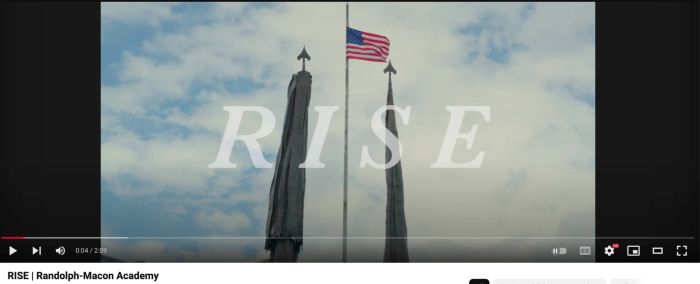
Example: Randolph-Macon Academy uses high-quality footage, eye-catching editing, and epic music to tell a compelling story about the student life experience they offer. Hype promo videos are an excellent avenue for visual storytelling.
Source: Randolph – Macon Academy | YouTube
User-Generated Content
User-generated content (UGC) is a game-changer for student recruitment. Content created by current students, alumni, or ambassadors exudes authenticity, which prospective students highly value.
Whether it’s a student documenting their day on campus or an alumnus sharing their career journey, UGC builds trust and fosters a sense of relatability. Institutions can encourage student participation by offering incentives like branded merchandise or featuring contributors prominently on official channels.
Example: This UGC video from Cumberland College is authentic and appeals to the desires of a specific Gen-Z audience particularly as the popularity of online careers grows. Throughout your UGC campaign, be sure to focus on highlighting genuine experiences to differentiate the content from a traditional ad.
Limited budgets should never deter institutions from producing impactful video content. If you’re wondering how to create video ads on a limited budget, look no further than a modern smartphone. Capable of capturing high-quality footage, you can create professional-looking videos without expensive equipment.
Simple strategies like natural lighting, stabilizing the camera, and adding subtitles can elevate production quality. Starting small with test videos allows for refinement over time, paving the way for a more robust video marketing strategy.
Example: Video marketing for schools doesn’t always have to involve highly produced footage. As long as the quality isn’t compromised, and the results are just as engaging, all you really need to get started is a modern smartphone with a decent camera and some creative ideas. Video marketing is heavily trend-driven, particularly on platforms where short-form videos are popular. For your DIY videos, do preliminary research, taking note of the trends that viewers are responding to.
Source: Cambridge University | YouTube
Strategies for Effective Video Content
Creating effective video ads requires more than just compelling visuals. Institutions must adopt a strategic approach to ensure their content aligns with their goals and resonates with their target audience.
Focus on Quality Over Quantity
Every video should reflect the institution’s values, strengths, and mission. To ensure consistently high-quality video content, schools can implement several strategies.
First, create clear production guidelines that include lighting, sound, and framing recommendations. These guidelines can help amateur creators, such as students contributing user-generated content, maintain a professional standard.
When relying on user-generated content (UGC), provide participants basic training or tip sheets on capturing footage. Encourage contributors to use stable tripods, proper lighting, and minimal background noise to enhance video clarity. Offering editing support or simple tools to enhance UGC—such as branded filters or overlays—ensures that the final product aligns with the institution’s brand identity.
Consistency in quality also comes from pre-production planning. For example, institutions can create storyboards or scripts for key content themes, ensuring each video maintains a cohesive narrative. Review processes are equally critical; assigning a designated team or individual to review and approve content before publication allows schools to catch inconsistencies and errors early.
Investing in scalable tools, such as video editing software or mobile apps, allows schools to polish videos before posting. Paired with these efforts, periodic feedback sessions with creators can help refine content over time. A single high-quality video can generate more engagement and drive more conversions than a series of poorly produced clips.
Segment Videos by Topic
Educational institutions cater to diverse audiences, each with unique interests and priorities. By creating topic-specific videos, schools can address these varying needs effectively. For instance, one video might highlight academic programs, while another focuses on student life or campus facilities.
This segmentation ensures prospective students receive information tailored to their interests, enhancing engagement and encouraging further exploration.
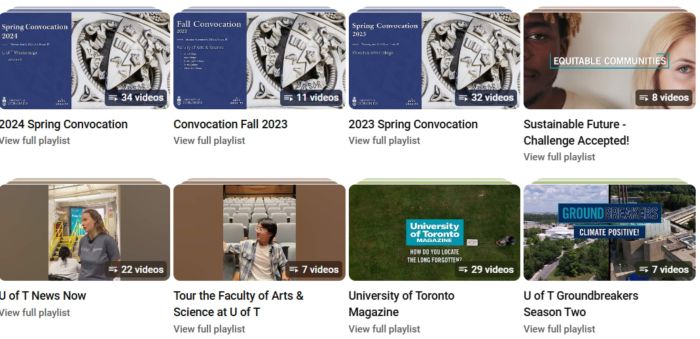
Example: Organize your videos into playlists to make it easier for viewers to find what they’re looking for as the University of Toronto did on their YouTube page in the image below.
Source: University of Toronto
Showcase Real Success Stories
Nothing resonates more deeply than genuine success stories. Featuring interviews with current students, alumni, or faculty members allows institutions to highlight real-world outcomes and the impact of their programs.
These narratives provide relatable insights that prospective students can envision for themselves, making the institution’s offerings more tangible and aspirational.
To create compelling success story videos, schools should start by identifying standout students or alumni whose journeys reflect the institution’s values and strengths.
Conduct interviews in visually appealing settings, such as iconic campus locations, to give viewers a sense of place. Incorporate diverse voices and experiences to ensure the stories resonate with a wide audience.
Actionable strategies include integrating authentic visuals, such as clips of the featured individual participating in classes, engaging in extracurricular activities, or achieving milestones in their careers. Pair these visuals with concise, heartfelt narratives that emphasize personal growth and accomplishments.
For consistency and quality, schools can create a structured framework for storytelling. This might include opening with a brief introduction, highlighting the challenges or goals the individual faced, and concluding with their achievements and future aspirations. Encourage participants to speak naturally, as unscripted moments often feel more genuine and relatable.
Additionally, amplify the impact of these stories by embedding them into broader marketing campaigns. Share snippets on social media, include them in email outreach, or feature them prominently on the institution’s website. This multi-channel approach ensures that success stories reach prospective students at various touchpoints, enhancing their overall effectiveness.
Boost Engagement with CTAs
Every video should include a clear and compelling Call-To-Action (CTA). CTAs are the bridge between engagement and action, guiding viewers to take the next step in their journey with the institution. To craft effective CTAs, schools should focus on clarity and relevance. For instance, a video showcasing campus life might end with an invitation to “Book a Campus Tour,” while a testimonial video could encourage viewers to “Apply Today and Start Your Journey.”
The placement and timing of CTAs are equally important. CTAs placed at the end of a video often drive action most effectively, as viewers are already immersed in the content. However, mid-video CTAs can also be used strategically in longer videos to re-engage audiences who may drop off before the end. Interactive elements like clickable links or embedded forms can make CTAs even more effective by reducing friction for viewers.
Customization of CTAs based on the platform is another key strategy. On YouTube, a CTA might take the form of a video overlay or end screen, while Instagram could use stickers or swipe-up features. These platform-specific approaches ensure that the CTA feels natural and intuitive to the viewer.
Finally, measuring the success of CTAs is critical. Schools can track metrics such as click-through rates, conversions, and engagement to refine their approach over time. A/B testing different CTA phrasing or formats can also provide valuable insights into what resonates most with prospective students. With these strategies in place, CTAs can transform passive viewership into active interest and tangible results.
Overcoming Challenges in Video Marketing
Despite its benefits, video marketing comes with its own set of challenges. Educational institutions must address these hurdles to maximize the impact of their campaigns.
Privacy and Legal Compliance
Privacy concerns are paramount when creating promotional content involving students. Institutions should implement consent forms and adhere to relevant regulations to ensure that all video materials comply with legal requirements. Transparency in this process not only safeguards the institution but also builds trust with stakeholders.
Maintaining Brand Cohesion
Consistency is key to building a strong brand identity. To achieve this, schools should develop a brand style guide that outlines visual and messaging standards for all video content. This ensures that every video aligns with the institution’s overall branding, reinforcing recognition and credibility.
Generating Fresh Content
Keeping content fresh and engaging can be a challenge, especially for institutions with limited resources. One solution is to develop themes or “content buckets,” such as academic achievements, campus events, or faculty highlights. This approach provides a structured framework for content creation, making it easier to maintain a steady flow of new material.
Leveraging Stock Footage
For institutions with constrained budgets, stock footage offers a cost-effective alternative to original video production. By customizing stock footage with branded elements like logos or text overlays, schools can create visually appealing content that feels authentic and aligned with their messaging.
Enhancing Impact with Professional Elements
While authenticity is critical, incorporating professional touches can elevate video quality and make content more impactful. Techniques like using green screens, investing in studio settings, and optimizing videos for mobile viewing can significantly enhance production value.
Additionally, tailoring content for specific platforms—such as LinkedIn for professional audiences or Instagram for visual storytelling—ensures maximum reach and engagement.
Building Trust Through Authenticity
Authenticity is the cornerstone of effective video marketing. Overly polished advertisements can sometimes feel impersonal, while genuine, unscripted content fosters emotional connections.
Videos that highlight real student experiences, showcase unfiltered moments, or provide behind-the-scenes glimpses into campus life resonate deeply with prospective students, making them more likely to consider the institution.
Cost-Effectiveness and ROI
Video marketing doesn’t have to break the bank. User-generated content, in particular, offers a highly cost-effective way to create engaging videos. Encouraging students and alumni to contribute content not only reduces production costs but also enhances relatability.
When paired with strong CTAs, video ads often outperform other formats in generating conversions, making them a high-ROI investment for student recruitment campaigns.
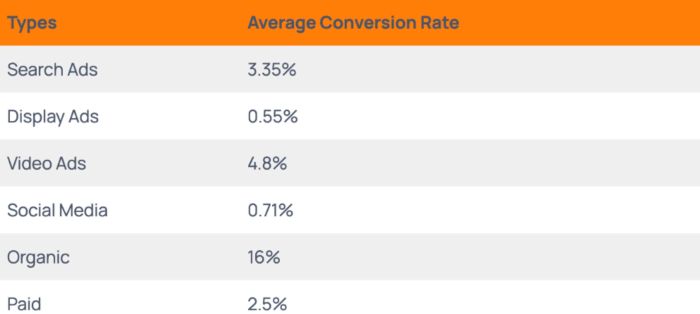
Example: Pictured below are the average conversion rates of various traffic sources. Second only to organic traffic (referring to visitors that complete a desired action after finding your institution through unpaid search results), video marketing boasts a high 4.8% conversion rate making it a worthy investment.
Source: Business Dasher
In review, what are the best video marketing strategies for schools? Creating effective video ads requires you to go beyond compelling visuals. Schools need to adopt a strategic approach to ensure their content aligns with their goals and resonates with their target audience.
This includes focusing on quality over quantity by creating visually appealing and professional videos that reflect the institution’s values. Schools should also segment their video content by topic to cater to the diverse interests of their prospective students, ensuring each video delivers targeted and relevant information.
Leveraging real success stories is another impactful strategy, as these narratives provide relatable and aspirational insights. Institutions should also craft clear and engaging calls-to-action (CTAs) that guide viewers toward the desired next steps, such as applying or signing up for a campus tour.
Ensuring consistency in quality, brand cohesion, and authenticity while addressing privacy concerns and optimizing for platform-specific formats will further enhance the effectiveness of video ads. By combining these strategies, you can create videos that capture attention and drive meaningful engagement and conversions.
Video ads are transforming digital marketing strategies for schools. Embracing this powerful medium can significantly amplify your reach, foster emotional connections, and drive enrollment. From leveraging user-generated content to creating high-quality promotional videos, the strategies outlined in this guide provide a roadmap for success.
Don’t get left behind as marketing trends evolve. Institutions that prioritize video marketing will be better positioned to connect with the next generation of students and thrive in an increasingly competitive landscape. The time to invest in video ads is now and we can help you get started.
Struggling to stand out in a crowded market?
Boost Enrollment with Engaging Short Videos
Frequently Asked Questions
Question: How to create video ads on a limited budget?
Answer: Look no further than a modern smartphone. Capable of capturing high-quality footage, you can create professional-looking videos without expensive equipment. Simple strategies like using natural lighting, stabilizing the camera, and adding subtitles can elevate production quality.
Question: What are the best video marketing strategies for schools?
Answer: Creating effective video ads requires you to go beyond compelling visuals. Schools need to adopt a strategic approach to ensure their content aligns with their goals and resonates with their target audience.
Social media has connected kids like never before, but what they get in likes and shares, they lose in real, meaningful engagement with their peers and classmates. Lunch hours are spent hunched over smartphones, and after-school time means less sports and more Snapchat.
The adverse effects of this excessive screen time have significantly impacted students’ social- emotional health. Forty-one percent of teens with the highest social media usage struggle with mental health issues, and between 2010 and 2020, anxiety among adolescents skyrocketed by 106 percent.
At Spokane Public Schools (SPS), educators and administrators are reversing the side effects of social media by re-connecting with students through school-based extracurricular activities. Through its transformative Engage IRL (Engage in Real Life) initiative, the district is encouraging kids to get off their devices and onto the pickleball court, into the swimming pool, and outside in the fresh air. With more than 300 clubs and sports to choose from, SPS students are happier, healthier, and less likely to reach for their smartphones.
An innovative approach to student engagement
Even before the pandemic, SPS saw levels of engagement plummet among the student population, especially in school attendance rates, due in part to an increase in mental health issues caused by social media. Rebuilding classroom connections in the era of phone-based childhoods would require district leaders to think big.
“The question was not ‘How do we get kids off their phones?’ but ‘How do we get them engaged with each other more often?’” said Ryan Lancaster, executive director of communications for SPS. “Our intent was to get every kid, every day, involved in something positive outside the school day and extend that community learning past the classroom.”
To meet the district’s goal of creating a caring and connected community, in 2022, school leaders formed a workgroup of parents, community members, coaches, and teachers to take inventory of current extracurriculars at all district schools and identify gaps in meeting students’ diverse interests and hobbies.
Engaging with students was a top priority for workgroup members. “The students were excited to be heard,” explained Nikki Otero Lockwood, SPS board president. “A lot of them wanted an art club. They wanted to play board games and learn to knit. No matter their interests, what they really wanted was to be at school and be connected to others.”
Working with community partners and LaunchNW, an Innovia Foundation initiative focused on helping every child feel a sense of belonging, SPS launched Engage IRL–an ambitious push to turn students’ ideas for fun and fulfillment into real-life, engaging activities.
Over the past two years, Engage IRL has been the catalyst for increasing access and opportunities for K-12 students to participate in clubs, sports, arts activities, and other community events. From the Math is Cool Club and creative writing classes to wrestling and advanced martial arts, kids can find a full range of activities to join through the Elite IRL website. In addition, five engagement navigators in the district help connect families and students to engagement opportunities through individual IRL Plans and work with local organizations to expand programming.
“All day, every day, our navigators are working to break down barriers and tackle challenges to make sure nothing gets in the way of what kids want to be involved in and engaged in,” said Stephanie Splater, executive director of athletics and activities for SPS. “For example, when we didn’t have a coach for one of the schools in our middle school football program, our navigators mobilized for really good candidates in a short amount of time just from their personal outreach.”
In only two years, student engagement in extracurriculars has nearly doubled. Furthermore, according to Lancaster, since the Engage IRL launch, SPS hasn’t experienced a day where it dipped below 90 percent attendance.
“That’s an outlier in the past few years for us, for sure, and we think it’s because kids want to be at school. They want to be engaged and be part of all the cool things we’re doing. We’ve had a really great start to the 2024-2025 school year, and Engage IRL has played a huge role.”
Engage IRL also helped SPS weather student blowback when the district launched a new cell phone policy this year. The policy prohibits cell phone use in elementary and middle school and limits it to lunch and periods between classes for high school students. Because students were already building personal connections with classmates and teachers through Engage IRL, many easily handled social media withdrawal.
Creating opportunities for all kids
Key to Engage IRL’s success was ensuring partnerships and programs were centered in equity, allowing every child to participate regardless of ability, financial or transportation constraints, or language barriers.
Establishing a no-cut policy in athletics by creating additional JV and C teams ensured kids with a passion for sports, but not college-level skills, continued to compete on the court or field. Partnering with Special Olympics also helped SPS build new unified sports programs that gave children with disabilities a chance to play. And engagement navigators are assisting English language learners and their families in finding activities that help them connect with kids in their new country.
For Otero Lockwood, getting her daughter with autism connected to clubs after years of struggling to find school activities has been life-changing.
“There are barriers to finding community for some kids,” she shared. “We know kids with disabilities are more likely to be underemployed as adults and not as connected to the community. This is something we have the power to do that will have a lasting impact on the children we serve.”
Through Engage IRL, SPS has redefined student engagement by expanding access and opportunity to 6,000 students across 58 schools. In just two short years, the district has seen attendance increase, student wellness improve, and dependence on smartphones diminish. By continuing to listen to the needs of students and rallying the community to partner on out-of-school activities, Spokane Public Schools is successfully fostering the face-to-face connections every child needs to thrive.
Sean Duke, Washington State School Directors’ Association
Sean Duke is the communications officer for the Washington State School Directors’ Association, where he has served for over six years.
Latest posts by eSchool Media Contributors (see all)
It was just after 1 am when Los Angeles charter school superintendent Ian Mcfeat started getting text messages and phone calls at a relative’s house where he was sheltering from the fires.
His neighbors said his house was burning down in the wildfires – along with his entire Altadena neighborhood of Los Angeles.
Aveson School of Leaders, which McFeat runs and where his kids attended school just three blocks from his house, was also burning.
Unable to sleep, Mcfeat drove away from his in-law’s house that he’d been evacuated to and made the drive back to Altadena.
He drove through the fire lines and into his neighborhood to see if he could salvage anything, save anyone, or put out the fires that had raged on the east side for more than 48 hours straight, and decimated the Palisades in the west.
He was greeted with a scene out of a horror movie. Fueled by a violent windstorm and piles of brush left from a particularly wet winter last year, the firestorm was like a tornado shooting flames, blasting through his neighborhood.
“It was like driving through a bomb scene,” said Mcfeat. “There were homes exploding. I probably shouldn’t have been there.”
Despite the devastating losses, Mcfeat can’t imagine not rebuilding his home and school right where they were in Altadena. But the road to recovery will be a long and painful one.
“No doubt about it. We are going to rebuild,” said Mcfeat. Aveson has started a GoFundMe. At this point, a new site for the school has not been identified. The district hasn’t been able to help them yet.
“I don’t know what we’re going to do,” said Mcfeat.
The wildfires that burned Los Angeles this month are the costliest and most destructive in the city’s history, displacing more than 150,000 residents and killing at least 25 people. Two massive blazes fed by windstorms, the Palisades Fire and the Eaton Fire, simultaneously scorched the city from the sea to the mountains, filling the air with vast plumes of ash and smoke.
As the wind and flames began to retreat last week, and firefighters gained control of the fires, schools began to reopen. And the kids began to return to class.
The Los Angeles Unified School District, which is by far the largest district of about 80 in Los Angeles County, resumed instruction Monday after being totally closed since last Thursday. Seven schools remain shut because they’re located in evacuation zones. Another three won’t reopen because their buildings were badly burned or destroyed in the fires.
Dozens of much smaller districts in Los Angeles County also reopened this week, with the exceptions of two districts, Pasadena Unified, which encompasses Altadena, and La Cañada Unified, which neighbors Altadena to the west.
The Eaton fire has destroyed at least five schools but was mostly contained by Friday.
Kids from two of the LAUSD schools that burned in the Palisades, Marquez Charter Elementary School and Palisades Charter Elementary School, were placed, with intact school rosters, in close-ish LAUSD school buildings that already had other schools in them.
The students who attended the burned schools were given their own entrances, classrooms and courtyards for kids to play. When parents dropped them off at class this week, there were a lot of tearful reunions.
Families from Palisades Charter were somber, but excited to return to normalcy with their new space located inside of Brentwood Science Magnet School.
Joseph Koshki, a parent from the Palisades whose son attends third grade at Palisades Charter, walked holding hands with his son to their new classroom at Brentwood Science, which had been stacked with balloons.
“When he saw his school burned on the news he was crying for days,” Koshki said of his child. “But when he heard that he was going to his new school with his old friends, he was so happy”.
Nina Belden, a parent of a Palisades Charter student who had made an emergency evacuation from her house in the Palisades with her family, said it was important for the students at her daughter’s school to stay together and receive in-person instruction.
“We were worried they were going to do something like remote learning,” said Beldon.
Marquez Charter, which also burned in the Palisades fire, has a long history in the community, having opened in 1955 when the Palisades still had a frontier feel, before the neighborhood became a favorite of Hollywood stars and media execs.
For Victoria Flores, who works as a paraeducator at Marquez, the school is part of her family. Flores went to Marquez when she was in elementary school, and her mother works in the cafeteria.
“It was my home away from home. We are devastated by what happened,” Flores said.
But Flores said she and the rest of the staff were glad to be relocated together at a LAUSD school called Nora Sterry, about ten miles from the burned Marquez campus.
“We are a really close family,” said Flores. “That’s helped us a lot.”
Upstairs at Nora Sterry, Clare Gardner’s class had about eight of twenty students show up on the first day of relocation.
Her third-grade class was playing with clay and Mrs. Gardner, who is a twenty-seven-year veteran of Marquez, held back her tears as she helped students arrive into class.
“We always call it the Marquez family,” Gardner said as the children greeted each other.
One boy in Mrs. Gardner’s class said he was happy to be around his friends and teacher but sad about his classroom fish and books, which were lost in the fire.
Later in the morning, LAUSD Superintendent Alberto Carvalho went to visit parents at Nora Sterry.
After nearly a week off school, Carvalho says attendance is still below normal.
“I think where that attendance is lacking is in schools that were directly affected” by the fires, Carvalho said.
Also hurting attendance, Carvalho said, is the fact that many families are enduring temporary relocations, while others lack stable housing entirely.
LAUSD staff attendance is back to normal, he said, while student attendance is about 88% — down from an average of about 90%, representing about 10,000 fewer students than normal.
“As conditions of the families begin to normalize and stabilize, those [attendance] numbers will rise,” said Carvalho.
For other schools in other areas of Los Angeles, recovery may be longer in the making.
Bonnie Brinecomb, principal of Odyssey Charter School – South in Altadena, which burned to the ground in the Eaton Fire, estimates that the homes of 40% of the students enrolled in the school also burned.
Families and school staffers are scrambling to ensure displaced families have food, shelter and clothing, Brinecomb said. Some students are turning up for daycare at a nearby Boys and Girls Club that offered to take them in.
Brinecomb said Odyssey has partnered with McFeat’s school Aveson to search for new facilities. But the double loss of students’ homes and the schools’ campuses is a gutpunch.
“It’s just heartbreak. Pure shock,” she said. “You don’t even process how bad of a situation just happened.”
Like Aveson, Odyssey has launched an online fundraiser and Brinecomb says the school will rebuild. How long that will take, though, remains an open question.
From the perspective of displaced children and families, the faster things return to normal, the better, said Dr. Frank Manis, professor emeritus of psychology at the University of Southern California.
The experience of trauma can intensify if routines are disrupted for longer periods, and the intensity of the disruption matters as well, said Manis. Kids who lost their homes to fires may have a harder time bouncing back than those who only lost their schools, he said.
“It’s sort of on that spectrum of wartime PTSD, but not as bad,” said Manis. “So what it could lead to is nightmares, difficulty sleeping, and emotional or behavior problems that can last for quite a while.”
Children fighting post-traumatic stress from the fires may become withdrawn, or act out in class, said Manis. But mostly, he said, the research from past natural disasters shows that even children badly impacted by the fires may begin to feel normal within a few months.
“Kids are pretty resilient,” said Manis. “But trauma can disappear for a while, and then it can resurface later. When everyone’s forgotten how bad it was, it can resurface.”
This audio is auto-generated. Please let us know if you have feedback.
Schools across Southern California impacted by devastating wildfires this month are working to ensure students, families and staff are safe and have basic needs — all while attempting to restart instruction and as-normal-as-possible school routines after school closures.
At least 335 schools from Los Angeles, San Bernardino, Riverside, Ventura and San Diego counties had closed temporarily when fires broke out last week, affecting more than 211,000 students, according to the California Department of Education.
Two schools in the Los Angeles Unified School District — Palisades Charter Elementary and Marquez Charter Elementary — will need to be rebuilt due to fire damage, LAUSD said in a Jan. 13 statement.
At an event Tuesday in Washington, D.C., to highlight U.S. Department of Education initiatives under the Biden administration, Deputy Secretary of Education Cindy Marten, who previously served as superintendent of San Diego Unified School District, said the area is close-knit and that people have been “deeply affected” by the destructive wildfires.
“What we know is that precious schools have burned down and communities are reeling,” said Marten, adding that the U.S. Education Department will provide training and funding to communities affected by the disaster.
According to the California Department of Forestry and Fire Protection, known as CAL FIRE, 40,695 acres have burned and more than 12,300 structures have been destroyed. Several fires that started Jan. 7 or after still have not been fully contained.
Most schools in LAUSD — the second largest school system in the nation — reopened Monday after district employees cleaned schools and others worked “around the clock” over the weekend to ensure campuses were safe for students and staff, a Jan. 13 district statement said. By Wednesday, outdoor activities including P.E. and recess could resume at all campuses pending local conditions, and students at the two schools destroyed by fire were relocated to two other campuses, the district said.
“We have a unique opportunity to show the strength and resilience of our community in the face of adversity,” said Pamela Magee, executive director and principal of Palisades Charter High School, in a statement Jan 13. “By coming together, we can ensure that our students can stay in their learning environment, with their friends and mentors, at a time when they need it most.”
Schools in Malibu are closed through at least Jan. 21, while Santa Monica schools are open, according to the Santa Monica-Malibu Unified School District. The district and its partners have organized optional gathering spaces for children and teens displaced by the fires and not in school.
In the Pasadena Unified School District, more than 1,300 Pasadena USD staff members had homes within the burn zone, and the district is still determining the exact number of students and families impacted. That number is anticipated to be in the thousands, according to the California Department of Education.
The district is closed through Jan. 17, although students had access to optional, self-directed learning options, Superintendent Elizabeth Blanco wrote in a statement to the school district community Jan. 10.
“The health and safety of our PUSD community remain our highest priority as we navigate the significant impact of the fire on so many of our students, families, and staff,” said Blanco, adding that nearly half of the district’s employees live within the fire evacuation zone and that many staff, students and families lost their homes.
Odyssey Charter Schools, South Campus, in Altadena, California, and authorized by PUSD, was destroyed by the Eaton fire on Jan. 8. The 7-year-old school served about 375 students in grades TK-8.
“While our campus is closed, Odyssey Charter Schools South continues and will move forward stronger than ever. We’ve already built this school from an idea to a full institution. Then we rebuilt it again online during COVID and we built it a third time when we had to relocate so we are a resilient community and we already weathered many challenges,” said a video showing the fire’s destruction to the campus.
With the widespread impact of the wildfires and ongoing firefighting, the focus on learning is taking a backseat to supplying students, families and school employees with basic needs.
According to the California School Employees Association, Los Angeles Chapter 500, a union that represents school employees in LAUSD, the district is providing employees displaced from their primary residence up to five days paid time off, as well as $500 per displaced employee to help with short-term costs.
LAUSD has set up support hotlines for families and employees and posted resources for child care, food, transportation and housing assistance. Other area districts are doing the same.
To help children and their families impacted by the fires, the California Department of Education has partnered with SupplyBank.org to collect donations for school communities and their disaster relief efforts.
“In times of crisis, Californians consistently demonstrate their resilience and generosity as we continue to deal with the effects of climate change,” said State Superintendent of Public Instruction Tony Thurmond, in a Jan. 8 statement. “Let’s continue to unite and support those in need as they work to stay safe and rebuild.”
Los Angeles-area students are also being supported by charitable efforts from schools across the country. In Maryland, the Anne Arundel County Public Schools has created a donation drive titled #LiftLA.
“The rebuilding of Los Angeles will take years, if not decades,” said AACPS Superintendent of Schools Mark Bedell in a Jan. 16 statement. “Our efforts can make a difference for children we may never meet, but whose lives can be bettered by our generosity.”
In California, the fires have also led to adjustments with certain education requirements and deadlines. An executive order issued by Gov. Gavin Newsom on Jan. 14 addresses certain rules for early childhood education and K-12, including:
Waivers of regulations to allow childcare providers to accommodate additional children displaced by fires.
A directive for school districts to immediately enroll any student who is unhoused due to the fires.
The requirement that school systems continue to serve enrolled students who are displaced and are temporarily living outside their home district boundaries in the greater Los Angeles area.
The option for affected school systems to suspend adherence to a 180-day or 175-day school year calendar.
Additionally, the California Student Aid Commission has extended the March 3 priority state aid deadline to April 2 for high school students and California community college students in Los Angeles and Ventura counties seeking to attend or transfer to a four-year university.
As a school striving to broaden its reach, you likely already understand the importance of personalized communication to attract and retain students. That may sound like a lot of work because, without the right tools, it certainly can be. Fortunately, our team, with over fifteen years of experience working closely with educational institutions, has developed specialized solutions that address key challenges faced by schools looking to streamline their processes and boost enrollment.
HEM’s custom-built solutions—Mautic by HEM, a powerful Customer Relationship Management (CRM) and marketing automation system, and HEM’s Student Portal, an all-in-one Student Information System (SIS)—offer the tools you need to manage your admissions and student engagement efforts seamlessly. Let’s explore how you can give yourself the gift of efficiency this holiday season with these systems!
Simplify student management and boost recruitment efficiency!
Transform your student portal experience. Get a FREE HEM-SP demo today.
Understanding CRMs and How They Benefit Your Institution
What is a CRM and how can it benefit educational institutions? A CRM, or Customer Relationship Management system, is a platform that helps organizations manage and analyze customer interactions and data throughout the customer lifecycle.
For educational institutions, a CRM is essential in managing prospective student relationships, tracking their progress through the admissions funnel, and keeping detailed records of interactions. At its core, a CRM enables schools to create personalized experiences for prospective students, allowing them to engage in meaningful ways at every stage of their journey.
Mautic by HEM, our tailored CRM for educational institutions leverages the open-source marketing automation platform Mautic to deliver a seamless experience designed specifically for the education sector. With features like lead segmentation, automated workflows, custom reporting, and multichannel marketing, Mautic by HEM empowers schools to enhance their lead management and marketing efficiency.
By segmenting contacts based on their stage in the admissions process, program of interest, or geographical location, your institution can ensure that each prospect receives targeted messages that are more likely to result in conversions.
Reach out to us for a demo to see how Mautic can boost efficiency for your school’s marketing campaign!
Mautic by HEM: Supercharge Your Lead Management and Marketing
Mautic by HEM goes beyond a standard CRM, combining powerful customer relationship management with advanced marketing automation to help you maximize your student recruitment efforts.
Mautic makes it easy to manage a large number of prospective students by allowing you to segment, organize, and follow up with prospects efficiently. By automating workflows and assigning follow-up tasks, your team can manage their workload better, ensuring that each prospect receives timely attention.
Source: Mautic | HEM
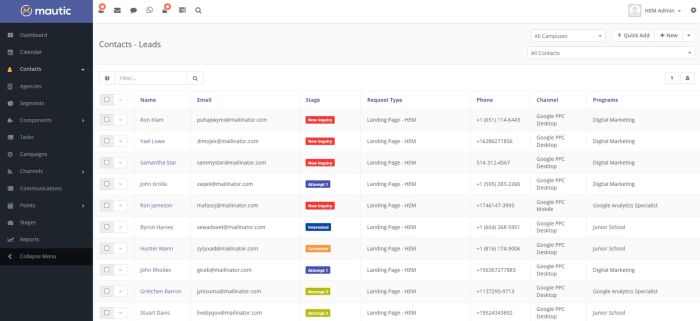
Example: Do you see how centralizing prospect information helps you track the effectiveness of your campaigns and determine the next step in the enrollment funnel? Here, prospects are categorized by their current stage in the enrollment process, their program of interest, the channel through which they first interacted with your institution, and what sort of contact they are. That’s all the information you need to craft an appropriate and compelling follow-up message tailored to each unique responsibility. Mautic helps you with that part too!
In addition, Mautic by HEM’s marketing automation tools enable you to scale up your email marketing, create dynamic landing pages, design forms, and automate workflows. This allows your institution to maintain a high level of personalized engagement with prospects across multiple channels, thereby improving your reach and effectiveness in digital recruitment.
The solution’s custom reporting features also give you detailed insights into your admissions pipeline. With Mautic by HEM, you can monitor productivity, track lead progress, and evaluate channel performance, which will help you refine your approach and allocate resources to high-impact activities.
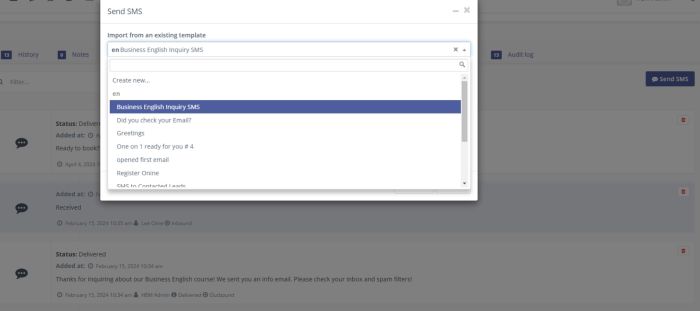
Ensuring timely follow-up is essential for converting leads to students, and Mautic by HEM enables automated SMS and email follow-ups, allowing you to communicate with leads through their preferred channels. Whether it’s sending reminders, booking meetings, or making calls, Mautic by HEM has the tools your team needs to maintain a consistent communication flow.
Source: Mautic | HEM
Example: Viewing the contact history for each prospect lets you know how they prefer to communicate. In addition to other vital data such as name and contact information, you can craft a highly personalized message such as the SMS pictured above.
Finally, Mautic by HEM also helps your team manage their daily tasks and workload. With integrated calendars, workflow assignments, and productivity tracking, your staff can stay organized and focused on what matters most—building relationships and driving enrollments.
Why You Need an SIS for Your School
Now, what is a Student Information System (SIS)?Student Information System software is designed to manage student data from application through graduation. An SIS handles everything from enrollment and class scheduling to academic records and financial management. This centralized database makes it easy for staff to track student progress and streamline administrative tasks.
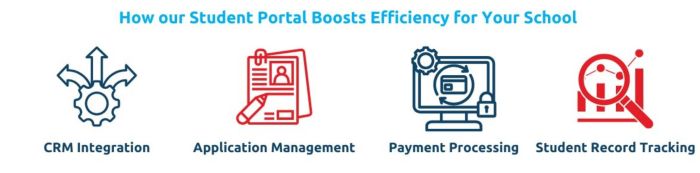
HEM’s Student Portal integrates CRM and SIS functionalities to provide an all-in-one admissions and student management platform. Tailored to meet the demands of educational institutions, the portal includes tools for application management, payment processing, and student record tracking. This integrated solution enables institutions to centralize and simplify operations, allowing your staff to focus on building meaningful relationships with prospective and current students.
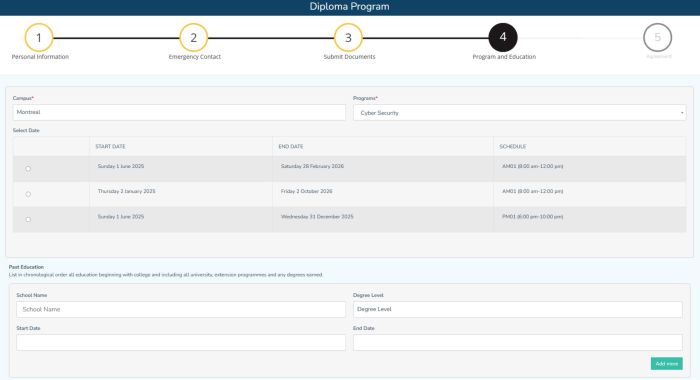
HEM’s Student Portal takes SIS integration to a new level, offering an all-encompassing admissions and student management system designed specifically for educational institutions. The Student Portal simplifies the application process, offering a virtual admissions assistant that guides students from start to finish. Students can inquire, apply, pay, and even enroll through an easy-to-use interface.
Source: Student Portal | HEM
Example: A customized Student Portal will guide students through your application process from initial form submission to payment in a user-friendly format as pictured above.
Customizable forms and a centralized management system make it easy for your staff to track applications, ensuring nothing falls through the cracks. Additionally, the portal seamlessly integrates with Mautic by HEM, allowing you to manage marketing and admissions in one place. By streamlining communication and automating workflows, this system supports your institution’s goals for efficiency and high-quality engagement with prospective students.
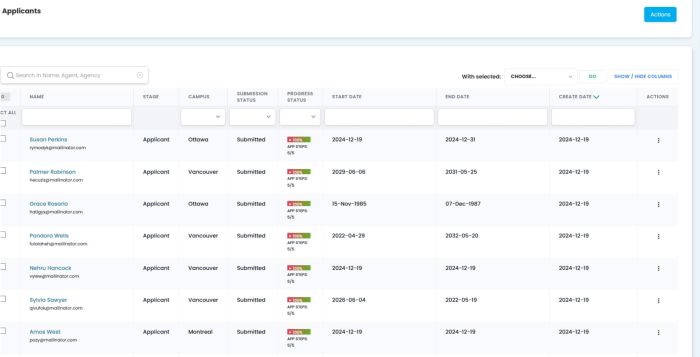
The Student Portal allows for comprehensive data management, tracking all aspects of student data from initial inquiry to graduation. With detailed records and customizable reports, your team can monitor application status, manage payment processing, and keep detailed academic records, providing staff with a complete view of each student’s journey.
Source: Student Portal | HEM
Example: Here, you can see our centralized application management system. See all incoming applications and determine which applications were started and not completed. In addition, the Student Portal platform allows you to track prospects based on name, program, whether they’ve been sent an invoice, and whether that invoice has been paid. This information is valuable as it clarifies the next step for each contact.
Furthermore, the portal’s quote builder tool allows prospective students to calculate program costs, offering them a transparent view of financial requirements. This provides clarity and builds trust, making it easier for students and their families to plan for the financial aspects of their education.
Designed to improve efficiency across all departments, the Student Portal facilitates better collaboration by centralizing data and providing tools for managing projects and tracking progress. This comprehensive approach allows staff to work towards strategic institutional goals, fostering a collaborative environment that drives both student success and institutional growth.
Experience the HEM Advantage: Efficiency
Mautic by HEM and the HEM Student Portal offer transformative CRM and SIS solutions that empower educational institutions to work smarter, not harder. By combining lead management, marketing automation, admissions tracking, and student data management, HEM’s tools create a cohesive system designed to meet the unique needs of schools. That’s what we accomplished for Micheal Vincent Academy.
Founded by Tally B. Hajek, a multi-talented recording artist and makeup artist, and her husband Michael Vincent, a renowned celebrity photographer, MVA teaches around 350 students annually. Each student gains expert instruction and builds a professional portfolio, launching them toward successful careers in beauty and media.
MVA sought an organized, streamlined solution to manage its student recruitment efforts, and they found the answer in Mautic by HEM. This customized CRM software, specifically tailored for educational institutions, allows MVA to efficiently automate its marketing efforts and seamlessly follow up with prospective students.
Transformative Results for a Thriving Institution
With Mautic, MVA’s team can now easily track and manage leads. The CRM’s powerful reporting tools give the academy a clear view of each lead’s journey through the admissions process. Staff can track the progress of every prospective student, monitor recruitment team activities, and measure productivity—all crucial for a private institution focused on cost-effective outreach. Furthermore, the lead-scoring feature in Mautic enables the recruitment team to identify and prioritize high-value leads, allowing MVA to concentrate on students who are genuinely interested and likely to succeed within the academy’s creative programs.
As Tally Hajek highlights, the organizational capabilities of Mautic are essential to building meaningful connections with prospective students. “We value connections with prospective students, but connections cannot happen without organization,” she explains. The system enables her team to foster relationships with students who are both committed and well-suited to the academy’s professional and artistic environment.
Moreover, HEM’s attentive and supportive customer service has made the partnership especially rewarding. “We love working with the HEM team,” says Hajek. “We feel like they really understand us and want us to succeed.” With HEM’s customized solutions, MVA has significantly increased staff efficiency in student recruitment, giving their team the tools to excel in a competitive educational market and helping the academy continue to thrive as a leader in beauty and media education.
Imagine a system that handles every step of the student journey—engaging prospective students, nurturing leads, simplifying applications, and supporting students through their academic journey—all from a single platform. HEM is dedicated to providing solutions that help you enhance recruitment, boost enrollment, and offer the seamless digital experience that students expect.
To see how Mautic and the HEM Student Portal can transform your institution, request a demo today and discover the possibilities of giving yourself the gift of efficiency.
Give Yourself the Gift of Efficiency
This holiday season, give your institution the ultimate gift: the power to work smarter, not harder. HEM’s custom-built solutions, including Mautic CRM and the HEM Student Portal, are designed to streamline your operations and boost your team’s effectiveness.
From managing prospective student leads to enhancing engagement and improving communication, these tools empower your staff to focus on what truly matters—building connections and driving success.
Simplify student management and boost recruitment efficiency!
Transform your student portal experience. Get a FREE HEM-SP demo today.
FAQ
Question: What is a CRM and how can it benefit educational institutions?
Answer: A CRM, or Customer Relationship Management system, is a platform that helps organizations manage and analyze customer interactions and data throughout the customer lifecycle.
Question: What is a Student Information System (SIS)?
Answer: Student Information System software is designed to manage student data from application through graduation.