New media center at North Dade Middle School marks milestone in initiative revitalizing learning environments to benefit the entire learning community
GREENVILLE, WI– November 21, 2025 –School Specialty and the College Football Playoff (CFP) Foundation today announced the completion of a media center makeover at North Dade Middle School, marking the 100th learning space transformed in collaboration with the Extra Yard Makeover initiative. As a part of their nationwide effort to enhance learning environments for students and educators alike, the two organizations have now invested over $5 million into reinvigorating classrooms across the country.
Miami will host the 2026 College Football Playoff National Championship in January, and as part of its legacy work in the community, the CFP Foundation has committed to delivering more than 30 Extra Yard Makeovers alongside School Specialty to revitalize innovation spaces across schools in Miami-Dade, Broward and Palm Beach counties. With this latest round of makeovers, the CFP Foundation will have helped enrich learning environments in every Miami-Dade middle school.
“Changing our middle school libraries into modern learning spaces has had a tremendous impact on engagement and learning outcomes,” said Dr. Jose L. Dotres, Superintendent of Miami-Dade County Public Schools. “In addition to renovation, the transformation is an investment in our teachers, our students and our future. These new innovative spaces support hands-on learning for students of today and tomorrow, so they can develop greater curiosity for learning and lifelong skills.”
These makeovers transform static spaces into flourishing learning environments, providing upgrades like flexible furniture, technology, supplies and even fresh paint or murals. Each school receives the School Specialty proprietary Projects by DesignⓇ experience, which includes comprehensive consultations to determine the type of space that best supports students, educators and the broader school community. Past rooms made over include STEM labs, broadcast classrooms, libraries, media centers, makerspace rooms, teachers lounges, wellness spaces, sensory rooms, multi-purpose rooms, an esports room and a mariachi room.
“The transformation of our media center is truly invaluable to our students and staff,” said Nicole Fama, Executive Director at Phalen Leadership Academies, which received a makeover in 2024. “We are profoundly grateful to the College Football Playoff Foundation and School Specialty for this investment. Before the media center, we lacked a space that truly fostered community. Now, everything happens here—from senior breakfasts and college athlete signing days to family game nights and teacher appreciation events. It has become the heart of our community, a space we didn’t realize we needed until it was here.”
These makeovers serve to benefit both students and teachers, allowing schools to improve their offerings, inspire innovation and modern learning, and directly counter some of the top issues in education today.
“Addressing teacher burnout and maximizing student engagement starts with the physical environment,” said Jeremy Westbrooks, Director of Strategic Account Development at School Specialty. “The physical classroom is an educator’s primary tool, and by modernizing these spaces, the CFP Foundation and School Specialty are delivering a critical resource that empowers teachers to stay focused on their students’ growth and long-term success.”
“We’re proud to work alongside School Specialty to bring these meaningful makeover projects to life,” said Britton Banowsky, Executive Director College Football Playoff Foundation. “Their expertise in the design of the spaces and incredible generosity make it possible for us to turn vision into impact for teachers and students.”
In addition to the CFP Foundation and School Specialty, these makeovers have been supported over the years by Bowl Games, Conference partners, Sponsors and host committees of each College Football Playoff National Championship. To date, makeovers have taken place in 18 states across 58 counties.
To learn more about the College Playoff Foundation’s Extra Yard Makeover initiative, click here.
With a 60-year legacy, School Specialty is a leading provider of comprehensive learning environment solutions for the infant-K12 education marketplace in the U.S. and Canada. This includes essential classroom supplies, furniture and design services, educational technology, sensory spaces featuring Snoezelen, science curriculum, learning resources, professional development, and more. School Specialty believes every student can flourish in an environment where they are engaged and inspired to learn and grow. In support of this vision to transform more than classrooms, the company applies its unmatched team of education strategists and designs, manufactures, and distributes a broad assortment of name-brand and proprietary products. For more information, go to SchoolSpecialty.com.
About the College Football Playoff Foundation
The College Football Playoff (CFP) Foundation is the 501(c)3 non-profit organization serving as the community engagement arm of the College Football Playoff and works in partnership with institutions of higher education, sports organizations, corporations and non-profits to support educators and improve student outcomes. The purpose of the CFP Foundation lies in supporting PK-12 education by elevating the teaching profession. The CFP Foundation inspires and empowers educators by focusing its work in four areas: recognition, resources, recruitment and retention, and professional development. To learn more, visit cfp-foundation.org and follow Extra Yard for Teachers (@CFPExtraYard) on social media.
eSchool Media staff cover education technology in all its aspects–from legislation and litigation, to best practices, to lessons learned and new products. First published in March of 1998 as a monthly print and digital newspaper, eSchool Media provides the news and information necessary to help K-20 decision-makers successfully use technology and innovation to transform schools and colleges and achieve their educational goals.
US News & World Report released its latest ranking of public elementary schools. The results exposed the key component to student success, even if the topmost schools approached it in vastly different ways.
For New York City, Lower Lab, an Upper East Side Gifted & Talented school was ranked number one by US News. Also in the top 10 were four citywide G&T programs. Each school exclusively accepts students who have been designated as “gifted.”
Rounding out the top 10, however, are Success Academy – Bushwick and Success Academy – Bensonhurst, public charter schools that accept students by lottery, while also prioritizing English Language Learners (ELL).
On the surface, these schools couldn’t be more different. Number one, Lower Lab, has only 13% of students qualifying for Free or Reduced Price Lunch (FRL), and 1% ELLs. Number 10, Success Academy Charter School – Bensonhurst, conversely, has 65% of its students qualifying for free or reduced price lunch, and 26% who are English language learners.
But the selective G&T schools and the unscreened charter schools have one characteristic in common: An expectation that their students can succeed.
At the end of the year, the “students that were chosen were more likely to make larger gains in their academic performance,” with those “7-8 years old gaining an average of 10 verbal IQ points.”
This study concluded that “when teachers expected certain children would show greater intellectual development, those children did show greater intellectual development.”
At the G&T schools, teachers have every reason to believe their students are capable of performing at the highest levels.
Parents have seen this firsthand.
“I strongly believe that when teachers are told their students are gifted, they begin to treat them as gifted — and this changes everything,” asserts mom Natalya Tseytlin. “In a gifted classroom, if a student struggles, teachers don’t assume it’s because of laziness or inability; they respond with patience and extra attention. In a regular class, that student might not receive the same support or challenge, because the teacher sees the child as average.
Tseytlin said her son started his first grade gifted and talented program with limited English skills. But because his teacher offered consistent support and believed in him, he excelled.
“Today he is performing at the same level as his peers,” she said.
“I don’t think the expectations at (my child’s) G&T school are so high that only gifted kids can meet them,” another parent, who only asked to be identified as M.K. opined. “Regular schools don’t ‘push’ kids enough to reach their potential. Those G&T schools that do push, get results because most kids are capable of this level of learning without being ‘gifted.’ If teachers treat students as capable, students will indeed meet expectations.”
The belief that all students can perform at a “gifted” level is sacrosanct at Success Academy.
“Success Academy is Gifted for All,” CEO Eva Moskowitz affirms. “When adult expectations are high, our scholars — mostly low-income, Black and Hispanic — can meet the highest academic standards.”
The same is true at Harlem Academy, a kindergarten through 8th grade private school for students whose potential might otherwise go unrealized.
“It’s tough to decouple the influence of high-quality programming from high expectations,” concedes Head of School Vinny Dotoli, “but authentically challenging students is central to the ethos of our school. When great teachers set ambitious goals and provide the structure and support to reach them, it almost always makes a lasting difference in student achievement.”
Parents with children in schools where high expectations aren’t the norm would love to see changes.
“I have a daughter in a dual language program in East Harlem,” Maria McCune relates. “A neighbor who used to attend our school changed his daughter to a G&T program at another school in East Harlem. He immediately noticed a difference in the quality of instruction and in his daughter’s performance (MUCH improved). I participate in my daughter’s School Leadership Team and I have seen the apathy teachers there exhibit. It is concerning. When I tried to provide feedback about improving the educational experience, teachers/staff often became defensive. It is this that leads me to want to pursue G&T for my daughter.”
For Tiffany Ma, the solution is obvious. “Our second grader that transferred into G&T writes much neater and does her homework much more happily since she’s in an environment where academics and homework is valued by other classmates and parents. We should expand G&T programs. It’s regular programming that shouldn’t exist.”
Yet New York City seems headed in the opposite direction. Mayor-Elect Zohran Mamdani has vowed to get rid of elementary school G&T programs that begin in kindergarten. He would wait until students enter third grade, even though the research referenced above specifically mentioned children 7 and 8 years of age( i.e. second graders), as being the biggest beneficiaries of high expectations. He is against charter schools, as well.
This move would lower the academic standards and expectations of all schools, which deeply concerns parents like McCune. She fears “Children like my daughter may be left as collateral damage of an educational experience that falls short of setting them up for significant academic success.”
The top schools in NYC have repeatedly demonstrated that high expectations are key to helping all students reach their full potential.
We need more such schools, be they public G&T, charter, or private. And more teachers who believe in all our kids.
Did you use this article in your work?
We’d love to hear how The 74’s reporting is helping educators, researchers, and policymakers. Tell us how
When I first stepped into my role overseeing student data for the Campbell County School District, it was clear we were working against a system that no longer served us.
At the time, we were using an outdated platform riddled with data silos and manual processes. Creating school calendars and managing student records meant starting from scratch every year. Grade management was clunky, time-consuming, and far from efficient. We knew we needed more than a patchwork fix–we needed a unified student information system that could scale with our district’s needs and adapt to evolving state-level compliance requirements.
Over the past several years, we have made a full transition to digitizing our most critical student services, and the impact has been transformational. As districts across the country navigate growing compliance demands and increasingly complex student needs, the case for going digital has never been stronger. We now operate with greater consistency, transparency, and equity across all 12 of our schools.
Here are four ways this shift has improved how we support students–and why I believe it is a step every district should consider:
How centralized student data improves support across K-12 schools
One of the most powerful benefits of digitizing critical student services is the ability to centralize data and ensure seamless support across campuses. In our district, this has been a game-changer–especially for students who move between schools. Before digitization, transferring student records meant tracking down paper files, making copies, and hoping nothing was lost in the shuffle. It was inefficient and risky, especially for students who required health interventions or academic support.
Now, every plan, history, and record lives in a single, secure system that follows the student wherever they go. Whether a student changes schools mid-year or needs immediate care from a nurse at a new campus, that information is accessible in real-time. This level of continuity has improved both our efficiency and the quality of support we provide. For districts serving mobile or vulnerable populations, centralized digital systems aren’t just convenient–they’re essential.
Building digital workflows for student health, attendance, and graduation readiness
Digitizing student services also enables districts to create customized digital workflows that significantly enhance responsiveness and efficiency. In Campbell County, we have built tools tailored to our most urgent needs–from health care to attendance to graduation readiness. One of our most impactful changes was developing unified, digital Individualized Health Plans (IHPs) for school nurses. Now, care plans are easily accessible across campuses, with alerts built right into student records, enabling timely interventions for chronic conditions like diabetes or asthma. We also created a digital Attendance Intervention Management (AIM) tool that tracks intervention tiers, stores contracts and communications, and helps social workers and truancy officers make informed decisions quickly.
These tools don’t just check boxes–they help us act faster, reduce staff workload, and ensure no student falls through the cracks.
Digitization supports equitable and proactive student services
By moving our student services to digital platforms, we have become far more proactive in how we support students–leading to a significant impact on equity across our district. With digital dashboards, alerts, and real-time data, educators and support staff can identify students who may be at risk academically, socially, or emotionally before the situation becomes critical.
These tools ensure that no matter which school a student attends–or how often they move between schools–they receive the same level of timely, informed support. By shifting from a reactive to a proactive model, digitization has helped us reduce disparities, catch issues early, and make sure that every student gets what they need to thrive. That’s not just good data management–it’s a more equitable way to serve kids.
Why digital student services scale better than outdated platforms
One of the most important advantages of digitizing critical student services is building a system that can grow and evolve with the district’s needs. Unlike outdated platforms that require costly and time-consuming overhauls, flexible digital systems are designed to adapt as demands change. Whether it’s integrating new tools to support remote learning, responding to updated state compliance requirements, or expanding services to meet a growing student population, a digitized infrastructure provides the scalability districts need.
This future-proofing means districts aren’t locked into rigid processes but can customize workflows and add modules without disrupting day-to-day operations. For districts like ours, this adaptability reduces long-term costs and supports continuous improvement. It ensures that as challenges evolve–whether demographic shifts, policy changes, or new educational priorities–our technology remains a reliable foundation that empowers educators and administrators to meet the moment without missing a beat.
Digitizing critical student services is more than a technical upgrade–it’s a commitment to equity, efficiency, and future readiness. By centralizing data, customizing workflows, enabling proactive support, and building scalable systems, districts can better serve every student today and adapt to whatever challenges tomorrow may bring.
Sara Douglas, Campbell County Schools
Sara Douglas is the District Data Leader for Campbell County Schools in Jacksboro, Tennessee.
Latest posts by eSchool Media Contributors (see all)
by Bianca Vázquez Toness, The Hechinger Report November 18, 2025
This story was produced by the Associated Press and reprinted with permission.
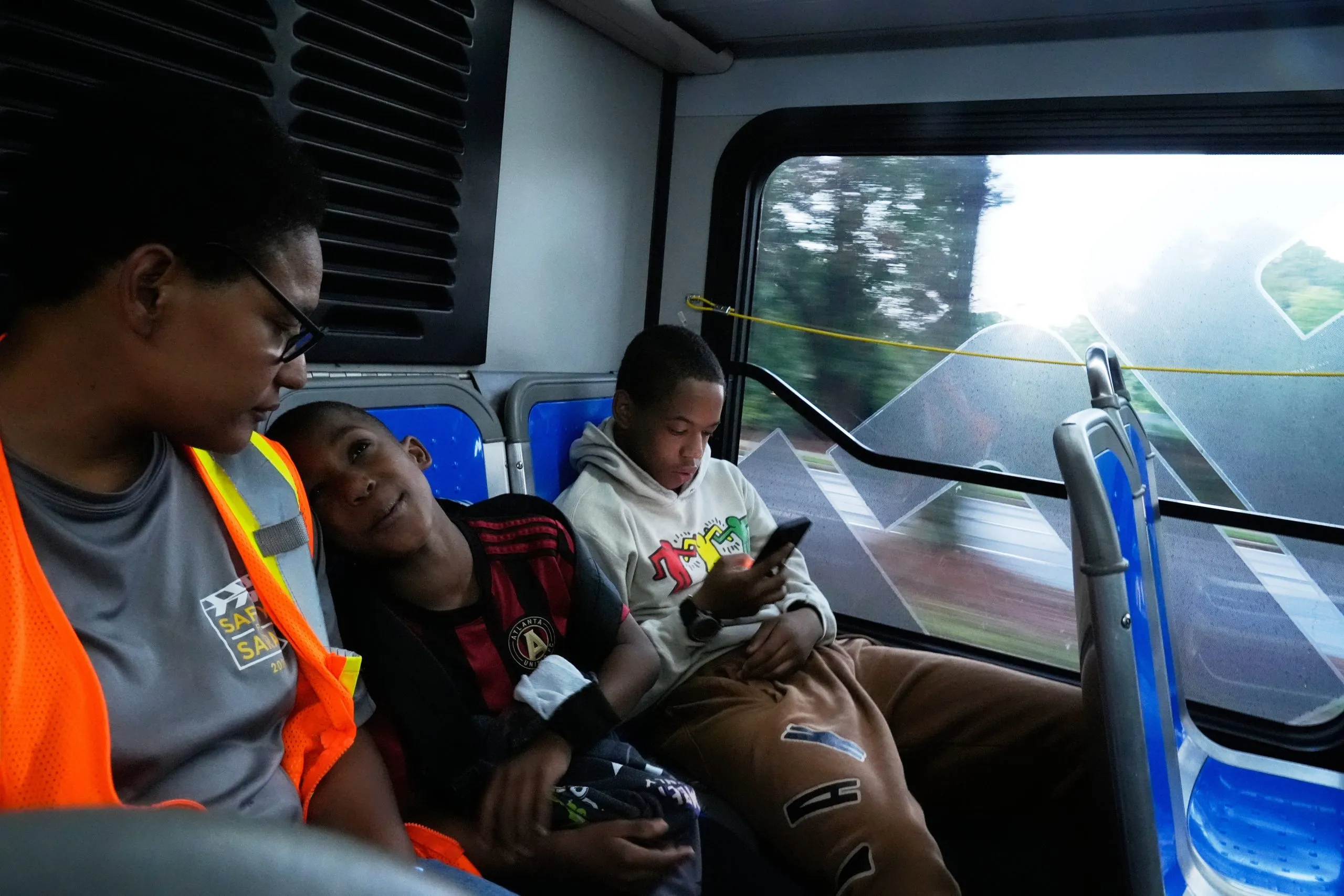
ATLANTA — It was the worst summer in years. Sechita McNair’s family took no vacations. Her younger boys didn’t go to camp. Her van was repossessed, and her family nearly got evicted — again.
But she accomplished the one thing she wanted most. A few weeks before school started, McNair, an out-of-work film industry veteran barely getting by driving for Uber, signed a lease in the right Atlanta neighborhood so her eldest son could stay at his high school.
As she pulled up outside the school on the first day, Elias, 15, stepped onto the curb in his new basketball shoes and cargo pants. She inspected his face, noticed wax in his ears and grabbed a package of baby wipes from her rental car. She wasn’t about to let her eldest, with his young Denzel Washington looks, go to school looking “gross.”
He grimaced and broke away.
“No kiss? No hugs?” she called out.
Elias waved and kept walking. Just ahead of him, at least for the moment, sat something his mother had fought relentlessly for: a better education.
The link between where you live and where you learn
Last year, McNair and her three kids were evicted from their beloved apartment in the rapidly gentrifying Old Fourth Ward neighborhood of Atlanta. Like many evicted families, they went from living in a school district that spends more money on students to one that spends less.
Thanks to federal laws protecting homeless and evicted students, her kids were able to keep attending their Atlanta schools, even though the only housing available to them was in another county 40 minutes away. They also had the right to free transportation to those schools, but McNair says the district didn’t tell her about that until the school year ended. Their eligibility to remain in those schools expired at the end of last school year.
Still wounded by the death of his father and multiple housing displacements, Elias failed two classes last year, his freshman year. Switching schools now, McNair fears, would jeopardize any chance he has of recovering his academic life. “I need this child to be stable,” she says.
Related: Become a lifelong learner. Subscribe to our free weekly newsletter featuring the most important stories in education.
With just one week before school started, McNair drove extra Uber hours, borrowed money, secured rental assistance and ignored concerns about the apartment to rent a three-bedroom in the Old Fourth Ward. At $2,200 a month, it was the only “semi-affordable” apartment in the rapidly gentrifying ward that would rent to a single mom with a fresh eviction on her record.
On Zillow, the second-floor apartment, built in 2005, looked like a middle-class dream with its granite countertops, crown molding and polished wood floors. But up close, the apartment looked abused and held secrets McNair was only beginning to uncover.
The first sign something was wrong came early. When she first toured the apartment, it felt rushed, like the agent didn’t want her to look too closely. Then, even as they told her she was accepted, the landlord and real estate agent wouldn’t send her a “welcome letter” laying out the agreement, the rent and deposit she would pay. It seemed like they didn’t want to put anything in writing.
When the lease came, it was full of errors. She signed it anyway. “We’re back in the neighborhood!” she said. Elias could return to Midtown High School.
But even in their triumph, no one in the family could relax. Too many things were uncertain. And it fell to McNair — and only McNair — to figure it out.
The first day back
Midtown is a high school so coveted that school administrators investigate student residency throughout the year to keep out kids from other parts of Atlanta and beyond. For McNair, the day Elias returned to the high school was a momentous one.
“Freedom!” McNair declared after Elias disappeared into the building. Without child care over the summer, McNair had struggled to find time to work enough to make ends meet. Now that the kids were back in class, McNair could spend school hours making money and resolving some of the unsettled issues with her new apartment.
McNair, the first person in her family to attend college, studied theater management. Her job rigging stage sets was lucrative until the writers’ and actors’ strike and other changes paralyzed the film industry in 2023. The scarcity of work on movie sets, combined with her tendency to take in family and non-family alike, wrecked her home economy.
The family was evicted last fall when McNair fell behind on rent because of funeral expenses for her foster daughter. The teen girl died from an epileptic seizure while McNair and everyone else slept. Elias found her body.
McNair attributes some of Elias’s lack of motivation at school to personal trauma. His father died after a heart attack in 2023, on the sidelines of Elias’s basketball practice.
On his first day back at school this August, Elias appeared excited but tentative. He watched as the seniors swanned into school wearing gold cardboard crowns, a Midtown back-to-school tradition, and scanned the sidewalk for anyone familiar.
If Elias had his way, his mom would homeschool him. She’s done it before. But now that he’s a teenager, it’s harder to get Elias to follow her instructions. As the only breadwinner supporting three kids and her disabled uncle, she has to work.
Elias hid from the crowds and called up a friend: “Where you at?” The friend, another sophomore, was still en route. Over the phone, they compared outfits, traded gossip about who got a new hairdo or transferred. When Elias’s friend declared this would be the year he’d get a girlfriend, Elias laughed.
When it was time to go in, Elias drifted toward the door with his head down as other students flooded past.
The after-school pickup
Hours later, he emerged. Despite everything McNair had done to help it go well — securing the apartment, even spending hundreds of dollars on new clothes for him — Elias slumped into the backseat when she picked him up after class.
“School was so boring,” he said.
“What happened?” McNair asked.
“Nothing, bro. That was the problem,” Elias said. “I thought I was going to be happy when school started, since summer was so horrible.”
Of all of the classes he was taking — geometry, gym, French, world history, environmental science — only gym interested him. He wished he could take art classes, he said. Elias has acted in some commercials and television programs, but chose a science and math concentration, hoping to study finance someday.
After dinner at Chick-fil-A, the family visited the city library one block from their new apartment. While McNair spoke to the librarian, the boys explored the children’s section. Malachi, 6, watched a YouTube video on a library computer while Derrick, 7, flipped through a book. Elias sat in a corner, sharing video gaming tips with a stranger he met online.
“Those people are learning Japanese,” said McNair, pointing to a group of adults sitting around a cluster of tables. “And this library lets you check out museum passes. This is why we have to be back in the city. Resources!”
McNair wants her children to go to well-resourced schools. Atlanta spends nearly $20,000 per student a year, $7,000 more than the district they moved to after the eviction. More money in schools means smaller classrooms and more psychologists, guidance counselors and other support.
But McNair, who grew up in New Jersey near New York City, also sees opportunities in the wider city of Atlanta. She wants to use its libraries, e-scooters, bike paths, hospitals, rental assistance agencies, Buy Nothing groups and food pantries.
“These are all resources that make it possible to raise a family when you don’t have support,” she said. “Wouldn’t anyone want that?”
Support is hard to come by
On the way home, the little boys fall asleep in the back seat. Elias asks, “So, is homeschooling off the table?”
McNair doesn’t hesitate. “Heck yeah. I’m not homeschooling you,” she says lightly. “Do you see how much of a financial bind I’m in?”’
McNair pulls into the driveway in Jonesboro, the suburb where the family landed after their eviction. Even though the family wants to live in Atlanta, their stuff is still here. It’s a neighborhood of brick colonials and manicured lawns. She realizes it’s the dream for some families, but not hers. “It’s a support desert.”
As they get out of the car, Elias takes over as parent-in-charge. “Get all of your things,” he directs Malachi and Derrick, who scowl as Elias seems to relish bossing them around. “Pick up your car seats, your food, those markers. I don’t want to see anything left behind.” Elias would be responsible for making the boys burritos, showering them and putting them to sleep.
McNair heads out to drive for Uber. That’s what is necessary to pay $450 a week to rent the car and earn enough to pay her rent and bills.
But while McNair is out, she can’t monitor Elias. And a few days after he starts school, Elias’s all-night gaming habit has already drawn teachers’ attention.
“I wanted to check in regarding Elias,” his geometry teacher writes during the first week of school. “He fell asleep multiple times during Geometry class this morning.”
Elias had told the teacher he went to bed around 4 a.m. the night before. “I understand that there may be various reasons for this, and I’d love to work together to support Elias so he can stay focused and successful in class.”
A few days later, McNair gets a similar email from his French teacher.
That night, McNair drives around Atlanta, trying to pick up enough Uber trips to keep her account active. But she can’t stop thinking about the emails. “I should be home making sure Elias gets to bed on time,” she says, crying. “But I have to work. I’m the only one paying the bills.”
Obstacles keep popping up
Ever since McNair rented the Atlanta apartment, her bills had doubled. She wasn’t sure when she’d feel safe giving up the house she’d been renting in Clayton County, given the problems with the Atlanta apartment. For starters, she was not even sure it was safe to spend the night there.
A week after school started in August, McNair dropped by the apartment to check whether the landlords had made repairs. At the very least, she wanted more smoke detectors.
She also wanted them to replace the door, which looked like someone had forced it open with a crowbar. She wanted a working fridge and oven. She wanted them to secure the back door to the adjoining empty apartment, which appeared to be open and made her wonder if there were pests or even people squatting there.
But on this day, her keys didn’t work.
She called 911. Had her new landlords deliberately locked her out?
When the police showed up outside the olive-green, Craftsman-style fourplex, McNair scrolled through her phone to find a copy of her lease. Then McNair and the officer eyed a man walking up to the property. “The building was sold in a short sale two weeks ago,” he told McNair. The police officer directed the man to give the new keys to McNair.
The next day, McNair started getting emails from an agent specializing in foreclosures, suggesting the new owners wanted McNair to leave. “The bank owns the property and now you are no longer a tenant of the previous owner,” she wrote. The new owner “might” offer relocation assistance if McNair agreed to leave.
McNair consulted attorneys, who reassured her: It might be uncomfortable, but she could stay. She needed to try to pay rent, even if the new owner didn’t accept it.
So McNair messaged the agent, asking where she should send the rent, and requested the company make necessary repairs. Eventually, the real estate agent stopped responding.
Some problems go away, but others emerge
Finally, McNair moved her kids and a few items from the Jonesboro house to the Atlanta apartment. She didn’t allow Elias to bring his video game console to Atlanta. He started going to bed around 11 p.m. most nights. But even as she solved that problem, others emerged.
It was at Midtown’s back-to-school night in September that McNair learned Elias was behind in most of his classes. Some teachers said maybe Midtown wasn’t the right school for Elias.
Perhaps they were right, McNair thought. She’d heard similar things before.
Elias also didn’t want to go to school. He skipped one day, then another. McNair panicked. In Georgia, parents can be sent to jail for truancy when their kids miss five unexcused days.
McNair started looking into a homeschooling program run by a mother she follows on Facebook. In the meantime, she emailed and called some Midtown staff for advice. She says she didn’t get a response. Finally, seven weeks after the family’s triumphant return to Midtown, McNair filed papers declaring her intention to homeschool Elias.
It quickly proved challenging. Elias wouldn’t do any schoolwork when he was home alone. And when the homeschooling group met twice a week, she discovered, they required parents to pick up their children afterward instead of allowing them to take public transit or e-scooters. That was untenable.
Elias wanted to stay at home and offered to take care of McNair’s uncle, who has dementia. “That was literally killing my soul the most,” said McNair. “That’s not a child’s job.”
Hell, no, she told him — you only get one chance at high school.
Then, one day, while she was loading the boys’ clothes into the washing machine at the Atlanta apartment, she received a call from an unknown Atlanta number. It was the woman who heads Atlanta Public Schools’ virtual program, telling her the roster was full.
McNair asked the woman for her opinion on Elias’s situation. Maybe she should abandon the Atlanta apartment and enroll him in the Jonesboro high school.
Let me stop you right there, the woman said. Is your son an athlete? If he transfers too many times, it can affect his ability to play basketball. And he’d probably lose credits and take longer to graduate. He needs to be in school — preferably Midtown — studying for midterms, she said. You need to put on your “big mama drawers” and take him back, she told McNair.
The next day, Elias and his mother pulled up to Midtown. Outside the school, Elias asked if he had to go inside. Yes, she told him. This is your fault as much as it’s mine.
Now, with Elias back in school every day, McNair can deliver food through Uber Eats without worrying about a police officer asking why her kid isn’t in school. If only she had pushed harder, sooner, for help with Elias, she thought. “I should have just gone down to the school and sat in their offices until they talked to me.”
But it was easy for her to explain why she hadn’t. “I was running around doing so many other things just so we have a place to live, or taking care of my uncle, that I didn’t put enough of my energy there.”
She wishes she could pay more attention to Elias. But so many things are pulling at her. And as fall marches toward winter, her struggle continues. After failing to keep up with the Jonesboro rent, she’s preparing to leave that house before the landlord sends people to haul her possessions to the curb.
As an Uber driver, she has picked up a few traumatized mothers with their children after they got evicted. She helped them load the few things they could fit into her van. As they drove off, onlookers scavenged the leftovers.
She has promised herself she’d never let that happen to her kids.
Bianca Vázquez Toness is an Associated Press reporter who writes about the continuing impact of the pandemic on young people and their education.
The Associated Press’ education coverage receives financial support from multiple private foundations. AP is solely responsible for all content. Find AP’s standards for working with philanthropies, a list of supporters and funded coverage areas at AP.org.
This <a target=”_blank” href=”https://hechingerreport.org/she-wanted-to-keep-her-son-in-his-school-district-it-was-more-challenging-than-it-seemed/”>article</a> first appeared on <a target=”_blank” href=”https://hechingerreport.org”>The Hechinger Report</a> and is republished here under a <a target=”_blank” href=”https://creativecommons.org/licenses/by-nc-nd/4.0/”>Creative Commons Attribution-NonCommercial-NoDerivatives 4.0 International License</a>.<img src=”https://i0.wp.com/hechingerreport.org/wp-content/uploads/2018/06/cropped-favicon.jpg?fit=150%2C150&ssl=1″ style=”width:1em;height:1em;margin-left:10px;”>
This article is part of Bright Spots, a series highlighting schools where every child learns to read, no matter their zip code. Explore the Bright Spots map to find out which schools are beating the odds in terms of literacy versus poverty rates.
This story is part of The 74’s special coverage marking the 65th anniversary of the Los Angeles Unified School District. Read all our stories here.
When The 74 started looking for schools that were doing a good job teaching kids to read, we began with the data. We crunched the numbers for nearly 42,000 schools across all 50 states and Washington, D.C. and identified 2,158 that were beating the odds by significantly outperforming what would be expected given their student demographics.
Seeing all that data was interesting. But they were just numbers in a spreadsheet until we decided to map out the results. And that geographic analysis revealed some surprising findings.
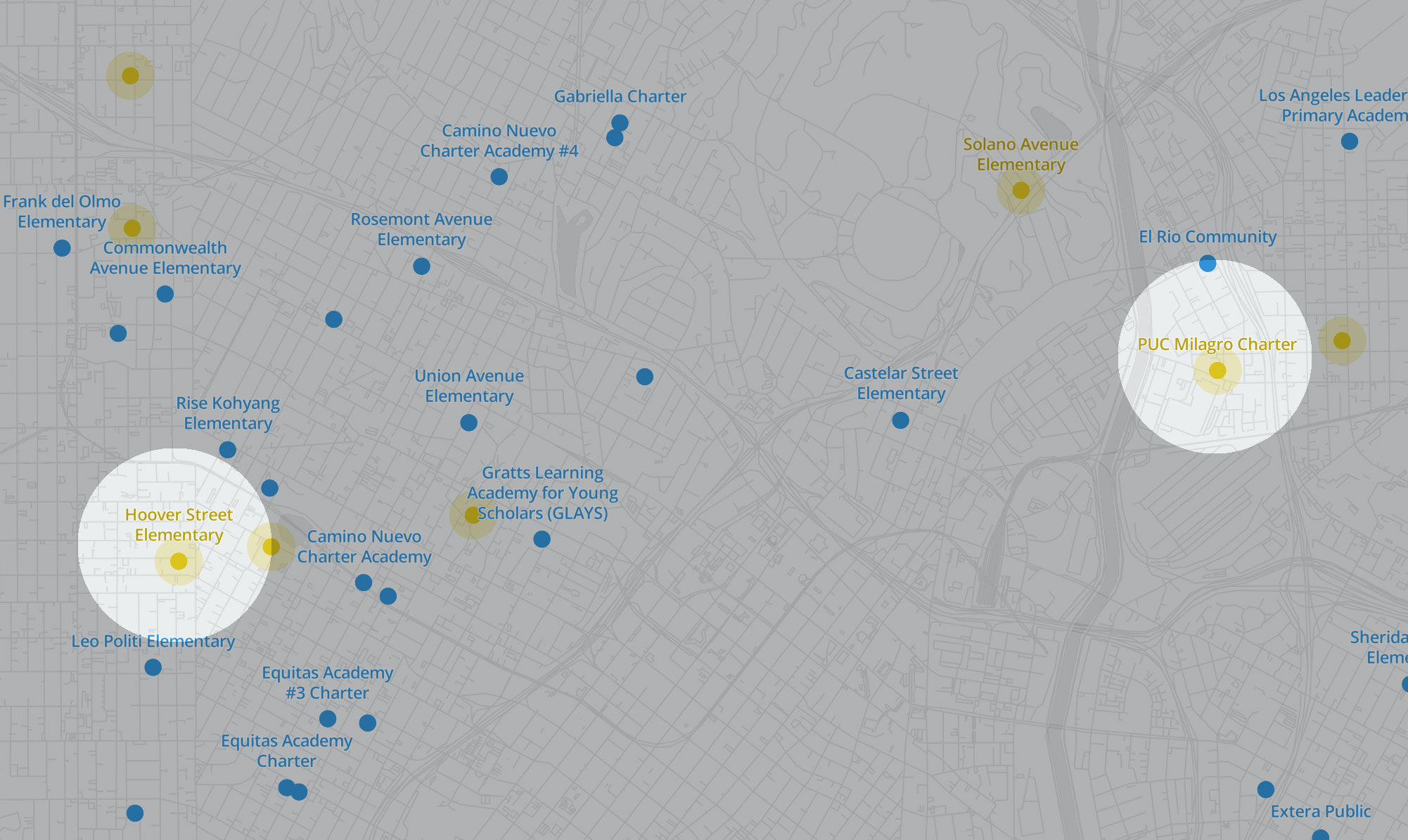
For example, we found that, based on our metrics, two of the three highest-performing schools in California happened to be less than 5 miles apart from each other in Los Angeles.
The PUC Milagro Charter School came out No. 1 in the state of California. With 91% of its students in poverty, our calculations projected it would have a third grade reading rate of 27%. Instead, 92% of its students scored proficient or above. Despite serving a high-poverty student population, the school’s literacy scores were practically off the charts.
PUC Milagro is a charter school, and charters tended to do well in our rankings. Nationally, they made up 7% of all schools in our sample but 11% of those that we identified as exceptional.
But some district schools are also beating the odds. Just miles away from PUC Milagro is our No. 3-rated school in California, Hoover Street Elementary. It is a traditional public school run by the Los Angeles Unified School District. With 92% of its students qualifying for free- or reduced-price lunch, our calculations suggest that only 23% of its third graders would likely be proficient in reading. Instead, its actual score was 78%.
Still, as Linda Jacobson reported last month, the district as a whole has been making impressive gains in reading and math over the last few years. In 2025, it reported its highest-ever performance on California’s state test. Moreover, those gains were broadly shared across the district’s most challenging, high-poverty schools.
Our data showed that the district as a whole slightly overperformed expectations, based purely on the economic challenges of its students. We also found that, while Los Angeles is a large, high-poverty school district, it had a disproportionately large share of what we identified as the state’s “bright spot” schools. L.A. accounted for 8% of all California schools in our sample but 16% of those that are the most exceptional.
All told, we found 45 L.A. district schools that were beating the odds and helping low-income students read proficiently. Some of these were selective magnet schools, but many were not.
INTERACTIVE
Map of Los Angeles Area Bright Spots
Some of the schools on the map may not meet most people’s definition of a good school, let alone a great one. For example, at Stanford Avenue Elementary, 47% of its third graders scored proficient in reading in 2024. That may not sound like very many, but 97% of its students are low-income, and yet it still managed to outperform the rest of the state by 4 percentage points. (It did even a bit better in 2025.)
Schools like Stanford Avenue Elementary don’t have the highest scores in California. On the surface, they don’t look like they’re doing anything special. But that’s why it’s important for analyses like ours to consider a school’s demographics. High-poverty elementary schools that are doing a good job of helping their students learn to read deserve to be celebrated for their results.
Did you use this article in your work?
We’d love to hear how The 74’s reporting is helping educators, researchers, and policymakers. Tell us how
LEWISTOWN — Slaughterhouses and butchers used to be scattered throughout the United States, numbering about 10,000 in 1967.
Only about 3,000 remain and about 85% of the American meatpacking industry is controlled by four companies: JBS, Tyson Foods, Cargill and Smithfield. The other 15% of that market share is held in part by small and very small meat producers scattered across the country, including some in Montana.
This is true for much of the agricultural industry, and many small businesses have disappeared as corporate America has exerted its will on farmers and ranchers. About 70% of the consumer’s dollar went to cattle producers in 1970, with the other 30% going to processors and retailers. Cattle producers now get about 30% of the consumer’s dollar, according to Farm Action.
Additionally, about 98% of America’s beef is processed in just over 50 plants. Beef processing co-ops have been created around the state in an effort to help give beef producers more options, but there’s another problem too — employees.
That’s the place some educators in Montana are looking to step in. Fergus High School in Lewistown, for example, has a robust agricultural education program. It’s also part of the Central Montana Career and Technology Education Academy, a public charter school that was set up this year to connect students with skills and knowledge needed to work in agriculture.
‘A dying art’
Logan Turner, one the teachers at Fergus High School, put it pointedly.
“Kids aren’t really getting into it,” he said. “Cutting meat is kind of a dying art.”
His goal has been, in part, to help change that trend. The technical academy seeks to bridge a gap of agricultural knowledge. Beyond meat cutting, classes at the school include farm business management, fabrication and science classes geared toward teaching about soil health among others.
Turner grew up on his family’s farm outside Missoula and quickly decided he wanted to be a teacher. There’s an urgency for him too, with worries, among them a feeling no one knows where their food comes from and the world’s growing population.
“We’ve always been faced with this big issue as agriculturalists,” Turner said. “2050 is right around the corner, and there’s going to be two billion more people on the face of the planet, and how are we going to feed them all? I think it all starts with education and understanding … and so I felt like being an educator probably was the best way for me to contribute.”
Only about three percent of the food Montanans eat is produced in the state. There are options for eating local food, but they can sometimes be hard to find.
Having kids learn about these could also help them enter the workforce with more ideas about what they want to do, which is one of the goals of the program. Orin Johnson, the Central Montana CTE Academy director, said they also want to get students as close as possible to certification in a variety of careers.
“Every kid doesn’t learn the same way,” Johnson said. “And some really do strive and need to be hands on, and it’s about finding a way to create opportunities that they can be hands on.”
Students at the school have shown interest and it’s included partnerships with Future Farmers of America and the Montana Farmers Union, which gave the meat processing program two grants totaling about $13,000 over the summer.
“We do a lot of meat processing at my house because my dad loves hunting, and so we do a lot of wild game,” said Shyanne Ricks, a student at the school who’s gone through the program. “And so doing the meats class really helps with seeing the whole process, not just wild game.”
Ricks, along with Tori Rindal, a freshman at the school, and the other Lewistown agricultural education teacher — Jared Long — went to the Montana Farmers Union Annual convention and spoke about the program.
Rindal said she’s hoping to take the meats class next year. Long pointed out agricultural education is broad and students can take many different paths.
The program offers five pathways: welding, natural resource and conservation, meat processing, animal science and agricultural mechanics. There’s a variety of classes within those, both Long and Turner explained.
“The common misconception is that it’s just cows and plows,” Long said. “So that’s really our job, we feel like, is to open doors to kids that they might never have.”
Daily Montanan is part of States Newsroom, a nonprofit news network supported by grants and a coalition of donors as a 501c(3) public charity. Daily Montanan maintains editorial independence. Contact Editor Darrell Ehrlick for questions: [email protected].
Did you use this article in your work?
We’d love to hear how The 74’s reporting is helping educators, researchers, and policymakers. Tell us how
UK business schools continue to be buffeted by hostile immigration policies, with some institutions noting two consecutive years of declining overseas enrolments, according to 2025/26 results from the 2025 Chartered Association of Business Schools (ABS) annual membership survey of 48 members.
But the picture seems to be improving. Almost half of the schools surveyed (46%) reported an increase in international enrolments, up from just 11% the previous year. At undergraduate level, 45% reported rising numbers, compared with 64% at postgraduate level.
Nevertheless, the association has pointed to policies affecting international students in the UK as continuing causes for concern for business schools as promises made in Keir Starmer’s immigration white paper become a reality.
While international enrolments at the undergraduate level were down on 2024/25 for 14% of respondents, this is far lower than the 39% who reported the same trend in 2024/25.
Similarly, while a sizeable chunk of respondents (39%) said overseas enrolments for postgraduate students were down year on year, this is still a noticeable improvement than over three quarters of respondents the year before.
But the Chartered ABS noted that international enrolments will still be lower than before 2024/25, with some schools reporting two years of decline in a row.
The Chartered ABS pointed to hostile policies in the UK as a potential reason for declining international enrolments. The UK government’s decision to reduce the Graduate Route by six months is already having an effect, it said, with 60% of survey respondents saying the incoming policy has had a negative impact.
“The shortening of the Graduate Route, the ban on student dependants, and the proposals for the international student levy will continue to have a damaging impact on business school finances, and by extension, their parent institutions,” warned Stewart Robinson, chair of the Chartered ABS and dean of Newcastle University Business School.
“These results reveal that while some institutions are seeing student numbers grow and finances stabilise, many institutions continue to face significant challenges. Budget cuts, restructuring, and redundancies will continue, and many business schools will face another year of declining student numbers and income,” he added.
The survey revealed that many UK business schools are feeling the pinch, with an increasing number (48%) reporting a drop in year-on-year income in 2025/26 compared to 36% in 2024/25.
Budget cuts, restructuring, and redundancies will continue, and many business schools will face another year of declining student numbers and income Stewart Robinson, Chartered ABS and Newcastle University Business School
However, more than half of the schools surveyed (58%) said they expected income to increase in 2025/26 – an improvement on the previous year, when more than half expected further decline.
A slew of policies affecting the international education sector were announced as part of the immigration white paper, with stakeholders concerned that each could have a serious impact on overseas enrolments.
The government has decided to cut the Graduate Route from two years to just 18 months, shaving six months off the visa route for international graduates from UK institutions.
A levy on the income institutions make from international student fees was also announced as part of the changes, with a later decision to ringfence this cash to spend on maintenance grants for domestic students. Critics have warned that the move could decimate international enrolments if students are put off by the higher fees many institutions will have to set to cover the cost of the tax.
An earlier decision to ban almost all international students from bringing their dependants to the country with them on a student visa. Since 2024, when the policy was announced, net migration numbers in the UK have seen a steep decline.
The next wave of prospective students is already taking shape: Generation Alpha, born between 2010 and 2024. They’re poised to become the most digitally fluent, diverse, and tech-immersed generation in history, raised on smartphones, voice assistants, and AI from day one. By 2028, the first Gen Alpha freshmen will be setting foot on college campuses, bringing entirely new expectations for how learning happens and how schools communicate their value.
Here’s the thing: education marketers can’t afford to wait. Gen Alpha’s habits and motivations differ sharply from Millennials or even Gen Z. In this article, we’ll unpack who Gen Alpha is, what drives their choices, and why institutions must start adapting their recruitment strategies now.
Drawing on Higher Education Marketing (HEM)’s latest research and webinar insights, we’ll introduce our recommended “PAC” framework, Platform, Algorithm, Culture, a model designed to help schools reach Gen Alpha effectively. We’ll also explore strategies like dual-audience messaging (targeting both students and their Millennial parents), along with content tactics centered on authenticity, user-generated content (UGC), answer-first communication, and AI-ready web experiences.
These ideas will be grounded in real-world examples, from universities using Roblox campus tours to schools experimenting with Snapchat AR lenses, and illustrated through HEM client success stories across K–12, language, and higher education sectors.
By the end, you’ll have a clear roadmap to engage both Gen Alpha and their parents through an integrated approach that connects CRM lead nurturing, SEO, social media, and multilingual content into a cohesive next-gen recruitment strategy.
Let’s dig into what makes Generation Alpha unique and how your institution can get ready now.
Who Is Generation Alpha?
Generation Alpha refers to children born between 2010 and 2024. They are the first cohort raised entirely in the 21st century, often called the first true digital natives.
From iPads in the crib to AI assistants in the living room, Gen Alpha has never known life without touchscreens or high-speed internet. Many learned to navigate apps and streaming platforms before they could read, making technology an effortless part of everyday life.
Early experiences with remote and hybrid learning have also shaped them. Even in primary school, they joined online video classes, used learning apps, and explored online games, giving them a comfort with digital learning that feels natural.
Raised largely by Millennial parents, Gen Alpha is globally minded and culturally diverse. They are aware of issues like climate change and social justice, value inclusivity, and seek purpose in education.
Their aspirations are high, and so are their expectations. They and their parents will assess the return on investment of higher education carefully. College decisions will be shared within the family, meaning recruitment messages must appeal to both the student and the parent.
Gen Alpha’s Behavior, Media Use, and Decision Drivers
To connect with Generation Alpha, institutions need to meet them on their terms. Let’s look at how they interact with media, information, and the factors shaping their decisions.
Authenticity Over Polish
Gen Alpha can spot inauthenticity a mile away. Surrounded by social media from birth, they value honesty over gloss. Highly produced marketing materials feel distant to them; real voices earn trust. Peer content matters more than official content, and a student’s testimonial filmed on a phone will often outperform a polished promo video. Schools that feature current students or young alumni as micro-influencers tend to resonate most. A student-led TikTok dorm tour, for instance, can do more to inspire confidence than a scripted campus video.
Short-Form Video and Shared Screens
Raised on YouTube and TikTok, Gen Alpha consumes information in quick bursts. They use short-form videos to learn, discover, and be entertained. Yet, they also share viewing time with family, watching longer videos together on smart TVs. This dual habit creates an opportunity for schools to publish family-friendly content on YouTube while using TikTok or Instagram Reels for short, high-impact storytelling.
Social Means Conversational and Interactive
Gen Alpha doesn’t just scroll; they participate. They use Snapchat for authentic chats and AR filters for creative expression. Gaming worlds such as Roblox and Minecraft double as social spaces where they collaborate and build together. This generation expects to engage, not just observe. Recruitment content should invite participation through polls, challenges, or interactive Q&As rather than simply broadcasting messages.
Digital-Native, but Still Campus-Curious Although they are digital natives, Gen Alpha still craves real-world experiences. Campus visits remain important, but they expect them to be hands-on and immersive. They want to test a lab, attend a mini class, or pilot a drone. For them, visiting campus feels like trying on an experience to see if it fits. Schools should design events that blend physical and virtual engagement to appeal to this tactile curiosity.
Instant Answers and Micro-Decisions This generation grew up with instant search and voice assistants. They want quick, direct answers, not lengthy explanations. They prefer content structured as questions and answers, such as “What scholarships does this college offer?” followed by a concise response. This approach supports both their research style and the shift toward AI-driven search engines that prioritize clear, digestible information.
Values-Driven and Proof-Oriented Gen Alpha deeply cares about social impact. Issues such as sustainability, inclusion, and mental health influence their decisions. However, they don’t take claims at face value. They expect evidence through authentic stories, real programs, and visible results. Institutions that demonstrate genuine action, rather than marketing slogans, will earn their trust.
Bottom line: Gen Alpha lives online but thinks critically. They move fast, multitask across screens, consult their parents, and expect authenticity at every turn. To earn their attention and trust, institutions must create marketing that is honest, interactive, and evidence-based.
Why Institutions Must Start Preparing Now
Why should institutions start preparing now? It might seem like there’s still time before Generation Alpha reaches college. The oldest are only about 15 or 16 today, but the time to prepare is now.
The Oldest Are Already in High School
Those born in 2010 are entering the college research phase alongside their Millennial parents. By 2028, they’ll be enrolling in universities. For K–12 private schools, Gen Alpha isn’t the future; they’re your current students. Enrollment strategies, open houses, and outreach events already need to align with their digital-first expectations.
Strategy Shifts Take Time
Building authentic social channels, redesigning content ecosystems, and integrating CRM workflows can’t happen overnight. Starting now means time to test and refine. Schools experimenting with TikTok, YouTube Shorts, or AI-powered content today will lead the field when Gen Alpha applications surge.
Gen Z Is the Bridge
Current college students have already pushed institutions to modernize through video storytelling and social media. Those adaptations laid the groundwork. Now, Gen Alpha’s shorter attention spans and AI fluency require schools to go further. If you’ve successfully reached Gen Z, you’re ahead. If not, there’s catching up to do.
Early Adopters Will Stand Out
Institutions that embrace next-gen tactics, from interactive chat tools to UGC-driven campaigns and dynamic FAQ hubs, will gain a visible edge. These schools appear more innovative and student-centered to both teens and parents.
Parent Expectations Are Rising Too
Millennial parents expect quick, personalized communication. Text alerts, Instagram Live Q&As, and ROI-focused content all resonate. Preparing now allows you to fine-tune messaging for both audiences: students and parents.
In short, every admissions cycle will include more Gen Alpha students. The strategies that worked for Millennials and Gen Z must evolve now, and Higher Education Marketing (HEM) is ready to help institutions future-proof recruitment.
HEM’s Next-Gen Recruitment Strategies: The PAC Framework and Beyond
At Higher Education Marketing (HEM), our research into Generation Alpha’s habits has led to the development of the PAC Framework, short for Platform, Algorithm, Culture. This model helps institutions design content and campaigns that genuinely connect with Gen Alpha and get noticed in today’s media environment. Around PAC, we integrate complementary tactics such as dual-audience messaging, authenticity systems, answer-first content, immersive campus experiences, and AI search optimization.
1. Platform: Go Where Gen Alpha Is
It sounds simple, yet many institutions still miss this step. “Platform” means existing where Gen Alpha spends their time, on platforms like TikTok, YouTube, Snapchat, or even Roblox. Don’t just create accounts; learn how each ecosystem works. What’s trending? What humor or language feels native? Explore these platforms like a student would. Then decide how your institution should engage, through creator collaborations, banner placements, or sponsored events. The key is to meet students where they are, not where you’re comfortable.
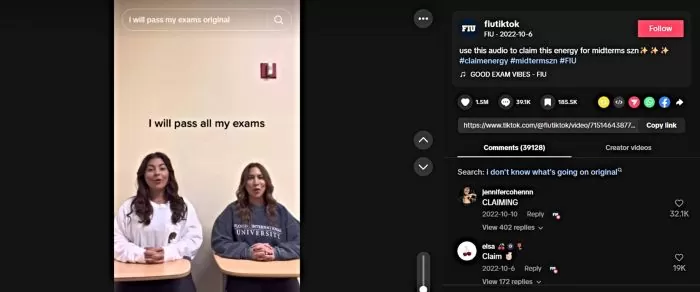
Example: Florida International University (USA): FIU has adopted TikTok to connect with Gen Alpha, where they spend their time. FIU’s social team went viral by leveraging a trending audio challenge on TikTok aimed at students hoping to excel on their midterms. The result was a TikTok that garnered over 10 million views and 1.46 million engagements, demonstrating how being present on Gen Alpha’s favorite platforms can massively boost reach.
Algorithms decide who sees your content. Success depends on understanding how each platform’s system rewards engagement. On TikTok, videos with high watch time and early comments rise quickly. On Google, structured Q&A pages and strong metadata perform best. Research shows attention spans among younger audiences now average two to three seconds. Lead with a hook, such as a bold question, emotion, or relatable visual. Keep captions tight and content shareable. Treat the algorithm like a person you need to impress fast.
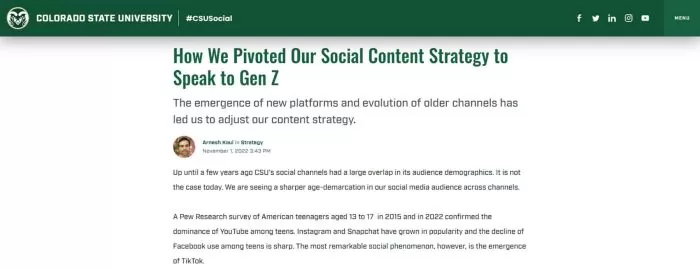
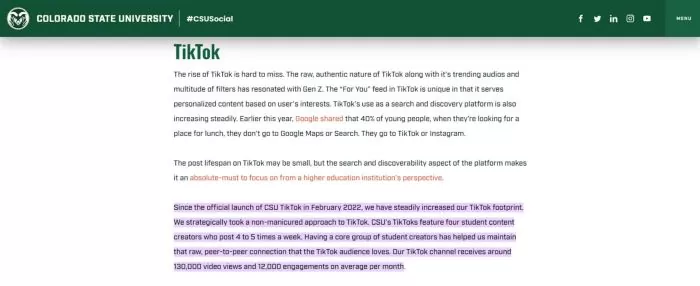
Example: Colorado State University (USA): CSU has strategically designed content to please each platform’s algorithm and grab attention within seconds. Seeing the rise of TikTok’s algorithm-driven “For You” feed, CSU shifted heavily to short-form vertical video and front-loaded content with hooks. The social team launched an official TikTok in 2022 with a “non-manicured” approach: four student creators post 4–5 raw, authentic videos per week. This consistency and emphasis on trending audios and quick, relatable hooks led to about 130,000 video views and 12,000 engagements per month on CSU’s TikTok. By tailoring content format (e.g., snappy cuts, engaging captions) to each platform’s algorithmic preferences, CSU ensures its posts get maximum distribution in Gen Alpha’s feeds.
Culture is where authentic connection happens. Gen Alpha responds to real voices, humor, and values. Collaborate with students to produce takeovers, TikToks, or short vlogs. Reflect diversity and align with current conversations. Join cultural moments carefully, whether that’s referencing a popular meme or spotlighting sustainability initiatives. Imperfection, such as a slightly unpolished student video, signals truth and authenticity.
As HEM puts it, algorithms get you seen, but culture gets you remembered. Using PAC as a creative checklist ensures your marketing is visible, relevant, and real.
Because Generation Alpha’s education decisions will be co-driven by their Millennial parents, Gen Alpha student recruitment messaging must speak to both audiences at once. HEM’s approach, dual-audience messaging, ensures every touchpoint, from websites to ads, connects with both teens and parents in harmony.
For Students
Gen Alpha students care about community, creativity, and experience. They’re asking, “Will I fit in? Will this be exciting?” Highlight student life, clubs, and hands-on learning opportunities through visuals and peer perspectives. Use quotes or short video clips from current students discussing campus life or real projects. Peer voice matters more than institutional formality; a student testimonial will always carry more weight than a dean’s welcome.
For Parents
Millennial parents want reassurance. Their questions are about safety, credibility, and ROI. Showcase graduation rates, career outcomes, accreditation, and alumni success stories. Include details on support services, mental health resources, and campus security. Demonstrating both value and care builds confidence.
How to Integrate Both
Every major recruitment asset should serve both audiences. You can segment sections (“For Students” vs. “For Parents”) or blend them seamlessly. For instance, a video might open with student testimonials, transition into outcomes and parental perspectives, and end with a message that resonates with both.
Action Step: Audit your current materials for balance. Ensure students feel inspired and parents feel assured.
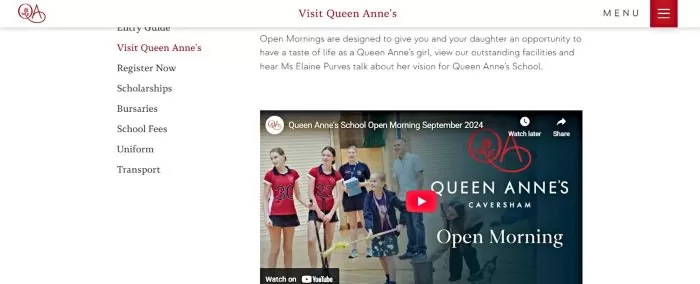
Example: Queen Anne’s School (UK): This independent girls’ school in England structures every recruitment touchpoint to speak to both Gen Alpha students and their millennial parents in tandem. For example, Queen Anne’s hosts Open Mornings that explicitly cater to “you and your daughter.” During these events, girls sample classes and campus life (answering the student’s “Will I have fun and fit in?”), while parents tour facilities and hear the Head’s vision for the school (addressing the parents’ concerns about values and outcomes). The school offers a wide range of visit options – from personal family tours to student “taster days” where 11–13 year olds spend a day on campus – ensuring both audiences are engaged.
3. Establish an “Authenticity System” (UGC and Influencers)
For Generation Alpha, authenticity is the ultimate trust signal. To deliver it consistently, HEM recommends building an Authenticity System, a structured process that continuously produces genuine, student-driven content.
User-Generated Content (UGC) Cadence
Plan for a steady flow of unpolished, real moments. Repost student photos or short TikToks weekly to show campus life through their eyes. Campaigns like #MyCampusMondays, where students share everyday snapshots, keep your content authentic and current. The goal is to make sure that whenever a Gen Alpha prospect visits your social channels, they see real students, not PR gloss.
Student Ambassadors and Creators
Empower students to take part in marketing. Invite ambassadors or micro-influencers to run Instagram takeovers, film vlogs, or stream events. These voices carry credibility because they feel peer-to-peer, not top-down. As HEM research shows, student creators can dramatically increase engagement by making your institution feel accessible and alive.
Authentic Voice and Visuals
Encourage content that sounds natural and looks real. A video filmed on a phone, with casual language or inside jokes, often performs better than a polished shoot. Include candid photos or unscripted clips, authenticity over perfection every time.
Integrate Authentic Content Across Channels
Don’t let UGC live in isolation. Embed student testimonials, quote cards, or video clips directly on program or FAQ pages. Pairing factual info with real student stories creates a persuasive one-two punch.
In short, authenticity shouldn’t happen by accident, it should already be built into your system.
Example: Colorado State University (USA): CSU has built a systematic pipeline for authentic, student-driven content. After officially launching its TikTok, CSU deliberately adopted a “raw” content style – no slick ads, just students with smartphones. It set up a core group of student content creators who post unfiltered clips multiple times a week, giving a continuous stream of real campus moments. In addition, CSU regularly reposts user-generated content from students: from dorm room mini-blogs to everyday campus snapshots. Every week, prospective Gen Alpha students checking CSU’s socials will see new posts by their peers, not just the PR team. By baking student UGC into the content calendar, CSU continuously projects an honest, peer-to-peer voice that Gen Alpha trusts.
4. Embrace Answer-First Content and AI Search Readiness
Generation Alpha searches differently. They ask full questions and expect immediate, concise answers. To connect with them and perform well in AI-driven search, schools need an answer-first content strategy.
Build Q&A Hubs
Create web pages organized by questions and answers, not long paragraphs. For example:
What hands-on experiences will I get in the Nursing program?
What are the career outcomes for graduates? This structure helps both humans and AI bots find what they need quickly. HEM calls these “answer-first hubs,” expanded FAQ-style pages covering dozens of micro-questions. Use data from inquiries and chats to identify what prospects ask most often.
Add Video and Micro-Content
Gen Alpha prefers short, visual responses. Embed 30–60 second video answers from students or staff directly on your pages. A student selfie explaining “What’s the first-year experience like?” feels more authentic than text alone. For parents, include short clips addressing safety or support topics. Repurpose each Q&A across platforms like YouTube Shorts or Reddit for added reach.
Implement Structured Data
Make content machine-readable. Adding FAQ schema markup tells Google and AI assistants what each Q&A covers, improving visibility in featured snippets and AI chat results. HEM research shows this can increase AI-driven visibility by up to 30%.
Write for Voice and Natural Language
Use conversational phrasing such as “How do I apply for financial aid?” instead of standard titles. Ensure each answer short but complete, ideal for AI summaries or voice assistants. Schools already applying this approach have seen measurable boosts in organic traffic and “People Also Ask” placements.
Bottom line: think like an answer engine. Gen Alpha asks questions, so make sure your content answers first.
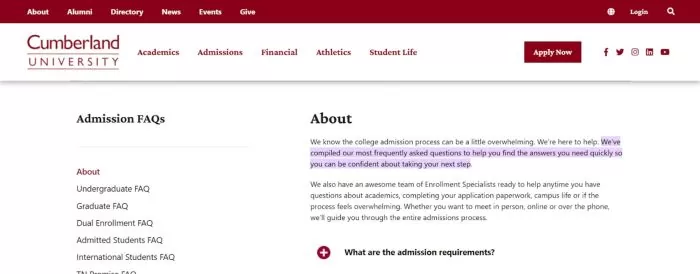
Example: Cumberland University (USA): Cumberland makes information instantly accessible by structuring its admissions content around questions and direct answers. Its website features a comprehensive Admission FAQs hub that compiles “our most frequently asked questions to help you find the answers you need quickly”. Prospective students and parents can click categories like Undergraduate, Graduate, International, etc., and find dozens of bite-sized Q&As (e.g., “What are the application requirements?”, “Is there housing for freshmen?”). Each answer is concise and written in plain language – perfect for Gen Alpha’s tendency to ask full questions in Google or AI assistants. By adopting this answer-first approach (instead of burying info in long paragraphs), Cumberland not only improves user experience but also boosts its visibility on search engines. Many of its FAQ entries use structured data markup, so they often appear as featured snippets or “People Also Ask” results on Google.
5. Treat Your Campus as a Product: Demos and Immersive Experiences
For Generation Alpha, choosing a school feels like choosing a lifestyle brand. They want to experience it before committing. That’s why HEM recommends marketing your campus like a product demo, through in-person and virtual experiences that let students and parents “test-drive” what you offer.
Creator-Hosted Events
Make campus events hybrid and interactive. Invite student creators to livestream open houses or campus days on TikTok, YouTube, or Instagram Live. A student host with a GoPro or phone camera gives the experience authenticity and energy. Let online viewers ask questions in real time while seeing dorms, labs, or the dining hall rush. It’s immersive, engaging, and feels like hanging out with a trusted peer.
Hands-On Campus Trials
When prospects visit in person, let them participate. Replace passive tours with interactive demos, mini labs, culinary workshops, or creative challenges. Some schools have gamified tours, turning them into scavenger hunts or student-led challenges. Participation builds emotional connection and makes visits memorable.
Augmented Reality (AR) and Virtual Worlds
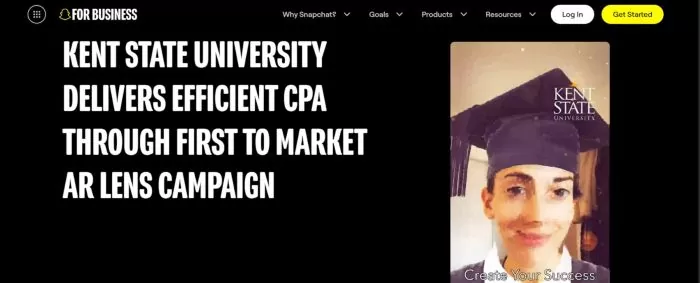
Add AR filters or lenses during events to blend play with information. Imagine scanning a building to reveal fun facts or seeing your mascot in AR. Schools like Kent State University have used Snapchat AR lenses to boost engagement while lowering recruitment costs.
Take it further by creating virtual campuses in platforms like Roblox or Minecraft. Students can explore, play, and imagine life at your school long before applying.
Use Existing Tools
360° tours and virtual events on platforms like YouVisit or CampusTours make immersion easy.
The goal is to let Gen Alpha see themselves on campus. When they can explore, touch, and interact, even virtually, they’re far more likely to enroll.
Examples: Kent State turned its campus into an interactive product demo via augmented reality on Snapchat. In a pioneering campaign (the first of its kind in higher ed), Kent State built a custom AR lens that let prospective students virtually “try on” a piece of the college experience – in this case, placing a Kent State graduation cap on their heads, tassel and all. Users could move and see the tassel shake, and with one tap, were prompted to “apply to the university” right from Snapchat. This immersive lens was deployed to Snapchatters aged 16–18 in Kent State’s key recruiting regions. The results were astounding: engagement soared, and the AR campaign achieved a cost-per-application 24% lower than the university’s goal.
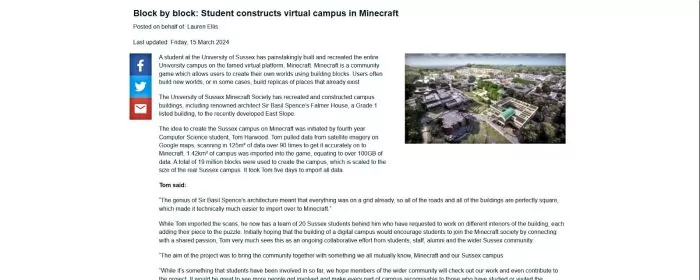
University of Sussex (UK): At Sussex, students themselves have helped create a virtual campus that anyone can explore – effectively offering a perpetual, gamified open house. In 2024, a Sussex Computer Science student led a project to recreate the entire university campus in Minecraft, block by block. Using satellite data, the team imported ~1.4 km² of campus into the game (over 19 million blocks), achieving a 1:1 scale replica of Sussex’s buildings and grounds. Now, a group of 20+ students (and even alumni) is collaboratively adding interiors and details to bring it fully to life.
6. Integrate CRM, SEO, Social Campaigns, and Multilingual Content
Creating next-gen content for Generation Alpha is only half the battle. To convert attention into enrollment, schools need to align these tactics with the systems that power modern digital marketing. Here’s how HEM integrates CRM, SEO, social media, and multilingual strategy into a single recruitment engine.
CRM for Lead Nurturing
A robust education CRM is essential for tracking Gen Alpha inquiries and engaging them across multiple touchpoints—social DMs, event sign-ups, web forms, and more. Automated workflows can send personalized follow-ups instantly, such as a welcome video from a student ambassador or a link to a virtual Q&A. HEM often implements Mautic or HubSpot to manage this process. The result: faster responses, stronger engagement, and less manual work. Segment Gen Alpha students and their parents into complementary streams—student-life content for one, academic and ROI-focused messaging for the other.
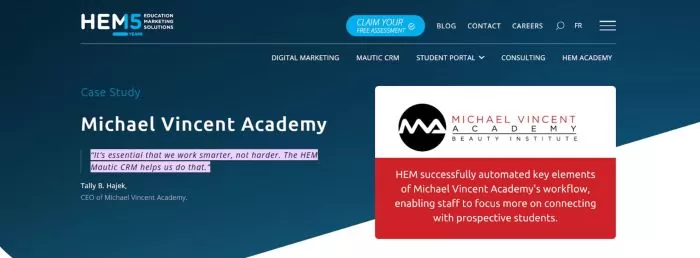
Example: Michael Vincent Academy: Michael Vincent Academy, a private career school in Los Angeles, partnered with HEM to deploy a customized Mautic CRM for student recruitment. “It’s essential that we work smarter, not harder. The HEM Mautic CRM helps us do that,” said Tally B. Hajek, the academy’s CEO. HEM’s CRM solution automated key marketing workflows (such as follow-ups with prospective students) and provided reports to track lead progress and team activities. The system also included a lead-scoring mechanism to identify and prioritize high-value leads, ensuring staff focus on serious, good-fit applicants. As a result, core recruitment processes became automated, allowing the admissions team to spend more time building personal connections with prospects.
All that great content needs visibility. Use SEO to make it discoverable through optimized site structure, keyword strategy, and internal linking. Develop content clusters, interconnected pages and blogs built around key topics, to boost authority. HEM’s SEO overhauls have helped clients like Cumberland College achieve double-digit growth in organic traffic. Technical SEO, schema markup, and fast mobile performance are nonnegotiable for Gen Alpha’s on-demand expectations.
Social Media Campaigns
Meet Gen Alpha where they live: TikTok, YouTube, Snapchat, and Instagram. Blend organic storytelling with paid targeting. Use TikTok Spark Ads or Snapchat placements to amplify authentic student content that already performs well. Combine this with parent-focused Facebook and Google campaigns for a full-funnel strategy. HEM’s campaign for Queen Anne’s School used this dual approach, improving conversion rates from inquiry to enrollment.
Multilingual and International Reach
Gen Alpha is global. Translate or localize key pages and ads to reach families in multiple languages. Include subtitles, translated summaries, and multilingual SEO to capture diverse search traffic. HEM’s work with Wilfrid Laurier University demonstrated that localized messaging in Portuguese and Spanish drove stronger ROI in international markets.
Integrating these elements (CRM, SEO, social, and multilingual content) creates a seamless ecosystem that attracts, nurtures, and converts Gen Alpha prospects efficiently. It’s how institutions move from generating attention to generating results.
Actionable Takeaways for Reaching Gen Alpha
Generation Alpha may still be young, but the time to reach them is now. To connect authentically, schools must meet them where they are and communicate in ways that feel human, immediate, and real.
Be present on the platforms they love, such as YouTube, TikTok, Snapchat, and even gaming spaces, featuring student creators who speak their language. Empower current students and recent graduates to share their stories, building trust through authenticity.
Balance messaging for both students and parents, addressing excitement and reassurance in equal measure. Adopt an answer-first content model using structured FAQs and schema to increase visibility in AI and voice search. Treat campus tours like product demos, creating interactive, hands-on, or virtual experiences that bring your institution to life.
Finally, measure what matters by tracking engagement, conversions, and insights from data to refine continuously. Above all, stay authentic and adaptable. The institutions that start now will lead the next generation of recruitment success.
Frequently Asked Questions
Question: Who is Generation Alpha?
Answer: Generation Alpha refers to children born between 2010 and 2024. They are the first cohort raised entirely in the 21st century, often called the first true digital natives.
Question: Why should institutions start preparing now?
Answer:Institutions must start preparing now because Generation Alpha is already entering the college decision phase, and adapting strategies early allows schools to refine digital, authentic, and parent-inclusive recruitment approaches before their enrollment surge.
Home » Careers in Healthcare » Training Future Physicians and Serving Communities: How Osteopathic Medical Schools Make an Impact
Across America, communities are struggling with a critical shortage of doctors. One Pennsylvania city, working with osteopathic medical schools, may have found a solution.
In Scranton, PA, an innovative partnership is offering a multifaceted approach where it’s needed most, providing quality care to underserved patients, training the next generation of physicians, and supporting the regional healthcare workforce.
Last summer, nine passionate medical students from two osteopathic colleges helped launch the Northeast Pennsylvania Clinical Education Consortium (NEPCEC). Today, that effort has grown into a powerful partnership between three osteopathic medical schools, the City of Scranton, Lackawanna College, and local healthcare organizations.
“It’s been a pleasure to work with our partnering physicians and healthcare providers to help build an osteopathic physician training network in Northeastern Pennsylvania,” said Frank Kolucki, M.D., Commonwealth Health System physician & NEPCEC medical director. “The students…have been eagerly engaged in their training and have brought an excitement and enthusiasm that is very refreshing and exciting to witness.”
NEPCEC offers something rare: a clear path from clinical training to residency in underserved areas, where new doctors, especially family-practice doctors with community ties, are urgently needed. Through this program, students from the Philadelphia College of Osteopathic Medicine (PCOM), Touro College of Osteopathic Medicine, and New York Institute of Technology College of Osteopathic Medicine are gaining hands-on experience.
“We have long seen the value of purposeful community partnerships at Lackawanna College, and the NEPCEC is an opportunity that continues to be a natural fit for us, our students, and the community,” said Dr. Jill Murray, president and chief innovation officer of Lackawanna College. “This program has established a clear pathway for our osteopathic medical students to learn, grow, and build relationships within our community that will help them establish a strong footing for future careers in our region.”
“One of the first things I noticed about Scranton was its small-town atmosphere, where people are always ready to lend a helping hand,” said Camryn Butera, third-year PCOM student rotating in Scranton. “I’ve seen healthcare staff consistently go above and beyond for their patients. Every attending physician has taken the time to work with me one-on-one, not only to teach their specialty but also to offer mentorship, life advice, and even recommendations for great local spots. When I first arrived, I was admittedly nervous about moving from a big city to a smaller town, but Scranton has truly offered the best of both worlds.”
Expanding access to community-based care
This kind of community-based clinical education is central to osteopathic medical training. A key part of that training happens outside major hospitals, in places like Scranton, that most resemble where the average American receives their healthcare, and where doctors are often in short supply.
“This program provided the opportunity to participate actively in primary patient care, reemphasizing my passion and commitment to becoming a family physician,” said C. Veronica Ruiz, fourth-year PCOM student, Scranton Core Clinical Campus. “I am very grateful to the outstanding healthcare teams for allowing me a safe space to learn and grow as a future family doctor.”
Programs like NEPCEC are a win-win. Students get high-quality training, and communities get the physicians they so urgently need. We believe that clinical education partnerships like these have the potential to meet challenges nationwide.
The impact is growing. We are working with Congress to pass the Community Training, Education, and Access for Medical Students (Community TEAMS) Act, H.R. 3885, legislation that would expand programs like the NEPCEC, giving more medical students the chance to train where they’re most needed and help close the gap in healthcare access, bringing the osteopathic philosophy of whole-person, community-based care to more patients across the country.
Schools can keep QR logins safe and seamless by blending clear visual cues, ongoing user education, and risk-based checks behind the scenes
QR-based single sign-on (SSO) is fast becoming a favorite in schools seeking frictionless access, especially for bring-your-own-device (BYOD) environments.
The BYOD in education market hit $15.2 billion in 2024 and is projected to grow at a 17.4 percent CAGR from 2025 to 2033, driven by the proliferation of digital learning and personal smart devices in schools.
However, when attackers wrap malicious links into QR codes, school IT leaders must find guardrails that preserve usability without turning every login into a fortress.
Phishing via QR codes, a tactic now known as “quishing,” is where attackers embed malicious QR codes in emails or posters, directing pupils, faculty, and staff to fake login pages. Over four out of five K-12 schools experienced cyber threat impacts with human-targeted threats like phishing or quishing, exceeding other techniques by 45 percent.
Because QR codes hide or obscure the URL until after scanning, they evade many traditional email spam filters and link scanners.
Below are three strategies to get that balance between seamless logins and safe digital environments right.
How to look out for visual signals
Approximately 60 percent of emails containing QR codes are classified as spam. Branded content, such as the school or district logo, consistent with the look and feel of other web portals and student apps, will help students identify a legitimate QR over a malicious one.
Frontier research shows that bold colors and clear iconography can increase recognition speed by up to 40 percent. This is the kind of split-second reassurance a student or teacher needs before entering credentials on a QR-based login screen.
Training your users to look for the full domain or service name, such as “sso.schooldistrict.edu” under the QR, is good practice to avoid quishing attacks, school-related or not. However, this will be trickier for younger students.
The Frontier report demonstrates how younger children rely more heavily on color and icon cues than on text or abstract symbols. For K-12 students, visual trust cues such as school crests, mascots, or familiar color schemes offer a cognitive shortcut to legitimacy.
Still, while logos and “Secured by…” badges are there to reassure users, attackers know this. Microsoft, Cisco Talos, and Palo Alto Unit42 have documented large-scale phishing campaigns where cybercriminals cloned Microsoft 365 and Okta login pages, complete with fake security seals, to harvest credentials.
For schools rolling out QR-based SSO, pairing visible trust cues with dynamic watermarks unique to the institution makes it harder for attackers to replicate.
User education on quishing risk
Human error drives most breaches, particularly in K-12 schools. These environments handle a mix of pupils who are inexperienced with security risks and, therefore, are less likely to scrutinize QR codes, links, or credentials.
Students and teachers must be taught the meaning of signs and the level of detail to consider in order to respond more quickly and correctly. A short digital literacy module about QR logins can dramatically cut phishing and quishing risk, reinforcing what legitimate login screens should look like. These should be repeated regularly for updates and to strengthen the retrieval and recognition of key visual cues.
Research in cognitive psychology shows that repeated exposure can boost the strength of a memory by more than 30 percent, making cues harder to ignore and easier to recall. When teaching secure login habits, short, repeated micro-lessons–for example, 3-5 min videos with infographics–can boost test scores 10-20 percent. Researcher Piotr Wozniak suggests spacing reviews after 1 day, then 7 days, 16 days, 35 days, and later every 2-3 months.
With proper education, students should instinctively not trust QRs received via text message or social media through unverified numbers or accounts. Encouraging the use of a Secure QR Code Scanner app, at least for staff and perhaps older students, can be helpful, because it will verify the embedded URL before a user opens it.
When to step up authentication after a scan
QR codes make logging in fast, but after a scan, you don’t have to give full access right away. Instead, schools can use these scans as the first factor and decide whether to require more proof before granting access, depending on risk signals.
For example, if a student or teacher scans the QR code with a phone or tablet that’s not on the school’s “known device” list, the system should prompt for a PIN, passphrase, or MFA push before completing login. The same applies to sensitive systems that include student data or financial information.
Microsoft’s 2024 Digital Defense Report shows that adding MFA blocks 99.2 percent of credential attacks. That means a simple SMS or push-based MFA can drastically slash phishing and quishing success rates. By adding a quick MFA prompt only when risk signals spike, school IT teams preserve the speed of QR logins without giving up security.
Schools can also apply cloud-security platforms to strengthen QR-based SSO without sacrificing ease of use. These tools sit behind the scenes, continuously monitoring Google Workspace, Microsoft 365, and other education apps for unusual logins, risky devices, or policy violations.
By automatically logging every QR login event, including device, time, and location, and triggering alerts when something looks off, IT teams gain visibility and early warning without adding extra friction for staff or students. This approach lets schools keep QR sign-ins fast and familiar with risk-based controls and data protection running in the background.
Schools can keep QR logins safe and seamless by blending clear visual cues, ongoing user education, and risk-based checks behind the scenes. Students and staff learn to recognize authentic screens, while IT teams add extra verification only when behavior looks risky. Simultaneously, continuous monitoring tracks every scan to catch problems early and improve education resources, all without slowing anyone down.
Latest posts by eSchool Media Contributors (see all)