
Tag: science of reading

  • What Football Can Tell Us About How to Teach Reading – The 74

    What Football Can Tell Us About How to Teach Reading – The 74


    Get stories like this delivered straight to your inbox. Sign up for The 74 Newsletter

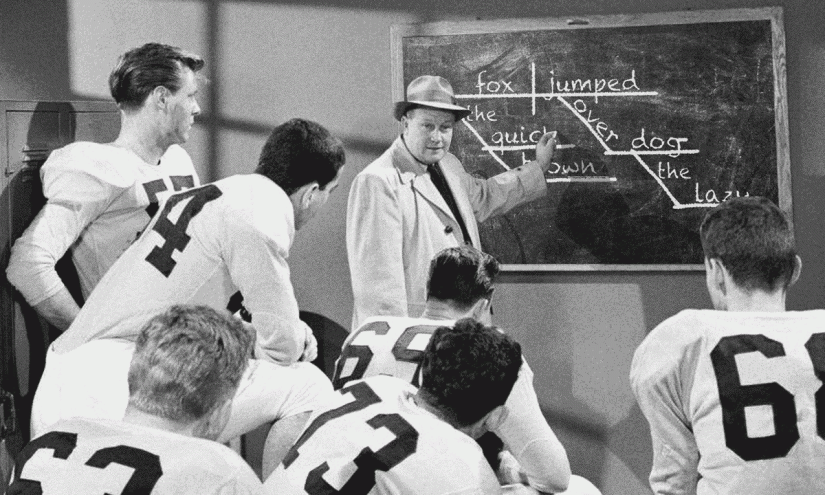
    When I go to my son’s football games, I can tell you which team will win — most of the time — just by watching them warm up. It’s not necessarily having the flashiest uniforms or the biggest player; it’s about the discipline, the focus and the precision of their routines.

    A school is no different.

    In my Texas school district, I can walk into a classroom and, in the first five minutes, tell you if effective reading instruction is happening. I don’t need to see the lesson plan or even look at the teacher. I just need to look at the kids. Are they engaged? Are they in a routine? Are they getting the “reps” they need?

    For too long, districts have been losing the game before it starts. They buy a new playbook (i.e., a curriculum) as a “hail Mary,” hoping for a fourth-quarter miracle. Still, they ignore the fundamentals, practice and team culture required for sustainable success.

    Chapel Hill Independent School District is committed to educating all children to compete in an ever-changing world. To that end, we’ve made literacy a nonnegotiable priority across all campuses. We anchor our approach in research-based practices and a culture of continuous learning for both students and staff.

    We’re building for the long run: a literacy dynasty. But our literacy success hasn’t come without putting in the work. We have a relentless focus on the fundamentals and, most importantly, a culture where every player — every teacher and administrator — fits our system.

    Trust the Analytics, Not Your Gut

    In reading instruction, we can’t make assumptions; all instruction has to start with the fundamentals. For decades, instruction was based on gut feelings, like an old-school coach deciding whether to go for it on fourth down or punt based on a hunch. But today, the best coaches trust the analytics, not their gut. They watch the game film.

    Chapel Hill is an analytics district; we do our research. And our game film is the science of reading.

    Many years ago, we started using structured literacy for a small group of students with dyslexia. It worked so well that we asked ourselves: If structured literacy is effective for a small group of students with dyslexia, shouldn’t it be essential for all students?

    We didn’t just adopt a new curriculum; we redesigned our literacy infrastructure — from structured literacy professional development for every teacher to classroom coaching and a robust tiered system of support to ensure no student falls through the cracks.

    That logic is our offensive strategy. It’s why we use tools like the Sold a Story podcast to show our staff why we’ve banned the strategies of a bygone era, like three-cueing. We have to be willing to reprogram the brain to align with what research proves works. But having the right playbook is only half the battle.

    A great playbook is useless without the right team to execute it.

    This is the most crucial part: “First who, then what.” In the NFL draft, teams don’t always draft the most talented player available. They conduct interviews and personality assessments and ultimately draft the player who best fits their system—the cultural fit.

    Tom Brady is arguably the greatest quarterback of all time, but he couldn’t run a read-option offense, which requires a fast, running quarterback. He wouldn’t fit the system, and the team would fail. But put Brady in a play-action offense, sit back and watch the magic happen.

    We operate the same way. When we interview, we’re not just looking for a teacher with excellent credentials and experience; we’re looking for a “Chapel Hill Way” teacher. It’s a specific profile: someone who believes in our philosophy of systematic, explicit, research-based instruction.

    This culture starts with our team captains: our campus principals. We need them to believe in our playbook, not just buy in because the district office said so. We invest in their development so they can champion literacy daily, monitor instruction and ensure every classroom executes our playbook with fidelity. It’s their conviction that turns a curriculum on a shelf into a living, breathing part of our culture.

    Talented teams win games. Disciplined, team-first organizations build dynasties.

    Building a dynasty requires sacrifice. When an educator joins our team, whether they’re a rookie or a seasoned veteran, we ask them to let go of the “I’ve always done it this way” mindset. That’s the equivalent of a player prioritizing their personal stats over a team win.

    It’s a team-first mindset. It’s about a willingness to put personal preference aside to build a championship team. For Chapel Hill ISD, our championship is ensuring every child learns to read.

    Our team-first philosophy has translated into measurable results: Across campuses, students are gaining the foundational skills they need, and data shows growth for every subgroup, including students with dyslexia and multilingual learners. We want students to become a product of our expectations, rather than their environment. Our district, which serves a diverse population, including a high percentage of students classified as low socioeconomic status, consistently scores above the state average in third-grade reading.

    At Wise Elementary, our largest campus[MOU1] , 56% of third graders met grade-level standards, and 23% scored above grade level on the 2023-2024 STARR assessment. And we had similar results across the district.

    So to my fellow education leaders: Before you shop for a new playbook, ensure you have the right team culture in place. Define your culture. Draft the right players. Build your team. Coach your captains. And obsess over the fundamentals.

    That’s how you win.


    Did you use this article in your work?

    We’d love to hear how The 74’s reporting is helping educators, researchers, and policymakers. Tell us how

    Source link

  • Science of Reading Training, Practice Vary, New Research Finds – The 74

    Science of Reading Training, Practice Vary, New Research Finds – The 74


    Get stories like this delivered straight to your inbox. Sign up for The 74 Newsletter

    North Carolina is one of several states that have passed legislation in recent years to align classroom reading instruction with the research on how children learn to read. But ensuring all students have access to research-backed instruction is a marathon, not a sprint, said education leaders and researchers from across the country on a webinar from the Hunt Institute last Wednesday.

    Though implementation of the state’s reading legislation has been ongoing since 2021, more resources and comprehensive support are needed to ensure teaching practice and reading proficiency are improved, webinar panelists said.

    “The goal should be to transition from the science of reading into the science of teaching reading,” said Paola Pilonieta, professor at the University of North Carolina at Charlotte who was part of a team that studied North Carolina’s implementation of its 2021 Excellent Public Schools Act.

    That legislation mandates instruction to be aligned with “the science of reading,” the research that says learning to read involves “the acquisition of language (phonology, syntax, semantics, morphology, and pragmatics), and skills of phonemic awareness, accurate and efficient work identification (fluency), spelling, vocabulary, and comprehension.”

    The legislature allocated more than $114 million to train pre-K to fifth grade teachers and other educators in the science of reading through a professional development tool called the Language Essentials for Teachers of Reading and Spelling (LETRS). More than 44,000 teachers had completed the training as of June 2024.

    Third graders saw a two-point drop, from 49% to 47%, in reading proficiency from the 2023-24 to 2024-25 school year on literacy assessments. It was the first decline in this measure since LETRS training began. First graders’ results on formative assessments held steady at 70% proficiency and second graders saw a small increase, from 65% to 66%.

    “LETRS was the first step in transforming teacher practice and improving student outcomes,” Pilonieta said. “To continue to make growth in reading, teachers need targeted ongoing support in the form of coaching, for example, to ensure effective implementation of evidence-based literacy instruction.”

    Teachers’ feelings on the training

    Pilonieta was part of a team at UNC-Charlotte and the Education Policy Initiative at Carolina (EPIC) at UNC-Chapel Hill that studied teachers’ perception of the LETRS training and districts’ implementation of that training. The team also studied teachers’ knowledge of research-backed literacy practices and how they implemented those practices in small-group settings after the training.

    They asked about these experiences through a survey completed by 4,035 teachers across the state from spring 2023 to winter 2024, and 51 hour-long focus groups with 113 participants.

    Requiring training on top of an already stressful job can be a heavy lift, Pilonieta said. LETRS training looked different across districts, the research team found. Some teachers received stipends to complete the training or were compensated with time off, and some were not. Some had opportunities to collaborate with fellow educators during the training; some did not.

    “These differences in support influenced whether teachers felt supported during the training, overwhelmed, or ignored,” Pilonieta said.

    Teachers did perceive the content of the LETRS training to be helpful in some ways and had concerns in others, according to survey respondents.

    Teachers holding various roles found the content valuable in learning about how the brain works, phonics, and comprehension.

    They cited issues, however, with the training’s applicability to varied roles, limited differentiation based on teachers’ background knowledge and experience, redundancy, and a general limited amount of time to engage with the training’s content.

    Varied support from administrators, coaches

    When asking teachers about how implementation worked at their schools, the researchers found that support from administrators and instructional coaches varied widely.

    Teachers reported that classroom visits from administrators with a focus on science of reading occurred infrequently. The main support administrators provided, according to the research, was planning time.

    “Many teachers felt that higher levels of support from coaches would be valuable to help them implement these reading practices,” Pilonieta said.

    Teachers did report shifts in their teaching practice after the training and felt those tweaks had positive outcomes on students.

    The team found other conditions impacted teachers’ implementation: schools’ use of curriculum that aligned to the concepts covered in the training, access to materials and resources, and having sufficient planning time.

    Some improvement in knowledge and practice

    Teachers performed well on assessments after completing the training, but had lower scores on a survey given later by the research team. Pilonieta said this suggests an issue with knowledge retention.

    Teachers scored between 95% to 98% across in the LETRS post-training assessment. But in the research team’s survey, scores ranged from 48% to 78%.

    Teachers with a reading license scored higher on all knowledge areas addressed in LETRS than teachers who did not.

    When the team analyzed teachers’ recorded small-group reading lessons, 73% were considered high-quality. They found consistent use of explicit instruction, which is a key component of the science of reading, as well as evidence-backed strategies related to phonemic awareness and phonics. They found limited implementation of practices on vocabulary and comprehension.

    Among the low-quality lessons, more than half were for students reading below grade level. Some “problematic practices” persisted in 17% of analyzed lessons.

    What’s next?

    The research team formed several recommendations on how to improve reading instruction and reading proficiency.

    They said ongoing professional development through education preparation programs and teacher leaders can help teachers translate knowledge to instructional change. Funding is also needed for instructional coaches to help teachers make that jump.

    Guides differentiated by grade levels would help different teachers with different needs when it comes to implementing evidence-backed strategies. And the state should incentivize teachers to pursue specialized credentials in reading instruction, the researchers said.

    Moving forward, the legislation might need more clarity on mechanisms for sustaining the implementation of the science of reading. The research team suggests a structured evaluation framework that tracks implementation, student impact, and resource distribution to inform the state’s future literacy initiatives.

    This article first appeared on EdNC and is republished here under a Creative Commons Attribution-NoDerivatives 4.0 International License.


    Get stories like these delivered straight to your inbox. Sign up for The 74 Newsletter

    Source link

  • How We Outperformed National Reading Scores – And Kept Students at Grade Level – The 74

    How We Outperformed National Reading Scores – And Kept Students at Grade Level – The 74


    Get stories like this delivered straight to your inbox. Sign up for The 74 Newsletter

    As reading scores remain a top concern for schools nationwide, many districts are experimenting with ability-based grouping in the early grades. The idea is to group students in multiple grade levels by their current reading level — not their grade level. A classroom could have seven kindergartners, 10 first graders, and three second graders grouped together for reading because they all read at the same level.

    While this may work for some schools, in our district, Rockwood School District in Missouri, we’ve chosen a different path. We keep students together in their class during whole-class instruction — regardless of ability level — and provide support or enrichment by creating flexible groups based on instructional needs within their grade level.

    We’re building skilled, confident readers not by separating them, but by growing them together.

    Children, like adults, learn and grow in diverse groups. In a Rockwood classroom, every student contributes to the shared learning environment — and every student benefits from being part of it.

    Our approach starts with whole-class instruction. All students, including English multilingual learners and those working toward grade-level benchmarks, participate in daily, grade-level phonics and comprehension lessons. We believe these shared experiences are foundational — not just for building literacy, but for fostering community and academic confidence.

    After our explicit, whole-group lessons, students move into flexible, needs-based small groups informed by real-time data and observations. Some students receive reteaching, while others take on enrichment activities. During these blocks, differentiation is fluid: A student may need decoding help one day and vocabulary enrichment the next. No one is locked into a static tier. Every day is a new opportunity.

    Students also engage in daily independent and partner reading. In addition, reading specialists provide targeted, research-based interventions for striving readers who need additional instruction.

    We build movement into our instruction, as well — not as a brain break, but as a learning tool. We use gestures for phonemes, tapping for spelling and jumping to count syllables. These are “brain boosts,” helping young learners stay focused and engaged.

    We challenge all students, regardless of skill level. During phonics and word work, advanced readers work with more complex texts and tasks. Emerging readers receive the time and scaffolded support they need — such as visual cues and pre-teaching or exposing students to a concept or skill before it’s formally taught during a whole-class lesson. That can help them fully participate in every class. A student might not yet be able to decode or encode every word, but they are exposed to the grade-level standards and are challenged to meet the high expectations we have for all students.

    During shared and interactive reading lessons, all students are able to practice fluency and build their comprehension skills and vocabulary knowledge. Through these shared experiences, every child experiences success.

    There’s a common misconception that mixed-ability classrooms hold back high achievers or overwhelm striving readers. But in practice, engagement depends more on how we teach rather than who is in the room. With well-paced, multimodal lessons grounded in grade-level content, every learner finds an entry point.

    You’ll see joy, movement, and mutual respect in our classrooms — because when we treat students as capable, they rise. And when we give them the right tools, not labels, they use them.

    While ability grouping may seem like a practical solution, research suggests it can have a lasting downside. A Northwestern University study of nearly 12,000 students found that those placed in the lowest kindergarten reading groups rarely caught up to their peers. For example, when you group a third grader with first graders, when does the older child get caught up? Even if he learns and progresses with his ability group, he’s still two grade levels behind his third-grade peers.

    This study echoes what researchers refer to as the Matthew Effect in reading: The rich get richer, and the poor get poorer. Lower-track students are exposed to less complex vocabulary and fewer comprehension strategies. Once placed on that path, it’s hard to catch up. Once a student is assigned a label, it’s difficult to change it — for both the student and educators.

    In Rockwood, we’re confident in what we’re doing. We have effective, evidence-based curricula for Tier I phonics and comprehension, and every student receives the same whole-class instruction as every other student in their grade. Then, students receive intervention or enrichment as needed.

    At the end of the 2024–25 school year, our data affirmed what we see every day. Our kindergarteners outperformed national proficiency averages in every skill group — in some cases by more than 17 percentage points, according to our Reading Horizons data. Our first and second graders outpaced national averages across nearly every domain. We don’t claim to have solved the literacy crisis — or know that our model will work for every district, school, classroom or student — but we’re building readers before gaps emerge.

    We’ve learned that when every student receives strong Tier I instruction, no one gets left behind. The key isn’t separating kids by ability. It’s designing instruction that’s universally strong and strategically supported.

    We recognize that every community faces distinct challenges. If you’re a district leader weighing the trade-offs of ability grouping, consider this: When you pull students out of the room during critical learning moments, the rich vocabulary, the shared texts and the academic conversation, you are not closing the learning gap, but creating a bigger one. Those critical moments build more than skills; they build readers.

    In Rockwood, our data confirms what we see every day: students growing not only in skills, but also in confidence, stamina and joy. We’re proving that inclusive, grade-level-first instruction can work — and work well — for all learners.


    Get stories like these delivered straight to your inbox. Sign up for The 74 Newsletter

    Source link