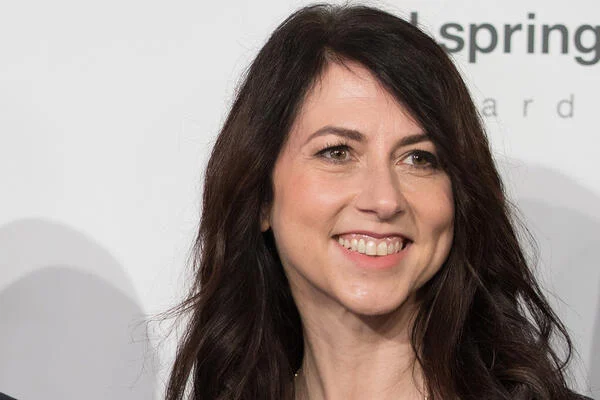
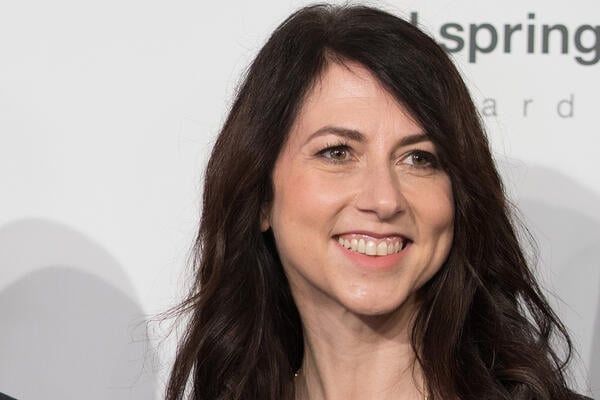
Philanthropist MacKenzie Scott gave more multimillion donations out to colleges.
picture alliance/Getty Images
Philanthropist MacKenzie Scott is at it again with another round of gifts.
Robeson Community College in North Carolina announced a $24 million gift from Scott on Thursday, the single largest contribution in the rural college’s history.
Robeson’s president, Melissa Singler, called the gift “a profound affirmation of our students, our faculty and staff, and the limitless potential of Robeson County.”
“Never before have we been given a gift of this magnitude that affords our team the time, space and freedom to think, dream and plan boldly,” Singler said in a news release.
Scott also gifted Carl Albert State College in Oklahoma $23 million. The college is working on a strategic plan for how to use the funds, focused on “sustainability, academic and career success, innovation, and community engagement,” according to an announcement last week. Connors State College, also in Oklahoma, celebrated a $15 million contribution from Scott, its largest gift ever.
Fond du Lac Tribal and Community College also announced a “multi-million dollar gift” last week, the largest unrestricted gift in its history, but didn’t specify the amount. The tribal college plans to use Scott’s funding to support scholarships and grants for native and non-native students.
Philanthropist MacKenzie Scott continued her latest giving spree this week, showering millions of dollars on another slew of higher ed institutions.
Scott gave $50 million each to California State University, East Bay, the largest single donation in the university’s history, and to Lehman College, part of the City University of New York system, according to announcements from the institutions on Thursday. (Scott also gifted Lehman College $20 million in 2020 and has given a total of $125 million to campuses across the CUNY system in the last five years.)
This audio is auto-generated. Please let us know if you have feedback.
Dive Brief:
Eight historically Black colleges and universities have received a total of $387 million in unrestricted donations from billionaire philanthropistMacKenzie Scottsince mid-October.
On Sunday, Howard University, in Washington, D.C., revealed it had received an $80 million gift from Scott, with $17 million earmarked for its medical school. The following day, Spelman College, a women’s HBCU in Georgia, said Scott had donated $38 million.
Both colleges, along with most of the six other HBCUs, previously received multimillion dollar donations from Scott during her first round of higher education giving in 2020. Each described their gift as one of the biggest — if not the largest — in their history.
Dive Insight:
In 2019, the same year Scott divorced Amazon founder Jeff Bezos, she signed the Giving Pledge, a pact directed at the world’s wealthiest people to donate more than half their wealth.
“I have a disproportionate amount of money to share,” Scott, one of the richest women in the world, wrote in her pledge statement at the time. “And I will keep at it until the safe is empty.”
She still has quite a ways to go. As of this week, Bloomberg estimated Scott’s net worth at $42 billion — up from $39.4 billion last November.
Scott is now in the midst of another significant round of donations, and the notably private donor acknowledged the attention it would attract in a rare online statement last month.
“When my next cycle of gifts is posted to my database online, the dollar total will likely be reported in the news,” she said in an Oct. 15 blog post. But she characterized that amount as “a vanishingly tiny fraction” of the hundreds of billions of dollars in annual charitable giving in the U.S. each year “that we don’t read about online or hear about on the nightly news.”
Her most recent spate of HBCU donations include:
Scott also donated $70 million in September to UNCF, the largest private scholarship provider for minority students in the U.S. The organization, which counts 37 private HBCUs as members, said the money would go to bolstering the long-term financial health of those colleges.
In 2020, Scott donated over $800 million to colleges, focusing much of the funding on HBCUs. In addition to their high-dollar value, her gifts stood out because they were unrestricted, and she did not appear to have a personal relationship with the recipients.
The Council for Advancement and Support of Education found that unrestricted contributions to surveyed colleges increased by nearly a third in fiscal 2021 compared to the year before, attributing much of that growth to Scott.
By early 2023, she had donated at least $1.5 billion to roughly six dozen colleges, with an emphasis on minority-serving institutions like HBCUs.
Foundations disproportionately give less to HBCUs compared to similar non-HBCUs, and public HBCUs have historically been underfunded by the government.
From 2015 to 2019, foundations donated a combined $5.5 billion to the eight Ivy League institutions, compared to $303 million for 99 HBCUs, according to a 2023 study. That worked out to the average Ivy League institution receiving 178 times more foundation funding than the average HBCU.
And a 2023 analysis from the Biden administration found that land-grant HBCUs in 16 states missed out on over $12 billion from 1987 to 2020 due to state underfunding.
Five years out from Scott’s first donations, research suggests those funds may help boost enrollment and retention.
A 2021 analysis of the 23 HBCUs that received a total of $560 million from Scott in 2020 found that their median new student enrollment was more than 300 students higher than HBCU counterparts that did not receive funding. Their retention rates were an average of 15% higher as well.
Colleges have reported using the money in a variety of ways.
Spelman, for example, received $20 million from Scott in 2020. Of that, $11 million went to the college’s endowment, and $1.1 million went to its Social Justice Scholars program, a spokesperson told The Atlantic Journal-Constitution. In addition, every student that year received a $3,500 scholarship. The remainder of the gift went to technology upgrades, academic programming and other improvements, the spokesperson said.
Beyond adding to a college’s coffers directly, a large dollar donation can help raise an institution’s profile.
Clark Atlanta saw a “catalytic impact” to its fundraising efforts thanks to Scott’s $15 million donation in 2020, college President George French Jr. told AJC before the latest round of donations became public.
Philanthropist MacKenzie Scott has gifted Morgan State University $63 million in unrestricted funds, the largest gift in the university’s history.
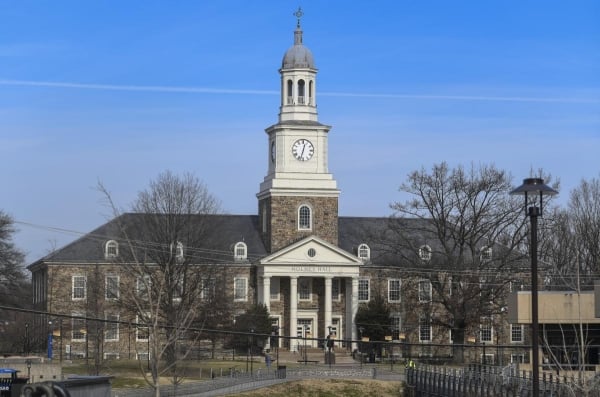
In 2020, Scott awarded the historically Black university in Baltimore $40 million, which went toward multiple research centers and endowed faculty positions, among other advancements.
Morgan State leaders announced that the new funding will help build the university’s endowment, expand student supports and advance its research.
David K. Wilson, president of Morgan State, called the gift “a resounding testament to the work we’ve done to drive transformation, not only within our campus but throughout the communities we serve.”
“To receive one historic gift from Ms. Scott was an incredible honor; to receive two speaks volumes about the confidence she and her team have in our institution’s stewardship, leadership, and trajectory,” Wilson said in the announcement. “This is more than philanthropy—it’s a partnership in progress.”
Philanthropist MacKenzie Scott donated $70 million to the United Negro College Fund last week. The funds will be distributed to private historically Black colleges and universities that are UNCF members.
The $70 million will be spread across 37 member institutions.
Scott’s donation contributes to UNCF’s goal of raising $370 million (as part of a larger $1 billion capital campaign) for a pooled endowment to be split across its membership. UNCF plans to distribute $5 million to each member and work with universities to raise matching funds, in the hopes of “creating a $10 million stake per institution,” with annual distributions of 4 percent.
“This extraordinary gift is a powerful vote of confidence in HBCUs and in the work of UNCF,” said Michael L. Lomax, president and CEO of UNCF, in a news release announcing the donation last week. “It provides a once-in-a-generation opportunity for our member institutions to build permanent assets that will support students and campuses for decades to come.”
Scott’s donation follows a $10 million gift to UNCF in 2020. Scott, the ex-wife of Amazon founder Jeff Bezos, also donated heavily to HBCUs and tribal colleges in 2020, giving away tens of millions of dollars to individual institutions, many of which have historically been underfunded.
We have a long history of working with Scott Jeffe during his time as the VP of research at RNL. Recently, Scott moved on from RNL to begin working as an independent higher ed market research consultant and adviser to universities. To learn more about the work that Scott does and to hopefully gain some insight into where things may be going with online and graduate programs, we asked Scott the following questions.
Q: Tell us about what it means to be an independent higher ed market researcher. What sort of projects do you work on? How does what you do for universities differ from the services available from traditional consulting firms?
A: In higher education, the best market research means more than just gathering data—it means showing up as a consultant. That’s something I’ve really learned throughout my career. Too often, I see research reports that are, frankly, hard to interpret or apply. The data might be sound, but it’s overly complex, the visualizations are unclear or the recommendations are disconnected from the realities of how colleges and universities actually operate.
I’ve had those moments—looking at a data visualization and spending several minutes just trying to figure out what it’s supposed to say. And I know that no dean, provost or president has the time to do that. I’ve also read plenty of conclusions that are technically accurate but completely impractical in the real-world context of higher ed. That’s the kind of disconnect that leads campus leaders to quietly shelve the report, walk away and think, “Well, that was a waste of money.”
That is exactly what my work today seeks to avoid. My research and consulting prioritize being more direct, actionable and grounded in higher ed’s current challenges. My work now spans both institutional consulting and national research, and I think that balance is part of what makes my approach effective. For example, I’ve recently completed national studies on graduate student expectations and mentorship, which give me insight into broader trends that I can then bring into highly tailored campus-level work.
Over the past six months, I’ve developed four core services designed specifically for this moment in higher ed—politically, economically and culturally. They’re affordable, practical and fast to implement. I don’t believe in one-size-fits-all solutions, but I do believe institutions deserve work that respects their time, their context and their need to move quickly on what matters.
That’s ultimately the difference between what I offer and what many vendors often provide. I’m not just delivering a report—I’m helping institutions make real decisions, grounded in both the data and the dynamics of higher ed today.
Q: What are the most significant challenges and opportunities for universities wanting to grow graduate and/or online enrollment today?
A: At the graduate level, one of the biggest looming challenges is the likely decline in international enrollment, which has quietly propped up graduate enrollment growth for the past several years. Under the Biden administration, we saw international graduate enrollment rise by more than 117,000 students—reaching over 500,000 total. Just last year, international students made up a full one-third of new graduate enrollments in the U.S., and over 200 institutions reported that international students represented more than 30 percent of their total graduate population.
But we have to be clear-eyed: Not only is that level of growth not sustainable, but decline is coming. Whether due to shifting geopolitics, visa policy changes or growing global competition, institutions will need to refocus their efforts on the domestic graduate market—and fast.
That said, there’s opportunity in the challenge. In fact, the current job market will likely nudge more adults to consider graduate study as a buffer or springboard during economic uncertainty. The catch? Institutions are now facing unprecedented competition. By some counts, we’re adding 800 new master’s programs each year. To grow—or even maintain—enrollment, institutions must have an acute understanding of what today’s graduate students expect. That means building a blueprint rooted in student preferences and behaviors and then aligning everything—program design, marketing, recruitment and support—around those insights.
That’s where much of my work comes in. Over the last two decades, I’ve helped institutions do exactly this through tools like my Scorecard and Playbook and the Audience Alignment Study, which zero in on how to position programs for today’s increasingly selective learners.
Now, on the online education side, the landscape is a bit more favorable at the moment—particularly due to the regulatory environment calming down. The Biden administration’s push to more heavily regulate online programs—particularly around OPMs and state reciprocity—has largely been shelved. That’s good news for smaller institutions, where online offerings often represent the best path to enrollment stability or growth. Interestingly, one of the unintended effects of that regulatory scrutiny is that OPM contract terms are now much more favorable than they were a few years ago. Institutions have more leverage.
In terms of opportunity, there are two major areas I’m watching closely. First, the long-discussed but rarely well-executed effort to serve the 30 to 40 million U.S. adults with some college and no credential is almost entirely an online opportunity. However, most institutions struggle to fully serve this group. The barriers tend to fall into three key areas: restrictive credit transfer policies, pricing models that remain out of reach and a misplaced assumption that these students will return to campus for their courses. Institutions that succeed here build fully online programs with wraparound support—advising, tech help, financial aid guidance—specifically designed for students who haven’t set foot on a campus in years. And when they do that, it doesn’t just help this population—it improves online education quality for everyone.
The second opportunity is more subtle but just as important: the increased demand from traditional undergraduates for access to online courses. While this isn’t online program growth in the classic sense, it presents a major advantage. A robust online course infrastructure doesn’t just support distance learners—it makes the entire campus experience more flexible, more attractive and more resilient. For institutions, that’s a strategic win across multiple audiences.
Q: How can universities better choose which programs to start and invest in and then grow enrollments to financially sustainable numbers?
A: At all levels, I think most institutions are doing a much better job now of integrating market data into their program decision-making. There’s a pretty direct line between the era when those insights were missing and the wave of program cuts we’re seeing now. For instance, Inside Higher Ed recently reported that Indiana’s public institutions have combined or eliminated over 400 programs that weren’t meeting fairly modest graduation thresholds. That’s a clear example of the consequences of earlier decisions made without solid market alignment.
When I work with institutions on program strategy, my role is really to facilitate a conversation that balances market data and institutional strengths. I bring the external perspective—labor market demand, competitor analysis, growth trends—and they bring the internal knowledge of what they’re truly good at. The goal isn’t just to chase hot programs, but to find areas where there’s strong or emerging market demand and where the institution already has expertise, capacity and visibility. That combination is where real opportunity lives.
Why take that approach? Because institutions need quick wins. We’re often working with limited time and resources and pressure to show results. If you can build momentum by improving or reconfiguring an existing program—something that already has a foundation—you get to impact faster and more cost-effectively. In fact, across dozens of program prioritization studies I’ve been involved in, I’ve rarely seen a proposed new program with more short- or midterm market potential than several underperforming existing ones. That’s why I usually recommend a 3-to-1 or 4-to-1 investment ratio favoring existing programs over net-new launches.
Once we identify the right programs to focus on, differentiation becomes key—especially in the online space, where commodification is a real concern. Institutions need detailed competitor intelligence, not just high-level benchmarking. We’re looking at how programs are positioned, how they’re structured and what messages they’re putting in front of students. That kind of granularity allows us to develop a true blueprint for differentiation—one that goes beyond clichés like “small class sizes” or “personalized attention” and speaks to what really sets a program apart.
And finally, with federal regulations increasingly focused on graduate outcomes and return on investment, it’s more important than ever to bake those metrics—job openings, wage growth, projected earnings—into the program planning process from the beginning. We’re entering a new phase where programs will be judged not just on academic merit or enrollment numbers, but on how they impact students’ long-term economic success.
So to me, the smartest institutions are those that align their strengths with market needs, invest in what they already do well and differentiate with purpose—grounded in real data.
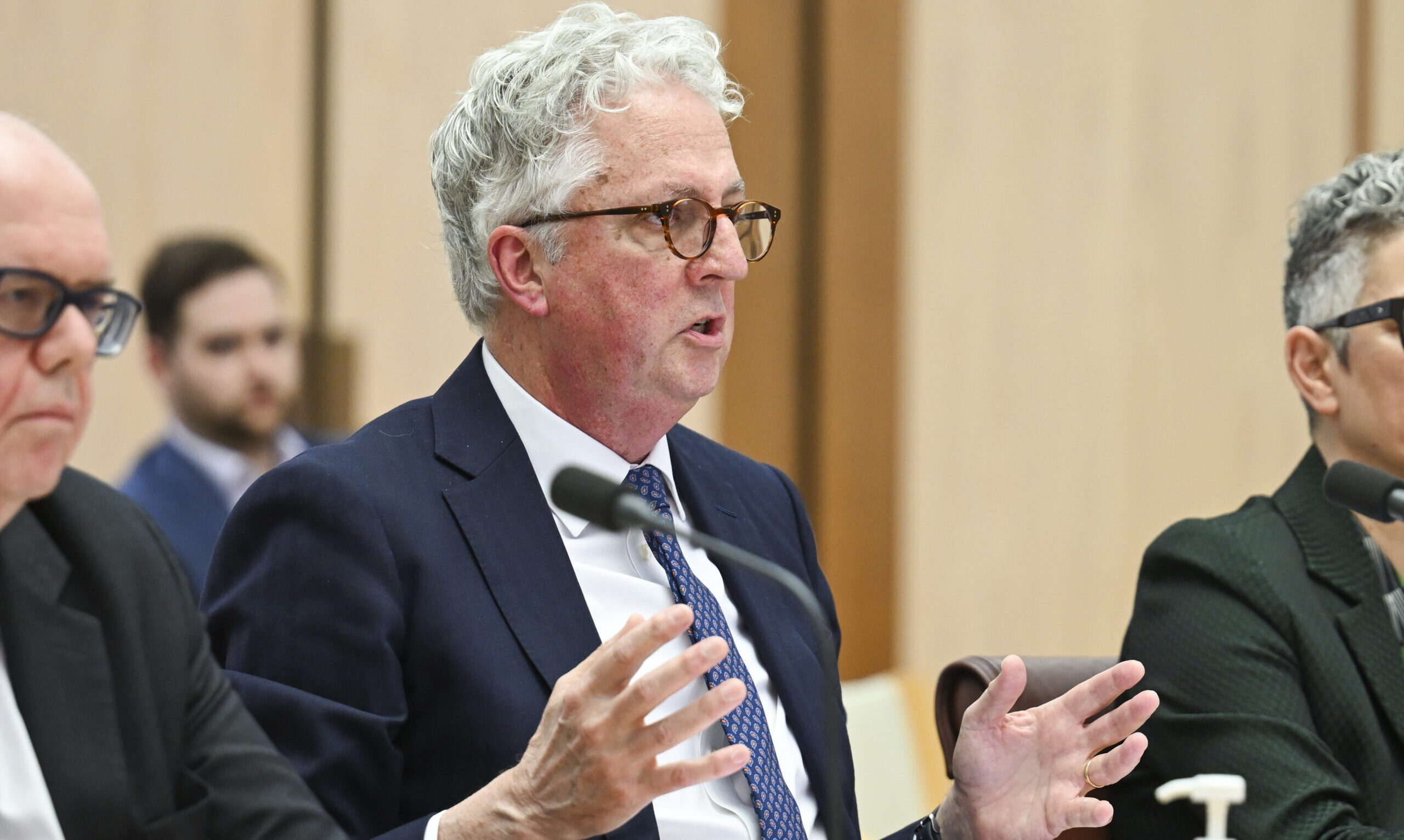
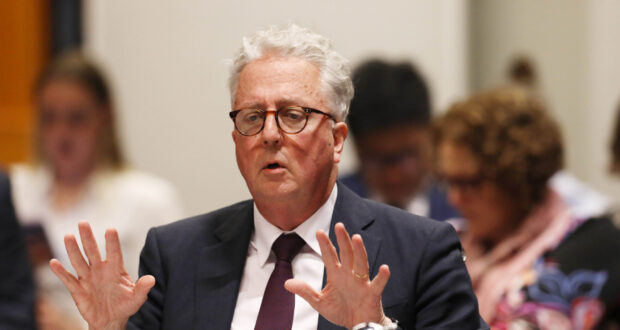
Mark Scott received a 150k pay rise last year. Picture: Martin Ollman
The University of Sydney (USyd) recorded a $500 million surplus in 2024 and boosted its vice-chancellor Mark Scott’s pay by $150,000 to a $1.349 million salary, its 2024 financial result showed.
Please login below to view content or subscribe now.
University of Sydney vice-chancellor Mark Scott reaffirmed that all international students are welcome at his university during a meeting of student unions on Wednesday.
Please login below to view content or subscribe now.