Tag: Search

  • What to Do When Your Job Search Stalls (opinion)

    What to Do When Your Job Search Stalls (opinion)

    Graduating into a tight job market can feel very daunting. You’ve invested years into your education and training, built strong skill sets, and followed the advice given by mentors and peers to make yourself competitive. So why aren’t the offers coming?

    If you find yourself in this situation, it’s normal to feel discouraged, demoralized or unsure of what to do next. Below are some steps you can take to help jump-start your job hunt by evaluating what’s working and identifying what might need adjusting so you can move forward and maintain momentum.

    Step 1: Evaluate Your Job Search Strategy

    Before making any major changes, start by examining your current approach.

    Are you submitting lots of job applications but not hearing back? This could be a sign that your application materials need refinement. Ask yourself: Are my CV or résumé and cover letter polished and tailored to each role? Am I clearly highlighting how my skills align with the job description? If you’re unsure, reach out to a professional in your field, mentor or career coach to review these materials and provide feedback.

    Are you getting interviews but not progressing to the next round or receiving final offers? This may signal that your interview approach needs improvement. Using structured interview methods, such as the STAR method (situation, task, action, result), can help you learn how to better organize your responses to highlight your experiences in a more focused manner. Practicing with a mentor or even a peer can help you identify gaps in preparation or missteps in how you present yourself. Many universities offer free career services, including mock interviews, to their students and alumni.

    In a competitive market, job searching also requires proactive strategies beyond submitting applications. I often see job seekers hyperfixate on tweaking applications that are already strong when their time would be better spent networking. Reach out to professionals, schedule informational interviews and make connections that help you uncover hidden opportunities and potentially receive internal referrals. These conversations can also help you better understand your target roles and the broader job landscape.

    Step 2: Broaden Your Search Strategically

    If networking and refining your materials isn’t enough, it may be time to broaden the types of jobs you’re considering. This doesn’t mean giving up on your long-term career aspirations; instead it means exploring bridge or adjacent roles that can help you stay on track while you continue to grow professionally. While bridge roles may not be your first choice, they can support future career moves by helping you gain relevant work experience, build new skills and expand your professional network.

    One way to identify bridge roles is to explore LinkedIn profiles of alumni and professionals in your field. Examining the positions they held after graduating and where they are now can help expand your list of possible bridge roles. Take this a step further during informational interviews by asking professionals about their knowledge of bridge roles. For example, a person targeting a medical science liaison role might ask an MSL in an informational interview, “I have been applying to MSL roles without any success; what other roles could help me work toward this path?” They might learn of opportunities in medical communications, clinical research or technical sales, positions that develop many of the same skills valued in MSL roles and often done by professionals before landing an MSL position.

    Bridge jobs can also provide financial stability while allowing you to build your skills. For example, I work with many students who aim to move directly into industry as scientists. However, if the job search stalls, an academic postdoc can be a strategic choice, especially when it aligns with building specific skills and provides much-needed income. One graduate I advised discovered through informational interviews that he would need additional expertise in advanced sequencing techniques to be competitive for the R&D roles he was targeting. He chose to take a two-year academic postdoc with a clear plan to build those exact skills, positioning himself for a stronger transition into industry while providing financial stability for his family. A postdoc can offer time to deepen your technical expertise, build a more competitive research portfolio and prepare for roles in biotech, R&D or other sectors.

    If you pursue a postdoc as a bridge role, be transparent with the postdoc mentor about your intentions. Take the earlier example of the graduate pursuing industry R&D roles. He was clear in communicating both the specific skills he needed to gain (RNA sequencing) and the time frame he would commit (two years). That kind of clarity helps establish shared expectations and ensures the postdoc experience is mutually beneficial for both you and the lab.

    Another important strategy for broadening your job search is to reflect carefully on your needs versus preferences. Needs are the nonnegotiables, such as visa requirements, caregiving responsibilities or a two-income household situation. A person’s preferences might include living in a specific city, having a certain job title or starting at a particular salary. While all of these are important to consider, being flexible on preferences can help you uncover new possibilities. Ask yourself: Are there geographic areas I’ve ruled out that might be worth reconsidering? Could I shift my salary expectations temporarily to get a foot in the door? Widening your criteria doesn’t mean compromising your goals; it’s a strategic step in reaching them.

    Step 3: Know When to Pivot

    If you’ve been searching consistently and not gaining traction, it may be time for a bigger strategic shift. Sometimes we become so focused on our initial ideas about our career that we overlook other options that could be equally or more fulfilling. Ask yourself: Could there be paths that better match my strengths or allow me to grow in ways my original plan didn’t? Have I overlooked opportunities that may better align with my values, interests or lifestyle goals as they are now?

    In the book Designing Your Life: How to Build a Well-Lived, Joyful Life (Knopf, 2016), authors Bill Burnett and Dave Evans suggest that being stuck can be a powerful launchpad for creativity and personal growth. They encourage readers to approach career planning as a design problem that benefits from curiosity, experimentation and iteration. One recommended exercise to stimulate curiosity is to brainstorm multiple career paths for yourself. Once you have your list of possible futures, you can then explore the most promising options through research and conversations with professionals in those roles.

    If you need help identifying new directions, the individual development plan can be a useful tool. Platforms such as myIDP or ImaginePhD offer exercises and assessments to help you identify your skills, interests and values and pinpoint career paths aligned with your results. These platforms also include resources to guide you toward researching and setting goals to reach a new path.

    Importantly, pivoting doesn’t mean giving up. It means recognizing that there are many viable paths available and you may end up at a better destination than originally planned.

    Managing the Emotions of Job Searching

    Job searching can take a real emotional toll, especially when it feels like you’re doing everything right and not seeing results. Many students feel intense pressure to secure a job after graduation, and when that doesn’t happen quickly, feelings of inadequacy can creep in. These feelings can make it harder to ask for help, reach out for support or even acknowledge how difficult the process has been. When the process feels overwhelming, shift your focus to what you can control. Set small, achievable goals each week to keep your momentum going during a slow-moving search. For example, set a goal of applying to a defined number of jobs, completing a short online course to build a new skill or attending a virtual or local networking event in your field.

    One trend I’ve noticed is that some students reach a point in which they are tempted to pay someone to “fix” the problem. If you are considering investing in paid career coaching, do your homework first. This should be a thoughtful decision, not an emotional reaction driven by frustration. Some paid coaches and services are legitimately helpful, but others overpromise results and prey on frustrated job seekers. Ask about outcomes, get referrals and make sure that their services align with your goals.

    Take Your Next Steps

    After reading this, you may have several new ideas or directions you are considering. To avoid feeling overwhelmed, start by writing down one microgoal you can complete in the next few days that is simple but still meaningful. For example, you might set up a meeting with a mentor, revise a section of your résumé or research a new role. Choose something that is doable and aligned with where you want to go. Small steps like these can really jump-start your progress.

    Even if it’s not going according to your original timeline, remember that the job search is a dynamic process. By keeping an eye on your long-term goals but remaining flexible, you’ll be open to the roles and experiences that can help you get there. Most importantly, give yourself credit for working the problem, pushing forward and continuing to put yourself out there.

    Raquel Y. Salinas is the assistant dean of career and alumni engagement at the University of Texas MD Anderson Cancer Center UTHealth Houston Graduate School of Biomedical Sciences. She is a member of the Graduate Career Consortium, an organization providing an international voice for graduate-level career and professional development leaders.

    Source link

  • USF Ditches Search Firm That Helped U of Florida Pick Ono

    USF Ditches Search Firm That Helped U of Florida Pick Ono

    Bryan Bedder/Stringer/Getty Images

    The University of South Florida has dropped SP&A Executive Search as the firm leading its presidential search, The Tampa Bay Times reported Tuesday. The move comes after the Florida Board of Governors rejected the candidate that SP&A had helped the University of Florida pick for its top job: former University of Michigan president Santa Ono, whom the UF board unanimously approved.

    Ono’s rejection came after conservatives mounted a campaign opposing him, citing his past support of diversity, equity and inclusion and his alleged failure to protect Jewish students.

    After that failed hire, Rick Scott, a Republican U.S. senator representing Florida, blamed SP&A, telling Jewish Insider that the firm didn’t sufficiently vet Ono.

    SP&A describes itself on its website as a “boutique woman- and minority-owned executive search firm.” Scott Yenor—a Boise State University political science professor who resigned from the University of West Florida’s Board of Trustees in April after implying that only straight white men should be in political leadership—highlighted that description in an essay he co-wrote, titled “How did a leftist almost become president of the University of Florida?”

    “We can only speculate about how the deck was stacked,” Yenor and Steven DeRose, a UF alum and business executive, wrote. “SP&A colluded with campus stakeholders, especially faculty, when they were retained. Together, they developed the criteria necessary to hire a Santa Ono.”

    They also pointed out that SP&A was leading the USF search. SP&A didn’t respond to Inside Higher Ed’s requests for comment Wednesday.

    USF didn’t provide an interview or answer written questions. In a June 20 statement, USF trustee and presidential search committee chair Mike Griffin said the university was now using the international firm Korn Ferry.

    “We value the expertise of our initial search consultant and thank them for their engagement,” Griffin wrote.

    Source link

  • High school sleuths search fish guts for clues to plastic pollution

    High school sleuths search fish guts for clues to plastic pollution

    NEW YORK — The fish, glassy-eyed and inert, had been dead for decades. Yet its belly held possible clues to an environmental crisis unfolding in real time.   

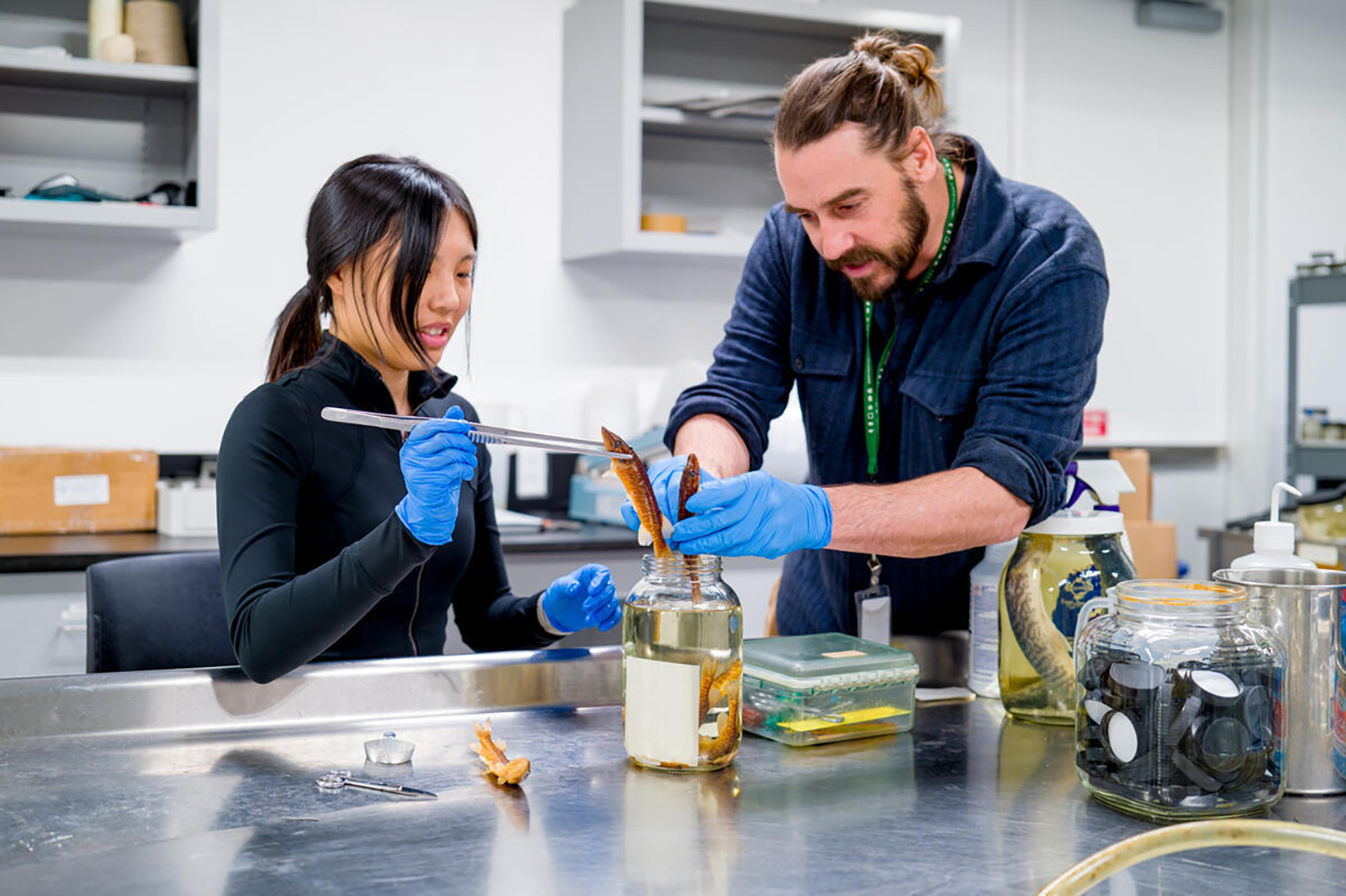
    Forceps in hand, Mia Fricano, a high school junior, was about to investigate. She turned over the fish, a bluegill, and slid in a blade, before extracting its gastrointestinal tract. Then, she carried the fish innards to a beaker filled with a solution that would dissolve the biological material, revealing if there were any tiny particles of plastic — known as microplastics — inside.

    Mia and two other high schoolers working alongside her in a lab this spring were part of a program at the American Museum of Natural History designed to give young people hands-on experience in professional science. Called the Science Research Mentoring Program, or SRMP (pronounced “shrimp”), the program enrolls roughly 60 high school juniors and seniors each year who collaborate with scientists on a research project. 

    Mia and her peers were matched with Ryan Thoni, an ichthyologist and curatorial associate in the museum’s division of vertebrate zoology. Thoni’s project to gather information on when and how microplastics began to enter the environment relied on the museum’s vast collection of fish specimens dating from more than a century ago — some 3.2 million in total.

    Concern about the tiny pieces of plastic debris has grown in the last few years, along with early-stage research on the health risks they pose. The particles are found in human blood, breast milk and even the brain — and in animals, including, as it turned out, nearly all the fish in Thoni’s lab.    

    “It was kind of shocking to see just how many we did find,” Mia said later. “We weren’t expecting to find more than two to three per fish but in some fish, we would find over 15.” Specimens from the 1970s or earlier were less likely to contain high levels of microplastic, more than three or so pieces, and fish near urban centers seemed to have more of the plastics, on average, than fish from less populated areas. 

    “It really does make you realize just how much the environment has been affected,” said Mia. “There hasn’t been a lot of research on it yet,” she added. “Our project might be able to help future people who are also doing research on microplastics.”  

    Related: Want to read more about how climate change is shaping education? Subscribe to our free newsletter.

    SRMP, started in 2009, is operating at a time when the federal government is eliminating fellowships and other support for early career scientists, and defunding scientific research broadly. That both amplifies the need for, and complicates the work of, programs like this one, said Amanda Townley, executive director of the nonprofit National Center for Science Education. Over the last 15 years in particular, such programs have played a big role in giving students a chance to do the kind of applied science that is rarely available in K-12 classrooms because of money and time constraints, she said. 

    “Museums, university extensions, sometimes libraries, have really done this tremendous job of creating spaces for high school and younger students to engage with scientists doing science,” said Townley. “Those museums, libraries and universities are all under attack.” She added: “We’re going to see a generational impact.” 

    While the American Museum of Natural History has received some federal government funding, the SRMP program’s money comes from private foundations and individual donors, with additional support from the New York City Council. Students in SRMP participate in a summer institute in August, when they learn basics like how to investigate research questions. Then they spend two afternoons a week during the school year on their projects. 

    Each student receives a stipend, $2,500 over the course of the year. “It’s really important for high school students to know their time is valuable,” said Maria Strangas, the museum’s assistant director of science research experiences. “They are doing something here that is really useful for the researchers; it’s an education program, but they aren’t the only ones who are benefiting.” 

    Students from New York City schools that partner with the museum can apply, as well as those who have participated in programs with the museum in the past. SRMP has also spawned a network of about 30 similar programs across the city, with institutions including Brooklyn College, Bronx River Alliance and many others participating. 

    In the lab on the sixth floor of the museum, Mia, who attends the New York City Museum School, cleaned out a beaker, while Yuki Chen, a senior at Central Park East High School, sat at a metal table, dissecting a pike. Thoni inserted a slide containing material harvested from one of the fish under a microscope, and pointed out a few microplastics, which looked like threads. 

    Ryan Thoni of the American Museum of Natural History, right, with high schoolers Mia Fricano (center) and Freyalise Matasar. Credit: Caroline Preston/The Hechinger Report

    Freyalise Matasar, a junior at the Ethical Culture Fieldston School in the Bronx, plucked a white sucker fish from a jar. She said SRMP had altered her career trajectory. Before the program, she was considering studying journalism in college, but her experience this year persuaded her to focus on engineering and data science instead. 

    “I have totally fallen in love with science,” she said. “It’s been an amazing experience to see what professional science looks like — and more than just see it, to be a part of it.”

    Freyalise said she wanted to build those skills in order to help fight climate change, perhaps by working on weather models to predict climate risks and ideally spur people to action. “It’s the biggest problem faced by our generation. It’s inescapable and unignorable, no matter how much people try,” she said. “It’s everyone’s responsibility to do what they can to fight it.”   

    Related: So much for saving the planet. Science careers, and many others, evaporate for class of 2025

    Microplastics contribute to climate change in several ways, including by potentially disrupting oceans’ ability to sequester carbon and by directly emitting greenhouse gases.

    Interest in climate science among young people is growing, even as the federal government tries to zero out funding for it. Other climate-related topics SRMP students explored this year included the climate on exoplanets, the ecology of sea anemones and aquatic wildlife conservation in New York City.

    Sometimes the fish dissections were gross: Mia, who plans to study biology and machine learning in college, sliced into one large fish to find poorly preserved, rotten innards — and a major stink. Sometimes they provided a lesson beyond pollution: Yuki identified a small pickerel inside a larger one. (Pickerels prey even on members of their own species, the students learned.) 

    The scientists in the program, most of whom are postdoctoral fellows, are trained on how to be effective mentors. “Scientists are often not trained in mentorship; it’s something that people pick up organically seeing good or bad examples in their own lives,” said Strangas. “A lot of it comes down to: ‘Think about the impact you want to have, think about the impact you don’t want to have, think about the power dynamic at play, and what this student in front of you wants to get out of it.’”  

    Thoni earned rave reviews from the students, who said he ensured they understood each step of the research process without being patronizing. 

    Thoni’s next steps include working to publish the microplastics research, which could earn the students their first co-authorship in a scientific journal. “Aside from forgetting to put on gloves,” he said in a playful jab at one student, “they can operate this machine on their own. They do science.”

    Contact editor Caroline Preston at 212-870-8965, via Signal at CarolineP.83 or on email at [email protected]

    This story about science careers was produced by The Hechinger Report, a nonprofit, independent news organization focused on inequality and innovation in education. Sign up for the Hechinger newsletter on climate and education.

    The Hechinger Report provides in-depth, fact-based, unbiased reporting on education that is free to all readers. But that doesn’t mean it’s free to produce. Our work keeps educators and the public informed about pressing issues at schools and on campuses throughout the country. We tell the whole story, even when the details are inconvenient. Help us keep doing that.

    Join us today.

    Source link

  • Measuring AI Density within the Evolving Search Marketing Landscape

    Measuring AI Density within the Evolving Search Marketing Landscape

    This fundamental shift demands a re-evaluation of how we evaluate, measure, and evolve our SEO and website marketing efforts. For higher education institutions, staying ahead of this curve isn’t just about visibility; it’s about connecting with prospective students in new and impactful ways.

    The world of Search Engine Optimization (SEO) is in constant flux, and never has this been more evident than in the current era of artificial intelligence. AI-driven search experiences are fundamentally shifting how prospective students search for schools and programs, and what worked yesterday won’t be enough to drive success going forward.

    Gone are the days when organic traffic and keyword rankings were the sole arbiters of SEO success. While still important, the reasons for their diminishing effectiveness are becoming increasingly clear:

    • Traffic is no longer a perfect proxy for exposure: With the rise of AI-powered search features like Google’s AI Overviews, users are increasingly finding answers directly on the Search Engine Results Page (SERP) without needing to click through to a website. This “zero-click” phenomenon means your content can provide value and influence prospective students even if it doesn’t result in a website visit. A high ranking might lead to less traffic if the answer is provided directly on the SERP, skewing traditional traffic metrics.
    • Keyword rankings don’t capture semantic understanding: AI excels at understanding natural language and user intent. While a keyword ranking tells you if you’re visible for a specific phrase, it doesn’t tell you if your content is truly satisfying the underlying need or being recognized as authoritative for a broader topic. Users are asking more complex questions, and AI is providing more nuanced answers, making a simple keyword ranking less indicative of true search performance.

    The Rise of AI Overviews and Our “AI Density” KPI Approach

    Google’s AI Overviews (formerly Search Generative Experience) are transforming how information is consumed. These AI-generated summaries appear prominently at the top of the SERP, synthesizing information from multiple authoritative sources to provide immediate answers.

    Google AI Overview example within a higher education SERP

    For higher education marketers, this means that even if a user doesn’t click on your link, your institution’s content can still be featured, influencing their perception of your brand and their enrollment decision-making. With this, it is necessary to expand your measurement framework to encompass new KPIs; one such KPI is AI density.

    AI density measures how often your institution’s content is cited or referenced within AI Overviews for relevant queries. This KPI goes beyond clicks, focusing on the ultimate visibility and attribution your brand receives within these AI-powered summaries. A high AI Density signifies that your content is considered a trusted and valuable source by AI models, driving more visibility among high-intent prospective students.

    How to Influence Your Website’s AI Density:

    • Optimize for authority and trustworthiness: AI models prioritize content from credible and authoritative sources. Focus on building E-E-A-T (Experience, Expertise, Authoritativeness, and Trustworthiness) through high-quality, in-depth content, expert authors, and strong internal and external linking.
    • Structure your content for AI readability: Use clear headings, concise answers to common questions, and structured data (schema markup) to help AI models easily understand and extract information from your pages.
    • Analyze source citations: Pay attention to which websites Google’s AI Overviews are sourcing their information from. Are you among them?

    Beyond the Click: Other Essential Modern SEO KPIs

    While AI density is a powerful new addition, a holistic view of your SEO performance in the AI era requires tracking a broader set of KPIs. Here are some that will become increasingly vital:

    • Search Share of Voice: This metric moves beyond individual keyword rankings to assess your institution’s overall visibility for a set of relevant topics or queries compared to your competitors. In the modern search landscape, this encompasses your website, your social media presence, your external brand mentions, and more.
    • On-Platform Visibility: Students are searching on more platforms than ever before, from social platforms like Reddit, YouTube, and TikTok, to chatbots like ChatGPT, Gemini, and Claude. Your SEO strategy needs to consider visibility on these platforms, and your KPIs should reflect your presence and engagement there.
    • Brand Search Volume: As AI provides direct answers, users may be exposed to your brand without visiting your site. Monitor branded search queries in Google Search Console and Google Trends. An increase in branded searches indicates growing brand awareness and recall, even if the initial search didn’t lead to a click.
    • Engagement Quality (Beyond Bounce Rate): Instead of solely focusing on bounce rate, delve into metrics that indicate true engagement. Look at “engaged sessions” in GA4, video views, downloads of resources, and repeat visits. These metrics show that your content is truly resonating with users, even if the conversion isn’t immediate.
    • Conversion Influence (aka Assisted Conversions): SEO’s role in the user journey is becoming more complex. It might not always be the last click, but it often initiates or assists a conversion. Utilize GA4’s attribution models to understand how organic search influences conversions further down the funnel, even if other channels get the “last click” credit.

    Adapting for the Future

    The shift in the SEO landscape is not a threat but an opportunity for marketers to become more strategic and meet prospective student needs more effectively. By evolving our KPIs to reflect the realities of AI-powered search, higher education institutions can gain a deeper understanding of their online performance and adapt their strategies to thrive.

    EducationDynamics is committed to helping institutions navigate this evolving digital terrain. By focusing on these modern KPIs, you can ensure your SEO efforts are not just about ranking for keywords, but about building genuine visibility, authority, and engagement in an increasingly intelligent search environment. Contact us to learn how we can support your strategy.

    Source link

  • AI Is Changing How Students Search: Will Your Website Show Up?

    AI Is Changing How Students Search: Will Your Website Show Up?

    AI is no longer a distant disruption. It’s already influencing how prospective students and families search, navigate, and make decisions on higher education websites. As teams responsible for delivering seamless digital experiences, we need to understand the behavioral shifts underway and how to respond strategically.

    Across the institutions we support, we’re seeing early but consistent signals: users expect smarter, faster, and more personalized interactions. These changes are subtle in some places and dramatic in others. But they’re accelerating.

    How AI is changing search behavior

    AI tools like Google’s Search Generative Experience (SGE), ChatGPT, and other large language models are changing how people expect to interact with information. According to a 2023 Pew Research study, 58% of U.S. adults are aware of ChatGPT, and younger audiences are among the most active users. Meanwhile, Google continues testing SGE, which presents AI-generated summaries above traditional search results.

    Students are learning to type full, natural language questions — and they expect precise, context-aware responses in return. This behavior is now showing up in on-site search patterns.

    Across higher ed websites, here are a few things we’re noticing:

    • A rise in long-form, conversational search queries, especially within internal site search tools
    • Increased use of search bars over menu navigation (particularly on mobile). A recent E-Expectations Trend report found that half of high school students use the site search to navigate a website.
    • Across the higher ed websites we support, we see stronger performance on pages that are tailored to high-intent topics like cost, admissions, and outcomes. A recent analysis of over 200 higher ed sites found that 53% of engaged sessions come from organic search — highlighting the importance of content that’s built for both SEO and AI-driven discovery.
    • Additionally, research indicates that 80% of high school juniors and seniors consider an institution’s website the most influential resource when exploring schools. This highlights the critical role of personalized and relevant content in engaging prospective students effectively.
    • These findings emphasize the necessity for higher education institutions to develop and maintain website content that is specifically tailored to the needs and questions of their target audiences to enhance engagement and support enrollment goals.
    • Parents and adult learners demonstrate similar behavior as they vet institutions with a clearer sense of goals and outcomes.

    Ready for a Smarter Way Forward?

    Higher ed is hard — but you don’t have to figure it out alone. We can help you transform challenges into opportunities.

    We still need to get the fundamentals right

    It’s important to say: AI-driven search doesn’t eliminate the need for strong site structure. Navigation menus, clear page hierarchy, and thoughtful content design still matter — a lot. Most users move fluidly between browsing and searching. What’s changing is the expectation for speed, relevance, and control.

    To meet this moment, higher ed websites should focus on:

    • Modernizing internal search tools to move beyond keyword matching and support relevance-based or semantic search with tools like Vertex AI in full-site search tools or even program finders.
    • Designing content around user intent, not just institutional priorities. Emphasize topics that students are searching for — like affordability, flexibility, and outcomes — rather than internal program structures or catalog-style descriptions.
    • Making calls to action easy to find and easy to act on (especially for first-time visitors.) We help partners optimize for conversion with AB testing for placement, messaging, and functionality that best resonates with your audience.
    • Better leveraging personalized and dynamic content to deliver tailored experiences based on user behavior, location, or stage in the journey. For instance, high-intent pages like “How to Apply” can be leveraged to serve personalized content blocks based on the visitor’s context. A returning user who previously viewed graduate programs might see a prompt to schedule a call with a graduate admissions counselor. A visitor browsing from New York in the evening hours could be shown a message about flexible online options for working professionals. These dynamic cues guide prospective students forward in their journey without overhauling the entire site.

    Why this isn’t a one-time fix

    This is not a single redesign or one-time upgrade. Optimizing your site for how people actually use it needs to be a continuous process.

    This should include the following:

    • Reviewing analytics and user behavior regularly
    • Conducting search query audits to identify gaps
    • A/B testing calls to action and user pathways
    • Collecting both qualitative and quantitative research to understand different audience needs

    Higher ed website performance is directly tied to enrollment growth. According to a 2024 survey conducted by UPCEA and Collegis Education to better understand the perspectives of post-baccalaureate students, 62% of respondents said not being able to easily find basic program information on the institution’s website would cause them to disengage.

    The survey focuses on program preferences, delivery methods, and expectations during the inquiry and application processes and offered insights into how these preferences vary by age and degree level.

    How to prepare for what’s next

    To stay competitive and relevant, institutions need to invest in both smart search experiences and a streamlined digital journey. Here are some high-level recommendations:

    1. Audit your internal search functionality. How are users searching your site, and are they getting the right results?
    2. Map user journeys for key audiences. This includes traditional students, adult learners, and family decision-makers.
    3. Evaluate AI integration options. Tools like Google’s Vertex AI or other semantic search platforms can enhance search accuracy and personalization.
    4. Don’t overlook AEO (answer engine optimization). As AI-powered tools reshape how students discover and evaluate schools, it’s time to think beyond traditional SEO. AEO focuses on structuring content to directly answer the natural-language questions students now ask in tools like ChatGPT and Google’s SGE. We can help you begin integrating AEO into your strategy and content planning, so your institution stays visible in the next wave of search.
    5. Treat optimization as ongoing. Staying competitive in the AI era requires continuous improvements grounded in data, user behavior, and evolving search trends. Ongoing commitment to this initiative is crucial.

    Smarter web experiences start now

    The future of higher ed websites isn’t just about making information accessible. It’s about making it findable, meaningful, and actionable – and being able to act fast and stay committed to this work.

    Institutions that recognize how AI is already reshaping user expectations, and respond with thoughtful, strategic digital experiences, will meet today’s learners where they are and build trust for the long-term.

    We’re paying close attention to these shifts and helping institutions make smart, scalable updates. If you’re rethinking how your website supports recruitment, engagement, or conversion, now is the right time to start. Collegis Education supports institutions with strategic marketing and web solutions designed to meet these evolving needs.

    Let’s talk about how we can work together to future proof your web and digital experiences to best support enrollment growth for years to come. 

    See how your website stacks up — Contact us to request your AI Readiness Assessment

    Innovation Starts Here

    Higher ed is evolving — don’t get left behind. Explore how Collegis can help your institution thrive.

    Source link

  • A Timeline for Job Search Success (opinion)

    A Timeline for Job Search Success (opinion)

    One of the most common questions I get from Ph.D. students and postdocs is “When should I begin my job search?” Most of the time, they are referring only to the application process—they are asking when they should start actually applying for jobs. While I generally recommend applying three to four months before you are available to start, the job search itself should begin much earlier. There is a lot of information and data that you need to gather in advance so that you are well positioned to recognize that a job is a good fit and make an informed decision with confidence.

    I see a lot of similarities between the job search and the way you might approach committing to a large purchase such as that of a car or home: The more research and preparation you do, the more confident and informed you’ll be when the right opportunity comes along.

    Like a house, a job needs to align with your values, interests and goals. However, compromise is inevitable. Just as home buyers must balance their wish list with budget constraints and market realities, job seekers must consider factors such as location, salary, job stability and growth potential. A strategic, long-term approach ensures that when the ideal opportunity presents itself, you can recognize it and act decisively.

    That said, it’s important to recognize that in both job searching and home buying, there are many variables we can’t control. Many Ph.D. students and postdocs I speak with are understandably concerned about the uncertainty of the job market they’ll be entering into in light of federal employee layoffs and university hiring freezes. This is unfortunate but makes long-term, careful planning all the more important.

    The House-Hunting Approach to Job Searching

    When I was a postdoc, my husband and I wanted to buy our first home. Initially, I had a long list of must-haves: a safe neighborhood close to work, hardwood floors, a spacious updated kitchen, three bedrooms, two bathrooms, a fireplace, a deck, a two-car garage and a lush yard for gardening. We determined our budget and began our search.

    For six months, we attended open houses and scoured online listings, refining our expectations along the way. We learned what features were common in our price range and which ones were unrealistic. We adjusted our priorities, and when we finally found the right home, even though it wasn’t exactly what we had first envisioned, we were confident in our decision because of the knowledge we had gained along the way.

    The job search follows a similar process. The more job descriptions you analyze and the more people you talk to, the more attuned you become to industry norms, required skills and job value. This preparation allows you to confidently apply and evaluate offers, just as a seasoned home buyer recognizes a great deal when they see one.

    To best position yourself for success, your job search should start long before you submit applications. Here’s a suggested timeline.

    More Than One Year Out: Laying the Foundation

    • Identify your career interests: Before house hunting, you need a vision for your ideal home. Likewise, before applying for jobs, you need a clear sense of your desired career path. If you’re unsure, conduct informational interviews to learn from professionals in different fields. Ideally, these conversations would be taking place throughout your graduate and postdoctoral training. More about informational interviewing can be found at Live Career. Resources such as MyIDP (for the sciences) and ImaginePhD (for humanities and social sciences) can help you explore career options. Vanderbilt University’s “Beyond the Lab” video and podcast interview series explores a variety of biomedical career paths, and InterSECT Job Simulations offers job simulation exercises to help Ph.D.-level scientists and humanists learn about various career options. Finally, the Propelling Careers podcast is another resource I would recommend that provides valuable insights into career exploration topics and the entire job search process.
    • Build your professional presence: Just as no one starts house hunting without securing their financing and mortgage pre-approval, you shouldn’t enter the job market without your professional documents ready. A strong, polished application package is like a solid financial foundation—it ensures you’re taken seriously and can move quickly when the right opportunity appears.

    Prepare your CV or résumé well in advance, tailoring it to the roles you’re considering. The National Institutes of Health Office of Intramural Training and Education has a great resource for these on their website. For jobs outside of academia, you will need a résumé, and this can take time to do well. Seek feedback from colleagues and career advisers to refine it. An up-to-date and well-crafted résumé also can be extremely valuable when you are conducting informational interviews to share with the professionals you meet; they will understand your background better, can provide feedback and may pass your document along to hiring managers.

    Updating your LinkedIn profile is equally important—it serves as both your online résumé and a networking and research tool. A polished LinkedIn profile increases your visibility and credibility within your target industry.

    One Year Out: Researching the Market

    • Track job postings: A year before you plan to transition, start monitoring job postings, just as you would start researching and looking at houses online and driving through neighborhoods. Save descriptions of roles that interest you and analyze them for common themes. This practice helps refine your job search keywords and informs the skills you should highlight on your résumé.
    • Identify skill gaps: By analyzing job descriptions early, you may discover missing skills that are crucial for your target roles. By recognizing this in advance, you can take online courses, join organizations or gain hands-on experience to strengthen your qualifications before applying.
    • Prepare for additional requirements: Depending on the field, you may be asked to share a writing sample or coding project. If you’ve been preparing throughout the year, you won’t be caught off guard.
    • Experiment with AI assistance: AI tools like ChatGPT can help analyze job descriptions to identify key themes and skills. They can also provide feedback on your résumé and help tailor application materials to specific roles.
    • Be open to exceptional opportunities: Occasionally, a job posting might appear that is a perfect fit—what I call a “Cinderella’s slipper” job. Even if it’s earlier than your planned timeline, consider applying or reaching out to someone in the organization. Expressing interest might open doors for a future opportunity.

    Three to Four Months Out: Start Applying

    • Start submitting applications: At this stage, it’s time to actively apply for jobs while continuing to network. Informational interviews remain valuable, as many jobs are never publicly posted. Take this time to reach back out to the contacts you have made over the past year or so to let them know you are on the market.
    • Tailor your application materials: Customize your résumé and cover letter for each application, incorporating language from the job description to highlight your fit. If the application allows an optional cover letter, always include one—it may be the deciding factor between you and another equally qualified candidate.
    • Leverage networking for hidden opportunities: Identify organizations of interest and connect with employees to learn more. This proactive approach often leads to learning about openings before they’re publicly listed. We’ve all heard stories of people reaching out to homeowners with letters expressing interest in a house—even if it’s not for sale—hoping the owners might consider selling in the future.
    • Secure references: Consider who can provide strong recommendations. Reach out in advance to confirm their willingness to serve as references and keep them updated on your search.
    • Keep a job search log: Maintain a spreadsheet to track applications, including submission dates, job descriptions and tailored résumé and cover letter versions. This record will be invaluable when preparing for interviews and following up with employers.

    Conclusion: Finding Your Dream Job

    Job searching is a complex and important decision-making process, one that also has to remain flexible in light of changing market conditions and unique personal constraints. Just as home buyers don’t purchase the first house they see, job seekers shouldn’t rush into the first opportunity that arises. A strategic job search, like a well-planned home-buying journey, requires research, patience and flexibility. By starting early, refining your criteria, and actively engaging with your field, you’ll be well prepared when the right job—your “dream home” in the professional world—becomes available. With knowledge and preparation, you can confidently apply, interview and accept an offer, knowing you’ve found the right fit for this stage of your career.

    Ashley Brady is assistant dean of biomedical career engagement and strategic partnerships and associate professor of medical education and administration at Vanderbilt University in the School of Medicine’s Biomedical Research, Education and Training Office of Career Development ASPIRE Program. She is also a member of the Graduate Career Consortium—an organization providing a national voice for graduate-level career and professional development leaders.

    Source link

  • Search for Higher Ed Legislation Proposed in Congress

    Search for Higher Ed Legislation Proposed in Congress

    Welcome Inside Higher Ed‘s legislation tracker, a database of the key higher-ed related bills lawmakers have proposed in Congress. Few will likely become law, but the proposals offer insights into how Republicans and Democrats want to reshape the sector.

    So far, lawmakers have proposed 31 bills that would directly impact colleges and universities.

    You can search the database below to learn more about each proposal. The current session of Congress runs through the end of 2026 which means this list will grow. We’ll update the database regularly, so please check back for updates.

    Questions, comments or think we’re missing a bill? Email [email protected].

    The database was last updated March 20.

    More Coverage of Higher Ed and Congress:

    Source link

  • Three States Weigh Changes to Presidential Search Processes

    Three States Weigh Changes to Presidential Search Processes

    Three states are considering changes to how public universities hire presidents via legislation to provide more, and in the case of Utah, less transparency in executive searches.

    Florida, Utah and Washington are all weighing changes, driven by state legislators in response to recent presidential searches. In the case of Florida, the move comes after the state, known for broad open records laws, revised presidential search processes in recent years in ways that narrowed transparency, which was followed by an influx of hires connected to conservative politics.

    Evergreen State legislators have proposed the changes following closed-door presidential searches at both the University of Washington and Washington State University, which they argue lacked adequate transparency because finalists were not named during the process. (However, they’ve backed off an initial bill to require universities to name finalists.)

    In Utah, lawmakers have crafted legislation to limit information on presidential searches. Current state law requires public universities to release the name of three to five finalists for presidential positions, but that could change with only a single finalist unveiled at the end of the search.

    The legislative proposals reflect a broader debate over how much transparency should be built into presidential searches and the politics of hiring processes.

    Florida’s Proposed Reversal

    The Florida Legislature passed a bill in 2022 that allowed institutions to keep the identity of applicants secret until a university identified three finalists. The change marked an about-face from prior practices, in which lists of applicants were released as part of presidential searches.

    Although the law passed in 2022 charged universities with naming three finalists, in practice it has often meant that institutions only release the name of one applicant at the end of the process. And since the passage of that legislation, Florida has tapped numerous Republican lawmakers to lead public universities, including former Nebraska U.S. senator Ben Sasse at the University of Florida, who stepped down after less than 18 months amid questions about his spending.

    Since Sasse’s exit, critics have alleged UF’s board missed or ignored multiple red flags.

    Governing boards have hired numerous other Republican former lawmakers to lead institutions since 2022. Recent hires include Adam Hasner at Florida Atlantic University, Jeanette Nuñez at Florida International University (who stepped down as lieutenant governor to take the job), Richard Corcoran at New College of Florida, Fred Hawkins at South Florida State College, Mel Ponder at Northwest Florida State College and Torey Alston at Broward College.

    In a statement on why she filed the bill to open search processes, Florida representative Michelle Salzman, a Republican, wrote that the legislation would ensure “our higher education institutions are governed in a transparent and ethical manner, with the best interests of our students and taxpayers as the guiding principle.”

    To Judith Wilde, a research professor at George Mason University who studies presidential searches and contracts, the bill seems like backlash to Republican governor Ron DeSantis, who many critics allege has used a heavy hand in installing GOP officials as college presidents.

    “They are definitely moving away from the more secretive and controlled processes that they’ve been under for the last few years. I’d say that is because so many people now are tired and upset with DeSantis putting in place his personal choices and how badly that has worked out,” Wilde said.

    Last year, the Florida Board of Governors also gave itself more authority over presidential searches, adopting a policy that requires its chair to approve a list of finalists before candidates are submitted to individual governing boards. That would go away under proposed legislation.

    The Florida Board of Governors did not respond to an inquiry about its position on the bill.

    Washington Backtracks

    Washington lawmakers initially proposed changes to how presidential searches are conducted with a bill that would require public universities to name “up to four priority candidates” for the job. But lawmakers backed off that idea, submitting a substitute bill that would expand voting rights for students and faculty on presidential searches, but not require finalists to be named.

    University of Washington officials had expressed concern about the initial proposed legislation, arguing that UW could lose highly qualified candidates if they can’t keep names confidential.

    “It’s important to understand that sitting presidents or chancellors participate in these processes at considerable professional risk. There may be reputational damage up to termination, even if their candidacy is unsuccessful, should their present employers learn that they are pursuing other employment,” Blaine Tamaki, chair of UW’s Board of Regents, wrote in a statement.

    A UW spokesperson also pointed to fallout in 2020 in the University of Alaska system when then-president Jim Johnsen stepped down after he emerged as the sole finalist to lead the University of Wisconsin system. Johnsen withdrew from the Wisconsin search after criticism that the process lacked transparency. He then resigned from the Alaska presidency mere weeks later.

    (Johnsen’s tenure at Alaska was heavily scrutinized while he was there, however, and many students and faculty members expressed relief that he planned to leave for another job, which Wilde suggested was more of a factor in his abrupt exit than his candidacy for the Wisconsin position.)

    Washington State University had also expressed concerns about the initial bill.

    “Specifically, we were apprehensive about losing strong candidates who would be unwilling to make their names public before a selection was announced,” a Washington State spokesperson wrote to Inside Higher Ed by email. “There is a very real concern for some candidates that they would lose their effectiveness at their home institutions if it became public that they were exploring employment opportunities elsewhere. This is particularly true for sitting presidents.”

    Washington State has expressed support for the new bill.

    Opacity in Utah?

    State Senator Chris Wilson, the Utah Republican who sponsored the bill to overhaul presidential searches, has argued the law needs to be changed so public universities don’t lose quality candidates who are unwilling to go through a process that exposes their identity.

    The Utah legislation seems at least partly inspired by Elizabeth Cantwell exiting the presidency at Utah State University last month to take the top job at Washington State.

    Wilson has pointed to Cantwell departing for Washington State as an example of why the bill is needed. Last month, in a House Education Committee meeting, Wilson stressed the need for confidentiality in searches and argued, “There’s no way the president of Utah State University would have applied for the presidency of Washington State if it wasn’t a private process.”

    Utah commissioner of higher education Geoff Landward has cast doubt on the notion that public universities in the state have lost applicants due to current processes.

    “I can confidently say that we have not had a single search wherein we were talking to very high-quality candidates who essentially said that they would be interested and willing to apply, were it not for the fact that the final three candidates would have to be public because that would put their current employment in peril unnecessarily,” Landward told lawmakers in February.

    But, he added, “This is a question of who did we not get to consider?”

    Wilde is skeptical of Utah’s proposal. She points to an example at Montana State University in 2019 when President Waded Cruzado informed the board that she was being recruited for another job. In response, the board gave Cruzado a $150,000 pay raise to entice her to stay—and it worked.

    “Just because they’re in the job market doesn’t necessarily mean that they want to leave the university,” Wilde said. “And if they’re doing a good job, make the effort to keep them.”

    Source link

  • Dr. Jennifer T. Edwards: A Texas Professor Focused on Artificial Intelligence, Health, and Education: Use Google Trends for FREE Search Engine Keywords

    Dr. Jennifer T. Edwards: A Texas Professor Focused on Artificial Intelligence, Health, and Education: Use Google Trends for FREE Search Engine Keywords

    I really like using Google Trends for almost EVERYTHING! I use Google Trends for creating news articles, blog posts, course syllabi, and even when designing graphics!

    Here’s a video that I created about Google Trends – an amazing FREE technology!

    Exploring Google Trends is one of the best ways to discover social media topics and ideas for posts. Here’s a quick video focused on how to use Google Trends for Content Generation.

    Check it out! You can use Google Trends for everything from education to community engagement. Also, these are great for governmental outreach and engagement as well (depending on the search terms within your community).

    ###

    Try this campaign! Also, there are more campaigns available in my book – Retaining College Students Using Technology: A Guidebook for Student Affairs and Academic Affairs Professionals.

    Remember to order copies for your team as well!

    Thanks for visiting! 


    Sincerely,


    Dr. Jennifer T. Edwards
    Higher Education Speaker and Researcher


    My Social Media Channels!
    Remember to Follow Me on Twitter! @drjtedwards
    I Always Post Higher Education Videos on YouTube
    Find Me on Instagram
    Engage with Me on Facebook!
    Watch My Videos on Twitter Live – http://www.periscope.com/drjtedwards/
    Email Me! I am PR Friendly! – [email protected]


    Source link