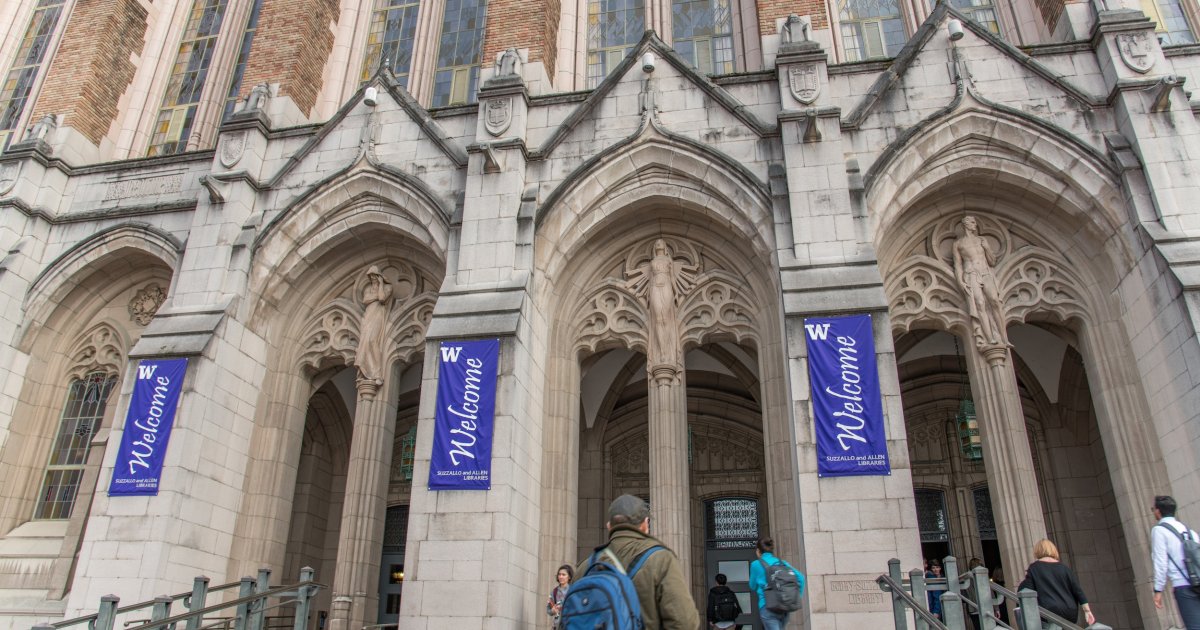
Amid the urban hum of downtown Seattle and the friendly clatter of a FIRE supporters’ meetup, a consequential alliance was born.
Two alumni of the University of Washington, separated by generations but united by a shared purpose, converged in conversation. Cole Daigneault, a freshly minted graduate from the class of 2024, and Bill Severson, a two-time UW graduate who earned his bachelor’s and law degree in the early 1970s, lamented over the encroaching illiberalism at their alma mater.
That evening’s conversation, later sustained through an alumni email listserv, soon crystallized into Husky Alumni for Academic Excellence.
This new, independent UW alumni group has articulated a mission that is ambitious yet essential: “To reinvigorate free and open academic inquiry and to foster a campus ethos where civil discourse and intellectual courage flourish.”
“My hope with this alumni group,” Daigneault says, “is to rally former UW students, who like me, are concerned about the culture of discourse on campus. The group will also be a place for graduated students to continue the fight long after they leave.”
Daigneault’s early activism was catalyzed by the controversy surrounding UW professor Stuart Reges, whose parody land acknowledgment and subsequent legal battles with the university became a major flashpoint in the free speech landscape. Inspired by Reges’ story — and FIRE’s robust defense of him — Daigneault founded Huskies for Liberty in 2022, a UW student organization devoted to “the preservation of free expression and individual liberty on campus and beyond.”
The fight for free speech on campus, as history has long demonstrated, is never truly won. It must be waged anew by each generation.
Furthermore, through FIRE’s Campus Scholar Program, Daigneault organized “Free Speech Matters,” UW’s first student-led conference devoted to the enduring relevance of free speech, civil discourse, and academic freedom.
Alongside Daigneault, Bill Severson brings over a half-century of legal experience and an unabiding love for his alma mater. His concerns over the state of higher education were sparked by the 2017 debacle at Evergreen State College, where an angry mob of students confronted Professor Bret Weinstein for publicly objecting to a proposal that white students and professors leave campus for Evergreen’s annual “Day of Absence.”
“I was appalled by how that situation was handled,” Severson recounts. “It led me to explore thinkers like Jonathan Haidt and Steven Pinker and organizations like FIRE.”
Severson’s recollections of his time in school are colored with a mixture of nostalgia and grave concern. “When I attended UW in the late 1960s and early 1970s, the atmosphere on campus was markedly different than today. Then, as now, students and faculty leaned left, but it was not a monoculture and there was not such a marked intolerance of other viewpoints.”
The emergent partnership between Daigneault and Severson is not only remarkable, it highlights an enduring truth: The defense of free speech on campus is not a transient endeavor but a generational relay, requiring both the vigor of youth and wisdom of age. One without the other is as useful as a compass without a needle.
Daigneault and Severson’s decision to form Husky Alumni for Academic Excellence is timely, to say the least.
“Last year, free speech became a major campus issue due to widespread protests over the Israel-Hamas War,” Daigneault recalls. “Unfortunately, alongside many instances of protected expression, we also saw a rise in illiberal behaviors, such as shouting down speakers, preventing students from accessing public areas, and even vandalizing historic buildings on campus.”
Daigneault’s reflections are not mere anecdotes. They are substantiated by FIRE’s reports. UW has consistently languished near the bottom of FIRE’s College Free Speech Rankings (in 2022, UW was the lowest ranked public university). And 2024 was not much better: UW ranked 226 out of 257 schools.
The data is grim:
- 71% of students believe it is sometimes acceptable to shout down a speaker.
- 30% think using violence to silence a speaker is sometimes acceptable.
- 50% admit to self-censoring on campus at least once or twice a month.
Among the faculty and administration, the picture is scarcely brighter. According to FIRE’s 2024 Faculty Survey Report, over one-third of UW faculty respondents confessed to moderating their writing to avoid controversy, while 40% expressed uncertainty about the administration’s commitment to protecting free speech.
FIRE to Congress: More work needed to protect free speech on college campuses
News
FIRE joined Rep. Murphy’s annual Campus Free Speech Roundtable to discuss the free speech opportunities and challenges facing colleges.
For Severson, the conclusion is clear.
“Educational institutions have lost their way,” he says, though he insists there is still hope. “Alumni can be a force to push schools back toward their mission — promoting honest inquiry, academic excellence, the pursuit of truth, and the dissemination of knowledge.”
In the burgeoning movement of alumni stewardship, Daigneault and Severson offer a clarion call to UW alumni who not only revere the university’s storied past (UW is one of the oldest universities on the West Coast), but also seek to reclaim it against the present maladies of orthodoxy and intellectual timidity.
The fight for free speech on campus, as history has long demonstrated, is never truly won. It must be waged anew by each generation. Daigneault and Severson have valiantly taken up the mantle. The question remains, who will join them?
If you’re ready to join Husky Alumni for Academic Excellence, or if you’re interested in forming a free speech alumni alliance at your alma mater, contact us at [email protected]. We’ll connect you with like-minded alumni and offer guidance on how to effectively protect free speech and academic freedom for all.