

Every admissions CRM contains a neglected segment: inquiries who downloaded a viewbook, began an application, attended a webinar, or requested program information, then disengaged. Over time, these records accumulate and are often written off as lost opportunities.
The typical response is to increase acquisition activity, launch another broad campaign, or invest further in top-of-funnel media. Yet in today’s enrollment funnel, acquisition costs continue to rise. Reactivation is often the more efficient growth lever.
A well-structured student lead re-engagement campaign enables institutions to recover dormant interest without damaging sender reputation, improve ROI across the recruitment funnel, and convert marketing-qualified leads without increasing ad spend. When grounded in behavioral segmentation and lead scoring, reactivation efforts can shorten time to application and strengthen overall CRM performance.
The difference between spam and strategy is not volume. It is segmentation, timing, and message design. This article outlines how to build a reactivation campaign rooted in behavioral data, admissions CRM logic, and practical enrollment outcomes.
Do you need help strengthening your lead nurturing?
Our expert digital marketing services can help you attract and enroll more students!
What Is a Re-Engagement Campaign in Higher Education?
A re-engagement campaign is a structured marketing automation workflow designed to reconnect with prospective students who previously showed interest but have since become inactive within the admissions CRM.
In higher education recruitment, inactivity may include no email engagement for 60 to 120 days, stalled application progress after initial inquiry, event attendance without subsequent action, partial application abandonment, or incomplete program inquiry submissions.
These signals indicate friction, shifting priorities, or unresolved objections, not necessarily a loss of interest.
A student lead re-engagement campaign is not a generic “we miss you” message. It is a targeted intervention triggered by behavioral data and aligned with the prospect’s position in the enrollment funnel. Messaging, timing, and offer design are tailored to the specific barrier identified, whether informational, financial, academic, or motivational.
When executed strategically, re-engagement strengthens lead nurturing for higher education and improves conversion efficiency without expanding acquisition spend.
Why Re-Engagement Matters More in 2026
Institutions across North America are operating in a more complex recruitment environment. Paid media costs continue to rise. Privacy restrictions limit granular tracking. Decision cycles are longer. Prospective students compare more programs, more formats, and more institutions before committing.
Capturing an inquiry is no longer the finish line. It is the starting point.
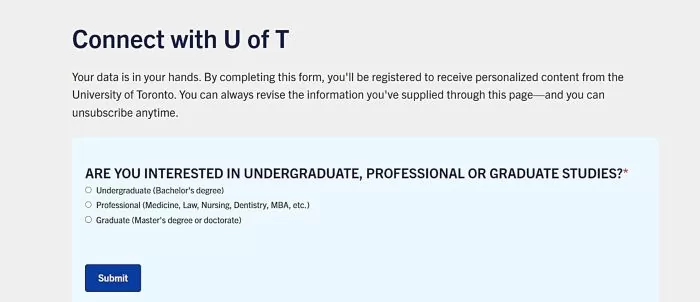
Example: The University of Toronto uses a program-discovery and program-level content structure (“program-specific landing pages” in practice) and pairs it with a formal inquiry capture pathway: the “Connect with U of T” form registers prospects for personalized content and explicitly allows them to revise submitted info and unsubscribe.
Source: University of Toronto
However, inquiry volume alone does not ensure progression through the enrollment funnel. Without structured follow-up, early engagement dissipates.
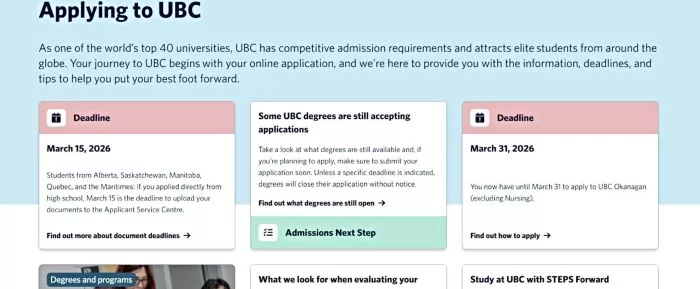
Example: The University of British Columbia uses a stage-based application guidance architecture that organizes admissions content by applicant phase and clearly separates steps, requirements, and timelines within the enrollment process. Its Applying to UBC hub structures progression logic so prospects understand exactly where they are and what comes next. For a re-engagement strategy, this model makes it easier for admissions teams to identify where a student stalled, trigger stage-specific reactivation messaging, and reduce friction by clarifying next steps rather than sending generic reminders.
Source: University of British Columbia
This reflects a core reality: engagement is cyclical. Prospects move forward, pause, reassess finances or program fit, explore alternatives, and often return.
A strong student lead re-engagement campaign acknowledges this behavior. Instead of assuming silence equals disinterest, it treats inactivity as a predictable phase within the enrollment journey and plans targeted interventions accordingly.
Step 1: Segment Before You Send
The most common mistake in student lead re-engagement campaigns is batch-and-blast outreach. Dormant leads are not a single audience. They paused at different points, for different reasons.
Instead, build behavioral segmentation rules based on:
1. Funnel Stage
- Inquiry only
- Application started
- Application submitted
- Offer received
- Deferred
Each stage requires different messaging. An inquiry-stage prospect needs program clarity and reassurance. A deferred applicant may need deadline reminders or financial guidance.
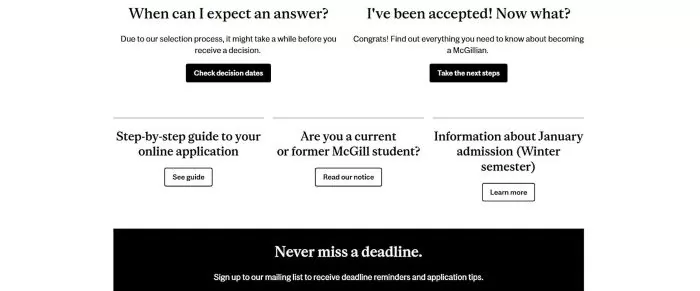
Example: McGill University structures its admissions experience around clearly segmented applicant and admitted student pathways, differentiating communications and content based on enrollment status. Through its Undergraduate Admissions Apply hub, McGill separates application instructions from admitted student next steps while clearly outlining documentation requirements and procedural expectations. For a re-engagement strategy, this model enables precise funnel-stage segmentation within the CRM, prevents misaligned messaging between applicants and admitted students, and supports targeted reactivation campaigns based on a prospect’s exact enrollment phase.
Source: McGill University
Your admissions CRM should reflect comparable segmentation logic. Reactivation must align with where progression stopped.
2. Engagement History
Use behavioral segmentation criteria such as:
- Pages visited
- Program categories viewed
- Email clicks
- Event attendance
- Downloaded assets
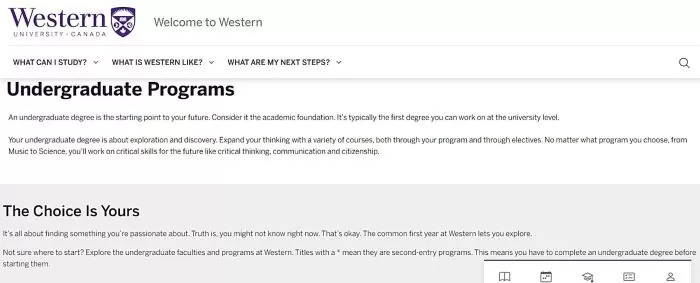
Example: Western University structures its recruitment ecosystem around faculty-based academic segmentation and regionally informed audience pathways, organizing content by academic area while personalizing messaging based on geography and prospect type. Through its admissions hub, Western aligns program content with declared academic interests and provides differentiated entry points for domestic and international students. For a re-engagement strategy, this structure enables behavior-based follow-up that references specific faculty interest, improves email relevance by aligning with prior browsing patterns, and strengthens mid-funnel reactivation precision by grounding outreach in demonstrated intent.
Source: Western University
3. Lead Scoring Thresholds
Lead scoring enables prioritization rather than reactive mass outreach.
Example scoring logic:
- +10 for campus visit registration
- +5 for webinar attendance
- -10 for 90 days of inactivity
- +15 for application start
When a lead’s score drops below a defined threshold, trigger a reactivation campaign. Lead scoring aligns admissions automation with behavioral signals, not arbitrary calendar timelines.
Step 2: Design Content That Restarts the Conversation
The objective of a student lead re-engagement campaign is not to increase pressure. It is to remove friction. When prospects disengage, it is usually because a concern remains unresolved, whether academic, financial, logistical, or personal. Effective reactivation content addresses that barrier directly.
Strong re-engagement offers are specific, practical, and stage-aware.
1. Program Fit Tools
Many dormant leads are still evaluating whether a program aligns with their goals. Offer tangible evaluation resources such as career pathway guides, program comparison charts, sample course breakdowns, or graduate outcome reports.
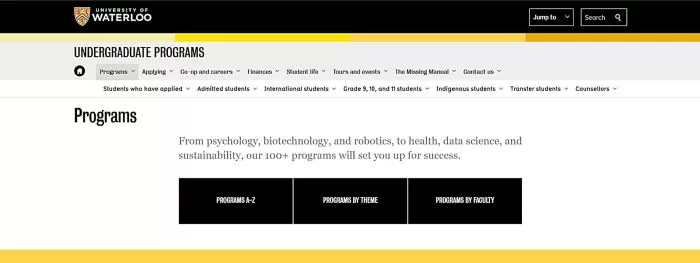
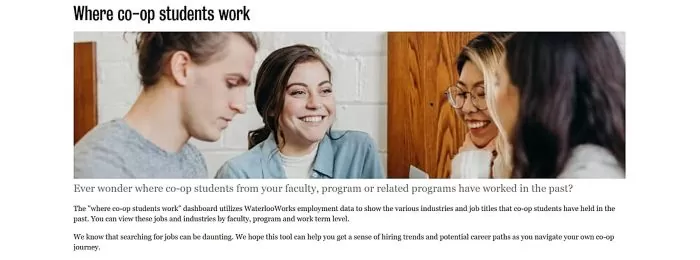
Example: The University of Waterloo integrates employment outcomes and career data directly into its program ecosystem, embedding co-op statistics, employer data, and graduate employment metrics within academic program pages. By explicitly connecting fields of study to career pathways and measurable post-graduation results, Waterloo emphasizes return on investment and long-term outcomes as part of the recruitment narrative. For the re-engagement strategy, this approach supports ROI-focused reactivation messaging, addresses mid-funnel evaluation concerns related to employability, and provides strong content assets for prospects who stalled during program comparison.
Source: University of Waterloo
Source: University of Waterloo
A re-engagement email that references verified employment outcomes or alumni pathways reframes the conversation around long-term return on investment. This is significantly more persuasive than a generic reminder to “complete your application.”
2. Application Clarity Content
For partially completed applicants, uncertainty about next steps often causes delay. Provide content that explains what happens after submission, outlines key dates, clarifies document requirements, or details how decisions are communicated.
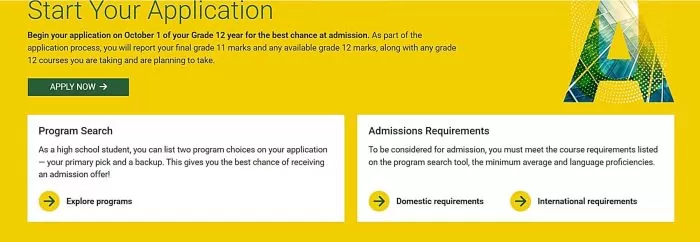
Example: The University of Alberta emphasizes step-by-step admissions process transparency through structured application checklists, clearly defined document requirements, published deadlines, and detailed explanations of decision timelines. By outlining what applicants need to submit and what happens after submission, the institution reduces ambiguity within the enrollment process. For a re-engagement strategy, this clarity helps reduce application-stage uncertainty, supports abandoned application workflows, and enables messaging focused on “here’s exactly what to expect next,” which can restore momentum for stalled prospects.
Source: University of Alberta
Mirroring this clarity within your admissions CRM reduces ambiguity. A reactivation message that says, “Here’s exactly what to expect next,” lowers perceived complexity and encourages progression.
3. Financial Planning Support
Cost is one of the most common application stall points. Offer scholarship breakdowns, tuition estimators, financial planning webinars, or FAQs about payment schedules.
Example: The University of Calgary centralizes financial planning and scholarship information within its undergraduate admissions ecosystem, consolidating tuition details, award opportunities, funding tools, and cost guidance. By presenting clear breakdowns of expenses alongside financial planning resources, the institution reduces ambiguity around affordability and cost structure. For the re-engagement strategy, this approach directly addresses cost-related application stalls, supports funding-focused reactivation campaigns, and provides targeted content for leads who disengaged during financial consideration stages.

Source: University of Calgary
Re-engagement campaigns that highlight funding tools acknowledge a core decision factor rather than avoiding it.
4. Student Stories and Social Proof
Prospects often disengage when they struggle to picture themselves at an institution. Peer narratives reduce that distance.
Including relatable student stories in reactivation emails reconnects emotion with intent. Social proof reinforces belonging, which frequently precedes action.
Re-engagement succeeds when content answers the question that caused silence.
Step 3: Use Preference Centers Instead of Unsubscribes
One overlooked tactic in higher education marketing automation is the strategic use of a preference center. When leads disengage, the default response is often an unsubscribe link. A smarter approach offers flexibility before exit.
Instead of forcing a binary decision, allow prospects to adjust how they hear from you. This can include switching intended programs, selecting a different intake term, reducing email frequency, or choosing specific content types such as scholarships, events, or program updates.
Example: University of Colorado Denver offers an International Admissions “subscription preferences” workflow that explicitly offers “subscribe,” “update my information,” and “change my subscription preference,” and states users can “select your email preferences.” This is a clear example of consent-based preference management for prospective students.
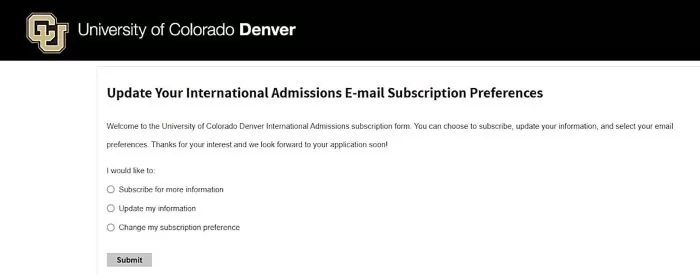
Source: University of Colorado Denver
Offering preference updates protects sender reputation, reduces spam complaints, and preserves long-term lead value. A dormant prospect may not be uninterested. They may simply need different timing or information.
Include a clear “Update email preferences” call to action within your re-engagement campaign. Flexibility sustains engagement more effectively than pressure.
Step 4: Craft Strategic Re-Engagement Email Subject Lines
Subject lines in student lead re-engagement campaigns should signal relevance, not desperation. When a prospect has paused, urgency alone rarely restores momentum. Clarity and contextual alignment perform better.
Effective re-engagement email subject lines include:
- “Still considering [Program Name]?”
- “Your application is waiting.”
- “Questions about funding for Fall 2026?”
- “Compare your top programs.”
- “Ready when you are.”
Each example acknowledges prior interest and reopens the conversation without assuming commitment.
Avoid:
- Excessive urgency
- Multiple exclamation points
- Aggressive countdowns
Overly forceful language can trigger unsubscribes or spam complaints, particularly among leads who are undecided rather than disengaged.
Remember, the objective is conversation, not pressure. Re-engagement succeeds when the subject line reflects timing, context, and the prospect’s stage within the enrollment funnel.
Step 5: Build a Structured Reactivation Campaign Workflow
A strong student lead re-engagement campaign follows a defined progression rather than a single reminder email. Structure reinforces intent and prevents overcommunication.
A typical workflow includes:
- Email 1: Contextual Reminder
Reference prior engagement, such as a downloaded guide, event attendance, or started application. Reestablish relevance. - Email 2: Value Add
Provide a useful resource aligned to the prospect’s stage, such as a funding guide, program comparison tool, or admissions walkthrough. Avoid deadline pressure. - Email 3: Preference Confirmation
Offer the opportunity to update email preferences, change program interest, or select a different intake. - Email 4: Soft Close
Ask directly, “Would you like to stay connected?”
If there is no response, suppress the lead from active campaigns to protect deliverability, but retain them for future intake cycles and strategic reactivation windows.
Timing Guidelines for Admissions Automation
Re-engagement timing should reflect funnel velocity, not arbitrary calendar triggers.
- 60 days of inactivity for inquiry-stage leads
- 30 days of inactivity for application-stage prospects
- 14 days of inactivity for deposit-stage students
Later funnel stages require shorter intervention windows because decision urgency increases as prospects approach commitment.
These intervals must align with your institution’s enrollment cycle. Use admissions CRM reporting to calculate the median number of days between inquiry and application, and between application and deposit. Reactivation triggers should be calibrated to actual progression data, ensuring interventions occur before momentum is lost.
Behavioral Segmentation in Action
Behavioral segmentation becomes meaningful when applied to real admissions CRM scenarios rather than abstract categories.
Consider Lead A. This student downloaded an Engineering brochure, attended a virtual lab tour, and then showed no activity for 75 days. The behavioral signals indicate strong STEM interest and high academic intent, followed by a mid-funnel stall. The friction point is likely evaluation rather than awareness.
A suitable reactivation offer would include engineering alumni career outcome data, internship and co-op placement statistics, and a program comparison sheet outlining specializations. The objective is to reinforce return on investment and clarify differentiation.
Now consider Lead B. This prospect started an application but abandoned it at the financial section. The segment reflects application-stage friction, likely related to cost or funding uncertainty.
An effective reactivation offer would include a funding webinar invitation, a financial aid checklist, and direct contact details for an admissions advisor. Different behavioral segments require distinct messaging strategies. This precision is the foundation of effective student lead re-engagement campaigns.
Protecting Sender Reputation
Protecting sender reputation is central to any student lead re-engagement campaign. Large institutions such as UBC and McGill sustain strong email deliverability by enforcing disciplined segmentation, authentication standards, and database hygiene practices.
Technical safeguards should include properly configured SPF, DKIM, and DMARC authentication protocols to protect domain integrity and prevent spoofing. When launching reactivation workflows after long periods of inactivity, domain warming strategies should be used to gradually reintroduce segmented audiences rather than sending to large dormant lists at once.
Best practice begins with removing chronically inactive contacts rather than continuing to send to disengaged records. Engagement-based suppression logic, such as excluding contacts with 12 months of inactivity or repeated non-opens, protects inbox placement and reduces spam complaint risk. Admissions teams should monitor bounce rates, unsubscribe trends, spam complaint signals, and engagement decay over time to identify emerging deliverability risks.
Reactivation campaigns should strengthen database quality, not compromise it. When segmentation logic, authentication protocols, and inactivity thresholds are enforced consistently, re-engagement workflows protect domain health while preserving long-term recruitment opportunity. Deliverability is not separate from enrollment performance. It underpins it.
How This Fits into the Student Recruitment Funnel
The student recruitment funnel typically includes:
- Awareness
- Inquiry
- Application
- Offer
- Enrollment
Student lead re-engagement campaigns operate most effectively between Inquiry and Application, and between Application and Deposit. These are the stages where intent exists but momentum has slowed.
At the inquiry stage, prospects may be evaluating fit, cost, or program structure. At the application stage, friction often relates to documentation, funding, or uncertainty about next steps. Structured reactivation workflows intervene before disengagement becomes permanent.
By reactivating stalled leads:
- Marketing-qualified leads increase.
- Admissions staff workload becomes more focused.
- Institutions frequently observe improved cost efficiency per enrolled student when reactivation workflows are integrated with segmentation and scoring logic.
Rather than expanding top-of-funnel acquisition, institutions extract greater value from existing inquiry volume.
This approach is particularly important for institutions recruiting across multiple provinces and internationally, where decision cycles are longer, and comparison behavior is higher. Re-engagement provides controlled, stage-aware intervention without increasing acquisition spend.
How do you promote student engagement? Through:
- Behavioral segmentation
- Lead scoring
- Relevant content offers
- Timely follow-ups
- Preference flexibility
Engagement increases when communication reflects prior behaviour.
Stop Buying What You Already Own
Every dormant lead represents prior investment. Paid media budget generated the inquiry. Content production supported the download or event registration. CRM infrastructure stores and tracks the records. Staff time nurtured the initial interaction. When that lead stalls, the sunk cost remains.
A well-structured student lead re-engagement campaign converts underutilized database volume into a renewed enrollment opportunity. Rather than defaulting to additional acquisition spend, institutions can reactivate intent that already exists within their admissions CRM.
Institutions that integrate behavioral segmentation, lead scoring, admissions automation, and structured preference management consistently outperform those relying on repetitive top-of-funnel activity. Precision outperforms volume.
Reactivation is not a secondary tactic. It is a core efficiency strategy within higher education marketing campaigns, particularly in a cost-sensitive, privacy-restricted environment.
If you would like support structuring segmentation logic inside your admissions CRM or implementing higher education marketing automation workflows, explore HEM’s digital marketing services or connect directly with our team.
Do you need help strengthening your lead nurturing?
Our expert digital marketing services can help you attract and enroll more students!
FAQs
Q: What are re-engagement campaigns?
A: A re-engagement campaign is a structured marketing automation workflow designed to reconnect with prospective students who previously showed interest but have since become inactive within the admissions CRM.
Q: How do you promote student engagement?
A: Through:
- Behavioral segmentation
- Lead scoring
- Relevant content offers
- Timely follow-ups
- Preference flexibility
Engagement increases when communication reflects prior behaviour.
Q: What are the 4 C’s of student engagement?
A: Common frameworks define the 4 C’s as:
- Communication
- Connection
- Community
- Commitment
In recruitment marketing, this translates into consistent messaging, relational storytelling, peer proof, and clear next steps.