

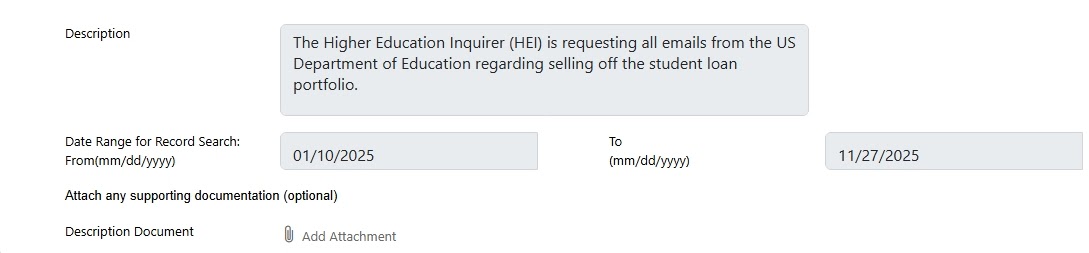

The letter from Democrats — signed by U.S. Sens. Elizabeth Warren, Richard Blumenthal and Ron Wyden, among others — follows an October report from Politico about talks in the Trump administration that centered on a partial sale of the government’s student loans.
According to Politico, senior officials in the U.S. departments of Education and Treasury have recently discussed selling high-performing student loan debt to the private sector.
The administration has also broached the possibility with finance executives, among them potential buyers of the loans, and is considering bringing in consultants or banks to review the portfolio, the news outlet reported.
In addition to calling for the Trump administration to cease any talks, the lawmakers requested detailed information on any potential plan and the names of those who have participated in any discussions. The Education and Treasury departments did not respond to requests for comment by publication time on Tuesday.
The Education Department’s Federal Student Aid office oversees the loan portfolio and contracts out servicing to private entities. Student loan receivables represent one of the largest assets on the nation’s balance sheet.
A 1998 law allows the government to sell student loan assets — so long as it is done at no cost to the government — which could be why no such sale has taken place to date. The Sunday letter said the first Trump administration mulled the possibility but never pursued it, pointing to Wall Street Journal reporting that the agency hired the consultancy McKinsey & Co. at the time to review the portfolio..
The Democratic lawmakers and others have argued the no-cost provision means the government could not sell the loans for less than what it would collect if it kept them on the public balance sheet.
In 2024, FSA estimated the net value of the government’s student loan portfolio at about $1.1 trillion. However, a 2025 analysis from the Project on Predatory Student Lending argues this figure “is almost certainly wrong,” based on data and assumptions that “have proven wildly off-base.”
That figure represents the government’s own valuation of the loan portfolio. In the case of a sale, the relevant figure would be the price a private sector buyer would be willing to pay.
The student lending project said the government has several advantages as a lender over private companies, including unlimited time to collect, the ability to withhold federal payments such as tax refunds to offset loan defaults, and immunity from legal liability for loan servicing failures. All of that means student loans are likely worth more to the government than to the private sector, according to PPSL.
Along with a potential loss to taxpayers, the Democratic lawmakers warned of the possible impact to student borrowers from transferring loan assets.
“By selling parts of the federal student loan portfolio, the Trump Administration may seek to unlawfully strip borrowers of their legally guaranteed protections,” they wrote.
The lawmakers pointed to protections such as income-driven repayment, public service loan forgiveness, disability and death discharges, and debt relief for those determined to have been defrauded by predatory colleges.
“Private lenders typically do not guarantee these kinds of borrower rights,” they wrote. “Profits would likely come at the expense of the borrower via fewer protections and less generous benefits. However, the federal government cannot simply eliminate its legal obligations to borrowers.”
PPSL argued in its analysis that removing provisions for borrowers could make the loan portfolio more valuable to private buyers, but those loan provisions in contracts with the federal government represent property protected by the Fifth Amendment.
“Any law stripping repayment rights or other favorable terms from student loan contracts would potentially trigger an obligation to compensate student loan borrowers for the loss of those terms,” the organization said.
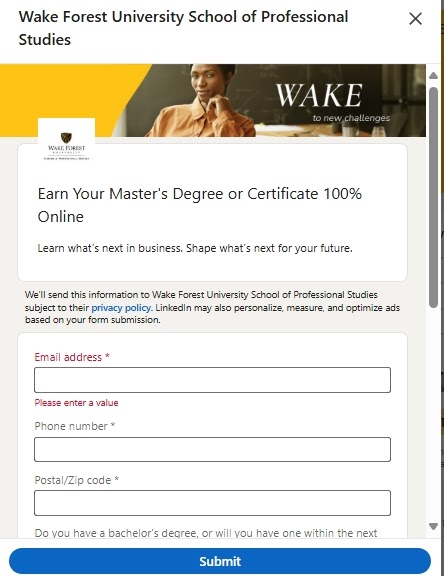
Wake Forest’s online offerings, now delivered in collaboration with Kaplan, are dressed in glowing promotional language. Prospective students are promised access to “a global network of 80,000+ alumni,” “1-on-1 guidance from a dedicated Student Success Manager,” and a curriculum shaped by “a Program Advisory Board of diverse business leaders.” The university assures working professionals that they can “earn a 100% online master’s degree or graduate certificate” on their own terms, with a “streamlined admissions process” and “flexible courses.”
But strip away the buzzwords and what’s left is a degree-granting operation outsourced to a for-profit education company with a controversial legacy. Kaplan, now owned by Graham Holdings (formerly the parent company of The Washington Post), has been at the center of lawsuits, regulatory scrutiny, and allegations of exploitative practices in its higher ed ventures—including its role in managing Purdue Global, formerly Kaplan University. The company has a long history of targeting vulnerable populations—especially working-class adults—with high-cost, low-value credentials that often don’t lead to the promised career outcomes.
So why is Wake Forest—an elite university with a storied reputation—collaborating with Kaplan?
The answer is simple: profit and scale.
In an era when even wealthy private universities are looking to expand their revenue streams, online education has become a lucrative frontier. But building and managing online degree programs in-house requires serious investment, time, and expertise. Enter Kaplan, which provides the infrastructure, marketing, enrollment management, and student support—all in exchange for a share of the revenue.
What does this mean for students?
It means that Wake Forest’s name is now being used to sell online degrees to mid-career professionals under the promise of prestige, convenience, and upward mobility—without the full intellectual, cultural, or communal experience that Wake Forest once symbolized. The degrees may bear the Wake Forest seal, but they are increasingly indistinguishable from the mass-produced credentials churned out by dozens of other universities that have sold access to their brands through partnerships with Online Program Managers (OPMs) like Kaplan, 2U, Wiley, and Coursera.
The “1-on-1 Student Success Manager” may sound supportive, but in practice these positions are often little more than call center roles staffed by Kaplan employees trained to ensure retention and upsell future courses—not to engage in meaningful academic mentorship.
The curriculum may be “developed and led by recognized faculty and industry experts,” but in many cases these are adjunct instructors or contract workers who have limited interaction with students and little say in the structure or pedagogy of the courses. This model contributes to the broader exploitation of contingent academic labor—an issue Wake Forest, like many elite universities, prefers not to discuss.
And the promise of becoming a leader “from anywhere” with a Wake Forest SPS degree? That too should be questioned. These degrees exist in an increasingly saturated credential market where employers are skeptical, return on investment is uncertain, and students often find themselves saddled with debt and disappointment.
If Wake Forest were truly committed to ethical leadership, it would take a hard look at the implications of commodifying its brand through a partnership with a company like Kaplan. Instead, it has chosen to chase market share and tuition revenue at the expense of its academic credibility—and at the risk of misleading students who believe they’re buying into the full Wake Forest experience.
The truth is this: Wake Forest is selling the illusion of prestige, wrapped in a glossy brochure of online convenience and corporate optimism. In reality, it’s another cog in a profit-driven machine that markets higher education as a product rather than a public good. And that’s not transformative change. That’s business as usual in the credential economy.