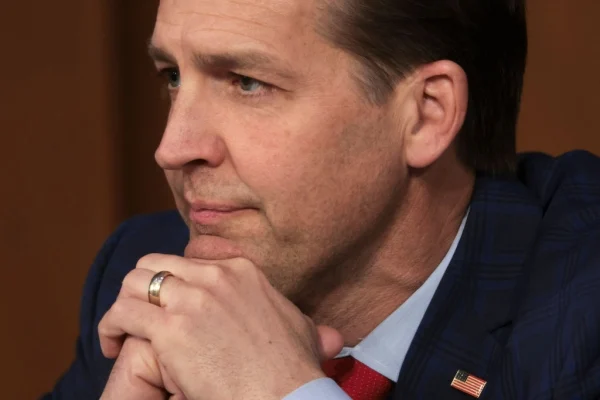
Former University of Florida president Ben Sasse is now an American Enterprise Institute fellow.
The American Enterprise Institute, a prominent conservative-leaning think tank, has named former U.S. senator and university president Ben Sasse a nonresident senior fellow, AEI announced Friday. Its website says his work there will focus on “higher education, innovation, technology, American history and culture, and national security.”
Sasse’s AEI post and his continuing voice at other major conservative institutions—The Wall Street Journal has run at least three op-eds by him this year, including one calling on university board members across the country to stand up to faculty “radicals” and “encourage greater intellectual diversity”—shows he’s not persona non grata after his abrupt exit from the University of Florida last year.
Sasse attributed his resignation from UF to his wife’s health, though the student newspaper, The Independent Florida Alligator, has reported the board may have forced him out. During the first year of his roughly 18-month presidency, his office spent more than $17 million. Sasse denied wrongdoing and argued that driving new initiatives at UF required major investments.
Sasse, a Republican who represented Nebraska in the Senate, remains a professor in UF’s Hamilton Center for Classical and Civic Education. He previously was president of Midland University.
Are you searching for a learning designer, instructional designer or, as the University of Michigan calls the role, a learning experience designer? If so, your search is the perfect fit for Featured Gigs. Please reach out.
Q: What is the university’s mandate behind this role? How does it help align with and advance the university’s strategic priorities?
A: Imagine being the person who turns bold ideas into learning experiences that reach thousands of learners across the globe. The University of Michigan’s commitment to life-changing education, a key pillar of our Look to Michigan vision, drives this role’s focus on expanding access to high-quality, equitable learning experiences for a global audience.
The learning experience designer senior role advances the Center for Academic Innovation’s mission to collaborate across campus and around the world to create equitable, lifelong educational opportunities for learners everywhere. At CAI, we help translate Michigan’s academic excellence into scalable, learner-centered opportunities, both in our noncredit and for-credit portfolios. The learning experience designer senior role is at the forefront of our work.
Designers at CAI don’t just build courses; they co-create learning experiences that merge research-informed design and empathy with faculty expertise. We ensure every online or hybrid course reflects Michigan’s commitment to excellence while reimagining how learning reaches people across every stage of life, whether they are traditional students, working professionals or lifelong learners.
Q: Where does the role sit within the university structure? How will the person in this role engage with other units and leaders across campus?
A: Reporting to the learning experience design lead, the learning experience designer senior operates within a highly cross-functional team that brings together experts in design, technology, data and media. We have a highly collaborative environment, both within the center and with our faculty and academic partners.
As a learning experience designer senior, the ideal candidate will be collaborative and relationship-driven, working closely with faculty and academic unit leaders across the university’s schools and colleges to design meaningful online and hybrid learning experiences. We work in an environment that values experimentation, collaboration and continuous learning.
Q: What would success look like in one year? Three years? Beyond?
A: Our learning experience designers at CAI are connectors and translators. We turn teaching goals into actionable design strategies and align pedagogical vision with institutional priorities. In your first year, success looks like being a trusted connector who builds strong relationships across our team and with our academic partners. You’ll be shaping not only our courses but our culture, contributing your voice, curiosity and care to our thriving community.
In three years, this role may become a recognized mentor, leader and thought partner in learning experience design across U-M. A person in this role would be recognized for advancing best practices in digital pedagogy, mentoring colleagues and contributing to the university’s growing portfolio of online and hybrid programs.
Beyond that, success means lasting impact. The courses and programs you’ve helped build will keep reaching new learners, and the practices you’ve influenced will continue guiding our work long after any single project ends.
Q: What kinds of future roles would someone who took this position be prepared for?
A: This role offers the chance to develop strategic, creative and leadership skills that are highly transferable across higher education and beyond. Learning experience designers in this role gain experience with a diverse range of online and hybrid learning experiences, from degree programs, noncredit MOOCs and certificate-based stackable programs. This prepares our designers for roles that require both pedagogical expertise and operational agility.
People who grow in this role are well positioned to step into leadership positions, including leading design teams, shaping instructional design strategy within academic units or moving into broader academic innovation–focused roles within or outside of higher education.
Please get in touch if you are conducting a job search at the intersection of learning, technology and organizational change.
After 7 years of service with a great team, I’ve been laid off from Duke, like many of my colleagues.
I’m taking some time to consider what I want to do next. This includes any of my areas of expertise, from learning design and libraries to visual art and journalism. I’m also keeping my eye out for roles that combine my experience in new ways.
If you have 5 minutes, could you please share this post, connect me with someone you think I should talk to, or share any relevant job openings?
I’m looking for hybrid roles in the Triad and Triangle of NC and remote roles anywhere (willing to travel some, too).
I saw Heather’s post, read all the supportive comments the post generated and had two questions: 1) Which university or organization will be smart and lucky enough to recruit Heather? 2) Would Heather be willing to share her story in this space for this community?
On my second question, Heather graciously agreed to participate in this Q&A.
Q: Tell us about your professional and educational background. What are the projects, initiatives and services that you have contributed to and led? What are your superpowers that potential employers should know about?
A: I’m an art major who worked in journalism for five years after college, doing writing and editing. Then I pursued my master’s in library and information studies and worked for several years as an academic librarian focused on teaching and learning. I moved into instructional design for online learning at UNC Chapel Hill and then worked at Duke University for seven years, most recently as a senior learning experience designer.
My recent accomplishments include:
Establishing digital education strategies with five professional schools and developing certificate programs in UAS (Drones) Applications and Operations in Environmental Science, Church Administration and Human Resources, and Healthcare Leadership for Climate Science.
Leading continuous improvement initiatives to develop new or updated workflows, create standard operating procedures and update team roles and responsibilities.
Mentoring and coaching newer designers in project leadership and advanced learning design skills, like creating assessments and drafting course content.
Developing team AI guidelines that set expectations for how generative AI is used in course development work.
My superpowers are empathy, strategy and creativity. I excel at building relationships, collaborating and coaching, whether that be to design an online course for the first time or to grow as a professional. I think analytically and strategically about work processes, projects and goals. I generate a lot of ideas, and I enjoy figuring out how to take an idea or vision and implement it successfully.
Q: In thinking about your next role, what is the organizational culture and institutional priorities that you are looking for in determining the fit with your strengths and values?
A: As I look for roles, I keep going back to the idea of work being human-centered. Does the organization value its people and its impact more than its profits? Does it genuinely want to improve educational access for everyone? How has it shown that it keeps humans centered in discussions of technology and AI? Further, is it continuing to prioritize equity and inclusivity, and does it ask, “Who needs a seat at the table?” when embarking on new projects and initiatives?
Like people, organizations are works in progress—ultimately, what I care about is follow-through. Do you set human-centered intentions and see them through? I want a workplace where leaders embrace empathy and difficult conversations while encouraging healthy collaboration and boundaries. Finally, I want a workplace where workers have agency to think deeply and creatively.
Q: From your experience navigating the fallout of the federal attack on higher education, what advice do you have for all of us also dealing with job uncertainty and professional stress?
A: I’ve been asking everyone else this question! What I’ve learned so far is that we are a community of educators that is much bigger than any particular institution or organization. How can we help each other and continue to do the important work we care about?
I wasn’t expecting the outpouring of support I received, and it reminded me that it’s okay to reach out and ask for help. It also strengthened my resolve to help others when I can.
Finally, remember that you are much more than your role and your organization–you can figure it out, and you contain multitudes that may end up surprising you.
This HEPI blog was kindly authored by Karen Lander, Senior Lecturer in Experimental Psychology at the University of Manchester
For many academics, reaching Senior Lecturer status is a milestone – but what happens when you stay there for years, unable to break through to the next level? Some see it as a respectable career achievement with an established role within higher education. Others feel stuck in an academic system that demands more but rewards less.
The reality? Academic promotions may be perceived as being increasingly difficult and the pressure to strive for professorship can feel both exhausting and unending. So, is Senior Lecturer a fulfilling end goal, a stage for resilience, or a sign of an academic system failing its scholars?
The UK vs. US Divide: Who Gets to Be ‘Professor’?
Unlike the UK, where professor is a distinguished rank, the US academic system grants the title more broadly. In the UK, academic titles typically follow a hierarchy: Lecturer (entry level) – Senior Lecturer (mid-career) – Reader – Professor (elite academic status). Reader is less common, as many academics make the leap directly from Senior Lecturer to Professor. In contrast, in the US, academics are referred to as Assistant Professor – Associate Professor – Full Professor. Confusingly, these terms are also sometimes used in the UK, mostly in some newer (post-1992) universities. Here, the distinction between ranks is still as important (certainly for those within this system) but the ‘Professor’ title is less exclusive. This more generic use of the term ‘Professor’ adds confusion for people looking in, less familiar with the way the Professor title is used and assigned.
In the UK, making Professor is usually only awarded to those deemed exceptional in their fields. Whereas in the US, being a Professor is standard, with tenure usually being a more pertinent marker of success. For UK academics, this transatlantic distinction may make career progression even more frustrating, given that their US counterparts are professors far earlier in their careers.
The Reality of being a Senior Lecturer
In UK academia, a Senior Lecturer will likely have demonstrated themselves in teaching, research, scholarship and university service (with the pattern of contribution depending on contract type) with many finding themselves stuck in this permanent middle tier. Indeed, according to HESA data, currently only about 10-12% of academics currently have the title of ‘Professor’ (see Figure 1). For the majority, then, career progression stalls at Senior Lecturer or Reader Level
Vertical axis: Number of academic staff
Figure 1: Stacked column bar chart showing the number of Higher Education academic staff by year (HESA data; see https://www.hesa.ac.uk/news/28-01-2025/sb270-higher-education-staff-statistics). The percentage of Professors are shown. Note: some ‘senior academic’ staff members may also have the title ‘Professor’ taking the estimated total up to a maximum of 12%.
Several factors contribute to this, including high competition, specific promotion criteria, and individual career choices. In addition, against the current economic background, a number of UK universities have paused all promotion applications and the focus on ‘surviving’ is increasingly important. Finally, gender disparities may prolong academic progression for women, who take, on average an additional 6 years to become Professor compared with their male counterparts (Harris et al., 2024).
So, while some Senior Lecturers remain content in their existing roles, others battle an uphill struggle for recognition.
Striving: The Fight for Professorship
For some, professorship remains the ultimate goal. This title typically functions as an external indicator of academic success, institutional prestige, and influence in one’s field. Yet, earning this title requires significant effort. Universities set demanding criteria for promotion, which – depending on your academic focus or contract type – is likely to include high-impact publications in leading academic journals; a track record of large-scale external research grant success; long term excellence in teaching, scholarship and mentorship; and educational leadership through committee work, departmental influence, and public engagement (Mantai & Marrone, 2023).
Yet, even meeting these criteria doesn’t guarantee promotion. In academia, the number of professors is generally not fixed and fluctuates over time due to institutional restructuring, shifts in student enrolment, budget allocations and evolving academic priorities (Gappa, Austin, & Trice, 2007). Some struggle with institutional biases, while others lack the confidence and mentorship necessary to push themselves forward.
Surviving: Satisfaction of Staying Put
Not everyone desires a professorial title, and for many, Senior Lecturer is a satisfying career stage. It allows for meaningful student interaction and continued research without the pressures that come with high-level institutional leadership.
Yet survival mode kicks in when people are being made redundant, expectations keep rising, workloads expand, and the pathway forward remains unclear. Senior Lecturers often absorb significant administrative burdens as universities assign management tasks onto mid-career academics (Bosanquet, Mailey, Matthews & Lodge, 2017). This administrative burden may also come with mentoring responsibilities without corresponding leadership recognition, and teaching-heavy roles, with less time for research advancement or scholarship. Without clear incentives for promotion, frustration builds.
In some extreme cases, long-serving Senior Lecturers may find themselves working harder yet missing out on funding, decision-making power, and institutional influence.
Stuck? The Changing Landscape of UK Academia
There are certainly more professors now than there used to be, but the road to becoming a professor is still long and confusing. Competition is fierce and promotion criteria are often somewhat vague. Coupled with shifts in universities’ funding models, many highly capable scholars never achieve Professor status.
Further with the shift toward managerial roles, professors are expected to handle greater administrative responsibilities, deterring some academics from pursuing promotion at all. For those in Senior Lecturer positions, this shift makes career progression feel more like an exception than an expectation. And as gender and age disparities persist, some find themselves wondering whether striving for Professor is even worth it anymore.
Is Striving worth It?
If you’re a Senior Lecturer, the key question is whether promotion matters to you. If professorship remains your goal, it requires strategic networking and institutional visibility, securing high-profile research funding, leadership or scholarship influence beyond your department and a clear narrative of impact.
Yet for those feeling satisfied where they are or exhausted by the pursuit, the alternative is to find meaning beyond titles. Some choose to focus on teaching innovation and mentorship or drive other aspects of their role without chasing formal recognition.
Ultimately, Professorship remains a highly selective process with evolving criteria. And for those who remain Senior Lecturers. It may be time to redefine success in academia. For me? I keep striving.
This story was produced by The 19th and reprinted with permission.
On July 4, Nory Sontay Ramos stepped off a flight from San Antonio into a country she hardly recognized: Guatemala.
The summer wasn’t supposed to start this way. The 17-year-old had plans. In early June, she wrapped up 11th grade on a high note, having made the honor roll and represented her Los Angeles high school in the city finals for track. With track season over, she turned her attention to cross-country, showing up to campus for practice after the school year ended.
Everything changed when she and her mother, Estela Ramos — both undocumented — appeared at what they thought was a standard check-in visit with immigration officials on June 30.
“ICE took us to a room, and they ended up telling my mom, ‘Your case is over, so we have to take you guys with us,’” Sontay Ramos told The 19th. Over the objections of their attorney, federal agents led them away.
The next day, she and her mother were shipped to Texas. And by July 4, they were on a plane to Guatemala, a country where neither of them have lived for over a decade. On Independence Day — an occasion associated with freedom, with hope — their American dream shattered. Sontay Ramos has no idea what will become of the friends, family members and school community her deportation forced her to leave behind in Los Angeles.
A lawyer hired after she and her mother were detained said Monday that a motion to reopen the case has been filed with the Board of Immigration Appeals but provided no other information to The 19th.
A year shy of becoming a high school graduate in the United States, the teen’s life — and opportunities — completely changed in the span of five days.
“I’m confused,” Sontay Ramos said, her voice breaking. “I don’t know. I’m just really sad about everything.”
President Donald Trump campaigned for a return to office with the promise of mass deportations, characterizing undocumented immigrants as criminals and threats to women and girls. But as his administration has ramped up enforcement of his policy priority, undocumented people with no criminal backgrounds have made up the largest share of immigrants targeted. Those who are pursuing legal status through the proper channels have also become vulnerable — showing up to check-ins, like Sontay Ramos and her mother — only to be detained. These developments, recent polls reveal, have led to public disapproval of the Trump administration’s strategies.
Civil liberties and advocacy groups have raised concerns that undocumented immigrants are being removed so quickly they have been denied the right to due process. With Trump’s One Big Beautiful Bill Act directing $150 billion more toward mass deportations, expedited removals of undocumented immigrants will almost certainly increase — and those immigrants who arrived in the United States as children like Sontay Ramos stand to get caught in the middle.
The Trump administration deported more than 93,800 people from January 20 to June 11, with ICE more than doubling its arrests compared with the same period in 2024, revealed an analysis by the Washington Post based on information from the Deportation Data Project. (The data does not reflect arrest and removal numbers from Customs and Border Protection.) Of those, 61 percent did not have criminal records and almost 90 percent were men, underscoring how relatively uncommon it is for a mother and daughter to be removed.
The Trump administration has not provided a tally of how many minors have been deported this year, but The 19th’s review of figures from the Deportation Data Project found that only about 3 percent of removals involved children. When ICE targets juveniles, the incidents often make national headlines, such as when a 9-year-old boy and his father living in Torrance, California, were detained in May and swiftly deported to Honduras. In states including Michigan, Massachusetts and New York, the detainment of teenagers, including those who are technically legal adults, have also garnered widespread media attention this year.
But when Sontay Ramos and her mother exited their Guatemala-bound flight on Friday, they weren’t met with fanfare. None of their family members in the Central American nation knew to expect them. With the help of an internet connection, they managed to contact one of Sontay Ramos’ older sisters, with whom they’re now living. The teenager isn’t sure which part of Guatemala she’s in, though she describes the area as rural.
Just six when she left Guatemala, Sontay Ramos struggles to recall what life there was like. But she remembers the emotion she felt as a small child: fear.
“I was scared because there’s gangsters here, and they tried to kill my mom,” she said. A family member involved in a gang threatened her mother, once attacking her so badly she needed to be hospitalized, she said. “My mom was scared.”
A research study exploring the root causes of immigration from Guatemala from 2012 to 2019 found violence, poverty, climate change and corruption to be among the driving factors and that many such migrants hail from rural parts of the country.
“The two major reasons, especially if we look at families, have to do with violence and drought,” said David Leblang, a coauthor of that study and politics professor at the University of Virginia. “It has been drought and then flood, hurricane and then drought that has just decreased the ability for families to put food on the table, so you see a combination of economic insecurity, but more so for families, food insecurity — because when you can’t feed your kids, that’s when families are going to pick up and they’re going to move first to more urban areas and then out of the country.”
About 11 years ago, Sontay Ramos and her mother headed by car to the United States in search of safety and opportunity. There, other family members awaited them and they hoped to be granted asylum, she said.
The transition was not easy. They left behind three of Sontay Ramos’ older siblings who did not want to come to the United States, she said. Her father remained in Guatemala, too. His death from illness shortly after she moved away was devastating.
“Unfortunately, her dad passed away at a young age, just like two weeks after her arrival to the States,” recalled Jennifer Ramos, Sontay Ramos’ 22-year-old cousin who lives in Los Angeles. “She grew up with her dad, so that also hit her at such a young age, just coming to a new country at six years old and not knowing the language here and losing her father. It was definitely hard for her.”
Getting accustomed to life in Los Angeles also wasn’t easy. Sontay Ramos and her mother are Indigenous Guatemalans, fluent in K’iche’. Few resources in their native tongue made assimilation more challenging in a city where English and Spanish are the primary languages.
Jennifer Ramos helped her little cousin learn to speak English. “She would come over, and I would help her with her homework. When she first came to the States, my younger sister was kind of her only friend in school because she didn’t know anybody and, again, the language barrier. She actually does struggle speaking Spanish.”
In time, Sontay Ramos and her mother adjusted to life in California. Her mother ultimately became a garment worker, employed as a seamstress until physical setbacks — illness and surgery — sidelined her earlier this year. Her deportation has separated her from her life partner, with whom she and her daughter shared an apartment in the Westlake District of Los Angeles, the neighborhood where an ICE raid at a Home Depot close to an elementary school in June panicked families, and days of demonstrations in nearby downtown escalated after Trump deployed 4,000 National Guard troops and 700 Marines.
Los Angeles is a deeply blue city in a liberal state, with the nation’s highest concentration of immigrants — a place that the president has made ground zero for his immigration raids. In November, the City Council voted unanimously to make L.A. a sanctuary city, which bars it from using resources for immigration enforcement. Last week, the Trump administration filed suit, challenging the law. Meanwhile, advocacy groups including the American Civil Liberties Union of Southern California and Public Counsel are suing the Trump administration for what it describes as a pattern of federal violations during immigration raids in Greater Los Angeles.
Before Trump’s immigration policies roiled her neighborhood and upended her life, Sontay Ramos was indistinguishable from her peers born in the United States. She grew up on the Netflix shows “Stranger Things” and “Cobra Kai,” enjoys the music of Lana Del Rey and The Weeknd and dotes on her cat, Max, who turned one on May 15. He is black — one of her two favorite colors. In her spare time, Sontay Ramos practices taekwondo, which she’s been learning for nearly four years.
“I just liked it,” she said of the martial art. Knowing how to fight, she added, helps her feel protected.
Sontay Ramos never sensed she was in danger before the immigration check-in that would push her out of the United States.
But her cousin Jennifer Ramos worried. The night before, Ramos’ father invited the family over to have Sunday dinner with his wife and three daughters. The evening was largely festive. Her father made shrimp ceviche and was eager for his family to enjoy the tangy, citrusy dish — especially Estela Ramos, who had just celebrated her 45th birthday. But when Estela mentioned that she and her daughter had an immigration check-in scheduled, everyone fell quiet.
“We were kind of scared,” Jennifer Ramos said. “We were like, ‘Are you sure you should go?’”
Estela Ramos poses for a picture with Jennifer Ramos at her quinceanera in 2017. Credit: COURTESY OF JENNIFER RAMOS
But her aunt tried to reassure them by letting them know their lawyer said it would be fine. After all, they had shown up for previous check-ins without incident, and if they didn’t appear, immigration officials would just find them at home.
Now, Jennifer Ramos doesn’t know when she’ll see her aunt and cousin again.
“It is unfair that a young student like her has been detained,” she said. “She’s the most deserving person. This should be the least of her worries.”
Sontay Ramos couldn’t help but tear up when she described what she was looking forward to about senior year — graduation, her friends, track-and-field and cross-country.
Although excited to reunite with family members they hadn’t seen in years, she and her mother have been weeping off and on since they arrived in Guatemala.
“I was happy, but I was expecting to see them in another way,” she said of her relatives. “Not like this.”
Sleeping and eating have been tough as has the constant feeling of disorientation. She doesn’t know where she is. In K’iche’, she asked her mother for the name of the town they’re in, but it didn’t register.
She also continues to feel blindsided about why she and her mother were deported at all. She doesn’t understand how or why their case was closed.
Recent polls, particularly those conducted after the immigration raids in Los Angeles, reveal that the Trump’s administration’s immigration crackdowns may be unpopular with the majority of the public. A PBS News/NPR/Marist poll released July 1 found that just 43 percent of Americans support Trump’s tactics.
Sixty-four percent of registered voters support giving most undocumented immigrants in the United States a pathway to legal status, with 31 percent preferring deportation for most of them, according to a Quinnipiac University national poll released June 26. Six months ago, only 55 percent of voters supported giving unauthorized immigrants a path to legal status, while 36 percent backed deportation.
Leblang, the politics professor, said that ultimately the economy will sway the public to take a stand on immigration.
“All of those people who are being deported, they’re consuming goods that are produced by natives,” he said. “So, what the evidence suggests is that’s going to affect native workers’ wages, so across the board, this is going to have a negative effect on the economy.”
For Manuel Guevara — a physical education teacher and coach at the Miguel Contreras Learning Complex, where Sontay Ramos is enrolled as a student — immigration isn’t an economic issue but a personal one. He came to the United States at 11 months in the mid-1980s amid El Salvador’s horrific 12-year civil war, becoming a citizen as a teenager. He fears that more deportations of youth from his school are imminent. He knows some families skipped school graduations in the area due to their concerns over raids. Some are so worried they refuse to let their children attend football practice. He’s heard that other families intend to self deport.
“This is not normal,” Guevara said. “Our whole community is beyond vulnerable. A lot of their [students’] parents, sad to say, don’t know how to read and write. Their kids need to do that for them. If they’re presented with [immigration] paperwork, they might not even be able to read it because that’s not their primary language.”
Before her deportation, Nory Sontay Ramos was recognized at school for her academic and athletic achievements. Credit: COURTESY OF JENNIFER RAMOS
He can hardly believe that Sontay Ramos, whom he taught for most of her high school years, is gone.
“She was smiling, happy-go-lucky,” Guevara said. He’s astounded that she was detained and deported in less than a week. “Nory is going into her senior year, which is another thing that’s just killing me. She was going into her senior year with all this momentum.”
Guevara fondly recalled the teen’s high-pitched voice that gets even higher when she’s excited.
“You could tell when she’s coming from down the hallway, for sure,” he said. But her trademark voice is now subdued due to her deportation ordeal. Through tears, she expressed gratitude for how her teachers, classmates and other supporters have donated nearly $7,000 to her GoFundMe campaign.
“I just want to thank everybody for the support and tell them to just be safe out there and be strong no matter what’s going to happen,” she said.
If she can’t return to the United States, she will figure out how to finish her education in Guatemala, Sontay Ramos said.
Guevara is certain she has the aptitude for greatness. Her academics and extracurricular activities are just hints of what she’s capable of, he said.
“She was about to reach cruising altitude,” he said. “Some of our students are capable of reaching the clouds up there and doing some great things. And I really believe that she was on her way.”
The Hechinger Report provides in-depth, fact-based, unbiased reporting on education that is free to all readers. But that doesn’t mean it’s free to produce. Our work keeps educators and the public informed about pressing issues at schools and on campuses throughout the country. We tell the whole story, even when the details are inconvenient. Help us keep doing that.