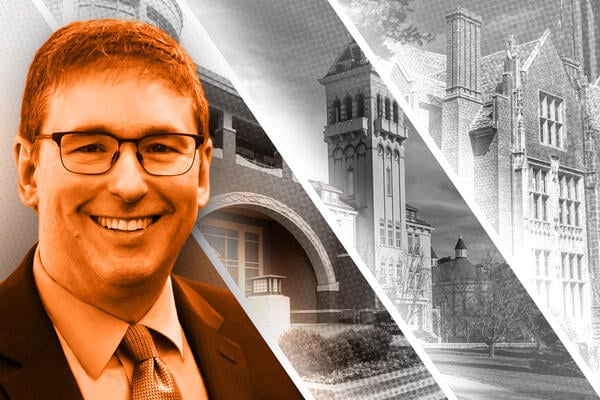
After two decades with Belle Wheelan at the helm, the Southern Association of Colleges and Schools Commission on Colleges is under new leadership since she retired earlier this year.
New SACS president Stephen Pruitt comes from the Southern Regional Education Board, which he led from 2018 until June, when he stepped down, before starting his current job in August. Pruitt previously served as the commissioner of education in Kentucky, worked for the Georgia Department of Education and taught both at the K–12 level and as an adjunct faculty member.
Pruitt arrives at a time when accreditors are increasingly under fire from federal and state officials, who have accused such bodies—and SACSCOC specifically—of overstepping, and as the Trump administration aims to make it easier for new accreditors to enter the market. In a phone interview last week with Inside Higher Ed, Pruitt discussed how he intends to approach the job, his 100-day plan, the current landscape for accreditation and more.
The interview has been edited for length and clarity.
Q: First, what interested you in the job? What drew you to the accreditation world?
A: I enjoyed my time at the Southern Regional Education Board. It was really a fantastic place to work and [has] great people, and we did a lot of good stuff there, but when the opportunity to move over to SACS came up, I had a desire to help shape policy that can improve how we see higher ed and hopefully improve aspects of higher ed. And it felt like the right avenue.
Q: What’s it like to follow in the footsteps of Belle Wheelan, who was an institution unto herself?
A: It helps that Belle is a good friend. I’ve known Belle for a good while now, so our transition has been a good one. She was our longest-serving president; she was there for 20 years, and I kept joking with her that her record was safe. I don’t see myself there for 21 years. But following her has been an absolute pleasure and honor to get to build on the things that she started, to realize that now’s a good time, because we also need to look to the future and see that the world and how we approach things in higher ed has to change.
Q: How does one dive into a job like this? I imagine there’s so much to learn and take on.
A: Part of my background was in accountability. Given, it was at the K–12 level, but there’s a lot of parallel there. Jumping into something like this, the No. 1 thing—whether it’s this or any other job, and I did the same thing when I was commissioner of education in Kentucky—you have to listen to people, learn the dynamics of accreditation, learn the current system. My staff will tell you that I ask probably a thousand questions a day, because I tend to get into the weeds so I can understand it. Every day I’m in a different office asking questions. But there was a month in the transition where I had no managerial responsibilities. I was able to take that month and get on calls with presidents, with liaisons, spend time with staff and spend a lot of time listening.
Q: Did your predecessor give you any advice on how to approach the job?
A: She did. I don’t know that I could sum it up in a single statement, but she gave me advice on different aspects. She gave me a list of things that she felt like I needed to address early, and some of the things you do see in the 100-day plan. She provided some ideas. But at the end of the day, the most poignant advice, probably, was that it’s important to listen to membership.
Q: You announced a 100-day plan not long after you started. What’s in it?
A: Our focus as we move forward is thinking about, how do we really need to respond and be flexible, to be able to manage things in this current year, this current environment, so that our institutions are both being held accountable appropriately, but also to be able to incentivize the behaviors that that we know [are] our best for students? … Students first, always, is our No. 1 pillar. Everything has to be about, is what we’re doing actually making the world better for our students?
Second thing is we’ve got to have leadership and transparency. We want to make sure that everything we’re doing is aboveboard and transparent. We want to have some service with accountability … To me, it’s about walking alongside our institutions, working with our state agencies, so that we build a common vision of what we believe higher ed can be, and then we invest in that vision.
We are going to have our own communications department, which we’ve never had. We are conducting a communication audit right now of the way we communicate with our members and the general public. Probably one of the big things that has the most impact is that we’re going to be doing a principles-of-accreditation review—in other words, a standards review. We’re going to be announcing and launching that in October … Arguably, right now, I think that we need to have a focus on streamlining our principles.
[Reporter’s note: Full details of the First 100 Days Plan are available on the SACSCOC website.]
Q: Does SACS plan to expand or do you want to keep membership numbers where they are?
A: I think we’re going to continue to expand. Right now, I’m more focused on getting our house in order, so to speak. Like our sister organizations, we would prefer to not go out and recruit away from other places, but we also want to be available. We do have members that are international, and I think that we may see some potential expansion there when people come to us. But at the end of the day we’re going to be open for business. If there are other institutions out there that like what we’re doing, that like that we can offer value, then of course, we’ll be glad to bring them in.
Q: SACS has been caught up in political headwinds in recent years and is often targeted by conservative politicians. Given the current political climate, does that concern you as you seek renewal of federal recognition later this year? What do you expect from that process?
A: I’ve spent the last 20 years of my career working with state legislators and governors, and one thing that I hope people will see in the new SACSCOC is that we’re going to be completely free of ideology. We want to ensure that we’re fiercely nonpartisan and make sure that the things that are divisive in our country right now—and things that a lot of our legislatures and the [Trump] administration are saying are divisive—that we are stepping away from those things, and we’re focused on the business at hand. And that business at hand is ensuring quality for higher ed.
So does it worry me? Not really, because I can’t control any of that. What I can control is doing our best to ensure that we are not going to be seen as an organization that pushes a particular doctrine or particular ideologies. One of the things that we are planning on doing is creating a legislative advisory council of legislators that will help us ensure that we are staying in the proper bounds of focusing in the right way to ensure that we don’t get crossways with any of those ideologies. I think they need to be part of the process. They’ve never really been part of the process here; I’m not sure if they are anywhere else. Legislators that we’re going to invite to the table will be representative of our states. We want to hear from them and hopefully let them help guide us in how to avoid some of the pitfalls that we’ve gotten caught up in in the past.
Q: Related to conservative backlash, several state systems with universities accredited by SACS announced that they were getting into the accreditation business themselves with the launch of the Commission for Public Higher Education. How do you view the launch of CPHE?
A: I personally have always believed that competition makes us better. My understanding is they are working to make sure that their mission is supporting public institutions, but that all of them are making it another option versus making it required. Again, it’s something that’s not in my control. I certainly hope that as we all go through affirmation with the U.S. Department of Education that we all are going through the same affirmation, and I believe we will. We’re going to be supportive of one another. From my side, I’m not going to speak ill of any of them.
Q: Broadly speaking, given the political landscape, what do you see as the future of accreditation?
A: I don’t know completely how to answer that. I get asked that question a lot. I don’t know where it goes, but—if I have, maybe not a crystal ball, but my magic wand—my hope is that what we do is we really focus on the things that are important around accreditation, which is improving our schools, providing an environment that students can go to that feels fully supported, that they have structures in place to help them get through to attainment.
That attainment can be anything from a certificate through a doctorate degree, and it’s preparing students to go out into the workforce and to be productive members of society. And I think accreditation has a role to play in that. And it’s way more than counting library books or any of that. It is more about, how do we evaluate the progress that our institutions are making? And so my hope is that the future of accreditation is, frankly, where I believe we’re headed, and that is a place that believes in achievement, a place that believes in flexibility based on the size and mission of the institution, and a place that also provides opportunities for excellence.
Q: What else would you want readers to know?
A: Welcome to the new SACSCOC. We have an incredible foundation and great people who have led and worked in this organization, but we also are at a point that it’s time for us to look to the future. So for me, we are grounded in certain things—like peer review—that have been the hallmark and the gold standard of what’s happened in the past. But we also are in a new day and the way we want to approach the work, I hope people will look at us and [recognize our flexibility].
And to reiterate some of your political questions earlier, states’ rights matter. We need to acknowledge that, and as an organization, we will acknowledge that. I think, historically, we’ve maybe dabbled in that more than we should. So we’re going to recognize state authority, the work that happens with our institutions at the state level, from governors all the way through boards of governors, through boards of higher ed. So that matters, and then we just want to make sure that we’re free of the ideologies that have created some of the divisiveness and some of the real angst and some of the slings and arrows that have come our way.