

Tag: sheriff

  • They displayed anti-Trump buttons — then the sheriff alerted Secret Service

    They displayed anti-Trump buttons — then the sheriff alerted Secret Service

    When members of the Ashland County Democratic Party set up a booth at their local fair last month, they might have expected a few political disagreements. What they surely didn’t expect was to be expelled from the fairgrounds and reported to the Secret Service over buttons expressing opposition to President Donald Trump. Now, they’re suing the officials who trampled their First Amendment rights. 

    The booth displayed various buttons depicting red MAGA-style hats, but instead of “Make America Great Again,” they said things such as “Fascist,” “Resist,” “Felon,” and “8647” (meaning to eighty-six, or remove, the 47th president, Trump).

    According to the lawsuit, the trouble started when fair officials told booth staffers they’d received complaints about two particular buttons. One read “Felon” and, beneath that, “Is he dead yet?” The other said “Fascism” and, beneath that, “One day, we will wake up to his obituary.” Officials said the buttons weren’t “family friendly” and had to go. Booth staff had already put them away, but that didn’t get them off the hook.

    Officials later returned to the booth with sheriff’s deputies and ordered the group to “pack up and leave.” The sheriff’s office then reported the matter to the Secret Service and began weighing criminal charges over the allegedly “threatening” buttons. 

    None of this should have happened. As the complaint explains, and as FIRE told the sheriff and fair board in a September letter, the First Amendment squarely protects the buttons’ political messages. That’s true even if the speech offends others or expresses a wish (serious or not) for someone’s demise. By ordering the removal of the buttons and ejecting the Ashland Democrats from the fairgrounds, county officials engaged in classic viewpoint discrimination. 

    The unwritten “family friendly” standard is far too vague to survive constitutional scrutiny. As this case shows, vague rules invite arbitrary and selective enforcement. Other vendors freely displayed merchandise depicting or glorifying violence or drug use, yet only the Ashland Democrats were shown the exit. It’s hard to escape the conclusion that their political views drove the decision.

    Some may find the buttons objectionable. That’s their right, and they’re free to voice that opinion. That exchange of views is exactly what the First Amendment is designed to protect. 

    Nor can officials hide behind fairgoers’ complaints. Censorship designed to appease offended onlookers is still censorship. That’s called a heckler’s veto, and it’s flatly unconstitutional.

    Reporting the incident to the Secret Service only added to the constitutional violations. There’s no evidence that the Ashland Democrats were threatening to physically harm the president. In Watts v. United States, the Supreme Court reversed a Vietnam War draftee’s conviction for telling a crowd, “If they ever make me carry a rifle the first man I want to get in my sights is L.B.J.” The Court recognized the statement as rhetorical, not an actual threat. The generalized slogans on the Ashland Democrats’ buttons are even further from a true threat than Watts’ direct, first-person reference to shooting President Johnson.

    The First Amendment also carves out an exception for inciting imminent lawless action, but it’s extremely narrow. Speech qualifies as incitement only when it directs others to commit unlawful acts and they’re likely to do so right away. The Ashland Democrats’ buttons did neither. They expressed disdain, not directives.

    The slogan “8647” is political shorthand for expressing opposition to Trump. When Joe Biden was president, a prominent conservative commentator used “8646” the same way. Both phrases even appear on Amazon merchandise. While the precise meaning may vary from one speaker to the next, it doesn’t inherently call for violence. There are ways to eighty-six a president that don’t involve violence, including impeachment and removal from office. 

    But even if the term is read to imply something darker, it’s still generally protected. Recall that incitement requires the speech to be likely to trigger imminent unlawful action. The idea that a fairgoer would see any of the buttons and then immediately track down the president’s whereabouts and try to kill him is, on its face, ludicrous.

    Some may find the buttons objectionable. That’s their right, and they’re free to voice that opinion. That exchange of views is exactly what the First Amendment is designed to protect. What it doesn’t protect is government officials wielding power to silence speech they dislike. Ashland County officials may soon learn that lesson the hard way.
    Source link

  • ‘New sheriff in town’: DOJ to enforce anti-trans Trump orders

    ‘New sheriff in town’: DOJ to enforce anti-trans Trump orders

    This audio is auto-generated. Please let us know if you have feedback.

    The Trump administration on Friday announced a major change in Title IX enforcement at schools and colleges, tapping the U.S. Department of Justice to help investigate and ultimately enforce the separation of transgender students from girls’ and women’s athletics teams and spaces in schools and colleges. 

    The Title IX Special Investigations Team shifts some civil rights investigations and enforcement from the U.S. Department of Education to the Department of Justice — both of which are a part of the newly minted unit.

    The move is part of a Trump administration effort to push through a backlog of complaints at the Education Department’s Office for Civil Rights. These investigations usually take months — sometimes years — to complete. The process typically includes interviews and other tools and ultimately ends in resolution agreements to bring schools into compliance.  

    Instead, the department will rely on a rapid resolution process to address sex discrimination complaints, framing the move as a way to protect cisgender girls and women, according to a Friday announcement. Rapid resolution is “an expedited case processing approach,” according to the Trump administration’s case processing manual, which was updated in January. 

    There are certain requirements before rapid resolution is an option, including having the complainant initiate the expedited process and having schools on board with that plan of action to resolve a complaint. The tool can be tapped when schools have already taken action to resolve the complaint on their own accord. It was used under the previous administration as well to address the increasing volume of complaints.

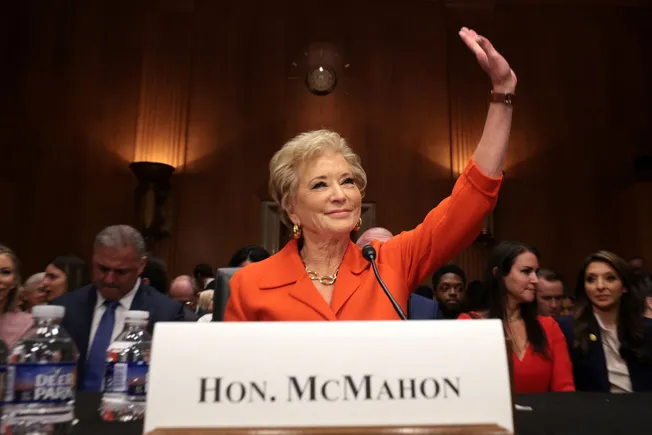
    OCR under this Administration has moved faster than it ever has, and the Title IX SIT will ensure even more rapid and consistent investigations,” U.S. Secretary of Education Linda McMahon said in Friday’s announcement. “To all the entities that continue to allow men to compete in women’s sports and use women’s intimate facilities: there’s a new sheriff in town. We will not allow you to get away with denying women’s civil rights any longer.”

    Attorney General Pamela Bondi said in an accompanying statement that “protecting women and women’s sports is a key priority” for the Department of Justice. The agency will “ take comprehensive action when women’s sports or spaces are threatened,” she continued. The administration has often used that language to separate transgender students from programs spaces aligning with their gender identities with blanket bans. 

    The department’s formal announcement that it is handing off Title IX enforcement to the Justice Department and joining forces on investigations comes after weeks of collaboration between the two agencies, confirming suspicions from education civil rights attorneys that DOJ involvement will be the new normal.

    It was also expected, considering that Education Department layoffs gutted half of OCR enforcement offices nationwide, and the department was already relying on the DOJ in the layoffs’ wake. 

    The Education Department already tapped the Justice Department in an investigation the Trump administration launched into the Maine Department of Education over the state’s transgender athlete policy.

    “Why would they continue to administratively enforce when they’re trying to put themselves out of jobs?” Kayleigh Baker, a Title IX attorney for TNG Consulting, an education civil rights consultant group, surmised late last month in wake of the Maine case. “And so I think leaning on DOJ makes sense.” 

    Prior to this administration, the DOJ was rarely called off the bench to enforce civil rights protections in schools, and its involvement was usually only reserved for complex and high-profile cases.

    Source link

  • ‘New sheriff in town’: DOJ to enforce anti-trans Trump orders

    ‘New sheriff in town’: DOJ to enforce anti-trans Trump orders

    This audio is auto-generated. Please let us know if you have feedback.

    The Trump administration on Friday announced a major change in Title IX enforcement at schools and colleges, tapping the U.S. Department of Justice to help investigate and ultimately enforce the separation of transgender students from girls’ and women’s athletics teams and spaces in schools and colleges. 

    The Title IX Special Investigations Team shifts some civil rights investigations and enforcement from the U.S. Department of Education to the Department of Justice — both of which are a part of the newly minted unit.

    The move is part of a Trump administration effort to push through a backlog of complaints at the Education Department’s Office for Civil Rights. These investigations usually take months — sometimes years — to complete. The process typically includes interviews and other tools and ultimately ends in resolution agreements to bring schools into compliance.  

    Instead, the department will rely on a rapid resolution process to address sex discrimination complaints, framing the move as a way to protect cisgender girls and women, according to a Friday announcement. Rapid resolution is “an expedited case processing approach,” according to the Trump administration’s case processing manual, which was updated in January. 

    There are certain requirements before rapid resolution is an option, including having the complainant initiate the expedited process and having schools on board with that plan of action to resolve a complaint. The tool can be tapped when schools have already taken action to resolve the complaint on their own accord. It was used under the previous administration as well to address the increasing volume of complaints.

    OCR under this Administration has moved faster than it ever has, and the Title IX SIT will ensure even more rapid and consistent investigations,” U.S. Secretary of Education Linda McMahon said in Friday’s announcement. “To all the entities that continue to allow men to compete in women’s sports and use women’s intimate facilities: there’s a new sheriff in town. We will not allow you to get away with denying women’s civil rights any longer.”

    Attorney General Pamela Bondi said in an accompanying statement that “protecting women and women’s sports is a key priority” for the Department of Justice. The agency will “ take comprehensive action when women’s sports or spaces are threatened,” she continued. The administration has often used that language to separate transgender students from programs spaces aligning with their gender identities with blanket bans. 

    The department’s formal announcement that it is handing off Title IX enforcement to the Justice Department and joining forces on investigations comes after weeks of collaboration between the two agencies, confirming suspicions from education civil rights attorneys that DOJ involvement will be the new normal.

    It was also expected, considering that Education Department layoffs gutted half of OCR enforcement offices nationwide, and the department was already relying on the DOJ in the layoffs’ wake. 

    The Education Department already tapped the Justice Department in an investigation the Trump administration launched into the Maine Department of Education over the state’s transgender athlete policy.

    “Why would they continue to administratively enforce when they’re trying to put themselves out of jobs?” Kayleigh Baker, a Title IX attorney for TNG Consulting, an education civil rights consultant group, surmised late last month in wake of the Maine case. “And so I think leaning on DOJ makes sense.” 

    Prior to this administration, the DOJ was rarely called off the bench to enforce civil rights protections in schools, and its involvement was usually only reserved for complex and high-profile cases.

    Source link