Tag: Shocking

  • Shocking Cancellation of a Special Journal Issue (opinion)

    Shocking Cancellation of a Special Journal Issue (opinion)

    Rumors are swirling about the extent to which Harvard University will acquiesce to the Trump administration’s attempt to crush institutions of higher education. Until very recently Harvard was being publicly lauded for standing up to the government. Reports that Harvard may be willing to pay a sizable financial settlement to resolve legal accusations that it allowed antisemitism and promoted diversity policies were shocking to many. But the university’s purported resistance to government overreach already had a glaring exception—Palestine—and we as scholars who work on the subject have recently experienced it firsthand.

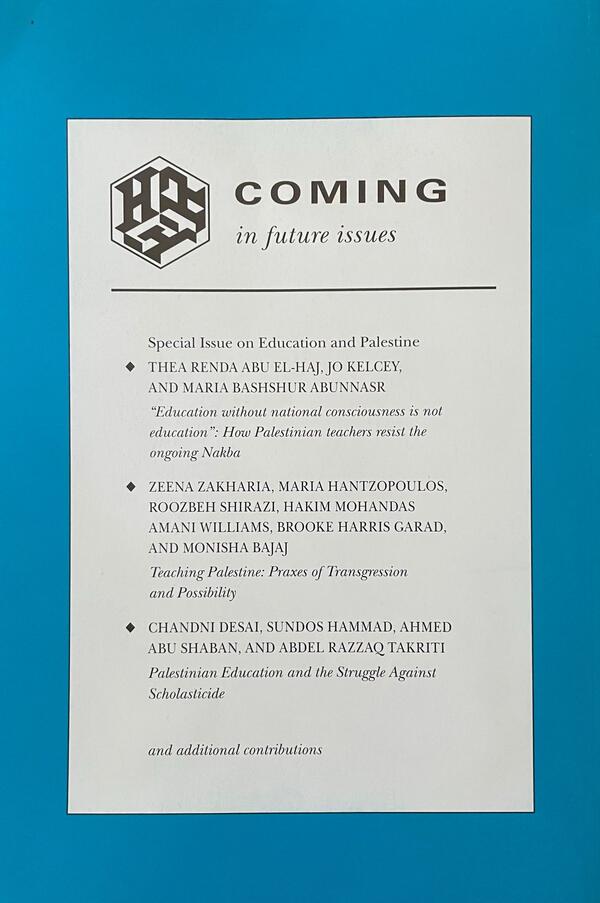
    The Harvard Educational Review was set to release a special issue this summer focusing on education and Palestine. The topic, commissioned in early 2024, was timely in the wake of Israel’s onslaught on Gaza, which rights groups and other experts have concluded is a genocide, and aligned with the journal’s commitment to publishing research that tackles the most pressing issues facing education. The articles had been accepted, edited and contracted. The special issue had already been promoted at major education conferences and on the back cover of the spring issue of the HER. But suddenly, Harvard pulled the plug.

    As recently reported in The Guardian, the Harvard Education Publishing Group (HEPG), which publishes the Review, abruptly and unilaterally decided to cancel the forthcoming special issue.

    We wrote one of the articles that was supposed to be published in the special issue. Our article, one of 10 slated for publication, focused on the experiences of Palestinian teachers during the Lebanese civil war. But in May, as the special issue was nearing publication, we were surprised to find out that HEPG wanted to submit the entire issue to Harvard’s Office of the General Counsel for an exceptional and last-minute “risk” review. Articles had already been through the regular publishing process and were under contract. At no point to our knowledge had any “risk”-related concerns been raised about any of them. An additional review was therefore well outside the realm of routine practice.

    Alarmed by this move and the dangerous precedent of subjecting academic scholarship to vetting by university lawyers, all authors in the special issue organized and expressed unequivocal refusal to this additional review in a letter sent to HEPG.

    After we expressed our refusal, HEPG went radio silent for almost a month. And then it canceled the whole issue, only then claiming that there were problems with copyediting and its internal process. But procedural claims have often been leveled to silence speech, especially when it comes to Palestine. Whatever concerns about the process, there is no justification for the cancellation of the entire special issue. HEPG’s decision is yet another example of the “Palestine exception” in action: the term used to describe how seemingly liberal institutions restrict freedom of expression when it comes to Palestine.

    Given the timing of HEPG’s decision—which aligns with the Trump administration’s weaponizing of Title VI of the Civil Rights Act—this seems to be the logical outcome of a political climate that has promoted sweeping claims of antisemitism to attack student protesters and higher education institutions, including Harvard. In this climate it seems far more likely that HEPG opted for censorship over academic freedom.

    Of particular concern is Harvard’s recent adoption of a problematic new definition of antisemitism. That definition, proposed by the International Holocaust Remembrance Alliance (IHRA), has been roundly criticized by experts—and one of the authors of the definition—for equating critiques of the state of Israel with antisemitism. This conflation makes it harder to speak out against Israel’s actions and policies toward Palestinians and easier to victimize Palestinians. Harvard is not alone in this action.

    Even before Israel’s latest brutal onslaught of Gaza, scholars writing and advocating for Palestinian rights confronted the limits of liberal empathy for Palestinians in the form of tenure denials, censored freedom of speech, doxing by pro-Israel groups and even death threats. But the repression of knowledge production and freedom of speech on Palestine has escalated since October 2023. U.S. universities and colleges (including Harvard) have canceled events that center Palestinian rights, attempted to censor scholarship, forcibly suppressed student protests against Israel’s actions in Gaza and beyond, and dismissed faculty over Palestine-related programming.

    Still, the scrapping of this special issue marks a worrying escalation. It suggests that even those universities that are outspoken about their liberal values are ready to stifle academics’ legitimate criticism of Israeli policies and practices. Make no mistake: Anticipatory censorship of this kind is a hallmark of the governmental overreach that authoritarian regimes around the world are known for. As a growing number of higher education institutions adopt the IHRA definition of antisemitism, we fear we will see more and more examples of the suppression of academic freedom.

    The consequences of this extend far beyond the academy. As the death toll in Gaza exceeds 60,000 and young people there face a third year without education amid ongoing bombardment, blockade and starvation, knowledge, debate and democratic action are essential to preventing the kind of horrors that are unfolding in Gaza today.

    Thea Renda Abu El-Haj is a professor of education at Barnard College, Columbia University. Jo Kelcey is assistant professor of education in the Department of Psychology and Education at Lebanese American University.

    Source link

  • Jeffrey Sachs EXPOSES Israel–U.S.–Iran War Plot: Shocking Claims Uncovered (Times Now World)

    Jeffrey Sachs EXPOSES Israel–U.S.–Iran War Plot: Shocking Claims Uncovered (Times Now World)

    Renowned economist Jeffrey Sachs has launched a scathing critique of U.S. foreign policy in the Middle East, placing the blame squarely on Washington’s alliance with Israel’s far-right leadership. Speaking at the Antalya Diplomacy Forum, Sachs claimed that American interference—encouraged by Israeli Prime Minister Benjamin Netanyahu—has devastated the region. He cited covert operations like the CIA’s Timber Sycamore as catalysts behind the Syrian civil war and accused Israel of pushing for armed conflict with Iran after having allegedly promoted six previous wars.

    Source link

  • A Shocking Case of Academic Misconduct at Universite Libre de Bruxelles (Emmanuel Legeard)

    A Shocking Case of Academic Misconduct at Universite Libre de Bruxelles (Emmanuel Legeard)

    A Flagrant and Repeated Breach of Academic Ethics (Université Libre de Bruxelles and European Journal of Applied Physiology)

    For
    several years now, Jacques Duchâteau and his team at the Université Libre de Bruxelles (ULB) have sought to misappropriate the 3/7 Method, a
    strength-training protocol I independently developed more than 20 years
    ago. Jean-Pierre Egger revealed the method — while respecting its
    intellectual property — during seminars and university lectures in 2012.
    Regardless of this elementary fact, ULB’s claims are contradicted by
    ample evidence proving my authorship, such as correspondence with Egger
    dating back to 2008, his documented public presentation at the
    University of Lausanne in 2012 within the ISSUL Master’s program, and
    Duchâteau’s recorded presentations at the French National Institute of
    Sport (INSEP).

    THE 3/7 METHOD, ALSO KNOWN AS THE LEGEARD PROTOCOL (Presented by Jean-Pierre Egger at the University of Lausanne in 2012)

    (You can download the full .pdf here: (PDF) Emmanuel Legeard Le 3–7 Master en sciences du sport, Université de Lausanne)

    Initially,
    Jacques Duchâteau organized conferences about me — curiously, without
    my involvement or consent — where the 3/7 Method was even referred to as
    “Legeard’s Method”. Gradually, Duchâteau resorted to insinuating that
    the method might not solely be my creation, a claim he knew was false.
    My method has never been modified by anyone. At the time, I dismissed
    these rumors as baseless. However, it became clear that this was a
    calculated strategy to dilute my rights and claim ownership of my work.

    2014: DUCHÂTEAU PRESENTS THE “LEGEARD’S METHOD” AT INSEP

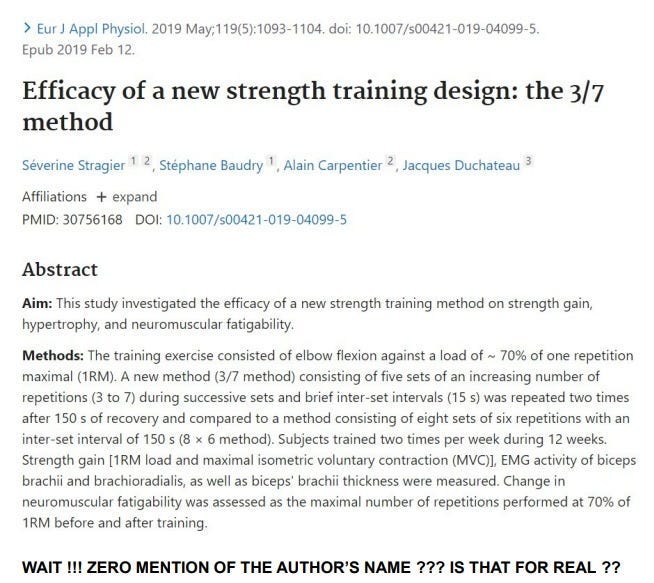
    Subsequently, Duchâteau’s team — including Séverine Stragier, Stéphane Baudry, and Alain Carpentier — published a 12-page article in the European Journal of Applied Physiology about my method. Shockingly, my name, Emmanuel Legeard, WAS ENTIRELY OMITTED
    ! This publication, titled “Efficacy of a new strength training design:
    the 3/7 method”, audaciously describes the method as “new”, a blatant
    misrepresentation given its development over two decades ago and its
    public introduction in 2012 by Egger.

    European
    Journal of Applied Physiology’s predatory publishing — Predatory publishing, also write-only publishing or deceptive publishing, is an
    exploitative academic publishing business model, where the journal or
    publisher prioritizes self-interest at the expense of scholarship. It is
    characterized by misleading information, deviates from the standard
    peer-review process, and is highly opaque.

    The
    misrepresentation has not gone unnoticed. T.C. Luoma, a renowned
    American sports journalist and editor of T-Nation — a site with over
    three million monthly visitors — highlighted the issue, stating:

    “That’s
    why reading about the 3/7 method aroused my interest. It’s a set-rep
    scheme developed by French strength coach Emmanuel Legeard in the early
    2000s.”

    (Source: T-Nation Forums)

    2023: THE DUCHÂTEAU TEAM’S UNABASHED IDEA THEFT

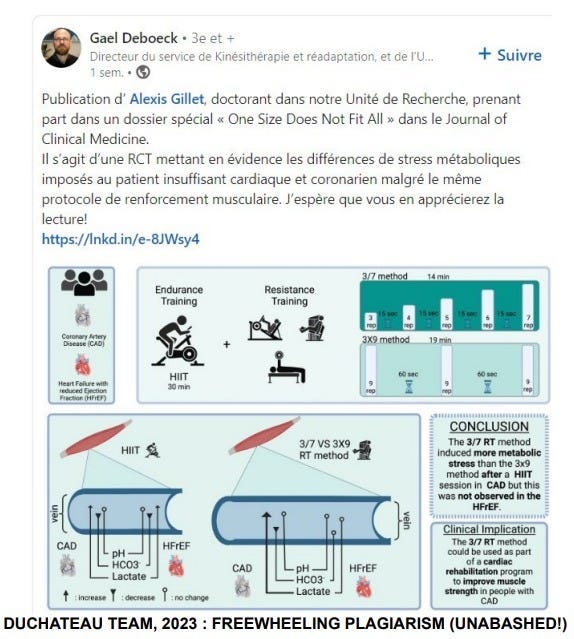
    Last year, Grigoraș Diaconescu, an international rugby player, shared his outrage after discovering a post by Gaël Deboeck, identified as the head of Physical Therapy and Rehabilitation at ULB. Deboeck congratulated Alexis Gillet,
    a doctoral student, for using the 3/7 Method to “prove” what I
    demonstrated 20 years ago. Unsurprisingly, the publication made no
    mention of the method’s original creator. It is now evident that ULB
    intends to mislead the public into believing that their laboratory
    developed the 3/7 Method. These unethical actions demand accountability.

    2023: THE DUCHÂTEAU TEAM’S UNABASHED IDEA THEFT


    CONSEQUENCES OF THIS ACADEMIC MISCONDUCT

    If
    the Université Libre de Bruxelles believes I will quietly accept the
    theft of my work, they are mistaken. This scandal, indicative of
    dishonesty incompatible with academic integrity, must result in
    sanctions. Public funding cannot continue to
    support crooked research where my work is falsely attributed to
    impostors like Jacques Duchâteau, Séverine Stragier
    , Stéphane Baudry, Alain Carpentier, Gael Deboeck or Alexis Gillet. I
    have been lenient for years, but my patience as the rightful creator
    has reached its limit. I have begun publicly correcting this falsehood
    online, as seen in similar cases — such as one involving the University
    of Zurich — which have led to severe consequences for academic dishonesty.

    Dr Emmanuel Legeard, Ph.D. — Creator, among quite a few others, of the 3/7 Method, also known as the “Legeard Method”.

    This article originally appeared on Medium.

    Source link