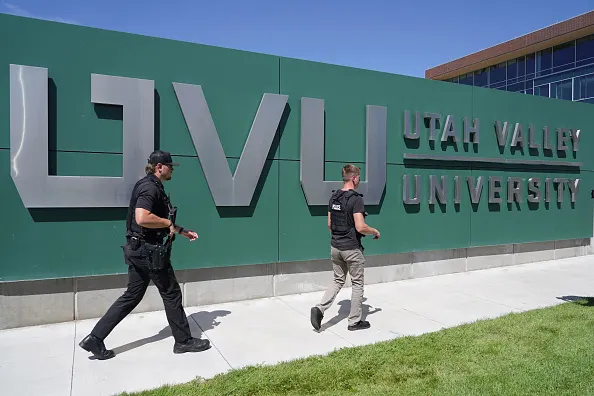
The shooter who killed Turning Point USA founder Charlie Kirk Wednesday on the Utah Valley University campus appeared to fire from the roof of a university building that houses administrative offices and student advisement services.
The Losee Center for Student Success is a 90,000-square-foot building with a mix of campus offices and student services that underwent a $4.5 million renovation in 2009. The building is fewer than 200 yards from the outdoor amphitheater where Kirk was speaking. A video taken by an attendee captures images of what appears to be the shooter standing on the roof of the building after the shooting and running away.
“The rooftop to the Losee building is pretty easy to access,” a CNN reporter said in a video analysis of the shooting. “It’s connected to another building by an elevated walkway, which … is only separated from the roof by a railing.”
Because of the distance and accuracy of the shot, it was likely fired from a large-caliber rifle, Jim Cavanaugh, a former officer of the U.S. Bureau of Alcohol, Tobacco, Firearms and Explosives, said on MSNBC show The Beat with Ari Melber. “It does appear to be a large rifle round,” Cavanaugh said. “I would call it a .308 or a .30-06, like a deer rifle. One shot. That’s all.”
Cavanaugh explained that “Snipers use that attack method for two reasons. One, they can’t get close … and secondly, because you want to get away. That gives you the distance to get away. You can fire the round and then egress from the scene.”
“Two hundred yards is not a difficult rifle shot,” Christopher O’Leary, former director of hostage recovery for the federal government, told Melber. “Most people have optics on their weapon. … With a true optic on it, 200 yards is very easy to do.”
The university, in Orem, Utah, prohibits guns on campus to the extent allowed by state law. Utah’s Concealed Weapons Law allows people with a state concealed carry permit to be on campus with a concealed firearm, according to the campus police website.
An estimated 3,000 people were attending the Kirk event, the first of a series of campus talks the conservative activist was scheduled to hold around the country. Kirk was shot while answering a question about mass shootings. “Do you know how many mass shootings in America there have been over the last 10 years?” an attendee asked, the CNN video analysis shows. “Counting or not counting gang violence?” Kirk responded before he was hit.
Local police and half a dozen campus police officers provided security at the event, but there was no screening, the CNN analysis said.
“Let’s be realistic,” O’Leary said on The Beat. “We’re not going to lock down a college campus for every speaker outdoors. Maybe you want to take it indoors. I think that’s all going to be assessed moving forward.”
Phil Lyman, a former Utah state legislator who was at the event, said on The Beat that he saw what he believed were “a lot of undercover police officers running around” after the shooting, which surprised him. “I would not have thought that [those were officers].”
The campus is closed for the week while law enforcement officials conduct their forensic work.
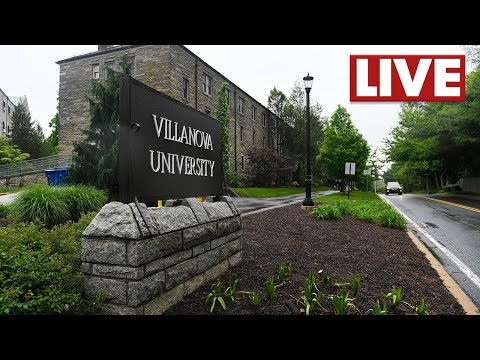
News sources in the Philadelphia area were alerted today that there was an active shooter at Villanova University. Students received text messages and rushed for safety. About two hours later, the university President Rev. Peter M. Donohue called it a “cruel hoax.”
Campus hoaxes are not mere pranks. They are crimes and a dangerous reflection of a society where the line between reality and rumor blurs under the shadow of violence. Each false alarm chips away at the sense of security that universities promise their students. Until the United States addresses the root causes of both gun violence and the culture of fear it breeds, campus hoaxes will remain part of higher education’s uneasy reality.
The threat of harm is not abstract. In the U.S., campus shootings have become a recurring tragedy: Virginia Tech (2007), Northern Illinois University (2008), Umpqua Community College (2015), and Michigan State (2023), among many others. This context makes hoaxes especially dangerous: police and students cannot know in the moment whether the threat is real. A single misstep could cost lives.
Accountability and Prevention
Universities and local authorities have begun tracking and prosecuting hoaxes and swatting calls, but enforcement is difficult. Prevention may require better technology, coordinated responses, and clear communication with students. Most importantly, it requires addressing the broader conditions that make both real shootings and hoaxes possible: widespread access to firearms, untreated mental illness, and a culture desensitized to violence.