The City Council now requires New York City’s Education Department to report data on school librarians and library access.
The first-ever report of public school library data was released last month, and revealed that across 1,614 public schools, 1,016 have a library. Yet, there were only 273 full-time librarians and 12 part-time librarians.
Research has shown access to school libraries with certified librarians tends to result in better academic performance and higher graduation rates at those schools. One study showed that a loss of librarians is associated with lower reading scores.
City Council passed school librarians data law after years of advocacy from parents and librarians who warned of a drastic loss in librarians across the city. In 2023, Chalkbeat analyzed school budget item lines to find that nearly a third of schools with more than 700 students did not have a librarian listed in their budget, even though state standards require all secondary schools with more than 700 students to have a full-time certified librarian.
This year’s data paints a similarly dire picture, and advocates have concerns about both what the data reveals and the accuracy of the data itself. For one, they are critical of the method the Education Department used to report on the number of schools that have libraries. Also, having a library space without a librarian remains a concern.
“Even if all the numbers are accurate, it still … paints a picture that there’s still so much work that needs to be done,” said Roy Rosewood, a school librarian in Queens who’s been advocating for librarians since 2013.
Rosewood and other advocates are concerned that the Education Department used a school’s operating hours as a proxy for the school’s library hours, according to the data. Advocates and librarians told Chalkbeat that this is not a reliable measurement of a library’s open hours, since libraries can often be shut down for testing, meetings, or other purposes.
“Last year, the library was pretty much closed all of April and May for testing,” said one librarian who is untenured and spoke on the condition of anonymity for fear of retaliation. “A lot of times when they shut down the libraries for testing, they don’t even put the librarian to proctor those tests. So we’re not even in the space that is closed down.”
For those two months, she spent most of her time in the teachers’ cafeteria and periodically, she walked around the school with a cart of books for students to check in or out.
Advocates also pointed out the importance of having a librarian, not just a library.
“A physical space means nothing,” said Jenny Fox, a New York City public school parent and founder of Librarians = Literacy, an advocacy group focused on raising awareness about the city’s library desert. Fox said she spends a lot of time educating people on what librarians do, something that is often misunderstood or overlooked.
“They’re not just checking books in and out. They’re teaching your kids about media literacy, safety online, how to vet an article for truthfulness,” Fox said. Librarians build their own curriculum, help students with research skills, and are one of the only people in the school who interact with every child.
An Education Department spokesperson said the department recognizes that school libraries are “essential,” and noted, “There’s still room to grow, and we will continue expanding these numbers to bring more knowledge, books, and a culture of reading to more students.”
On his fourth day as New York City schools chancellor, Kamar Samuels visited a Brooklyn school, and parents and educators pressed him about the lack of librarians. He agreed that school libraries were “critical,” saying when schools in the districts he worked in got libraries put into their buildings, “you could see the difference in the culture that changes.”
Parts of the City Council’s school library law have yet to be implemented. State law states that students in seventh and eight grades are required to receive at least one period of library and information instruction per week. Only about 20% of K-8 schools and junior high schools have a full-time librarian, according to a data analysis from Librarians = Literacy, suggesting the law’s requirements aren’t being met. The anonymous librarian said she is only teaching four library classes, but there are about 60 classes of seventh and eighth graders at her school.
The data on the number of students in those grades who receive library instruction is set to be released on June 1. Next year’s data will also include information such as the number of non-licensed school librarians that are assigned to help fill the librarian gap, the number of hours per day licensed librarians are assigned to do school library work, and more.
Chalkbeat is a nonprofit news site covering educational change in public schools. This story was originally published by Chalkbeat. Sign up for their newsletters at ckbe.at/newsletters.
Did you use this article in your work?
We’d love to hear how The 74’s reporting is helping educators, researchers, and policymakers. Tell us how
This story was produced in partnership with Work Shift and reprinted with permission.
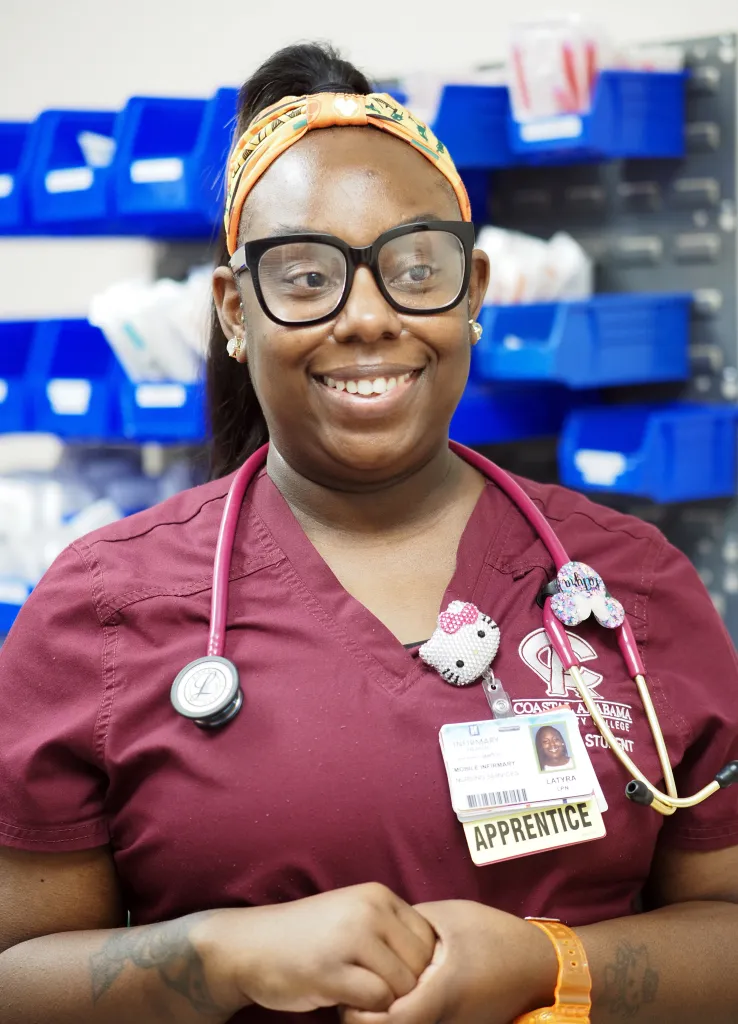
MOBILE, Ala. — Three or four times a week, LaTyra Malone starts her day at Mobile Infirmary hospital at 6:30 a.m. For the next 12 hours, she makes her rounds and visits with patients — asking if they’re in pain, checking vitals, administering fluids. To an outside observer, she appears to be a nurse.
But Malone, 37, is a registered nurse apprentice. Everything she has learned how to do in her nursing classes at Coastal Alabama Community College, she can do at the hospital under the supervision of registered nurse Ondrea Berry, her journeyworker — a term typically used in the skilled trades. Unlike most nursing students who complete their required clinical hours in groups for no pay, Malone gets paid as an employee with benefits. She also gets much more personalized, hands-on learning time.
“It’s like having a little kid attached to your leg all day,” Berry joked.
For Malone, the partnership is invaluable.
“I learn so much more one-on-one,” Malone said. “I might know the basics of disease processes or why we’re giving a certain medicine, but hearing her break it down to me helps a lot.”
The pair work largely as a team, alternating duties to allow Malone a chance to observe and practice. By now, Malone knows the ropes pretty well: In addition to her apprenticeship training and classes, she has 16 years of experience as a certified nursing assistant and a medical assistant. And Berry, who is 25, says she benefits from the working relationship too. “There are teaching moments for both of us,” she said.
Degreed nursing apprenticeships, like the one in Alabama, have emerged nationally as a potential solution to a thorny problem. The national nursing shortage is creeping toward crisis levels, with the demand for RNs like Berry and licensed practical nurses, or LPNs, projected to outstrip the supply for at least the next decade. At the same time, tens of thousands of people like Malone are already working in patient care in hospitals. Many aspire to be nurses — in fact, many certified nursing assistant programs sell the idea that you can start there, quickly land a job and then continue on to become a nurse.
But in reality, that’s a huge leap that requires an entirely different admissions process and English, math and science prerequisites that many nursing assistants don’t have. It also assumes that someone working an eight- or 12-hour shift for $18 an hour can find the time and the money for more education.
“The sort of ‘we are excellent’ ethos in nursing might be self-defeating in that it is weeding out a lot of people who would be amazing nurses,” said Iris Palmer, director for community colleges with the education policy program at New America.
Ondrea Berry, left, dispenses medication at Mobile Infirmary hospital while LaTyra Malone looks on. As an apprentice, Malone must be supervised by Berry at all times. Credit: Mike Kittrell for Work Shift
Related: Interested in more news about colleges and universities? Subscribe to our free biweekly higher education newsletter.
Several states, including Texas, North Carolina and Wisconsin, have begun growing registered apprenticeships in nursing — which have approval from the U.S. Department of Labor — to help address this problem. But no state has done quite as much as Alabama in scaling the model.
In 2021, the Alabama Board of Nursing worked with the state legislature to create a nursing apprenticeship license. Normally, nursing students are not licensed until after they graduate and pass a national licensure exam, and therefore they can’t be paid for their supervised clinical hours. The new apprenticeship license allows them to earn while they learn, making nursing school much more accessible for students like Malone and helping to fill critical staffing needs in hospitals.
Since the law passed, 80 employers and 28 colleges and universities in Alabama have jointly created LPN and RN apprenticeship programs for those who are still working toward a degree. Nearly 450 apprentices — the great majority RNs — have completed the program and passed their exam, with more than 500 currently apprenticing. It’s too soon to say whether apprenticeships will solve the nursing shortage in the state, but early data shows benefits for employers and aspiring nurses alike.
Mobile Infirmary has had over 90 nursing apprentices since the hospital’s program began in 2022, first with the LPN apprenticeship and soon after with the RN one. Graduates are required to stay at the hospital for one year after the apprenticeship ends, but most are staying beyond that. Only five have left so far, according to Stefanie Willis-Turner, the director of nursing school partnership and programs at Mobile Infirmary.
The hospital, like many others, already offered tuition reimbursement for employees who wanted to go back to college and move into nursing or another higher-level position. But such programs have notoriously low uptake, in part because most low-income employees can’t front the cost of tuition and also because many don’t know what steps to take.
“It amazed me the number of people that wanted to go back to school but didn’t really know where to get started,” Willis-Turner said. “Having a person to help guide them has really been our trigger, and that’s how we run this program.”
LaTyra Malone is a two-time apprentice at Mobile Infirmary hospital. Last year, she worked with Ondrea Berry as a licensed practical nurse apprentice while she earned the certification. This year, she is a registered nurse apprentice. Credit: Mike Kittrell for Work Shift
Willis-Turner played a crucial role in recruiting Malone for the apprenticeship. Malone has wanted to be a nurse since she was a teenager when she was president of her high school’s chapter of HOSA-Future Health Professionals, a global student-led organization that promotes careers in health care. But her plans to become a registered nurse were delayed when she became a mother. The financial burden plus the rigid schedules of nursing school made it difficult to make room for parenting, working and studying.
With the apprenticeship, Malone doesn’t have to worry about paying for college, and she can provide for her family while improving her nursing skills. Her path stands in stark contrast to that of Berry, who worked at Dairy Queen throughout nursing school to pay for tuition and health insurance. Berry didn’t have kids to take care of, but she also didn’t have financial support from anyone else in her family. Her only on-the-job training in nursing school was the clinical hours, where she joined a group of students who took turns practicing new skills with just one nurse. Berry says she only attempted two IVs in that time. Malone has done so many she can’t count.
About 75 percent of the apprentices at Mobile Infirmary over the last three years were already working at the hospital. The rest came from surrounding medical facilities. Some even quit their jobs to transfer to Mobile Infirmary for a better chance at getting into the apprenticeship program. In addition to paying students for their work, Mobile Infirmary pays for any tuition that isn’t covered by scholarships or grants. The hospital also provides two uniforms free of charge. And students know they have a guaranteed job after they graduate and pass the nursing exam.
This kind of targeted support is what makes the best apprenticeships successful in boosting individual economic mobility, its advocates say. Another key factor is the type of job an apprenticeship prepares people for. Most health care apprenticeships are for entry-level roles like CNAs, patient care technicians and medical assistants — jobs that, on average, pay $18-$20 an hour.
About half of states offer apprenticeships for LPNs, who make about 50 percent more than that, and half do so for RNs, whose median salaries are close to six figures, according to data from the U.S. Department of Labor. But far fewer apprentices are in those LPN and RN programs — and the majority of RN apprenticeships are for nurses who already have degrees, not for those who are still learning. That means aspiring nurses must still get all the way through the financial and logistical obstacles of nursing school before they can start to work.
Josh Laney helped set up the different model in Alabama when he was director of the state’s Office of Apprenticeship. For a long time, he said, he bought into the “urban legend” that training more people to be certified nursing assistants, especially when they’re young, would get people onto the path to becoming nurses.
“The pitch was, ‘We get you the certificate and then you’re going to work at a hospital because it’s a very high-demand occupation. From there you can go on and move into nursing or whatever else you want to do,’” Laney said. “But there was no specified plan for how to do that — just a low-wage, very stressful and strenuous job.”
The data backs that up. A 2018 study of federal Health Profession Opportunity Grants for CNA training showed that only 3 percent of those who completed the training went on to pursue further education to become an LPN or RN. Only 1 percent obtained an associate degree or above. A study in California showed slightly better odds: 22 percent of people who completed certificate programs at community colleges to become CNAs went on to get a higher-level credential in health care, but only 13 percent became registered nurses within six years.
Because of these outcomes, Laney refused to pursue apprenticeships for CNAs in Alabama. One reason apprenticeships for CNAs and medical assistants are common, however, is that they are jobs that don’t require degrees and have fewer regulations when it comes to training. Setting up a registered apprenticeship for nurses who don’t already have a bachelor’s degree is complex and requires the work of many entities — the nursing board, colleges and employers.
When he went to the state board of nursing to propose LPN and RN apprenticeships, Laney was initially shut down.
“To their credit, they said, ‘Go away, bureaucrat! You’re not industry, you’re not the employer. You don’t really have anything to do with this,’” he recalled. “What I learned there, and what I’ve recommended to every other state who’s tried this, is let the employers carry your water. If they want it, they’ll get it done.”
Laney then talked to the Alabama Hospital Association and Alabama Nursing Home Association, to reach employers. Given the shortages they had been experiencing, they bought into the idea and approached the nursing board themselves. Next, Laney’s team got community colleges on board, then universities. With the assurance that apprenticeships wouldn’t cut down on any of the required classes and clinical hours, the nursing board agreed to create the new license, following legislative approval.
Other states embarking on nursing apprenticeships have faced similar challenges.
Apprenticeships aren’t a panacea. They hold promise for creating upward mobility, diversifying the profession and improving the odds a student makes it through to graduation, but they can’t solve all the knotty challenges of the nursing shortage. A lack of instructors in nursing schools — and therefore a lack of available seats for qualified students — is still one of the biggest factors. And in the apprenticeship model, every student needs one-on-one mentorship, meaning hospitals must have enough staff available and willing to work in a mentoring role for up to a year.
Jay Prosser, executive director of the Massachusetts Nursing Council on Workforce Sustainability, knows all that. But he thinks apprenticeships will bring in more “practice-ready” nurses who are more likely to stay in the field long-term, especially those who were already working in patient care in the United States or other countries. Massachusetts is on the cusp of starting a licensed practical nurse apprenticeship with one employer and one academic partner, after working with the state nursing board and colleges for the past year. Unlike in Alabama, the nursing board didn’t need to create a new license, but rather the board judges whether educational programs meet regulations or not.
The Massachusetts Nursing Council on Workforce Sustainability is also creating a nursing apprenticeship network in the state, to make it easier for different institutions and programs to exchange ideas.
Prosser said one of the biggest barriers was making sure that the scope of practice for apprentices was clearly defined. He worked with local colleges to make sure of this. Prosser had previously worked as an assistant chief nursing officer in Birmingham, Alabama, and moved to Massachusetts in 2021 with the idea of apprenticeships already in mind.
Several other states have also created nursing apprenticeships for students who don’t already have a degree, but they’re limited to single institutions. In 2023, Texas began offering nursing apprenticeships for students who hadn’t already earned a degree in a collaboration between South Texas College and the Texas Workforce Commission.
The University of Wisconsin Health system has created a portfolio of nine registered apprenticeship programs, including an RN program launched in 2023 and a handful of other apprenticeship-style programs. Bridgett Willey, director of allied health education and career pathways, said the hospital started with entry-level apprenticeships, like medical assistants, before proposing degreed programs.
“There’s still kind of a myth that the colleges are going to do all this on their own,” Willey said. “Well, that’s not true. Employers have to sponsor, because we’re the ones hiring the apprentices and often supporting tuition costs, as well.”
The outcomes from the entry-level apprentice programs helped convince the health system that it was worth investing more. A three-year study showed that staff retention rates for those who participated in the hospital’s apprenticeships were 22% higher than for those who didn’t. In the two-year-old RN program, attrition is less than 10% so far — significantly lower than the attrition rate the hospital has seen with traditional students who participate in clinicals at the hospital.
UW Health supports efforts to scale their apprenticeship model across the state, but so far they haven’t panned out. Willey said employers are interested, but conversations often stall when questions arise about how to create more clinical capacity and find funding sources to support apprentices.
Even so, Eric Dunker, founding executive director of the National Center for the Apprenticeship Degree, which is affiliated with Reach University, predicts that nursing apprenticeships are about to see major growth, as teaching apprenticeships did five years ago. Earlier this year, Reach University received a $1 million grant to expand apprenticeships in behavioral health, and is planning for nursing ones. The strict licensing regulations for nursing make it more complicated than scaling up teaching apprenticeships, but Dunker sees the possibility of expanding them if nursing boards, colleges and employers all come to the table, as they did in Alabama.
“There’s a lot of entry-level health care apprenticeships,” Dunker said. “But the key is upward mobility, which is nursing and nurse practitioners. There’s typically been a bottleneck in stacking these pathways, but that’s where you’re starting to see more states and systems become a little more creative.”
Tyler Sturdivant, Coastal Alabama Community College’s associate dean of nursing, knows what that looks like. Figuring out the logistics of setting up an apprenticeship program was a challenge, he said, and required hiring an additional staff member to liaise between the college and hospital partners. But three years into the apprenticeship program for LPNs and RNs, the school is seeing higher completion rates than for traditional students.
This means they’re producing more licensed nurses to fill positions and someday mentor, or even teach, other apprentices.
On a typical Friday morning in September at Mobile Infirmary, Malone and Berry visited a 70-year-old man who came in for a urinary tract infection that then weakened him. That day, the apprentice and journeyworker switched out his bed for one lower to the ground to reduce the fall risk, taught him how to raise the bed so he could sit upright, updated him on a plan for physical therapy and adjusted his socks for him.
Malone appeared comfortable and confident, taking the lead in the patient’s care while Berry assisted her. Malone says the many hours of practice she’s had through the apprenticeship has made her feel prepared for the job and ready to continue to follow her dreams. One day, she wants to become a nurse practitioner specializing in mental health.
“I won’t feel complete until I actually become a nurse,” Malone says. “I thought I was going to be one sooner, but bumps in the road happened and I ended up having a child. If it wasn’t for the apprenticeship, I probably wouldn’t be here now.”
Contact editor Lawrie Mifflin at 212-678-4078 or on email at [email protected].
This story was produced in partnership with Work Shift and reprinted with permission.
Since you made it to the bottom of this article, we have a small favor to ask.
We’re in the midst of our end-of-year campaign, our most important fundraising effort of the year. Thanks to NewsMatch, every dollar you give will be doubled through December 31.
If you believe stories like the one you just finished matter, please consider pitching in what you can. This effort helps ensure our reporting and resources stay free and accessible to everyone—teachers, parents, policymakers—invested in the future of education.
This audio is auto-generated. Please let us know if you have feedback.
Dive Brief:
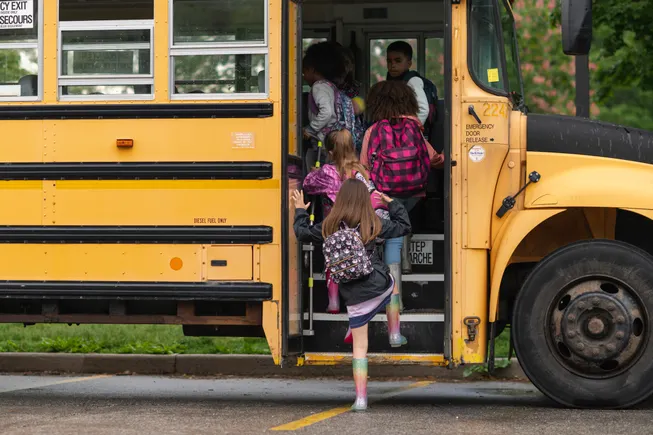
Higher hourly wages are credited for modest growth in the number of school bus drivers over the past year, but employment in the field remains down 9.5% compared to 2019 staffing levels, according to a recent analysis from the Economic Policy Institute.
The median hourly wage for school bus drivers was $22.45 on Aug. 1, a 4.2% increase year over year when accounting for inflation.
Nonetheless, the K-12 staffing outlook overall shows instability as school systems continue adjusting to the end of federal COVID-19 emergency funding and as changes implemented by the Trump administration put more fiscal pressures on state and local school systems, EPI said.
Dive Insight:
Employment for all K-12 positions is up 1.4% from August 2019 to August 2025, EPI found. Custodian positions dropped 12.4%, joining school bus drivers among those seeing the largest decreases. Slots for paraprofessionals, on the other hand, increased 16.5% during the same period, according to EPI.
The recent wage growth for school bus drivers is not the typical pattern seen over the past 15 years, EPI said. In fact, from Nov. 1, 2012, through June 1, 2015, school bus drivers saw negative year-over-year wage growth. Negative growth also occurred for this role in July 2018, November 2018 and September 2019.
EPI said the split-shift schedule required for the beginning and end of school days makes it difficult to recruit bus drivers. Moreover, school bus drivers — along with paraprofessionals, custodians and food service workers — tend to receive low pay. These jobs also are disproportionately held by women, Black and brown workers, and older employees, according to a 2024 EPI report.
School bus driver employment has grown by about 2,300 jobs over the past year. This growth is due to state and local government school bus driver employment, which saw an increase of nearly 9,900 drivers since the fall of 2024. Private-sector school bus employment fell by 8,200 jobs over the same period.
The institute’s most recent report said it’s hard to draw meaningful conclusions about the school bus driver wage growth over the last few years due to COVID-influenced changes in the labor market, as well as difficulty collecting labor data during the pandemic.
Still, EPI said “the wage growth for school bus drivers in the last year stands out as a much-needed investment in this critical segment of the education workforce.”
Several schools in Pennsylvania and one school system in Ohio closed for at least a day this school year due to school bus driver shortages, according to local news reports. Other localities have consolidated bus routes or made other adjustments to respond to driver shortages.
This audio is auto-generated. Please let us know if you have feedback.
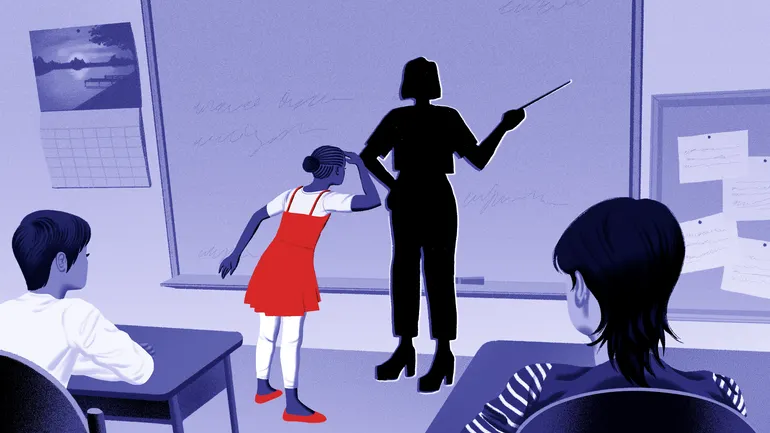
Teacher preparation experts fear ongoing special education teacher shortages will worsen as the Trump administration continues to downsize the U.S. Department of Education.
During the 2024-25 school year alone, 45 states reported shortages in special education — the most frequently reported shortage area nationwide, according to Learning Policy Institute. The other most common shortages reported by states include science (41), math (40), language arts (38), world languages (35) and career and technical education (33), LPI found.
A wave of layoffs in October at the Education Department that decimated most of the Office of Special Education Programs — a decision that is currently tied up in the courts — sent shockwaves throughout the special education community. OSEP helps administer and oversee the distribution of federal funds through the Individuals with Disabilities Education Act.
One of the grants impacted by these changes in particular is IDEA Part D for personnel development to improve services for children with disabilities.
The IDEA Part D personnel development grants received $115 million in federal appropriations during fiscal year 2024. Under the Trump administration’s FY 26 proposal, that same program would be zeroed out, and the newly allocated funds would go to IDEA Part B programs into a single state block grant program.
The budget proposal stated that even with this consolidation of funds, “states would continue to meet key IDEA accountability and reporting requirements aimed at ensuring a free appropriate public education is available to all students with disabilities and protecting the rights of those students and their families.”
Regardless, there’s minimal support in Congress for this kind of state block grant program, as both the House and Senate appropriations committees have rejected the measures in their budget planning for FY 26.
These IDEA Part D funds are typically awarded for five years to state education agencies, school districts, higher education institutions and nonprofits.
On top of challenges for OSEP to oversee the IDEA Part D personnel preparation funds while it is shortstaffed, experts and advocates say the Trump administration’s budget proposal to consolidate IDEA Part D into state block grants will harm teacher prep programs’ ability to train high-quality special educators.
The changes this year are of particular concern for Laurie VanderPloeg, associate executive director for professional affairs at the Council for Exceptional Children, who said the absence of IDEA Part D preparation program funds could reduce the number of special education teacher candidates in educator preparation programs.
Even at current enrollment levels in special education teaching programs, VanderPloeg said, there’s still not enough people in the pipeline to meet the demands in the field.
“So with the reduction in enrollment in the educator prep programs, it’s going to reduce our national flexibility with being able to fill all of the open positions with good, qualified personnel,” said VanderPloeg, who also served as director of OSEP during the first Trump administration.
The uncertainty around IDEA Part D grant funds is also hanging over the heads of educator preparation programs, leaving many wondering how long these federal dollars dedicated to training special educators will last, VanderPloeg said. If these grants are disrupted, she said, there could be other implications for teaching candidates currently enrolled in programs that benefit from the funds.
“Would they be able to complete the program in the absence of having funding availability?” VanderPloeg asked. “Would it put them into a position where they would have to financially support themselves through the completion of the program?”
Still, the Trump administration has suggested its efforts to eliminate the Education Department and give more control to the states will not impact instructional services for students with disabilities. President Donald Trump and U.S. Education Secretary Linda McMahon have named the U.S. Department of Health and Human Services as a potential agency to take on special education oversight from the Education Department. But there is no official plan in place to make such a move yet.
Marquita Grenot-Scheyer, former chairperson of the American Association of Colleges for Teacher Education board of directors, also said that the Education Department shakeups impacting special education will only make the declining enrollment in special education teacher training programs worse.
Educator preparation programs are worried about how these cuts will further strain working conditions for special educators, she said — and that’s especially the case if there’s less federal funding for technical assistance and possible increased class sizes in special education programs. At the same time, an analysis of federal data by The Advocacy Institute found that the number of students with disabilities, ages 3-21, could jump by about 1 million students between 2021 and 2025.
VanderPloeg agrees that those workforce strains exist, noting that the optics of these drastic changes to federal special education programs could cause those training in the field to question if there will be adequate resources and professional development opportunities to support them as they enter the profession. The cuts in funds and staffing for oversight to bolster the special education teacher pipeline sends a message to prospective teachers that may deter them from pursuing a career in the field, she said.
“So many of our university programs are uncertain with how best to address this or plan for the future — not only from a recruitment perspective into their educator prep programs, but certainly from a staff perspective as well,” VanderPloeg said.
Sitting on the Kentucky border, the Christian Academy of Indiana draws students from 56 different ZIP codes in southern Indiana. Some come from as far as 30 miles away and live in counties without private schools.
Families in those distant communities make the drive every day — sometimes carpooling — because they’re drawn to the school’s environment and extracurriculars, and especially its Christian teaching, said Lorrie Baechtel, director of admissions for the school, which is part of a three-school network in Indiana and Kentucky.
“There are lots of good public school options in Indiana. Families come to our Indiana campus more for that mission,” Baechtel said.
The school’s enrollment has boomed in the last four years, driven in part by the expansion of the Choice Scholarship, Indiana’s signature voucher program. That’s made tuition more affordable, Baechtel said. More than 1,200 students attended in 2024-2025, up from around 700 in 2021-22.
That reflects a statewide trend: Voucher use has surged in recent years as Indiana lawmakers loosened eligibility requirements. In 2026, the program will open to all families, regardless of income.
But the Christian Academy’s ability to attract students from far away tells another story too. Even as vouchers have become more accessible, Indiana’s rural students aren’t using them at the same rate as their urban and suburban peers. That’s in part because one-third of counties don’t have a private school that accepts vouchers within their borders, and distance is a factor in parents’ decisions on school choice.
The result is that students who live closer to an urban center — which typically have one or more voucher-accepting private schools — may use vouchers at rates up to 30 percentage points higher than those for students who live in a neighboring district.
“If there are no schools there for you to attend it’s unlikely it’s going to be all that useful for you,” said Jon Valant, director of the Brown Center on Education Policy at the Brookings Institution.
More than that, public education advocates say splitting state school funding with vouchers leaves less for the rural public schools these students do attend.
“We’re making the policy choice to fund a lot more choices than we used to,” said Chris Lagoni, executive director of the Indiana Small and Rural Schools Association, which represents public schools. “We’re inviting more and more folks to Sunday dinner. It’s a little bit of a bigger meal, but a lot more guests.”
But the state’s Republican lawmakers have dismissed the fears of a hit to public rural schools as a result of vouchers, saying that rural voters support choice and parents want educational options — whether that’s private, charter, or traditional public schools.
Meanwhile, school choice advocates say the latest expansion of the Choice Scholarship, along with a growing preference for smaller learning environments and the rise of voucher-accepting online schools, could mean more private school access for rural areas in the near future.
“I think we’re best when we have a robust ecosystem of private and public options,” said Eric Oglesbee of the Drexel Fund, a nonprofit venture philanthropy organization that funds new private schools in Indiana and throughout the U.S.
Location matters in accessing a private school
Across the state, around 76,000 students received vouchers for the 2024-25 school year — an increase of about 6,000 students from the year before. The program cost the state $497 million last year, and the average voucher recipient came from a household with just over $100,000 in income.
But around one-third of Indiana counties don’t have voucher-accepting private schools within their borders, according to a Chalkbeat analysis of state data, which also shows that voucher use is lower in rural areas than urban ones.
Voucher use can shift dramatically even between nearby areas. For example, around 16% of students who reside in the Madison school district in southern Indiana use vouchers, but that rate drops to as low as 1% in nearby districts that are more rural. Similar trends hold in other areas of the state, like Indianapolis, Evansville, Fort Wayne, and South Bend.
Location matters because driving distance has been shown to be a factor in how parents choose a school.
In a 2024 survey of parent preferences by EdChoice, an Indianapolis-based group that supports vouchers, around half of parents said they would drive a max of 15 minutes for their children “to attend a better school.” Just over a quarter said they would drive no more than 20 minutes, and the final quarter said 30 minutes would be their max.
Concerns about this issue have persisted in the state for years. Alli Aldis of the advocacy group EdChoice pointed to a 2018 report from her organization that called areas of rural Indiana as “schooling deserts.” It estimated that in the 2017-18 school year, around 3% of Indiana students, many in rural counties, lived more than 30 minutes from a charter, magnet, or voucher-accepting private school.
Starting a new school anywhere, but particularly in a rural area, comes with challenges like finding a building, said Oglesbee of the Drexel Fund.
A 2023 Drexel Fund report found that facilities in the state are “inadequate to meet the needs of new entrants to the market.” Though the report notes that real estate is both affordable and available, there are no public sources of facilities funding, and surplus facilities are not available to private schools.
But new laws in Indiana have the potential to change that. House Enrolled Act 1515 established voluntary school facility pilot programs open to both public and private schools to “allow for additional flexibility and creativity in terms of what is considered a school facility,” like colocating with schools, government entities, and community organizations.
Oglesbee said the organization is fielding an explosion of interest from potential new private schools in Indiana, possibly as a latent result of the 2023 expansion to voucher eligibility, which made the program nearly universal.
School succeeds ‘if the community asks for it’
Other challenges to opening a private school include hiring staff and recruiting students, which can be a particular issue in rural areas with both fewer children and licensed teachers, advocates said.
Opening a school also requires a team of people with both education and business experience, Oglesbee said. And they’re more likely to succeed if they have roots in the community they hope to serve.
“I see less of the ‘if you build it, they will come’ idea,” Oglesbee said. “A school is successful if the community asks for it.”
At a recent conservative policy conference, Indiana House Speaker Todd Huston said rural Indiana communities were “super excited” for school choice, and noted that no Republican lawmaker had been beaten in a primary for supporting the policy.
But Indiana voters haven’t voted on school vouchers, and don’t have a legal avenue to overturn the policy, said Chris Lubienski of the Center for Evaluation and Education Policy at Indiana University. Last year, voters in Kentucky and Colorado rejected ballot measures in favor of school choice, while Nebraska voters partially repealed a state-funded scholarship program.
“There’s resistance: ‘Why do I want to have my taxes fund a program I can’t use?’” Lubienski said.
In rural areas, support for school choice may actually mean support for transfers between public school districts, said Lagoni.
Ultimately, the Rural Schools Association believes any school receiving state dollars should be subject to the same expectations of transparency and accountability, Lagoni said.
Asked about concerns that rural students often have difficulty using vouchers, Huston said he expects voucher usage to continue to grow once the program becomes universal in 2026-27.
“We want to make sure our policies align with what works best for families,” Huston said.
Vouchers add to financial stress for rural schools
With more school options in Indiana, downward pressure on local tax revenue, and declining population, rural public schools feel pressure to compete. Sometimes that means closing and consolidating schools.
Vigo County schools recently announced plans to close two rural elementary schools as part of a plan to renovate facilities and offer more programming. The school corporation’s enrollment has declined slightly, due in part to an overall decline in the county’s total population, said spokesperson Katie Shane.
More students who reside in the district are using vouchers, although they’re not the biggest reason for the district’s falling enrollment. While 429 students used vouchers to attend private schools last school year, an increase from 252 the year before, around 870 Vigo students transferred to another public school district in the fall of the 2024-25 school year. That reflects a statewide trend.
Without their nearest public elementary schools, students may have to travel by bus for half an hour or more to the nearest school, according to community members who have started a petition to save one of the two schools marked for closure, Hoosier Prairie Elementary School.
“Hoosier Prairie isn’t just about going to school,” said Shyann Koziatek, an educational assistant at the school who also signed the petition to stop its closure. “Kids love to learn and love the routine we have.”
Rural schools also often function as large area employers and drivers of the economy.
“Schools are often the center and identity of the community, how people view who they are,” Lubienski said. “You go and cheer on your football team, it’s where you put on your school play.”
But private schools can serve the same role, choice advocates say.
“If people have stronger educational options, more choices, that only strengthens the community,” said Aldis of EdChoice.
Chalkbeat is a nonprofit news site covering educational change in public schools. This story was originally published by Chalkbeat. Sign up for their newsletters at ckbe.at/newsletters.
The number of vacancies is likely an undercount, because this number does not include substitutes or unqualified teachers who may have been hired to fill gaps.
Local news reports and job boards suggest that at least some Michigan districts are still struggling to fill open positions for the fall of 2025.
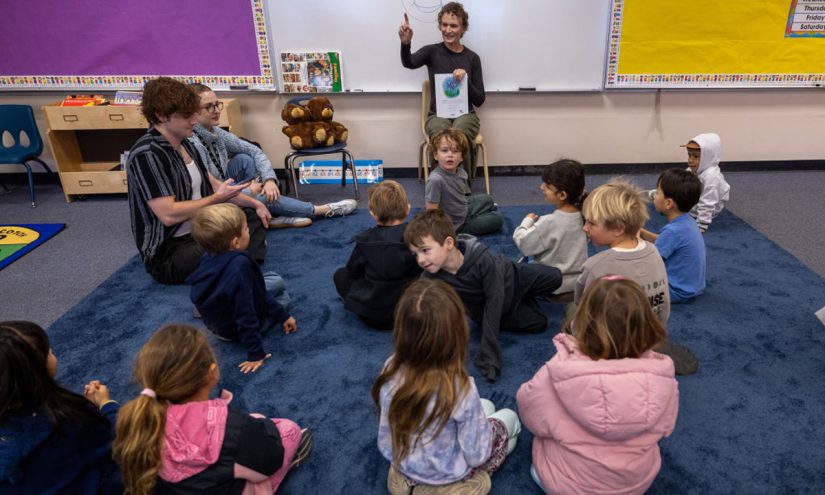
For more than two decades, my work at Michigan State University has centered on designing and leading effective teacher preparation programs. My research focuses on ways to attract people to teaching and keep them in the profession by helping them grow into effective classroom leaders.
Low pay and lack of support
Teacher shortages are the result of a combination of factors, especially low salaries, heavy workloads and a lack of ongoing professional support.
From my experience working with teachers and district leadership across the state, I know that beginning teachers – especially those in districts which have severe shortages – are often given the most challenging teaching loads. And in some districts, teachers have been forced to work without the benefit of any kind of planning time in their daily schedule.
Even some school districts, including the Detroit Public Schools Community District, have adopted this strategy in order to certify teachers and fill vacant positions.
Perhaps even more visible are national programs such as Teachers of Tomorrow and Teach for America. Candidates in such programs often work as full-time teachers while completing teacher training coursework with minimal oversight or support.
‘Stuffing the pipeline’ is not the solution
But simply “stuffing the pipeline” with new recruits is not enough to solve the teacher-shortage problem in Michigan.
The primary reasons for the higher attrition rates include a lack of awareness of the complexity of schools and schooling, the lack of effective mentoring during the certification period, and the absence of instructional and other professional guidance in the early years of teaching.
How to repair the leaky faucet
So how can teachers be encouraged to stay in the profession?
Temper expectations. Teaching is a critically important career, but leading individuals to believe that they can repair the damage done by a complex set of socioeconomic issues – including multigenerational poverty and lack of access to healthy and affordable food, housing, drinking water and health care – puts beginning teachers on a short road to early burnout and departure.
Recognize the limits of online learning. Online teacher preparation programs are convenient and have their place but don’t provide student teachers with real-world experience and opportunities for guided discussion about what they see, hear and feel when working with students.
Respect the process of “becoming.” Professional support should not end when a new teacher is officially certified. Teachers, like other professionals such as nurses, doctors and lawyers, need time to develop skills throughout their careers.
Providing this support sends a powerful message: that teachers are valued members of the community. Knowing that helps them stay in their jobs.
As Australia stares down the barrel of a looming pilot shortage, more than 100 NSW university students are taking to the skies in brand new state-of-the-art training aircraft.
Please login below to view content or subscribe now.