Autistic college students are experiencing anxiety and depression at significantly higher rates than their non-autistic peers, according to new research from Binghamton University that analyzed data from nearly 150,000 undergraduate students across 342 institutions nationwide.
The study, published in the Journal of Autism and Developmental Disorders, represents one of the most comprehensive examinations to date of mental health challenges facing autistic students in higher education—a population that researchers say has been historically underrepresented in academic research despite growing enrollment numbers.
“What we found is really staggering—autistic individuals endorse much higher rates of anxiety and depression compared to their non-autistic peers,” said Diego Aragon-Guevara, the study’s lead author and a PhD student in psychology at Binghamton University.
The research team analyzed data from the National Survey of Student Engagement (NSSE), which in 2021 became the first year that autism was included as an endorsable category in the survey. This milestone allowed researchers to conduct the first large-scale comparison of mental health outcomes between autistic and non-autistic college students.
“We were really excited to see what the data would tell us. It was a big opportunity to be able to do this,” said Dr. Jennifer Gillis Mattson, professor of psychology and co-director of the Institute for Child Development at Binghamton University, who co-authored the study.
The findings come at a critical time for higher education institutions as autism diagnoses continue to rise nationwide and more autistic students pursue college degrees. The research highlights a significant gap in support services that could impact student success and retention.
“We know the number of autistic college students continues to increase every single year,” Gillis-Mattson noted. “We really do have an obligation to support these students, and to know how best to support these students, we need to look beyond just autism.”
The study reveals that campus support systems may be inadvertently overlooking mental health needs while focusing primarily on autism-specific accommodations. Aragon-Guevara, whose research focuses on improving quality of life for autistic adults, said this represents a critical oversight in student services.
“Support personnel might address an individual’s autism and, in the process, overlook their mental health issues,” he explained. “More care needs to be put into addressing that nuance.”
The research underscores the need for institutions to develop more comprehensive support frameworks that address both autism-related needs and concurrent mental health challenges. The findings suggest that traditional disability services approaches may need significant enhancement to serve this population effectively.
“We want to provide the best support for them and to make sure that they have a college experience where they get a lot out of it, but also feel comfortable,” Aragon-Guevara said.
Dr. Hyejung Kim, an assistant professor in Binghamton’s Department of Teaching, Learning and Educational Leadership, noted that the complexity of factors affecting autistic students requires deeper investigation.
“This population often skews male, and interactions between personal factors and conditions such as anxiety and depression may shape overall well-being in college,” she said.
Kim also pointed to additional considerations that institutions should examine.
“Autistic students are also more likely to pursue STEM fields, and many report different experiences with faculty and staff across institutional settings,” she said. “We still have much to learn about how these and other contextual factors relate to mental well-being.”
The Binghamton team views this study as foundational research that confirms the scope of mental health challenges among autistic college students. Their next phase will investigate specific contributing factors, including social dynamics, faculty support, campus accessibility, and other environmental elements that influence student well-being.
“There are so many elements that go into being comfortable in the new environment that is college,” Aragon-Guevara explained. “We want to look into that and see if there are any deficits in those areas that autistic college students are experiencing, so that we know where we can help support them, or create institutional things to help improve quality of life as a whole.”
The research is part of a broader effort at Binghamton to better understand and support autistic students in higher education, with plans to collaborate with campus partners to develop targeted interventions based on their findings.
Researchers and the academic community may have reason to be hopeful about the future of federal funding. Early indications from the appropriations process suggest that both the House and Senate will diverge significantly from the president’s federal budget proposal for science and technology for the next fiscal year.
In May, the White House released its budget proposal that aims to reduce federal research and development funding by nearly a quarter, according to an analysis from the American Association for the Advancement of Science. It also proposed eliminating funding for the National Endowment for the Humanities, the National Endowment for the Arts and the Institute of Museum and Library Services.
Congress still has months of negotiations before the start of the next fiscal year on Oct. 1 but, so far, funding for science has received bipartisan support in appropriations meetings—though the House appears more willing to make significant cuts than the Senate.
In a July 10 Senate Appropriations Committee meeting, legislators put forth a cut to the National Science Foundation (NSF) of only $16 million compared to the more than $5 billion proposed by Trump. Four days later, a House Appropriations Committee subcommittee suggested slashing $2 billion—less than half of Trump’s proposal.
Alessandra Zimmermann, budget analyst and senior manager for the American Association for the Advancement of Science’s R&D Budget and Policy Program, highlighted in a statement the Senate’s proposal and noted that the House’s over 20 percent proposed cut to NSF is still “a much smaller decrease than the Administration’s initial request.”
“This shows that there is bipartisan support for investing in basic research, and putting the U.S. on track for FY26,” Zimmermann said. “The story of the future of science is still being written, and we appreciate the strong support from Congress.”
The House has also suggested increasing by $160 million funding for the Department of Energy’s Office of Science—rejecting the White House’s planned 14 percent cut. The House has floated cutting NASA’s Science Mission Directorate by $1.3 billion, or 18 percent, but that’s still better than Trump’s proposal to nearly halve that budget. The House also proposed $288 million for the Fulbright scholarship, a highly selective cultural exchange program that Trump had recommended eliminating.
The White House didn’t respond to a request for comment Friday.
Bipartisan Support for R&D
Congressional Republicans have remained in lock step with the second Trump administration. Early grumbles about the One Big Beautiful Bill were silent when the House passed it into law July 3, cutting nearly $1 trillion from Medicaid, eliminating a loan program for graduate students and much more.
Still, observers say there is reason for science and research communities to have some optimism that Republicans will step out of line on budget proposals.
“Neither bill goes to the extreme of the president’s budget,” said Debbie Altenburg, vice president of research policy and advocacy at the Association of Public and Land-grant Universities. “We are pleased that both the House and the Senate have marked up bills that are above what the president called for.”
She noted that Republicans, who want the federal government to have a smaller footprint, control Congress and the White House.
“We will be lucky if we get that flat funding” that senators have proposed, she said.
The House and Senate have to agree on a dozen appropriations bills to pass the federal budget by Sept. 30 or risk a government shutdown.
“It’s a very tense political situation,” she said. “It will be hard for Congress to complete all of these bills by the end of September.”
Roger Pielke, a senior fellow at the conservative American Enterprise Institute, noted that “this is not the first time that Congress, on science-technology policy issues, has pushed back on the Trump administration.” It happened during Trump’s first term. And, going back to the 1970s and ’80s, research and development “has been a strong bipartisan area of agreement.”
“R&D money goes all over the country,” Pielke said. “… It does kind of have a built-in support structure.”
He said the NSF, which focuses on basic research, may be more insulated from political fights than agencies such as the National Oceanic and Atmospheric Administration, which deals with climate science, and the National Institutes of Health, which deals with vaccines. The congressional appropriations committees haven’t yet indicated what they plan to do with Trump’s proposed 38 percent cut to the NIH.
But, Pielke noted, “in this day and age, everything can be politicized.”
‘Scientific Supremacy’
While House Republicans appear more willing to protect spending for science than the president, Democratic members of the Commerce, Justice, Science, and Related Agencies subcommittee have criticized the bill. Representative Grace Meng, a New York Democrat and the subcommittee’s ranking member, said a proposed cut to the NSF and NASA “disinvests in the scientific research that drives American innovation, technological leadership and economic competitiveness.”
“As other countries are racing forward in space exploration and climate science, this bill would cause the U.S. to fall behind by cutting NASA’s science account by over $1.3 billion,” Meng said.
Representative Rosa DeLauro, a Connecticut Democrat and ranking member of the full House Appropriations Committee, said the bill “continues Republicans’ senseless attacks on America’s scientific supremacy.”
“They have fired hundreds of scientists, including scientists who monitor extreme weather and who advance our scientific goals in space,” DeLauro said, referencing the mass layoffs at federal research agencies. “Why on Earth are we forfeiting America’s scientific supremacy? What would you do differently if you were America’s adversary and wanted to undermine everything that made us a superpower?”
In the Senate, where Republicans need Democratic support to get to 60 votes to pass their bill, proposed spending cuts have been more modest.
Sen. Susan Collins, a Maine Republican who chairs the Senate Appropriations Committee, said during its July 10 meeting that the NSF and NASA appropriations bill “funds research in critical scientific and technological fields.” She said another appropriations bill “supports much-needed investments in agricultural research in animal and plant health that were requested by nearly every member in this room.”
Sen. Patty Murray, a Washington state Democrat and ranking member of the Senate committee, said “these compromise bills offer a far better outcome for families back home than the alternatives of either the House or another disastrous CR [continuing resolution].”
She cautioned, though, that rescissions legislation—like the bill passed by Congress last week that claws back $9 billion in foreign aid and public broadcasting funding–could undermine consensus on a budget.
“We cannot allow bipartisan bills with partisan rescission packages,” she said, asking, “if we start passing partisan cuts to bipartisan deals, how are we ever supposed to work together?”
What if I told you the education system isn’t broken—it’s working exactly the way it was built to? That’s not just a soundbite from my TEDx Talk—it’s my lived experience.
I grew up in a historically underserved neighborhood in Houston, Texas, zoned to one of the lowest-performing elementary schools in the city. But due to a granted academic transfer, I ended up attending a top-performing public school just three miles away. Same city. Different ZIP code. Completely different resources—and trajectory.
That three-mile difference changed everything. And today, as a doctoral student and aspiring professor, I can see how those early disparities still show up in our college classrooms.
Here’s the thing: public school funding in the U.S. depends heavily on local property taxes. That means wealthier neighborhoods get better schools—often with state-of-the-art facilities, robust extracurriculars, and college prep courses—while nearby communities may struggle with crumbling infrastructure and underpaid staff (Owens-Young 2023).
Part of my dissertation, I compared two elementary schools less than three miles apart. One had a PTA raising over $100,000 annually. The other didn’t have working air conditioning. These weren’t just different schools—they were different worlds. And students from those environments bring that context with them when they walk into our lecture halls.
But what we see in higher education—missed assignments, low engagement, quiet classrooms—isn’t always a motivation issue. Often, it’s a preparedness gap. And that gap isn’t the student’s fault.
As faculty, we can’t change where our students come from. But we can shape what they experience once they’re here. Below are four strategies I use in the classroom to help level the playing field:
1. Start by Asking, Not Assuming
Instead of assuming a lack of interest, ask about their background. I use a quick, anonymous prompt on the first day of class: “What’s one thing you overcame to get here today?” One student wrote about taking two buses from the other side of town after getting their younger siblings off to school. That kind of insight changes how we teach.
2. Rethink Participation
Not everyone feels comfortable speaking up in class. Consider using written reflections, discussion boards, or tools like Jamboard and Padlet. For instance, in one of my leadership classes, I use a shared Google Doc where students add thoughts anonymously. The quieter students thrive—and the louder ones gain new perspectives.
3. Normalize Struggle
Students from under-resourced schools often view academic struggle as failure. That’s why I share my own story of nearly failing out during undergrad. I also let students revise one major assignment. One student improved from a 72 to a 90—and more importantly, realized they were capable all along.
4. Offer Flexible Assessment Options
Some students express themselves better visually or verbally. I once had a student create a narrated photo essay instead of a traditional paper—it was powerful, reflective, and demonstrated full mastery. When students see that their strengths are valued, their confidence grows.
None of these ideas require overhauling your entire course. But they do require intentionality. And that’s what makes the difference.
I’ve been the under-resourced student, and now I’m becoming the professor I wish I had—someone who saw potential beyond performance.
We don’t control our students’ ZIP codes. But we do influence how they feel in our classrooms—and whether they believe they belong there.
Lloyd Lindley Jr. is a PhD student in Educational Leadership and Organization at Texas Woman’s University, a TEDx speaker, and author of “From the Hood to Understood”. He is the co-founder of a grassroots nonprofit that advocates for equitable access to education, mentorship, and financial literacy in underserved communities. Lloyd has been featured on Good Morning Houston and KTSU Radio for his impactful community work and continues to champion culturally responsive teaching and student empowerment at all levels of education.
References
Owens-Young, Jessica. 2023. “The ZIP Code Effect.” American University.
What if I told you the education system isn’t broken—it’s working exactly the way it was built to? That’s not just a soundbite from my TEDx Talk—it’s my lived experience.
I grew up in a historically underserved neighborhood in Houston, Texas, zoned to one of the lowest-performing elementary schools in the city. But due to a granted academic transfer, I ended up attending a top-performing public school just three miles away. Same city. Different ZIP code. Completely different resources—and trajectory.
That three-mile difference changed everything. And today, as a doctoral student and aspiring professor, I can see how those early disparities still show up in our college classrooms.
Here’s the thing: public school funding in the U.S. depends heavily on local property taxes. That means wealthier neighborhoods get better schools—often with state-of-the-art facilities, robust extracurriculars, and college prep courses—while nearby communities may struggle with crumbling infrastructure and underpaid staff (Owens-Young 2023).
Part of my dissertation, I compared two elementary schools less than three miles apart. One had a PTA raising over $100,000 annually. The other didn’t have working air conditioning. These weren’t just different schools—they were different worlds. And students from those environments bring that context with them when they walk into our lecture halls.
But what we see in higher education—missed assignments, low engagement, quiet classrooms—isn’t always a motivation issue. Often, it’s a preparedness gap. And that gap isn’t the student’s fault.
As faculty, we can’t change where our students come from. But we can shape what they experience once they’re here. Below are four strategies I use in the classroom to help level the playing field:
1. Start by Asking, Not Assuming
Instead of assuming a lack of interest, ask about their background. I use a quick, anonymous prompt on the first day of class: “What’s one thing you overcame to get here today?” One student wrote about taking two buses from the other side of town after getting their younger siblings off to school. That kind of insight changes how we teach.
2. Rethink Participation
Not everyone feels comfortable speaking up in class. Consider using written reflections, discussion boards, or tools like Jamboard and Padlet. For instance, in one of my leadership classes, I use a shared Google Doc where students add thoughts anonymously. The quieter students thrive—and the louder ones gain new perspectives.
3. Normalize Struggle
Students from under-resourced schools often view academic struggle as failure. That’s why I share my own story of nearly failing out during undergrad. I also let students revise one major assignment. One student improved from a 72 to a 90—and more importantly, realized they were capable all along.
4. Offer Flexible Assessment Options
Some students express themselves better visually or verbally. I once had a student create a narrated photo essay instead of a traditional paper—it was powerful, reflective, and demonstrated full mastery. When students see that their strengths are valued, their confidence grows.
None of these ideas require overhauling your entire course. But they do require intentionality. And that’s what makes the difference.
I’ve been the under-resourced student, and now I’m becoming the professor I wish I had—someone who saw potential beyond performance.
We don’t control our students’ ZIP codes. But we do influence how they feel in our classrooms—and whether they believe they belong there.
Lloyd Lindley Jr. is a PhD student in Educational Leadership and Organization at Texas Woman’s University, a TEDx speaker, and author of “From the Hood to Understood”. He is the co-founder of a grassroots nonprofit that advocates for equitable access to education, mentorship, and financial literacy in underserved communities. Lloyd has been featured on Good Morning Houston and KTSU Radio for his impactful community work and continues to champion culturally responsive teaching and student empowerment at all levels of education.
References
Owens-Young, Jessica. 2023. “The ZIP Code Effect.” American University.
Roughly half of middle and high schoolers report losing interest in math class at least half the time, and 1 in 10 lack interest nearly all the time during class, a new study shows.
In addition, the students who felt the most disengaged in math class said they wanted fewer online activities and more real-world applications in their math classes.
Feeling bored in math class from time to time is not an unusual experience, and feeling “math anxiety” is common. However, the RAND study notes that routine boredom is associated with lower school performance, reduced motivation, reduced effort, and increased rates of dropping out of school.
Perhaps unsurprisingly, the study found that the students who are the most likely to maintain their interest in math comprehend math, feel supported in math, are confident in their ability to do well in math, enjoy math, believe in the need to learn math, and see themselves as a “math person.”
Dr. Heather Schwartz, a RAND researcher and the primary investigator of the study, noted that the middle and high school years are when students end up on advanced or regular math tracks. Schwartz said that for young students determining their own sense of math ability, “Tracking programs can be a form of external messaging.”
Nearly all the students who said they identified as a “math person” came to that conclusion before they reached high school, the RAND survey results show. A majority of those students identified that way as early as elementary school. In contrast, nearly a third of students surveyed said they never identified that way.
“Math ability is malleable way past middle school,” Schwartz said. Yet, she noted that the survey indicates students’ perception of their own capabilities often remains static.
The RAND study drew on data from their newly established American Youth Panel, a nationally representative survey of students ages 12-21. It used survey responses of 434 students in grades 5-12. Because this was the first survey sent to members of the panel, there is no comparable data on student math interest prior to the pandemic, so it doesn’t measure any change in student interest.
The RAND study found that 26% percent of students in middle and high school reported losing interest during a majority of their math lessons. On the other end of the spectrum, a quarter of students said they never or almost never lost interest in math class.
There weren’t major differences in the findings across key demographic groups: Students in middle and high school, boys and girls, and students of different races and ethnicities reported feeling bored during a majority of math class at similar rates.
Dr. Janine Remillard, a professor at the University of Pennsylvania Graduate School of Education and expert in mathematics curriculum, said that in many math classes, “It’s usually four or five students answering all the questions, and then the kids who either don’t understand or are less interested or just take a little bit more time — they just zone out.”
Over 50% of students who lost interest in almost all of their math classes asked for fewer online activities and more real-world problems, the RAND study shows. Schwartz hypothesizes that some online math programs represent a “modern worksheet” and emphasize solo work and repetition. Students who are bored in class instead crave face-to-face activities that focus on application, she said.
During Remillard’s math teacher training classes, she puts students in her math teacher training class into groups to solve math problems. But she doesn’t tell them what strategy to use.
The students are forced to work together in order to understand the process of finding an answer rather than simply repeating a given formula. All of her students typically say that if they had learned math this way, they would think of themselves as a math person, according to Remillard, who was not involved in the RAND study.
Chalkbeat is a nonprofit news site covering educational change in public schools.
For more news on STEM learning, visit eSN’s STEM & STEAM hub.
Norah Rami, Chalkbeat
Norah Rami is a Dow Jones education reporting intern on Chalkbeat’s national desk. Reach Norah at [email protected].
Latest posts by eSchool Media Contributors (see all)
In 2023, New Jersey’s Office of the Secretary of Higher Education signed a first-of-its-kind agreement with a digital mental health provider, Uwill, to provide free access to virtual mental health services to college students across the state.
Over the past two years, 18,000-plus students across 45 participating colleges and universities have registered with the service, representing about 6 percent of the eligible postsecondary population. The state considers the partnership a success and hopes to codify the offering to ensure its sustainability beyond the current governor’s term.
The details: New Jersey’s partnership with Uwill was spurred by a 2021 survey of 15,500 undergraduate and graduate students from 60 institutions in the state, which found that 70 percent of respondents rated their stress and anxiety as higher in fall 2021 than in fall 2020. Forty percent indicated they were concerned about their mental health in light of the pandemic.
Under the agreement, students can use Uwill’s teletherapy, crisis connection and wellness programming at any time. Like others in the teletherapy space, Uwill offers an array of diverse licensed mental health providers, giving students access to therapists who share their backgrounds or language, or who reside in their state. Over half (55 percent) of the counselors Uwill hires in New Jersey are Black, Indigenous or people of color; among them, they speak 11 languages.
What makes Uwill distinct from its competitors is that therapy services are on-demand, meaning students are matched with a counselor within minutes of logging on to the platform. Students can request to see the same counselor in the future, but the nearly immediate access ensures they are not caught in long wait or intake times, especially compared to in-person counseling services.
Under New Jersey’s agreement, colleges and students do not pay for Uwill services, but colleges must receive state aid to be eligible.
The research: The need for additional counseling capacity on college campuses has grown over the past decade, as an increasing number of students enter higher education with pre-existing mental health conditions. The most recent survey of counseling center staff by the Association for University and College Counseling Center Directors (AUCCCD) found that while demand for services is on the decline compared to recent years, a larger number of students have more serious conditions.
Over half of four-year institutions and about one-third of community colleges nationwide provide teletherapy to students via third-party vendors, according to AUCCCD data. The average number of students who engaged with services in 2024 was 453, across institution size.
Online therapy providers tout the benefits of having a service that supplements on-campus, in-person therapists’ services to provide more comprehensive care, including racially and ethnically diverse staff, after-hours support and on-demand resources for students.
Eric Wood, director of counseling and mental health at Texas Christian University, told Inside Higher Ed that an ideal teletherapy vendor is one that increases capacity for on-campus services, expanding availability for on-campus staff and ensuring that students do not fall through the cracks.
A 2024 analysis of digital mental health tools from the Hope Center at Temple University—which did not include Uwill—found they can improve student mental health, but there is little direct evidence regarding marginalized student populations’ use of or benefits from them. Instead, the greatest benefit appears to be for students who would not otherwise engage in traditional counseling or who simply seek preventative resources.
One study featured in the Hope Center’s report noted the average student only used their campus’s wellness app or teletherapy service once; the report calls for more transparency around usage data prior to institutional investment.
The data: Uwill reported that from April 2023 to May 2025, 18,207 New Jersey students engaged in their services at the 45 participating institutions, which include Princeton, Rutgers, Montclair State and Seton Hall Universities, as well as the New Jersey Institute of Technology and Stevens Institute of Technology. Engaged students were defined as any students who logged in to the app and created an account.
New Jersey’s total college enrollment in 2022 was 378,819, according to state data. An Inside Higher Ed analysis of publicly available data found total enrollment (including undergraduate and graduate students) among the 45 participating colleges to be 327,353. Uwill participants in New Jersey, therefore, totaled around 4 percent of the state’s postsecondary students or 6 percent of eligible students.
The state paid $4 million for the first year of the Uwill contract, as reported by Higher Ed Dive, pulling dollars from a $10 million federal grant to support pandemic relief and a $16 million budget allocation for higher education partnerships. That totals about $89,000 per institution for the first year alone, or $12 per eligible student, according to an Inside Higher Ed estimate.
In a 2020 interview with Inside Higher Ed, Uwill CEO Michael London said the minimum cost to a college for one year of services is about $25,000, or $10 to $20 per student per year.
New Jersey students met with counselors in more than 78,000 therapy sessions, or about six sessions per student between 2023 and 2025, according to Uwill data. Students also engaged in 548 chat sessions with therapists, sent 6,593 messages and requested 1,216 crisis connections during the first two years of service.
User engagement has slowly ticked up since the partnership launched. In January 2024, the state said more than 7,600 students registered on the platform, scheduling nearly 20,000 sessions. By September 2024, Uwill reported more than 13,000 registered students on the platform, scheduling more than 49,000 sessions. The most recent data, published June 6, identified 18,000 students engaging in 78,000 sessions.
Over 1,200 of Montclair State’s 22,000 students have registered with Uwill since June 2023, Jaclyn Friedman-Lombardo, Montclair State’s director of counseling and psychological services, said at a press conference, or approximately 6 percent of the total campus population.
The state does not require institutions to track student usage data to compare usage to campus counseling center services, but some institutions choose to, according to a spokesperson for both the office of the secretary and Uwill. The secretary’s office can view de-identified campus-level data and institutions can engage with more detailed data, as well.
Creating access: One of the goals of implementing digital mental health interventions is to expand access beyond traditional counseling centers, such as after hours, on weekends or over academic breaks.
Roughly 30 percent of participants in the Uwill partnership completed a session between 5 p.m. and 9 a.m. on a weeknight or on the weekends. Over the 2024–25 winter break, students engaged in 3,073 therapy sessions. More than 90 of those took place outside New Jersey. Students also used Uwill services over summer vacation this past year (9,235 sessions from May 20 to Aug. 26, of which 10 percent took place outside New Jersey).
A majority of users were traditional-aged college students (17 to 24 years old), and 32 percent were white, 25 percent Hispanic and 17 percent Black. The report did not compare participating students’ race to those using on-campus services or general campus populations.
About 85 percent of New Jersey users were looking for a BIPOC therapist, and 9 percent requested therapists who speak languages other than English, including Hindi and Mandarin.
Postsession assessment completed by students who do schedule an appointment has returned positive responses, with a feedback score of 9.5 out of 10 in New Jersey, compared to Uwill’s 9.2 rating nationally.
Unanswered questions: Wood indicated the data leaves some questions left unanswered, such as whether students were also clients at the on-campus counseling center, or if the service had improved students’ mental health over time from a clinical perspective.
“Just because a student had four sessions with a telehealth provider, if they came right back to the counseling center, did it really make an impact on the center’s capacity to see students?” Wood said.
The high cost of the service should also give counseling center directors pause, Wood said, because those dollars could be used for a variety of other interventions to create capacity.
The data indicated some benefits to counseling center capacity, including diverse staff and after-hours support. But to create a true return on investment, counseling centers should calculate how much capacity the tele–mental health service created and its direct impact on student wellness, not just participation in services.
“It would be ideal to compare the number of students receiving services (not just creating an account) through the platform to the number of students who would likely benefit from receiving treatment, as identified by clinically validated mental health screens on population surveys,” said Sara Abelson, assistant professor at the Hope Center and the report’s lead author.
What’s next: New Jersey renewed its contract with Uwill first in January 2024 and then again in May, extending through spring 2026. State leaders said the ongoing services are still supported by pandemic relief funds.
On May 2, New Jersey assemblywoman Andrea Katz from the Eighth District introduced a bill, the Mental Health Early Access on Campus Act, which would require colleges to implement mental health first aid training among campus stakeholders, peer support programs, mental health orientation education and teletherapy services to ensure counseling ratios are one to every 1,250 students per campus. The International Accreditation of Counseling Services recommends universities maintain a ratio of at least one full-time equivalency for every 1,000 to 1,500 students.
“We know that mental health services that our kids need are not going to end when we change governors,” Katz said at a press conference. “We need to make sure that all of this is codified into law.”
Prior research shows attendance is one of the best predictors of class grades and student outcomes, creating a strong argument for faculty to incentivize or require attendance.
Attaching grades to attendance, however, can create its own challenges, because many students generally want more flexibility in their schedules and think they should be assessed on what they learn—not how often they show up. A student columnist at the University of Washington expressed frustration at receiving a 20 percent weighted participation grade, which the professor graded based on exit tickets students submitted at the end of class.
“Our grades should be based on our understanding of the material, not whether or not we were in the room,” Sophie Sanjani wrote in The Daily, UW’s student paper.
Keenan Hartert, a biology professor at Minnesota State University, Mankato, set out to understand the factors affecting students’ performance in his own course and found that attendance was one of the strongest predictors of their success.
His finding wasn’t an aha moment, but reaffirmed his position that attendance is an early indicator of GPA and class community building. The challenge, he said, is how to apply such principles to an increasingly diverse student body, many of whom juggle work, caregiving responsibilities and their own personal struggles.
“We definitely have different students than the ones I went to school with,” Hartert said. “We do try to be the most flexible, because we have a lot of students that have a lot of other things going on that they can’t tell us. We want to be there for them.”
Who’s missing class? It’s not uncommon for a student to miss class for illness or an outside conflict, but higher rates of absence among college students in recent years are giving professors pause.
An analysis of 1.1 million students across 22 major research institutions found that the number of hours students have spent attending class, discussion sections and labs declined dramatically from the 2018–19 academic year to 2022–23, according to the Student Experience in the Research University (SERU) Consortium.
More than 30 percent of students who attended community college in person skipped class sometimes in the past year, a 2023 study found; 4 percent said they skipped class often or very often.
Students say they opt out of class for a variety of reasons, including lack of motivation, competing priorities and external challenges. A professor at Colorado State University surveyed 175 of his students in 2023 and found that 37 percent said they regularly did not attend class because of physical illness, mental health concerns, a lack of interest or engagement, or simply because it wasn’t a requirement.
A 2024 survey from Trellis Strategies found that 15 percent of students missed class sometimes due to a lack of reliable transportation. Among working students, one in four said they regularly missed class due to conflicts with their work schedule.
High rates of anxiety and depression among college students may also impact their attendance. More than half of 817 students surveyed by Harmony Healthcare IT in 2024 said they’d skipped class due to mental health struggles; one-third of respondents indicated they’d failed a test because of negative mental health.
A case study: MSU Mankato’s Hartert collected data on about 250 students who enrolled in his 200-level genetics course over several semesters.
Using an end-of-term survey, class activities and his own grade book information, Hartert collected data measuring student stress, hours slept, hours worked, number of office hours attended, class attendance and quiz grades, among other metrics.
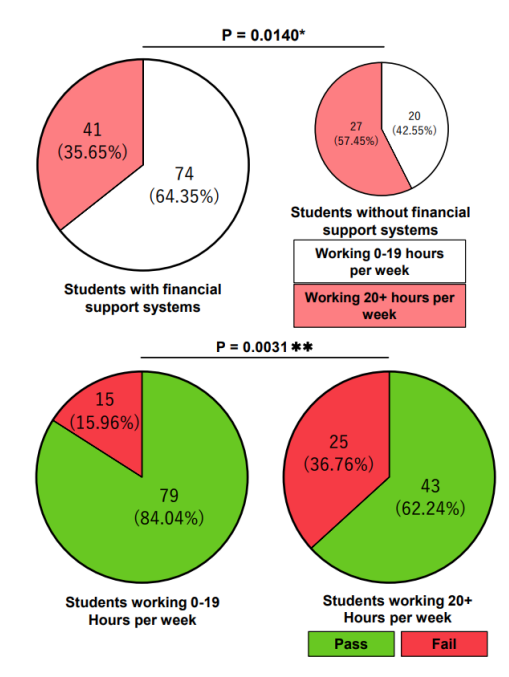
Mapping out the various factors, Hartert’s case study modeled other findings in student success literature: a high number of hours worked correlated negatively with the student’s course grade, while attendance in class and at review sessions correlated positively with academic outcomes.
Data analysis by Keenan Hartert, a biology professor at Minnesota State University, Mankato, found student employment negatively correlated with their overall class grade.
Keenan Hartert
The data also revealed to Hartert some of the challenges students face while enrolled. “It was brutal to see how many students [were working full-time]. Just seeing how many were [working] over 20 [hours] and how many were over 30 or 40, it was different.”
Nationally, two-thirds of college students work for pay while enrolled, and 43 percent of employed students work full-time, according to fall 2024 data from Trellis Strategies.
Hartert also asked students if they had any financial resources to support them in case of emergency; 28 percent said they had no fallback. Of those students, 90 percent were working more than 20 hours per week.
Data analysis of student surveys show students who are working are less likely to have financial resources to support them in an emergency.
The findings illustrated to him the challenges many students face in managing their job shifts while trying to meet attendance requirements.
A Faculty Aside
While some faculty may be less interested in using predictive analytics for their own classes, Hartert found tracking factors like how often a student attends office hours was beneficial to helping him achieve his own career goals, because he could include those measurements in his tenure review.
An interpersonal dynamic: A less measured factor in the attendance debate is not a student’s own learning, but the classroom environment they contribute to. Hartert framed it as students motivating their peers unknowingly. “The people that you may not know that sit around you and see you, if you’re gone, they may think, ‘Well, they gave up, why should I keep trying?’ Even if they’ve never spoken to you.”
One professor at the University of Oregon found that peer engagement positively correlated with academic outcomes. Raghuveer Parthasarathy restructured his general education physics course to promote engagement by creating an “active zone,” or a designated seating area in the classroom where students sat if they wanted to participate in class discussions and other active learning conversations.
Compared to other sections of the course, the class was more engaged across the board, even among those who didn’t opt to sit in the participation zone. Additionally, students who sat in the active zone were more likely to earn higher grades on exams and in the course over all.
Attending class can also create connections between students and professors, something students say they want and expect.
A May 2024 student survey by Inside Higher Ed and Generation Lab found that 35 percent of respondents think their academic success would be most improved by professors getting to know them better. In a separate question, 55 percent of respondents said they think professors are at least partly responsible for becoming a mentor.
The SERU Consortium found student respondents in 2023 were less likely to say a professor knew or had learned their name compared to their peers in 2013. Students were also less confident that they knew a professor well enough to ask for a letter of recommendation for a job or graduate school.
“You have to show up to class then, so I know who you are,” Hartert said.
Meeting in the middle: To encourage attendance, Hartert employs active learning methods such as creative writing or case studies, which help demonstrate the value of class participation. His favorite is a jury scenario, in which students put their medical expertise into practice with criminal cases. “I really try and get them in some gray-area stuff and remind them, just because it’s a big textbook doesn’t mean that you can’t have some creative, fun ideas,” Hartert said.
For those who can’t make it, all of Hartert’s lectures are recorded and available online to watch later. Recording lectures, he said, “was a really hard bridge to cross, post-COVID. I was like, ‘Nobody’s going to show up.’ But every time I looked at the data [for] who was looking at the recording, it’s all my top students.” That was reason enough for him to leave the recordings available as additional practice and resources.
Students who can’t make an in-person class session can receive attendance credit by sending Hartert their notes and answers to any questions asked live during the class, proving they watched the recording.
Hartert has also made adjustments to how he uses class time to create more avenues for working students to engage. His genetics course includes a three-hour lab section, which rarely lasts the full time, Hartert said. Now, the final hour of the lab is a dedicated review session facilitated by peer leaders, who use practice questions Hartert designed. Initial data shows working students who stayed for the review section of labs were more likely to perform better on their exams.
“The good news is when it works out, like when we can make some adjustments, then we can figure our way through,” Hartert said. “But the reality of life is that time marches on and things happen, and you gotta choose a couple priorities.”
Do you have an academic intervention that might help others improve student success? Tell us about it.
***HEPI and the UPP Foundation will host a free webinar on 4 June at 1pm on service learning, how universities can integrate community service with academic studies. Register for your place here.***
This HEPI blog was authored by Isabelle Bristow, Managing Director UK and Europe at Studiosity. Studiosity is AI-for-Learning, not corrections – to scale student success, empower educators, and improve retention with a proven 4.4x ROI, while ensuring integrity and reducing institutional risk.
During September 2020, Studiosity launched the Professor Tracey Bretag Prize for Academic Integrity – an annual commitment to those who are advancing the understanding and implementation of academic integrity in the higher education sector, in honour of Tracey’s work as a researcher in the field of educational integrity.
Tracey was one of the world’s leading experts on academic integrity, founding the International Journal for Educational Integrity and serving as Editor-in-Chief of the Handbook of Academic Integrity. She spoke widely and publicly on the importance of universities taking a strong stand on educating their students about academic integrity and enforcing the rules with vigour and strong sanctions.
Tracey also came to work alongside the team at Studiosity, providing advice, guidance, and sharing her research at events. When asked for her permission to create an annual Academic Integrity award named in her honour, this was Tracey’s response:
I am so deeply honoured by your suggestion that I am almost speechless. Thank you so much for coming up with such a fabulous idea, and especially for putting it in my name. … Thank you again for this incredible recognition of my very small contribution to the field of academic integrity. As I work hard every day to try to demonstrate the type of bravery I’ve always advocated, this certainly gives me a great deal of comfort.
Tracey prematurely passed away on 7 October 2020. In February 2021, she was honoured posthumously with a Career Achievement Award from the Australian Awards for University Teaching.
Entrants over time – a five-year overview
Looking at the Award’s previous entries, we can see a clear shift in how institutions approach educational integrity:
from a more broad-based education about what constitutes misconduct in 2020;
towards more specialised training of large student groups;
to a significant pivot in 2023 towards integrity projects that address the challenge of AI – specifically led by assessment redesign and the use of whole-institution frameworks.
Another change over time is certainly who and where integrity nominations are coming from – there are more dedicated institutional units for managing educational integrity now in 2025 than we saw in 2020-2021.
Tracey earned a great deal of respect globally for her evidence-based, systemic, and students-first approaches to educational integrity. It is fitting that these approaches are gaining interest and momentum in higher education at this moment. We look forward to seeing another year of evidence-based nominations, and thank our Academic Advisory Board for their time and energy once again in judging.
Feeling inspired?
As senior leadership look for ways to ethically embed generative AI within their institutions, academic integrity – the original owner of the AI acronym – is paramount. And so for this year’s prize submissions, the expectation is that the 2025 shortlist will acknowledge gen-AI as part of the challenge, show evidence of impact, and help answer the question: How can the sector keep educational integrity, humanity, and learning at the heart of the student experience?
Last year, the University of Greenwich won the UK prize for their initiative ‘Integrity Matters: Nurturing a culture of integrity through situational learning and play’. Staff there designed an interactive e-learning module (available to all education institutions under licence) designed to raise awareness of academic integrity. You can learn more here.
Sharon Perera, Head of Academic and Digital Sills who led the initiative said:
We are thrilled to have been awarded the Tracey Bretag prize for advancing best practice and the impact of academic integrity in higher education. Thank you Studiosity for championing this in the sector.
At the University of Greenwich our goal is to raise awareness of the academic conventions in research and writing and to create a culture of integrity. We are doing this through our student communities – by sharing best practice and learning about the challenges we face in the GenAI era.
Academic integrity is at greater risk than ever in the age we live in, and we need to work together to celebrate integrity and authenticity.
While sharing your initiative is for the good of the sector and a personal recognition of your tireless efforts to protect and nurture academic integrity – the prize also comprises a financial reward! You can enter this year’s prize here – nominations close 30 May. Evidence might be at the level of policy, implementation, measured student or staff participation, and/or other evidence of behaviour.
The U.S. Department of Justice introduced the Americans With Disabilities Act final rule for digital accessibility in 2024, requiring public colleges and universities to follow Web Content Accessibility Guidelines for ensuring that online programs, services and activities are accessible. These laws require institutions to update inaccessible documents and ensure new content follows accessibility requirements.
A recent survey by Anthology found that faculty members feel they lack sufficient support and access to resources to create an accessible online classroom environment, and they have a general lack of awareness of new ADA requirements.
Anthology’s survey—which included responses from 2,058 instructors at two- and four-year colleges and universities across the U.S.—highlights a need for professional development and institutional resources to help faculty meet students’ needs.
Supporting student success: Expanding accessibility isn’t just mandated by law; it has powerful implications for student retention and graduation outcomes.
Approximately one in five college students has a disability, up 10 percentage points from the previous decade, according to 2024 data from the U.S. Government Accountability Office. A majority of those students have a behavioral or emotional disability, such as attention deficit disorder, or a mental, emotional or psychiatric condition.
While a growing number of students with disabilities are enrolling in higher education, they are less likely than their peers without a disability to earn a degree or credential, due in part to the lack of accessibility or accommodations on campus.
Survey says: Only 10 percent of faculty believe their institution provides “absolutely adequate” tools to support students with disabilities, and 22 percent say they consider accessibility when designing course materials.
Instructors are largely unaware of the ADA’s Web Content Accessibility Guidelines; one-third of survey respondents said they are “not at all” aware of the requirements, and 45 percent said they were aware but “unclear on the details.”
When asked about the barriers to making course content accessible, faculty members pointed to a lack of training (29 percent), lack of time (28 percent) and limited knowledge of available tools (27 percent) as the primary obstacles.
A lack of awareness among faculty members can hinder student use of supports as well. A 2023 survey found that only about half of college students are aware of accessibility and disability services, though 96 percent of college staff members said the resources are available.
In Anthology’s survey, 17 percent of instructors said they were unaware of what tools their institution provides to help students access coursework in different formats, and 30 percent said they were aware but didn’t share information with students.
Less experienced faculty members were more likely to say they haven’t considered accessibility or were unaware of ADA requirements; one-third of respondents with fewer than two years of teaching experience indicated they rarely or never consider accessibility when creating materials.
One in four faculty members indicated more training on best practices would help them make their digital content more accessible, as would having the time to update and review course materials.
Improving accessibility: Some colleges and universities are taking action to empower faculty members to increase accessibility in the classroom and beyond.
The University of North Dakota in spring 2023 created an assistive technology lab, which trains faculty and staff members to make course resources accessible. The lab, led by the university’s Teaching Transformation and Development Academy, offers access to tech tools such as Adobe Acrobat Pro and the screen-reader software Job Access with Speech, for course content development. Lab staff also teach universal design principles and conduct course reviews, as needed.
The State University of New York system created the SUNY Accessibility Advocates and Allies Faculty Fellowship program in January, designating 11 fellows from across the system to expand digital accessibility and universal design for learning practices at system colleges. Fellows will explore strategies to build a culture of access, share expertise and experience, connect with communities of practice, and design a plan to engage their campus community, among other responsibilities.
The University of Iowa built a new digital hub for accessibility-related resources and information, providing a one-stop shop for campus members looking for support. The university is also soliciting questions from users to build out a regularly updated FAQ section of the website. Iowa has a designated Accessibility Task Force with 10 subcommittees that address various applications of accessibility needs, including within athletics, communication, health care, student life and teaching.
Colorado State University has taken several steps to improve community compliance for accessibility, including offering free access to Siteimprove, a web-accessibility assessment tool that helps website developers and content managers meet accessibility standards and improve digital user experience. Siteimprove offers training resources to keep users engaged in best practices, as well as templates for creating content, according to CSU’s website. The university also has an accessibility framework to help faculty members bring electronic materials into compliance.
Get more content like this directly to your inbox. Subscribe here.
The report based its findings on voluntary online surveys of at least 1,200 students across a variety of countries and more than 1,000 employers in the U.S., U.K., Brazil, France, India, Indonesia, Mexico, Saudi Arabia, Thailand and Turkey. The surveys were fielded between December 2024 and January 2025. Coursera offers a variety of microcredentials on its course-sharing platform.
The survey found that most employers, 96 percent, felt microcredentials help a candidate’s application, and 85 percent were more likely to hire a job candidate with a microcredential compared to one without. Meanwhile, 90 percent of employers were willing to offer higher starting salaries to candidates with recognized, credit-bearing microcredentials. Most employers believed microcredentials have various advantages, including employers saving on first-year training costs and hires coming in with higher proficiency in vital industry skills. Eighty-seven percent of employers hired at least one employee with a microcredential in the past year.
Learners surveyed had overwhelmingly positive feelings toward microcredentials, as well. Ninety-four percent of students felt microcredentials build essential career skills. The same percentage wanted to see microcredentials embedded in degree programs, up from 55 percent in 2023. The report says students are twice as likely to enroll in a program that includes a microcredential and 2.4 times more likely to enroll if it’s a microcredential for credit.
The report also found that entry-level employees with microcredentials felt the programs benefited their careers. Among surveyed entry-level workers with microcredentials, 28 percent reported receiving a pay raise and 21 percent received a promotion after earning a microcredential. Seventy percent felt like their productivity increased after earning a microcredential and 83 percent said microcredentials gave them confidence to adapt to new job responsibilities.
“Employer demand for skills-based hiring requires educators to prioritize skills-based learning,” Francesca Lockhart, professor and cybersecurity clinic program lead at the University of Texas at Austin, said in a blog post about the report from Coursera. “We must adapt our curricula to prepare students for a job market where desired qualifications are shifting too quickly for traditional education to keep pace.”