Tag: Signed

  • Are treaties worth the paper they are signed on?

    Are treaties worth the paper they are signed on?

    If you agree to something and put it in writing, shouldn’t you abide by that agreement? Until now, that seemed to be a pretty basic idea. 

    Agreements at the international level come in the form of treaties. When countries sign treaties they voluntarily agree to follow a given set of rules. The agreements tend to be broad and carefully negotiated. Once signed and ratified, treaties commit countries to obligations. 

    In June, the countries of Finland, Poland, Estonia, Latvia and Lithuania announced that they will withdraw from the 1997 Anti-Personnel Mine Treaty. Signed by 165 international states, the treaty forbids the use, production, stockpiling and transfer of anti-personnel landmines, which are devices buried in the ground that explode when someone steps on them. 

    This month, Ukraine announced it would also withdraw. 

    Russia’s 2002 invasion of Ukraine radically changed the geopolitical context that existed when the Mine Ban Treaty was signed. But since landmines are only used in times of war, it seems like the potential circumstance of war would have been considered when the countries agreed to ban them. 

    But Russia, which invaded Ukraine in 2022, never signed the treaty. So has the war in Ukraine really changed everything?

    Disarming the power of treaties

    All five countries that announced their withdrawal from the treaty border either Russia or Russia-friendly Belarus. The use of anti-personnel landmines can be easily seen as a defensive military action against Russia. Norway, however, which has a 121 mile land border with Russia, remains committed to its anti-mine obligations. 

    The withdrawals represent a serious weakening of disarmament treaties that have humanitarian objectives as well as respect for international law. The five-country withdrawals could be setting a precedent that could see countries withdraw from other treaties such as those banning biological, chemical and nuclear weapons as well as withdrawals from international institutions.

    The withdrawals are a considerable reversal for the International Campaign to Ban Landmines (ICBL), a loose coalition of non-governmental organizations that was awarded the 1997 Nobel Peace Prize along with its founding coordinator Jody Williams. 

    The campaign was an unusual movement that garnered the support of many high profile people, including Princess Diana, Paul McCartney and James Bond actor Daniel Craig.

    While treaties are formally signed by states, it is unique that the initiative behind the ICBL came from non-state organizations. 

    Banning a conventional weapon

    Back in 1999, Williams wrote that widespread support for a landmine ban came as a surprise. “Few imagined that the grassroots movement would capture the public imagination and build political pressure to such a degree that, within five years, the international community would come together to negotiate a treaty banning anti-personnel landmines,” she wrote. She noted that it was the first time in history that a conventional weapon in widespread use had been comprehensively prohibited.

    That this is no longer the case has shocked land mine opponents.

    “We are furious with these countries,” said Thomas Gabelnick, the current director of the ICBL. “They know full well that this will do nothing to help them against Russia.”

    The signing of the 1997 Ottawa Convention and the awarding of the Nobel Peace Prize were hailed as crucial steps in disarmament – getting governments to reduce their stockpiles of destructive weapons. 

    The treaty was the first disarmament agreement where governments and civil society worked closely together, representing a new form of international diplomacy. Unlike previous disarmament treaties, it banned weapons actually in use instead of striving to prevent or ban weapons designed as deterrents, such as nuclear weapons – weapons so destructive that the mere fear of their use would stop one country from attacking another.

    The treaty ratification process

    Historically, the treaty was signed during the euphoric period after the fall of the Berlin Wall and before the 11 September attacks that took down the World Trade Center in 2001. During this period global tensions seemed to be easing. Following the end of the Cold War many believed that more disarmament treaties would follow.

    The landmines treaty came into force in 1999 when it was ratified by a sufficient number of states. But some of the most largest and most powerful countries declined to sign. Besides Russia, other countries that stayed out include China, India, Iran, Pakistan, Israel and the United States.

    The treaty has successfully led to the destruction of tens of millions of stockpiled landmines. Hundreds of thousands of square miles have been de-mined (13,000 in Ukraine alone) and well the number of civilians maimed or killed by mines has been drastically reduced.

    The withdrawal by the five countries could be an unfortunate example for withdrawals from other disarmament treaties or multilateral organizations. 

    Mary Wareham, the deputy director of the crisis, conflict and arms division at Human Rights Watch, told The New York Times that the withdrawals set a terrible precedent. “Once an idea gets going it picks up steam,” she said. “Where does it stop?” 

    A treaty set to expire

    The last arms control agreement between the United States and Russia, for example, is scheduled to expire in January 2026. Will that treaty — the New Start Treaty — which eliminated important nuclear and conventional missiles, be renewed?

    The legitimate reason for leaving a treaty is force majeure, an unforeseen circumstance. As a Finnish Parliamentarian said justifying her country’s leaving the Treaty, the war in Ukraine “changed everything.” 

    Norway doesn’t agree.

    Writing for the European Leadership Network, Wareham and Laura Lodenius, the executive director at Peace Union of Finland, warned that the humanitarian impact will far outweigh any marginal military advantages. “The deterrent factor of re-embracing anti-personnel mines isn’t worth the civilian risk, humanitarian liabilities and reputational damage, all of which extend far beyond their borders,” they wrote.

    As for the United States, it has recently withdrawn from bilateral treaties — those between two nations — and several multilateral accords in which multiple parties sign on.

    A treaty that ended the Cold War

    In a historic ceremony in Iceland back in 1987, U.S. President Ronald Reagan and Mikhail Gorbachev signed the Intermediate-Range Nuclear Forces Treaty (INF Treaty), which was largely seen as an end to the Cold War that had lasted since the end of World War II.

    Under the first Trump Administration in 2019, the U.S. withdrew from that treaty. 

    Trump has twice withdrawn the United States from the Paris Climate Accord and, in addition, withdrew from the Open Skies Treaty, which allows for the use of surveillance planes or drones for intelligence capturing purposes. 

    The United States has also withdrawn from institutions like the World Health Organization and is threatening to withdraw from the World Trade Organization. It has already left the U.N. Human Rights Council. 

    In an ominous move for multilateralism, Trump has set in motion a review of U.S. participation in intergovernmental organizations, including those that are part of the United Nations, with the intention of withdrawing from or seeking to reform them. 

    Breaking a treaty by executive order

    Trump’s executive order of 4 February 2025, started by saying: “The United States helped found the United Nations (UN) after World War II to prevent future global conflicts and promote international peace and security. But some of the UN’s agencies and bodies have drifted from this mission and instead act contrary to the interests of the United States while attacking our allies and propagating anti-Semitism.” 

    That’s his subjective interpretation of recent events. There is no justification in the mandate for the review for any change based on force majeure, certainly not that the United Nations and some of its agencies “drifted from this mission and instead act contrary to the interests of the United States.”

    Withdrawing from treaties or organizations has consequences for global stability. The announcement by the five countries that they are withdrawing from the Mine Ban Treaty is a worrisome addition to Trump’s general assault on multilateralism. Pacta sunt servanda, the underlying principle of contracts and law, translates to “agreements must be kept.” It is the foundation of international law and cooperation. 

    The withdrawals are a bad omen. They lessen the value of conventions and treaties. States should not respect their obligations only when they are in their favor. 

    Confidence that states will respect their obligations is the primary support for an international system. 

    The Ukraine war has not changed that. Without that confidence, the system collapses. 

    Can we agree on that?


    A version of this story has been published previously in the publication Counterpunch. 


    Questions to consider:

    1. What is a treaty?

    2. Why would a country decide to not ratify a treaty that bans landmines?

    3. When was the last time you agreed to do something. Was it difficult to keep that agreement?


    Source link

  • At Least 10 Florida Universities Have Signed ICE Agreements

    At Least 10 Florida Universities Have Signed ICE Agreements

    At least 10 Florida public universities have struck agreements with the federal government authorizing campus police to question and detain undocumented immigrants.

    Inside Higher Ed requested public records from all 12 State University System of Florida institutions related to their agreements with U.S. Immigration and Customs Enforcement. Based on the results, it is clear that at least 10 have signed deals with ICE: Florida A&M University, Florida Atlantic University, Florida Gulf Coast University, Florida International University, New College of Florida, the University of Central Florida, the University of Florida, the University of North Florida, the University of South Florida and the University of West Florida.

    Florida State University and Florida Polytechnic University are in the process of signing the paperwork, according to spokespersons at each institution.

    It is unclear whether any of the 28 members of the Florida College System, which don’t all have sworn police forces, have made similar arrangements with ICE. An FCS system spokesperson did not respond to a request for comment on whether its colleges have also entered such agreements.

    Universities across the state signed memorandums of agreement at the direction of Republican governor Ron DeSantis, who ordered law enforcement agencies to partner with ICE “to execute functions of immigration enforcement,” according to a Feb. 19 news release.

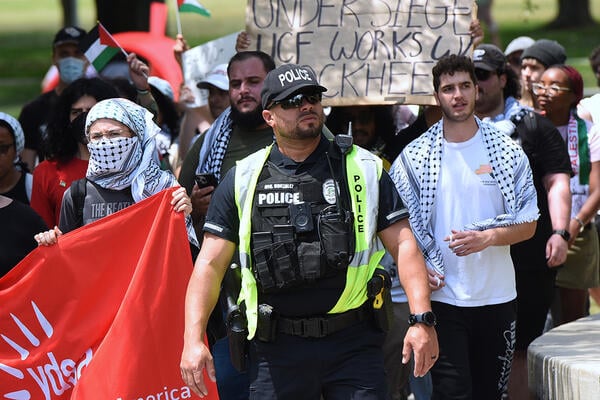
    Legal experts and Florida faculty members note that such agreements are rare and mark a shift away from the typical duties of campus police, which don’t usually include immigration enforcement. They also raised concerns about how such arrangements could create a climate of fear on campuses.

    Enforcers Seeking Partners

    The DeSantis directive came shortly after the governor tapped Larry Keefe, a former U.S. attorney for the Northern District of Florida, to serve as executive director of the nascent State Board of Immigration Enforcement, created by Florida’s Legislature. Keefe is known for helping DeSantis orchestrate flights of migrants from Texas to Massachusetts in 2022.

    Keefe was named to the role on Feb. 17. Eight days later, Jennifer Pritt, executive director of the Florida Police Chiefs Association, sent an email to multiple universities that included a template for a memorandum of agreement with ICE. “Director Keefe is seeking participation from as many municipalities as possible, as soon as possible,” Pritt wrote.

    Most universities, however, offered limited statements about their agreements with ICE. A Florida Board of Governors spokesperson also provided few details.

    “Several police departments at universities within the State University System of Florida are partnering with U.S. Immigration and Customs Enforcement,” Cassandra Edwards, director of public affairs for FLBOG, wrote by email. “We do not maintain these records and recommend contacting individual universities for specific information about the partnerships.”

    Public records show that Florida Poly was hesitant to sign on, apparently due to guidance by Polk County sheriff Grady Judd, who is also on the State Board of Immigration Enforcement.

    “He wants us to hold off and not sign because he’s going to be handling all from Polk and not wants [sic] us to be involved as of now,” Florida Poly police chief Rick Holland wrote in a March 25 email response to questions from administrators at other universities about the agreements.

    Though Florida Poly noted it is still in the consideration process, emails obtained by Inside Higher Ed show another message from Holland indicating that Florida Poly appears willing to sign.

    “Can you send me a signed copy of your MOU as a template to where I need to sign?” Holland wrote in an April 3 email sent to Jennifer Coley, the chief of police at New College of Florida.

    (Florida Poly confirmed after publication that it planned to sign the paperwork Wednesday.)

    The Agreements

    Memorandums of agreement reviewed by Inside Higher Ed show that universities that entered arrangements with ICE will grant their police the authority to perform tasks typically reserved for government officials, such as questioning, arresting and preparing charges for individuals on campus suspected of immigration violations.

    Campus police will be required to undergo mandatory training “on relevant administrative, legal, and operational issues tailored to the immigration enforcement functions to be performed,” according to copies of agreements between universities and ICE reviewed by Inside Higher Ed.

    Universities that signed agreements did not provide a timeline for when the training might begin.

    Michael Kagan, a law professor and director of the University of Nevada, Las Vegas, Immigration Clinic, said such agreements are uncommon at universities, noting that he is unaware of any others. He said they are essentially “force multipliers for ICE that deputize local police agencies to do the work that ICE would normally do itself.”

    Jennifer Chacón, a professor at Stanford Law School, also said that she had not heard of prior agreements between campus police and ICE. Chacón noted that 287(g) agreements, introduced in 1996 to delegate immigration enforcement powers to other law enforcement agencies, have ebbed and flowed over the years, rising under Republican presidents and falling under their Democratic counterparts. Under President Donald Trump, who has made a crackdown on immigration a central part of his policy agenda, such agreements are proliferating.

    “Over the last three months, we’ve seen an explosion in 287(g) agreements under Trump,” Chacón said.

    ‘Designed to Increase Fear’

    Faculty and legal scholars are skeptical and concerned about campus agreements with ICE.

    In a statement to Inside Higher Ed, the Florida International chapter of United Faculty of Florida called for the university to immediately withdraw from the program, which it condemned.

    “We affirm that every member of our university community has a basic right to feel safe on campus—free from profiling, surveillance, and fear of deportation,” members wrote. “FIU’s latest act of anticipatory obedience undermines the rights of our community and jeopardizes the opportunity for all students and faculty to learn from and engage with their non-citizen peers. FIU’s haste to comply with ICE is in direct conflict with its stated vision. These actions distract from our educational mission and erode the inclusive environment FIU claims to foster.”

    The statement added the student body is “majority Hispanic, heavily immigrant, and home to nearly 600 students protected by the Deferred Action for Childhood Arrivals (DACA) program,” calling the agreement a betrayal of FIU’s legacy as a prominent Hispanic-serving institution.

    Faculty at FIU also wrote that they were “equally alarmed to hear about the termination of the F-1 visa status of 18 FIU students.” (As of Tuesday evening, at least 1,234 students at 209 colleges have had their visas revoked, in some cases for participating in campus protests but often for unclear reasons.)

    Legal scholars shared faculty members’ concerns about the fallout of such agreements.

    “It seems like this is designed to increase fear. And whether that’s by design or not, it is likely to increase racial profiling on campus, and it is not at all an effective way to police immigration,” Chacón said.

    Kagan said he would be unsurprised to see similar agreements at universities in other red states.

    “I think that it will accentuate the extremes in terms of how different university systems react to the reality that immigrants are part of their campus life,” he said. “You have one extreme, where Florida is saying, ‘Let’s hunt them down with our own police,’ while you have other university systems that have started programs to be more welcoming to undocumented students.”

    Editor’s note: This article has been updated to reflect that Florida Poly plans to sign an agreement with ICE on Wednesday.

    Source link

  • Reauthorization of Violence Against Women Act Signed Into Law – CUPA-HR

    Reauthorization of Violence Against Women Act Signed Into Law – CUPA-HR

    by CUPA-HR | April 12, 2022

    On March 15, President Biden signed into law the Violence Against Women Act (VAWA) Reauthorization Act of 2022. The legislation reauthorizes all current VAWA grant programs through 2027 and was included in the omnibus appropriations package, which provided $1.5 trillion to fund the federal government for fiscal year 2022.

    Several of the VAWA Reauthorization Act’s provisions will specifically impact higher education institutions. The bill:

    • requires colleges and universities to conduct campus climate surveys of students to track their experiences of sexual violence on campus;
    • expands and provides additional funding for the Rape Prevention and Education Grant Program and other existing campus grants designed to provide comprehensive prevention education for students;
    • establishes a pilot program that provides funding to colleges and universities (among other entities) to create programs on restorative practices to prevent and address sexual violence;
    • requires the Secretary of Health and Human Services to create a demonstration grant program for colleges and universities to provide comprehensive forensic training to train healthcare providers on forensic assessments and trauma-informed care to survivors of sexual violence; and
    • requires the Government Accountability Office to examine the relationships between victims of sexual violence and their ability to repay their student loans.

    Of particular concern for higher ed institutions is the survey to track student experiences of sexual violence on campus. Conducting the survey could create challenges for the institutions as well as for the Department of Education charged with developing it. Additionally, some institutions are already conducting similar surveys on their campuses, creating a risk of duplicated efforts. This will be a complex undertaking for both the department and higher ed institutions.

    CUPA-HR will update members on any additional information on the implementation of the VAWA Reauthorization Act as it is released.


    Source link