Tag: Skills

  • New Program for College Students’ Executive Functioning Skills

    New Program for College Students’ Executive Functioning Skills

    Since the COVID-19 pandemic forced many schools to move instruction online, some students have struggled to regain or even learn the interpersonal and organizational skills they need to succeed in college.

    To rectify that, the University of Mary Washington created a new four-week program this fall to help incoming students hone their planning and social skills. Called LaunchPad, the program aims to help ease students’ transition into higher education, provide them with life-management skills and connect them with peers and supportive staff.

    What’s the need: Data shows that current traditional-aged college students are less likely than previous cohorts of students to be prepared for postsecondary education. A 2024 report from ed-tech provider EAB found that students increasingly struggle with resiliency and conflict resolution and are less likely to be involved in campus organizations or social opportunities.

    Surveys show that students are interested in receiving additional support to help them get organized and learn to manage their time. A study from Anthology, also published in 2024, found that 40 percent of students feel overwhelmed and anxious about their academic workload, and a quarter say they lack time-management skills. Similarly, a 2023 survey by Inside Higher Ed found that one-third of respondents want help planning their schedules and managing their time, such as a through a deadline organizer.

    At the University of Mary Washington, “many students struggle with organization, time management and involvement, especially post-pandemic,” said April Wynn, director of the first-year experience. “LaunchPad provides structured support in these areas.”

    How it works: LaunchPad teaches students executive functioning and socialization skills, including how to maintain a schedule, track deadlines, employ technology, communicate effectively and respond to adversity, according to a university press release.

    Starting the first week of class, students are invited to participate in a LaunchPad session, beginning with syllabus organization and then in subsequent week moving on to Microsoft basics, campus involvement and time management.

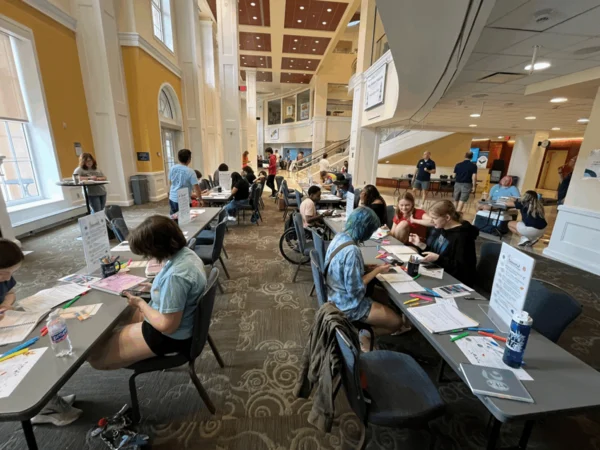
    Each week, students could opt in to a LaunchPad activity to help them develop practical life skills.

    University of Mary Washington

    Teaching the tech tools is essential because students often enroll with more experience using Chromebooks than Microsoft products, Wynn noted. Students also received a physical planner during the syllabus session, marking upcoming deadlines at the start of the term to help them prepare.

    The initiative is supported by a Fund for Mary Washington Impact Grant, which provides donor-funded grants, ranging from $500 to $5,000, to students, faculty and staff for projects. Wynn and Dean of Students Melissa Jones applied for the grant and received $5,000 to fund peer-mentor stipends, day planners, workshops and more.

    LaunchPad involves representatives from a variety of campus offices, including the career center, student activities, new student programs, the writing center, campus recreation, housing and residence life, and the Office of Disability Resources.

    The impact: The fall 2025 pilot offered 51 hours of programming over four weeks, with 378 student participants and 466 hours of work by staff, faculty and peer mentors, Wynn said. “Student and facilitator feedback was collected at each session, with additional student survey feedback scheduled for December, after they’ve had time to test out what they learned in the program,” she said.

    The university is considering a shorter program in the spring semester to capture transfer and other new students, as well as expanding the fall program to six weeks to include major and career advising, Wynn said. “While LaunchPad is geared toward first-year students, we hope to plan it around the fall senior class meeting in the future to provide a refresher for soon-to-be graduates,” Wynn said.

    Getting Students Organized

    Several other colleges have implemented new programs to help students build executive-functioning skills.

    • Faculty at DePaul University created a short course in the College of Communication to help students set goals and reflect on their academic progress.
    • Wake Forest University’s Center for Learning Access and Student Success established a digital syllabus that outlines all assignments and assessments for each class a student is enrolled in, creating a centralized depot for organization.
    • Dartmouth College created regular programming to help students build time management and organization skills, led by peers to normalize challenges.

    How does your college encourage students to be organized and improve their life skills? Tell us more.

    Source link

  • Skills England has a new way to talk about skills, and the sector needs to listen

    Skills England has a new way to talk about skills, and the sector needs to listen

    Although on one level tertiary education policy has never been more concerned with skills, we’ve never really had a proper understanding of what skills actually are or how they fit together with either jobs or courses.

    While – as a select and very well-informed group of attendees at The Festival of Higher Education were delighted to learn – there are any number of conceptualisations of what a skill (or a group of skills) might be, matching skills needs to jobs or to courses has never been easy to do in a reliable way.

    To be a bit less abstract, if we want anyone to train our future workforce we need to know what we want them to be trained in. And, not only do we not know that because we can’t predict the future – we also don’t know that because we simply do not have the vocabulary or frameworks of understanding we need to pose the right questions. Employers and industries cannot talk to course providers and prospective employees about this stuff because each of these groups has spoken a different language.

    Until today!

    Into this ontological hellscape comes Skills England. The release of the UK Standard Skills Classification (UK-SSC) – alongside a wonderfully whizzy UK Skills Explorer tool – is, in a quiet way, the most significant thing to happen to the skills landscape in a generation: not least because, for the first time we are able to see it.

    Before this, the skills landscape was, (at best) uneven. SOC codes helped us understand occupational requirements for jobs, SIC codes helped us understand the kind of work that goes on in particular industries, and HECoS codes gave us an understanding of what areas particular courses of study cover. All of this was useful, but none of it really linked together and – as you’ve probably spotted – none of it talked about actual skills.

    So what is a “skill”? Well, it might be “a capability enabling the competent performance of a job-related activity”: an occupational skill. Or it could be a more generic competence, “a fundamental ability that contributes to the capability to carry out tasks associated with a specific job”: a core skill.

    Skills England has identified 3,343 occupational skills (within 22 domains, 106 areas, and 606 groups). Occupational skills combine with knowledge (4,926 of these are defined) and core skills (just 13) to give someone the capability to do one or more of 21,963 identified occupational tasks.

    UK-SSC levels diagram

    So what?

    The existence of these definitions should make it a lot easier to translate employer and industry needs, into opportunities that strategic government support, and an offer of courses that satisfies these needs.

    Let’s give an example. Imagine the government decides that any future transition away from carbon-based power requires batteries and electrical components, and notices that we have quite a lot of the rare-earth metals and other minerals that we need to make these somewhere under the ground in the UK. We need to get them out, and we need to train the people that can do that. And we currently only have one school of mining with a little over a hundred students.

    Because we can map the UK-SSC to Standard Industrial Classification (SIC) codes, we can very easily run up a list of the key skills we need to train people in.

    [Full screen]

    That way, when we get to specifying what the new mining schools we are going to open actually need to teach, and we get to working with industry to decide what skills they need to do all this mining we have an agreed list. A starting point, sure, but one that saves a lot of time.

    You will note that this is not just training people how to dig stuff up. There are research jobs, planning jobs, management jobs, and a fair few design jobs that need to be done. The bar chart aspect here gives us an indication as to how important each skill is to employers in this industry.

    From specification to commission

    So if we know what skills we need, how do we get people training in them? Or do we have people training in them already?

    UK-SSC also maps to HECoS codes, which are the language we use in higher education to think about subject areas. So, to continue our example, let’s think about analysing mineral deposits – helping us figure out where to start digging holes.

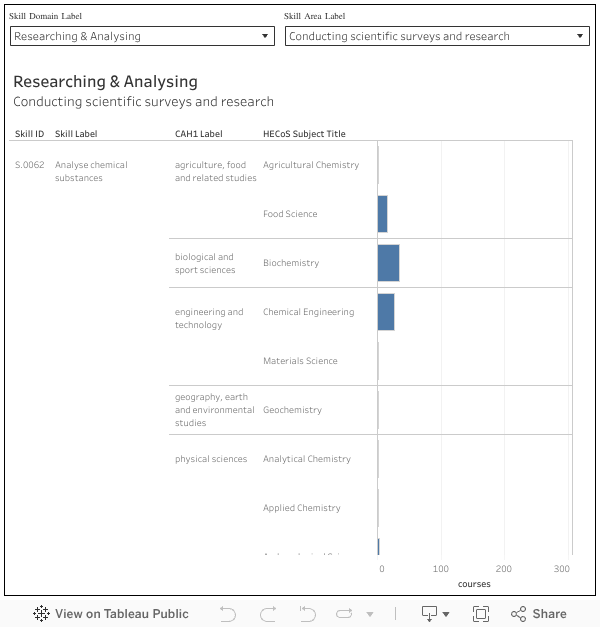
    “Analyse mineral deposits (S.0091)” is within the “researching & analysing” domain, and the “conducting scientific surveys and research” area. And we can use one of the mappings developed by Skills England to check out whether we have any courses in related subjects currently being offered in the UK higher education sector that might help.

    I’m sorry to say I’ve been messing around with the data behind Discover Uni again. This maps individual courses to HECoS codes – so it lets us see how many courses are in subject areas linked to the skill we are interested in.

    [Full screen]

    Setting the filters appropriately and scrolling down we can see that we are not well-served with educational opportunities in this space. There are 19 subject areas associated with this skill, and only a few have courses that are being tagged with them. Notably there are 14 courses in environmental geosciences, 8 in geology, and 3 in archeological sciences. Nobody (not even the Camborne School of Mines!) is tagging themselves with the specific engineering-related disciplines of minerals processing or quarrying.

    This neatly demonstrates that a linking vocabulary can only take us too far if subject coding (or any other kind of data collection) is done in a less-than-complete way. Using this very basic desk analysis we can see that there is probably a case for more specialist mining provision – and based on that we can suggest that there may be a cause for government investment. But it could equally demonstrate that tagging courses with HECoS code to power a course comparison website that hardly anyone looks at is not a way of generating a comprehensive picture of what is on offer.

    And this is just a starting point. We can drill down from these occupational skills into job tasks, knowledge concepts, and core skills from here – all of which would help us specify what we need to train people to do in detail fine enough to design and run a suitable course for them.

    So how has this been done?

    If you are imagining a bunch of very diligent and smart people at Skills England and the University of Warwick taking a bunch of pre-existing information and pulling together this vocabulary you are probably most of the way there. Starting from six existing sources a combination of expert input and large language models refined and deduplicated entries within:

    • A list of skills generated by (Skills England predecessor) the Institute for Apprenticeships and Technical Education
    • A list developed by the the Association of Graduate Careers Advisory Services
    • A list from the National Careers Service
    • A list from the Workforce Foresighting Hub in Innovate UK
    • And two international comparators – the European Skills, Competences, Qualifications, and Occupations (ESCO) level 4 skills, and the (US based) O*NET detailed work activities.

    A similar approach generated and tested all of the mappings and hierarchies that have been made available to download and play with.

    And core skills?

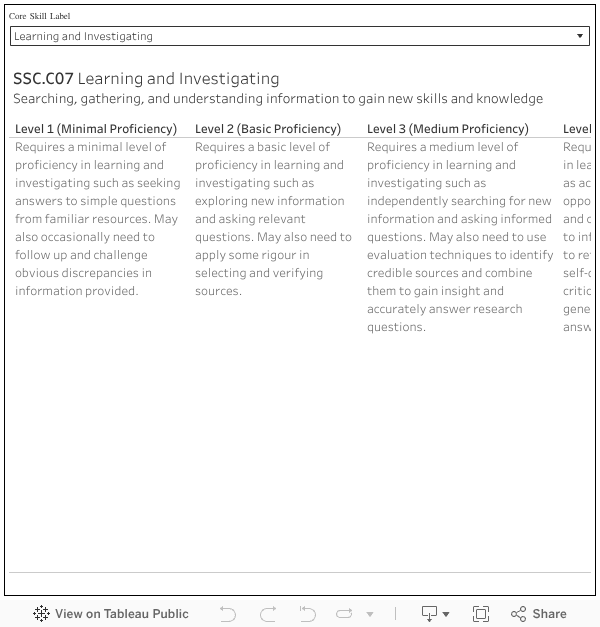
    As above there are just 13 of these, but these are assigned levels of proficiency in language that feels a lot like grade descriptors (note, these are not FHEQ levels but I bet somebody, somewhere, is thinking about a mapping).

    [Full screen]

    Each of these core skills also maps, to a greater or lesser extent, to each of the occupational skills – so our old friend “Analyse mineral deposits (S.0091)” requires level 4 “learning and investigating”, level 3 “planning and organising”, and level 2 “listening”.

    You can’t help but think that forward-looking course leaders will be incorporating these definitions into their learning outcomes in the years to come. Proficiency levels may also be coming to the occupational skills definitions, and there’s even an idea of creating basic curricula for benchmarking and general use.

    Skills for the future

    There’s an old XKCD cartoon about standards that has become a meme – and it highlights that just because someone has combined everyone’s needs into a single standard there is nothing to say anyone will actually use that one rather than whatever language they’ve been speaking for years.

    The UK-SSC attempts to avoid this in two ways. Firstly it maps to other vocabularies that people are already using in linked areas, and does so by design. And secondly it bears the imprinteur of the government, suggesting that at least one influential body will be using it every time it talks about skills.

    And there’s another aspect that helps drive adoption. It will iterate – based on job vacancy data, workforce foresight, feedback from employers, even via public community forums (Stack Exchange, Discord!). And the links to other vocabularies will iterate too. The plan is that this will happen on a five year cycle, but with a first update next year.

    Make no mistake, this is a major intervention in the skills landscape – and it has been done diligently and thoughtfully. If your job involves anything from designing courses to working with employers and local skills improvement plans, if you are a professional body, or working on subject benchmark statements, you need to get on board.

    Source link

  • Students must intentionally develop durable skills to thrive in an AI-dominated world

    Students must intentionally develop durable skills to thrive in an AI-dominated world

    Key points:

    As AI increasingly automates technical tasks across industries, students’ long-term career success will rely less on technical skills alone and more on durable skills or professional skills, often referred to as soft skills. These include empathy, resilience, collaboration, and ethical reasoning–skills that machines can’t replicate.

    This critical need is outlined in Future-Proofing Students: Professional Skills in the Age of AI, a new report from Acuity Insights. Drawing on a broad body of academic and market research, the report provides an analysis of how institutions can better prepare students with the professional skills most critical in an AI-driven world.

    Key findings from the report:

    • 75 percent of long-term job success is attributed to professional skills, not technical expertise.
    • Over 25 percent of executives say they won’t hire recent graduates due to lack of durable skills.
    • COVID-19 disrupted professional skill development, leaving many students underprepared for collaboration, communication, and professional norms.
    • Eight essential durable skills must be intentionally developed for students to thrive in an AI-driven workplace.

    “Technical skills may open the door, but it’s human skills like empathy and resilience that endure over time and lead to a fruitful and rewarding career,” says Matt Holland, CEO at Acuity Insights. “As AI reshapes the workforce, it has become critical for higher education to take the lead in preparing students with these skills that will define their long-term success.”

    The eight critical durable skills include:

    • Empathy
    • Teamwork
    • Communication
    • Motivation
    • Resilience
    • Ethical reasoning
    • Problem solving
    • Self-awareness

    These competencies don’t expire with technology–they grow stronger over time, helping graduates adapt, lead, and thrive in an AI-driven world.

    The report also outlines practical strategies for institutions, including assessing non-academic skills at admissions using Situational Judgment Tests (SJTs), and shares recommendations on embedding professional skills development throughout curricula and forming partnerships that bridge AI literacy with interpersonal and ethical reasoning.

    Latest posts by eSchool Media Contributors (see all)

    Source link

  • The bewitchment of skills: time for a rebalancing and a reordering

    The bewitchment of skills: time for a rebalancing and a reordering

    Join HEPI for a webinar on Thursday 11 December 2025 from 10am to 11am to discuss how universities can strengthen the student voice in governance to mark the launch of our upcoming report, Rethinking the Student Voice. Sign up now to hear our speakers explore the key questions.

    This blog was kindly authored by Professor Ronald Barnett, Emeritus Professor at the Institute of Education, University of London and President Emeritus of the Philosophy and Theory of Higher Education Society, and Secretary of the Global Forum for Re-Humanizing Education.

    We are faced today, especially in the UK, with a policy discourse in higher education that speaks entirely of ‘skills’ and an academic discourse, especially in the humanities and social theory, which speaks of ‘education’. In the skills discourse, there is typically no mention of education per se; and in the education discourse, there is no mention of skills per se.

    It will be said that this is an exaggeration, to which I invite such commentators to look at the evidence. In the policy discourse, rafts of blogs, public pronouncements by politicians, and reports from think tanks speak of skills without the idea of education being even mentioned as such, let alone raised up for consideration. On the other side, whole papers in the academic literature and even books can be found that speak of education, student development, criticality, self-formation and so on, while paying only perfunctory attention to the matter of skills, if that. 

    On the skills side of the debate, we may observe a HEPI blog entitled ‘Bridging the Gap: How Smart Technology Can Align University Programmes with Real-World Skills (Pete Moss, 22 July, 2025). The term ‘skills’ appears twenty times, with an additional mention of ‘reskilling’ and the phrases ‘skills gap’ and ‘skills taxonomy’. The term ‘education’ appears just three times, with two of those instances being in the form of phrases – ‘higher education’ and ‘university education’. 

    Only once does the term ‘education’ appear unadorned, and that in the last line: ‘After all, education is a journey.  It’s time the map caught up’. Nowhere are we treated to any indication as to the nature of the journey beyond it being the acquisition of skills. What education as such is, we are left to ponder.

    This debate in higher education is not really a debate at all, but rather a situation in which ships pass in the night and without even acknowledging each other. There is an occasional – if rather perfunctory – doffing of the hat towards skills on the educational side; but pretty well a near-complete silence about education on the skills side.

    Does this matter? After all, it might be suggested that what we have here is nothing more than a continuation of the polarisation of the liberal-vocational perspectives that have been with us in the United Kingdom for two hundred years or more. Nothing new here, it may be said.  I disagree.

    First, the intensity of this polarisation is now extreme. As remarked, characteristically, as I see it, positions are taken up of a kind that exhibits a total blankness towards the other side. As a result, there is no mutual engagement of positions. 

    Second, this blankness is particularly marked on the skills side, so to speak; and that is where the power lies. As a result, the framing of higher education in terms of skills becomes the dominant discourse. 

    Third, the skills side is not only utilitarian, but it is also instrumental. Every aspect of higher education comes to be valued insofar as it demonstrably has an outcome, and this logic is extended to students themselves. They become ends towards external purposes, now of economic, societal and national advancement. The development of students, understood as human beings, is rendered invisible. 

    Fourth, the world is facing great difficulties: egregious inequalities (of a like not seen for hundreds of years), crises of the natural environment, non-comprehension across peoples, violence (both material and discursive), and a degrading instrumentality in the way states treat their citizens are just indicative. What, against these horizons, might ‘higher education’ mean? Simply to speak of skills misses the point.

    Lastly, the world is in difficulty partly due to its institutions of higher education losing sight of their educational responsibilities. At best, those institutions have become institutions of higher skills.  In the process, universities have played a part in forging the instrumentality that is now dominant in the world. That the world is in grave difficulty can be laid, in part, at the door of universities.

    What, then, is to be done? The answer is obvious. We need a rebalancing in our debates, our language, our practices, our evaluation mechanisms, and the ways in which we identify what is of value in higher education. It is right for skills – and knowledge too, for that matter – to have a place, but that place has to be against the horizon of what is good for the education of students as human beings on and in this troubled Earth. 

    But this rebalancing calls for a reordering, where concerns with education have to precede concerns with skills. Wisdom, critical reflection, dialogue for understanding, care, consideration, carefulness, self-understanding, the world, Nature, dispute, antagonism, and mutuality have to become part of the vocabulary of student formation in constructing a proper policy debate. Unless and until this happens, the policy framework will be blind and surrender itself into the interests and technologies of the powerful.

    Source link

  • Podcast: Reform UK, local skills, students at work

    Podcast: Reform UK, local skills, students at work

    This week on the podcast we examine what the rise of Reform UK – and new insight into its prospective voters – might mean for universities, international education, and the wider public legitimacy of higher education.

    Plus we discuss Skills England’s new guidance on local skills improvement plans – and the move to place higher education, up to postgraduate level, at the heart of local skills ecosystems – and a new study of student working lives that reveals how paid employment alongside full-time study is reshaping participation, wellbeing, and outcomes.

    With Sam Roseveare, Director of Regional and National Policy at University of Warwick, Alex Favier, Director at Favier Ltd, Jen Summerton, Operations Director at Wonkhe and presented by Jim Dickinson, Associate Editor at Wonkhe.

    Labour takes steps to bring higher education and local skills closer together

    Long hours and poor working conditions hit students’ outcomes hard

    The surprising pragmatism of Reform UK voters towards international education

    Higher education’s civic role has never been more important to get right

    You can subscribe to the podcast on Apple Podcasts, YouTube Music, Spotify, Acast, Amazon Music, Deezer, RadioPublic, Podchaser, Castbox, Player FM, Stitcher, TuneIn, Luminary or via your favourite app with the RSS feed.

    Source link

  • Three hot takes you may have missed from the Post-16 Education and Skills White Paper.

    Three hot takes you may have missed from the Post-16 Education and Skills White Paper.

    This blog was kindly authored by Rose Stephenson, Director of Policy and Strategy at HEPI.

    It is the ninth blog in HEPI’s series responding to the post-16 education and skills white paper. You can find the others in the series herehereherehereherehere, here and here.

    There have been oodles of column inches already published about the Post-16 White Paper, and many have rightly focused on the headlines: increased tuition fees, a return of targeted maintenance grants funded by an international students levy and a move towards more specialist institutions.

    In this blog, I want to dive beyond these headlines, as the paper contains a number of further bold policy proposals, some of which could be transformational for the sector.

    Break points

    The White Paper places a strong focus on flexible learning, including a greater number of Level 4 and 5 qualifications. There is a specific target of at least 10% of young people going into Level 4 or 5 study, including apprenticeships, by 2040. Clearly, the Government wants to see more movement in this direction from the sector, adding:

    We need to build clear and well-understood pathways at these levels [4 and 5], underpinned by qualifications that are easier to study close to home, which are both modular and flexible.

    In terms of higher education providers, the Government sets out:

    We will expect providers to offer more flexible, modular provision and strengthen progression routes from further education into higher education, supported by transferable credits. We will consult on making student support for level 6 degrees conditional on the inclusion of break points in degree programmes. This marks a significant shift towards a more inclusive and adaptable model of learning, empowering individuals to tailor their educational journey.

    There is little detail, but it reads to me that the Government will consult on a proposal that students will only be able to access student loan funding for institutions that offer ‘break points’ at Level 4 and 5 of a full three-year degree.

    This was also a recommendation from the Augar report, which outlined:

    … providers with degree-awarding powers will be required to offer them [level 4 and 5 qualifications] as ‘exit’ qualifications if learners choose to leave a course early.

    In my experience, most institutions now do this. If a student wants or needs to finish their studies at the end of their first year, for example, (providing they have passed the required modules), the institution would offer to award them with the Level 4 qualification that recognises their learning to date – most likely a certificate of higher education. However, ‘CertHEs’ are only routinely awarded ‘mid-degree’ if a student withdraws, and many students don’t know that there is an option to take a qualification at the end of their first year. One might wonder if providers could maintain this ‘consolation prize’ status quo. However, the paper goes further, stating:

    The introduction of break points will ensure that learners are acquiring vital, usable skills in every year of higher education. It will give them the option to break down their learning, achieving a qualification at level 4 after the first year and level 5 after their second year of studies, while also ensuring institutions are incentivised to support those who wish to continue their studies. This will enable young people to ‘stay local and go further’ by connecting local provision at level 4 and 5 with internationally recognised degree-level providers, unlocking opportunity and ambition across every region.

    I am reading between the lines here, but it looks as though providers may be expected to award students at the end of each year of learning, increasing awareness of stackable, flexible learning, and potentially a knock-on increase in student mobility between institutions. As with much of this White Paper, we await the details.

    Accommodation

    The white paper outlines:

    We will work with the sector and others so that the supply of student accommodation meets demand, including increasing the supply of affordable accommodation where that is needed. We will work with the sector, drafting a statement of expectations on accommodation which will call upon providers to work strategically with their local authorities to ensure there is adequate accommodation for the individuals they recruit.

    Firstly, this statement is a little ironic given that the Renters Reform Act that has just passed through parliament is likely to reduce small (generally one to two bedroom) off-street student housing provision – as outlined by Martin Blakey in his blog.

    This feels woolly to me. What levers does the Government have to pull to increase the supply of affordable accommodation for students? If it does have any, why have these not been pulled already? The main driver of expensive student accommodation is that there are not enough houses (for the general population as well as students), allowing rents to be driven ever higher. Providers working strategically with local authorities won’t deliver more housing stock. (Unless the magic house bush grows alongside the magic money tree?)

    We’ve seen a ‘Statement of Expectations’ previously, delivered by the OfS in relation to sexual harassment prevention and response on campus. This was an evaluated stepping stone on the way to regulation. Could there be an increased expectation on institutions to provide affordable accommodation as part of future regulation? A sensible ideology, perhaps. After all, we know students want and need cheap places to live. But given the financial position of many institutions, the resulting pause in capital building projects, the increase in commuter students and the impending decline in 18-year-old population numbers, I can’t see many subsidised student flats being built anytime soon.

    Apprenticeship ‘units’

    We have known since before the 2024 General Election that Labour wanted to expand the Apprenticeship Levy to become the Growth and Skills Levy. We see some more detail about this in the paper:

    We want employers to be able to use the levy on short, flexible training courses.

    Currently, apprenticeships are funded by the apprenticeship levy. Businesses with a pay bill of over £3 million pay 0.5% of this into the levy ‘pot’. Businesses can then use the levy fund to cover the cost of training apprenticeships. Since the introduction of the levy, the number of apprenticeship starts has fallen, and the age profile of apprenticeships has changed. Since 2015, proportionately more apprenticeships have been started by those aged 25 or over.

    Source: Department for Education, Apprenticeships and traineeships data

    So – the apprenticeship levy was, unintentionally, a good policy for lifelong learning; businesses wanted to reinvest their levy costs into their business and found that an effective way to do this was to upskill colleagues already employed in their organisation, often on higher or degree apprenticeships. The flip side of this meant that the intended outcomes of the policy, supporting school and college-leavers into apprenticeships, were stymied.

    To tackle this, most Level 7 Apprenticeships were defunded, with the aim of pushing funding back towards younger learners and lower-level apprenticeships. So the move to ‘apprenticeship units’ feels undermining of this aim. Again, this is likely to be great for lifelong learning. Employers will be able to upskill their workforce, initially in ‘priority areas’ such as artificial intelligence, digital and engineering.

    There is a limited pot of growth and skills levy funding, which has been fully or overspent for the last two academic years. So if the Government wants to increase apprenticeships for younger learners, it will need to expand this pot, and potentially ring-fence some of this. The potential for a bigger pot is hinted at:

    We will work with businesses and employers over the coming months to ensure that the growth in skills levy author is developed to help meet their needs and incentivise further employer investment in training.

    However, ring-fencing is not mentioned. The Government will need to put some guardrails in place here if they want to meet their target of two-thirds of young people going to university, further education or a ‘gold standard apprenticeship’ by the age of 25.  

    Conclusion

    So, while some of these statements are bold, remember that White Papers set out proposals for future legislation; there is a long way to go before legislation is in place. Further, there are several places in the white paper where the Government doesn’t specifically propose legislation; instead, there’s a sense of just asking the sector nicely. This is all well and good, but in times of severe financial constraint, asking institutions nicely to take steps that will cost them money is unlikely to yield results.

    Source link

  • Labour takes steps to bring higher education and local skills closer together

    Labour takes steps to bring higher education and local skills closer together

    The post-16 white paper promised to strengthen statutory guidance on local skills improvement plans (LSIPs), including “clearer expectations on higher education providers to engage” and a move to make the plans cover skills all the way up to level 8.

    This greater roles for universities in LSIPs was gestured at in Skills England’s ministerial guidance, and even announced by Labour in opposition.

    Now, the revised guidance has been published – and the push for higher education providers to play a more central role has indeed materialised.

    This is a local shop

    LSIPs were introduced in the Skills and Post-16 Education Act under the last government as employer-owned priorities and actions around skills needs and the provision of technical education in a designated local area of England. Some 38 different plans were approved by the Secretary of State in summer 2023, with annual progress reports following – you can find them all on this page if you don’t mind navigating through some confusingly designed websites.

    That legislation also introduced mechanisms to assess how well education providers were contributing to the plans – for example, accountability agreements for further education colleges. For higher education institutions, the only mention of accountability in the old guidance was an enjoinder to make a note of activity related to LSIP priorities in strategic plans. The previous government framing around LSIPs was notably quiet on the role of higher education, as we’ve noted before – which is not to say that many HE institutions didn’t get involved, to greater or lesser extents (the progress reports linked above demonstrate this, though in a non-systematic way).

    LSIPs cover a three-year period, so a new round in summer 2026 is Labour’s big chance to reshape them in its preferred fashion. Today’s guidance is to be used for an LSIP draft submitted by the end of March, and – pending government approval – the new plans will be published in or around June next year.

    The areas covered by LSIPs, and the corresponding employer representative bodies (ERBs), have also been shifting – today we get the latest areas confirmed, now sensibly contiguous with local authority areas. An additional wrinkle that Labour announced in last year’s devolution white paper is for so-called strategic authorities (“mayoral and non-mayoral combined authorities, combined county authorities, and the Greater London Authority”) to take joint ownership of LSIPs, along with ERBs. Eventually everywhere will be in a strategic authority – one day – but today’s guidance is in many places split depending on whether the LSIP is or is not in a more devolved part of England.

    Best laid plans

    LSIPs are a complicated undertaking at the best of times – as the government puts it, they “unite employers, strategic authorities, higher education, further education and independent training providers and wider stakeholders in solving skills challenges together.” Their effectiveness in really driving change remains unproven but – in theory – they respond to calls for a skills system that is planned at a local rather than central government level (or one that is not planned at all).

    The new guidance confirms just quite how complex an endeavour putting a plan together has become. New LSIPs will need to join up with the industrial strategy and its sector plans, “as far as they relate to industries within the local area.” This will also create synergies (or cross-purposes) with the new local growth plans for mayoral authorities announced at the spending review, which focus on economic development, and the Local Get Britain Working Plans (GBWPs) which are supposed to be looking at “broader causes of economic inactivity.”

    The guidance references a need for a read-across to the clean energy jobs plan (the LSIPs legislation placed a requirement on the plans to consider the environment), but this presumably will equally apply all the other forthcoming workforce strategies – now renamed as jobs plans, keep up – that different sectors are being obliged to come up with for purposes of linking migration and skills.

    And in perhaps the most notable shift of all, the new Labour version of the LSIP is instructed to pay heed to the post-16 white paper, and specifically the new prime ministerial targets for participation in higher-level learning. This is even presented as the first bullet point in the list of what the Secretary of State will take into account in the approval process. Reading between the lines, it looks like the government will be wanting plans which are relatively bullish on the growth of provision, including – but not only – at levels 4 and 5.

    Skills England is tasked with monitoring and oversight, as well as providing copious data to inform the plans’ development.

    Get HE in

    As set out in the new guidance at least, each LSIP will function as a little microcosm of the more coherent and cooperative education and skills landscape that Labour is swinging for in its white paper vision. Whether the plans can really drive these reforms, or simply reflect their framing, is another question – but there’s similar language about asking both further and higher education providers to lean in and

    work together in support of the ambitions set out in their respective LSIP, creating a more coherent post-16 education system with better pathways and opportunities to progress from entry up to higher level skills, enabled by the Lifelong Learning Entitlement.

    As mentioned, LSIPs will now be required to run the full gamut of technical education from entry level up to level 8, having previously been limited to level 6 provision as a cut-off. Asking employers and local areas to think about postgraduate-level skills needs is a bit of a watershed moment, even if the government itself seems to have only limited appetite for much policy change, and it will be fascinating to see what comes of it.

    Perhaps it’s the paucity of much proper government support for the higher education sector in recent years which leads me to celebrate this, but the language in the guidance around higher education’s fit within local systems feels spot on, in terms of how the sector would like itself to be understood:

    Higher education providers (HEPs) are focal points for higher level technical skills, research and innovation. The differences in mission, specialisms and strategic objectives between different types of institutions mean that HEPs can add unique value to local skill systems in a variety of ways, including through industry partnerships, research-led innovation, and national and international development initiatives; as well as feeding in higher education specific intelligence, such as graduate outcomes or skills pipeline data, to complement and add to further education and employer data.

    What getting stuck in looks like

    Both HE and FE providers will be expected to play a role in LSIP governance. Core elements of the new plans will need to include details of how both types of providers have been engaged in shaping the priorities and actions, as well as identifying challenges, and set out how they will support implementation and review progress.

    The potential actions included within LSIPs are varied, but it’s anticipated that they will speak to both improving the local skills “offer” – including changes that higher and further education providers can make to better align provision with the skills needs of the area and to simplify access – and to raise awareness of existing provision, helping both employers and learners to better understand what’s available.

    On the latter, there’s a nice moment where the guidance makes a genuinely sensible suggestion:

    Where engagement between higher education providers and LSIPs has not previously taken place, ERBs (and Strategic Authorities) may find engaging with the heads of careers and employability (who tend to work on skills development and measuring skills impact) a useful starting point.

    Higher education institutions will be “expected” (more on that later) to help ERBs and local government structures help map higher technical skills needs, share information about what they currently offer, and reflect on how their provision can be more responsive. And help with evaluation, and use their subject expertise and industry links to help develop the technical skills of staff elsewhere. And employ their national and international reach to gather best practice. It’s almost as if universities are teeming hives of resource and capable people, rather than ivory towers intent on remaining aloof from their local areas.

    Plus there’s an expectation for collaboration with further education and with other higher education providers to, “where appropriate”,

    create a more strategically planned response to skills needs, leading to improved local and regional coverage and coordination.

    It all sounds very nice if it works – and it all helps to flesh out the how of the white paper’s grand but largely un-operationalised ideas.

    Who’s accountable then?

    In its promises to give universities a “seat at the table” in LSIPs, it sounded like there was the possibility of Labour introducing a degree of accountability for higher education institutions, in the same way that applies to further education colleges (both through accountability agreements with DfE, and in a growing emphasis on local skills in Ofsted inspections). Research from the Association of Colleges has previously highlighted universities’ lack of formal accountability within the LSIP system as a mild bone of contention among stakeholders.

    This hasn’t happened – as far as accountability applies to higher education institutions’ role in the plans, it will remain limited to an expectation that activity is recorded in strategic or business plans, as was previously the case. There is now also encouragement for HEIs to “publicly communicate their role in the LSIP in other ways.” What we do get much more of is an emphasis on those responsible for the plans to seek out and involve the higher education sector.

    We therefore run up against the same issues that dog Labour’s HE agenda elsewhere – there might be an attractive vision of collaboration and coherence, which all things being equal the sector would be well-disposed towards, but at a time of maximum turmoil and with incentives pointing in other directions, can it really gel? Otherwise put: is dedicating enormous resource, goodwill and strategic direction to local needs a prudent choice for institutions battling to survive, or would they be better off focusing on recruiting every single last international student they can get their hands on for the rest of the Parliament? To which we might also add that the retrenchment in higher education civic work that seems to be taking place in some areas has likely already damaged some of the required structures and led to the loss of needed expertise.

    It’s a similar story elsewhere in the system: local government structures have never been more stretched, devolution-related reforms are still in their infancy, and while employer groupings may be well-placed to say what skills they would like more of, are they really effective stewards of fiendishly complicated local projects involving multiple actors and spotty data?

    A set of 39 well thought through and carefully monitored LSIPs at the heart of a responsive ecosystem of employers, HE and FE, and local government – each with one eye on the industrial strategy, and another on an area’s own specific character – would do wonders for Labour’s education and skills agenda. But the conditions need to be in place for it to emerge, and right now it feels like quite the reach.

    Source link

  • How CTE inspires long and fulfilling careers

    How CTE inspires long and fulfilling careers

    This post originally published on iCEV’s blog, and is republished here with permission.

    A career-centered education built on real experience

    One of the most transformative aspects of Career and Technical Education is how it connects learning to real life. When students understand that what they’re learning is preparing them for long and fulfilling careers, they engage more deeply. They build confidence, competence, and the practical skills employers seek in today’s competitive economy.

    I’ve seen that transformation firsthand, both as a teacher and someone who spent two decades outside the classroom as a financial analyst working with entrepreneurs. I began teaching Agricultural Science in 1987, but stepped away for 20 years to gain real-world experience in banking and finance. When I returned to teaching, I brought those experiences with me, and they changed the way I taught.

    Financial literacy in my Ag classes was not just another chapter in the curriculum–it became a bridge between the classroom and the real world. Students were not just completing assignments; they were developing skills that would serve them for life. And they were thriving. At Rio Rico High School in Arizona, we embed financial education directly into our Ag III and Ag IV courses. Students not only gain technical knowledge but also earn the Arizona Department of Education’s Personal Finance Diploma seal. I set a clear goal: students must complete their certifications by March of their senior year. Last year, 22 students achieved a 100% pass rate.

    Those aren’t just numbers. They’re students walking into the world with credentials, confidence, and direction. That’s the kind of outcome only CTE can deliver at scale.

    This is where curriculum systems designed around authentic, career-focused content make all the difference. With the right structure and tools, educators can consistently deliver high-impact instruction that leads to meaningful, measurable outcomes.

    CTE tools that work

    Like many teachers, I had to adapt quickly when the COVID-19 pandemic hit. I transitioned to remote instruction with document cameras, media screens, and Google Classroom. That’s when I found iCEV. I started with a 30-day free trial, and thanks to the support of their team, I was up and running fast. 

    iCEV became the adjustable wrench in my toolbox: versatile, reliable, and used every single day. It gave me structure without sacrificing flexibility. Students could access content independently, track their progress, and clearly see how their learning connected to real-world careers.

    But the most powerful lesson I have learned in CTE has nothing to do with tech or platforms. It is about trust. My advice to any educator getting started with CTE? Don’t start small. Set the bar high. Trust your students. They will rise. And when they do, you’ll see how capable they truly are.

    From classroom to career: The CTE trajectory

    CTE offers something few other educational pathways can match: a direct, skills-based progression from classroom learning to career readiness. The bridge is built through internships, industry partnerships, and work-based learning: components that do more than check a box. They shape students into adaptable, resilient professionals.

    In my program, students leave with more than knowledge. They leave with confidence, credentials, and a clear vision for their future. That’s what makes CTE different. We’re not preparing students for the next test. We’re preparing them for the next chapter of their lives.

    These opportunities give students a competitive edge. They introduce them to workplace dynamics, reinforce classroom instruction, and open doors to mentorship and advancement. They make learning feel relevant and empowering.

    As explored in the broader discussion on why the world needs CTE, the long-term impact of CTE extends far beyond individual outcomes. It supports economic mobility, fills critical workforce gaps, and ensures that learners are equipped not only for their first job, but for the evolution of work across their lifetimes.

    CTE educators as champions of opportunity

    Behind every successful student story is an educator or counselor who believed in their potential and provided the right support at the right time. As CTE educators, we’re not just instructors; we are workforce architects, building pipelines from education to employment with skill and heart.

    We guide students through certifications, licenses, career clusters, and postsecondary options. We introduce students to nontraditional career opportunities that might otherwise go unnoticed, and we ensure each learner is on a path that fits their strengths and aspirations.

    To sustain this level of mentorship and innovation, educators need access to tools that align with both classroom needs and evolving industry trends. High-quality guides provide frameworks for instruction, career planning, and student engagement, allowing us to focus on what matters most: helping every student achieve their full potential.

    Local roots, national impact

    When we talk about long and fulfilling careers, we’re also talking about the bigger picture:  stronger local economies, thriving communities, and a workforce that’s built to last.

    CTE plays a vital role at every level. It prepares students for in-demand careers that support their families, power small businesses, and fill national workforce gaps. States that invest in high-quality CTE programs consistently see the return: lower dropout rates, higher postsecondary enrollment, and greater job placement success.

    But the impact goes beyond metrics. When one student earns a certification, that success ripples outward—it lifts families, grows businesses, and builds stronger communities.

    CTE isn’t just about preparing students for jobs. It’s about giving them purpose. And when we invest in that purpose, we invest in long-term progress.

    Empowering the next generation with the right tools

    Access matters. The best ideas and strategies won’t create impact unless they are available, affordable, and actionable for the educators who need them. That’s why it’s essential for schools to explore resources that can strengthen their existing programs and help them grow.

    A free trial offers schools a way to explore these solutions without risk—experiencing firsthand how career-centered education can fit into their unique context. For those seeking deeper insights, a live demo can walk teams through the full potential of a platform built to support student success from day one.

    When programs are equipped with the right tools, they can exceed minimum standards. They can transform the educational experience into a launchpad for lifelong achievement.

    CTE is more than a pathway. It is a movement driven by student passion, educator commitment, and a collective belief in the value of hard work and practical knowledge. Every certification earned, every skill mastered, and every student empowered brings us closer to a future built on long and fulfilling careers for everyone.

    For more news on career readiness, visit eSN’s Innovative Teaching hub.

    Latest posts by eSchool Media Contributors (see all)

    Source link

  • UC San Diego Sees Students’ Math Skills Plummet

    UC San Diego Sees Students’ Math Skills Plummet

    Laser1987/iStock/Getty Images

    The number of first-year students at the University of California, San Diego, whose math skills fall below a middle school level has increased nearly 30-fold over the past five years, according to a new report from the university’s Senate–Administration Working Group on Admissions. In the 2025 fall cohort, one in eight students placed into math below a middle school level, despite having a solid math GPA.

    The number of first-year students in remedial math courses at the university surged to 390 in fall 2022, up from 32 students in fall 2020. The remedial math course was designed in 2016 and only addressed missing high school math knowledge, but instructors quickly realized that many of their students had knowledge gaps that went back to middle or elementary school, the report states. For fall 2024, UC San Diego revamped its remedial math course to address middle school math gaps and introduced an additional remedial course to cover high school math. In fall 2025, 921 students enrolled in one of these two courses—11.8 percent of the incoming class.

    “This deterioration coincided with the COVID-19 pandemic and its effects on education, the elimination of standardized testing, grade inflation, and the expansion of admissions from under-resourced high schools,” the report states. “The combination of these factors has produced an incoming class increasingly unprepared for the quantitative and analytical rigor expected at UC San Diego.”

    Within the UC system, the San Diego campus isn’t alone, but its problem is “significantly worse,” the report states. This is partly because the university has, since 2022, admitted and enrolled more students from low-income schools that saw greater COVID-era learning loss than other UC campuses. Many other UC campuses are seeing similar, though smaller, declines in student preparation. About half of UC campus math chairs responded to a survey saying that the “number of first-year students that are unable to start in college-level precalculus” increased twofold between fall 2020 and fall 2025, and the other half said the number increased threefold. 

    High school grade inflation is not helping the university evaluate students’ math skills, the report states. In 2024, the average high school math GPA for students in Math 2, the middle school–level remedial math course, was 3.65—an A-minus.

    “At the same time our admit pool is slipping in math preparation, we see a slight improvement in their math grades from high school,” the report states. “The elimination of standardized testing together with COVID resulted in a mismatch between students’ course level/grades and their actual levels of preparation, with far-reaching implications for determining math readiness and course placement.”

    The working group put forward a number of recommendations for addressing these shortcomings, including using a “math index” based on historical placement data and transcript-based variables to “predict students’ likelihood of placement into remedial math.” The group also recommended establishing feedback mechanisms with high schools and requiring math placement testing by June 1 for incoming students, among other things.

    Source link

  • Higher education should back a national digital skills wallet

    Higher education should back a national digital skills wallet

    Across the UK, millions of people struggle to prove what they’re capable of. From students juggling part-time work, to graduates volunteering in their communities, much of their learning sits outside formal qualifications and is effectively invisible to employers and institutions.

    That invisibility costs everyone. It holds back individuals who can’t evidence their abilities and employers who struggle to identify the right talent, and it also drags on national productivity.

    Last month the RSA and Ufi VocTech Trust published the final report of the Digital Badging Commission, From Skills to Growth: A Plan for Digital Badging in the UK. The conclusion is clear: the UK urgently needs a national digital skills wallet, linked to emerging plans for a national digital ID and built on open, interoperable standards. It would allow people to collect, store and share digital badges and credentials for their skills and capabilities that sit alongside their formal qualifications for a more holistic approach to education.

    This recommendation now aligns directly with the UK government’s post-16 education and skills white paper which commits to a digital-first, lifelong learning system and the development of a national digital identity infrastructure. The commission’s proposals are therefore timely, practical and well placed to support the government’s agenda.

    The missing infrastructure

    While individual institutions issue transcripts in pdf format, and some pioneer digital badges alongside them, there’s no shared infrastructure to make those records connected nor visible across different sectors. As education and work become increasingly digital, paper certificates should be giving way to verifiable, portable digital records, alongside digital badges and credentials.

    These are not just icons of achievement, but verified records embedded with information about who issued them, what they recognise and when they were awarded. Built on open standards, they can be issued by any organisation that follows the same open technical framework, ensuring compatibility across sectors.

    Globally, digital badges and credentials are part of richer digital profile infrastructures, including Comprehensive Learner Records (CLRs) and Learning and Employment Records (LERs). CLRs capture academic, professional and co-curricular achievements, while LERs extend this to employment history, creating a portfolio of verified experience. Both can be stored in digital wallets, secure platforms that give individuals control over how and when they share their data with employers or education providers.

    Together, these systems represent a shift towards lifelong, learner-owned digital records, combining qualifications, skills and experience into one trusted framework. This is precisely the direction outlined in the government’s white paper, which calls for a more joined-up and data-driven post-16 education landscape.

    The Digital Badging Commission’s modelling shows that a trusted digital credentialing ecosystem could unlock billions in productivity across the wider economy through faster hiring and retention. But the gains go deeper than economics: visibility of skills drives inclusion. It means every learner, whatever their route, can have their capabilities recognised.

    Keeping up with global trends

    The use of digital skills wallets and LERs is accelerating worldwide. In the UK, the idea of a skills passport is not new – in 2022, the Council of Skills Advisers, chaired by David Blunkett, proposed a Learning and Skills Passport, a modular, assessment-based record built over a lifetime, linked to Individual Learning Accounts. More recently, under the industrial strategy, government confirmed that Skills England will work with industry to develop such passports.

    Across Europe, the EU’s Digital Identity Wallet is being piloted in several member states ahead of full rollout in 2026. It will let citizens store and share verified digital credentials, from qualifications to identity documents, through a secure mobile app integrated with Europass. The system aims to make skills and qualifications transferable across borders, supporting the EU’s vision for a flexible, skills-based digital economy.

    The Digital Badging Commission is calling for interoperable skills wallets that begins as an evolution of the Department for Education’s digital Education Record (which will be rolled out to all school pupils from August 2026). It will initially hold GCSEs for school-leavers but could expand to become a lifelong, portable record – potentially linking to whatever comes out of emerging plans for a national digital ID.

    Here the white paper is welcome but incomplete. It describes an “education record app” focused on qualifications and support information, yet it does not set out how essential, non-accredited learning (workplace skills, volunteering, micro-credentials) will be imported. To avoid a two-tier system, the government should seize the chance to ensure one integrated wallet – rather than a separate “skills app” – so a person’s full skillset is represented, not just formal assessments. Not only that, but individuals should be able to choose what they share, and with whom.

    This directly complements the white paper’s ambition for a unified skills and qualifications framework, ensuring that learning follows the individual, not the institution, across life and work.

    Crucially, it must adopt open standards so that every education provider can issue records that align with it, and can be exported into a shared national wallet or interoperable proprietary ones. Degree transcripts from universities would no longer be in pdf format, but living records exported to the same technical rules as other credentials. A learner could move a verified transcript directly into a skills and qualifications wallet, combine it with badges from professional training or volunteering, and share it securely with employers anywhere in the UK.

    That interoperability matters. Without it, the Education Record risks excluding lifelong learning altogether. With it, we can create a single, trusted architecture connecting higher education, workplace learning and civic participation. For universities, it means the qualifications they issue remain visible and valuable in a joined-up system.

    What higher education stands to gain

    There’s a strategic choice here. Universities can either wait until government or private platforms dictate the standards or help design them now.

    By engaging early, HEIs can enhance their reputation and competitiveness by being seen as innovators in trusted digital credentials. This will strengthen their global profile and appeal to learners and employers seeking transparent, skills-focused education. They can provide better learner outcomes by meaningfully capturing students’ broader skills, placements and co-curricular learning, improving employability and lifelong learning pathways – taking the former Higher Education Achievement Record to its natural digital conclusion, and making lifelong learning tangible, rather than rhetorical, to students. Moreover, early involvement will mean a smoother integration with existing systems (VLEs and student records), reducing future compliance costs and avoiding disruptive retrofitting when standards are mandated.

    The post-16 white paper’s call for a coherent digital skills framework reinforces this opportunity for universities to lead, not follow, in shaping the standards and technology that will define post-16 learning.

    The obvious concerns are trust, quality and cost. Without consistent quality assurance, digital credentials risk being untrusted markers of skill. That’s why the Commission also calls for a national registry for digital credential quality assurance – a registry that defines standards, metadata requirements and approved issuers.

    Quality is not the enemy of flexibility in this case; it is the enabler of trust. If universities lead in shaping these standards, they can ensure rigour and learner protection are built in from the start.

    Adopting open standards in education and digital skills systems will not necessarily be straightforward, particularly in environments where legacy systems have been modified incrementally over years. For many institutions, both large and small, modifying student information systems and integrating open standards to bring them into line will require significant overhaul of systems, as well as underpinning investment in staff training.

    However, the implementation of the LLE is requiring all institutions to explore the extent to which their student record systems are fit for purpose, and this represents a real opportunity to think broadly about what systems will be required in the future.

    A call to lead, not follow

    The RSA once helped invent the modern exam system. Today we need the same leap of imagination for the digital age. If we want an inclusive, high-trust and high-skill economy, recognition must catch up with reality.

    Universities are uniquely placed to lead this transition, rooted in evidence, trusted by learners and central to the national conversation about growth. The question is not whether digital credentials will become part of our landscape, but who will set the standards and values that shape them.

    By engaging with open standards for degree transcripts and flexing VLEs to deliver digital badges, higher education can ensure that the national digital skills wallet reflects academic quality, learner autonomy and social purpose. In the wake of the government’s post-16 white paper – and with clarity now needed on integrating non-accredited learning – the timing could not be better. It’s an opportunity to turn invisible learning into visible value.

    You can download the Digital Badging Commission’s final report, From Skills to Growth: A Plan for Digital Badging in the UK here.

    Source link