Tag: Skills

  • Free Social Skills Worksheets (2024)

    Free Social Skills Worksheets (2024)

    The following free social skills worksheets are designed to help children, people with learning disabilities, clients, and even adults to actively reflect on their skills in social situations.

    The worksheets cover various scenarios and sub-skills, including:

    • Conversation starters
    • Listening skills
    • Personal space
    • Social problem-solving
    • Giving and receiving compliments

    When printing, you might want to select “shrink to fit” to ensure an optimal output.

    License and Terms of Use: All printables are provided for non-commercial personal and classroom use only, not for resale or distribution. All rights reserved.

    Social Skills Worksheets

    check mark Designed by Chris

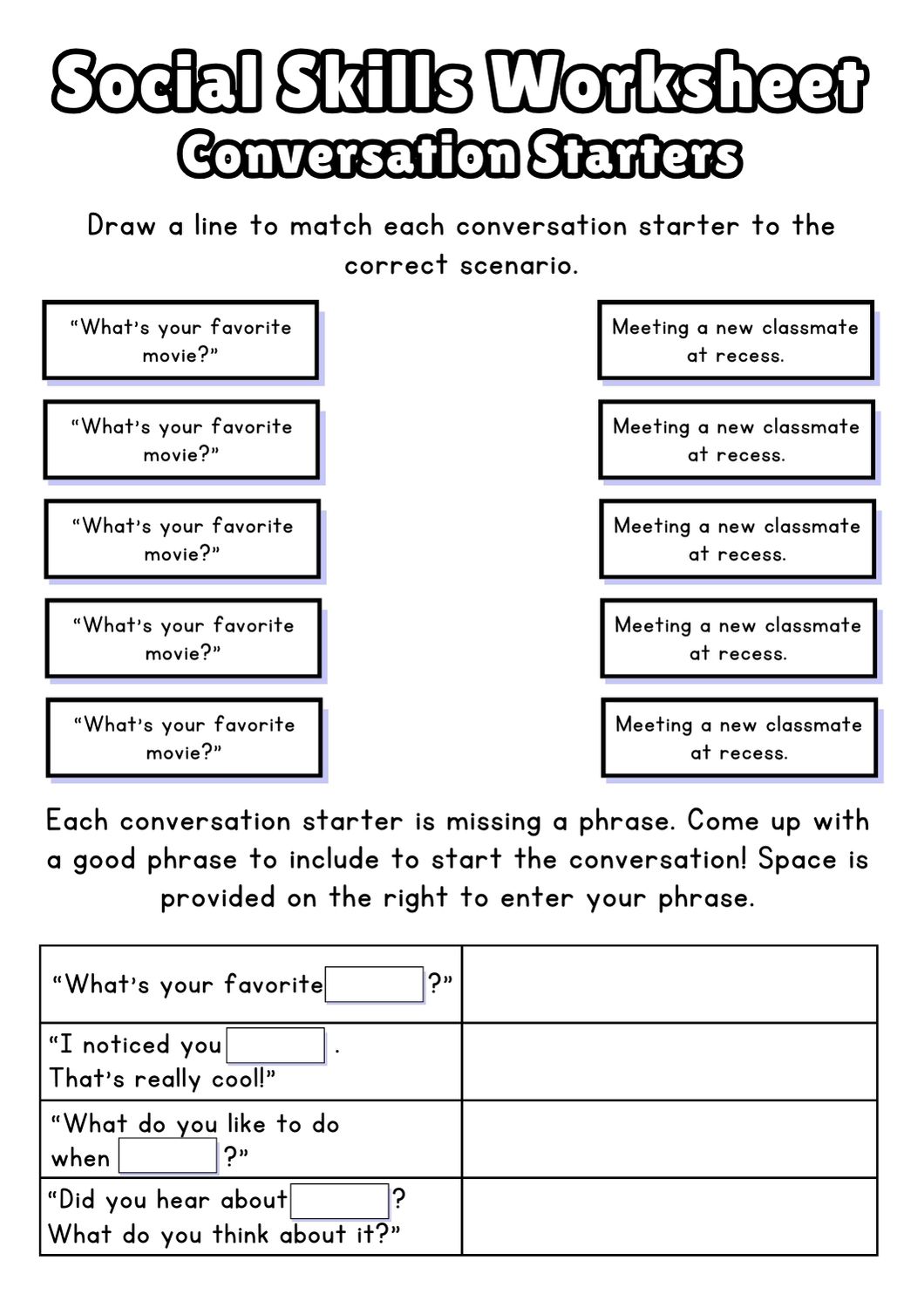
    Conversation Starters Worksheet

    Use this version for getting students to actively reflect on how to start a conversation and interact appropriately with others verbally.

    social skills worksheet

    check mark Designed by Chris

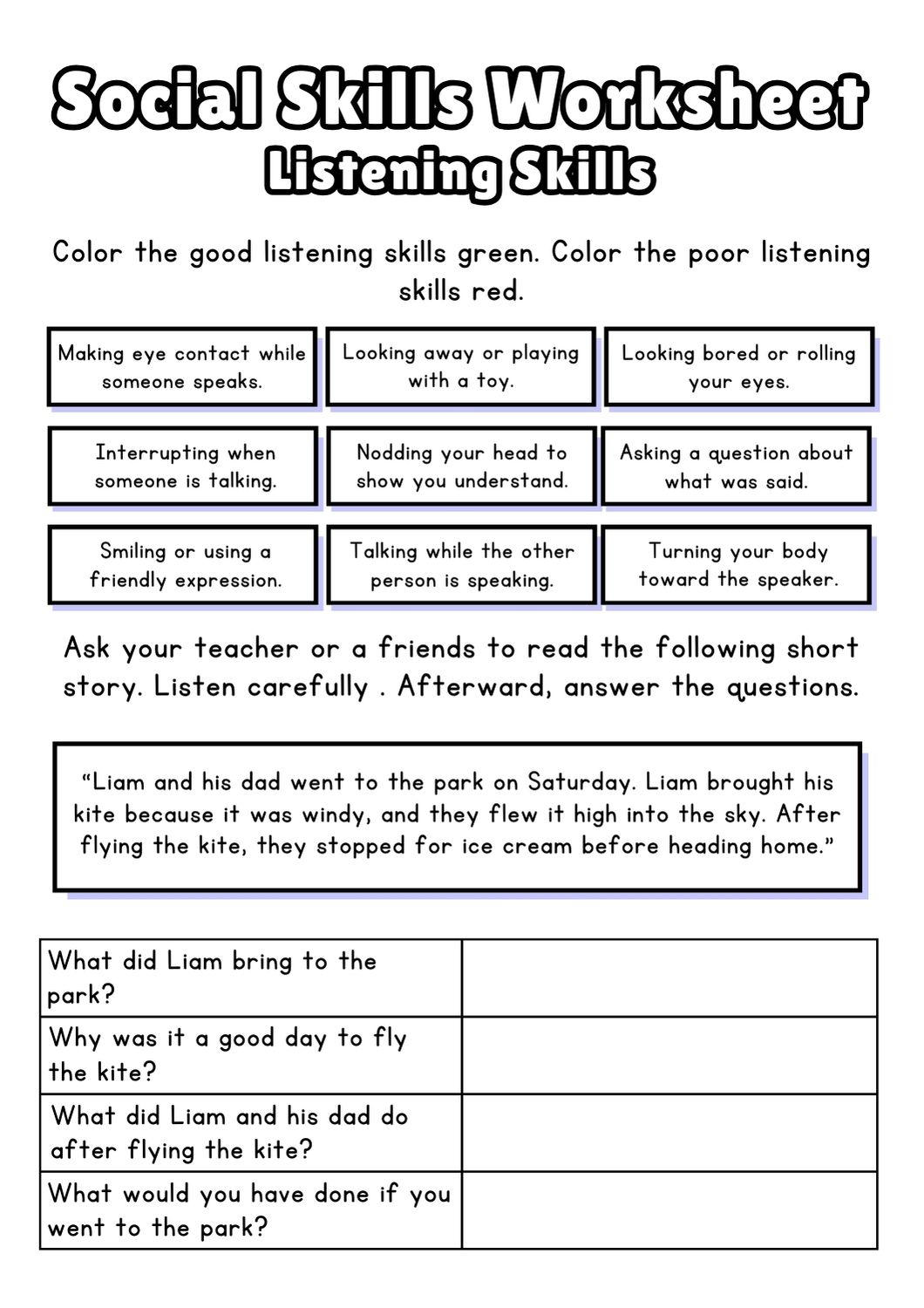
    Listening Skills Worksheet

    Use this version to get students to think about active listening skills and brainstorm the best ways to respond to people when listening to them in order to absorb what they’re saying.

    social skills worksheet

    check mark Designed by Chris

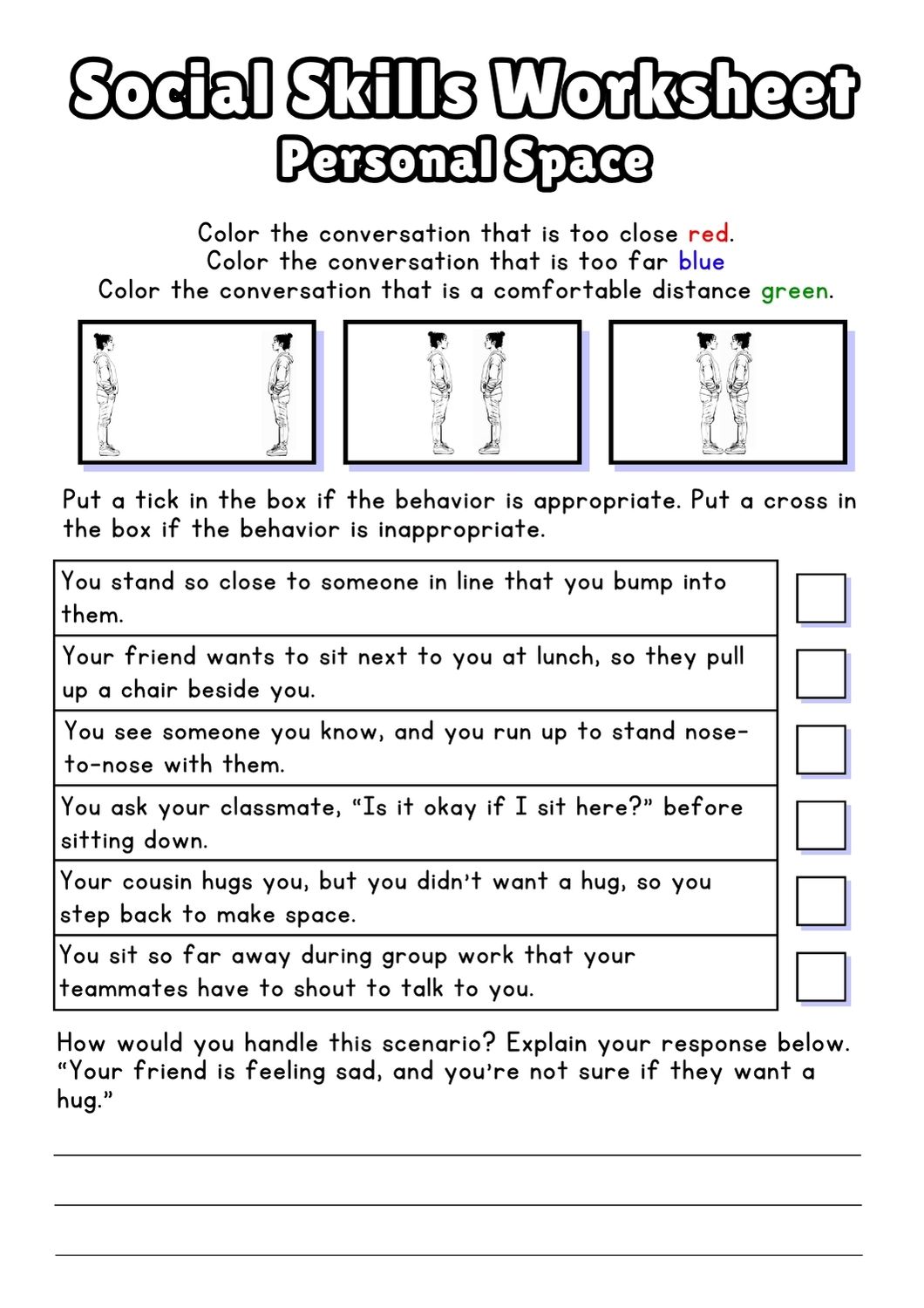
    Personal Space Worksheet

    Use this version to help people to understand how to give people personal space and maintain an appropriate distance in various social situations.

    social skills worksheet

    check mark Designed by Chris

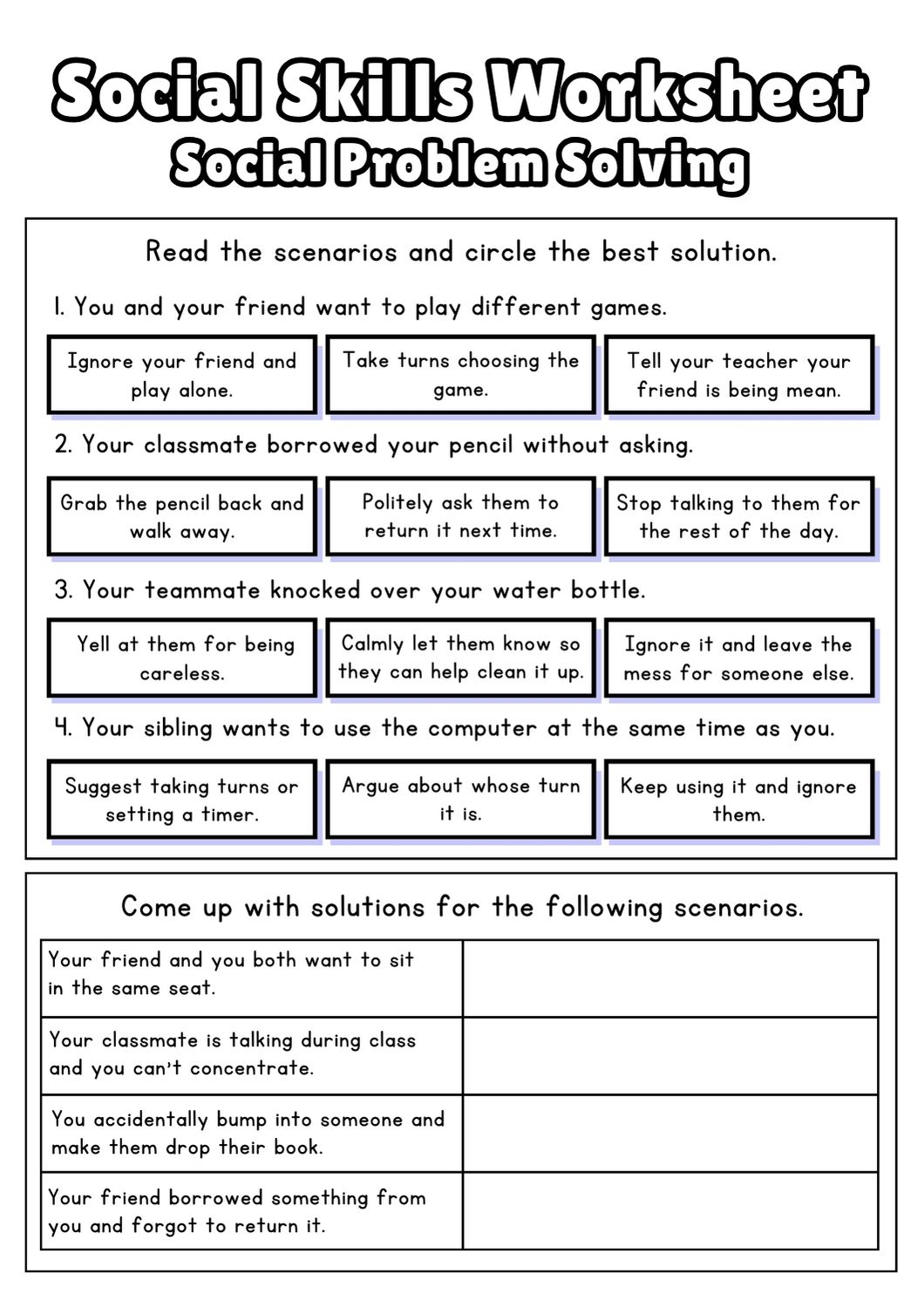
    Social Problem Solving Worksheet

    This version is ideal for helping people to deal with scenarios where someone may lose their temper. The scenarios discuss various appropriate ways to respond to potentially hairy situations.

    social skills worksheet

    check mark Designed by Chris

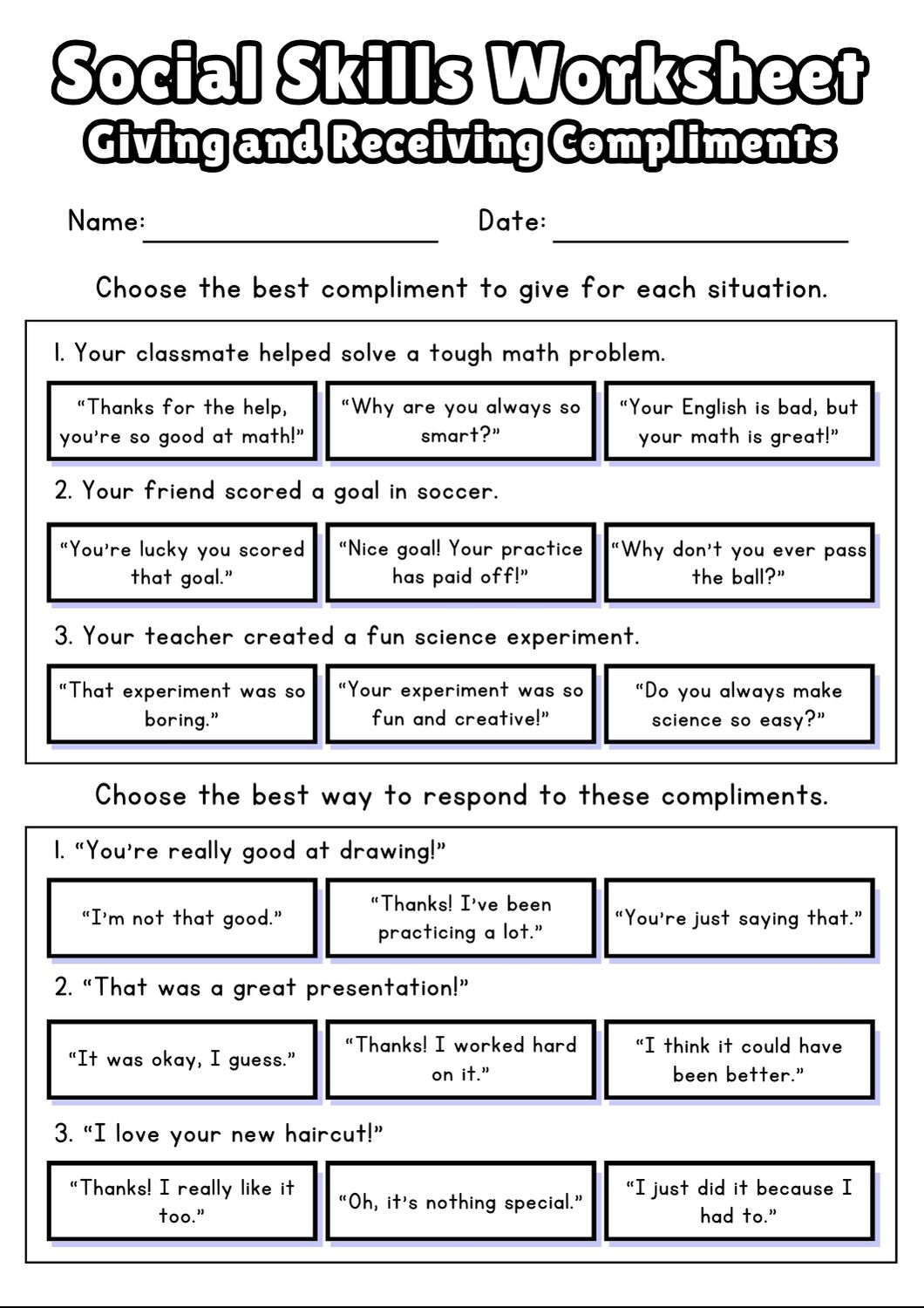
    Giving and Receiving Compliments

    Use this piece to brainstorm ways to give and receive compliments in various situations. Students must sort between various potential responses to compliment and ways to give compliments.

    social skills worksheet

    check mark Designed by Chris

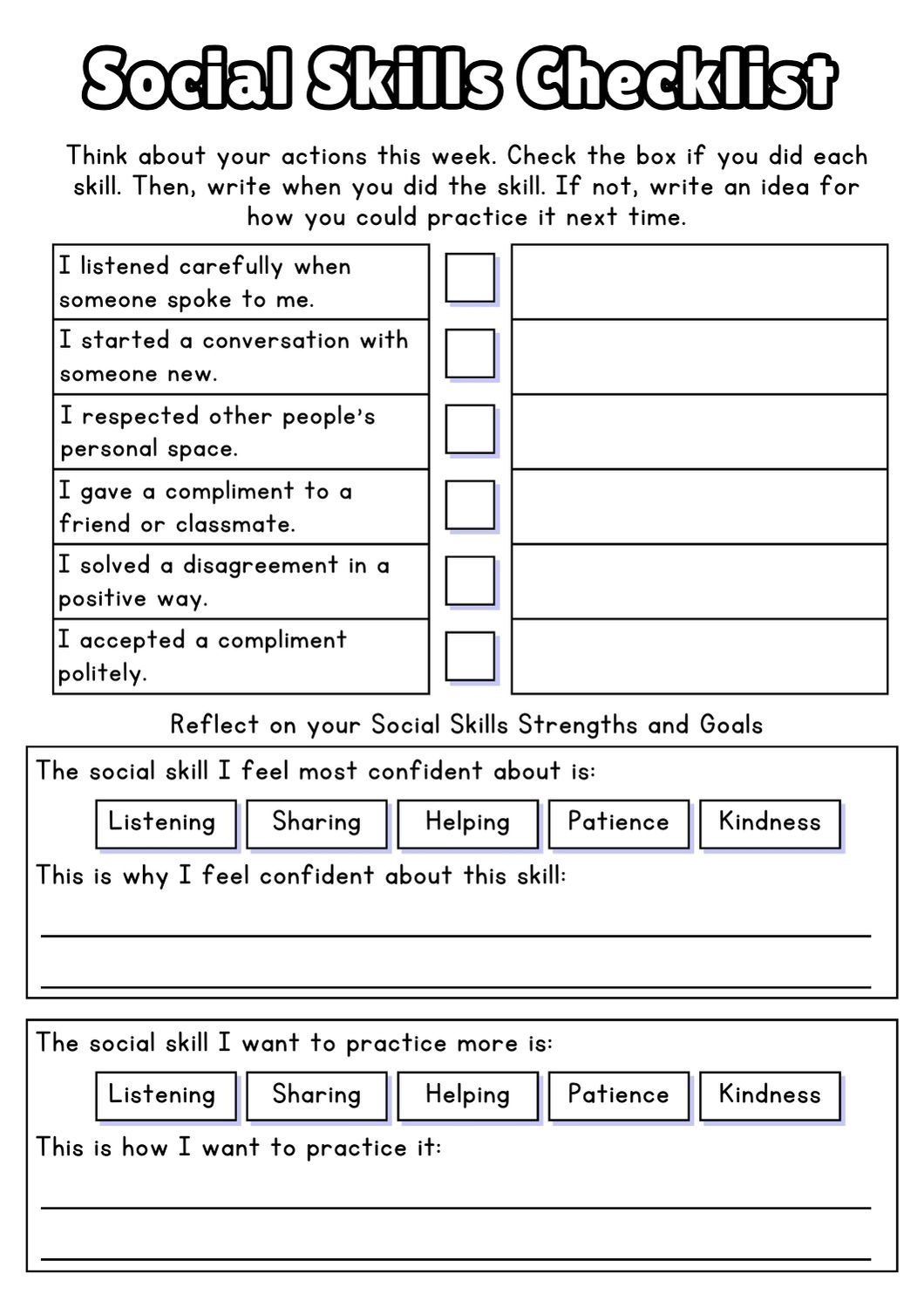
    Social Skills Checklist

    This checklist gets students to reflect on social skills they’ve used in the past week, and then to think about their strengths and areas for improvement.

    Thanks for checking out these worksheets. If you want to brainstorm different examples of social skills, read this blog post.


    Chris

    Dr. Chris Drew is the founder of the Helpful Professor. He holds a PhD in education and has published over 20 articles in scholarly journals. He is the former editor of the Journal of Learning Development in Higher Education. [Image Descriptor: Photo of Chris]

    Source link

  • The Migration Advisory Committee thinks about skills and long term net migration

    The Migration Advisory Committee thinks about skills and long term net migration

    The Migration Advisory Committee’s annual report for 2023 ended up being one of the publications with most policy influence on the subsequent year.

    Though it was released the week after then Home Secretary James Cleverly announced a review of the Graduate route, it clearly reflected ongoing Whitehall discussions and concerns over the post-study work visa, and much of its conclusions ended up being quoted incessantly through the subsequent debate around the MAC review – especially by those in favour of the route’s abolition or restriction:

    The graduate route may not be attracting the global talent anticipated, with many students likely entering low-wage roles.

    Our concern that the graduate visa would incentivise demand for short Master’s degrees based on the temporary right to work in the UK, rather than primarily on the value of qualification, may well be borne out in the trends that we have observed.

    As we have already shown, the rise in student numbers is almost entirely focused on taught Master’s degrees, and the growth has been fastest in less selective and lower cost universities. The rise in the share of dependants is also consistent with this.

    Given all that, it’s probably a relief to all concerned that the 2024 edition of the MAC annual report doesn’t go in depth on any international student-related issue, reflecting what feels like a (welcome) period of stasis in visa policy affecting higher education under the new government.

    Nevertheless, the MAC has a beefed up role under Labour – additional civil servant resource, plus we now learn that chair Brian Bell’s role will move from two to five days a week – and this time around the questions percolating away are worthy of some long-term thinking, even if they are not going to lead to knee-jerk policy decisions.

    Staying or going

    The annual review kicks off with consideration of long-term net migration trends, noting that the general election saw all main parties commit to bringing headline figures down.

    Thinking ahead, it notes:

    In the long run, work routes will have a greater impact on net migration compared to study routes as a greater percentage of those on the work route stay in the UK, whilst students are more likely to emigrate when they finish their course. Put simply, whilst students increase net migration in the year they arrive, they will reduce it by the same amount if and when they leave.

    This is a helpful soundbite for the sector, after last month’s ONS figures started to make clear what has been evident for a while – that historic claims around the “vast majority” of international students leaving the UK after completing their courses no longer hold much water. The ONS net migration stats estimated that the proportion of those on student visas who had transitioned to another visa three years after arriving was 48 per cent for those who arrived in year ending June 2021. This was up from nine per cent for those who arrived in June 2019, largely driven by introduction of the Graduate route.

    But the detail is still uncertain, as the MAC goes on to acknowledge. It cites recent Migration Observatory modelling (director Madeleine Sumption is now the MAC deputy chair) which estimates that the “stay rate” after eight years is around 26 per cent for those on study visas, compared to 56 per cent for those on work visas. The consequence of this is that – again, according to the Migration Observatory’s heavily caveated modelling – is that student visas contribute to 19 per cent of long-term net migration.

    (The modelling also lets you adjust the assumptions around stay rate and annual international student numbers – the baseline is rather simplistically 250,000 new student visas every year from 2024 to 2032, though to be fair recent volatility means that putting a firm prediction on international recruitment is a brave bet in itself.)

    All in all the MAC notes that stay rates are “highly uncertain” – but it’s an issue that will continue to inform the wider political debate, especially as the post-pandemic bulge is gradually smoothed out of net numbers. It’s notable in this context that think tank Labour Together – which typically has the ear of the government – has just put out a proposal for a “national migration plan” based on nationally set targets for different routes. Student visas, it says, would only be included in the analysis “to the extent that they have an impact on long-run net migration” through the Graduate and Skilled Worker visa routes.

    The skills puzzle

    The central piece of this year’s review is driven by the observation that the new government’s intention is “to more closely link migration and skills policy.” Given that starting point, the MAC carefully explores to what extent this can work. It’s of course written in the careful language you would expect of a government-sponsored committee with a Home Office secretariat, but reading between the lines there’s a cautionary note to it all (and not just in the observation that “skills” is an “ambiguous term both conceptually and empirically” – don’t tell Jacqui Smith).

    “In theory”, MAC observes, skills shortages lead employers to recruit using the immigration system. “If this were true,” the government can bring down work-related immigration via the reduction of skills shortages.

    In practice, there are some complications. Most obviously, skills investments take a long time to translate to the labour market – the last government repeatedly took the quicker route of facilitating international recruitment, especially in the health and care sectors, but also in not insignificant ways in areas like filling teacher vacancies.

    The MAC also stresses how employers will not deliberately make choices around whether to hire UK-based workers or those from overseas (speaking to The Times, Brian Bell specifically points to academic recruitment as an area where employers – universities – would not change their hiring practices if the domestic labour force had better qualifications). We are also told that labour demand and supply are not independent (“employers look for what they think they can get, and employees try to match what employers want”), and that skills aside there are other differences between domestic and international recruits.

    For the construction industry, this latter point was vividly illustrated by the Financial Times last week, which argued that many businesses in this field prefer “pay-by-the-day” labour and self-employed staff, and hence hire internationally and typically not via skilled worker routes – another consequence of this is that they are unlikely to commit to training apprentices. (The article also cites Brian Bell saying that high net migration leads to “real strains on our ability to manage housing and infrastructure,” in case anyone was thinking the MAC will take a more dovish approach under Labour.)

    All in all, bringing about a join-up between the skills and migration systems is a tough ask – or, more cynically, an unrealistic policy goal. It’s clear that the MAC is trying to temper expectations about what can be achieved:

    Linking immigration and skills policy is not a ‘one-size-fits-all’ approach and it is important to consider the individual circumstances within sectors and occupations, including diagnosing whether shortages are genuinely driven by a lack of skills or are due to poor pay and conditions of certain roles.

    And the elephant in the room is pay. In the care sector, the MAC has repeatedly stressed that wages need a significant uplift for other visa-related tinkering to have an impact. It stresses this again here, and makes the point that a large proportion of work visas go to public sector workers.

    This is a point for Skills England to take on board as well, you would hope. Its initial report was notably incurious about the role of low pay (especially in the public sector) in driving “skills mismatches”, rather presenting employment more as a simple supply and demand relationship between skills available and skills needed. The MAC annual report has some more persuasive analysis here, showing a lack of correlation between so-called “skills shortage vacancies” (SSVs) and skilled worker visa usage. That is to say, it’s by no means a given that those industries facing skills shortages are the ones more likely to sponsor workers from overseas. There are all kinds of factors at play.

    Quad to the rescue

    You get the sense that the team of economists who make up the Migration Advisory Committee are being careful about the government’s plans to link up skills and migration in a coherent way (it’s also noted at one point that skills is devolved and immigration is not – another challenge).

    What we’re getting to make this all fit together is a new “Quad framework” (I believe this is the first time it’s publicly been referred to in this way). As promised in Labour’s manifesto, the strengthened MAC will be working with the newly launched Industrial Strategy Council, the Department for Work and Pensions, and Skills England – the manifesto in fact promised “skills bodies across the UK”, but this hasn’t been fleshed out yet.

    This Quad will cooperate “to address systemic long-term issues that have led to reliance from certain sectors on international recruitment, and where appropriate, to reduce that reliance.” The MAC anticipates that the Quad will help identify priority sectors (following the industrial strategy, when ready) and determine which have a high reliance on migration, after which the MAC will – if it sees fit – recommend policy levers the government might pull, while Skills England will be drawing up workforce and skills plans, of some sort.

    It’s all a recipe for an incredibly complicated set of moving parts, and given Skills England’s involvement and the importance of overseas staff and student recruitment, one that the English higher education sector would be wise to keep an eye on and work out how it can contribute to.

    Source link

  • Innovation and skills in the English devolution white paper

    Innovation and skills in the English devolution white paper

    Devolution is a central plank of the government’s growth agenda. Providing places with the tools and resources to address local problems in ways that make sense on the ground is a means to unleash potential – and to end what English devolution minister Jim McMahon is happy to call the “top-down micromanaging” approach of ringfencing funds and centralising decision making.

    The launch of the English devolution white paper is the first step on that journey. Strategic authorities, led (for preference) by elected mayors, will cover the entirety of England. Integrated settlements will provide powers covering transport, infrastructure, housing, public services – and, of particular interest to the higher education sector, skills and innovation.

    A big part of the work of the white paper is in consolidating and standardising what had become an unruly system. Sitting above unitary, county, and district councils, a layer of strategic authorities will take on the services that larger areas need to thrive:

    Our goal is simple. Universal coverage in England of Strategic Authorities – which should be a number of councils working together, covering areas that people recognise and work in. Many places already have Combined Authorities that serve this role.

    The forthcoming English Devolution Bill will enshrine this concept in law. We get a computer game-like hierarchy of how strategic authorities will level up (so to speak): foundation strategic authorities (which do not – yet – have a mayor), followed by mayoral strategic authorities, which can then “unlock” designation as established mayoral strategic authorities through fulfilling various criteria. This will grant integrated funding settlements and other treats such as the ability to pilot new kinds of devolution.

    Already eligible for this top designation are Greater Manchester, Liverpool City Region, the North East, South Yorkshire, West Midlands, and West Yorkshire. There’s an aspiration for something similar to apply to London as well, but some legislative fiddling will be needed due to the capital’s “unique circumstances.”

    Innovation

    If you’ve got your head around the different levels of hierarchy, there’s actually quite a lot in the white paper for research and innovation, dependent on an area’s level of devolution.

    In language echoing the industrial strategy green paper, we are told that a strong local network of public and private institutions focused on R&D, innovation, and the diffusion of ideas “is one of the factors which sets highly productive local economies apart.” A big part of this is closer join-up between UKRI and local government.

    Working our way up the devolution ladder, all strategic authorities (including foundation level) will be able to draw on UKRI data on the location of R&D investments, to better allow them to “understand publicly supported innovation activity in their region and how to best take advantage of it.”

    Those mayoral strategic authorities will additionally work with Innovate UK to produce joint plans, to shape long-term innovation strategies and investments in places. UKRI will also be extending its regional partnerships and “network of embedded points of contact” with mayoral strategic authorities.

    And then coming up to the pinnacle of devolution, those established mayoral strategic authorities – to remind you: Greater Manchester, Liverpool City Region, the North East, South Yorkshire, West Midlands, and West Yorkshire, and possibly London – will get actual devolved research funding, in the form of a future regional innovation funding programme allowing local leaders to develop “bespoke innovation support offers for their regions.”

    This draws somewhat on the spirit of the Regional Innovation Fund, though this was allocated to individual higher education institutions – what’s on offer here sounds like a pot of money controlled by mayors. Its format is also to be based on lessons learned from the Innovation Accelerator pilot, which was funding by levelling up money.

    Plus, established mayoralties will get an annual meeting with the science minister, more regular engagement with senior staff at UKRI, and the chance to be consulted on the development of relevant DSIT and UKRI strategies.

    All in all, it’s a decent start down the road of a more significantly devolved research landscape. Important to note, however, that the actual funding on offer to established mayors is contingent on next year’s spending review, and so we’re talking about 2026–27 onwards here. And we might also observe that the House of Commons science committee’s inquiry into regional R&D, announced last week, has clearly been set up with an eye to influencing how this all comes together.

    At least to begin with, there will also be a not insignificant gap between what’s on offer to the most established sites of devolution – some funds to spend as desired, a seat at the strategy table – and what those “foundation” strategic authorities receive, which will be little more than a bit of regional R&D data. There’s potential for imbalance between regions here. Foundation-level authorities are described as a “stepping stone” to later acquiring a mayor, but it could be a long and drawn-out process.

    Skills and more

    On skills, strategic authorities will retain ownership of the Adult Skills Fund (with ringfencing removed from bootcamp and free course pots to allow for flexibility), take on joint ownership of Local Skills Improvement Plans alongside employer representative bodies, and work with employers to take on responsibility for promoting 16-19 pathways. In future, strategic authorities will have a “substantial role” in careers and employment support design outside of the existing Jobcentre Plus network, as the Get Britain Working white paper gestured towards.

    You’ll have spotted that this does not immediately extend to higher education, except to the extent that universities and colleges already get involved with adult skills provision. However the centre of gravity is such that any provider with an avowed interest in the local area will end up developing close relationships with strategic authorities. It isn’t just on skills or innovation – many universities work with local government on issues that affect students (and staff!) such as housing, infrastructure, and transport, and will have a strong interest in working with strategic authorities with new and wider powers to act.

    Administrative geography corner

    If you are labouring under the impression that dividing England up into administrative chunks is a fairly straightforward task, may we introduce you to possibly the single finest document ever published by the Office for National Statistics: the Hierarchical Representation of UK Geographies.

    Pedants may also note that the existing geography of LSIPs, which was controversially allowed to evolve into being outside of the established local authority boundaries, does not map cleanly to current or proposed local authorities – something that a future iteration of plans may need to consider. Likewise, the scope of university core recruitment areas or civic aspirations may not map to either.

    What we’d have loved to have shown you is a map showing which of the new strategic authorities your campus might be in. Sadly the boundaries of the “current map of English devolution” included in the white paper do not cleanly map to England’s many contradictory systems of administrative geography. Some of the devolved areas depicted are almost LSIP regions, one (Surrey) is a non-metropolitan ceremonial county, and one – Devon, including Torbay but not under any circumstances Plymouth – is just plain mad.

    As soon as we get an answer and some boundaries from ONS, we’ll let you know. In the meantime, here’s the map from the white paper:

    Source link

  • How to Equip Your Students With Essential Soft and Hard Skills Using Ed Tech

    How to Equip Your Students With Essential Soft and Hard Skills Using Ed Tech


    Today’s employers don’t just hire based on educational achievement. They’ve increasingly prioritized higher-order learning skills during the hiring process. To help students become job ready and land a role in the current workforce, professors need to empower learners with the necessary 21st-century skills, often called ‘soft skills.’

    This guide lays out key information on how to create opportunities for skill-based learning to help smoothen the transition from college to the workforce. It will also describe how to develop these skills in students while they’re still in the classroom. Most significantly, you’ll learn how educational technology can sharpen the essential soft skills students need beyond your course.  

    Below are 15 soft and hard skills that make up 21st-century learning.

    The 4 Cs of 21st-Century Learning

    The first four of these higher-order learning skills are widely considered the most vital 21st-century skills in the classroom for students to learn. Commonly known as the 4 Cs of 21st-century learning, they comprise:

    1. Critical thinking:

    Critical thinking is about problem-solving, and being able to bring a skeptical, discerning perspective to assertions of fact and opinion. Students are given opportunities to question and challenge the information presented to them. Troubleshooting and IT support are two hard skills that rely heavily on critical thinking as a foundation and are in-demand skills for the wide variety of technology-based careers in today’s job market.

    How Top Hat helps: Donna M. Smith, a math instructor, is a recipient of the Top Hat Black Educator Grant. A teacher of College Algebra at Sierra College, she has leveraged Top Hat to build a framework that helps students learn how to develop critical-thinking skills, and other soft skills like teamwork, adaptability and time management. She uses this framework to provide students with practice opportunities that demand specific actions from students, then gauges their higher-order learning using Top Hat’s range of assessment tools, spanning all six levels of Bloom’s Taxonomy. As a result, she reports, she’s found her students’ rate of success improved dramatically.

    In the same vein, 93 percent of students surveyed in a Top Hat research report said the variety of assessment types Top Hat offers help them learn how to develop critical-thinking skills.

    2. Creativity:

    This is the process of approaching problems from a variety of perspectives, including ones others might not notice. It helps develop trust in one’s own instincts and helps students seek out new solutions to old problems.

    3. Communication skills:

    This is the ability to convey thoughts and ideas clearly and effectively. In a 21st-century education, that includes being able to communicate well digitally, from texts, emails and social media, to podcasting and video conferencing.

    How Top Hat helps: Top Hat’s Discussion feature helps develop skill-building via collaboration in the classroom. While not all students are always on an equal playing field when it comes to comfort in group discussions, this Top Hat feature meets students where they are by allowing them to respond to comments and questions from any device. They can use simple text or incorporate images, sound bites and videos to propel the conversation forward. Teachers can even employ anonymity to make students comfortable engaging in sensitive topics. Teachers can use this Top Hat feature to drive up classroom participation significantly.

    4. Collaboration:

    This is the ability to work with others as a team to solve a problem or achieve a shared goal. It helps develop the abilities to share control, pitch solutions and discuss and decide with others the best course of action. It also helps students learn to effectively deal with others who may not agree with them, develop the critical abilities to resolve conflicts effectively and consider different viewpoints from their peers.

    Research shows that students who enter the workforce with knowledge and experience in the 4 Cs of 21st-century learning tend to be more adaptable and flexible in the constantly-shifting workplace environment. The 4 Cs of 21st-century learning, in turn, empower students to work better across cultures and are more prepared to take on leadership roles.

    Key Higher-Order Learning Skills

    Other important 21st-century skills in the classroom include:

    5. Problem-solving:

    This is the use of both conventional and innovative methods to solve different types of unfamiliar problems. It involves identifying and asking meaningful questions to clarify different viewpoints and arrive at more effective solutions.

    How Top Hat helps: The Top Hat Assignment feature enables teachers to provide students with interactive homework assignments that actively engage them in their own higher-order learning outside the classroom. A multimedia-friendly tool with 14 easy-to-use question types and automatic grading, this versatile feature keeps collaboration, communication and other essential skills front and center. It incorporates reading, answering questions and viewing media with worksheets, case studies and simulations to help students develop a deeper understanding of a problem and a multifaceted approach to its potential solutions. An added benefit for instructors is that it provides insights into students’ comprehension, participation and completion in real-time.

    6. Information literacy:

    This includes the ability to access, evaluate, utilize and manage information, critically and efficiently. It also involves the accurate and creative application of available information to the current problem or issue. It requires managing data flow from multiple sources, and the application of fundamental legal and ethical knowledge regarding access to and use of that information.

    7. Technology skills and digital literacy:

    Often abbreviated as ICT literacy (Information, Communication and Technology,) this is the collective set of abilities that allow students to effectively apply digital technologies to researching, evaluating, organizing and communicating information across digital channels. This may include using computers, mobile devices, social networks and other communication tools. Jobs in machine learning, product management and software development require understanding of technological platforms and apps. Individuals in these careers must be proficient in these skills in order to suceed.

    How Top Hat helps: Top Hat improves general literacy and digital literacy at the same time with Interactive Textbooks. Dynamic courseware incorporates text with high-quality images, videos and 3D simulations to captivate students’ interest and help them absorb and retain information better. They include case studies and customizable, interactive assessments, and students can access them anytime and from any device. Teachers can use Top Hat’s interactive textbooks in combination with physical textbooks, or on their own.

    Incorporating interactive textbooks and other digital technologies also helps students with skill-building and better prepare them to enter the 21st-century workforce by providing one-to-one computing, giving them the technology required to utilize their higher-order thinking skills in coursework.

    8. Media literacy:

    This includes the ability to analyze media and create media products. It involves understanding how, why and for what purpose various entities construct media messages, including what values and viewpoints they choose to include or exclude, and why. It also examines how people interpret messages differently and how that influences behaviors and beliefs. 

    9. Global awareness:

    This is the use of 21st-century skills to comprehend and address issues of global magnitude, and to collaborate with those from diverse backgrounds. It also involves taking an equitable or inclusive mindset when presenting new information. For example, educators might draw connections between cultural references in an English or cultural studies course. Teaching students the importance of global awareness also starts with reflecting on current and real-time events in your teaching, such as incorporating case studies on political or social uprisings.

    10. Self-direction:

    This is the ability to effectively set goals and manage time, as well as to work independently. It requires determining tangible and intangible criteria for success and balancing short-term tactical goals with long-term strategic ones. It also requires demonstrating initiative and commitment and working independently, including defining, prioritizing, monitoring and completing tasks without oversight, while reflecting on past experiences and learning from them.

    11. Social skills:

    This is the ability to effectively interact with others and work in diverse teams. Students recognize the appropriate times to listen or speak while remaining open-minded to diverse values and ideas. Students also learn how to conduct themselves professionally in a respectful manner, including when working with people from different backgrounds. Those looking to pursue careers in nursing or other areas of healthcare must be proficient in providing both emotional and physical care to patients. Common hard skills required for these careers include Basic Life Support (BLS), Patient Safety and Critical First Aid.

    12. Perseverance:

    This is the ability to persist in a determined effort in spite of obstacles and setbacks. It requires many of the other higher-order thinking skills, including problem-solving and self-direction, to employ effectively.

    How Top Hat helps: Top Hat’s 21st-century learning suite includes many tools that help educators make sure no student falls behind. Not least among them is learning insights. By tracking every interaction between a student and the software automatically, Top Hat enables you to see which students need additional help, in what area and when. Gauge attendance, progress, comprehension, participation—and act on these insights proactively in real-time.

    13. Literacy skills:

    Basic literacy skills include the abilities to create, comprehend, analyze, absorb, retain and recall written information. In the 21st-century workplace and modern economy, they especially apply to business, economic, financial, health and entrepreneurial interests.

    14. Civic literacy:

    Students become familiar with how civic decisions have local and global implications. This type of literacy involves effective participation in civic life by remaining informed and comprehending the processes of government. It also requires knowing how to exercise citizenship rights and obligations.

    15. Social responsibility:

    This encompasses everything from human rights, labor practices, the climate and the environment, fair operating practices, consumer issues and community involvement and development. It requires accountability, transparency, ethical behavior and respect for stakeholder interest, the rule of law, international norms of behavior and human rights.

    Why 21st-Century Skills Are Important

    Importance of Soft Skills for Students

    At its most basic level, teaching 21st-century skills, like critical thinking, provides a framework for higher-order learning. Beyond that, however, it also helps students develop the skills that ensure they will thrive when they leave the classroom and enter the workforce.

    Today’s workplaces are changing constantly, and the role of technology is ever-evolving and growing. That means that persistent, continual learning is essential to succeed and an emphasis on the importance of soft skills for students. Today’s graduates require not only the knowledge and skills for their chosen careers, but critical-thinking skills to navigate an always-changing landscape.

    Good for the World

    The greater community also benefits from new workers entering the workforce with a 21st-century education. The wellbeing of our broader society requires workers with competence and experience in:

    • Civic engagement
    • Critical thinking
    • Digital literacy
    • Effective communication
    • Global awareness

    Graduates equipped with these higher-order learning skills comprehend their role as good citizens and their connection to their neighbors and their shared environment. This way, they are more tolerant, they think more equitably and they aim to build a more diverse workforce. They are empowered to approach all they do in their work with a civic-minded focus.

    Conclusion

    As a 2017 research review in Nurse Education in Practice reported, “Technology has advanced in quantity and quality; recognized as a requirement of 21st-century learners.” Integrating curricula on critical thinking and other soft skills in your classroom will help your students enter the 21st-century workplace better equipped to meet the challenges facing future workers and leaders. As technology becomes an increasingly inseparable part of the working world, it’s becoming more evident that teachers who make effective use of it have an advantage in helping students prepare for life beyond the classroom.

    The developers and designers of Top Hat, including professional educators themselves, are singularly focused on employing the latest in 21st-century education technology to help educators empower students to achieve these aims.

    References

    Ross, D. (2017, April 24). Empowering Our Students with 21st-Century Skills for Today. Getting Smart. www.gettingsmart.com/2017/04/24/empowering-students-21st-century-skills/

    What is social responsibility? (n.d.). ASQ. asq.org/quality-resources/social-responsibility

    LinkedIn Jobs on the Rise 2022: The 25 U.S. roles that are growing in demand (2022, January 18). LinkedIn. https://www.linkedin.com/pulse/linkedin-jobs-rise-2022-25-us-roles-growing-demand-linkedin-news/


    Source link
  • Podcast with D2L’s Cristi Ford on Durable Skills and AI –

    Podcast with D2L’s Cristi Ford on Durable Skills and AI –

    I was delighted to speak with Cristi Ford, D2L’s VP of Academic Affairs, about durable skills and AI in higher education. You can find the episode in all the usual places:

    Apple Podcasts: https://podcasts.apple.com/us/podcast/how-teaching-skills-can-complement-the-use-of-ai/id1663544722?i=1000649960964

    Spotify: https://open.spotify.com/episode/1iYsMHqAKXzts9i4skDHPE

    YouTube (audio only): https://www.youtube.com/watch?v=oE6bbJHSa-A

    Show Notes: https://www.d2l.com/podcasts/teach-and-learn/how-teaching-skills-can-complement-the-use-of-ai-in-education-with-michael-feldstein/

    Cristi is a delightful, thoughtful educator and a pleasure to talk with about these important issues. (Side note: D2L is building up a very impressive staff roster. They have more people I would gladly share a meal with—and more that I would call my personal friends—than any other company in EdTech today.)

    The podcast flowed directly from a talk I gave at a D2L Ignite conference in Orlando, which, I’m gratified to say, has brought me more meaningful feedback and new connections than any talk I’ve given in a long time. We often talk aspirationally about AI being a humanizing technology. In my talk, I start by putting the idea of rapid change, including AI, in the context of humans learning from other humans. The heart of the talk is my own deeply personal story about how ChatGPT helped me cope with a terrible crisis. And I close by arguing that teaching skills are durable skills. Cristi was in the audience. Much of our podcast conversation elaborates on some of those themes in what was a packed 45-minute talk.

    Below, you can see my original talk, recorded for my hospitalized sister on my iPhone.

    AI and Durable Skills Keynote at D2L’s Ignite Orlando Summit


    Source link

  • Can Go Higher students save the environment? By Barbara Milne, Go Higher Study Skills Tutor – ALL @ Liverpool Blog

    Can Go Higher students save the environment? By Barbara Milne, Go Higher Study Skills Tutor – ALL @ Liverpool Blog

    Sustainability and the challenges of protecting our environment are key concerns for the Go Higher Diploma and for the University as a whole. A couple of weeks into semester two, our students were invited to work on a PowerPoint presentation and voice over, focusing on the topic of sustainability and / or the environment.

    The range of topics which they chose to focus on and research was hugely impressive. The task enabled them to not only develop their investigative and PowerPoint skills but also to highlight an issue which was important to them personally.

    Our Go Highers embraced this task, producing work of a high quality: innovative, dynamic, and engaging. By way of example, here are some titles: ‘Sustainability in Fashion’; ‘The important role frogs play in environment’, through to ‘Dogs’ ‘business’’ and its impact on our environment, to the fascinating subject of ‘Light Pollution’, collectively, a wide-ranging and diverse bank of work.

    I chatted with one of our Go Higher, who, reflecting on their presentation, highlighted positive aspects of their ‘PowerPoint experience’. They observed that ‘the presentation was a nice way to lead into the start of the new semester’. They noted, with appreciation, the freedom to select their theme within the topic remit, adding that ‘there were opportunities to settle on a subject that might not be widely known’, drawing attention to it, through the medium of PowerPoint.

    A further reflection highlighted the usefulness of having a sample presentation, plus rough working notes, as part of the task guidance. This advice served as an alarm bell, warning that not everything, however relevant and interesting, could be included within the five slide limit, so encouraging the development of discerning editing skills. The nature of this task was commented on as being instrumental in ‘taking the pressure off’, affording an opportunity to concentrate efforts on an item of work that would receive constructive comment, rather than a grade.

    A positive outcome, resulting from the presentation task, was pinpointed  during our conversation –  the interconnection between this assignment and the forthcoming Philosophy podcast  – feedback evidencing that the path towards making a podcast had been eased, because of the experience of providing a commentary to a PowerPoint presentation, speaking to an audience, a practice run for the podcast. This is a feature of Go Higher: there are linkages throughout the different modules with students supported to develop their skills and potential at a pace that is right for them.

    It’s terrific to see how much hard work has gone into producing engaging presentations that are both engaging and informative. Well done everyone!

    Image by Freepic

    Source link

  • Teaching Skills are Durable Skills with AI –

    Teaching Skills are Durable Skills with AI –

    I recently gave a keynote on AI at the durable skills-themed D2L Ignite conference in Orlando. I took the following positions:

    • Durable skills, unlike so many educational buzzwords, is a genuine civilizational shift that requires our urgent attention. AI does not cause it. It just made the change obvious.
    • AI genuinely will cause profound and unforeseeable changes to the way we live. I gave a highly personal example to make this point vivid.
    • Teaching skills are durable skills that translate quite well to the AI world.
    • Other skills, such as those required to design and test solutions to complex humans, are durable skills.

    As usual, I tried to cram an hour-long talk into 45 minutes, so I rushed some parts and left a few dots unconnected. In this post, I’ll the video and restate the elements of the third bullet point to ensure they’re clear. I’m putting the video at the bottom of the post because I’m hoping you’ll read it before watching the talk and keeping the post short because the idea that you’ll both read a blog post and watch a 45-minute talk is expecting a lot.

    To be clear, I’m not arguing that teaching skills are durable skills because generative AI works like the human mind. It doesn’t. I’ll briefly explain why each teaching skill I discuss transfers to AI. The reasons are different from point to point.

    Here are the skills:

    • Scaffolding: In education, scaffolding is rooted in Vygotsky’s notion of the Zone of Proximal Development (ZPD). We’re helping students stretch beyond what they could learn on their own by providing them with temporary supports or building blocks, progressively removing the support as we go. With AI, we focus the model on the right pieces by providing context and examples. It knows a lot, but it needs context. So, to get good results, we remind it of basic concepts it already knows, similarly to how we teach students of the basic concepts they need to solve complex problems. As with human students, we feed it more complex pieces to put together until it is thinking the way we need it to. The AI has something akin to the ZPD in the sense that it doesn’t always need scaffolding. Some things it can figure out on its own. Other things it can’t figure out even with help. Even though the reasons are entirely different, we get better results when we act as if the AI has a ZPD and apply scaffolding when we find ourselves working within that zone.
    • Formative assessments: Much is made of the fact that the AI is a black box. Little is made of the fact that the human mind is also a black box. We don’t know what students understand. In fact, good teachers probe continuously, in part because we are constantly trying to get a read on what the student understands and because students change. They learn. AIs don’t learn in the same way that students do, but they can change over time. ChatGPT is better at understanding some things than it was six months ago. And some of those improvements aren’t obvious. We have to design probes to test.
    • Worked examples: This one is crucial and goes beyond using generative AIs to actually building or fine-tuning models. With students, we show them how to solve a problem: here’s the question, here’s the answer, and here’s how we got from the question to the answer. If we’re making full use of this technique, we’ll show students a series of subtly but importantly different worked examples so that they can learn nuances. With AI, whether we are writing a prompt or constructing a training data set, the ideal input is a series of examples where we say to the machine, here is the input, here is the desired output, and here is an annotation explaining why this is good output. Particularly with model training, we want to provide a series of subtly but meaningfully different examples so that it can learn to differentiate.
    • Writing: To do almost anything with generative AI, you must be a good, clear, precise writer. We stress out about ChatGPT causing the loss of writing skills, forgetting that the majority of interactions most people have with the technology is, in fact, through writing. And better writing gets better answers or, if you’re training a model, better input data.

    That’s the short but (hopefully) clear version of the third part of the talk.

    The example I use for the second part of my talk is how ChatGPT helped me cope with the stream of medical information I was receiving about my little sister, who recently suffered a life-threatening brain hemorrhage. I recorded this video on my iPhone with no intention of sharing it with anyone but my close family. My sister is a teacher. I wanted to show her how the story of her struggle is helping other educators (and to show her a little bit of what I do for a living, which I have trouble explaining). I told her story to the D2L conference audience with her husband’s permission and with no intention of taking it further. I have been urged by a few people who were there that day to share it more widely. And so, with the blessing of my brother-in-law, I am publishing it. (My sister, by the way, is making amazing progress in her recovery. I hope she will be able to watch the video herself soon.) If you watch it and find it valuable, please comment below. She will find it meaningful to know that her story is helping other educators.

    This is for you, Sharon.

    D2L Rise Orlando 2024 Keynote on Durable Skills and Artificial Intelligence: https://youtu.be/ufwEElHcZAs


    Source link