
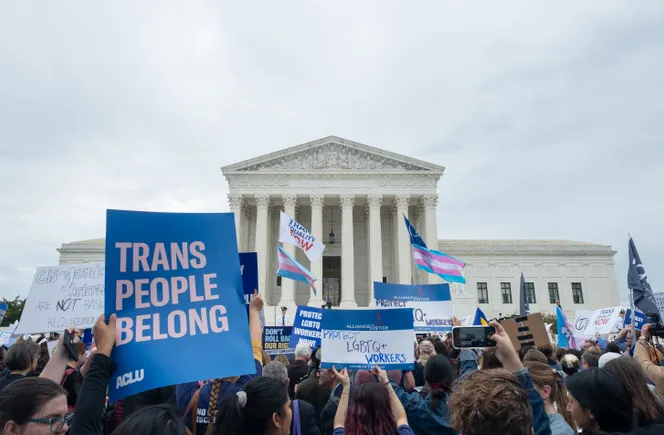
Just a week after the U.S. Supreme Court ruled to restrict gender-affirming medical care for transgender minors in June, the U.S. Department of Education began citing that decision in findings related to transgender access to athletics.
Although the high court’s ruling in U.S. vs. Skrmetti did not directly involve education civil rights law, the Trump administration has relied on it to bolster its stance that Title IX can be used to exclude transgender students from teams aligning with their gender identities.
The Supreme Court’s decision said a person’s identification as “transgender” is distinct from their “biological sex.” However, it did not touch on whether discrimination against transgender people amounts to sex-based discrimination.
But the Education Department’s Office of Civil Rights is using the decision to inform Title IX cases that have excluded transgender students from protections against sex-based discrimination. The decision’s use in OCR policy is leading to double-takes from Title IX experts, although one said district leaders may not have to change anything for now since the Supreme Court has placed a transgender athletics case on its docket for the next term.
The Trump administration has cited the Skrmetti case in at least two OCR cases related to transgender access to athletics.
In a June 25 press release, OCR cited the case in its finding that the California Department of Education and California Interscholastic Federation violated Title IX by discriminating against girls and women after the state allowed transgender students to play on girls’ sports teams.
“On June 18, 2025, the Supreme Court upheld a Tennessee law banning certain medical care for minors related to treating ‘gender dysphoria, gender identity disorder, or gender incongruence,’” OCR said in its news release. “In so holding, the Supreme Court acknowledged that a person’s identification as ‘transgender’ is distinct from a person’s ‘biological sex.’”
The department also cited the case in its July 27 finding that five large Northern Virginia school districts, including Fairfax County Public Schools, discriminated on the basis of sex when they allowed transgender students to access facilities aligning with their gender identities.
“There has been a little bit of a selective stretching,” said Kayleigh Baker, an advisory board member for the Association of Title IX Administrators. Baker and other ATIXA attorneys routinely work with school districts to train them on education civil rights laws.
“The four corners of the Supreme Court opinions have sort of been extrapolated and sort of merged together with this administration’s interpretation in a couple of arenas. And it seems like this is another one of those,” Baker said.
Jay Worona, partner at law firm Jaspan Schlesinger Narendran, said the Education Department did something similar with the Supreme Court’s 2023 SFFA v. Harvard decision banning race-conscious admissions.
Worona said in an email that the administration has used the case to argue that “K-12 school districts violate civil rights protections of students when they enact policies and engage in practices advancing DEI [diversity, equity and inclusion] despite the Supreme Court’s decision in that case only applying to higher education institutions.”
In February, the agency issued a Dear Colleague letter to prohibit the consideration of race in many more aspects of educational programming, including “financial aid, scholarships, prizes, administrative support, discipline, housing, graduation ceremonies, and all other aspects of student, academic, and campus life.”
“Although SFFA addressed admissions decisions, the Supreme Court’s holding applies more broadly,” the Education Department said in its letter to districts. “At its core, the test is simple: If an educational institution treats a person of one race differently than it treats another person because of that person’s race, the educational institution violates the law.”
Although a federal judge blocked that Dear Colleague letter last week, the department said in a statement that while it “is disappointed in the judge’s ruling, judicial action enjoining or setting aside this guidance has not stopped our ability to enforce Title VI protections for students at an unprecedented level.”
Is this practice usual?
This is not necessarily different from the practices of past administrations in applying Supreme Court decisions to education civil rights. The Biden administration, for example, applied the landmark Bostock v. Clayton County case — which protected LGBTQ+ people from sex discrimination in the workplace — to protect LGBTQ+ students under Title IX in the classroom.
“In that way, some of this is to be expected,” said Baker.
But whereas the Biden administration issued an official letter announcing its interpretation for schools to implement, the Trump administration quietly tucked its application of Skrmetti into its Title IX investigation announcements.
And while Bostock answered the question of whether discrimination against LGBTQ+ people amounts to sex discrimination in the workplace, Skrmetti does not directly address whether discrimination against transgender students is sex-based discrimination in any setting — educational or otherwise.
“The Department’s press releases cite the Skrmetti decision to highlight that the Supreme Court in its recent ruling substantiated the obvious: sex is an immutable characteristic,” a department spokesperson said in a statement to K-12 Dive on Monday.
Regardless, the Supreme Court is set to explicitly answer the question of whether Title IX policy bars transgender students from athletics and facilities aligning with their gender identities next term.
In July, the justices took on a pair of cases that could set nationwide precedent on transgender athletic participation in public schools — finally ending a policy pingpong that has persisted over the last three presidential administrations.
Until such a decision, Baker said, district leaders should check with their local counsel, as application of Title IX for transgender students may vary based on state law rather than on Skrmetti.
“I don’t think based solely off of the Skrmetti decision that districts need to jump into any changes,” said Baker.