For more than a decade, University of Kansas researchers have been developing a virtual reality system to help students with disabilities, especially those with autism spectrum disorder, to learn, practice and improve social skills they need in a typical school day. Now, the KU research team has secured funding to add artificial intelligence components to the system to give those students an extended reality, or XR, experience to sharpen social interactions in a more natural setting.
The U.S. Office of Special Education Programs has awarded a five-year, $2.5 million grant to researchers within KU’s School of Education & Human Sciences to develop Increasing Knowledge and Natural Opportunities With Social Emotional Competence, or iKNOW. The system will build on previous work and provide students and teachers with an immersive, authentic experience blending extended reality and real-world elements of artificial intelligence.
iKNOW will expand the capabilities of VOISS, Virtual reality Opportunity to Integrate Social Skills, a KU-developed VR system that has proven successful and statistically valid in helping students with disabilities improve social skills. That system contains 140 unique learning scenarios meant to teach knowledge and understanding of 183 social skills in virtual school environments such as a classroom, hallway, cafeteria or bus that students and teachers can use via multiple platforms such as iPad, Chromebooks or Oculus VR headsets. The system also helps students use social skills such as receptive or expressive communication across multiple environments, not simply in the isolation of a classroom.
IKNOW will combine the VR aspects of VOISS with AI features such as large language models to enhance the systems’ capabilities and allow more natural interactions than listening to prerecorded narratives and responding by pushing buttons. The new system will allow user-initiated speaking responses that can accurately transcribe spoken language in real-time. AI technology of iKNOW will also be able to generate appropriate video responses to avatars students interact with, audio analysis of user responses, integration of in-time images and graphics with instruction to boost students’ contextual understanding.
“Avatars in iKNOW can have certain reactions and behaviors based on what we want them to do. They can model the practices we want students to see,” said Amber Rowland, assistant research professor in the Center for Research on Learning, part of KU’s Life Span Institute and one of the grant’s co principal investigators. “The system will harness AI to make sure students have more natural interactions and put them in the role of the ‘human in the loop’ by allowing them to speak, and it will respond like a normal conversation.”
The spoken responses will not only be more natural and relatable to everyday situations, but the contextual understanding cues will help students better know why a certain response is preferred. Rowland said when students were presented with multiple choices in previous versions, they often would know which answer was correct but indicated that’s not how they would have responded in real life.
IKNOW will also provide a real-time student progress monitoring system, telling them, educators and families how long students spoke, how frequently they spoke, number of keywords used, where students may have struggled in the system and other data to help enhance understanding.
All avatar voices that iKNOW users encounter are provided by real middle school students, educators and administrators. This helps enhance the natural environment of the system without the shortcomings of students practicing social skills with classmates in supervised sessions. For example, users do not have to worry what the people they are practicing with are thinking about them while they are learning. They can practice the social skills that they need until they are comfortable moving from the XR environment to real life.
“It will leverage our ability to take something off of teachers’ plates and provide tools for students to learn these skills in multiple environments. Right now, the closest we can come to that is training peers. But that puts students with disabilities in a different box by saying, ‘You don’t know how to do this,’” said Maggie Mosher, assistant research professor in KU’s Achievement & Assessment Institute, a co-principal investigator for the grant.
Mosher, a KU graduate who completed her doctoral dissertation comparing VOISS to other social skills interventions, found the system was statistically significant and valid in improving social skills and knowledge across multiple domains. Her study, which also found the system to be acceptable, appropriate and feasible, was published in high-impact journals Computers & Education and Issues and Trends in Learning Technologies.
The grant supporting iKNOW is one of four OSEP Innovation and Development grants intended to spur innovation in educational technology. The research team, including principal investigator Sean Smith, professor of special education; Amber Rowland, associate research professor in the Center for Research on Learning and the Achievement & Assessment Institute; Maggie Mosher, assistant research professor in AAI; and Bruce Frey, professor in educational psychology, will present their work on the project at the annual I/ITSEC conference, the world’s largest modeling, simulation and training event. It is sponsored by the National Training & Simulation Association, which promotes international and interdisciplinary cooperation within the fields of modeling and simulation, training, education and analysis and is affiliated with the National Defense Industrial Association.
The research team has implemented VOISS, available on the Apple Store and Google Play, at schools across the country. Anyone interested in learning more can find information, demonstrations and videos at the iKNOW site and can contact developers to use the system at the site’s “work with us” page.
IKNOW will add resources for teachers and families who want to implement the system at a website called iKNOW TOOLS (Teaching Occasions and Opportunities for Learning Supports) to support generalization of social skills across real-world settings.
“By combining our research-based social emotional virtual reality work (VOISS) with the increasing power and flexibility of AI, iKNOW will further personalize the learning experience for individuals with disabilities along with the struggling classmates,” Smith said. “Our hope and expectation is that iKNOW will further engage students to develop the essential social emotional skills to then apply in the real world to improve their overall learning outcomes.”
Mike Krings,KU News Service
Mike Krings is a Public Affairs Officer with the KU News Service at the University of Kansas.
Latest posts by eSchool Media Contributors (see all)
AUSTIN, Texas, Feb. 7, 2025 — After a lawsuit from the Foundation for Individual Rights and Expression and Davis Wright Tremaine, a district court today stopped enforcement of a Texas law that would have blocked access to broad categories of protected speech for minors and forced websites to collect adults’ IDs or biometric data before they can access social media sites.
Northern District of Texas Judge Robert Pitman granted FIRE’s motion for a preliminary injunction against provisions of the Securing Children Online through Parental Empowerment Act (SCOPE Act) requiring content monitoring and filtering, targeted advertising bans, and age-verification requirements, ruling that these measures were unconstitutionally overbroad, vague, and not narrowly tailored to serve a compelling state interest.
“The court determined that Texas’s law was likely unconstitutional because its provisions restricted protected speech and were so vague that it made it hard to know what was prohibited,” said FIRE Chief Counsel Bob Corn-Revere. “States can’t block adults from engaging with legal speech in the name of protecting children, nor can they keep minors from ideas that the government deems unsuitable.”
The SCOPE Act would have required social media platforms to register the age of every new user. Platforms would have been forced to track how much of their content is “harmful” to minors and, once a certain percentage is reached, force users to prove that they are 18 or older. In other words, the law would have burdened adults who wanted to view content that is fully legal for adults, serving as an effective ban for those who understandably don’t trust a third-party website with their driver’s license or fingerprints.
The law also required websites to prevent minors from being exposed to “harmful material” that “promotes, glorifies, or facilitates” behaviors like drug use, suicide, or bullying. That definition was far too vague to pass constitutional muster: whether speech “promotes” or “glorifies” an activity is inherently subjective, and platforms had testified that they would be forced to react by censoring all discussions of those topics.
Today’s ruling should serve as yet another warning to states tempted to jump on the unconstitutional bandwagon of social media age verification bills.
“At what point… does alcohol use become ‘substance abuse?’” asked Judge Pitman in his ruling. “When does an extreme diet cross the line into an ‘eating disorder?’ What defines ‘grooming’ and ‘harassment?’ Under these indefinite meanings, it is easy to see how an attorney general could arbitrarily discriminate in his enforcement of the law.”
FIRE sued on August 16 on behalf of three plaintiffs who use the Internet to communicate with young Texans and keep them informed on issues that affect them. A fourth plaintiff, M.F., is a 16-year-old rising high school junior from El Paso who is concerned that Texas is blocking his access to important content.
Lead plaintiff Students Engaged in Advancing Texas represents a coalition of Texas students who seek to increase youth visibility and participation in policymaking.
Nope to SCOPE: FIRE sues to block Texas’ unconstitutional internet age verification law
Press Release
Texans browsing your favorite websites, beware. If the state has its way, starting next month, the eyes of Texas may be upon you.
“Young people have free speech rights, too,” said SEAT Executive Director Cameron Samuels. “They’re also the future voters and leaders of Texas and America. The SCOPE Act would make youth less informed, less active, and less engaged on some of the most important issues facing the nation.”
Earlier, Judge Pitman enjoined the content moderation requirements while ruling on a separate lawsuit from the Computer & Communications Industry Association and Netchoice. Judge Pitman ruled in August that Texas “cannot pick and choose which categories of protected speech it wishes to block teenagers from discussing online.”
“This is a tremendous victory against government censorship, especially for our clients—ordinary citizens—who stood up to the State of Texas,” said Adam Sieff, partner at Davis Wright Tremaine. “The Court enjoined every substantive provision of the SCOPE Act we challenged, granting even broader relief than its first preliminary injunction. We hope this decision will give other states pause before broadly restricting free expression online.”
Texas lawmakers perhaps could have predicted today’s ruling. Age verification laws have been enjoined by courts across the country in states like California, Arkansas, Mississippi, Ohio, and even initially in Texas, in another law currently before the Supreme Court for review.
“Today’s ruling should serve as yet another warning to states tempted to jump on the unconstitutional bandwagon of social media age verification bills,” said Corn-Revere. “What these laws have in common is that they seek to impose simplistic one-size-fits-all solutions to address complicated problems.”
The Foundation for Individual Rights and Expression (FIRE) is a nonpartisan, nonprofit organization dedicated to defending and sustaining the individual rights of all Americans to free speech and free thought — the most essential qualities of liberty. FIRE educates Americans about the importance of these inalienable rights, promotes a culture of respect for these rights, and provides the means to preserve them.
CONTACT:
Alex Griswold, Communications Campaign Manager, FIRE: 215-717-3473; [email protected]
As social action charity Student Hubs closes on 31 January 2025, we have spent the past six months creating resources, toolkits and a report which advocates for growing student social action within universities: we want to share an overview of our case and legacy to the higher education sector.
Student Hubs was developed by students in 2007, growing across England and Wales to deliver volunteering, events, conferences, training programmes and in-curricular activities. We reached 20,000 students across 10 Hub locations, including engaging 1,200 community organisations and over 16,000 community members. In 2023-24 our activities represented over 8,000 hours contributed to social issues across Bristol, Birmingham, Cambridge, London and Southampton. We are keen for universities to step up to meet the vast gap we will be leaving within the sector.
A Government definition in 2016 framed social action as ‘people coming together to help improve their lives and solve the problems that are important in their communities’. Our ‘Case for Social Action’ looks through the lens of Education Secretary Bridget Phillipson’s call to the sector in November 2024 outlining what the Labour Government expects universities to achieve moving forward. We summarise how social action can meet these agendas in practice.
‘Expanding access and improving outcomes for disadvantaged students’
Through social action there are opportunities to meet both the needs of young people and our current students, which we saw through delivering tutoring, school clubs, Saturday activity days, library and community-based activities and in-school workshops. We have seen first-hand how social action activities meet university agendas on access, student employability and civic engagement.
Speaking about Libraries Plus, where students provided tutoring support in libraries in Southampton, our student coordinator Sahiba from the University of Southampton shared:
Libraries Plus is an extremely rewarding and enriching project. At the start of term, a volunteer who is an international student was wary about their English speaking skills: by the end of term, they let me know how much their confidence and social skills had bloomed … parents constantly let me know how pleased they were with the project and how valuable the tutoring had been for their children, who just needed that little bit of extra help to unlock their full potential.
Civic roles and economic growth
Students need to play a much bigger part in universities delivering knowledge exchange, research and civic engagement activities. In our 2022-23 impact data, 71% of partners agreed that working with the Hub had positively changed their perceptions of university students, and 86% agreed that working with the Hub had given them a sense of connection to the student community. In a landscape where ‘only 10% of respondents listed more funding for universities as a priority’ in polling conducted by Public First prior to the 2024 general election, universities need to build stronger relationships with the public and share their expertise and resources.
For students, engaging with local organisations and community members enriches the in-curricular experience. In 2020-21, Dina, an International Business student at Kingston University, took part in a module that Student Hubs delivered in partnership with academics as part of our Community Engaged Learning approach, which embedded real-life briefs with socially impactful organisations. Dina consulted for a local organisation on adapting their marketing, programmes and outreach to engage a wider community of users in the Greater London area. She said:
It has been extremely beneficial, mainly because it has given me practical experience in learning more about different cultures. The fact that in this case my team and I were able to deal with issues related to the module whilst being able to communicate with the client directly helped to make a lot of theories and topics come into practice. It has been very inspirational to work directly with a community partner as it allowed me to actually understand the reality behind how some members of society are being integrated and given me insight into details to take into consideration in a professional environment to communicate with clients with confidence and competence.
Through this module, the partner organisation received research and recommendations they could implement in their local activities: an example of free knowledge exchange and capacity which the Voluntary, Community and Social Enterprise (VCSE) sector vitally needs right now. Student social action, facilitating staff volunteering for trusteeships and governorships and partnership activities which fill the funding the VCSE sector is struggling to achieve from elsewhere are all ways in which universities can support their regions to make genuine change. Speaking as a charity ourselves that is closing, we urge universities to do more to support these local organisations and integrate them into the university experience.
University reform
Embedding civic activities and social action, alongside the necessity for universities to reform, presents the opportunity to streamline and prioritise what the university experience means. This includes how the community is integrated into teaching, learning and extracurriculars and how graduate skills are embedded into all facets of university life. Social action should be fun, social and engaging, designed to inspire and develop students into individuals with the skills to make change. Our student and graduate cohorts are facing deep systemic social issues which they are desperate to face, but are struggling to know how to do so amidst balancing their commitments for study, work and making connections with their peers and place.
Social action can provide the space to do this and more for students and communities: what is needed is the long-term investment in our cause by universities themselves, now that Student Hubs are no longer there to champion student social action.
OKLAHOMA CITY — Oklahoma lawmakers filed hundreds of bills affecting education for the next legislative session.
Oklahoma Voice collected some of the top trends and topics that emerged in legislation related to students, teachers and schools. The state Legislature will begin considering bills once its 2025 session begins Feb. 3.
Bills would restrict minors’ use of cellphones and social media
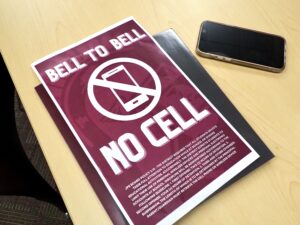
A poster reads, “bell to bell, no cell” at the Jenks Public Schools Math and Science Center on Nov. 13. The school district prohibits student cellphone use during class periods. (Nuria Martinez-Keel/Oklahoam Voice)
As expected, lawmakers filed multiple bills to limit student cellphone use in public schools, an issue that leaders in both chambers of the Legislature have said is a top priority this year.
The House and Senate each have a bill that would prohibit students from using cellphones during the entire school day. Some Oklahoma schools already made this a requirement while others allow cellphone access in between classes.
Senate Bill 139 from Education Committee vice chair Sen. Ally Seifried, R-Claremore, would require all districts to ban students from accessing their cellphones from the morning bell until dismissal, and it would create a $2 million grant program to help schools enact phone-free policies.
Legislation from a House leader on education funding, Rep. Chad Caldwell, R-Enid, would prohibit student cellphone use while on school premises.
Multiple bills target children’s social media use. Sen. Kristen Thompson, R-Edmond, aims to ban social media accounts for anyone under 16 with SB 838 and, with SB 839, to deem social media addictive and dangerous for youth mental health.
A bill from Seifried would outlaw social media companies from collecting data from and personalizing content for a minor’s account, which a child wouldn’t be allowed to have without parent consent
SB 371 from Sen. Micheal Bergstron, R-Adair, would require districts to prohibit the use of social media on school computers or on school-issued devices while on campus. SB 932 from Sen. Darcy Jech, R-Kingfisher, would allow minors or their parents to sue a social media company over an “adverse mental health outcome arising, in whole or in part, from the minor’s excessive use of the social media platform’s algorithmically curated service.”
Its original author, Rep. Kevin West, R-Moore, refiled it as House Bill 1232. Sen. Shane Jett, R-Shawnee, and Sen. Dana Prieto, R-Tulsa, filed similar school chaplain bills with SB 486 and SB 590.
More restrictions suggested for sex education, gender expression
Another unsuccessful bill returning this year is legislation that would have families opt into sex education for their children instead of opting out, which is the state’s current policy.
Students wouldn’t be allowed to take any sex education course or hear a related presentation without written permission from their parents under SB 759 from Prieto, HB 1964 from Danny Williams, R-Seminole, and HB 1998 from Rep. Tim Turner, R-Kinta.
Sen. Dusty Deevers, R-Elgin, would have any reference to sex education and mental health removed from health education in schools with SB 702.
Prieto’s bill also would exclude any instruction about sexual orientation or gender identity from sex education courses. It would require school employees to notify a child’s parents before referring to the student by a different name or pronouns.
Other bills similarly would limit students’ ability to be called by a different name or set of pronouns at school if it doesn’t correspond to their biological sex.
Deevers’ Free to Speak Act would bar teachers from calling students by pronouns other than what aligns with their biological sex or by any name other than their legal name without parent consent. Educators and fellow students could not be punished for calling a child by their legal name and biological pronouns.
Rep. Gabe Woolley, R-Broken Arrow, filed a similar bill.
No public school could compel an employee or volunteer to refer to a student by a name or pronoun other than what corresponds with their sex at birth under SB 847 from Sen. David Bullard, R-Durant, nor could any printed or multimedia materials in a school refer to a student by another gender.
Corporal punishment in schools
Once again, Oklahoma lawmakers will consider whether to outlaw corporal punishment of students with disabilities. State law currently prohibits using physical pain as discipline on children with only the most significant cognitive disabilities.
In 2020, the state Department of Education used its administrative rules to ban corporal punishment on any student with a disability, but similar bills have failed to pass the state Legislature, drawing frustration from child advocates.
Sen. Dave Rader, R-Tulsa, was an author of last year’s bill to prohibit corporal punishment of students with any type of disability. He filed the bill again for consideration this session.
HB 2244 from Rep. John Waldron, D-Tulsa, would require schools to report to the Oklahoma State Department of Education the number of times they administer corporal punishment along with the age, race, gender and disability status of the students receiving it. The state Department of Education would then have to compile the information in a report to the Oklahoma Commission on Children and Youth.
Oklahoma Voice is part of States Newsroom, a nonprofit news network supported by grants and a coalition of donors as a 501c(3) public charity. Oklahoma Voice maintains editorial independence. Contact Editor Janelle Stecklein for questions: [email protected].
Los Angeles, CA — As students navigate an increasingly complex world defined by artificial intelligence, social media, and rapid technological change, the need for essential life skills has never been greater. The Edge, an innovative, research-based social-emotional and life skills curriculum, creates a dynamic and effective learning environment where middle and high school students can build the social-emotional and life-readiness skills needed to succeed in school, relationships, and life.
Designed in collaboration with educators and aligned with the CASEL framework, The Edge is the first curriculum to meet educators’ demands for high-quality instructional materials for SEL and life-skills readiness. The curriculum helps students cultivate communication, problem-solving, and self-awareness, as well as essential life skills like entrepreneurship, negotiation, financial literacy, and networking, to boost their academic abilities.
“The Edge represents a paradigm shift in education,” says Devi Sahny, Founder and CEO of The Edge and Ascend Now. “It’s not just about helping students excel academically—it’s about helping them understand themselves, connect with others, and develop the resilience to face life’s challenges head-on.”
By combining bite-sized lessons with project-based learning, The Edge creates a dynamic and effective learning environment with ready-to-use, adaptable resources educators use to help students develop both hard and soft skills. Its advanced analytics track student progress whilesaving valuable preparation time. Designed to enable educators to adapt as needed, the curriculum is flexible and requires minimal preparation to support all learning environments—asynchronous and synchronous learning, even flipped learning.
Key highlights include:
Integrated Skill Framework: A robust curriculum featuring 5 pillars, 24 essential skills, and 115 modules, blending SEL with employability and life skills such as negotiation, financial literacy, and digital literacy, all aligned with CASEL, ASCA, and global educational standards.
Educator-Friendly Design: With over 1,000 customizable, MTSS-aligned resources, The Edge saves teachers time and effort while allowing them to adapt materials to meet their unique classroom needs.
Hard Skill Development Meets SEL: By engaging in activities like entrepreneurship, critical thinking, and leadership training, students develop technical proficiencies while enhancing communication, empathy, and resilience.
Real-Time Analytics: Advanced data tools provide administrators with actionable insights into student progress, enabling schools and districts to measure outcomes and improve program alignment with educational goals.
Compelling Content.The curriculum features engaging content that integrates the latest insights from learning sciences with professional writing from skilled authors affiliated with SNL, Netflix, and HBO Max. This combination guarantees that the material is educationally solid, relevant, and thought-provoking.
The Edge immerses students in real-life, complex scenarios that challenge them to think critically, collaborate effectively, and apply social-emotional learning (SEL) to everyday situations. For example, one lesson about conflict resolution uses an actual problem that Pixar faced when allocating resources for new movies.
Early adopters of The Edge have reported remarkable results. The Edge was used by rising high school seniors during a three-week summer college immersion program (SCIP) at Georgetown University, which prepares high school students from underserved backgrounds to apply for college. At the end of the program, 94% reported learning important skills, and 84% said they discovered something new about themselves.
ABOUT THE EDGE
The Edge is the latest innovation from Ascend Now US, dba The Edge, a US-based education startup committed to increasing both college and career readiness for all students. Sahny founded The Edge in the US after building and scaling Ascend Now Singapore, which has provided personalized academic and entrepreneurship tutoring to over 10,000 students and 20+ international schools over the last decade.
eSchool Media staff cover education technology in all its aspects–from legislation and litigation, to best practices, to lessons learned and new products. First published in March of 1998 as a monthly print and digital newspaper, eSchool Media provides the news and information necessary to help K-20 decision-makers successfully use technology and innovation to transform schools and colleges and achieve their educational goals.
Social media has connected kids like never before, but what they get in likes and shares, they lose in real, meaningful engagement with their peers and classmates. Lunch hours are spent hunched over smartphones, and after-school time means less sports and more Snapchat.
The adverse effects of this excessive screen time have significantly impacted students’ social- emotional health. Forty-one percent of teens with the highest social media usage struggle with mental health issues, and between 2010 and 2020, anxiety among adolescents skyrocketed by 106 percent.
At Spokane Public Schools (SPS), educators and administrators are reversing the side effects of social media by re-connecting with students through school-based extracurricular activities. Through its transformative Engage IRL (Engage in Real Life) initiative, the district is encouraging kids to get off their devices and onto the pickleball court, into the swimming pool, and outside in the fresh air. With more than 300 clubs and sports to choose from, SPS students are happier, healthier, and less likely to reach for their smartphones.
An innovative approach to student engagement
Even before the pandemic, SPS saw levels of engagement plummet among the student population, especially in school attendance rates, due in part to an increase in mental health issues caused by social media. Rebuilding classroom connections in the era of phone-based childhoods would require district leaders to think big.
“The question was not ‘How do we get kids off their phones?’ but ‘How do we get them engaged with each other more often?’” said Ryan Lancaster, executive director of communications for SPS. “Our intent was to get every kid, every day, involved in something positive outside the school day and extend that community learning past the classroom.”
To meet the district’s goal of creating a caring and connected community, in 2022, school leaders formed a workgroup of parents, community members, coaches, and teachers to take inventory of current extracurriculars at all district schools and identify gaps in meeting students’ diverse interests and hobbies.
Engaging with students was a top priority for workgroup members. “The students were excited to be heard,” explained Nikki Otero Lockwood, SPS board president. “A lot of them wanted an art club. They wanted to play board games and learn to knit. No matter their interests, what they really wanted was to be at school and be connected to others.”
Working with community partners and LaunchNW, an Innovia Foundation initiative focused on helping every child feel a sense of belonging, SPS launched Engage IRL–an ambitious push to turn students’ ideas for fun and fulfillment into real-life, engaging activities.
Over the past two years, Engage IRL has been the catalyst for increasing access and opportunities for K-12 students to participate in clubs, sports, arts activities, and other community events. From the Math is Cool Club and creative writing classes to wrestling and advanced martial arts, kids can find a full range of activities to join through the Elite IRL website. In addition, five engagement navigators in the district help connect families and students to engagement opportunities through individual IRL Plans and work with local organizations to expand programming.
“All day, every day, our navigators are working to break down barriers and tackle challenges to make sure nothing gets in the way of what kids want to be involved in and engaged in,” said Stephanie Splater, executive director of athletics and activities for SPS. “For example, when we didn’t have a coach for one of the schools in our middle school football program, our navigators mobilized for really good candidates in a short amount of time just from their personal outreach.”
In only two years, student engagement in extracurriculars has nearly doubled. Furthermore, according to Lancaster, since the Engage IRL launch, SPS hasn’t experienced a day where it dipped below 90 percent attendance.
“That’s an outlier in the past few years for us, for sure, and we think it’s because kids want to be at school. They want to be engaged and be part of all the cool things we’re doing. We’ve had a really great start to the 2024-2025 school year, and Engage IRL has played a huge role.”
Engage IRL also helped SPS weather student blowback when the district launched a new cell phone policy this year. The policy prohibits cell phone use in elementary and middle school and limits it to lunch and periods between classes for high school students. Because students were already building personal connections with classmates and teachers through Engage IRL, many easily handled social media withdrawal.
Creating opportunities for all kids
Key to Engage IRL’s success was ensuring partnerships and programs were centered in equity, allowing every child to participate regardless of ability, financial or transportation constraints, or language barriers.
Establishing a no-cut policy in athletics by creating additional JV and C teams ensured kids with a passion for sports, but not college-level skills, continued to compete on the court or field. Partnering with Special Olympics also helped SPS build new unified sports programs that gave children with disabilities a chance to play. And engagement navigators are assisting English language learners and their families in finding activities that help them connect with kids in their new country.
For Otero Lockwood, getting her daughter with autism connected to clubs after years of struggling to find school activities has been life-changing.
“There are barriers to finding community for some kids,” she shared. “We know kids with disabilities are more likely to be underemployed as adults and not as connected to the community. This is something we have the power to do that will have a lasting impact on the children we serve.”
Through Engage IRL, SPS has redefined student engagement by expanding access and opportunity to 6,000 students across 58 schools. In just two short years, the district has seen attendance increase, student wellness improve, and dependence on smartphones diminish. By continuing to listen to the needs of students and rallying the community to partner on out-of-school activities, Spokane Public Schools is successfully fostering the face-to-face connections every child needs to thrive.
Sean Duke, Washington State School Directors’ Association
Sean Duke is the communications officer for the Washington State School Directors’ Association, where he has served for over six years.
Latest posts by eSchool Media Contributors (see all)
When
borrowers default on their federal student loans, the U.S. Department
of Education (“Department of Education”) can collect the outstanding
balance through forced collections, including the offset of tax refunds
and Social Security benefits and the garnishment of wages. At the
beginning of the COVID-19 pandemic, the Department of Education paused
collections on defaulted federal student loans.
This year, collections are set to resume and almost 6 million student
loan borrowers with loans in default will again be subject to the
Department of Education’s forced collection of their tax refunds, wages,
and Social Security benefits.
Among the borrowers who are likely to experience forced collections are
an estimated 452,000 borrowers ages 62 and older with defaulted loans
who are likely receiving Social Security benefits.
This
spotlight describes the circumstances and experiences of student loan
borrowers affected by the forced collection of Social Security benefits.
It also describes how forced collections can push older borrowers into
poverty, undermining the purpose of the Social Security program.
Key findings
The
number of Social Security beneficiaries experiencing forced collection
grew by more than 3,000 percent in fewer than 20 years; the count is
likely to grow as the age of student loan borrowers trends older.
Between 2001 and 2019, the number of Social Security beneficiaries
experiencing reduced benefits due to forced collection increased from
approximately 6,200 to 192,300. This exponential growth is likely driven
by older borrowers who make up an increasingly large share of the
federal student loan portfolio. The number of student loan borrowers
ages 62 and older increased by 59 percent from 1.7 million in 2017 to
2.7 million in 2023, compared to a 1 percent decline among borrowers
under the age of 62.
The total amount
of Social Security benefits the Department of Education collected
between 2001 and 2019 through the offset program increased from $16.2
million to $429.7 million. Despite the exponential increase in
collections from Social Security, the majority of money the Department
of Education has collected has been applied to interest and fees and has
not affected borrowers’ principal amount owed. Furthermore, between
2016 and 2019, the Department of the Treasury’s fees alone accounted for
nearly 10 percent of the average borrower’s lost Social Security
benefits.
More than one in three
Social Security recipients with student loans are reliant on Social
Security payments, meaning forced collections could significantly
imperil their financial well-being. Approximately 37 percent of the
1.3 million Social Security beneficiaries with student loans rely on
modest payments, an average monthly benefit of $1,523, for 90 percent of
their income. This population is particularly vulnerable to reduction
in their benefits especially if benefits are offset year-round. In 2019,
the average annual amount collected from individual beneficiaries was
$2,232 ($186 per month).
The physical well-being of half of Social Security beneficiaries with student loans in default may be at risk.
Half of Social Security beneficiaries with student loans in default and
collections skipped a doctor’s visit or did not obtain prescription
medication due to cost.
Existing minimum income protections fail to protect student loan borrowers with Social Security against financial hardship.
Currently, only $750 per month of Social Security income—an amount that
is $400 below the monthly poverty threshold for an individual and has
not been adjusted for inflation since 1996—is protected from forced
collections by statute. Even if the minimum protected income was
adjusted for inflation, beneficiaries would likely still experience
hardship, such as food insecurity and problems paying utility bills. A
higher threshold could protect borrowers against hardship more
effectively. The CFPB found that for 87 percent of student loan
borrowers who receive Social Security, their benefit amount is below 225
percent of the federal poverty level (FPL), an income level at which
people are as likely to experience material hardship as those with
incomes below the federal poverty level.
Large
shares of Social Security beneficiaries affected by forced collections
may be eligible for relief or outright loan cancellation, yet they are
unable to access these benefits, possibly due to insufficient
automation or borrowers’ cognitive and physical decline. As many as
eight in ten Social Security beneficiaries with loans in default may be
eligible to suspend or reduce forced collections due to financial
hardship. Moreover, one in five Social Security beneficiaries may be
eligible for discharge of their loans due to a disability. Yet these
individuals are not accessing such relief because the Department of
Education’s data matching process insufficiently identifies those who
may be eligible.
Taken together,
these findings suggest that the Department of Education’s forced
collections of Social Security benefits increasingly interfere with
Social Security’s longstanding purpose of protecting its beneficiaries
from poverty and financial instability.
Introduction
When
borrowers default on their federal student loans, the Department of
Education can collect the outstanding balance through forced
collections, including the offset of tax refunds and Social Security
benefits, and the garnishment of wages. At the beginning of the COVID-19
pandemic, the Department of Education paused collections on defaulted
federal student loans. This year, collections are set to resume and
almost 6 million student loan borrowers with loans in default will again
be subject to the Department of Education’s forced collection of their
tax refunds, wages, and Social Security benefits.
Among
the borrowers who are likely to experience the Department of
Education’s renewed forced collections are an estimated 452,000
borrowers with defaulted loans who are ages 62 and older and who are
likely receiving Social Security benefits.
Congress created the Social Security program in 1935 to provide a basic
level of income that protects insured workers and their families from
poverty due to situations including old age, widowhood, or disability.
The Social Security Administration calls the program “one of the most
successful anti-poverty programs in our nation’s history.”
In 2022, Social Security lifted over 29 million Americans from poverty,
including retirees, disabled adults, and their spouses and dependents.
Congress has recognized the importance of securing the value of Social
Security benefits and on several occasions has intervened to protect
them.
This
spotlight describes the circumstances and experiences of student loan
borrowers affected by the forced collection of their Social Security
benefits.
It also describes how the purpose of Social Security is being
increasingly undermined by the limited and deficient options the
Department of Education has to protect Social Security beneficiaries
from poverty and hardship.
The forced collection of Social Security benefits has increased exponentially.
Federal
student loans enter default after 270 days of missed payments and
transfer to the Department of Education’s default collections program
after 360 days. Borrowers with a loan in default face several
consequences: (1) their credit is negatively affected; (2) they lose
eligibility to receive federal student aid while their loans are in
default; (3) they are unable to change repayment plans and request
deferment and forbearance; and (4) they face forced collections of tax refunds, Social Security benefits, and wages among other payments.
To conduct its forced collections of federal payments like tax refunds
and Social Security benefits, the Department of Education relies on a
collection service run by the U.S. Department of the Treasury called the
Treasury Offset Program.
Between
2001 and 2019, the number of student loan borrowers facing forced
collection of their Social Security benefits increased from at least
6,200 to 192,300.
That is a more than 3,000 percent increase in fewer than 20 years. By
comparison, the number of borrowers facing forced collections of their
tax refunds increased by about 90 percent from 1.17 million to 2.22
million during the same period.
This exponential growth of Social Security offsets between 2001 and 2019 is likely driven by multiple factors including:
Older
borrowers accounted for an increasingly large share of the federal
student loan portfolio due to increasing average age of enrollment and
length of time in repayment. Data from the Department of Education
(which is only available since 2017), show that the number of student
loan borrowers ages 62 and older, increased 24 percent from 1.7 million
in 2017 to 2.1 million in 2019, compared to less than 1 percent among
borrowers under the age of 62.
A larger number of borrowers, especially older borrowers, had loans in default.
Data from the Department of Education show that the number of student
loan borrowers with a defaulted loan increased by 230 percent from 3.8
million in 2006 to 8.8 million in 2019. Compounding these trends is the fact that older borrowers are twice as likely to have a loan in default than younger borrowers.
Due
to these factors, the total amount of Social Security benefits the
Department of Education collected between 2001 and 2019 through the
offset program increased annually from $16.2 million to $429.7 million
(when adjusted for inflation).
This increase occurred even though the average monthly amount the
Department of Education collected from individual beneficiaries was the
same for most years, at approximately $180 per month.
Figure 1: Number of Social Security beneficiaries and total amount collected for student loans (2001-2019)
Source: CFPB analysis of public data from U.S. Treasury’s Fiscal Data portal. Amounts are presented in 2024 dollars.
While the total collected from
Social Security benefits has increased exponentially, the majority of
money the Department of Education collected has not been applied to
borrowers’ principal amount owed. Specifically, nearly three-quarters of
the monies the Department of Education collects through offsets is
applied to interest and fees, and not towards paying down principal
balances.
Between 2016 and 2019, the U.S. Department of the Treasury charged the
Department of Education between $13.12 and $15.00 per Social Security
offset, or approximately between $157.44 and $180 for 12 months of
Social Security offsets per beneficiary with defaulted federal student
loans. As a matter of practice, the Department of Education often passes these fees on directly to borrowers.
Furthermore, these fees accounted for nearly 10 percent of the average
monthly borrower’s lost Social Security benefits which was $183 during
this time.
Interest and fees not only reduce beneficiaries’ monthly benefits, but
also prolong the period that beneficiaries are likely subject to forced
collections.
Forced collections are compromising Social Security beneficiaries’ financial well-being.
Forced
collection of Social Security benefits affects the financial well-being
of the most vulnerable borrowers and can exacerbate any financial and
health challenges they may already be experiencing. The CFPB’s analysis
of the Survey of Income and Program Participation (SIPP) pooled data for
2018 to 2021 finds that Social Security beneficiaries with student
loans receive an average monthly benefit of $1,524.
The analysis also indicates that approximately 480,000 (37 percent) of
the 1.3 million beneficiaries with student loans rely on these modest
payments for 90 percent or more of their income,
thereby making them particularly vulnerable to reduction in their
benefits especially if benefits are offset year-round. In 2019, the
average annual amount collected from individual beneficiaries was $2,232
($186 per month).
A
recent survey from The Pew Charitable Trusts found that more than nine
in ten borrowers who reported experiencing wage garnishment or Social
Security payment offsets said that these penalties caused them financial
hardship.
Consequently, for many, their ability to meet their basic needs,
including access to healthcare, became more difficult. According to our
analysis of the Federal Reserve’s Survey of Household Economic and
Decision-making (SHED), half of Social Security beneficiaries with
defaulted student loans skipped a doctor’s visit and/or did not obtain
prescription medication due to cost.
Moreover, 36 percent of Social Security beneficiaries with loans in
delinquency or in collections report fair or poor health. Over half of
them have medical debt.
Figure 2: Selected financial experiences and hardships among subgroups of loan borrowers
Source: CFPB analysis of the Federal Reserve Board Survey of Household Economic and Decision-making (2019-2023).
Social Security recipients
subject to forced collection may not be able to access key public
benefits that could help them mitigate the loss of income. This is
because Social Security beneficiaries must list the unreduced amount of
their benefits prior to collections when applying for other means-tested
benefits programs such as Social Security Insurance (SSI), Supplemental
Nutrition Assistance Program (SNAP), and the Medicare Savings Programs.
Consequently, beneficiaries subject to forced collections must report
an inflated income relative to what they are actually receiving. As a
result, these beneficiaries may be denied public benefits that provide
food, medical care, prescription drugs, and assistance with paying for
other daily living costs.
Consumers’
complaints submitted to the CFPB describe the hardship caused by forced
collections on borrowers reliant on Social Security benefits to pay for
essential expenses.
Consumers often explain their difficulty paying for such expenses as
rent and medical bills. In one complaint, a consumer noted that they
were having difficulty paying their rent since their Social Security
benefit usually went to paying that expense.
In another complaint, a caregiver described that the money was being
withheld from their mother’s Social Security, which was the only source
of income used to pay for their mother’s care at an assisted living
facility.
As forced collections threaten the housing security and health of
Social Security beneficiaries, they also create a financial burden on
non-borrowers who help address these hardships, including family members
and caregivers.
Existing minimum income protections fail to protect student loan borrowers with Social Security against financial hardship.
The
Debt Collection Improvement Act set a minimum floor of income below
which the federal government cannot offset Social Security benefits and
subsequent Treasury regulations established a cap on the percentage of
income above that floor.
Specifically, these statutory guardrails limit collections to 15
percent of Social Security benefits above $750. The minimum threshold
was established in 1996 and has not been updated since. As a result, the
amount protected by law alone does not adequately protect beneficiaries
from financial hardship and in fact no longer protects them from
falling below the federal poverty level (FPL). In 1996, $750 was nearly
$100 above the monthly poverty threshold for an individual.
Today that same protection is $400 below the threshold. If the
protected amount of $750 per month ($9,000 per year) set in 1996 was
adjusted for inflation, in 2024 dollars, it would total $1,450 per month
($17,400 per year).
Figure
3: Comparison of monthly FPL threshold with the current protected
amount established in 1996 and the amount that would be protected with
inflation adjustment
Source: Calculations by the CFPB. Notes: Inflation adjustments based on the consumer price index (CPI).
Even if the minimum protected
income of $750 is adjusted for inflation, beneficiaries will likely
still experience hardship as a result of their reduced benefits.
Consumers with incomes above the poverty line also commonly experience
material hardship. This suggests that a threshold that is higher than the poverty level will more effectively protect against hardship.
Indeed, in determining an income threshold for $0 payments under the
SAVE plan, the Department of Education researchers used material
hardship (defined as being unable to pay utility bills and reporting
food insecurity) as their primary metric, and found similar levels of
material hardship among those with incomes below the poverty line and
those with incomes up to 225 percent of the FPL.
Similarly, the CFPB’s analysis of a pooled sample of SIPP respondents
finds the same levels of material hardship for Social Security
beneficiaries with student loans with incomes below 100 percent of the
FPL and those with incomes up to 225 percent of the FPL.
The CFPB found that for 87 percent of student loan borrowers who
receive Social Security, their benefit amount is below 225 percent of
the FPL.
Accordingly, all of those borrowers would be removed from forced
collections if the Department of Education applied the same income
metrics it established under the SAVE program to an automatic hardship
exemption program.
Existing options for relief from forced collections fail to reach older borrowers.
Borrowers
with loans in default remain eligible for certain types of loan
cancellation and relief from forced collections. However, our analysis
suggests that these programs may not be reaching many eligible
consumers. When borrowers do not benefit from these programs, their
hardship includes, but is not limited to, unnecessary losses to their
Social Security benefits and negative credit reporting.
Borrowers who become disabled after reaching full retirement age may miss out on Total and Permanent Disability
The
Total and Permanent Disability (TPD) discharge program cancels federal
student loans and effectively stops all forced collections for disabled
borrowers who meet certain requirements. After recent revisions to the
program, this form of cancelation has become common for those borrowers
with Social Security who became disabled prior to full retirement age. In 2016, a GAO study documented the significant barriers to TPD that Social Security beneficiaries faced.
To address GAO’s concerns, the Department of Education in 2021 took a
series of mitigating actions, including entering into a data-matching
agreement with the Social Security Administration (SSA) to automate the
TPD eligibility determination and discharge process.
This process was expanded further with new final rules being
implemented July 1, 2023 that expanded the categories of borrowers
eligible for automatic TPD cancellation. In total, these changes successfully resulted in loan cancelations for approximately 570,000 borrowers.
However,
the automation and other regulatory changes did not significantly
change the application process for consumers who become disabled after
they reach full retirement age or who have already claimed the Social
Security retirement benefits. For these beneficiaries, because they are
already receiving retirement benefits, SSA does not need to determine
disability status. Likewise, SSA does not track disability status for
those individuals who become disabled after they start collecting their
Social Security retirement benefits.
Consequently,
SSA does not transfer information on disability to the Department of
Education once the beneficiary begins collecting Social Security
retirement.
These individuals therefore will not automatically get a TPD discharge
of their student loans, and they must be aware and physically and
mentally able to proactively apply for the discharge.
The
CFPB’s analysis of the Census survey data suggests that the population
that is excluded from the TPD automation process could be substantial.
More than one in five (22 percent) Social Security beneficiaries with
student loans are receiving retirement benefits and report a disability
such as a limitation with vision, hearing, mobility, or cognition.
People with dementia and other cognitive disabilities are among those
with the greatest risk of being excluded, since they are more likely to
be diagnosed after the age 70, which is the maximum age for claiming
retirement benefits.
These
limitations may also help explain why older borrowers are less likely
to rehabilitate their defaulted student loans. Specifically, 11 percent
of student loan borrowers ages 50 to 59 facing forced collections
successfully rehabilitated their loans, while only five percent of borrowers over the age of 75 do so.
Figure
4: Number of student loan borrowers ages 50 and older in forced
collection, borrowers who signed a rehabilitation agreement, and
borrowers who successfully rehabilitated a loan by selected age groups
Age Group
Number of Borrowers in Offset
Number of Borrowers Who Signed a Rehabilitation Agreement
Percent of Borrowers Who Signed a Rehabilitation Agreement
Number of Borrowers Successfully Rehabilitated
Percent of Borrowers who Successfully Rehabilitated
50 to 59
265,200
50,800
14%
38,400
11%
60 to 74
184,900
24,100
11%
18,500
8%
75 and older
15,800
1,000
6%
800
5%
Source: CFPB analysis of data provided by the Department of Education.
Shifting demographics of
student loan borrowers suggest that the current automation process may
become less effective to protect Social Security benefits from forced
collections as more and more older adults have student loan debt. The
fastest growing segment of student loan borrowers are adults ages 62 and
older. These individuals are generally eligible for retirement
benefits, not disability benefits, because they cannot receive both
classifications at the same time. Data from the Department of Education
reflect that the number of student loan borrowers ages 62 and older
increased by 59 percent from 1.7 million in 2017 to 2.7 million in 2023.
In comparison, the number of borrowers under the age of 62 remained
unchanged at 43 million in both years.
Furthermore, additional data provided to the CFPB by the Department of
Education show that nearly 90,000 borrowers ages 81 and older hold an
average amount of $29,000 in federal student loan debt, a substantial
amount despite facing an estimated average life expectancy of less than
nine years.
Existing exceptions to forced collections fail to protect many Social Security beneficiaries
In
addition to TPD discharge, the Department of Education offers reduction
or suspension of Social Security offset where borrowers demonstrate
financial hardship.
To show hardship, borrowers must provide documentation of their income
and expenses, which the Department of Education then uses to make its
determination.
Unlike the Debt Collection Improvement Act’s minimum protections, the
eligibility for hardship is based on a comparison of an individual’s
documented income and qualified expenses. If the borrower has eligible
monthly expenses that exceed or match their income, the Department of
Education then grants a financial hardship exemption.
The
CFPB’s analysis suggests that the vast majority of Social Security
beneficiaries with student loans would qualify for a hardship
protection. According to CFPB’s analysis of the Federal Reserve Board’s
SHED, eight in ten (82 percent) of Social Security beneficiaries with
student loans in default report that their expenses equal or exceed
their income.
Accordingly, these individuals would likely qualify for a full
suspension of forced collections. Yet the GAO found that in 2015 (when
the last data was available) less than ten percent of Social Security
beneficiaries with forced collections applied for a hardship exemption
or reduction of their offset.
A possible reason for the low uptake rate is that many beneficiaries or
their caregivers never learn about the hardship exemption or the
possibility of a reduction in the offset amount.
For those that do apply, only a fraction get relief. The GAO study
found that at the time of their initial offset, only about 20 percent of
Social Security beneficiaries ages 50 and older with forced collections
were approved for a financial hardship exemption or a reduction of the
offset amount if they applied.
Conclusion
As
hundreds of thousands of student loan borrowers with loans in default
face the resumption of forced collection of their Social Security
benefits, this spotlight shows that the forced collection of Social
Security benefits causes significant hardship among affected borrowers.
The spotlight also shows that the basic income protections aimed at
preventing poverty and hardship among affected borrowers have become
increasingly ineffective over time. While the Department of Education
has made some improvements to expand access to relief options,
especially for those who initially receive Social Security due to a
disability, these improvements are insufficient to protect older adults
from the forced collection of their Social Security benefits.
Taken
together, these findings suggest that forced collections of Social
Security benefits increasingly interfere with Social Security’s
longstanding purpose of protecting its beneficiaries from poverty and
financial instability. These findings also suggest that alternative
approaches are needed to address the harm that forced collections cause
on beneficiaries and to compensate for the declining effectiveness of
existing remedies. One potential solution may be found in the Debt
Collection Improvement Act, which provides that when forced collections
“interfere substantially with or defeat the purposes of the payment
certifying agency’s program” the head of an agency may request from the
Secretary of the Treasury an exemption from forced collections.
Given the data findings above, such a request for relief from the
Commissioner of the Social Security Administration on behalf of Social
Security beneficiaries who have defaulted student loans could be
justified. Unless the toll of forced collections on Social Security
beneficiaries is considered alongside the program’s stated goals, the
number of older adults facing these challenges is only set to grow.
Data and Methodology
To
develop this report, the CFPB relied primarily upon original analysis
of public-use data from the U.S. Census Bureau Survey of Income and
Program Participation (SIPP), the Federal Reserve Board Board’s Survey
of Household Economics and Decision-making (SHED), U.S. Department of
the Treasury, Fiscal Data portal, consumer complaints received by the
Bureau, and administrative data on borrowers in default provided by the
Department of Education. The report also leverages data and findings
from other reports, studies, and sources, and cites to these sources
accordingly. Readers should note that estimates drawn from survey data
are subject to measurement error resulting, among other things, from
reporting biases and question wording.
Survey of Income and Program Participation
The
Survey of Income and Program Participation (SIPP) is a nationally
representative survey of U.S. households conducted by the U.S. Census
Bureau. The SIPP collects data from about 20,000 households (40,000
people) per wave. The survey captures a wide range of characteristics
and information about these households and their members. The CFPB
relied on a pooled sample of responses from 2018, 2019, 2020, and 2021
waves for a total number of 17,607 responses from student loan borrowers
across all waves, including 920 respondents with student loans
receiving Social Security benefits. The CFPB’s analysis relied on the
public use data. To capture student loan debt, the survey asked to all
respondents (variable EOEDDEBT): Owed any money for student loans or
educational expenses in own name only during the reference period. To
capture receipt of Social Security benefits, the survey asked to all
respondents (variable ESSSANY): “Did … receive Social Security
benefits for himself/herself at any time during the reference period?”
To capture amount of Social Security benefits, the survey asked to all
respondents (variable TSSSAMT): “How much did … receive in Social
Security benefit payment in this month (1-12), prior to any deductions
for Medicare premiums?”
The
Federal Reserve Board’s Survey of Household Economics and
Decision-making (SHED) is an annual web-based survey of households. The
survey captures information about respondents’ financial situations. The
CFPB relied on a pooled sample of responses from 2019 through 2023
waves for a total number of 1,376 responses from student loan borrowers
in collection across all waves. The CFPB analysis relied on the public
use data. To capture default and collection, the survey asked all
respondents with student loans (variable SL6): “Are you behind on
payments or in collections for one or more of the student loans from
your own education?” To capture receipt of Social Security benefits, the
survey asked to all respondents (variable I0_c): “In the past 12
months, did you (and/or your spouse or partner) receive any income from
the following sources: Social Security (including old age and DI)?”
by Márton Demeter, Manuel Goyanes, Gergő Háló and Xin Xu
The dynamics of Chinese social sciences are shifting rapidly. As policies aim to balance domestic priorities with global integration, the interplay between China’s academic output and its international reception highlights critical challenges and opportunities. In a recent study published in Policy Reviews in Higher Education, we analyzed 8,962 publications by the top 500 most productive China-affiliated scholars in Economics, Education, and Political Science between 2016 and 2020.
Uneven impacts across disciplines
Our analysis reveals that most Chinese-authored works in these disciplines are published in Western-edited journals. Political Science publications often focus on China-specific topics, creating what may be interpreted as intellectual silos.
By contrast, Economics stands out for its significant global impact, with Chinese scholars’ publications frequently outpacing the citation rates of their Western peers. Meanwhile, Education and Political Science publications from China generally attract fewer citations compared to those from the U.S., U.K., and Germany.
Why does Economics perform so well? The field’s emphasis on data-driven, globally relevant research – addressing topics like economic policy, market dynamics, and financial crises – positions it effectively within international discourse. Substantial funding and resources further strengthen Economics’ visibility and impact.
In contrast, Education often highlights region-specific practices that may resonate less with a global audience, while Political Science is constrained by political sensitivities and limited opportunities for broad international collaboration.
Patterns of collaboration
Collaboration offers another perspective of Chinese academia’s strengths and limitations. Scholars in Economics and Education often engage in diverse partnerships, with strong connections to both Western and Asian institutions. In contrast, Political Science remains more insular, with most co-authorships occurring within mainland China. This inward focus may restrict the field’s integration into global academic conversations.
At an institutional level, hybrid collaborations – combining domestic and international partnerships – highlight China’s strategic approach to bridging local and global aspirations. However, the predominance of Western collaborators, particularly from the United States, underscores a continued reliance on established academic hubs.
The duality of “siloed internationalisation”
A significant finding of our study is the duality evident in Political Science research: while these publications often appear in international journals, their focus on China-specific issues reflects a form of “scientific nationalism”. This approach limits their global engagement, confining them to niche scholarly communities rather than positioning them as contributors to broader, international dialogues.
The “international in format but national in essence” approach underscores a broader challenge for Chinese academia. It must navigate the tension between adhering to global visibility standards while championing non-Western perspectives and priorities.
Policy and practical implications
Our findings also carry critical implications for policymakers, institutions, and global academic networks. For China, fostering more diverse collaborations – beyond traditional Western partners – can reduce overreliance on dominant paradigms and contribute to a more equitable global knowledge production system. Initiatives with an emphasis on partnerships with Asia-Pacific, Africa, and Eastern Europe, could play a key role in reshaping these dynamics.
We believe that, for the global academic community, greater inclusivity requires deliberate efforts to decenter Western paradigms. Platforms that ensure equitable participation and strategies to protect collaborations from geopolitical tensions are vital for sustaining open and impactful scientific exchange.
Looking forward
The field of Economics exemplifies how targeted investment and international integration can amplify visibility and impact. To replicate this success in Education and Political Science, expanding international collaboration and addressing thematic silos are essential. At the same time, global academic networks must also embrace diverse perspectives to ensure that voices from regions like China enrich rather than merely adapt to dominant discourses.
Importantly, in an era of geopolitical uncertainty, research can serve as a vital conduit for mutual understanding and collaboration. By prioritising equitable partnerships and sustaining global dialogue, we can work toward a more inclusive and, therefore, more resilient academic ecosystem.
Our study offers practical guidance for addressing the challenges of internationalization in Chinese social sciences, providing valuable tools for scholars, institutions, and policymakers working to advance global knowledge production.
For more details, explore our full paper:
Demeter, M, Goyanes, M. Háló, G and Xu, X (2024) ‘The Internationalisation of Chinese Social Sciences Research: Publication, Collaboration, and Citation Patterns in Economics, Education, and Political Science’ https://doi.org/10.1080/23322969.2024.2438240.
Márton Demeter is a Full Professor at the University of Public Service, Budapest at the Department of Social Communication, and he is the Head of Department for Science Strategy. He has extensively published on academic knowledge production in communication studies and beyond.
Manuel Goyanes serves as Associate Professor of Research Methods at Universidad Carlos III de Madrid. His interdisciplinary work revolves around theoretically designing, and empirically testing, cutting-edge quantitative and qualitative methodological procedures to scientifically address challenging aspects of social science inquiry
Gergő Háló, an assistant professor at the National University of Public Service Budapest, specialises in socio-critical studies of geopolitical and gender inequalities in science, academic performance, research assessment frameworks, and higher education policies.
Xin Xu is a Departmental Lecturer in Higher/Tertiary Education at the Department of Education, University of Oxford, and the deputy director of the Centre for Skills, Knowledge, and Organisational Performance (SKOPE). Her research focuses on tertiary education and the research on research.
The following free social skills worksheets are designed to help children, people with learning disabilities, clients, and even adults to actively reflect on their skills in social situations.
The worksheets cover various scenarios and sub-skills, including:
Conversation starters
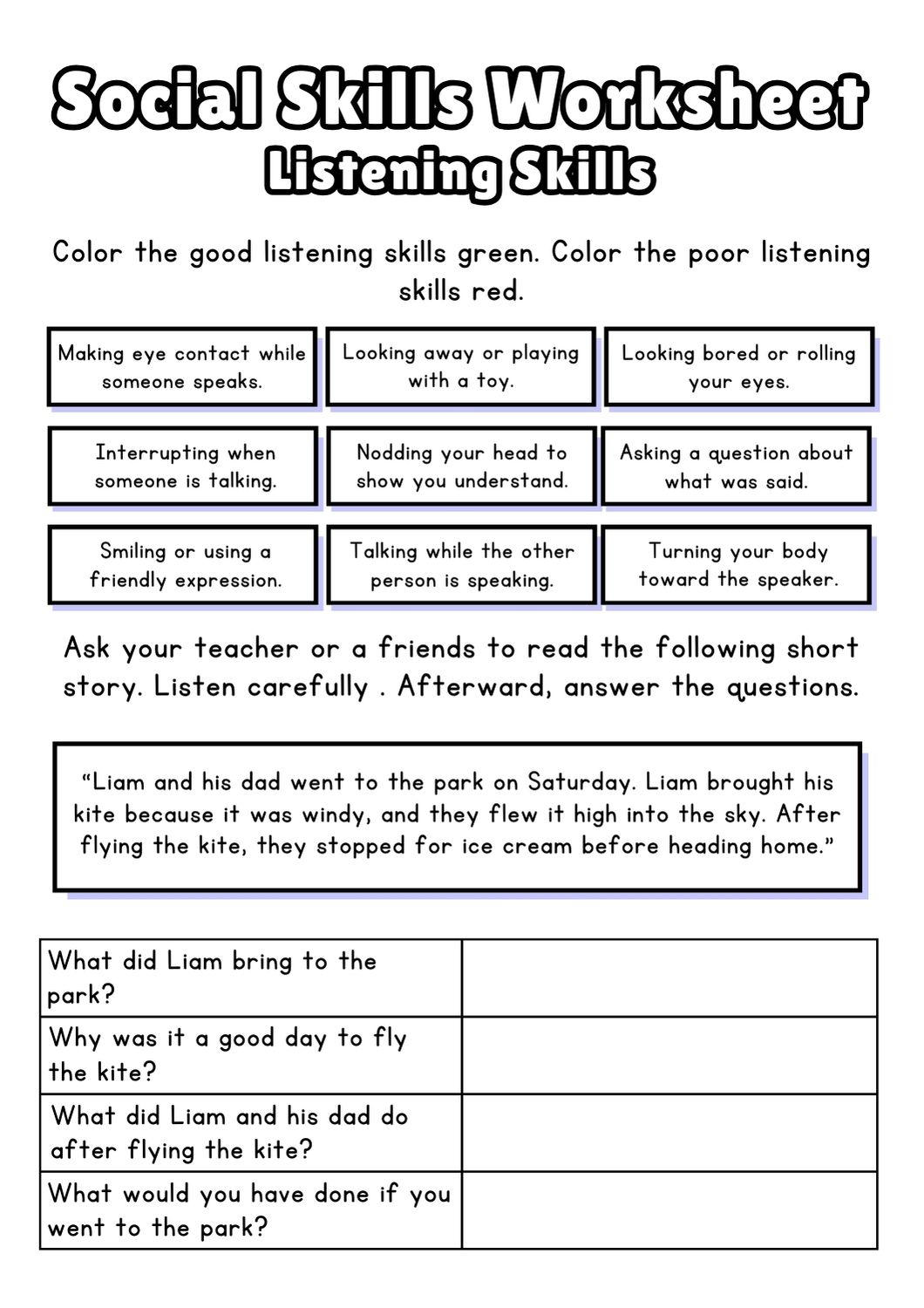
Listening skills
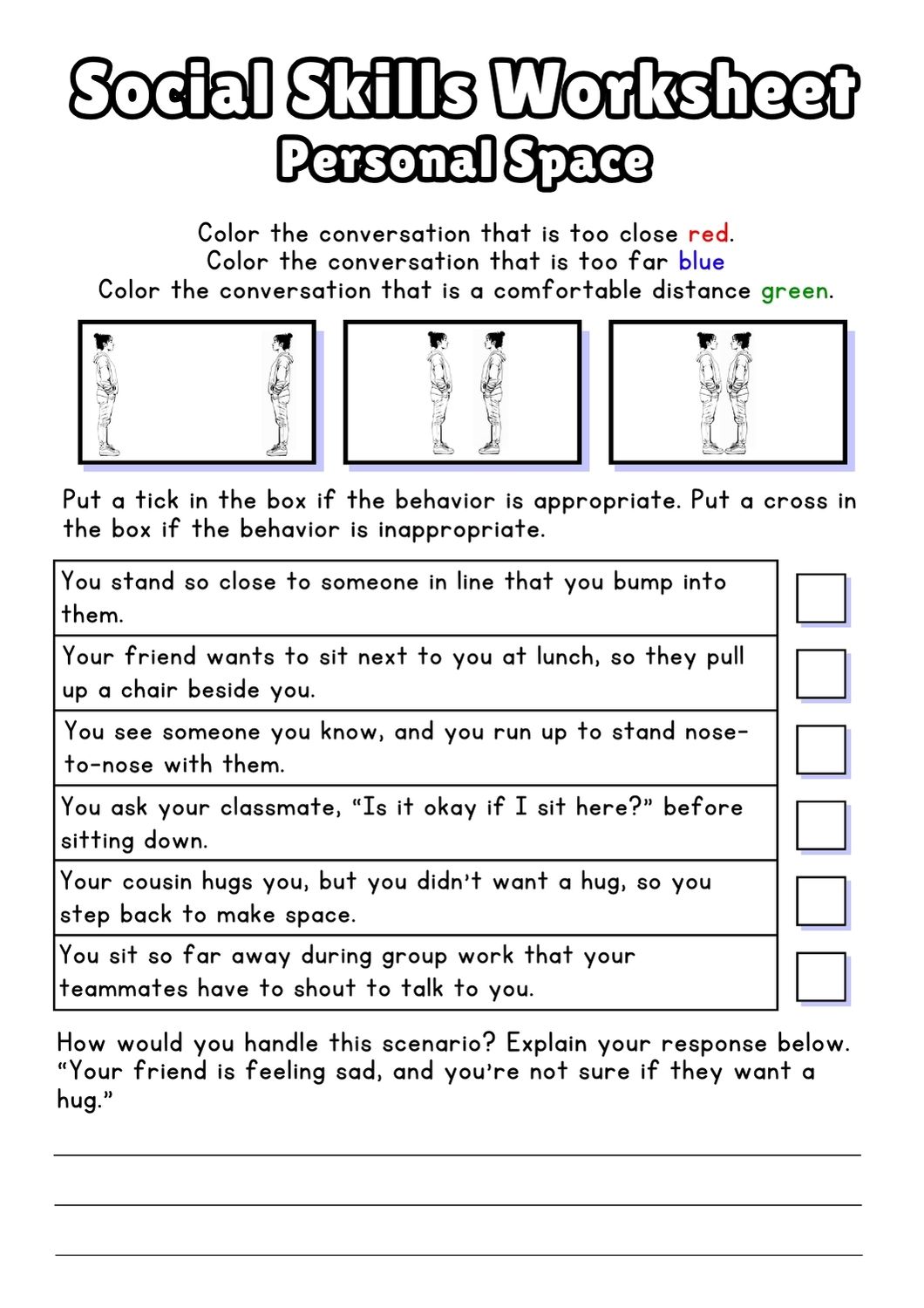
Personal space
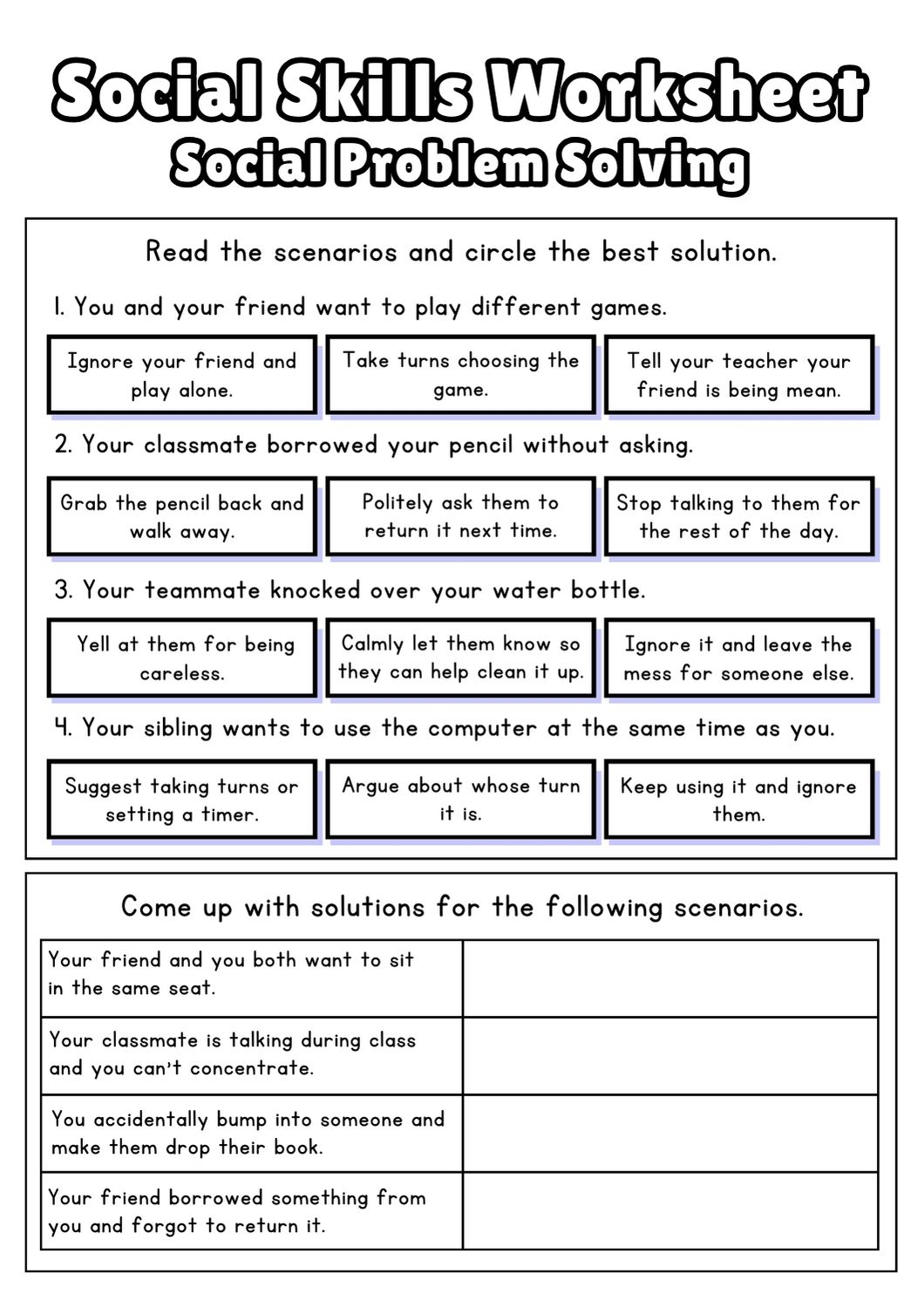
Social problem-solving
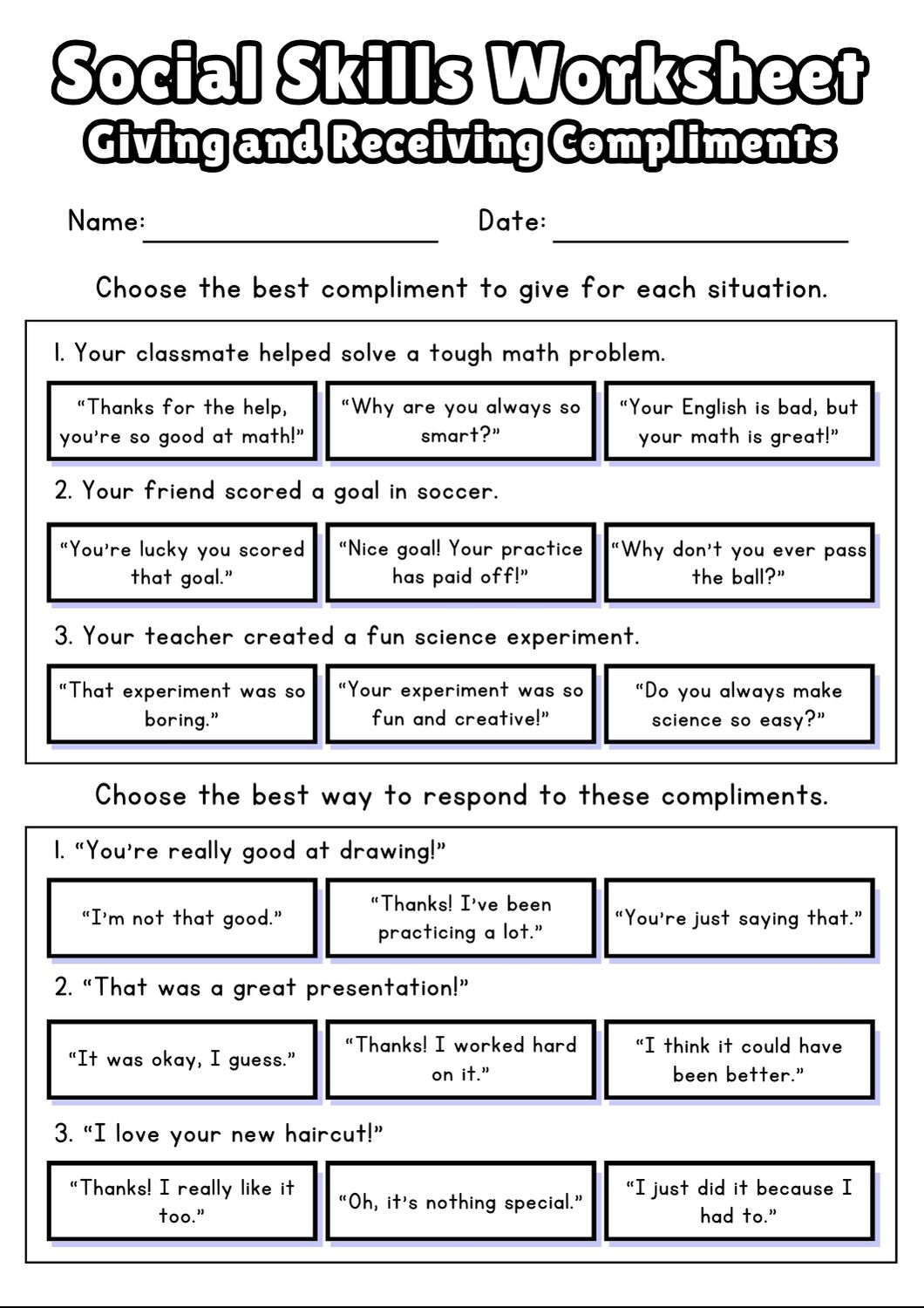
Giving and receiving compliments
When printing, you might want to select “shrink to fit” to ensure an optimal output.
License and Terms of Use: All printables are provided for non-commercial personal and classroom use only, not for resale or distribution. All rights reserved.
Social Skills Worksheets
Designed by Chris
Conversation Starters Worksheet
Use this version for getting students to actively reflect on how to start a conversation and interact appropriately with others verbally.
Designed by Chris
Listening Skills Worksheet
Use this version to get students to think about active listening skills and brainstorm the best ways to respond to people when listening to them in order to absorb what they’re saying.
Designed by Chris
Personal Space Worksheet
Use this version to help people to understand how to give people personal space and maintain an appropriate distance in various social situations.
Designed by Chris
Social Problem Solving Worksheet
This version is ideal for helping people to deal with scenarios where someone may lose their temper. The scenarios discuss various appropriate ways to respond to potentially hairy situations.
Designed by Chris
Giving and Receiving Compliments
Use this piece to brainstorm ways to give and receive compliments in various situations. Students must sort between various potential responses to compliment and ways to give compliments.
Designed by Chris
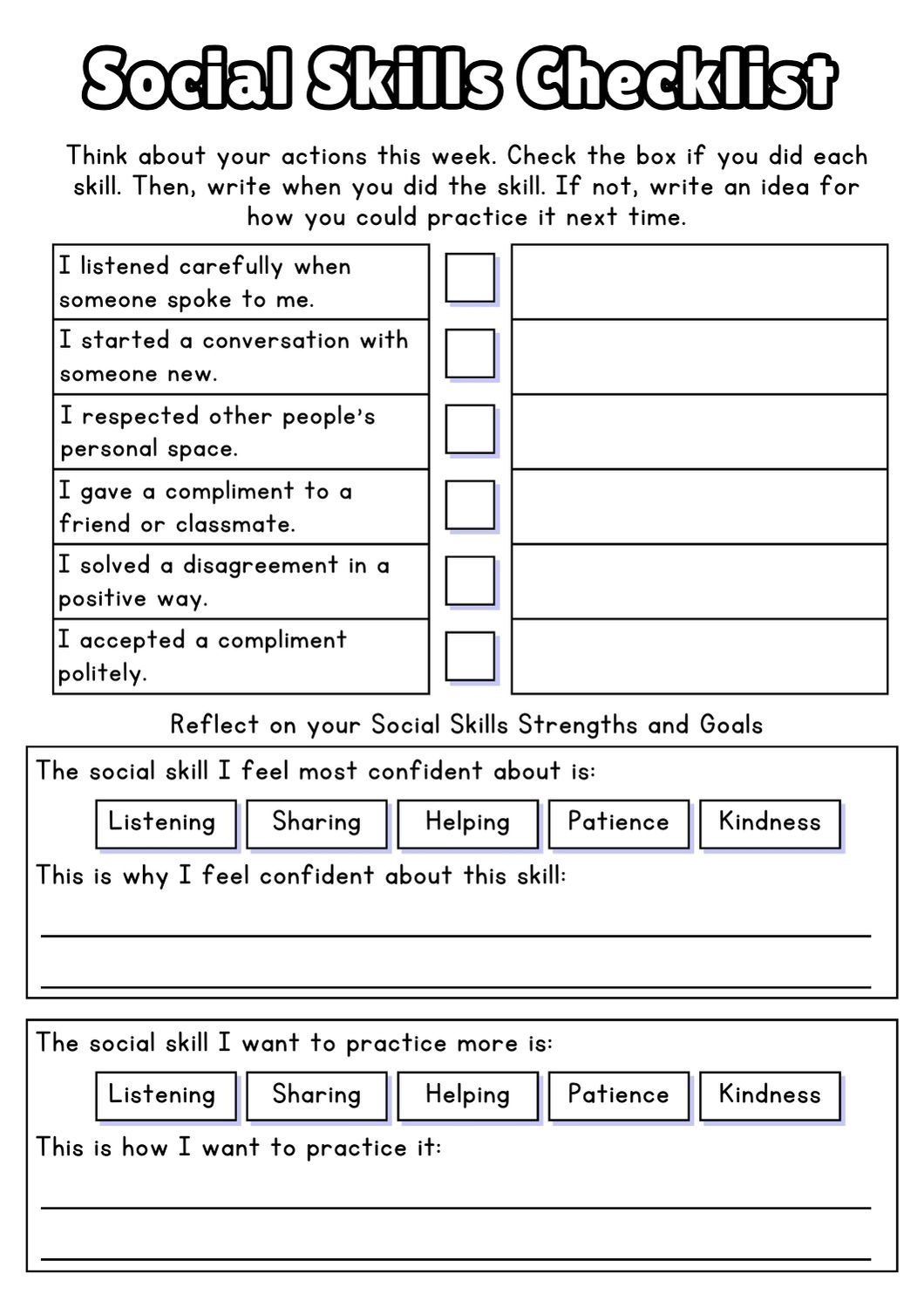
Social Skills Checklist
This checklist gets students to reflect on social skills they’ve used in the past week, and then to think about their strengths and areas for improvement.
Thanks for checking out these worksheets. If you want to brainstorm different examples of social skills, read this blog post.
Dr. Chris Drew is the founder of the Helpful Professor. He holds a PhD in education and has published over 20 articles in scholarly journals. He is the former editor of the Journal of Learning Development in Higher Education. [Image Descriptor: Photo of Chris]
This year, FIRE launched the Free Speech Dispatch, a regular series covering new and continuing censorship trends and challenges around the world. Our goal is to help readers better understand the global context of free expression. The previousentries covered policing of online speech, assassination attempts on U.S. soil, and more. Want to make sure you don’t miss an update? Sign up for our newsletter.
One step forward, two steps back for Australia
(Mojahid Mottakin / Shutterstock.com)
Communications Minister Michelle Rowland confirmed there was “no pathway to legislate” the government’s controversial plans to require platforms to moderate “misinformation.” In other words, the legislation is effectively dead. The bill, which I covered in a previous Dispatch, defined misinformation as “reasonably verifiable as false, misleading, or deceptive” and “likely to cause or contribute to serious harm.” There are many free speech concerns that arise when the government grants itself the power to require moderation of speech it deems untrue.
But while Australia’s troubling misinformation legislation failed, another worrying bill sailed forward. Late last month, Australia passed the Social Media Minimum Age bill, legislation banning social media for children under the age of 16 that does not even allow for parent permission, despite the myriad threats it poses to free speech and privacy.
Australia isn’t the only country considering measures limiting youth access to social media. Here in the United States, the Kids Online Safety Act — which suffers from numerous First Amendment pitfalls — risks passage in Congress. Advocates and legislators have even pushed for bills similar to Australia’s that would wholesale stop American teens from accessing social media sites.
UK adds blasphemy to its mounting free speech woes
WATCH VIDEO: Free nations don’t have blasphemy laws. The UK needs to tread carefully.
Once again, the UK is making headlines — the bad kind. The reason this time? Late last month, Member of Parliament Tahir Ali called on UK Prime Minister Keir Starmer to lead “measures to prohibit the desecration of all religious texts and the prophets of the Abrahamic religions.”
There’s a term for that: a blasphemy law.
The UK’s relationship with free expression is currently in a free fall and the last thing it needs right now is more forms of expression to police. Blasphemy laws are often packaged and promoted in language about protecting the powerless but, as countlessrecentarrestsandprosecutionsmakeclear, are regularly wielded as a tool to preserve power, whether religious, political, or somewhere in between.
Ali’s advocacy of a blasphemy law is deeply wrong-headed, but he is far from the only one to think it might be a worthy venture. Last year, in response to a spate of Quran burning incidents, the United Nations Human Rights Council passed a resolution encouraging more countries to “address, prevent and prosecute acts and advocacy of religious hatred” — a nebulous concept prone to abuse — and months later, Denmark enacted such a law.
That wasn’t even the only blasphemy-related story to emerge this month out of the UK. In November, the Advertising Standards Authority banned comedian Fern Brady from using an advertisement for her stand-up tour that comically depicted Brady in place of the Virgin Mary in a riff on Alonso Cano’s 17th century painting, “St. Bernard and the Virgin.” In its decision, the ASA alleged that the image could cause “serious offence” to Christians, and directed her to avoid causing insult “on the grounds of religions” again.
An investigation from Legal Initiatives for Vietnam discovered a shockingly high 90% compliance rate from companies including Meta, Google, and TikTok in response to government requests for content moderation, often of material critical of the government. Meta even utilizes a secret list of Vietnamese officials its users aren’t allowed to criticize.
Pakistan appears to be the first country to block the relatively new social media platform Bluesky, but that’s no great surprise given Pakistan’s frequent internet censorship efforts.
A Citizen Lab report found that books “largely related to LGBTIQ, the occult, erotica, Christianity, and health and wellness” were the top items Amazon restricts shipments of to certain countries like Saudi Arabia and the United Arab Emirates. Troublingly, Amazon “uses varying error messages such as by conveying that an item is temporarily out of stock” rather than stating upfront that the books are not available due to local censorship rules.
If you’re in Kyrgyzstan, watch what you say on the internet. In late November, the country’s parliament approved a bill that will issue fines for online “insult and libel.”
Russian communications authority Roskomnadzor is reportedly beefing up its efforts to cut off foreign internet access — including VPNs — in regions including Chechnya as it’s “testing its own sovereign internet it can fully control.”
The Parliament of Malaysia passed a worrying Online Safety Bill handing over to authorities broad new power to combat “harmful” content on the internet, including the ability to search and seize material from service providers without a warrant. “Freedom of speech does exist,” Communications Minister Fahmi Fadzil said, “but we are also given power through Parliament to impose any necessary restrictions for the safety of the public.”
South Korea’s fleeting martial law decree threatened a free speech disaster
South Korea President Yoon Suk Yeol in 2023 (Gints Ivuskans / Shutterstock.com)
On Dec. 3, President Yoon Suk Yeol shocked the world by declaring martial law in South Korea under the guise of protecting “liberal democracy from the threat of overthrowing the regime . . . by anti-state forces active within the Republic of Korea.”
The decree banned, among other things, “fake news, public opinion manipulation, and false propaganda” as well as rallies and “all political activities.” All media would also be “subject to the control of the Martial Law Command.” Alleged violators of these and other provisions risked being “arrested, detained, and searched without a warrant.”
Hours later, Yoon reversed course in response to massive protests and a parliamentary veto.
Speech-related arrests and sentencing from Hong Kong to Brazil
“Righteous people live, villains must die.” Elsa Wu, the mother of a Hong Kong activist recently sentenced to four years in prison, was arrested “on suspicion of disorderly conduct” for holding a banner with this message outside of a courthouse in November.
Indian journalist Mohammed Zubair has been charged with “endangering sovereignty, unity and integrity of India” for criticizing, and posting video of, comments a well-known Hindu priest made about the Prophet Muhammad. “It’s a classic case of shooting the messenger,” one of Zubair’s colleagues said. “It’s a witch hunt.”
Shortly after Zubair’s arrest, and on a similar basis, Indian police raided the offices of the Association for Protection of Civil Rights on charges including “promoting enmity.” The raid was reportedly based on the group’s social media posts highlighting abuses against Muslims in India.
Thai human rights lawyer Arnon Nampa, already imprisoned on similar charges, was sentenced this month to another two years in prison “over a 2020 social media post in which he allegedly criticised the king’s authority.” In total, he will serve over 16 years in prison and is one of many Thai activists punished for insulting or criticizing the country’s monarchy. Additionally, three Thai activists were charged with “contempt of court” for protesting a 2022 ruling from the Constitutional Court about the prime minister’s term limit.
Dozens of protesters have been arrested after demonstrating against Prime Minister Irakli Kobakhidze’s announcement that Georgia will postpone its efforts to join the European Union until 2028.
A Brazilian court has issued its longest-ever sentence for racism — nearly nine years in prison — over a woman’s 2017 social media video about a Malawian child adopted by two white Brazilian celebrities. The woman, Day McCarthy, called the child a “monkey” in a video and complained that “fake people and suck-ups” criticize McCarthy, “who identifies as half Black,” for not having “blue eyes and straight hair and a beautiful nose” but compliment the child’s appearance. McCarthy now lives in France and it’s unclear if she will serve the sentence.
Iran releases two dissidents but expands cruel crackdown on forced veiling critics
Last week, a wide-ranging new law went into effect that will further punish women who transgress Iran’s deeply oppressive mandatory hijab laws. Punishments range from flogging to long prison terms to travel bans and even death for “nudity, indecency, unveiling and bad dressing” and related crimes.
But amidst this awful development, there were some bright spots. Iranian cartoonist Atena Farghadani was released after serving eight months in prison on charges of “propaganda against the state” and dissident rapper Toomaj Salehi was also released after being held for 753 days over his support of women’s rights protests in the country. At one point, Salehi had been sentenced to death before the ruling was overturned by Iran’s Supreme Court.
Tiananmen joke grounds ‘Family Guy’ episode from in-flight entertainment
WATCH VIDEO: In the first episode of the TV sitcom “Family Guy,” Peter Griffin briefly stands in front of the tanks at Tiananmen Square. (YouTube.com)
Hong Kong airline Cathay Pacific is the latest example of a corporation eager to comply with the Chinese government’s political sensibilities after a passenger complained about an in-flight Family Guy episode that jokingly referenced Tank Man and the Tiananmen Square.
“We emphasise that the content of the programme does not represent Cathay Pacific’s standpoint, and have immediately arranged to have the programme removed as soon as possible,” the airline wrote in a statement earlier this month. It remains unclear what, exactly, is the company’s “standpoint” on the Tiananmen Square killings.
Mostly, but not all, bad news in arts and media:
Bangladesh’s Press Information Department recalled the accreditation of 167 journalists in the country, a “broad and sweeping cancellation” that has “left the journalist community alarmed.”
Haiti’s telecommunications authority CONATEL suspended evening show Radio Mega after a wanted gang leader called into the show “claiming that he was offered a large bribe by a member of the ruling Presidential Transition Council to negotiate peace with the gangs.”
After a lengthy 14 years, broadcaster Luisito “Chito” Berjit Jr. was finally acquitted after a Filipino court found there was insufficient evidence to find him guilty of libel over his reporting about alleged government corruption.
A report this month from the Hong Kong Public Opinion Research Institute found that about two-thirds of respondents “perceived news outlets to have practiced self-censorship,” a record high result since the polling began in 1997.
French media regulatory authority Arcom reportedly fined a conservative TV station €100,000 for failure to uphold its “obligation of honesty and rigour in the presentation and processing of information” after it showed an image calling abortion the world’s leading cause of death during a Catholic program.
Kuwait has reportedly banned the release of “Wicked” within the country “amid reports that the film includes a gay character, which led to its prohibition.” The musical joins a long list of films, including “Barbie” and “Thor: Love and Thunder,” to face local bans over inclusions of LGBT themes or characters.
Belarusian authorities arrested seven reporters from an online independent news outlet for “supporting extremist activities.” The president of the Belarusian Association of Journalists said it “looks like the authorities have decided to arrest all journalists they suspect of being disloyal ahead of January’s presidential vote.”
If you expected to make it through this year without a censorship controversy from the divisive Australian Olympian break-dancer Raygun, think again. Her lawyers reportedly threatened legal action against the event space hosting comedian Steph Broadbridge’s show “Raygun: The Musical.” Broadbridge says Raygun’s lawyers “trademarked the poster used to advertise the musical” and “banned her from replicating the iconic kangaroo hop.”

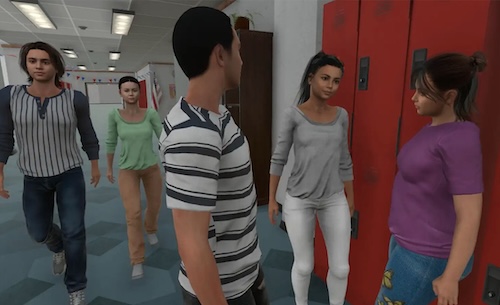

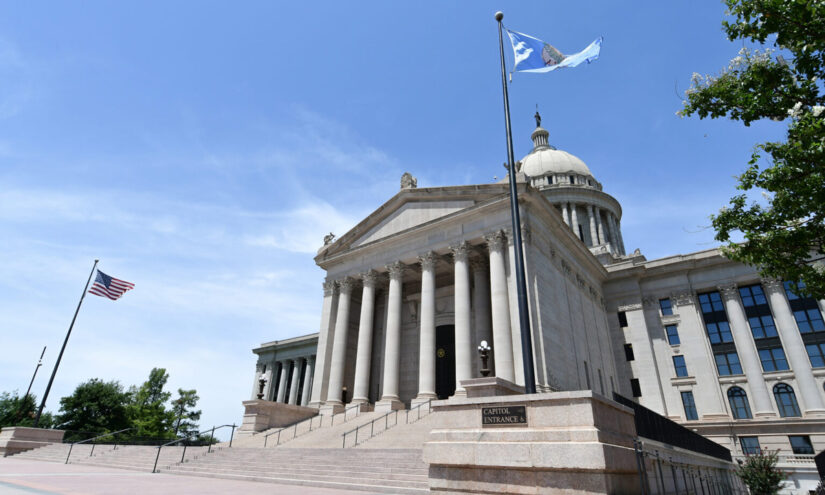
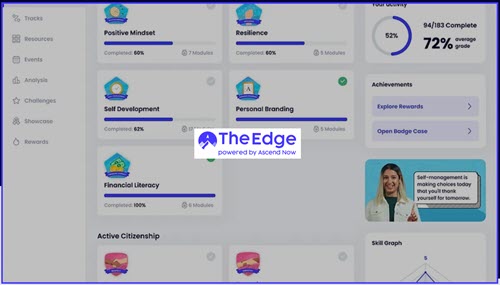


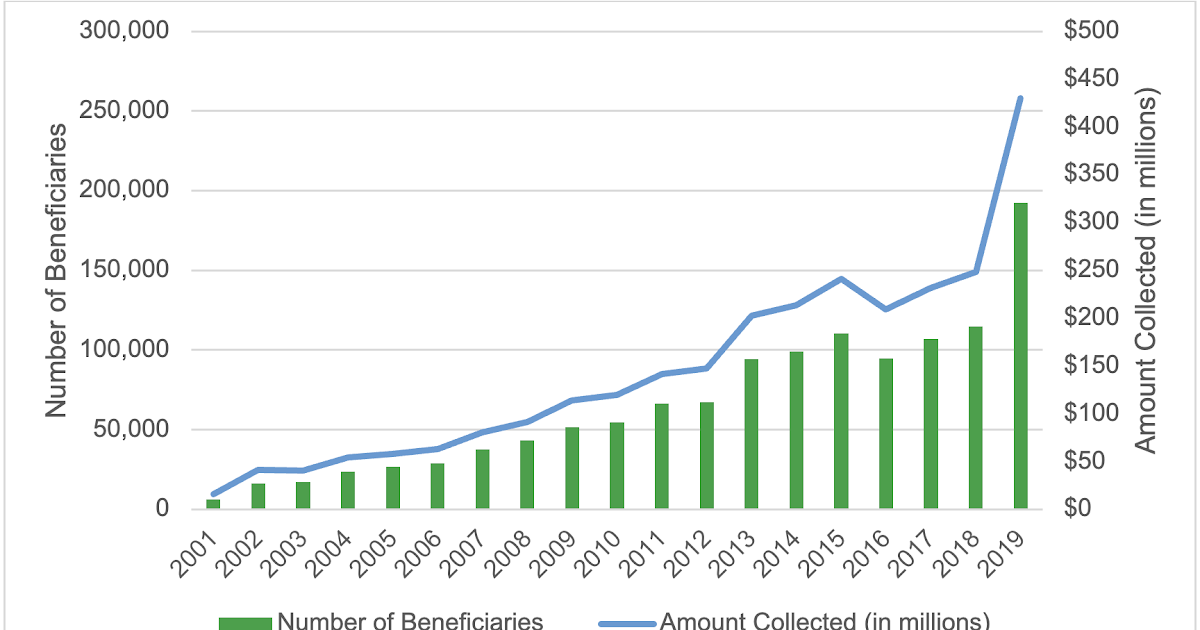
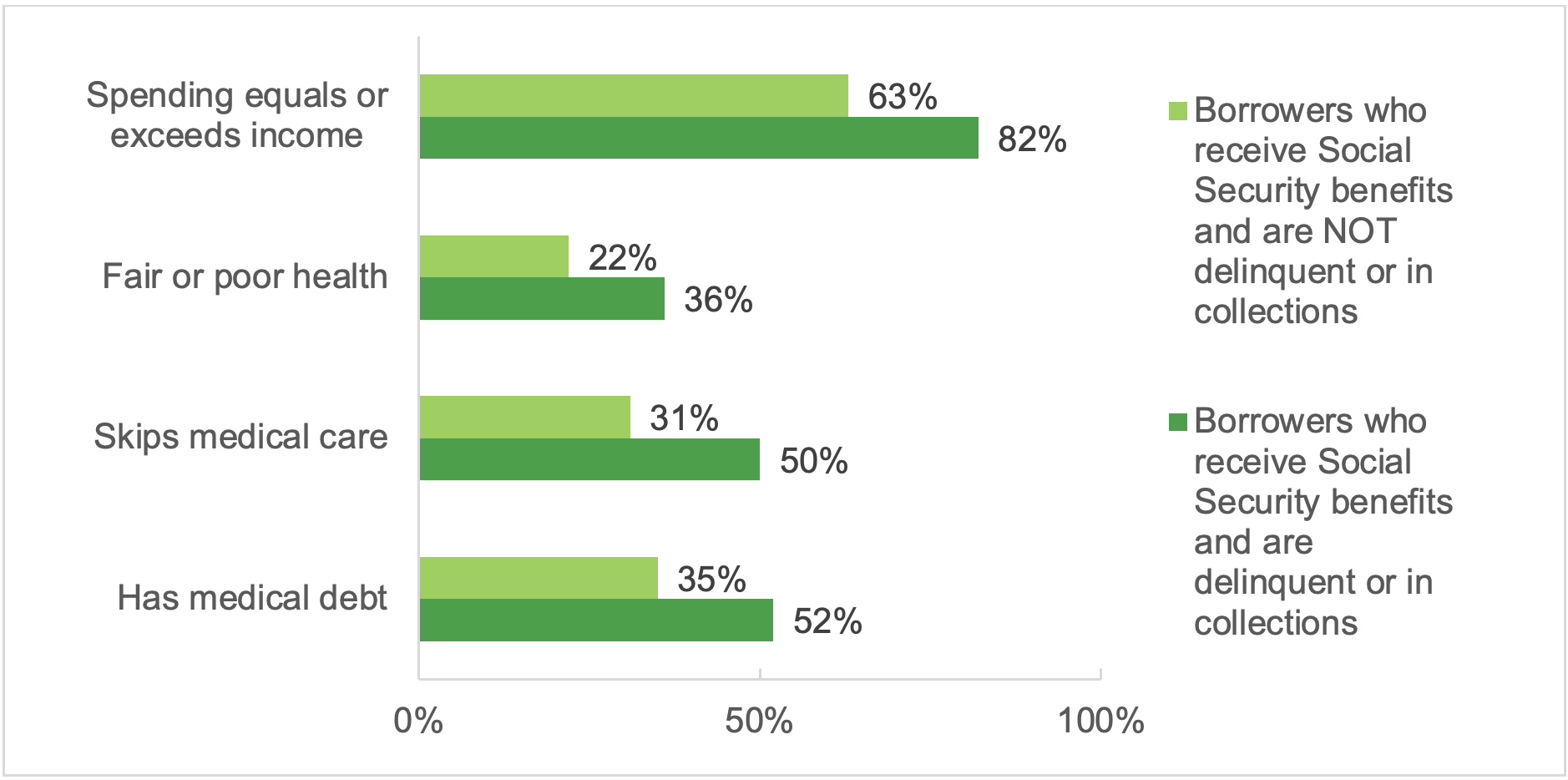
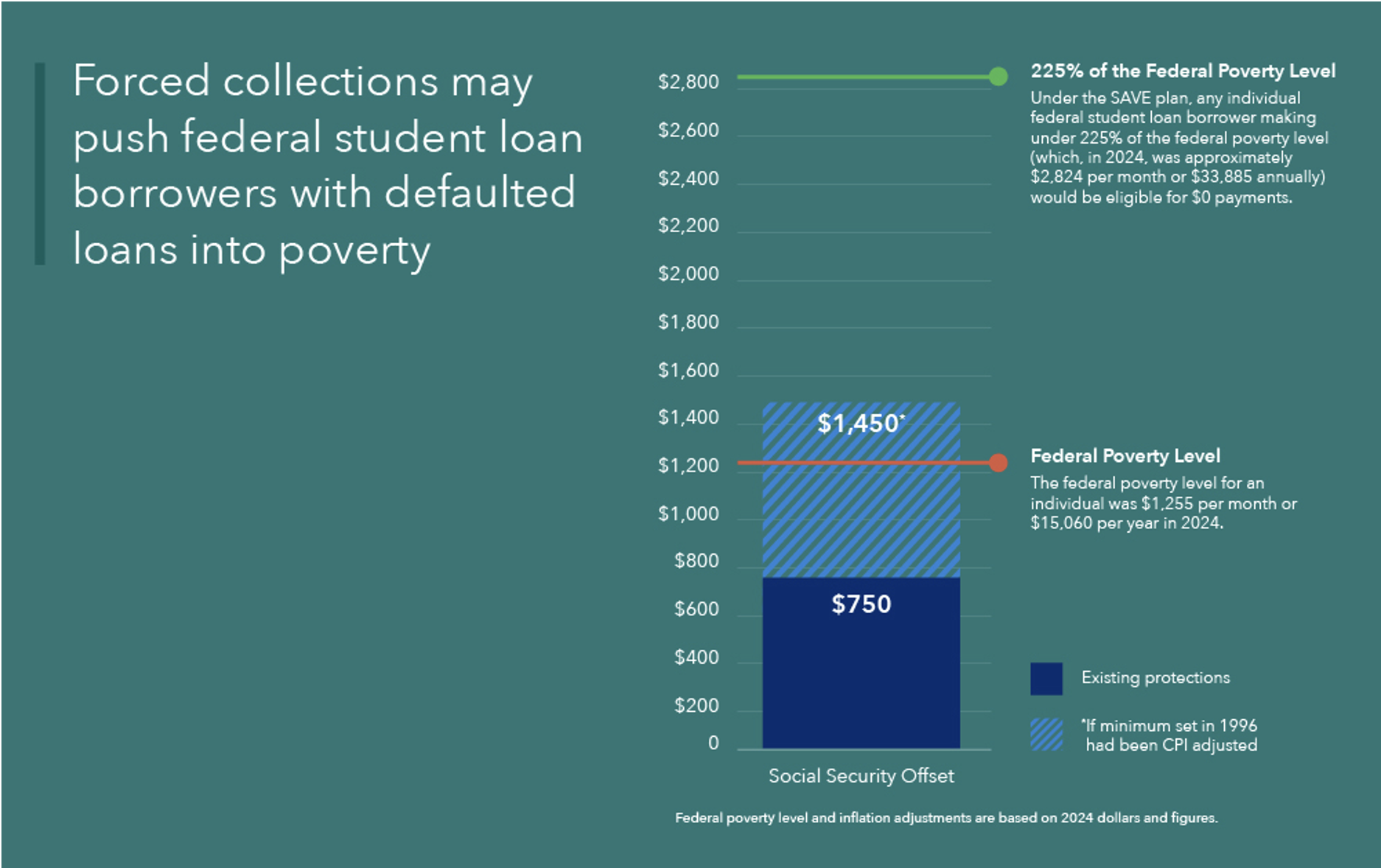


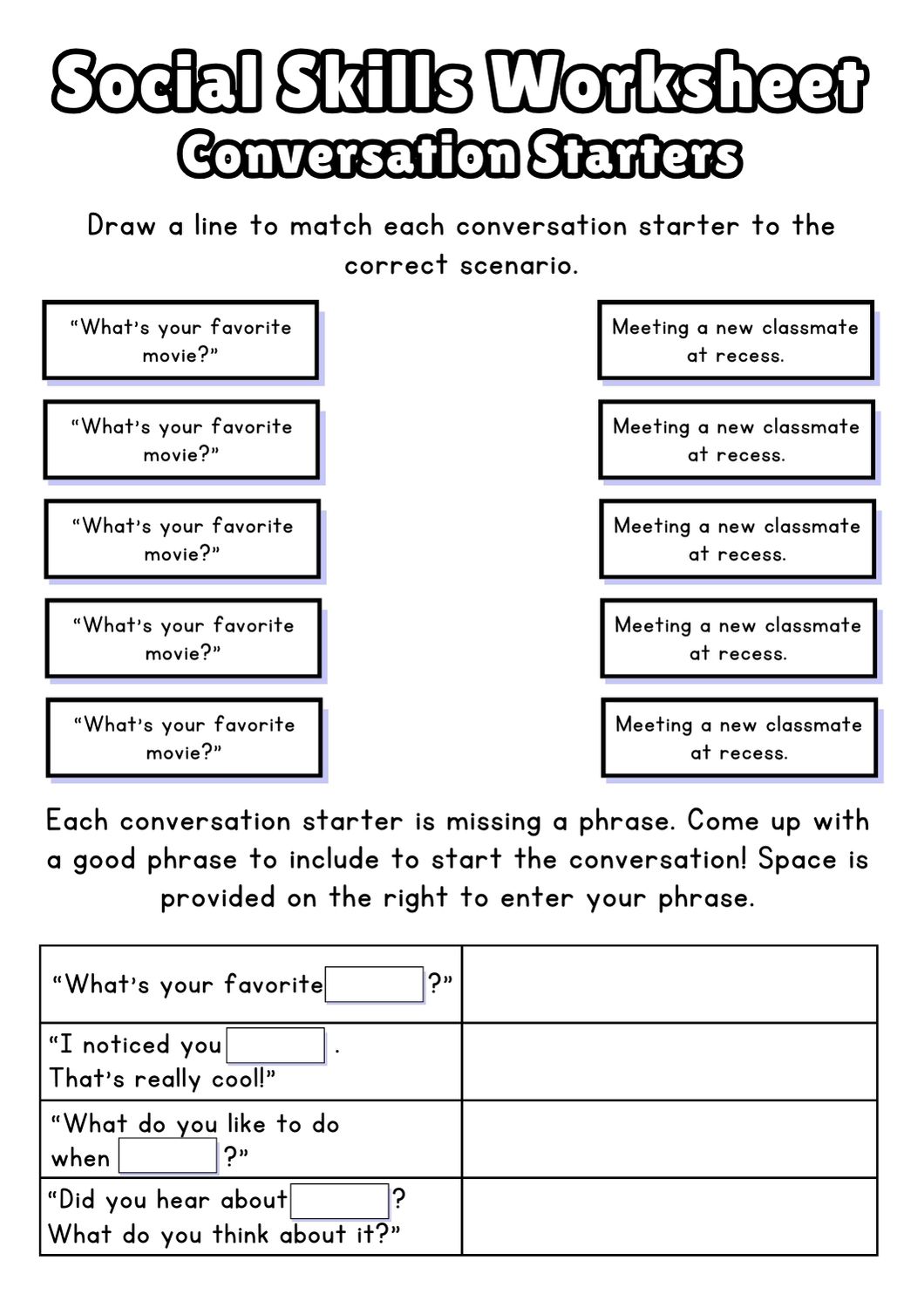
 Designed by Chris