Tag: Soft

  • The Courage to Be Soft (Jennifer Reed)

    The Courage to Be Soft (Jennifer Reed)

    As the semester is coming to a close (and my office building is closed and locked with no heat during finals week), I am reflecting on teaching in person again. I have only taught online since the Covid pandemic.

    Working with undergraduate students in person has given me better insight into what’s going on for young adults at this time. While they are struggling more with reading and writing overall, which we hear about often, there is another part I don’t really see written about.

    As another instructor put into words while we were discussing it, these students are generally “softer” but not in a way that is weak. Sure, there are more mental health struggles (I mean, look at the world they’ve grown up in), but this is separate and different.

    What I’ve witnessed and other instructors echoed in their recent experiences is what Brené Brown refers to as vulnerability. Vulnerability that is courageous, and proposed solutions to today’s social problems that are “both/and” rather than “either/or.”

    As a trend, they’re tired of the division. And they’re bringing their hearts, not just their minds to finding a way forward. I have come to see this as a strength. We don’t need more clever ideas. We need more people who care.

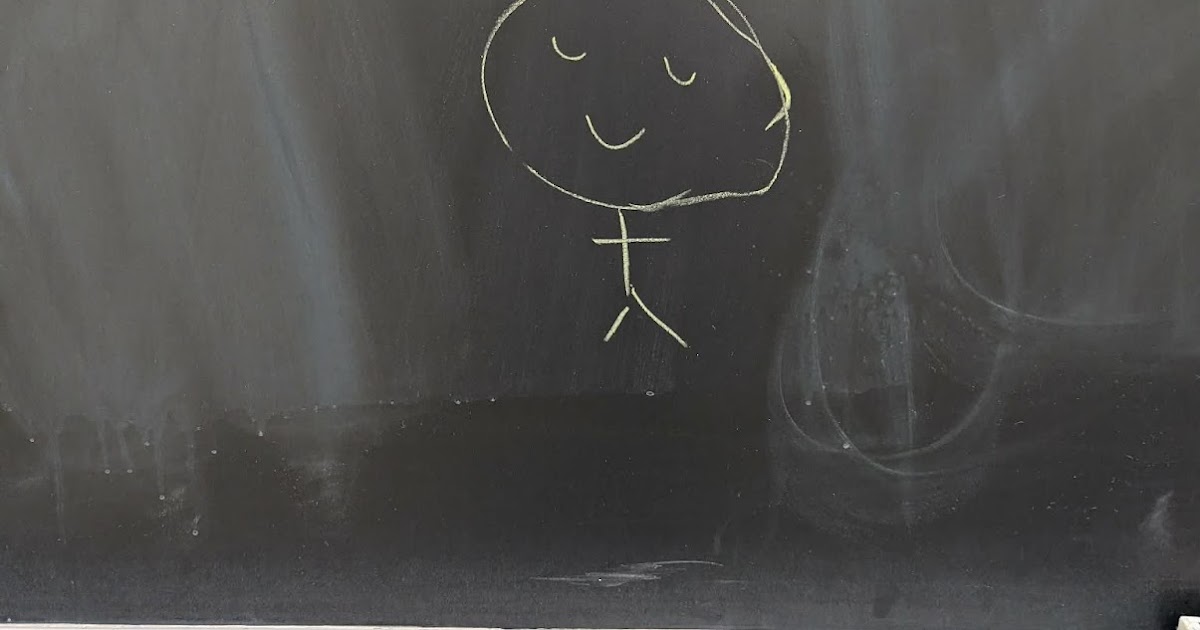
    So, the stick figure on the chalkboard was drawn by a young man right after class ended. We were having a class discussion about heavy topics, capitalism & the economy and authority & the state. Students engaged as small groups in a Power Council Meeting activity. Each group had to decide on one policy proposal to respond to an economic crisis. They did an amazing job.

    You can see the erased chalk all around the stick person. Remnants of a bunch of words I had written on the board pertaining to the lesson and students’ responses. This young man drew the stick person underneath in the middle of all that. It struck me.

    “What is he doing there?” I asked. “He’s just hanging out,” he replied. It was cold that day, so I asked if the guy in his drawing was at least warm. “No, but he’s trying to stay warm,” he said and looked down.

    We said our goodbyes. Then I started erasing the board. And I thought about the metaphor of this little person trying to just stay warm beneath all these big words and ideas. So, I erased all around him. Then snapped a picture to remember the moment.

    There was something so pure and poignant about it. That’s what I see in a lot of these young people. They understand that life doesn’t have to be this hard if you, we simply go back to the basics.

    Jennifer J. Reed, Ph.D. is an assistant lecturer of sociology at The University of Akron. She was a teen mom in Appalachian Ohio, completed her doctorate at the University of Nevada, Las Vegas, and is a gramma of 10.

    Source link

  • WEEKEND READING: Hard, Soft, Green, Mad, AI: The Skills Squeeze

    WEEKEND READING: Hard, Soft, Green, Mad, AI: The Skills Squeeze

    This blog was kindly authored by Dr Fadime Sahin, Senior Lecturer in Accounting and Finance at the University of Portsmouth, London.

    According to the latest available data, approximately 264 million students worldwide were enrolled in higher education in 2023. Reasons for attending include the desire to acquire knowledge and skills, enhance employment prospects, boost social mobility and contribute meaningfully to society. Nearly three million students were enrolled at UK higher education institutions in 2023/24 (the most recent figures).

    The role of universities is increasingly debated across public discourse, shaping policy documents and household discussions, considering the tension between traditional academic skills, employability demands, sustainability imperatives and the accelerating influence of AI. The skills agenda currently sits at the heart of policymaking in England due to the skills gap facing the UK. The Lifelong Learning Entitlement, a flagship UK policy initiative that was introduced as a central plank of this agenda, seeks to expand access to flexible, modular study across a lifetime, reinforcing the policy emphasis on reskilling and employability.

    In a recent HEPI blog, Professor Ronald Barnett argued that policy discourse speaks almost exclusively of skills (employability, reskilling, skills gap) – the new currency of education – moving away from education and knowledge acquisition; while academic discourse speaks of education, but rarely of skills, especially in the humanities and social theory, resulting in a polarised and disconnected debate.

    Dr Adam Matthews, in another HEPI blog, echoed that policy discourse has become increasingly concerned with doing (skills) rather than knowing (knowledge). He analysed both the Post-16 Education and Skills White Paper and TEF (2023) submissions and found a similar imbalance: ‘skills’ outnumbered those to ‘knowledge’ by a ratio of 3.7, even higher among large, research-intensive universities that might be expected to focus more on knowledge production. The Post‑16 Education and Skills White Paper used the word ‘skills’ 438 times, but ‘knowledge’ only 24. The shift has been shaped by economic and growth imperatives, accountability and the instrumental role of universities for economic and social engineering, however it also risks eroding universities’ identity as knowledge producers. The same pattern is evident in the WEF’s Defining Education 4.0: A Taxonomy for the Future of Learning, which references ‘skills’ 178 times, but ‘knowledge’ only 32.

    In a blog post, Professor Paul Ashwin cautioned that a tertiary education system built only on skills, without knowledge, will deepen inequality and suggested a knowledge-rich understanding of skills. He stressed that skills without knowledge are hollow and insufficient, because they lack the contextual and disciplinary knowledge that makes them meaningful and adaptable. He pointed out that the Skills England report champions skills, but offers little clarity on what they actually mean. The listed skills (teamworking, creative thinking, leadership, digital literacy, numeracy, writing) are generic and detached from a specific context.

    The knowledge society was built on this promise. Yet in a post-truth era, that promise is faltering. Over the years, the emphasis on knowing the pursuit of structured, disciplinary knowledge has diminished, eroded by information overload, easy accessibility, erosion of trust in experts and an increasing policy focus on application and skills, even before the advent of AI. This decline sets the stage for Ashwin’s concern that a skills‑only system risks becoming hollow and inequitable.

    Understanding skills

    Amid this tension, it is useful to trace how different categories of skills have been constructed and prioritised within higher education.

    Hard skills

    Over the decades, hard skills have dominated classrooms, a result of education systems built around industrial-era priorities, reinforced by measurability bias through standardised testing and the privileging of tangible qualifications. These skills refer to technical, tangible, quantifiable,  job-specific and measurable abilities that are closely linked to knowledge acquisition and reflected in formal qualifications. Hard skills include coding/programming, engineering, data analysis, bookkeeping/accounting, foreign languages and other technical and occupational skills. Yet, the balance has shifted in recent decades as employers and policymakers emphasise 21st‑century competencies, including soft skills, green skills, digital and global skills and now increasingly AI skills. The fastest-growing skills (AI) category in higher education did not exist in mainstream curricula three years ago.

    Soft skills

    Soft skillshave long been undervalued and sidelined in classrooms. Strikingly, the term itself was first formalised not in education by the U.S. Army in 1972, when the Continental Army Command defined interpersonal and leadership capabilities as ‘soft skills.’ What began as military doctrine has since become central to employability discourse. Soft skills are interpersonal, intangible, non‑technical, transferable and context‑dependent abilities. They are closely linked to personal attributes and social interaction and reflected in behaviours, relationships and adaptability rather than formal qualifications. Soft skills can be categorised as personal qualities and values; attitudes and predispositions; methodological and cognitive abilities; leadership, management and teamwork; interpersonal capabilities; communication and negotiation; and emotional awareness and labour.

    Digital skills and AI literacy

    Computer literacy emerged in the 1980s and 1990s; with the spread of the Internet, this evolved into digital literacy, which in turn laid the foundation for today’s broader category of digital skills. The digital revolution prompted reforms. The core 21st-century digital and global skills include technical proficiency, information literacy, digital communication and networking, collaborative capacity, creativity, critical thinking, problem‑solving, intercultural understanding, emotional self-regulation and wellbeing. Since the end of 2022, the rapid uptake of generative AI tools has further expanded this landscape, introducing new forms of AI literacy and human-AI collaboration as essential competencies.

    Green skills

    Beyond interpersonal competencies, sustainability imperatives have introduced a new category: green skills. Green skills have emerged as a central focus in policy frameworks, driven by growing awareness of climate change, environmental degradation and the imperative of sustainability. Green skills refer to ‘the knowledge, abilities, values and attitudes needed to live in, develop and support a society which reduces the impact of human activity on the environment’, together forming green human capital. Green competencies are increasingly linked not only with green jobs, but with the broader transition toward sustainable economies. Green skills include technical and practical (heat pump installation, domestic recycling, energy grid engineering, peatland restoration), enabling skills (project management, collaboration, public engagement, digital skills) and knowledge and attitudinal capacities (carbon and climate literacy, systems thinking, environmental stewardship).

    Mad skills

    Alongside sustainability imperatives, a newer emergent HR discourse is the so‑called ‘mad skills’ unconventional, disruptive and non-linear thinking or experiences in a rapidly changing labour market. Mad skills stem from personal passions, hobbies, creative ventures or extraordinary experiences or resilience stories. Although mad skills haven’t found its place in academic literature, it might have become part of the vocabulary of recruiters.

    Taken together, these categories illustrate the expanding and overlapping landscape of skills. Yet the very language we use to describe them is increasingly problematic. The label ‘soft skills,’ for instance implies that they are secondary, less important or less measurable than ‘hard’ skills, which risks undervaluing them. As AI increasingly automates hard skills (coding, data analysis, translation), the distinction begins to blur. What remains uniquely human empathy, judgement, creativity becomes central, better captured by the term ‘human skills.’ After all, we may end up dealing only with human skills and human‑AI collaborative skills.

    The role of the university

    Hard, soft, green, digital, global, AI… the list keeps expanding. Today’s workplace pressures candidates to master them all to stand out. These categories are overlapping and often co-developed. Universities, increasingly framed as providers of every imaginable skill, risk being reduced to training centres. When universities behave like training centres, the focus of education shifts from broad academic exploration, research and innovation to specific, narrowly vocational skill acquisition, designed for immediate employment needs. In the process, their identity as institutions of knowledge and civic purpose begins to erode. The problem is not the existence of these skills, but their policy dominance as output metrics. It is important to recognise that universities have historically embedded broad, intellectual and transferable capabilities alongside disciplinary knowledge; the current shift is toward narrow, vocational, immediately marketable packages. Cross-cutting skills are valuable when embedded within knowledge-led curricula, not as substitutes for knowledge production.

    Yet employment needs are never static. The skills taught today may lose relevance within five or ten years after graduation, with AI expected to further compress the lifespan of many skills. Universities will inevitably try to keep pace with the ever-evolving skills agenda, but graduates may still find themselves holding qualifications in skills that have become obsolete, even more so now with AI. This emphasis places considerable weight on cross-cutting competencies such as soft skills, green skills, digital/AI literacy and global awareness.

    However, in certain disciplines, e.g., accounting and finance, the accreditation requirements of major professional bodies (ACCA, CIMA, ICAEW) remain heavily exam‑driven, privileging technical knowledge and hard skills while leaving only a limited scope for the development of broader competencies. Universities do adjust, increasingly embedding diverse skills alongside technical skills, but structural constraints, sometimes necessary, remain.

    Changing student landscape adds a layer to this dynamic. HEPI’s 2025 Student Academic Experience Survey shows that almost 70% of full-time students in the UK 65% of home students and 77% of international students are engaged in paid employment during the academic term. More students are trading off study time for work to manage financial pressures. Students are now expected to master more skill categories than any previous generation, with less time to learn them. Universities must therefore navigate not only the shifting skills agenda, but also the reduced availability of students for independent study and, in some cases, even class attendance to develop these skills.

    Amid these pressures, universities are increasingly judged by the employment status of their graduates, yet such measures often ignore the realities of the job market, particularly for the young. A mismatch arises when well-prepared graduates with relevant skills remain unemployed, underscoring that graduate outcomes alone are not a reliable proxy for educational quality. In fact, the latest Graduate Labour Market Statisticsshow that only 67.9% of graduates in England were in high-skilled jobs in 2024. Nearly a third were in roles not requiring graduate-level skills. The proportion of graduates in high-skilled employment has hovered around 65–67% for a decade (2015-2024). The 2024 figure (67.9%) is the highest in the series, but only marginally above previous years. This pattern is not new. High-skilled employment rates for graduates were 69.5% in 2006, 67.3% in 2009, 65.3% in 2012 and 66.2% in 2015. In other words, for nearly two decades, the proportion of graduates entering high-skilled roles has remained stubbornly flat. This persistent underemployment, despite years of skills-focused reform, may challenge the assumption that expanding skills provision alone can resolve graduate underemployment.

    Universities find themselves caught between competing pressures: policymakers emphasising immediate employability skills; students juggling financial pressures and limited study time; and labour markets struggling to provide suitable graduate opportunities.

    This tension ultimately circles back to the principle of lifelong learning. We need to recognise that education cannot be reduced to a finite set of skills, but must remain a continuous process of adaptation, renewal and knowledge creation.

    Faced with the skills squeeze, it seems increasingly likely that ‘human skills’ and ‘human‑AI collaborations’ may matter most.

    Source link

  • Campus Censorship Puts American Soft Power at Risk

    Campus Censorship Puts American Soft Power at Risk

    International students see American life portrayed in movies and on TikTok; U.S. universities have built global brands, helped along by Hollywood and merchandising. When it comes time to apply, international students can readily imagine a U.S. college experience, starting with seeing themselves in a crimson sweatshirt studying on a grassy quad flanked by ivy-covered buildings.

    And as the U.S.’s hold on cutting-edge science and innovation slips away to China, and other destinations with more welcoming visa policies offer lower-cost degrees and jobs, soft power might be the only edge American universities have left.

    The desire is about more than bricks and mortarboards. Students from other countries have long sought out American values of academic freedom and open discourse. They are excited by ideas and experiences that are as emblematic of the American way of life as tailgating on game day: criticizing the government, discussing LGBTQ+ rights or learning about the Tiananmen Square massacre in China, the Armenian genocide in Turkey or the comfort women victimized by the Imperial Japanese Army.

    But in 2025, those freedoms are at risk of becoming strictly theoretical. Anti-DEI laws in Utah led to Weber State University asking researchers to remove the words “diversity,” “equity” and “inclusion” from their slides before presenting at a—wait for it—conference on navigating the complexities of censorship. Conference organizers canceled the event after other presenters pulled out in protest.

    University leaders in Texas and Florida are refusing to put in writing policies that prohibit faculty from talking about transgender identity or diversity, equity and inclusion in classrooms, sowing fear and confusion across their campuses. A secret recording of a Texas A&M professor talking about gender in her class led to a successful campaign by a state representative to get her fired and forced a former four-star general to resign as university president.

    This weekend, students at Towson University moved their No Kings rally off campus after school officials told them their speakers’ names would be run through a federal government database. They changed locations out of fear the speakers would be targeted by the Trump administration.

    Meanwhile, dozens of faculty are still out of jobs after being fired for posting comments online about the murder of Charlie Kirk. Repressing free speech on social media is also what the Chinese government does to political dissenters.

    It’s true that colleges are exercising American values by following laws passed by democratically elected legislators. And presidents say they will follow the rule of law without compromising their missions, but overcompliance with vague legislation and policies is incompatible with this aim.

    International students who care about more than a name brand may find the erosion of the country’s global reputation as a democratic stronghold a reason to look elsewhere. That means billions of dollars are also at stake if international students no longer trust in America’s values and choose to stay away. Modeling from NAFSA: Association of International Educators projected a 30 to 40 percent drop in international students this fall that would result in $7 billion in lost revenue and more than 60,000 fewer jobs across the country. Records from August suggest a similar outlook: 19 percent fewer students arrived in the U.S. compared to August 2024.

    International students bring more than just valuable tuition dollars to American campuses. They contribute global perspectives to their less traveled American peers and build relationships that could turn into partnerships when they go home and become entrepreneurs or political leaders.

    Higher ed can track the number of international student visas issued, students who enroll and the economic contributions of these students, but they can’t quantify what it means when a student in Shanghai stops imagining America as a place where all ideas can be expressed and explored. It’s taken decades for this country to build power based on free expression and open discourse, but by the time the loss of students starts to register in economic data and visa applications, the decline may be too late to reverse.

    Source link

  • How to Equip Your Students With Essential Soft and Hard Skills Using Ed Tech

    How to Equip Your Students With Essential Soft and Hard Skills Using Ed Tech


    Today’s employers don’t just hire based on educational achievement. They’ve increasingly prioritized higher-order learning skills during the hiring process. To help students become job ready and land a role in the current workforce, professors need to empower learners with the necessary 21st-century skills, often called ‘soft skills.’

    This guide lays out key information on how to create opportunities for skill-based learning to help smoothen the transition from college to the workforce. It will also describe how to develop these skills in students while they’re still in the classroom. Most significantly, you’ll learn how educational technology can sharpen the essential soft skills students need beyond your course.  

    Below are 15 soft and hard skills that make up 21st-century learning.

    The 4 Cs of 21st-Century Learning

    The first four of these higher-order learning skills are widely considered the most vital 21st-century skills in the classroom for students to learn. Commonly known as the 4 Cs of 21st-century learning, they comprise:

    1. Critical thinking:

    Critical thinking is about problem-solving, and being able to bring a skeptical, discerning perspective to assertions of fact and opinion. Students are given opportunities to question and challenge the information presented to them. Troubleshooting and IT support are two hard skills that rely heavily on critical thinking as a foundation and are in-demand skills for the wide variety of technology-based careers in today’s job market.

    How Top Hat helps: Donna M. Smith, a math instructor, is a recipient of the Top Hat Black Educator Grant. A teacher of College Algebra at Sierra College, she has leveraged Top Hat to build a framework that helps students learn how to develop critical-thinking skills, and other soft skills like teamwork, adaptability and time management. She uses this framework to provide students with practice opportunities that demand specific actions from students, then gauges their higher-order learning using Top Hat’s range of assessment tools, spanning all six levels of Bloom’s Taxonomy. As a result, she reports, she’s found her students’ rate of success improved dramatically.

    In the same vein, 93 percent of students surveyed in a Top Hat research report said the variety of assessment types Top Hat offers help them learn how to develop critical-thinking skills.

    2. Creativity:

    This is the process of approaching problems from a variety of perspectives, including ones others might not notice. It helps develop trust in one’s own instincts and helps students seek out new solutions to old problems.

    3. Communication skills:

    This is the ability to convey thoughts and ideas clearly and effectively. In a 21st-century education, that includes being able to communicate well digitally, from texts, emails and social media, to podcasting and video conferencing.

    How Top Hat helps: Top Hat’s Discussion feature helps develop skill-building via collaboration in the classroom. While not all students are always on an equal playing field when it comes to comfort in group discussions, this Top Hat feature meets students where they are by allowing them to respond to comments and questions from any device. They can use simple text or incorporate images, sound bites and videos to propel the conversation forward. Teachers can even employ anonymity to make students comfortable engaging in sensitive topics. Teachers can use this Top Hat feature to drive up classroom participation significantly.

    4. Collaboration:

    This is the ability to work with others as a team to solve a problem or achieve a shared goal. It helps develop the abilities to share control, pitch solutions and discuss and decide with others the best course of action. It also helps students learn to effectively deal with others who may not agree with them, develop the critical abilities to resolve conflicts effectively and consider different viewpoints from their peers.

    Research shows that students who enter the workforce with knowledge and experience in the 4 Cs of 21st-century learning tend to be more adaptable and flexible in the constantly-shifting workplace environment. The 4 Cs of 21st-century learning, in turn, empower students to work better across cultures and are more prepared to take on leadership roles.

    Key Higher-Order Learning Skills

    Other important 21st-century skills in the classroom include:

    5. Problem-solving:

    This is the use of both conventional and innovative methods to solve different types of unfamiliar problems. It involves identifying and asking meaningful questions to clarify different viewpoints and arrive at more effective solutions.

    How Top Hat helps: The Top Hat Assignment feature enables teachers to provide students with interactive homework assignments that actively engage them in their own higher-order learning outside the classroom. A multimedia-friendly tool with 14 easy-to-use question types and automatic grading, this versatile feature keeps collaboration, communication and other essential skills front and center. It incorporates reading, answering questions and viewing media with worksheets, case studies and simulations to help students develop a deeper understanding of a problem and a multifaceted approach to its potential solutions. An added benefit for instructors is that it provides insights into students’ comprehension, participation and completion in real-time.

    6. Information literacy:

    This includes the ability to access, evaluate, utilize and manage information, critically and efficiently. It also involves the accurate and creative application of available information to the current problem or issue. It requires managing data flow from multiple sources, and the application of fundamental legal and ethical knowledge regarding access to and use of that information.

    7. Technology skills and digital literacy:

    Often abbreviated as ICT literacy (Information, Communication and Technology,) this is the collective set of abilities that allow students to effectively apply digital technologies to researching, evaluating, organizing and communicating information across digital channels. This may include using computers, mobile devices, social networks and other communication tools. Jobs in machine learning, product management and software development require understanding of technological platforms and apps. Individuals in these careers must be proficient in these skills in order to suceed.

    How Top Hat helps: Top Hat improves general literacy and digital literacy at the same time with Interactive Textbooks. Dynamic courseware incorporates text with high-quality images, videos and 3D simulations to captivate students’ interest and help them absorb and retain information better. They include case studies and customizable, interactive assessments, and students can access them anytime and from any device. Teachers can use Top Hat’s interactive textbooks in combination with physical textbooks, or on their own.

    Incorporating interactive textbooks and other digital technologies also helps students with skill-building and better prepare them to enter the 21st-century workforce by providing one-to-one computing, giving them the technology required to utilize their higher-order thinking skills in coursework.

    8. Media literacy:

    This includes the ability to analyze media and create media products. It involves understanding how, why and for what purpose various entities construct media messages, including what values and viewpoints they choose to include or exclude, and why. It also examines how people interpret messages differently and how that influences behaviors and beliefs. 

    9. Global awareness:

    This is the use of 21st-century skills to comprehend and address issues of global magnitude, and to collaborate with those from diverse backgrounds. It also involves taking an equitable or inclusive mindset when presenting new information. For example, educators might draw connections between cultural references in an English or cultural studies course. Teaching students the importance of global awareness also starts with reflecting on current and real-time events in your teaching, such as incorporating case studies on political or social uprisings.

    10. Self-direction:

    This is the ability to effectively set goals and manage time, as well as to work independently. It requires determining tangible and intangible criteria for success and balancing short-term tactical goals with long-term strategic ones. It also requires demonstrating initiative and commitment and working independently, including defining, prioritizing, monitoring and completing tasks without oversight, while reflecting on past experiences and learning from them.

    11. Social skills:

    This is the ability to effectively interact with others and work in diverse teams. Students recognize the appropriate times to listen or speak while remaining open-minded to diverse values and ideas. Students also learn how to conduct themselves professionally in a respectful manner, including when working with people from different backgrounds. Those looking to pursue careers in nursing or other areas of healthcare must be proficient in providing both emotional and physical care to patients. Common hard skills required for these careers include Basic Life Support (BLS), Patient Safety and Critical First Aid.

    12. Perseverance:

    This is the ability to persist in a determined effort in spite of obstacles and setbacks. It requires many of the other higher-order thinking skills, including problem-solving and self-direction, to employ effectively.

    How Top Hat helps: Top Hat’s 21st-century learning suite includes many tools that help educators make sure no student falls behind. Not least among them is learning insights. By tracking every interaction between a student and the software automatically, Top Hat enables you to see which students need additional help, in what area and when. Gauge attendance, progress, comprehension, participation—and act on these insights proactively in real-time.

    13. Literacy skills:

    Basic literacy skills include the abilities to create, comprehend, analyze, absorb, retain and recall written information. In the 21st-century workplace and modern economy, they especially apply to business, economic, financial, health and entrepreneurial interests.

    14. Civic literacy:

    Students become familiar with how civic decisions have local and global implications. This type of literacy involves effective participation in civic life by remaining informed and comprehending the processes of government. It also requires knowing how to exercise citizenship rights and obligations.

    15. Social responsibility:

    This encompasses everything from human rights, labor practices, the climate and the environment, fair operating practices, consumer issues and community involvement and development. It requires accountability, transparency, ethical behavior and respect for stakeholder interest, the rule of law, international norms of behavior and human rights.

    Why 21st-Century Skills Are Important

    Importance of Soft Skills for Students

    At its most basic level, teaching 21st-century skills, like critical thinking, provides a framework for higher-order learning. Beyond that, however, it also helps students develop the skills that ensure they will thrive when they leave the classroom and enter the workforce.

    Today’s workplaces are changing constantly, and the role of technology is ever-evolving and growing. That means that persistent, continual learning is essential to succeed and an emphasis on the importance of soft skills for students. Today’s graduates require not only the knowledge and skills for their chosen careers, but critical-thinking skills to navigate an always-changing landscape.

    Good for the World

    The greater community also benefits from new workers entering the workforce with a 21st-century education. The wellbeing of our broader society requires workers with competence and experience in:

    • Civic engagement
    • Critical thinking
    • Digital literacy
    • Effective communication
    • Global awareness

    Graduates equipped with these higher-order learning skills comprehend their role as good citizens and their connection to their neighbors and their shared environment. This way, they are more tolerant, they think more equitably and they aim to build a more diverse workforce. They are empowered to approach all they do in their work with a civic-minded focus.

    Conclusion

    As a 2017 research review in Nurse Education in Practice reported, “Technology has advanced in quantity and quality; recognized as a requirement of 21st-century learners.” Integrating curricula on critical thinking and other soft skills in your classroom will help your students enter the 21st-century workplace better equipped to meet the challenges facing future workers and leaders. As technology becomes an increasingly inseparable part of the working world, it’s becoming more evident that teachers who make effective use of it have an advantage in helping students prepare for life beyond the classroom.

    The developers and designers of Top Hat, including professional educators themselves, are singularly focused on employing the latest in 21st-century education technology to help educators empower students to achieve these aims.

    References

    Ross, D. (2017, April 24). Empowering Our Students with 21st-Century Skills for Today. Getting Smart. www.gettingsmart.com/2017/04/24/empowering-students-21st-century-skills/

    What is social responsibility? (n.d.). ASQ. asq.org/quality-resources/social-responsibility

    LinkedIn Jobs on the Rise 2022: The 25 U.S. roles that are growing in demand (2022, January 18). LinkedIn. https://www.linkedin.com/pulse/linkedin-jobs-rise-2022-25-us-roles-growing-demand-linkedin-news/


    Source link