by Jill Barshay, The Hechinger Report January 12, 2026
Conservatives have long argued that unwed motherhood and single parenting are major drivers of poor student achievement. They contend that traditional two-parent families — ideally with a married mother and father — provide the stability children need to succeed in school. Single-parent households, more common among low-income families, are blamed for weak academic outcomes.
That argument has resurfaced prominently in Project 2025, a policy blueprint developed by the conservative Heritage Foundation that calls for the federal government to collect and publish more education data broken out by family structure.
Project 2025 acknowledges that the Education Department already collects some of this data, but asserts that it doesn’t make it public. That’s not true, though you need expertise to extract it. When I contacted the Heritage Foundation, the organization responded that the family-structure data should still be “readily available” to a layman, just like student achievement by race and sex. Fair point.
Related: Our free weekly newsletter alerts you to what research says about schools and classrooms.
With some help, I found the figures and the results complicate the conservative claim.
Since 2013, the National Assessment of Educational Progress (NAEP), often called the Nation’s Report Card, has asked students about who lives in their home. While the question does not capture every family arrangement, the answers provide a reasonable, albeit imperfect, proxy for family structure and it allows the public to examine how a nationally representative sample of students from different types of households perform academically.
I wanted to look at the relationship between family structure and student achievement by family income. Single-parent families are far more common in low-income communities and I didn’t want to conflate achievement gaps by income with achievement gaps by family structure. For example, 43 percent of low-income eighth graders live with only one parent compared with 13 percent of their high-income peers. I wanted to know whether kids who live with only one parent perform worse than kids with the same family income who live with both parents.
To analyze the most recent data from the 2024 NAEP exam, I used the NAEP Data Explorer, a public tool developed by testing organization ETS for the National Center for Education Statistics (NCES). I told an ETS researcher what I wanted to know and he showed me how to generate the cross-tabulations, which I then replicated independently across four tests: fourth- and eighth-grade reading and math. Finally, I vetted the results with a former senior official at NCES and with a current staff member at the governing board that oversees the NAEP assessment.
The analysis reveals a striking pattern.
Among low-income students, achievement differs little by family structure. Fourth- and eighth-grade students from low-income households score at roughly the same level whether they live with both parents or with only one parent. Two-parent households do not confer a measurable academic advantage in this group. Fourth-grade reading is a great example. Among the socioeconomic bottom third of students, those who live with both parents scored a 199. Those who live with just mom scored 200. The results are almost identical and, if anything, a smidge higher for the kids of single moms.
As socioeconomic status rises, however, differences by family structure become more pronounced. Among middle- and high-income students, those living with both parents tend to score higher than their peers living with only one parent. The gap is largest among the most affluent students. In fourth grade reading, for example, higher-income kids who live with both parents scored a 238, a whopping 10 points higher than their peers who live with only their moms. Experts argue over the meaning of a NAEP point, but some equate 10 NAEP points to a school year’s worth of learning. It’s substantial.
Family structure matters less for low-income studentachievement
Still, it’s better to be rich in a single-parent household than poor in a two-parent household. High-income students raised by a single parent substantially outperform low-income students who live with both parents by at least 20 points, underscoring that money and the advantages it brings — such as access to resources, stable housing, and educational support — matter far more than household composition alone. In other words, income far outweighs family structure when it comes to student achievement.
Despite the NAEP data, Jonathan Butcher, acting director of the center for education policy at the Heritage Foundation, stands by the contention that family structure matters greatly for student outcomes. He points out that research since the landmark Coleman report of 1966 has consistently found a relationship between the two. Most recently, in a 2022 American Enterprise Institute-Brookings report, 15 scholars concluded that children “raised in stable, married-parent families are more likely to excel in school, and generally earn higher grade point averages” than children who are not. Two recent books, Brad Wilcox’s “Get Married” (2024) and Melissa Kearney’s “The Two-Parent Privilege” (2023), make the case, too, and they point out that children raised by married parents are about twice as likely to graduate from college as children who are not. However, it’s unclear to me if all of this analysis has disaggregated student achievement by family income as I did with the NAEP data.
Family structure is a persistent theme for conservatives. Just last week the Heritage Foundation released a report on strengthening and rebuilding U.S. families. In a July 2025 newsletter, Robert Pondiscio, senior fellow at the American Enterprise Institute, a conservative think tank, wrote that “the most effective intervention in education is not another literacy coach or SEL program. It’s dad.” He cited a June 2025 report, “Good Fathers, Flourishing Kids,” by scholars and advocates. (Disclosure: A group led by one of the authors of this report, Richard Reeves, is among the funders of The Hechinger Report.)
That conclusion is partially supported by the NAEP data, but only for a relatively small share of students from higher-income families (The share of high-income children living with only their mother ranges between 7 and 10 percent. The single-parent rate is higher for eighth graders than for fourth graders.) For low-income students, who are Pondiscio’s and the scholars’ main concern, it’s not the case.
The data has limitations. The NAEP survey does not distinguish among divorced families, grandparent-led households or same-sex parents. Joint custody arrangements are likely grouped with two-parent households because children may say that they live with both mother and father, if not at the same time. Even so, these nuances are unlikely to alter the core finding: For low-income students, academic outcomes are largely similar regardless of whether they live with both parents all of the time, some of the time or only live with one parent.
The bottom line is that calls for new federal data collection by family structure, like those outlined in Project 2025, may not reveal what advocates expect. A family’s bank account matters more than a wedding ring.
This <a target=”_blank” href=”https://hechingerreport.org/proof-points-family-structure-student-achievement/”>article</a> first appeared on <a target=”_blank” href=”https://hechingerreport.org”>The Hechinger Report</a> and is republished here under a <a target=”_blank” href=”https://creativecommons.org/licenses/by-nc-nd/4.0/”>Creative Commons Attribution-NonCommercial-NoDerivatives 4.0 International License</a>.<img src=”https://i0.wp.com/hechingerreport.org/wp-content/uploads/2018/06/cropped-favicon.jpg?fit=150%2C150&ssl=1″ style=”width:1em;height:1em;margin-left:10px;”>
This story was produced in partnership with Work Shift and reprinted with permission.
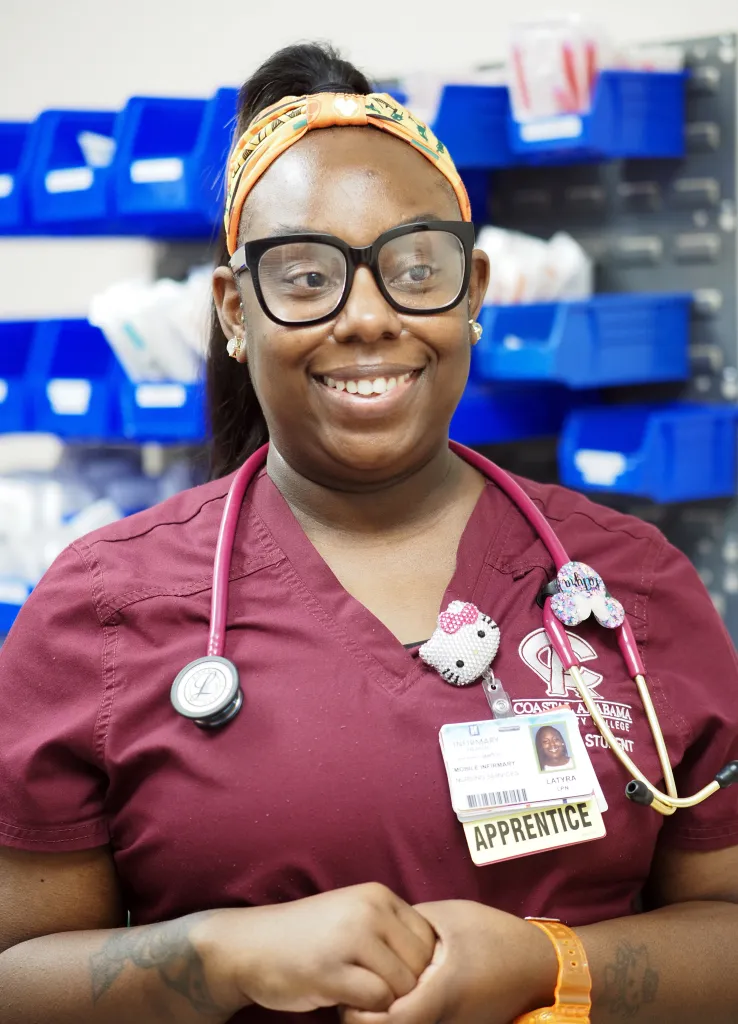
MOBILE, Ala. — Three or four times a week, LaTyra Malone starts her day at Mobile Infirmary hospital at 6:30 a.m. For the next 12 hours, she makes her rounds and visits with patients — asking if they’re in pain, checking vitals, administering fluids. To an outside observer, she appears to be a nurse.
But Malone, 37, is a registered nurse apprentice. Everything she has learned how to do in her nursing classes at Coastal Alabama Community College, she can do at the hospital under the supervision of registered nurse Ondrea Berry, her journeyworker — a term typically used in the skilled trades. Unlike most nursing students who complete their required clinical hours in groups for no pay, Malone gets paid as an employee with benefits. She also gets much more personalized, hands-on learning time.
“It’s like having a little kid attached to your leg all day,” Berry joked.
For Malone, the partnership is invaluable.
“I learn so much more one-on-one,” Malone said. “I might know the basics of disease processes or why we’re giving a certain medicine, but hearing her break it down to me helps a lot.”
The pair work largely as a team, alternating duties to allow Malone a chance to observe and practice. By now, Malone knows the ropes pretty well: In addition to her apprenticeship training and classes, she has 16 years of experience as a certified nursing assistant and a medical assistant. And Berry, who is 25, says she benefits from the working relationship too. “There are teaching moments for both of us,” she said.
Degreed nursing apprenticeships, like the one in Alabama, have emerged nationally as a potential solution to a thorny problem. The national nursing shortage is creeping toward crisis levels, with the demand for RNs like Berry and licensed practical nurses, or LPNs, projected to outstrip the supply for at least the next decade. At the same time, tens of thousands of people like Malone are already working in patient care in hospitals. Many aspire to be nurses — in fact, many certified nursing assistant programs sell the idea that you can start there, quickly land a job and then continue on to become a nurse.
But in reality, that’s a huge leap that requires an entirely different admissions process and English, math and science prerequisites that many nursing assistants don’t have. It also assumes that someone working an eight- or 12-hour shift for $18 an hour can find the time and the money for more education.
“The sort of ‘we are excellent’ ethos in nursing might be self-defeating in that it is weeding out a lot of people who would be amazing nurses,” said Iris Palmer, director for community colleges with the education policy program at New America.
Ondrea Berry, left, dispenses medication at Mobile Infirmary hospital while LaTyra Malone looks on. As an apprentice, Malone must be supervised by Berry at all times. Credit: Mike Kittrell for Work Shift
Related: Interested in more news about colleges and universities? Subscribe to our free biweekly higher education newsletter.
Several states, including Texas, North Carolina and Wisconsin, have begun growing registered apprenticeships in nursing — which have approval from the U.S. Department of Labor — to help address this problem. But no state has done quite as much as Alabama in scaling the model.
In 2021, the Alabama Board of Nursing worked with the state legislature to create a nursing apprenticeship license. Normally, nursing students are not licensed until after they graduate and pass a national licensure exam, and therefore they can’t be paid for their supervised clinical hours. The new apprenticeship license allows them to earn while they learn, making nursing school much more accessible for students like Malone and helping to fill critical staffing needs in hospitals.
Since the law passed, 80 employers and 28 colleges and universities in Alabama have jointly created LPN and RN apprenticeship programs for those who are still working toward a degree. Nearly 450 apprentices — the great majority RNs — have completed the program and passed their exam, with more than 500 currently apprenticing. It’s too soon to say whether apprenticeships will solve the nursing shortage in the state, but early data shows benefits for employers and aspiring nurses alike.
Mobile Infirmary has had over 90 nursing apprentices since the hospital’s program began in 2022, first with the LPN apprenticeship and soon after with the RN one. Graduates are required to stay at the hospital for one year after the apprenticeship ends, but most are staying beyond that. Only five have left so far, according to Stefanie Willis-Turner, the director of nursing school partnership and programs at Mobile Infirmary.
The hospital, like many others, already offered tuition reimbursement for employees who wanted to go back to college and move into nursing or another higher-level position. But such programs have notoriously low uptake, in part because most low-income employees can’t front the cost of tuition and also because many don’t know what steps to take.
“It amazed me the number of people that wanted to go back to school but didn’t really know where to get started,” Willis-Turner said. “Having a person to help guide them has really been our trigger, and that’s how we run this program.”
LaTyra Malone is a two-time apprentice at Mobile Infirmary hospital. Last year, she worked with Ondrea Berry as a licensed practical nurse apprentice while she earned the certification. This year, she is a registered nurse apprentice. Credit: Mike Kittrell for Work Shift
Willis-Turner played a crucial role in recruiting Malone for the apprenticeship. Malone has wanted to be a nurse since she was a teenager when she was president of her high school’s chapter of HOSA-Future Health Professionals, a global student-led organization that promotes careers in health care. But her plans to become a registered nurse were delayed when she became a mother. The financial burden plus the rigid schedules of nursing school made it difficult to make room for parenting, working and studying.
With the apprenticeship, Malone doesn’t have to worry about paying for college, and she can provide for her family while improving her nursing skills. Her path stands in stark contrast to that of Berry, who worked at Dairy Queen throughout nursing school to pay for tuition and health insurance. Berry didn’t have kids to take care of, but she also didn’t have financial support from anyone else in her family. Her only on-the-job training in nursing school was the clinical hours, where she joined a group of students who took turns practicing new skills with just one nurse. Berry says she only attempted two IVs in that time. Malone has done so many she can’t count.
About 75 percent of the apprentices at Mobile Infirmary over the last three years were already working at the hospital. The rest came from surrounding medical facilities. Some even quit their jobs to transfer to Mobile Infirmary for a better chance at getting into the apprenticeship program. In addition to paying students for their work, Mobile Infirmary pays for any tuition that isn’t covered by scholarships or grants. The hospital also provides two uniforms free of charge. And students know they have a guaranteed job after they graduate and pass the nursing exam.
This kind of targeted support is what makes the best apprenticeships successful in boosting individual economic mobility, its advocates say. Another key factor is the type of job an apprenticeship prepares people for. Most health care apprenticeships are for entry-level roles like CNAs, patient care technicians and medical assistants — jobs that, on average, pay $18-$20 an hour.
About half of states offer apprenticeships for LPNs, who make about 50 percent more than that, and half do so for RNs, whose median salaries are close to six figures, according to data from the U.S. Department of Labor. But far fewer apprentices are in those LPN and RN programs — and the majority of RN apprenticeships are for nurses who already have degrees, not for those who are still learning. That means aspiring nurses must still get all the way through the financial and logistical obstacles of nursing school before they can start to work.
Josh Laney helped set up the different model in Alabama when he was director of the state’s Office of Apprenticeship. For a long time, he said, he bought into the “urban legend” that training more people to be certified nursing assistants, especially when they’re young, would get people onto the path to becoming nurses.
“The pitch was, ‘We get you the certificate and then you’re going to work at a hospital because it’s a very high-demand occupation. From there you can go on and move into nursing or whatever else you want to do,’” Laney said. “But there was no specified plan for how to do that — just a low-wage, very stressful and strenuous job.”
The data backs that up. A 2018 study of federal Health Profession Opportunity Grants for CNA training showed that only 3 percent of those who completed the training went on to pursue further education to become an LPN or RN. Only 1 percent obtained an associate degree or above. A study in California showed slightly better odds: 22 percent of people who completed certificate programs at community colleges to become CNAs went on to get a higher-level credential in health care, but only 13 percent became registered nurses within six years.
Because of these outcomes, Laney refused to pursue apprenticeships for CNAs in Alabama. One reason apprenticeships for CNAs and medical assistants are common, however, is that they are jobs that don’t require degrees and have fewer regulations when it comes to training. Setting up a registered apprenticeship for nurses who don’t already have a bachelor’s degree is complex and requires the work of many entities — the nursing board, colleges and employers.
When he went to the state board of nursing to propose LPN and RN apprenticeships, Laney was initially shut down.
“To their credit, they said, ‘Go away, bureaucrat! You’re not industry, you’re not the employer. You don’t really have anything to do with this,’” he recalled. “What I learned there, and what I’ve recommended to every other state who’s tried this, is let the employers carry your water. If they want it, they’ll get it done.”
Laney then talked to the Alabama Hospital Association and Alabama Nursing Home Association, to reach employers. Given the shortages they had been experiencing, they bought into the idea and approached the nursing board themselves. Next, Laney’s team got community colleges on board, then universities. With the assurance that apprenticeships wouldn’t cut down on any of the required classes and clinical hours, the nursing board agreed to create the new license, following legislative approval.
Other states embarking on nursing apprenticeships have faced similar challenges.
Apprenticeships aren’t a panacea. They hold promise for creating upward mobility, diversifying the profession and improving the odds a student makes it through to graduation, but they can’t solve all the knotty challenges of the nursing shortage. A lack of instructors in nursing schools — and therefore a lack of available seats for qualified students — is still one of the biggest factors. And in the apprenticeship model, every student needs one-on-one mentorship, meaning hospitals must have enough staff available and willing to work in a mentoring role for up to a year.
Jay Prosser, executive director of the Massachusetts Nursing Council on Workforce Sustainability, knows all that. But he thinks apprenticeships will bring in more “practice-ready” nurses who are more likely to stay in the field long-term, especially those who were already working in patient care in the United States or other countries. Massachusetts is on the cusp of starting a licensed practical nurse apprenticeship with one employer and one academic partner, after working with the state nursing board and colleges for the past year. Unlike in Alabama, the nursing board didn’t need to create a new license, but rather the board judges whether educational programs meet regulations or not.
The Massachusetts Nursing Council on Workforce Sustainability is also creating a nursing apprenticeship network in the state, to make it easier for different institutions and programs to exchange ideas.
Prosser said one of the biggest barriers was making sure that the scope of practice for apprentices was clearly defined. He worked with local colleges to make sure of this. Prosser had previously worked as an assistant chief nursing officer in Birmingham, Alabama, and moved to Massachusetts in 2021 with the idea of apprenticeships already in mind.
Several other states have also created nursing apprenticeships for students who don’t already have a degree, but they’re limited to single institutions. In 2023, Texas began offering nursing apprenticeships for students who hadn’t already earned a degree in a collaboration between South Texas College and the Texas Workforce Commission.
The University of Wisconsin Health system has created a portfolio of nine registered apprenticeship programs, including an RN program launched in 2023 and a handful of other apprenticeship-style programs. Bridgett Willey, director of allied health education and career pathways, said the hospital started with entry-level apprenticeships, like medical assistants, before proposing degreed programs.
“There’s still kind of a myth that the colleges are going to do all this on their own,” Willey said. “Well, that’s not true. Employers have to sponsor, because we’re the ones hiring the apprentices and often supporting tuition costs, as well.”
The outcomes from the entry-level apprentice programs helped convince the health system that it was worth investing more. A three-year study showed that staff retention rates for those who participated in the hospital’s apprenticeships were 22% higher than for those who didn’t. In the two-year-old RN program, attrition is less than 10% so far — significantly lower than the attrition rate the hospital has seen with traditional students who participate in clinicals at the hospital.
UW Health supports efforts to scale their apprenticeship model across the state, but so far they haven’t panned out. Willey said employers are interested, but conversations often stall when questions arise about how to create more clinical capacity and find funding sources to support apprentices.
Even so, Eric Dunker, founding executive director of the National Center for the Apprenticeship Degree, which is affiliated with Reach University, predicts that nursing apprenticeships are about to see major growth, as teaching apprenticeships did five years ago. Earlier this year, Reach University received a $1 million grant to expand apprenticeships in behavioral health, and is planning for nursing ones. The strict licensing regulations for nursing make it more complicated than scaling up teaching apprenticeships, but Dunker sees the possibility of expanding them if nursing boards, colleges and employers all come to the table, as they did in Alabama.
“There’s a lot of entry-level health care apprenticeships,” Dunker said. “But the key is upward mobility, which is nursing and nurse practitioners. There’s typically been a bottleneck in stacking these pathways, but that’s where you’re starting to see more states and systems become a little more creative.”
Tyler Sturdivant, Coastal Alabama Community College’s associate dean of nursing, knows what that looks like. Figuring out the logistics of setting up an apprenticeship program was a challenge, he said, and required hiring an additional staff member to liaise between the college and hospital partners. But three years into the apprenticeship program for LPNs and RNs, the school is seeing higher completion rates than for traditional students.
This means they’re producing more licensed nurses to fill positions and someday mentor, or even teach, other apprentices.
On a typical Friday morning in September at Mobile Infirmary, Malone and Berry visited a 70-year-old man who came in for a urinary tract infection that then weakened him. That day, the apprentice and journeyworker switched out his bed for one lower to the ground to reduce the fall risk, taught him how to raise the bed so he could sit upright, updated him on a plan for physical therapy and adjusted his socks for him.
Malone appeared comfortable and confident, taking the lead in the patient’s care while Berry assisted her. Malone says the many hours of practice she’s had through the apprenticeship has made her feel prepared for the job and ready to continue to follow her dreams. One day, she wants to become a nurse practitioner specializing in mental health.
“I won’t feel complete until I actually become a nurse,” Malone says. “I thought I was going to be one sooner, but bumps in the road happened and I ended up having a child. If it wasn’t for the apprenticeship, I probably wouldn’t be here now.”
Contact editor Lawrie Mifflin at 212-678-4078 or on email at [email protected].
This story was produced in partnership with Work Shift and reprinted with permission.
Since you made it to the bottom of this article, we have a small favor to ask.
We’re in the midst of our end-of-year campaign, our most important fundraising effort of the year. Thanks to NewsMatch, every dollar you give will be doubled through December 31.
If you believe stories like the one you just finished matter, please consider pitching in what you can. This effort helps ensure our reporting and resources stay free and accessible to everyone—teachers, parents, policymakers—invested in the future of education.
Dr. Marcela Rodriguez-Campo Through the work that I did as a director of a diversity office, I was always finding ways to make magic out of the least given how poorly our work was funded. Nonetheless, we did everything we could to pay folks for their time and labor. After finishing the planning of one of the largest state-wide events my team had ever hosted, a local artist we had collaborated with previously offered to return to our campus to offer my team a pour-painting workshop, for free. I was left stunned.
That’s too generous, right? Are you sure? Maybe we can dig up some funds or find a sponsorship?
No. I want to give this to your team as a thank you for the work that you all do. And for being a safe person folks can go to.
My eyes immediately welled up with tears: We were safe for her and now she wanted to keep our spirits safe in return. This is community care.
When people from historically marginalized communities enter the Ivory Tower as students, staff, or faculty, institutions actively work to estrange us from our communities. They teach us that our culture, our histories, our languages don’t matter, by rarely including us in the curriculum. They show us that our voices and our stories aren’t allowed to take up space there, when they ban our books, dismiss our questions, deny our realities, and reject our ways of knowing. They mold us into “professionals”, train us in Eurocentric research and teaching practices, and force us to subscribe to their ways of being in order to succeed and survive. They convince us that success will be measured by their standards, rather than those set forth by our communities.
Diversity, equity, & inclusion (DEI) offices are fundamentally about enacting an ethic of care that is culturally and politically grounded in the communities our students come from.
The Trump administration has deemed that a danger and threat to society. They are attempting to make us forget ourselves and pushing an agenda of historical amnesia. They are trying to make us forget that there is a whole world out there beyond the Ivory Walls that needs us to exist. Heartbreakingly enough, it is working. Once bold and visionary leaders are capitulating to authoritarianism and white supremacist ideology. As we see the far-reaching resistance to this now trending DEI-boogeyman, it is more important than ever that we remember our lineage, that we return to our communities, that we return to the river that offered us our first sips of liberation. So that we may continue to — as Toni Morrison taught us — move in the direction of freedom.
As we face persistent threats and attacks on our work, allow me to offer the DEI professionals and our student leaders a reminder: your community needs you and it needs you free, too. Let us learn from the lineage of our work and remember as our own continuous act of rebellion the river from which DEI pulls from.
Cultural centers and diversity offices did not come about placidly or because of the goodwill of institutions. They were fought for, demanded. They were created not because of the polite and demure requests of Students and Faculty of Color, but as a result of courageous boycotts, sit-ins, building occupations, protests, mobilization, and organizing of marginalized communities who recognized the second-class support they were receiving and who were inspired by the activism of the Civil Rights Movement of the 1960’s. Chicano students in East LA walked out of schools in droves to denounce the substandard education they were being given. They stepped out to demand better teachers, better learning conditions, more resources, and ethnic studies. In that same year a month later, Black students at Columbia University occupied Hamilton Hall to protest segregation and racism in higher education. Students collectively led a revolution through each act of resistance and refused to accept an education system that dehumanized and disrespected their community.
DEI is a byproduct of student activism. As Black cultural centers began opening, cultural centers for other community groups were created in the same vein, to offer safe spaces and resources to students from the margins. Cultural centers created spaces for students to develop a collective consciousness where they could find themselves and each other in a sea of white curriculum, culture, policies, and practices. They have historically supported the recruitment, retention, and graduation of marginalized student groups. Student and scholar activists’ radical visions of transforming higher education to equitably serve and empower students from the margins was stunted by institutional resistance that was coded as budgets, enrollment, and value add. Some of the same code words we hear today.
So, DEI was created as the compromise, a palatable option. One that checked some of the boxes, while not transforming the institution wholly. DEI was never intended to be the radical resolution student activists fought for.
The aggressive attack on DEI is the consequence of our ability to become effective, to reach a critical mass of folks nationally to question the status quo and the system enough to make the people in power uncomfortable. Whether DEI is banned for one presidency or two or forever, it was never meant to save us. We have to do that. Our communities have always done that. DEI was never going to be enough and at many institutions, it was never intended to be effective. We need to reclaim our agency and power and voices from the institutions who never loved us back anyway and recognize that there is so much more we could build with or without them in and with community. As this current moment and the highly organized right works to scare, intimidate, and paralyze us, the most critical thing we could be doing in this very moment is building community from within and especially from outside of our institutions.
Beloved, we are the global majority. And this current political moment is working hard and fast because it is the last opportunity to reset the scales. They are scared of the collective power and freedom we can tap into in our communities because our communities are our source. The very care that we offer to our students we first learned from our communities. The care we owe is to our communities. The reason we do this work is for our communities. The care we are searching for is in our communities. The resistance has begun and will continue to exist within our communities. Your work will likely need to evolve, as this work always has, so go ahead and evolve.
In Emergent Strategy by adrienne maree brown she shares this powerful wisdom on interdependence and community by Naima Penniman:
“When Hurricane Katrina slammed into the Gulf Coast, almost everything lost its footing. Houses were detached from their foundations, trees and shrubbery were uprooted, signposts and vehicles floated down the rivers that became of the streets. But amidst the whipping winds and surging water, the oak tree held its ground. How? Instead of digging its roots deep and solitary into the earth, the oak tree grows its roots wide and interlocks with other oak trees in the surrounding area. And you can’t bring down a hundred oak trees bound beneath the soil! How do we survive the unnatural disasters of climate change, environmental injustice, over-policing, mass-imprisonment, militarization, economic inequality, corporate globalization, and displacement? We must connect in the underground, my people! In this way, we shall survive” (p. 84–85).
We have left ourselves vulnerable because we have dug our roots deep in academia and have not rooted ourselves like the oak tree across our community. We must become an oak tree, rooting ourselves expansively, interdependently within community so that when they come for us– and they will– we will continue to stand. Whatever work we are able to do between now and the next attack on our work, let us reach towards the oak trees who seeded us and root ourselves to one another as we gear up for the struggle of our lifetime. It is the imperative of our lifetime to remember who we are and return to community.
When my institution quickly disposed of the legacy of the DEI professionals and students, community saved me. When they demonized me, targeted me, and worked to snuff out my fire, community reminded me of who I am. When the institution nearly convinced me that someone like me should not exist, community reminded me of the entire world that breathes and lives outside the ivory walls that needs me. Community rekindled my spirit and my hope, that even in the direst set of circumstances, my people make magic.
_____________________
Dr. Marcela Rodriguez-Campo is an educator and scholar-practitioner. She is a former DEI Director from a public four year institution. She is the founder of Co-Libre Education.
Prestigious EdTech Breakthrough award highlights Top Hat’s leadership in delivering flexible, AI-powered courseware to support faculty and students.
TORONTO – June 6, 2025 – Top Hat, the leader in student engagement solutions for higher education, has been named the 2025 Courseware Solution Provider of the Year. The annual EdTech Breakthrough Awards honor organizations that push the boundaries of educational technology—benefiting students, educators, and institutions across North America and around the world. In a global field of over 2,700 nominations, Top Hat stood out for its efforts to empower faculty to create and deliver engaging, connected, and affordable learning experiences for students.
“Receiving this award is an honor and supports our belief that better student outcomes begin with the course itself,” said Maggie Leen, CEO of Top Hat. “We’re proud to support thousands of faculty with tools that make it easier to adopt proven teaching practices, and grateful to our team for the creativity and care they show everyday in making great learning experiences a reality for more students.”
Now in its seventh year, the EdTech Breakthrough Awards have become a benchmark for excellence in educational technology. The program celebrates the industry’s most visionary companies—those dreaming bigger, innovating further, and setting new standards for enhancing the practice of teaching and learning. Top Hat’s selection reflects its track record of building solutions that drive measurable academic outcomes and dramatic improvements in student engagement, inside and outside the classroom.
Top Hat’s courseware platform gives instructors unprecedented flexibility to tailor content to their teaching goals. The platform integrates interactive assessments, multimedia, and AI-powered tools that allow educators to instantly create in-class questions and reflection prompts. This makes it easier than ever for instructors to apply evidence-based practices like active learning and low-stakes assessment. Students also benefit from AI-powered on-demand study support and unlimited practice questions rooted directly in course content.
Top Hat has a long-standing commitment to helping faculty adopt, adapt, or create modern, interactive course materials that improve engagement and comprehension while advancing institutional goals around student affordability and equity. By supporting the use of low- or no-cost learning materials—including customizable OpenStax and OER titles enriched with interactive features—Top Hat empowers educators to design meaningful learning experiences that reflect their unique pedagogical goals while reducing costs for students.
About Top Hat
As the leader in student engagement solutions for higher education, Top Hat enables educators to employ evidence-based teaching practices through interactive content, tools, and activities in in-person, online, and hybrid classroom environments. Thousands of faculty at 900 leading North American colleges and universities use Top Hat to create meaningful, engaging and accessible learning experiences for students before, during, and after class. To learn more, please visit tophat.com.
Authored by Dr Emma Roberts, Head of Law at the University of Salford.
The loss of a student to suicide is a profound and heartbreaking tragedy, leaving families and loved ones devastated, while exposing critical gaps in the support systems within higher education. Each death is not only a personal tragedy but also a systemic failure, underscoring the urgent need for higher education institutions to strengthen their safeguarding frameworks.
The time for piecemeal solutions has passed. To confront this crisis, bold and systemic reforms are required. One such reform – the introduction of an opt-out consent system for welfare contact – has the potential to transform how universities respond to students in crisis.
An opt-out consent model
At present, universities typically rely on opt-in systems, where students are asked to nominate a contact to be informed in emergencies. This has come to be known as the Bristol consent model. Where this system exists, they are not always invoked when students face severe mental health challenges. The reluctance often stems from concerns about breaching confidentiality laws and the fear of legal repercussions. This hesitancy can result in critical delays in involving a student’s support network at the time when their wellbeing may be most at risk, leaving universities unable to provide timely, life-saving interventions. Moreover, evidence suggests that many students, particularly those experiencing mental health challenges, fail to engage with these systems, leaving institutions unable to notify loved ones when serious concerns arise.
Not all universities have such a system in place. And some universities, while they may have a ‘nominated person’ process, lack the infrastructure to appropriately engage the mechanism of connecting with the emergency contact when most needed.
An opt-out consent model would reverse this default, automatically enrolling students into a system where a trusted individual – such as a parent, guardian or chosen contact – can be notified if their wellbeing raises grave concerns. Inspired by England and Wales’ opt-out system for organ donation, this approach would prioritise safeguarding without undermining student autonomy.
Confidentiality must be balanced with the need to protect life. An opt-out model offers precisely this balance, creating a proactive safety net that supports students while respecting their independence.
Legislative provision
For such a system to succeed, it must be underpinned by robust legislation and practical safeguards. Key measures would include:
Comprehensive communication: universities must clearly explain the purpose and operation of the opt-out system during student onboarding, ensuring that individuals are fully informed of their rights and options.
Defined triggers: criteria for invoking welfare contact must be transparent and consistently applied. This might include extended absences, concerning behavioural patterns or explicit threats of harm.
Regular reviews: students should have opportunities to update or withdraw their consent throughout their studies, ensuring the system remains flexible and respectful of changing personal circumstances.
Privacy protections: institutions must share only essential information with the nominated contact, ensuring the student’s broader confidentiality is preserved.
Staff training: university staff, including academic and professional services personnel, must receive regular training on recognising signs of mental health crises, navigating confidentiality boundaries and ensuring compliance with the opt-out system’s requirements. This training would help ensure interventions are timely, appropriate and aligned with legal and institutional standards.
Reporting and auditing: universities should implement robust reporting and auditing mechanisms to assess the effectiveness of the opt-out system. This should include maintaining records of instances where welfare contact was invoked, monitoring outcomes and conducting periodic audits to identify gaps or areas for improvement. Transparent reporting would not only enhance accountability but also foster trust among stakeholders.
Lessons from the organ donation model
The opt-out system for organ donation introduced in both Wales and England demonstrates the effectiveness of reframing consent to drive societal benefit. Following its implementation, public trust was maintained and the number of registered organ donors increased. A similar approach in higher education could establish a proactive baseline for safeguarding without coercing students into participation.
Addressing legal and cultural barriers
A common barrier to implementing such reforms is the fear of overstepping legal boundaries. Currently, universities are hesitant to breach confidentiality, even in critical situations, for fear of breaching trust and privacy and prompting litigation. Enshrining the opt-out system in law to include the key measures listed above would provide institutions with the clarity and confidence to act decisively, ensuring consistency across the sector. Culturally, universities must address potential scepticism by engaging students, staff and families in dialogue about the system’s goals and safeguards.
The need for legislative action
To ensure the successful implementation of an opt-out consent system, decisive actions are required from both the government and higher education institutions. The government must take the lead by legislating the introduction of this system, creating a consistent, sector-wide approach to safeguarding student wellbeing. Without legislative action, universities will remain hesitant, lacking the legal clarity and confidence needed to adopt such a bold model.
Legislation is the only way to ensure every student, regardless of where they study, receives the same high standard of protection, ending the current postcode lottery in safeguarding practices across the sector.
A call for collective action
Universities, however, must not wait idly for legislation to take shape. They have a moral obligation to begin addressing the gaps in their welfare notification systems now. By expanding or introducing opt-in systems as an interim measure, institutions can begin closing these gaps, gathering critical data and refining their practices in readiness for a sector-wide transition.
Universities should unite under sector bodies to lobby the government for legislative reform, demonstrating their collective commitment to safeguarding students. Furthermore, institutions must engage their communities – students, staff and families – in a transparent dialogue about the benefits and safeguards of the opt-out model, ensuring a broad base of understanding and support for its eventual implementation.
This dual approach of immediate institutional action paired with long-term legislative reform represents a pragmatic and proactive path forward. Universities can begin saving lives today while laying the groundwork for a robust, consistent and legally supported safeguarding framework for the future.
Setting a New Standard for Student Safeguarding
The rising mental health crisis among students demands more than institutional goodwill – it requires systemic change. While the suicide rate among higher education students is lower than in the general population, this should not be a cause for complacency. Each loss is a profound tragedy and a clear signal that systemic improvements are urgently needed to save lives. Higher education institutions have a duty to prioritise student wellbeing and must ensure that their environments offer the highest standards of safety and support. An opt-out consent system for welfare contact is not a panacea, but it represents a critical step towards creating safer and more supportive university environments.
The higher education sector has long recognised the importance of student wellbeing, yet its current frameworks remain fragmented and reactive. This proposal is both bold and achievable. It aligns with societal trends towards proactive safeguarding, reflects a compassionate approach to student welfare and offers a legally sound mechanism to prevent future tragedies.
The loss of 64 students to suicide in a single academic year is a stark reminder that the status quo is failing. By adopting an opt-out consent system, universities can create a culture of care that saves lives, supports grieving families and fulfils their duty to protect students.
The time to act is now. With legislative backing and sector-wide commitment, this reform could become a cornerstone of a more compassionate and effective national response to student suicide prevention.