Tag: Solutions

  • Students must intentionally develop durable skills to thrive in an AI-dominated world

    Students must intentionally develop durable skills to thrive in an AI-dominated world

    Key points:

    As AI increasingly automates technical tasks across industries, students’ long-term career success will rely less on technical skills alone and more on durable skills or professional skills, often referred to as soft skills. These include empathy, resilience, collaboration, and ethical reasoning–skills that machines can’t replicate.

    This critical need is outlined in Future-Proofing Students: Professional Skills in the Age of AI, a new report from Acuity Insights. Drawing on a broad body of academic and market research, the report provides an analysis of how institutions can better prepare students with the professional skills most critical in an AI-driven world.

    Key findings from the report:

    • 75 percent of long-term job success is attributed to professional skills, not technical expertise.
    • Over 25 percent of executives say they won’t hire recent graduates due to lack of durable skills.
    • COVID-19 disrupted professional skill development, leaving many students underprepared for collaboration, communication, and professional norms.
    • Eight essential durable skills must be intentionally developed for students to thrive in an AI-driven workplace.

    “Technical skills may open the door, but it’s human skills like empathy and resilience that endure over time and lead to a fruitful and rewarding career,” says Matt Holland, CEO at Acuity Insights. “As AI reshapes the workforce, it has become critical for higher education to take the lead in preparing students with these skills that will define their long-term success.”

    The eight critical durable skills include:

    • Empathy
    • Teamwork
    • Communication
    • Motivation
    • Resilience
    • Ethical reasoning
    • Problem solving
    • Self-awareness

    These competencies don’t expire with technology–they grow stronger over time, helping graduates adapt, lead, and thrive in an AI-driven world.

    The report also outlines practical strategies for institutions, including assessing non-academic skills at admissions using Situational Judgment Tests (SJTs), and shares recommendations on embedding professional skills development throughout curricula and forming partnerships that bridge AI literacy with interpersonal and ethical reasoning.

    Latest posts by eSchool Media Contributors (see all)

    Source link

  • Teacher shortages hinder special education progress. What are the solutions?

    Teacher shortages hinder special education progress. What are the solutions?

    This is part two of a two-part series on the 50th anniversary of the Individuals with Disabilities Education Act. For part one, click here.

    Special education staff turnover is a constant challenge at Godwin Heights Public Schools in Michigan.

    Sometimes a special education role will turn vacant just a month or six weeks after the district hired someone because they start and leave so quickly, says Derek Cooley, the district’s special education director.

    “We used to have staff that would spend their whole careers in special education” at Godwin Heights, Cooley says. “We just don’t see that anymore.”

    People often enter the special education field because they have family members with disabilities, or they come from a family of public educators, says Cooley. Throughout his own hiring history and over 20-year education career, he’s noticed this pattern, he says. 

    But what keeps special educators in schools “isn’t just passion,” Cooley says. “It’s also having strong mentoring and coaching, a manageable workload, and practical supports like tuition reimbursement that make the job sustainable and rewarding.”

    Godwin Heights Public Schools is not alone in the struggle to recruit and retain special education staff. In fact, this field is typically cited as one of the top staffing problem areas among districts nationwide. During the 2024-25 school year, 45 states reported teacher shortages in special education, according to the Learning Policy Institute.

    45

    The number of states that reported teacher shortages in special education during the 2024-25 school year.

    Source: Learning Policy Institute

    These shortages can also lead to costly litigation between districts and families for missed special education services. To fill special educator vacancies, schools often rely on teachers not certified in special education or hire outside contractors to fill these roles.

    These widespread shortages — which researchers and special education experts say were exacerbated by the COVID-19 pandemic — continue to be a sticking point as the education community celebrates the 50th anniversary of the Individuals with Disabilities Education Act. The historic legislation, signed into law on Nov. 29, 1975, guaranteed students with disabilities the right to a free and appropriate public education nationwide. Until then, there was no federal requirement that schools must educate students with disabilities. 

    But five decades later, special education experts and advocates say much work remains to ensure that all students with disabilities indeed have access to a high-quality education. 

    Since the 1990s, special education has been the top staffing shortage area in U.S. schools, said Bellwether Education Partners in a 2019 data analysis. 

    Meanwhile, the number of students with disabilities ages 3-21 served by IDEA has surged by nearly 20% since 2000-01, to 7.5 million students in the 2022-23 school year, according to the National Center for Education Statistics. 

    Derek Cooley is special education director at Godwin Heights Public Schools in Wyoming, Mich.

    Permission granted by Derek Cooley


    While all students are falling behind academically since the pandemic, as measured by the Nation’s Report Card and other data collections, students with disabilities are performing even worse than their general education peers. A majority — 72% — of 4th graders with disabilities scored below basic in reading, and 53% scored below basic in math on the 2024 National Assessment of Educational Progress. That’s compared to the 34% of 4th grade students without disabilities who scored below basic in reading, and the 19% who scored below basic in math. 

    Research and special education experts agree that special educator turnover and student outcomes are inextricably tied. A study released in May by the Center for Analysis of Longitudinal Data in Education Research, for instance, found that in Washington state, high turnover among special educators is “especially detrimental to students with disabilities” and their academic performance.

    “I think we’re far from the vision” and commitments of IDEA, says Heather Peske, president of the nonprofit National Council on Teacher Quality. As the latest scores from the Nation’s Report Card reveal, “there is the need for access to effective teachers, and so states and districts really need to focus on the opportunities available to them to increase both the quantity and the quality of special ed teachers,” Peske says.

    But hope remains alive — and is actively fueling efforts by researchers and state education leaders to implement innovative strategies to address the widespread, decades-long struggle to staff special education. 


    When we fail to fully staff our classrooms, we fail to deliver on the promise of a free and appropriate public education for students with disabilities.

    Abby Cypher

    Executive director of the Michigan Association of Administrators of Special Education


    In late September, the U.S. Commission on Civil Rights released a report acknowledging that the special education teacher shortage is more than a staffing problem — it’s also a civil rights issue. 

    “I 100% agree with that,” says Abby Cypher, executive director of the Michigan Association of Administrators of Special Education. “When we fail to fully staff our classrooms, we fail to deliver on the promise of a free and appropriate public education for students with disabilities.”

    Viewing the special education shortage as a civil rights issue is what keeps pushing Cypher to improve special educator recruitment and retention in Michigan. And it also reminds her that this is a problem that needs urgent solutions. 

    In recent years, Cypher says, the Michigan association has implemented new strategies to tackle the shortages as recommended by a state Legislature task force known as OPTIMISE, or Opening the Pipeline of Talent into Michigan’s Special Education. While the work is only just beginning, early results are promising, she said. 

    Special educators commonly leave the profession for a myriad of reasons, including low pay, poor working conditions, large workloads and heavy paperwork, as well as lack of school leadership support and professional development, according to special education experts.

    Source link

  • More parents are homeschooling–and turning to podcasts for syllabus support

    More parents are homeschooling–and turning to podcasts for syllabus support

    Key points:

    A revolution quietly underway in American education: the rise of homeschooling. In the past decade, there’s been a 61 percent increase in homeschool students across the United States, making it the fastest growing form of education in the country. You might not have noticed (I didn’t, at first), because only about 6 percent of students are homeschooled nationally. But that number is nearly double what it was just two years ago.

    Then I noticed something that made me take a closer look closer to home. At Starglow Media, the podcast company I founded in 2023, nearly 20 percent of our listenership comes from homeschool families. That substantially overindexes against the national population. In other words, podcasts were particularly popular in the homeschool community.

    I was curious, for my business and in general. We make podcasts for kids (and their parents)  without any specific content for homeschool families. Why was audio resonating so well with this audience? I did some digging, and the answers surprised me.

    First, I wanted to find out why homeschooling was booming. According to the Washington Post, the explosive growth is consistent across “every measurable line of politics, geography, and demographics.” Experts have offered multiple explanations. Some families started homeschooling during COVID and never went back, others want greater say in what their children learn. Some families feel their kids are safer from violence and discrimination at home, others think it’s a better environment for children with disabilities. All these reasons collectively suggest a broader motivation: people are dissatisfied with the traditional education system and are taking it into their own hands.

    None of these factors, however, explained why podcasts were popular among homeschool families. So I decided to ask the question myself. I reached out to some Starglow listeners in the Starglow community to hear what about the format was appealing to them. Three main themes emerged.

    Many people told me that podcasts are uniquely well-suited to address educational hurdles facing homeschool families. When you’re a homeschool parent, it can be difficult to navigate all the resources that inform lesson planning while ensuring that the content is age- and subject-appropriate. Parents have found podcasts to be an intuitive way to elevate their curricula. They can search for subjects, filter by age group, and trust that the content is suitable for their kids. Ads on the network add another layer of value–because parents can trust the content, they tend to trust further educational materials promoted via the same channels. Simply put, the podcast ecosystem offers a reliable means to supplement lesson plans.

    They also offer a clear financial benefit. Homeschooling can be expensive, especially in STEM, but the majority of states don’t offer government subsidies for homeschool education. Podcasts have proven to be a cost-effective way to supplement at-home learning modules. Parents appreciate that it’s free to listen.

    Lastly–and this came up in nearly every conversation–they fit in well to homeschool life. Routine is a critical part of any educational context, and podcasts are useful anchors in the school day. Parents can easily pair podcasts with lessons at any point in their day, whether it’s a current events primer paired with a news podcast over breakfast or a specific episode of “Who Smarted” (our most popular educational podcast) about how snow forms worked into a science lesson. In this way, podcasts are becoming an integral part of family life in the homeschool community. Educational content like “Who Smarted” or an age-appropriate audiobook of “Moby Dick” may be the gateway, but families tend to co-listen throughout the day, whether it’s to KidsNuz over coffee or a Koala Moon story at night.

    What does all this mean? Homeschooling is growing, and with it is the need for flexible, affordable, and trustworthy educational content. To meet that demand, families are turning to audio, which offers age-appropriate solutions that can be worked into family life through regular co-listening.

    I expect that the homeschool movement will continue to grow, because new formats and strategies are offering families new opportunities. That’s good news, because we need innovation in education right now. Test scores are falling, literacy is in decline, and school absenteeism hasn’t fully bounced back from the pandemic. The homeschool surge is just one indicator of our increased dissatisfaction with the status quo. If we want to course correct, we all need to embrace new resources, podcasts or otherwise, to enhance education at home and in the classroom. New media has the potential to transform how people teach–we should embrace the opportunity.

    Latest posts by eSchool Media Contributors (see all)

    Source link

  • American Financial Solutions and Borrower Defense to Repayment

    American Financial Solutions and Borrower Defense to Repayment

    [Editor’s Note: The Higher Education Inquirer has submitted a Freedom of Information Request F-2025-02034 for any Federal Trade Commission consumer complaints against American Financial Solutions. We expect student loan relief scams to grow over the next few years as federal government oversight is reduced.]

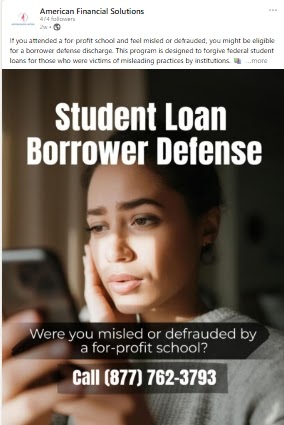
    American Financial Solutions (AFS) positions itself in social media as a lifeline for student loan borrowers, offering help with programs like Borrower Defense to Repayment (BDR), PSLF, closed-school discharge, teacher loan forgiveness, and income-driven repayment. They advertise a “95 percent success rate,” more than $25 million in loans discharged, and over 10,000 clients helped. AFS promotes a three-step approach: a free consultation, documentation collection, and federal application submission—with implied guarantees of approval. They even suggest that discharges can occur in as little as 12 to 36 months.

    Behind this polished marketing is a disturbing reality. When contacted directly, AFS quoted a $1,500 fee to file a Borrower Defense claim. The Department of Education provides this service for free, which makes the fee an unnecessary financial burden on people already struggling with debt. Worse still, AFS representatives falsely claimed that approval would be “guaranteed” because the borrower’s school was named in the Sweet v. Cardona settlement. That is not how the Sweet settlement worked, and no private company can guarantee outcomes in federal relief programs.

    AFS also collects a troubling amount of data from borrowers. According to its own disclosures, the company asks for names, contact information, educational histories, student loan details, financial information, and documentation of borrowers’ school experiences. It also stores communications and any additional information provided. Beyond that, the company automatically harvests website usage data, including IP addresses, device and operating system information, pages visited, time spent on the site, referring websites, and even search terms. This means that vulnerable borrowers are not only charged excessive fees but also exposed to unnecessary risks regarding their personal and financial data.

    While AFS presents itself as a nonprofit credit counseling agency with A+ BBB accreditation, consumer complaints suggest a lack of transparency and responsiveness. One unresolved 2024 complaint alleged billing issues, with the consumer insisting they were not liable for a debt and had no contract, while the company failed to respond. Independent review platforms show a mix of praise and criticism, with some clients reporting successful debt management experiences, but others raising questions about hidden costs, communication problems, and misleading claims.

    The bigger problem is that AFS fits a well-documented pattern of predatory practices in the student loan relief industry. Over the past decade, the Federal Trade Commission (FTC) and the Consumer Financial Protection Bureau (CFPB) have repeatedly shut down companies that charged for free government services, misrepresented their powers, and lied about forgiveness guarantees. In one case, the CFPB shut down Student Aid Institute, only to see its operator resurface under a new name and steal more than $240,000 from borrowers. In another, Monster Loans and its associates were sued for defrauding over 23,000 borrowers. The FTC has also acted against multiple operations that bilked millions of dollars from borrowers by pretending to be affiliated with the Department of Education. Even Navient, a major loan servicer, agreed in 2024 to pay $120 million after deceiving borrowers about repayment options.

    The risks to borrowers are increasing as federal oversight weakens. In 2025, reports revealed that the CFPB planned to scale back enforcement of student loan cases, leaving state regulators—who often lack resources—to fill the gap. Critics warned this would create “open season” for scammers. Against that backdrop, companies like AFS are free to charge high fees, collect sensitive data, and make deceptive promises while vulnerable borrowers remain unprotected.

    American Financial Solutions is not a solution. It is part of the problem, a business model that profits by charging people for free services, misrepresenting the law, and exposing them to new risks. Unless stronger oversight and enforcement are restored, borrowers will continue to be victimized first by predatory schools and then by predatory “relief” companies cashing in on their desperation.


    Sources

    American Financial Solutions marketing claims. amerifisolutions.com

    AFS data collection disclosure (website policy provided by user)

    Better Business Bureau profile. bbb.org

    BBB consumer complaint (2024). bbb.org

    Trustpilot reviews. trustpilot.com

    ConsumerAffairs reviews. consumeraffairs.com

    BestCompany review. bestcompany.com

    CuraDebt expert analysis. curadebt.com

    Federal Trade Commission. “American Financial Benefits Center Refunds.” ftc.gov

    Consumer Financial Protection Bureau. “CFPB Seeks Ban Against Operator of Student Loan Debt Relief Scam Reboot.” consumerfinance.gov

    Consumer Financial Protection Bureau. “CFPB Takes Action Against Operators of an Unlawful Student Loan Debt Relief Scheme.” consumerfinance.gov

    Federal Trade Commission. “FTC Acts to Stop Scheme that Bilked Millions out of Student Loan Borrowers.” ftc.gov, December 2024

    Federal Trade Commission. “Student Loan Debt Relief Scam Operators Agree to be Permanently Banned.” ftc.gov, May 2025

    Time Magazine. “Navient Settlement: Student Loan Borrowers to Receive Payments.” time.com, 2024

    The Guardian. “Brad Lander: CFPB Cuts Create Open Season for Fraudsters.” theguardian.com, May 2025

    Source link

  • UNITED ‘25: Principals explore solutions to pressing K-12 challenges

    UNITED ‘25: Principals explore solutions to pressing K-12 challenges

    Principals from K-12 schools across the country traveled to Seattle to attend UNITED, the National Conference on School Leadership, July 11-13, where they discussed and shared solutions for the many challenges facing the education sector.

    From concerns over school safety to the dilemma of chronic absenteeism, school leaders heard about innovative ways to tackle these issues by embracing local partnerships or looking into resources from national organizations. 

    Principals also learned about creative approaches emerging in the classroom. At one Indiana high school, for example, a public relations class is helping both to boost the school’s messaging to its community and to build students’ media skills. District administrators at Portland Public Schools, meanwhile, discussed how they’ve navigated and sustained a high-impact tutoring program in the state’s largest school district. 

    Read on for K-12 Dive’s coverage of the 2025 annual combined meeting of the National Association of Elementary School Principals and the National Association of Secondary School Principals.


    Source link

  • VP Online Enrollment, Integrated Marketing Solutions, Carnegie

    VP Online Enrollment, Integrated Marketing Solutions, Carnegie

    The last time we caught up with Shankar Prasad, he was telling us about his new role as chief strategy officer at Carnegie. Shankar reached out, saying that he is recruiting for the key role of Carnegie’s VP of online enrollment and integrated marketing solutions. As I’m on the lookout to share information with our community about roles at the intersection of learning, technology and higher education change, this job seemed perfect. Shankar graciously agreed to answer my questions about the role.

    Q: What is the mandate behind this role? How does it help align with and advance the company’s strategic priorities?

    A: Carnegie’s Online Program Experience (OPX) business line is an important growth area. The company aims to be the premier provider of integrated marketing and enrollment solutions for online programs. The mandate of the VP of online enrollment and integrated marketing solutions is to build and own the sales plan for this OPX business, drive revenue growth, and ensure that Carnegie’s full suite of services (research, strategy, digital marketing, lead generation, creative and website development) are successfully cross‑sold to new and existing clients.

    The job description states that the VP will “lead our sales strategy and execution to achieve our revenue targets,” shape the OPX growth strategy, and establish Carnegie as the premier provider of online program solutions in higher education. To do this, the VP must create the OPX sales plan, drive sales, meet goals and targets, and deliver growth through new clients and client‑expansion opportunities across Carnegie’s entire suite of services.

    This work aligns closely with Carnegie’s strategic priorities. The company positions itself as a leader in higher education marketing and enrollment strategy and emphasizes human‑centered, data‑driven solutions. By spearheading integrated marketing and enrollment solutions for online programs, the VP advances this mission—ensuring that Carnegie’s OPX offerings evolve with market trends, deliver measurable results and reinforce the organization’s leadership position. The role also requires thought leadership, cross‑team collaboration and partnerships, which support Carnegie’s focus on innovation and authentic human connections

    Q: Where does the role sit within the company’s structure? How will the person in this role engage with other units and leaders across the company?

    A: The VP of online enrollment and integrated marketing solutions is Carnegie’s leader of integrated sales for OPX. The position sits within the company’s growth and revenue organization and is accountable for the sales plan, revenue forecasting and team performance. The description notes that the VP “owns the development of all sales pursuits related to OPX” and partners closely with the SVP of marketing and the chief growth officer to develop messaging, positioning and proposals. This indicates that the role reports into or collaborates with senior leadership on growth strategy and marketing alignment.

    The role is highly cross‑functional. It requires partnering with marketing and business development to support inbound and new business pursuits and providing training and support to sales representatives in those divisions. The VP must collaborate with leaders of all business units to share feedback and optimize the OPX solution for clients.

    Day to day, the person will work with colleagues in sales, account management, production, senior strategists, client success, executive sales and enrollment strategy. They will also work with growth team members to craft proposals and coordinate with the marketing leader on business development materials and events. Additionally, the VP manages OPX revenue forecasting and ensures visibility across all accountable parties. This matrixed engagement means the VP acts as a connector between sales, marketing, product and leadership, ensuring that OPX solutions are delivered seamlessly and that market feedback informs strategic decisions.

    Q: What would success look like in one year? Three years? Beyond?

    A: In the first 12 months, success would involve laying the groundwork for a high-performing OPX sales organization. The VP should build and execute a sales plan, recruit or train a team, and cultivate strong relationships with marketing, business development and other unit leaders. Key milestones would include securing new OPX clients and expanding revenue from existing accounts, delivering on initial sales goals, instituting accurate revenue forecasting and establishing Carnegie as a respected thought leader at conferences and webinars.

    Three years: By year three, the VP should have turned OPX into a mature, scalable business line. The sales plan would be continuously optimized based on market feedback and the team would be driving sustained revenue growth across Carnegie’s services. Market penetration should be evident through a diversified client base, with high renewal and upsell rates. The VP should have built a strong network of external relationships and should be contributing to product evolution by monitoring industry trends and competitor activity. Measurable outcomes might include year‑over‑year revenue growth outpacing the market, higher average contract values and expanded partnerships or acquisitions that enhance the OPX offering.

    Beyond (five-plus years): Over a longer horizon, success would mean that the OPX division is a significant growth engine for Carnegie and a well‑recognized market leader. The VP will have built a resilient, data‑driven sales organization capable of adapting to changes in the higher education landscape. They may spearhead new offerings or strategic acquisitions and could play a central role in broader company leadership. The division’s revenue contribution might warrant further expansion into related services or international markets, ensuring Carnegie remains at the forefront of online program marketing and enrollment strategy.

    Q: What kinds of future roles would someone who took this position be prepared for?

    A: The VP of online enrollment and integrated marketing solutions oversees sales strategy, team leadership, revenue forecasting and cross‑functional collaboration. With 10-plus years of experience required in higher education enrollment and marketing for online programs, the role prepares someone for broader executive positions. Potential future roles could include:

    • Chief growth officer or chief revenue officer, because the VP manages revenue planning, sales execution and cross‑unit coordination.
    • General manager or president of a business unit, given the experience in developing a business line, building teams and driving profitability.
    • Chief marketing officer or chief commercial officer: The position demands collaboration with marketing leadership and deep knowledge of enrollment strategy.
    • Consulting or strategic advisory roles in higher education marketing and enrollment strategy, leveraging expertise in market trends, client relationships and integrated solutions.
    • Entrepreneurial leadership roles within the higher ed technology and services space, capitalizing on the growth mindset, executive presence and strategic thinking emphasized in the qualifications.

    By leading a high‑growth, cross‑disciplinary sales organization, the VP will develop a skill set that translates to senior leadership roles not only within Carnegie but across the broader higher education services sector.

    Source link

  • Empowering neurodiverse learners with AI-driven solutions

    Empowering neurodiverse learners with AI-driven solutions

    Key points:

    A traditional classroom is like a symphony, where every student is handed the same sheet music and expected to play in perfect unison. But neurodiverse learners are not able to hear the same rhythm–or even the same notes. For them, learning can feel like trying to play an instrument that was never built for them. This is where AI-powered educational tools step in, not as a replacement for the teacher, but as a skilled accompanist, tuning into each learner’s individual tempo and helping them find their own melody.

    At its best, education should recognize and support the unique ways students absorb, process, and respond to information. For neurodiverse students–those with ADHD, dyslexia, autism spectrum disorder (ASD), and other learning differences–this need is especially acute. Traditional approaches often fail to take care of their varied needs, leading to frustration, disengagement, and lost potential. But with advances in AI, we have the opportunity to reshape learning environments into inclusive spaces where all students can thrive.

    Crafting personalized learning paths

    AI’s strength lies in pattern recognition and personalization at scale. In education, this means AI can adapt content and delivery in real time based on how a student is interacting with a lesson. For neurodiverse learners who may need more repetition, multi-sensory engagement, or pacing adjustments, this adaptability is a game changer.

    For example, a child with ADHD may benefit from shorter, interactive modules that reward progress quickly, while a learner with dyslexia might receive visual and audio cues alongside text to reinforce comprehension. AI can dynamically adjust these elements based on observed learning patterns, making the experience feel intuitive rather than corrective.

    This level of personalization is difficult to achieve in traditional classrooms, where one teacher may be responsible for 20 or more students with diverse needs. AI doesn’t replace that teacher; it augments their ability to reach each student more effectively.

    Recent research supports this approach–a 2025 systematic review published in the EPRA International Journal of Multidisciplinary Research found that AI-powered adaptive learning systems significantly enhance accessibility and social-emotional development for students with conditions like autism, ADHD, and dyslexia.

    Equipping educators with real-time insights

    One of the most significant benefits of AI tools for neurodiverse learners is the data they generate–not just for students, but for educators. These systems can provide real-time dashboards indicating which students are struggling, where they’re excelling, and how their engagement levels fluctuate over time. For a teacher managing multiple neurodiverse learners, these insights are crucial. Rather than relying on periodic assessments or observations, educators can intervene early, adjusting lesson plans, offering additional resources, or simply recognizing when a student needs a break.

    Imagine a teacher noticing that a student with ASD consistently disengages during word problems but thrives in visual storytelling tasks. AI can surface these patterns quickly and suggest alternatives that align with the student’s strengths, enabling faster, more informed decisions that support learning continuity.

    Success stories from the classroom

    Across the U.S., school districts are beginning to see the tangible benefits of AI-powered tools for neurodiverse learners. For instance, Humble Independent School District in Texas adopted an AI-driven tool called Ucnlearn to manage its expanding dyslexia intervention programs. The platform streamlines progress monitoring and generates detailed reports using AI, helping interventionists provide timely, personalized support to students. Since its rollout, educators have been able to handle growing caseloads more efficiently, with improved tracking of student outcomes.

    Meanwhile, Houston Independent School District partnered with an AI company to develop reading passages tailored to individual student levels and classroom goals. These passages are algorithmically aligned to Texas curriculum standards, offering engaging and relevant reading material to students, including those with dyslexia and other learning differences, at just the right level of challenge.

    The future of neurodiverse education

    The promise of AI in education goes beyond improved test scores or sleek digital interfaces, it’s about advancing equity. True inclusion means providing every student with tools that align with how they best learn. This could be gamified lessons that minimize cognitive overload, voice-assisted content to reduce reading anxiety, or real-time emotional feedback to help manage frustration. Looking ahead, AI-driven platforms could even support early identification of undiagnosed learning differences by detecting subtle patterns in student interactions, offering a new frontier for timely and personalized intervention.

    Still, AI is not a silver bullet. Its impact depends on thoughtful integration into curricula, alignment with proven pedagogical goals, and ongoing evaluation of its effectiveness. To be truly inclusive, these tools must be co-designed with input from both neurodiverse learners and the educators who work with them. The score is not yet finished; we are still composing. Technology’s real legacy in education will not be in algorithms or interfaces, but in the meaningful opportunities it creates for every student to thrive.

    Latest posts by eSchool Media Contributors (see all)

    Source link

  • In an era of permacrisis, higher education needs to get better at coming up with solutions

    In an era of permacrisis, higher education needs to get better at coming up with solutions

    Readers of Wonkhe need no reintroduction to the storm surge of bad news that, wave after wave, is washing over the sector’s defences and causing the majority of UK institutions to take drastic financial evasive action.

    Given that the government’s response to the growing financial crisis in UK higher education seems to be “let’s do a ranking of vice chancellor salaries compared to graduate salaries” and “let’s introduce an international student levy that the Australian Government decided was a bad idea,” it also seems pretty clear that the sector isn’t exactly cutting through with its political affairs arguments.

    In other words, the sector has to generate our own solutions to the problems we face.

    On the back foot and retreating

    On 25 June The Venn University Leaders Forum will convene senior academic and professional service leaders from across the sector to provide them with the space, inspiration and facilitation needed to help develop these solutions.

    The Venn will feature interactive sessions focused on geopolitical scenario response, unconferences, challenges “from the vice chancellor’s desk” and perspectives from North America and from outside higher education. Most importantly it will take the conversations in the margins’ of conferences that so many of us find the most valuable part of these forums – and provide the space and format for that to happen during the main programme.

    We need a better playbook

    In adjusting to permacrisis, one of the challenges universities and the sector has as a whole is that we risk spending all our time and energy raising the shield to fend off each individual wave of issues; and wielding the sword only in a defensive, reactive measures to trim staff numbers, cut courses and reduce expenditure.

    There are two risks to this approach. First, institutions can’t “take a breath” to think about how they adapt to the new reality, leading to constant reactive churn, burnout of staff, and leadership feeling under siege. This reminds us of that moment in about February 2021 when the adrenaline of dealing with successive Covid impacts and new variants started to seriously ebb away from those within universities, and institutional leaders started to think longer term about how to turn ‘crisis-response mode’ into ‘crisis-as-usual’.

    Second, the sector misses the tsunami lurking on the horizon and fails to invest in measures that either avert or prepare for a much larger impact. Given that on almost every occasion in the last decade we’ve said, “oh, that couldn’t possibly happen” only for the Darkest Timeline to be victor – it’s now odds-on that a Farage-Badenoch ticket will sweep to victory in the next General Election. How is higher education preparing for this possibility?

    “Telling people what do” isn’t working

    When I was in the US recently as part of the CASE Global Leaders Programme, a senior representative from one of the US university associations said they had a shared bingo card with their colleagues that they used every time a university president said “we just need to tell our story better… we need a ‘Got Milk’ campaign.” But we’ve been trying versions of that for a while, and nothing has changed. It’s no longer sufficient for higher education to “tell” better. It needs to “do” better.

    For universities, the question is now no longer “how do you do more with less?” Instead, it is becoming “how do you do less with less?” – and what do you stop doing entirely? As difficult as the current situation may seem, the sector still has the resources, political capital and ingenuity to make bold, impactful choices about what it does differently. This includes new models of delivery that might change the public and political narrative, shift the dial financially and maybe even divert the worst case scenario. Critically it has the opportunity to look at what is happening around the world – most strikingly in the US – and learn what to do (and what not to do).

    This article is published in association with The Venn – find out more about The Venn and apply to attend here. Wonkhe is partnering with The Venn to create a dialogue between the event and our upcoming Festival of Higher Education on 11–12 November – early bird tickets are now on sale.

    Source link

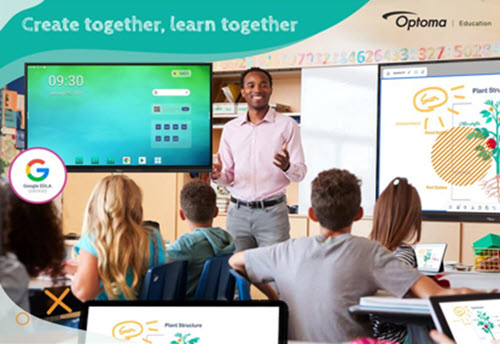
  • Optoma Announces Launch of the New 3-Series Interactive Displays with Google Certification and AI-Enabled Tools

    Optoma Announces Launch of the New 3-Series Interactive Displays with Google Certification and AI-Enabled Tools

    FREMONT, CA – Optoma, a world-leading provider of visual solutions, today announced its latest Creative Touch 3-Series Interactive Displays designed to empower educators and business professionals with new tools and features to enhance learning, make presentations more effective, and increase collaboration in classrooms, lecture halls, boardrooms, remote working and other business environments.

    With Google’s Enterprise Device Licensing Agreement (EDLA) Certification and added functionality, the new 3-Series empowers professionals and educators to deliver dynamic and impactful content by providing cutting-edge tools that streamline management and elevate engagement. The advanced capabilities of the new 3-Series simplify planning and workflow through wireless collaboration, screen sharing, and innovative meeting solutions in both corporate and educational environments alike, all packed into a robust yet user-friendly platform.

    The 3-Series: Purpose-Built for Corporate and Education Environments

    New features and key highlights include:

    Google EDLA Certification: Ensures compatibility and optimized performance with thousands of educational applications and services available directly from the pre-installed Google Play Store allowing users to experience the full Google Suite for real-time collaboration from practically anywhere in the world.  Without compatibility issues or the hassle of connecting an external PC, users can easily access the entire suite of Google-based applications they are accustomed to – including Google Drive, Google Docs, YouTube, and more!

    The Optoma Solution Suite (OSS®): User-friendly software featuring Artificial Intelligence (AI) enabled tools, such as Sticky Notes* and AI Handwriting Recognition, the OSS package also includes:

    • Whiteboard: Unleash creativity through a digital whiteboard packed with tools that make learning and sharing ideas engaging – facilitating collaboration in real-time from anywhere.
      • Smart Sketch tool is ideal for drawing diagrams as it recognizes shapes and drawings and converts them into clipart images.
      • Floating Toolbar and Infinity Canvas allow you to seamlessly switch between tools to suit your tasks with a virtually limitless writing space.
      • Innovative Annotation and Highlighter Tools make underlining key points or annotating complex diagrams a breeze.
    • File Manager: Easily save, organize, or move files from local storage to networkable storage or to popular cloud services in seconds.
    • Display Share: Connect any device to wirelessly broadcast, share, or stream your content to the big screen. Bringing your own device has never been easier.

    Exceptional Performance: Seamless performance with an 8-core processor, Android 14 OS, and Zero Bonding screen for that natural writing experience.

    “We are excited to announce our new 3-Series and partnership with Raptor Technologies which truly embodies our commitment to supporting education through cutting-edge visual solutions, enhanced software packages and safety and security,” said Maria Repole, Head of Marketing at Optoma.

    A value-added solution, Optoma Management Suite (OMS®) is available out of the box on the 3-Series Interactive Displays, with a free trial available.** OMS offers IT administrators and technicians a real time remote platform to monitor, manage, diagnose, and update multiple or entire fleets of displays simultaneously that are either on the same network or connected through the cloud. OMS makes it easy to broadcast emergency messages, alerts, or announcements across displays worldwide.

    Optoma is thrilled to partner with Raptor® Technologies, the leading innovator in school safety solutions, redefining the landscape of school security with its Raptor School Safety Software Suite. By integrating Raptor’s software with Optoma’s interactive displays, school administrators and students can receive real-time alerts and emergency notifications using CAP protocols to improve the overall safety of the school.

    To experience a demonstration and learn more about Optoma’s new Creative Touch 3-Series Interactive Displays, please schedule a demo or visit: https://www.optomausa.com/products/interactive-flat-panel-displays-3-series/education https://www.optomausa.com/products/interactive-flat-panel-displays-3-series/corporate

    *Some AI features may require the use of an Optoma (OSS) account.

    **Free trial licenses are available for a limited time. Please register your OMS® Cloud account at https://oms.optoma.com or speak with your local representative.

    OMS and OSS are registered trademarks of Optoma Corporation

    DLP is a registered trademark of Texas Instruments

    About Optoma Technology, Inc.  

    Optoma combines cutting-edge technology and innovation to deliver remarkable visual display products designed to connect audiences with engaging video experiences. From the company’s ProScene projectors to its Creative Touch interactive, Professional LCD and LED displays, Optoma’s suite of products can meet the demands of nearly any professional environment, including conference rooms and classrooms, digital signage, corporate, houses of worship, retail, simulation environments and control rooms. Optoma Technology is the U.S. headquarters for The Optoma Group, with continental headquarters also in Europe and Asia. For more information, visit optomausa.com.   

    eSchool News Staff
    Latest posts by eSchool News Staff (see all)

    Source link

  • Otus Wins Gold Stevie® Award for Customer Service Department of the Year

    Otus Wins Gold Stevie® Award for Customer Service Department of the Year

    CHICAGO, IL (GLOBE NEWSWIRE) — Otus, a leading provider of K-12 student data and assessment solutions, has been awarded a prestigious Gold Stevie® Award in the category of Customer Service Department of the Year at the 2025 American Business Awards®. This recognition celebrates the company’s unwavering commitment to supporting educators, students, and families through exceptional service and innovation.

    In addition to the Gold award, Otus also earned two Silver Stevie® Awards: one for Company of the Year – Computer Software – Medium Size, and another honoring Co-founder and President Chris Hull as Technology Executive of the Year.

    “It is an incredible honor to be recognized, but the real win is knowing our work is making a difference for educators and students,” said Hull. “As a former teacher, I know how difficult it can be to juggle everything that is asked of you. At Otus, we focus on building tools that save time, surface meaningful insights, and make student data easier to use—so teachers can focus on what matters most: helping kids grow.”

    The American Business Awards®, now in their 23rd year, are the premier business awards program in the United States, honoring outstanding performances in the workplace across a wide range of industries. The competition receives more than 12,000 nominations every year. Judges selected Otus for its outstanding 98.7% customer satisfaction with chat interactions, and exceptional 89% gross retention in 2024. They also praised the company’s unique blend of technology and human touch, noting its strong focus on educator-led support, onboarding, data-driven product evolution, and professional development.

    “We believe great support starts with understanding the realities educators face every day. Our Client Success team is largely made up of former teachers and school leaders, so we speak the same language. Whether it’s during onboarding, training, or day-to-day communication, we’re here to help districts feel confident and supported. This recognition is a reflection of how seriously we take that responsibility and energizes us to keep raising the bar,” said Phil Collins, Ed.D., Chief Customer Officer at Otus.

    Otus continues to make significant strides in simplifying teaching and learning by offering a unified platform that integrates assessment, data, and instruction—all in one place. Otus has supported over 1 million students nationwide by helping educators make data-informed decisions, monitor progress, and personalize learning. These honors reflect the company’s growth, innovation, and steadfast commitment to helping school communities succeed.

    About Otus

    Otus, an award-winning edtech company, empowers educators to maximize student performance with a comprehensive K-12 assessment, data, and insights solution. Committed to student achievement and educational equity, Otus combines student data with powerful tools that provide educators, administrators, and families with the insights they need to make a difference. Built by teachers for teachers, Otus creates efficiencies in data management, assessment, and progress monitoring to help educators focus on what matters most—student success. Today, Otus partners with school districts nationwide to create informed, data-driven learning environments. Learn more at Otus.com.

    Stay connected with Otus on LinkedIn, Facebook, X, and Instagram.

    eSchool News Staff
    Latest posts by eSchool News Staff (see all)


    Source link