As someone who’s dedicated my career to advancing the Science of Reading movement, I’ve seen firsthand what it takes to help every child become a strong, fluent reader. We’ve made incredible strides in shifting the conversation toward evidence-based instruction, but I know we’re at a critical inflection point. While we–obviously–continue our work helping schools and districts adopt SOR, there’s an issue that stands in the way of real, sustained, progress: the staffing crisis and leadership churn that are leaving our educators overwhelmed and skeptical toward “change.” Without addressing these deeper structural issues, we risk stalling the momentum we’ve worked so hard to build.
The hidden costs of constant turnover
The data on teacher and leader turnover is bleak, and I’ve seen how it undermines the long-term commitment needed for any meaningful change. Consider this: Roughly 1 in 6 teachers won’t return to the same classroom next year, and nearly half of new teachers leave within their first five years. This constant churn is a massive financial burden on districts, costing an estimated $20,000 per teacher to recruit, hire, and onboard. But the real cost is the human one. Every time a new leader or teacher steps in, the hard-won progress on a literacy initiative can be jeopardized.
I’ve watched districts spend years building momentum for the Science of Reading, providing extensive training and resources, only to see a new superintendent or principal arrive with a new set of priorities. This “leader wobble” can pull the rug out from under an initiative mid-stream. It’s especially frustrating when a new leader decides a program has had “plenty of professional learning” without taking the time to audit its impact. This lack of continuity completely disrupts the 3-5 years it takes for an initiative to truly take hold, especially because new teachers often arrive with a knowledge gap, as only about one-quarter of teacher preparation programs teach the Science of Reading. We can’t build on a foundation that’s constantly shifting.
Overwhelmed by “initiative fatigue”
I know what it feels like to have too much on your plate. Teachers, already juggling countless instructional materials, often see each new program not as a solution but as one more thing to learn, implement, and manage. Instead of excitement, there’s skepticism–this is initiative fatigue, and it can stall real progress. I’ve seen it firsthand; one large district I worked with rolled out new reading, math, and phonics resources all at once.
To prevent this, we need to follow the principle of “pull weeds to plant flowers.” Being critical, informed consumers of resources means choosing flowers (materials) that are:
• Supported by high-quality, third-party research • Aligned across all tiers of instruction • Versatile enough to meet varied student needs • Teacher-friendly, with clear guidance and instructional dialogue • Culturally relevant, reflecting the diverse backgrounds of students
Now, even when a resource meets these standards, adoption shouldn’t be additive. Teachers can’t layer new tools on top of old ones. To see real change, old resources must be replaced with better ones. Educators need solutions that provide a unified, research-backed framework across all tiers, giving teachers clarity, support, and a path to sustainable student progress.
Building a stable environment for sustained change
So, how do we create the stable environment needed to support our educators? It starts with leadership that is in it for the long game. We need to mitigate turnover by using data to understand why teachers are leaving and then acting on that feedback. Strengthening mentorship, clarifying career pathways, and improving school culture are all crucial steps.
Beyond just retaining staff, leaders must foster a culture of sustained commitment. It’s not enough to have a few “islands of excellence” where a handful of teachers are getting great results.
We need system-wide adoption. This requires strong leaders to balance support and accountability. I’ve seen how collaborative teams, engaged in problem-solving and data-based decision-making, can transform a school. When teachers see students as “our students” and not just “my students,” shared ownership grows.
A leader’s job is to protect and sustain this vision, making sure the essential supports–like collaborative planning time, ongoing professional development, and in-classroom coaching–are in place. But sustaining change goes beyond daily management; it requires building deep capacity so the work continues even if leadership shifts. This means hiring, training, and retaining strong educators, investing in future leaders, and ensuring committed advocates are part of the implementation team. It also requires creating a detailed, actionable roadmap, with budgets clearly allocated and accountability measures established, so that any initiative isn’t just a short-term priority but a long-term promise. By embedding these structures, leaders can secure continuity, maintain momentum, and ensure that every step forward in literacy translates into lasting gains for students.
Every field has its detectives. In medicine, some of the most skilled professionals are physician-scientists: individuals trained in both medicine and research, caring for patients while investigating the biology behind their illnesses.
A physician treats. A scientist discovers. A physician-scientist operates in both worlds, identifying patterns in the clinic that can lead to breakthroughs in the lab, and then applying those discoveries to patient care. They don’t work alone — advancing against disease is always a team effort —but their training and expertise help them connect the dots.
One of the biggest medical mysteries of the past 50 years has been HIV. The story of our progress, and how close we are to a cure, shows why physician-scientists are vital.
The early days of HIV
When AIDS first emerged in the early 1980s, it was a frightening, deadly, and poorly understood disease. An early breakthrough occurred when physician-scientist Dr. Robert Gallo, M.D. (in the United States) and scientists Françoise Barré-Sinoussi, Ph.D., and Luc Montagnier, Ph.D. (in France) co-discovered HIV as the cause of AIDS.
At a hopeful 1984 press conference, the U.S. health secretary announced that a vaccine would be available “within two years.” But it never materialized. HIV proved to be different, and traditional vaccination methods continued to fail. Nevertheless, physicians, scientists, and physician-scientists persisted. By 1987, the first drug, AZT, and the development of combination antiretroviral therapies offered a lifeline. They changed HIV from nearly certain death to a manageable chronic condition. This was a triumph of biomedical research, but it was not a cure.
A genetic clue
The next twist came from a curious observation: Some people exposed to HIV never got sick, even after repeated exposure. Physician-scientist Dr. Paolo Lusso, M.D., Ph.D., helped uncover why. The key was a protein on the surface of immune cells called CCR5, the very door HIV used to enter and infect cells. Around the same time, scientist Stephen O’Brien, Ph.D., found that the people who appeared resistant to infection carried a rare mutation in CCR5 (CCR5-Δ32), which essentially locked the door shut to HIV. It was a detective story in real time — a mystery observed from patients in the clinic that was solved in the research laboratory. It hinted at a direction for a cure.
The first cures
The CCR5 breakthrough was a pivotal moment. In 2007, physician-scientist Dr. Gero Hütter met Timothy Ray Brown (the “Berlin Patient”), an individual with HIV who also had leukemia. Dr. Hütter recalled that the CCR5-Δ32 mutation was the key to HIV resistance. He and his team wondered: What if they treated Brown’s leukemia with a bone marrow transplant from a donor with the CCR5-Δ32 mutation? Could this also cure his HIV infection? The outcome was remarkable. Timothy Ray Brown was treated for his leukemia and was also cured of HIV.
This wasn’t a one-time event, however, as physician-scientist Dr. Ravindra Gupta, M.D., Ph.D., reported on a second patient, Adam Castillejo (the “London Patient”), cured of HIV through a similar procedure a decade later. Curing HIV with a bone marrow transplant using cells resistant to infection was crucial. Today, about 10 people have been “cured” this way.
What comes next
Although bone marrow transplants have been a breakthrough in curing HIV, they are risky, costly, and not a practical solution for the 39 million people worldwide living with HIV. The key question now is, exactly how did the donor CCR5 mutation, or the transplant itself, lead to the clearance and complete resistance to HIV?
At Oregon Health & Science University, scientist Jonah Sacha, Ph.D., and his team are working to answer that question. Supported by a new joint NIH grant, his team is studying these HIV-cured individuals to discover what truly happened inside their bodies, and how to replicate it into a safe, scalable cure. With the foundational knowledge and expertise from decades of observations, research, and clinical work by physicians and physician-scientists, the Sacha team is prepared for the next breakthrough.
The ongoing story of HIV and AIDS highlights how crucial physician-scientists were in connecting patients’ experiences to scientific advances and transforming clues into cures.
Medical mysteries still exist, and physician-scientists are here to solve them.
Join our zero2eight Substack community for more discussion about the latest news in early care and education. Sign up now.
The U.S. military faced a new threat to national security toward the end of the 20th century. This threat affected the recruitment and retention of our nation’s armed forces, reducing their capacity to defend the denizens of the United States and our interests overseas.
The threat wasn’t the Cold War; it wasn’t tension in the Middle East; and it wasn’t international or domestic terrorism.
The threat was a lack of affordable, accessible, high-quality child care.
The makeup of the armed forces changed following the shift from a national draft to an all-volunteer military after the war in Vietnam. More service members had families in the late 1970s and 1980s — many of them with young children. And many more of those families included two working parents than in previous decades.
The child care crisis faced by the military 40 to 50 years ago was similar to the one civilians face today. More families with working parents increased the demand for child care. Thousands of children languished on waitlists, forcing families to consider forms of supervision that lacked consistent standards for safety, teacher training, student/teacher ratios, and curricula. Teachers were poorly compensated, and turnover was high.
Back then, as now, parents couldn’t afford the fees necessary to cover the costs of addressing these challenges, and limited public investment wasn’t enough to fill the gap.
Graphic by Lanie Sorrow
Because the child care crisis was seen as a threat to the collective future of Americans, elected officials took action. Congress passed the Military Child Care Act of 1989, which put a priority on affordability, accessibility, and quality in child care for service members.
With the end of child care stabilization efforts that were undertaken during the pandemic, North Carolinians now face a similar threat to our own collective future. The military’s approach offers lessons for where we can go from here, in our communities and across our state.
An experiment in universal child care
The Military Child Care Act wasn’t the first time the military had taken the lead on child care. During World War II, women entered the workforce in massive numbers, filling the roles of men who were drafted to serve in the military. This raised the question of who would care for children when both parents were working outside the home to defend American interests.
Congress responded with the Lanham Act of 1940, creating a nationwide, universal child care system to support working families with children through age 12. Federal grants were issued to communities that demonstrated their need for child care related to parents working in the defense industry.
The program distributed $1.4 billion (in 2025 dollars) between 1943 and 1946 to more than 600 communities in 47 states. The grants could be used to build and maintain child care facilities, train and compensate teachers, and provide meals to students.
In his 2017 analysis of the Lanham Act’s outcomes for mothers and children, Chris M. Herbst, of Arizona State University’s School of Public Affairs, found that “the Lanham Act increased maternal employment several years after the program was dismantled.”
An image of Rosie the Riveter from a 1943 issue of the magazine Hygeia (published by the American Medical Association) demonstrating the need for child care.
Herbst also found that “children exposed to the program were more likely to be employed, to have higher earnings, and to be less likely to receive cash assistance as adults.”
One lesson Herbst took from his research was that the Lanham Act was successful because of the broad support it received from parents, advocates for education and women, and employers. He noted: “Each group was committed to its success because something larger was at stake.”
Today’s military-operated child care model
While the Lanham Act was a short-lived national experiment that hasn’t received much study, the military’s child care program since adoption of the Military Child Care Act of 1989 has become a widely acclaimed model for publicly subsidized early care and learning, serving about 200,000 children each year.
Four categories of child care are available through military-operated child care programs: Child Development Centers (CDCs), Family Child Care (FCC), 24/7 Centers, and School Aged Care (SAC). The official military child care website describes each program type:
Child Development Centers (CDCs) — CDCs provide child care services for infants, pretoddlers, toddlers, and preschoolers. They operate Monday through Friday during standard work hours, and depending on the location offer full-day, part-day, and hourly care.
Family Child Care (FCC) — Family child care is provided by qualified child care professionals in their homes. Designed for infants through school agers, each FCC provider determines what care they offer, which may include full-day, part-day, school year, summer camp, 24/7, and extended care.
24/7 Centers — 24/7 Centers provide child care for infants through school age children in a home-like setting during both traditional and non-traditional hours on a regular basis. The program is designed to support watch standers or shift workers who work rotating or non-traditional schedules (i.e., evenings, overnights, and weekends).
School Aged Care (SAC) — School age care is facility-based care for children from the start of kindergarten through the end of the summer after seventh grade. This program type operates Monday through Friday during standard work hours. SAC programs provide both School Year Care and Summer Camp.
Requirements for military-operated child care programs are typically more stringent than state requirements. For one thing, they must be accredited by one of the following: National Association for the Education of Young Children (NAEYC), National Early Childhood Program Accreditation (NECPA), the Council on Accreditation (COA), or the National Accreditation Commission (NAC).
For context, the requirements for licensed child care in North Carolina are relatively stringent compared with other states, but still fall below the requirements for NAEYC accreditation, which is widely recognized as the national standard. Only 110 programs in our state are NAEYC-accredited — many of which are Head Start or military-operated programs — out of about 5,300 total state-licensed programs.
Military-operated child care programs offer families hourly, part-day, full-day, extended, or overnight care, plus afterschool and summer programs.
The maximum rate is on par with the national average for civilian child care in 2023, meaning that almost every family using military-operated child care programs is paying less than the national average for typically higher-quality early care and learning.
The Department of Defense budgeted about $1.8 billion for child care in 2024 — about 0.2% of its $841.4 billion total budget.
Military child care in North Carolina
In addition to military-operated child care programs, service members may be eligible for Military Child Care in Your Neighborhood (MCCYN), a fee assistance program for families who can’t access military-operated child care. MCCYN pays a portion of the cost of enrolling children in early care and learning programs that meet the military’s high-quality standards in their community.
North Carolina is one of 19 locations where military families may be eligible for MCCYN-PLUS, which expands the MCCYN program to child care programs that participate in state or local Quality Rating and Improvement Systems (QRIS) in places where nationally accredited care is not available.
Both programs rely on the availability of high-quality child care in civilian communities. That’s a challenge in North Carolina, which was already facing a child care shortage before the pandemic. Our state has lost almost 6% of licensed child care programs since February 2020, with more expected to close because stabilization grants have ended.
According to the NC Military Affairs Commission, there are 12 military bases and more than 130,000 active-duty military members in North Carolina, giving us the fourth-largest active-duty military population in the nation.
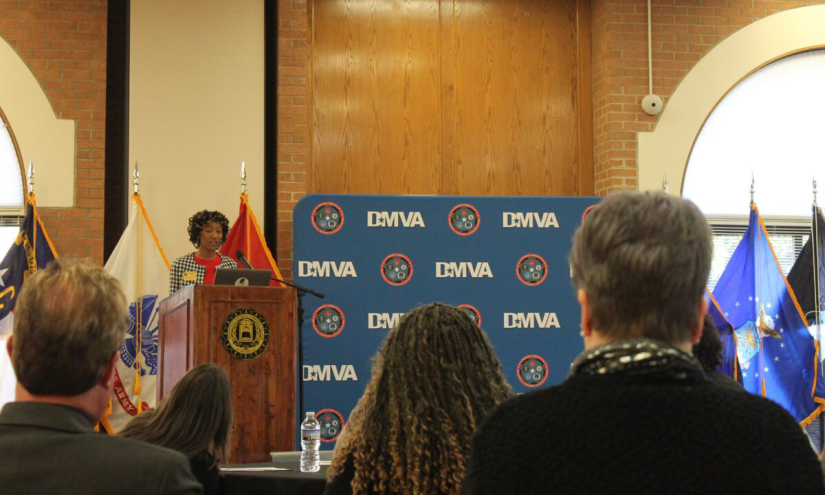
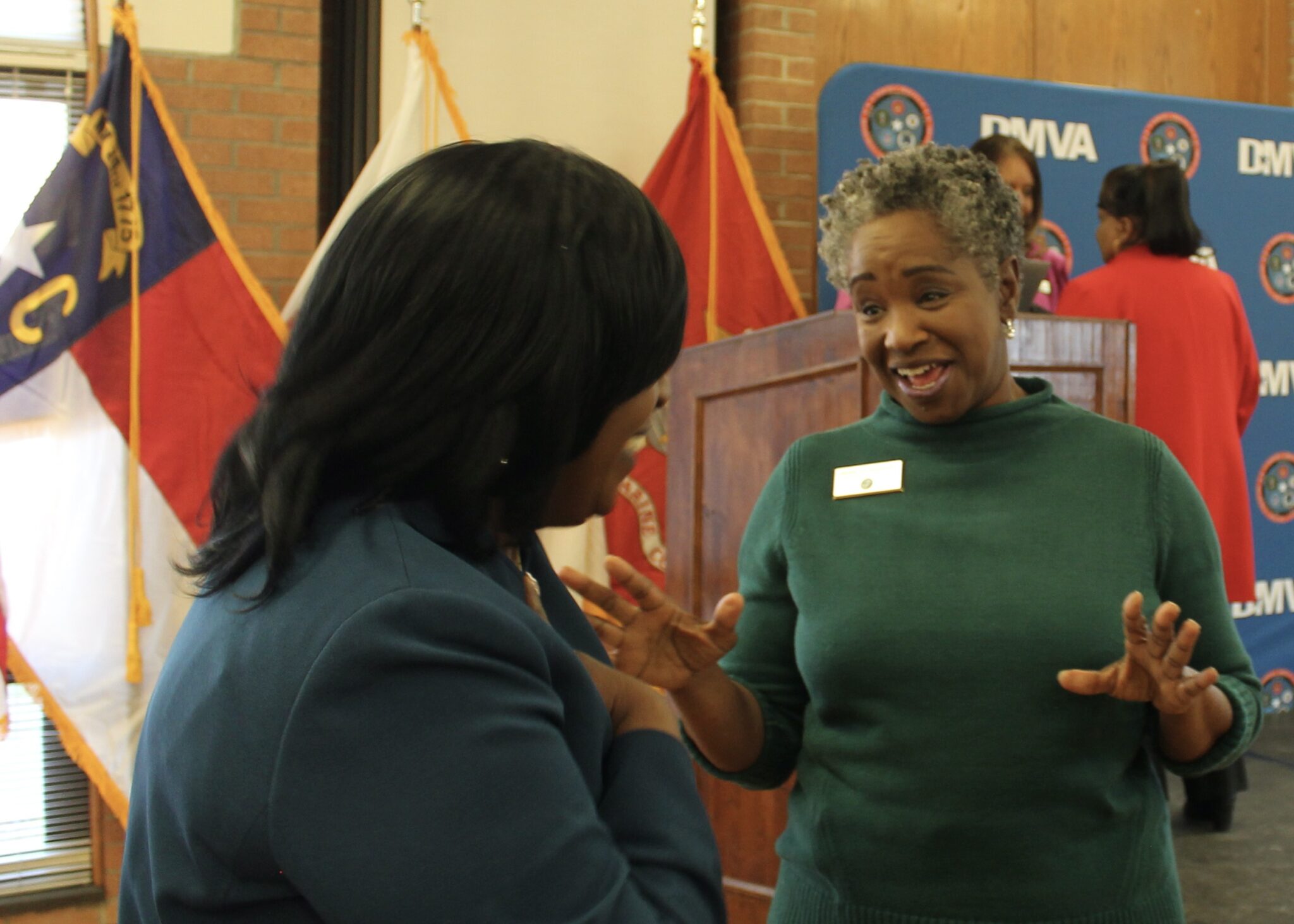
In January 2025, Fayetteville Technical Community College hosted the state’s first N.C. Military Community Childcare Summit, organized by the North Carolina Department of Military and Veteran Affairs (NCDMVA) to discuss the problem that military communities are having with access to community-based child care.
The first N.C. Military Community Childcare Summit in January 2025.( Katie Dukes/EdNC)
The summit culminated in a screening of Take Care, a documentary about North Carolina’s child care crisis produced by the state Department of Health and Human Services and featuring EdNC’s early childhood reporter, Liz Bell.
The issues of spouse resilience and child care are inextricably linked for Angie Mullennix, who works for The Honor Foundation at Fort Bragg, helping members of the U.S. Special Operations Forces (SOF) transition to careers in the private sector after their military service.
Mullennix served in the U.S. Army for four years after high school and has previously worked for the Department of Public Instruction as the state military liaison. Her husband recently retired from the SOF himself. They have two teenage children.
“If you look at the number of military spouses in North Carolina who have degrees and credentials and could be in the workforce, from nurses to lawyers, lots of them are staying at home,” Mullennix said.
“A big reason why about 40% of (military) spouses do not work is because of child care not being available to them,” Mullennix said, noting that lack of child care is also a barrier to workforce participation among the civilian population.
When Mullennix’s children were under the age of 5, she used hourly child care on base, which was available at no cost when her husband was away on assignment.
“You ask any parent in the world, I don’t care who they are, there’s nothing more important than their child’s safety — then their education,” Mullennix said. “And yet, the two things we think are the most important, we put (their providers) at the lowest pay and ask them to do quality care.”
That’s what sets military child care apart from civilian early care and learning for Mullennix: high quality standards and higher pay for early childhood educators, including benefits. She sees lessons in this for North Carolina.
“You gotta pay them to keep them, there’s no secret behind that,” Mullennix said. “If you pay them high, you can also set the standards really high.”
And because workforce participation — and military readiness — is directly tied to the accessibility and affordability of high-quality child care, not investing in it threatens our collective future.
“North Carolina, or any state that doesn’t offer child care, is shooting itself in the foot,” Mullennix said.
Lessons from military child care
Policymakers at every level who are seeking to end the child care crisis can learn much from the military child care model. One report on the topic offers these lessons:
Do not be daunted by the task. It is possible to take a woefully inadequate child care system and dramatically improve it.
Recognize and acknowledge the seriousness of the child care problem and the consequences of inaction.
Improve quality by establishing and enforcing comprehensive standards, assisting providers in becoming accredited, and enhancing provider compensation and training.
Keep parent fees affordable through subsidies.
Expand the availability of all kinds of care by continually assessing unmet need and taking concrete action steps to address it.
Commit the resources necessary to get the job done.
Both agreed these are the right takeaways for policymakers across North Carolina to consider.
Lesson 1: Do not be daunted by the task
Gale Perry said the top lesson for her is: “Start where you are, know that change is possible, and have a goal post in mind.”
She pointed out that the military’s goal wasn’t a fully publicly funded child care system. It was a system that acknowledged Americans’ values around the role of parents in raising young children — and paying for their care and education. But also that their employers and the government “have a role in offsetting that cost, so that we can ensure that child care is quality, and it is stable, and that the families can actually afford it.”
Smith said there was no “silver bullet” when she and her colleagues were tasked with solving the military’s child care crisis in the 1990s — and there isn’t one for the civilian child care crisis today.
We had to redo the standards, we had to look at the workforce, we had to look at the health and safety issues, we had to look at the fees and how we could bring those fees down. We had to look at the infrastructure of all of it. We’ve got to start thinking about the interconnectedness of all of these things if we’re going to be successful in this country.
Smith said people think that because she worked for the secretary of defense, “I could just tell all the bases what to do, and that would magically happen, which is so not true. It wasn’t just like we could give an order and everybody jumped.”
She said you just have to start where you are, and move up.
Lesson 2: Acknowledge the seriousness of the problem and the consequences of inaction
“The military understood very early the link between people getting to work and child care,” Smith said.
As the military shifted away from relying on conscription and became a more welcoming workplace for women, the need for child care became evident. Smith described working on a base where children were routinely left in cars when their parents were unexpectedly called into work.
“So (military leaders) really got the connection to their guys going to work very quickly, and I think that we still haven’t all understood that in this country,” Smith said, though she notes businesses have started making that connection since the pandemic.
“The other thing the military understood was that a pilot is every bit as important as the mechanic who works on the plane, and so they invest in all of their people,” Smith said.
She and her team had to design a program that worked for everyone, or it wouldn’t work for anyone.
Lesson 3: Improve quality
Smith said quality was of critical importance when she was designing the military’s child care system in the 1990s, especially after child abuse and neglect scandals that came to light in the 1980s.
She and her team studied the child care standards of all 50 states and created a set of military standards that fell squarely in the middle. Then they set about training the 22,000 early childhood educators they already had — most of whom were military spouses — to meet those standards.
That was a six-month training program. Then there was an 18-month training to get them to move beyond those standards toward national accreditation. They hired highly qualified trainers to work with educators at each site.
“And if you didn’t do it, guess what? You’re fired!” Smith said.
There was an incentive to participate in the training, beyond keeping their jobs — higher compensation.
“Maybe some were grumpy about it, but we didn’t have to fire people,” Smith said.
North Carolina already has some tools in place to help educators advance their education and improve their compensation, specifically through the WAGE$ and TEACH programs — both of which were highlighted in the report that identified these lessons.
“(The military) realized they had to get serious about quality and quality standards. And I would say that’s a lesson for us now, particularly in a climate that is deregulatory,” Gale Perry said. “And while I’m for sensible regulatory reform, I think we have to be really thoughtful about not wanting stacks of child deaths in child care sitting on a desk waiting to be investigated.”
Lesson 4: Keep parent fees affordable through subsidies
Smith said that while designing the military’s child care program, she and her team figured out that there was no way parents could afford the actual cost of high-quality child care. So they set up a subsidized system that would provide a 50% match — on average — to parents’ fees, paid directly to child care programs.
“We had to, on average, match parent fees dollar-for-dollar, with the higher-income people paying more and the lower-income paying less,” Smith said. “So a major, for example, would pay two-thirds of the cost, and a private would pay one-third, but the average was 50/50.”
Smith pointed out that we’re already subsidizing child care in ways that are hidden — through the public benefits and social programs that early childhood educators often rely on because of low compensation, and through lack of workforce participation.
Lesson 5: Expand the availability of all kinds of care
Gale Perry said the military’s model really stands out to her for its ability to assess unmet needs and take action to improve.
“In the early 2000s when there were the wars in Iraq and Afghanistan, there were a lot of deployments of National Guard and Reserve who did not live on post and did not have access to on-post child care,” Gale Perry said. “That is really when the military got in the business of thinking about, how do we help build capacity and make child care accessible for military families off post?”
That’s when the MCCYN came about, subsidizing high-quality early care and learning in a broader array of settings in the communities where service members live.
Smith said that the Military Child Care Act was originally targeted toward child care centers, but she recalls briefing the assistant secretary of defense on the potential effects of that strategy when they were designing the system:
I remember saying we need to apply all of this to family child care, to school-aged care, to part-day preschools, because if we don’t, all the parents are going to have a demand on these centers that we can’t meet, right? Because if you lower the cost in the centers and you improve the quality, why would somebody go to another place when they get it cheaper and better over here?
She made the case for educators in every setting getting the same access to training and the same level of compensation, because that’s what would work best for everyone.
“Everything applies to everybody,” Smith said. “And I think that was one of the smartest policy decisions we made.”
Lesson 6: Commit the resources necessary to get the job done
“There was this perception that we just had a lot of money and we threw it at” child care, Smith said. But that wasn’t the case.
“When they passed the Military Child Care Act, it didn’t come with an appropriation,” Gale Perry said. “So they had to fight equally hard for the funding, and a lot of the funding actually ended up coming from local base commanders making the decision to invest in child care.”
Now the military submits a budget request to Congress each year, and depends on those appropriations.
For state and local policymakers seeking to solve the civilian child care crisis without public investment, the woman credited with solving the military’s own child care crisis 35 years ago has a message.
“It’s gonna cost. There’s no way it doesn’t cost,” Smith said.
The recent NAEP scores have confirmed a sobering truth: Our schools remain in the grips of a literacy crisis. Across the country, too many children are struggling to read, and too many teachers are struggling to help them. But why? And how do we fix it?
There are decades of research involving thousands of students and educators to support a structured literacy approach to teaching literacy. Teacher preparation programs and school districts across the nation have been slow to fully embrace this research base, known as the science of reading. Since 2017, consistent media attention focused on the literacy crisis has created a groundswell of support for learning about the science of reading. Despite this groundswell, too many educators are still entering classrooms without the skills and knowledge they need to teach reading.
While there is steady progress in teacher preparation programs to move toward the science of reading-aligned practices, the National Council on Teacher Quality’s latest report on the status of teacher preparation programs for teaching reading (2023) still shows that only 28 percent of programs adequately address all five components of reading instruction. Furthermore, according to the report, up to 40 percent of programs still teach multiple practices that run counter to reading research and ultimately impede student learning, such as running records, guided reading, leveled texts, the three cueing systems, etc. This data shows that there is still much work to be done to support the education of the teacher educators responsible for training pre-service teachers.
The disconnect between theory and practice
When it comes to literacy instruction, this problem is especially glaring. Teachers spend years learning about teaching methods, reading theories, and child development. They’re often trained in methods that emphasize comprehension and context-based guessing. However, these methods aren’t enough to help students develop the core skills they need to become proficient readers. Phonics–teaching students how to decode words–is a critical part of reading instruction, but it’s often left out of traditional teacher prep programs.
One primary reason this disconnect happens is that many teacher prep programs still rely on outdated methods. These approaches prioritize reading comprehension strategies that focus on meaning and context, but they don’t teach the foundational skills, like phonics, essential for developing fluent readers.
Another reason is that teacher prep programs often lag when it comes to incorporating new research on reading. While the science of reading–a body of evidence built from decades of research and studies involving thousands of students and educators about how humans learn to read and the instructional practices that support learning to read–has been gaining deserved traction, it’s not always reflected in the teacher preparation programs many educators go through. As a result, teachers enter classrooms without the knowledge, skills, and up-to-date methods they need to teach reading effectively.
A way forward: Structured literacy and continuous professional development
For real progress, education systems must prioritize structured literacy, a research-backed approach to teaching reading that includes explicit, systematic instruction in phonics, decoding, fluency, and comprehension. This method is effective because it provides a clear, step-by-step process that teachers can follow consistently, ensuring that every single student gets the support they need to succeed.
But simply teaching teachers about structured literacy is not enough. They also need the tools to implement these methods in their classrooms. The goal should be to create training programs that offer both the theoretical knowledge and the hands-on experience teachers need to make a lasting difference. Teachers should graduate from their prep programs not just with a degree but with a practical, actionable plan for teaching reading.
And just as important, we can’t forget that teacher development doesn’t end once a teacher leaves their prep program. Just like doctors, teachers need to continue learning and growing throughout their careers. Ongoing professional development is critical to helping teachers stay current with the latest research and best practices in literacy instruction. Whether through in-person workshops, online courses, or coaching, teachers should have consistent, high-quality opportunities to grow and sharpen their skills.
What do teacher educators need?
In 2020, the American Federation of Teachers published an update to its seminal publication, Teaching Reading is Rocket Science. First published in 2000, this updated edition is a collaboration between the AFT and the Center on Development and Learning. Although some progress has been made over the past 20 years in teaching reading effectively, there are still too many students who have not become proficient readers.
This report outlines in very specific ways what pre-service and in-service teachers need to know to teach reading effectively across four broad categories:
Knowing the basics of reading psychology and development
Understanding language structure for word recognition and language comprehension
Applying best practices (based on validated research) in all components of reading
Using validated, reliable, efficient assessments to inform classroom teaching
There should be a fifth category that is directly related to each of the four areas listed above: the knowledge of how to address the specific oral language needs of multilingual learners and speakers of language varieties. Structured, spoken language practice is at the heart of addressing these needs.
Moving forward: Reimagining teacher training
Ultimately, fixing the literacy crisis means changing the way we think about teacher preparation and ongoing professional development. We need to create programs that not only teach the theory of reading instruction but also provide teachers with the practical skills they need to apply that knowledge effectively in the classroom. It’s not enough to just teach teachers about phonics and reading theory; they need to know how to teach it, too.
Literacy instruction must be at the heart of every teacher’s training–whether they teach kindergarten or high school–and ongoing professional development should ensure that teachers have the support they need to continuously improve.
It’s a big task, but with the right tools, knowledge, and support, we can bridge the gap between theory and practice and finally begin to solve a literacy crisis that has stubbornly endured for far too long.
Lacey Robinson, UnboundEd & CORE Learning
Lacey Robinson, CEO of UnboundEd and board chair of CORE Learning, has devoted her career to empowering educators to break the predictability of student achievement outcomes. She oversees UnboundEd’s vision for how grade-level, engaging, affirming, and meaningful–GLEAM®–instruction can ensure every single student succeeds and thrives. A former teacher, principal, professional development specialist, and author of Justice Seekers, Robinson was named to Forbes 50 Over 50 list in 2023.
Latest posts by eSchool Media Contributors (see all)
I write this post to e-Literate readers, Empirical Educator Project (EEP) participants, and 1EdTech members. You should know each other. But you don’t. We should all be working on solving problems together. But we aren’t.
Not yet, anyway. Now that EEP is part of 1EdTech, I’m writing to ask you to come together at our Learning Impact conference in Indianapolis, the first week in June, to take on this work together.
1EdTech has the potential to enable a massive learning impact because we have proven that we can change the way the entire EdTech ecosystem works together. (I recently posted a dialogue with Anthropic Claude about this topic.) I highlight the word “potential” because, as a community-driven organization, we only take on the challenges that the community decides to take on together. And the 1EdTech community has not had many e-Literate readers and EEP participants who can help us identify the most impactful challenges we could take on together.
On the morning of Monday, June 2nd, we’ll have an EEP mini-conference. For those of you who have been to EEP before, the general idea will be familiar but the emphasis will be different. EEP didn’t have a strong engine to drive change. 1EdTech does. So the EEP mini-conference will be a series of talks in which the speakers propose ideas about what the 1EdTech should be working on, based on its learning impact. If you want to come just for the day, you can register for the mini-conference for $350 and participate in the opening events as well. But I invite you to register for the full conference. If you scan the agenda, you’ll see sessions throughout the conference that will interest e-Literate readers and EEP participants.
EEP will become Learning Impact Labs
We’re building something bigger. Nesting EEP inside Learning Impact is just a start. Our larger goal is to create an umbrella of educational impact-focused proposals for work that 1EdTech can take on now and a series of exploratory projects for us to understand work that we may want to take on soon. You may recall my AI Learning Design Assistant (ALDA) project, for example. That experiment now lives inside 1EdTech. As a community, we will be working to become more proactive, anticipating needs and opportunities that are directly driven by our collective understanding of what works, what is needed, and what is coming. We will have ideas. But we need yours.
Come. Join us. If you’ve been a fellow traveler with me but haven’t seen a place for you at 1EdTech, I want you to know we have a seat with your name on it. If you’re a 1EdTech member who has colleagues more focused on the education (or the EdTech product design) side, let them know they can have a voice in 1EdTech.
Since the adjustments to the Office for Students’ (OfS) Condition B3: Student outcomes, published continuation rates have dropped from 91.1% in 2022 to 89.5% in 2024 for full-time students on their first degree.
This drop is most evident for students in four key areas: (1) foundation year courses; (2) sub-contracted and franchised courses; (3) those with lower or unknown qualifications on entry; and (4) those studying particular subjects including Business and Management, and Computing.
Universities utilising student engagement analytics are bucking this downward trend. Yet, surprisingly, engagement analytics are not mentioned in either the evaluation report or the accompanying Theory of Change document.
Ignoring the impact of analytics is a mistake: universities with real-time actionable information on student engagement can effectively target those areas where risks to continuation are evident – whether at the programme or cohort level, or defined by protected characteristics or risks to equality of opportunity.
The [engagement analytics] data you see today is next year’s continuation data.
Dr Caroline Reid, former Associate Dean at the University of Bedfordshire
A more complete view of student learning
The digital footprints generated by students offer deep insights into their learning behaviours, enabling early interventions that maximise the opportunity for students to access the right support before any issues escalate. While data can never explain why a student is disengaging from their learning, it provides the starting point for a supportive outreach conversation. What happens thereafter would depend on what the conversation revealed – what kind of intervention would be most appropriate for the student? Examples include academic skills development, health and wellbeing support or financial help. The precise nature of the intervention would depend on the ecosystem of (typically) the professional services success and support expertise available within each institution.
Analysing engagement activity at the cohort level, alongside the consequent demand on student services teams, further enables universities to design cohort or institution-wide interventions to target increasingly stretched resources where and when they are needed most.
[With engagement analytics we have] a holistic view of student engagement … We have moved away from attendance at teaching as the sole measure of engagement and now take a broader view to enable us to target support and interventions.
Richard Stock, Academic Registrar, University of Essex
In 2018–19, 88% of students at the University of Essex identified as having low engagement at week six went on to withdraw by the end of the academic year. By 2021–22, this had reduced to approximately 20%. Staff reported more streamlined referral processes and effective targeted support thanks to engagement data.
Bucking the trend at Keele
The OfS continuation dashboard shows that the Integrated Foundation Year at Keele University sits 8% above the 80% threshold. Director of the Keele Foundation Year, Simon Rimmington, puts this down to how they are using student engagement data to support student success through early identification of risk.
The enhanced data analysis undertaken by Simon and colleagues demonstrates the importance of working with students to build the right kind of academically purposeful behaviours in those first few weeks at university.
Withdrawal rates decreased from 21% to 9% for new students in 2023–24.
The success rate of students repeating a year has improved by nearly 10%.
Empowering staff and students with better engagement insights has fostered a more supportive and proactive learning environment.
Moreover, by identifying students at risk of non-continuation, Keele has protected over £100K in fee income in their foundation year alone, which has been reinvested in student support services.
Teesside University, Nottingham Trent University (NTU) and the University of the West of England (UWE) all referred explicitly to engagement analytics in their successful provider statements for TEF 2023.
The Panel Statements for all three institutions identified the ‘very high rates of continuation’ as a ‘very high quality’ feature of their submissions.
Teesside’s learning environment was rated ‘outstanding’, based on their use of ‘a learner analytics system to make informed improvements’.
NTU cited learning analytics as the enabler for providing targeted support to students, with reduced withdrawals due to the resulting interventions.
UWE included ‘taking actions … to improve continuation and completion rates by proactively using learning analytics’ to evidence their approach.
The OfS continuation dashboard backs up these claims. Table 1 highlights data for areas of concern identified by the OfS. Other areas flagged as key drivers for HEIs are also included. There is no data on entry qualifications. All figures where data is available, apart from one[1], are significantly above the 80% threshold.
Table 1: Selected continuation figures (%) for OfS-identified areas of concern (taught, full-time first degree 2018–19 to 2021–22 entrants)
The Tees Valley is the second most deprived of 38 English Local Enterprise Partnership areas, with a high proportion of localities among the 10% most deprived nationally. The need to support student success within this context has strongly informed Teesside University’s Access and Participation Plan.
Engagement analytics, central to their data-led approach, ‘increases the visibility of students who need additional support with key staff members and facilitates seamless referrals and monitoring of individual student cases.’ Engagement data insights are integral to supporting students ‘on the cusp of academic failure or those with additional barriers to learning’.
The NTU student caller team reaches out to students identified by its engagement dashboard as being at risk. They acknowledge that the intervention isn’t a panacea, but the check-in calls are appreciated by most students.
Despite everything happening in the world, I wasn’t forgotten about or abandoned by the University. NTU student
By starting with the highest risk categories, NTU has been able to focus on those most likely to benefit from additional support. And even false positives are no bad thing – better to have contact and not need it, than need it and not have it.
What can we learn from these examples?
Continuation rates are under threat across the sector resulting from a combination of missed or disrupted learning through Covid, followed by a cost-of-living crisis necessitating the prioritisation of work over study.
In this messy world, data helps universities – equally challenged by rising costs and a fall in fee income – build good practice around student success activity that supports retention and continuation. These universities can take targeted action, whether individually, at cohort level or in terms of resource allocation, because they know what their real-time engagement data is showing.
All universities cited in this blog are users of the StREAM student engagement analytics platform available from Kortext. Find out more about how your university can use StREAM to support improvements in continuation.
[1] The Teesside University Integrated Foundation Year performs above the OfS-defined institutional benchmark value of 78.9%.
The legal tort – a mechanism that seemed somehow to be designed to say “we’ve told the regulator to set up a rapid alternative mechanism to avoid having to lawyer up, but here’s a fast track way to bypass it anyway”, is to be deleted.
The complaints scheme – a wheeze which allowed an installed Director for Freedom of Speech and Academic Freedom to rapidly rule on whatever it was that the Sunday papers were upset about that week – will now be “free” (expected) to not take up every dispute thrown its way.
Students themselves with a complaint about a free speech issue will no longer have to flip a coin between a widely respected way of avoiding legal disputes and an untested but apparently faster one operated by the Director which was to be flagged in Freshers’ handbooks. The OIA it is.
Foreign funding measures – bodged into the act by China hawks who could never work out whether the security services, the Foreign Office or the Department for Education were more to blame for encouraging universities to take on Chinese students – will now likely form part of the revised “Foreign Influence Registration Scheme” created by the National Security Act 2023.
A measure banning universities from silencing victims of harassment via a non-disclosure agreement will stay, despite OfS saying it was going to ban NDAs anyway – although nobody seems able to explain why their use will still be fine for other victims with other complaints.
And direct regulation of students’ unions – a measure that had somehow fallen for the fanciful idea that their activities are neither regulated nor controlled by powerless university managements and the Charity Commission – will also go. The “parent” institution will, as has always been the case, revert to reasonably practicable steps – like yanking its funding.
As such, save for a new and vague duty to “promote” free speech and academic freedom, the new government’s intended partial repeal of legislation that somehow took the old one two parliaments to pass – a period of gestation that always seemed more designed to extend the issue’s prevalence in the press than to perfect its provisions – now leaves the sector largely back in the framework it’s been in for the best part of 40 years.
That the Secretary of State says that all of the above is about proceeding in a way that “actually works” will raise an eyebrow from those who think a crisis in the academy has been growing – especially when the government’s position is that the problem to be fixed is as follows:
In a university or a polytechnic, above all places, there should be room for discussion of all issues, for the willingness to hear and to dispute all views including those that are unpopular or eccentric or wrong.
Actually, that was a quote from Education Secretary Keith Joseph in 1986, writing to the National Union of Students over free speech measures in the 1986 act. But Bridget Phillipson’s quote wasn’t much different:
These fundamental freedoms are more important—much more important—than the wishes of some students not to be offended. University is a place for ideas to be exposed and debated, to be tried and tested. For young people, it is a space for horizons to be broadened, perspectives to be challenged and ideas to be examined. It is not a place for students to shut down any view with which they disagree.
The message for vice chancellors who fail to take this seriously couldn’t have been clearer – “protect free speech on your campuses or face the consequences”. But if it’s true that for “too long, too many universities have been too relaxed about these issues”, and that “too few took them seriously enough” – what is it that that must now change?
Back to the future
There is no point rehearsing here the arguments that the “problem” has been overblown, centring on a handful of incidents in a part of the sector more likely to have been populated by the lawmakers and journalists whose thirst for crises to crack down on needs constant fuel. And anyway, for those on the wrong end of cancellation, the pain is real.
There is little to be gained here from pointing out the endless inconsistencies in an agenda that seemed to have been designed to offer a simplistically minimalist definition of harassment and harm and a simplistically maximalist definition of free speech – until October 7th 2023 turned all that on its head.
There isn’t a lot of benefit in pointing out how unhelpful the conflation between academic freedom and freedom of speech has been – one that made sense for gender-critical academics feeling the force of protest, but has been of no help for almost anyone involved in a discipline attempting to find truth in historic or systemic reasons for other equality disparities in contemporary society.
Others write better than me, sometimes in ways I don’t recognise, sometimes in ways I do, about the way in which the need to competitively recruit students, or keep funders happy, or to not be the victim of a fresh round of course cuts inhibits challenge, drains the bravery to be unpopular, and is the real cause of a culture of “safetyism” on campus.
What I’m most concerned about isn’t a nostalgic return to elite HE, or business-as-usual return to whatever it was or wasn’t done in the name of academic freedom or freedom of speech in a mass age – and nor is it whatever universities or their SUs might do to either demonstrate or promote a more complex reality. I’m most concerned about students’ confidence.
The real crisis on campus
Back in early 2023, we had seen surveys that told us about self-censorship, pamphlets that professed to show a culture of campus “silent” no platforming, and polling data that invited alarm at students’ apparent preference for safety rather than freedom.
But one thing that I’d found consistently frustrating about the findings was the lack of intelligence on why students were responding the way they apparently were.
For the endless agents drawing conclusions, it was too easy to project their own assumptions and prejudices, forged in generational memory loss and their own experiences of HE. Too easy to worry about the 14 per cent of undergrads who went on to say they didn’t feel free to express themselves in the NSS – and too easy to guess “why” that minority said so.
We found that men were almost ten percentage points higher than women on “very free”, although there was gender consistency across the two “not free” options. Disabled students felt less free than non-disabled peers, privately educated students felt more free than those from the state system, and those eligible for means-tested bursaries were less confident than those who weren’t.
In the stats, those who felt part of a community of students and staff were significantly more likely to feel free to express themselves than those who didn’t – and we know that it’s the socio-economic factors that are most likely to cause feelings of not “fitting in”.
But it was the qualitative comments that stuck with me. Of those ticking one of the “not free” options, one said that because the students on their course were majority white students, they “often felt intimidated to speak about certain things”.
Another said that northern state school students are minorities – and didn’t really have voices there:
Tends to be posher middle class private school educated students who are heard.
Mature students aren’t part of the majority and what I have said in the past tends to get ignored.
Many talked about the sort of high-level technical courses that policymakers still imagine universities don’t deliver. “Engineering doesn’t leave much room for opinion like other courses”, said one. “Not a lot of room in my degree for expression” said another.
And another gave real challenge to those in the culture wars that believe that all opinions are somehow valid:
My course doesn’t necessarily allow me to express my freedom as everything is researched based with facts.
Ask anyone that attempted to run a seminar on Zoom during Covid-19, and you get the same story – switched-off cameras, long silences, students seemingly afraid to say something for fear of being ostracised, or laughed at, or “getting it wrong”.
As a former SU President put it on the site in 2023:
This year there have been lecture halls on every campus stacked with students who don’t know how to start up a conversation with the person sat next to them. There were emails waiting to be sent, the cursor flashing at the start of a sentence, that the struggling student didn’t know how to word… This question is whether or not the next generation is actually being taught how to interact and be comfortable in their own skin… They have to if they’re claiming to.
Freedom from fear?
The biggest contradiction of all in both the freedom of speech and academic freedom debates that have engulfed the sector in recent years was not a lack of freedom – it was the idea that you can legislate to cause people to take advantage of it:
In lectures and seminars there is often complete silence. The unanimity of asking a question or communicating becomes daunting when you’re the only one.
Fear you’ll be laughed at or judged if you get it wrong
In terms of lectures, the students in my class feel shy to share opinions which affects me when I want to share.
Again this is a personal thing I don’t often like expressing my points of view in person to people I don’t know very well. Also they probably won’t be listened to so I don’t see the point.
I feel very free amongst my other students in our WhatsApp groups (not governed by the university). However, freedom of expression in support sessions often ends up not occurring as everyone is anxious due to how the class has been set up.
Once in class I simply got one word mixed up with another and the lecturer laughed and said. ‘yes…well…they do mean the same thing so that has already been stated.’ Making me and also my fellow students reluctant to ask any questions at all as we then feel some questions are ridiculous to ask. How are we to express our thoughts if we feel we will be ridiculed or made to feel ridiculous?
For those not on programmes especially suited to endless moral and philosophical debates, a system where the time to take part in extracurriculars is squeezed by part-time work or public transport delays is not one that builds confidence to take part in them.
The stratification of the sector – where both within universities and between them, students of a particular type and characteristic cluster in ways that few want to admit – drives a lack of diversity within the encounters that students do have in the classroom.
And even for those whose seminars offer the opportunity for “debate”, why would you? Students have been in social media bubbles and form political opinions long before they enrol. And Leo Bursztyn and David Yang’s paper demonstrates that people think everyone in their group shares the same views, and that everyone in the outgroup believes the opposite.
As Harvard political scientist David Deming argues here:
Suppose a politically progressive person offers a commonly held progressive view on an issue like Israel-Palestine, affirmative action, or some other topic. Fearing social sanction, people in the out-group remain silent. But so do in-group members who disagree with their group’s stance on that particular issue. They stay silent because they assume that they are the only ones in the group who disagree, and they do not want to be isolated from their group. The only people who speak up are those who agree with the original speaker, and so the perception of in-group unanimity gets reinforced.
Deming’s solution is that universities should tackle “pluralistic ignorance” – where most people hold an opinion privately but believe incorrectly that other people believe the opposite.
He argues that fear of social isolation silences dissenting views within an in-group, and reinforces the belief that such views are not widely shared – and so suggests making use of classroom polling tech to elicit views anonymously, and for students to get to know each other privately first, giving people space to say things like “yes I’m progressive, but my views differ on topic X.”
Promoting free speech?
Within that new “promote” duty, it may be that pedagogical innovation of that sort within the curriculum will make a difference. It may also be that extracurricular innovation – from bringing seemingly opposed activist groups on campus together to listen to each other, through to carefully crafted induction talks on what free speech and academic means in practice – would help. Whether it’s possible to be positive about EDI in the face of the right to disagree with it remains to be seen.
Upstream work on this agenda might help too – it’s odd that a “problem” that must be partly about what happens in schools and colleges is never mentioned in the APP outreach agenda, just as it’s frustrating that the surface diversity of a provider is celebrated while inside, the differences in characteristics between, say, medical students and those studying Business and Management are as vast as ever.
Students unions – relieved of direct scrutiny on the basis that they are neither “equipped nor funded” to navigate such a complex regulatory environment – might argue that the solution is to equip them and fund them, not remove the regulation. They might also revisit work we coordinated back in 2021 – much of which was about strengthening political debate in their own structures as a way to demonstrate that democracy can work.
Overall, though, someone somewhere is going to get something wrong again. They’ll fail to act to protect something lawful; or they’ll send a signal that something was OK, or wrong, when they should have decided the opposite.
As such, I’ve long believed that the practice of being “wrong” needs to be role-modelled as strongly as that of being right. If universities really are spaces of debate and the lines between free speech and harassment are contested and context-specific, the sector needs to find a way to adjudicate conflict within universities rather than leaving that to the OIA, OfS, the courts or that other court of public opinion – because once it gets that far, the endless allegations of “bad faith” on both sides prevent nuance, resolution and trust.
If nothing else, if Arif Ahmed is right – and “speech and expression were essential to Civil Rights protestors, just as censorship was their opponents’ most convenient weapon”, we will have to accept that “nonviolent direct action seeks to… dramatize an issue that it can no longer be ignored” – and it has as much a place on campus as the romantic ideals of a seminar room exploring nuance.
Lightbulb moments need electricity
But even if that helps, I’m still stuck with the horse/water/drink problem – that however much you promote the importance of something, you still need to create the conditions to take up what’s on offer. What is desired feels rich – when the contemporary student experience is often, in reality, thin. What if the real problem isn’t student protest going too far, but too few students willing to say anything out loud at all?
Students (and their representatives) left Twitter/X/Bluesky half a decade ago, preferring the positivity of LinkedIn to being piled-onto for an opinion. Spend half an hour on Reddit’s r/UniUK and you can see it all – students terrified that one wrong move, one bad grade, one conversation taken the wrong way, one email to a tutor asking why their mark was the way it was – will lead to disaster. The stakes are too high, and the cushion for getting anything wrong too thin, to risk anything.
Just as strong messages about the importance of extracurricular participation don’t work if you’re holding down a full-time job and live 90 minutes from campus, saying that exploring the nuances of moral and political debate is important will fall flat if you’re a first-in-family student hanging on by a thread.
Much of this all, for me, comes back to time. Whatever else people think higher education is there to do, it only provides the opportunity to get things wrong once the pressure is off on always getting things right. Huge class sizes, that British obsession with sorting and grading rather than passing or failing, precarious employment (of staff and students) and models of student finance that render being full-time into part-time are not circumstances that lead anyone to exploring and challenging their ideas.
Put another way, the government’s desire that higher education offers something which allows horizons to be broadened, perspectives to be challenged and ideas to be examined is laudable. But if it really wants it happen, it does have to have a much better understanding of – and a desire to improve – the hopeless precarity that students find themselves in now.
If we can reduce the time it takes to design a course by about 20%, the productivity and quality impacts for organizations that need to build enough courses to strain their budget and resources will gain “huge” benefits.
We should be able to use generative AI to achieve that goal fairly easily without taking ethical risks and without needing to spend massive amounts of time or money.
Beyond the immediate value of ALDA itself, learning the AI techniques we will use—which are more sophisticated than learning to write better ChatGPT prompts but far less involved than trying to build our own ChatGPT—will help the participants learn to accomplish other goals with AI.
In today’s post, I’m going to provide an example of how the AI principles we will learn in the workshop series can be applied to other projects. The example I’ll use is Competency-Based Education (CBE).
Can I please speak to your Chief Competency Officer?
The argument for more practical, career-focused education is clear. We shouldn’t just teach the same dusty old curriculum with knowledge that students can’t put to use. We should prepare them for today’s world. Teach them competencies.
I’m all for it. I’m on board. Count me in. I’m raising my hand.
I just have a few questions:
How many companies are looking at formally defined competencies when evaluating potential employees or conducting performance reviews?
Of those, how many have specifically evaluated catalogs of generic competencies to see how well they fit with the skills their specific job really requires?
Of those, how many regularly check the competencies to make sure they are up-to-date? (For example, how many marketing departments have adopted generative AI prompt engineering competencies in any formal way?)
Of those, how many are actively searching for, identifying, and defining new competency needs as they arise within their own organizations?
The sources I turn to for such information haven’t shown me that these practices are being implemented widely yet. When I read the recent publications on SkillsTech from Northeastern University’s Center for the Future of Higher Education and Talent Strategy (led by Sean Gallagher, my go-to expert on these sorts of changes), I see growing interest in skills-oriented thinking in the workplace with still-immature means for acting on that interest. At the moment, the sector seems to be very focused on building a technological factory for packaging, measuring, and communicating formally defined skills.
But how do we know that those little packages are the ones people actually need on the job, given how quickly skills change and how fluid the need to acquire them can be? I’m not skeptical about the worthiness of the goal. I’m asking whether we are solving the hard problems that are in the way of achieving it.
Let’s make this more personal. I was a philosophy major. I often half-joke that my education prepared me well for a career in anything except philosophy. What were the competencies I learned? I can read, write, argue, think logically, and challenge my own assumptions. I can’t get any more specific or fine-grained than that. I know I learned more specific competencies that have helped me with my career(s). But I can’t tell you what they are. Even ones that I may use regularly.
At the same time, very few of the jobs I have held in the last 30 years existed when I was an undergraduate. I have learned many competencies since then. What are they? Well, let’s see…I know I have a list around here somewhere….
Honestly, I have no idea. I can make up phrases for my LinkedIn profile, but I can’t give you anything remotely close to a full and authentic list of competencies I have acquired in my career. Or even ones I have acquired in the last six months. For example, I know I have acquired competencies related to AI and prompt engineering. But I can’t articulate them in useful detail without more thought and maybe some help from somebody who is trained and experienced at pulling that sort of information out of people.
The University of Virginia already has an AI in Marketing course up on Coursera. In the next six months, Google, OpenAI, and Facebook (among others) will come out with new base models that are substantially more powerful. New tools will spring up. Practices will evolve within marketing departments. Rules will be put in place about using such tools with different marketing outlets. And so, competencies will evolve. How will the university be able to refresh that course fast enough to keep up? Where will they get their information on the latest practices? How can they edit their courses quickly enough to stay relevant?
How can we support true Competency-Based Education if we don’t know which competencies specific humans in specific jobs need today, including competencies that didn’t exist yesterday?
One way for AI to help
Let’s see if we can make our absurdly challenging task of keeping an AI-in-marketing CBE course up-to-date by applying a little AI. We’ll only assume access to tools that are coming on the market now—some of which you may already be using—and ALDA.
Every day I read about new AI capabilities for work. Many of them, interestingly, are designed to capture information and insights that would otherwise be lost. A tool to generate summaries and to-do lists from videoconferences. Another to annotate software code and explain what it does, line-by-line. One that summarizes documents, including long and technical documents, for different audiences. Every day, we generate so much information and witness so many valuable demonstrations of important skills that are just…lost. They happen and then they’re gone. If you’re not there when they happen and you don’t have the context, prior knowledge, and help to learn them, you probably won’t learn from them.
With the AI enhancements that are being added to our productivity tools now, we can increasingly capture that information as it flies by. Zoom, Teams, Slack, and many other tools will transcribe, summarize, and analyze the knowledge in action as real people apply it in their real work.
This is where ALDA comes in. Don’t think of ALDA as a finished, polished, carved-in-stone software application. Think of it as a working example of an application design pattern. It’s a template.
Remember, the first step in the ALDA workflow is a series of questions that the chatbot asks the expert. In other words, it’s a learning design interview. A learning designer would normally conduct an interview with a subject-matter expert to elicit competencies. But in this case, we make use of the transcripts generated by those other AI as a direct capture of the knowledge-in-action that those interviews are designed to tease out.
ALDA will incorporate a technique called “Retrieval-Augmented Generation,” or “RAG.” Rather than relying on—or hallucinating—the generative AI’s own internal knowledge, it can access your document store. It can help the learning designer sift through the work artifacts and identify the AI skills the marketing team had to apply when that group planned and executed their most recent social media campaign, for example.
Using RAG and the documents we’ve captured, we develop a new interview pattern that creates a dialog between the human expert, the distilled expert practices in the document store, and the generative AI (which may be connected to the internet and have its own current knowledge). That dialogue will look a little different from the one we will script in the workshop series. But that’s the point. The script is the scaffolding for the learning design process. The generative AI in ALDA helps us execute that process, drawing on up-to-the-minute information about applied knowledge we’ve captured from subject-matter experts while they were doing their jobs.
Behind the scenes, ALDA has been given examples of what its output should look like. Maybe those examples include well-written competencies, knowledge required to apply those competencies, and examples of those competencies being properly applied. Maybe we even wrap your ALDA examples in a technical format like Rich Skill Descriptors. Now ALDA knows what good output looks like.
That’s the recipe. If you can use AI to get up-to-date information about the competencies you’re teaching and to convert that information into a teachable format, you’ve just created a huge shortcut. You can capture real-time workplace applied knowledge, distill it, and generate the first draft of a teachable skill.
The workplace-university CBE pipeline
Remember my questions early in this post? Read them again and ask yourself whether the workflow I just described could change the answers in the future:
How many companies are looking at formally defined competencies when evaluating potential employees or conducting performance reviews?
Of those, how many have specifically evaluated catalogs of generic competencies to see how well they fit with the skills their specific job really requires?
Of those, how many regularly check the competencies to make sure they are up-to-date? (For example, how many marketing departments have adopted relevant AI prompt engineering competencies in any formal way?)
Of those, how many are actively searching for, identifying, and defining new competency needs as they arise?
With the AI-enabled workflow I described in the previous section, organizations can plausibly identify critical, up-to-date competencies as they are being used by their employees. They can share those competencies with universities, which can create and maintain up-to-date courses and certification programs. The partner organizations can work together to ensure that students and employees have opportunities to learn the latest skills as they are being practiced in the field.
Will this new learning design process be automagic? Nope. Will it give us a robot tutor in the sky that can semi-read our minds? Nuh-uh. The human educators will still have plenty of work to do. But they’ll be performing higher-value work better and faster. The software won’t cost a bazillion dollars, you’ll understand how it works, and you can evolve it as the technology gets better and more reliable.
Machines shouldn’t be the only ones learning
I think I’ve discovered a competency that I’ve learned in the last six months. I’ve learned how to apply simple AI application design concepts such as RAG to develop novel and impactful solutions to business problems. (I’m sure my CBE friends could express this more precisely and usefully than I have.)
In the months between now, when my team finishes building the first iteration of ALDA, and when the ALDA workshop participants finish the series, technology will have progressed. The big AI vendors will have released at least one generation of new, more powerful AI foundation models. New players will come on the scene. New tools will emerge. But RAG, prompt engineering, and the other skills the participants develop will still apply. ALDA itself, which will almost certainly use tools and models that haven’t been released yet, will show how the competencies we learn still apply and how they evolve in a rapidly changing world.
I hope you’ll consider enrolling your team in the ALDA workshop series. The cost, including all source code and artifacts, is $25,000 for the team. You can find an application form and prospectus here. Applications will be open until the workshop is filled. I already have a few participating teams lined up and a handful more that I am talking to.
You also find a downloadable two-page prospectus and an online participation application form here. To contact me for more information, please fill out this form: