Tag: south

  • 5 Years After Reopening, South Carolina Agriculture School is Beyond Capacity – The 74

    5 Years After Reopening, South Carolina Agriculture School is Beyond Capacity – The 74


    Get stories like this delivered straight to your inbox. Sign up for The 74 Newsletter

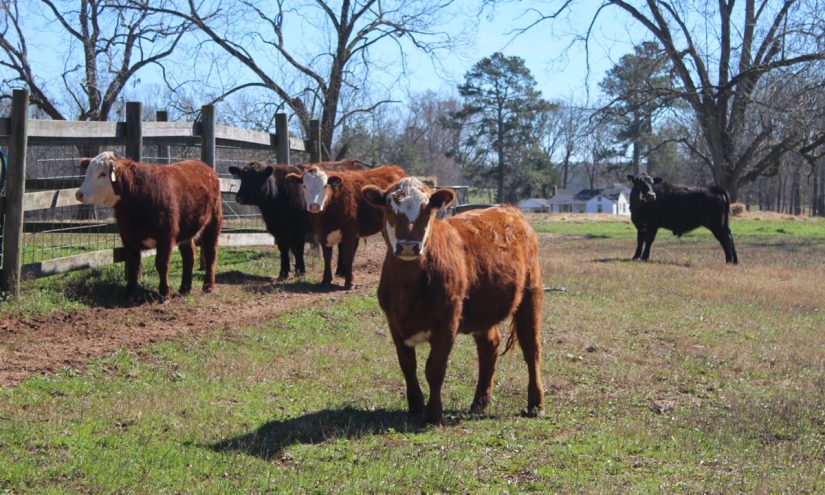
    McCORMICK — Cows compose the greeting committee at the Governor’s School for Agriculture, flocking to the fence just past the entrance to watch visitors drive past.

    Established in 1797 as a farming school for poor and orphaned children, the campus known for centuries as John de la Howe has changed missions several times. The latest turned it into the nation’s only residential public high school providing an agricultural education.

    Pastures of horses, sheep and cows dot the 1,310-acre property tucked off a rural road in McCormick County inside a national forest.

    The campus’ dozen residential halls are full, and for the first time since the new mission began, officials are having to turn away prospective students because of a lack of space, said Tim Keown, the school’s president.

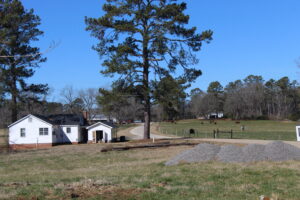
    Cows graze in a pasture behind a staff house at the Governor’s School for Agriculture on Feb. 21. (Photo by Skylar Laird/SC Daily Gazette)

    Two more halls sit mostly empty as they await decorations from the school’s alumni committee and, next year, a new batch of students to fill them.

    After a rocky start, including findings of ethical and financial mismanagement during the school’s first year after the change, things are looking up, Keown said.

    Last year, the school regained the accreditation it lost in 2016. And for the first time in 25 years, auditors last year found no problems, a rare accomplishment for a state agency, he said.

    Driving through the expansive campus, where classrooms abut greenhouses and open pastures, Keown described a vision for the school’s future, including continuing to expand its capacity and offering more classes to cover the full spectrum of agriculture.

    His ideas have gotten support from the House of Representatives’ budget writers.

    That chamber’s state spending plan for 2025-26, passed last week, includes $2 million for continuing renovations and $4 million for a new meat processing plant.

    “We don’t expect (students) to all go back and be full-time farmers,” Keown said. “But there are hundreds of thousands of jobs across South Carolina that need young people to enter those jobs.”

    Becoming a school for agriculture

    The mission adopted in 2020 is a return to the school’s roots.

    Dr. John de la Howe, a French doctor who immigrated to Charleston in 1764, wrote in his will that he wanted the farm he had purchased to be an agricultural seminary for “12 poor boys and 12 poor girls,” giving preference to orphans, Keown said.

    John de la Howe’s grave at the Governor’s School for Agriculture. (Photo by Skylar Laird/SC Daily Gazette)

    For years, that was what the school was.

    During World War I, John de la Howe became a state agency and a home for orphaned children, which it remained until the 1980s. Then, as orphanages waned in use, its purpose adjusted again to become a public residential school for sixth- through 10-graders with serious behavior problems.

    That, too, fell out of favor over the years, as more counties established programs that kept troubled teens closer to home.

    Attendance dropped, and costs per students skyrocketed.

    In 2003, then-Gov. Mark Sanford recommended, without success, closing the school and sending its students to a military-like public school in West Columbia for at-risk teens. In 2014, Gov. Nikki Haley recommended putting the Department of Juvenile Justice in charge.

    In March 2016, with the school’s accreditation on probation, House budget writers recommended temporarily transferring oversight to Clemson University.

    Weeks later, the state Department of Education made a final decision to yank the school’s accreditation. Deficiencies cited by inspectors included classes taught by uncertified teachers, the school not meeting the needs of students with disabilities, and the lack of online access.

    That forced the Legislature to make a decision.

    Legislators eventually settled on creating a third residential high school offering a specific education. The agriculture school joined existing governor’s schools for the arts and for science and math.

    The year the school was supposed to open its doors to its first new class of students, the COVID-19 pandemic began. Distancing restrictions meant students could no longer share rooms, so the school halved its capacity and began its first year with 33 students.

    The next year, the school’s population doubled.

    At the start of the 2024 school year, 81 students were enrolled, and another 81 had graduated. Once renovations in three dorms are complete, the capacity will increase to 124, plus day students, Keown said.

    “It’s been like putting together a huge puzzle with many missing pieces over the last couple of years,” Keown said. “But we’re finally finding all those pieces, and it’s all making more sense.”

    The new mission

    Blake Arias knew he wanted to study plants. Other than that, he had little interest in agriculture when he applied for the governor’s school.

    “If you looked at my application, it was very obvious that I didn’t have a background and that I didn’t know much,” Arias said.

    When he first arrived at the school nearly three hours from his home in Summerton, he wasn’t particularly interested in handling animals. And he really, really didn’t want to learn to weld.

    Three years later, Arias, who graduates this spring, still focuses primarily on plants.

    However, he also spends hours every day after class helping a rabbit, Chunky, lose some weight before he takes her to shows. He’s working on earning a beekeeping certification. And he even learned how to weld.

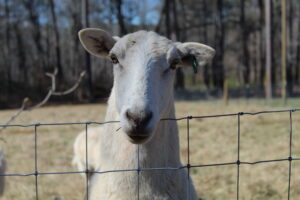
    A sheep looks over a fence at the Governor’s School for Agriculture on Feb. 21. (Photo by Skylar Laird/SC Daily Gazette)

    “Am I the best welder? Absolutely not,” Arias said. “But I really enjoyed it, and it taught me something new because they gave me the opportunity.”

    Arias is part of about half of the school’s population that comes in with little background in agriculture, Keown said. Applicants must have at least a 2.7 GPA. The goal is to take all kinds of students, whether they grew up on a farm or in a city and show them all sorts of opportunities in agriculture.

    That’s not limited to farming.

    The school offers four designated pathways: agricultural mechanics, horticulture, plant and animal systems, and environmental and natural resources. Students choose a focus, but they’re introduced to a sampler platter of what’s out there, Keown said.

    “It really shows you all the possibilities that there are in each field,” said Emily White, a senior from McCormick.

    Day to day

    The days typically begin long before students report to the cafeteria at 7:45 a.m.

    Like on any farm, horses, pigs and rabbits need feeding and cleaning, and plants need tending.

    Students take a blend of core classes, such as English, math and social studies, and classes focused on agriculture, Keown said.

    Even the core classes, which are all honors-level courses, typically use agriculture as a touch point for students, said Lyle Fulmer, a recent graduate.

    Math problems, for instance, might use real-life examples of balancing a budget on a farm. For students interested in agriculture, that adds excitement to what might usually be their hum-drum classes, he said.

    “Even if it was frustrating and I didn’t know how to solve the problem, I would work through it and I would know that this was something that I very well could be doing someday,” said Fulmer, who is now a freshman at Clemson University.

    Once classes are over, students have the rest of the afternoon to do as they please.

    The inside of a residence hall at the Governor’s School for Agriculture on Feb. 21. (Photo by Skylar Laird/SC Daily Gazette)

    White said she typically goes to the pig barn to clean, feed and work with Hank the Tank, a pig she’s planning to show.

    Other students might practice rodeo riding or clay shooting, two of the sports the school offers. Some gather at the saw mill to help process trees salvaged when Tropical Storm Helene swept through campus last September.

    By 6:15 p.m., students are expected to return to their residence halls or other communal areas for an hour of study time. Like college students, they have the run of their residence halls under the watchful eye of a residential advisor.

    Along with accumulating credits to get ahead in college courses, the freedom Fulmer had as a high school student helped prepare him for living in the dorms and all the challenges that accompany that. He already knew how to keep his space tidy and handle disagreements with roommates, which many incoming freshmen don’t, he said.

    “It really did prepare me a lot for college,” Fulmer said.

    What the future holds

    Standing on the front lawn of the president’s mansion, glimpses of the dining hall visible across an expansive open lawn, Keown described his vision of the school’s future.

    In the next couple of years, the school will start offering classes in culinary arts and hospitality management, which will help students who want to go into the growing industry of agritourism that creates attractions out of farms.

    “Our ag kids learn to grow (the food), our culinary students prepare it, our tourism hospitality students manage the banquets,” Keown said of his vision.

    Also in the near future is the meat processing plant, which Keown hopes to have finished in the next three years. That will give students skills to land high-paying jobs straight out of high school and fill a gap in the agricultural industry, Keown said.

    Timothy Keown, president of the Governor’s School for Agriculture, stands in front of the president’s house on Feb. 21, 2025. (Photo by Skylar Laird/SC Daily Gazette)

    A decade from now, Keown hopes to see 300 students roaming the grounds. He also wants them to grow about half of what they eat, compared with 20% now.

    In Keown’s mind, the school presents a bright spot for the future of agriculture. While the number of farmers under the age of 35 has grown slightly in recent years, the average age of farmers is 58, according to the U.S Department of Agriculture.

    Photos of recent alumni hung from flagpoles on campus. Driving under them, Keown named each graduate and where they went to school. Many go to Clemson, though some went to schools in other states.

    Most are still pursuing degrees in agriculture.

    “They are making us really proud,” Keown said.

    SC Daily Gazette is part of States Newsroom, a nonprofit news network supported by grants and a coalition of donors as a 501c(3) public charity. SC Daily Gazette maintains editorial independence. Contact Editor Seanna Adcox for questions: [email protected].


    Get stories like these delivered straight to your inbox. Sign up for The 74 Newsletter

    Source link

  • The blurred lines of higher education in South Korea: when colleges look like universities

    The blurred lines of higher education in South Korea: when colleges look like universities

    Edward Choi and Young Jae Kim

    South Korea has become an attractive destination for international students, boasting a strong higher education system with internationally recognised universities. A complication, however, is emerging with some foreign students enrolling in what they believe are universities, only to later discover that they are attending junior colleges, Korea’s flagship vocational institutions.

    This phenomenon may be linked to changes in institutional marketing (identity branding) and key organizational characteristics at junior colleges and universities alike. Many colleges have removed words like “technical” or “vocational” from their names and are now called universities in both Korean and English. They have also expanded their degree offerings to include bachelor’s and, in some cases, even graduate programs.

    The blurring of identities (and institutional traits) and the implications thereof are a focus of our study, Confusion in the Marketplace: A Study of Institutional Isomorphism and Organisational Identity in South Korea (Choi and Kim, 2024). Through a national, statistical overview and the content analysis of select institutional websites, we examined the dimensions along which South Korean colleges and universities are organizationally isomorphic, a concept that describes how organizations begin to resemble each other as a result of external pressures (see DiMaggio and Powell, 1983). Importantly, we discuss in our article the market implications for this type of institutional convergence.

    Key changes or dimensions of likeness

    Nearly all colleges (95%) have rebranded themselves with the term “university” in their Korean names, and 61% have done so in English. Colleges now offer bachelor’s-equivalent degrees, with 92% providing such programs, and some even offering graduate degrees (11%). Both colleges and universities emphasise similar disciplines, including Business Administration, Family & Social Welfare, and Mechanical Engineering, reflecting shared market demands.

    Institutional websites suggest colleges and universities adopt similar marketing strategies, emphasising employment outcomes and industry-academic collaboration. Less selective universities resemble colleges in focusing on job-market relevance in research and academic programming. Both institution types operate in local, national, and international spheres with internationalisation efforts at both types.

    There are key differences to note. Some universities, particularly elite ones, highlight intellectual growth and social development as a societal role in vision and other identity statements. Research at especially elite universities is both applied and humanities-focused, while this is not true in the case of colleges and lower-tier universities. Furthermore, internationalisation at universities is mostly about citizenship and cultural development while the same is less cultural but utilitarian at colleges (eg career development through international field placements).

    Why are junior colleges becoming more like universities?

    We discuss several key reasons behind the organisational sameness among Korea’s colleges and universities. One key factor is South Korea’s shrinking student population. With birth rates at record lows, the number of high school graduates has plummeted, creating a crisis for universities and junior colleges alike (Lee, 2024) and forcing these institutions to compete directly for a shrinking pool of students. The offering of baccalaureate degrees and graduate programming, among other organizational changes, may serve as primary examples of survival strategies amid the changing demographics. The same may be said of universities where there is a strong vocational dimension in academic offerings, much like what we see at colleges.

    Government policies (both historical and contemporaneous) have also played a major role in the Korean case of institutional isomorphism. Such policy directions have pushed both universities and junior colleges to align their offerings with workforce demands (Ministry of Education, 2023d, 2024a). In 2008 the government approved bachelor’s-equivalent degrees for junior colleges, allowing them to offer advanced major courses. In 2022, junior colleges were even permitted to introduce graduate programs, further blurring the distinction between these institutions and universities.

    Additionally, South Korea’s push for internationalisation amid globalisation has encouraged universities and junior colleges alike to aggressively market themselves to international students. The country has set ambitious national goals for attracting students from abroad (ICEF, 2023); as a result, both institutional types are using similar branding strategies. Words like “world-class,” “global,” and “innovative” appear frequently on websites, even in the case of junior colleges like Kyung-in Women’s University, an institution with virtually negligible global recognition or research excellence.

    The risks of blurred identities

    A key concern with blurred identities and institutional characteristics (including social roles) is that they can create confusion for international students who are increasingly looking to Korea as an attractive education destination. For students seeking a traditional university experience, this can lead to disappointment and even financial and academic setbacks, not to mention reputational damages to Korea and its higher education system.

    There is also the issue of mission creep, where junior colleges in their efforts to emulate universities, risk losing sight of their normative societal function. Junior colleges have historically complemented universities in increasing access to education and providing job training for students who might not otherwise pursue higher education (see Brint and Karabel, 1989; Dougherty, 1994; Lee, 1992). This mission is at stake. The accretion and expansion of new and existing programs and services, respectively, require invariably additional resources, which might drive up educational costs. Many prospective students may not be able to afford these fee hikes.

    What to make of institutional isomorphism?

    At the end of the day, students want a quality education and meaningful career opportunities. It is important for them to clearly understand what they are signing up for – given how important higher education is to shaping their career trajectories. Policy discussions at the national level must now consider the global character of Korea’s junior colleges, whose cosmetic and organisational changes can impact international mobility patterns. Clearer differentiation from a policy perspective is needed in this regard.

    We must not ignore the positive implications of institutional isomorphism, whose market advantages have not been fully explored by scholars. We argue that institutional isomorphism – particularly where college and university programs converge – can be strategically utilised as a policy lever to address market challenges. Rather than viewing institutional homogenization as inherently problematic, policymakers could use it to correct market inefficiencies like supply and demand challenges. The shortage of nurses in Korea (see Lee, 2023), for example, is likely being addressed through the joint efforts of colleges and universities in training and producing nurses with similar qualifications.

    Unchecked isomorphism, however, has its challenges, as pointed out earlier (ie confusion in the international student marketplace). We are also concerned about a skills mismatch where colleges and universities are pumping out graduates with homogenised skillsets. This type of sub-optimisation can result in high youth unemployment rates and students working in careers unrelated to their academic majors, which are already concerns in Korea (see Sungmin and Lee, 2023).

    To conclude, our study notes that institutional isomorphism is a global phenomenon, with similar trends observed in countries such as China, the US, and Australia (see Bae, Grimm, and Kim, 2023; Bük, Atakan-Duman, and Paşamehmetoğlu, 2017; Hartley and Morphew, 2008; Saichaie and Morphew, 2014; Taylor and Morphew, 2010). Further research is needed to assess whether isomorphism in higher education lends to competitive market advantages beyond Korea.

    Edward Choi is an Assistant Professor at Underwood International College, Yonsei University. His research interests centre on a range of topics: Korean higher education, traditional Korean education, the internationalisation of higher education, and the global phenomenon of family-owned universities. 

    Young Jae Kim was a student at Underwood International College, Yonsei University.

    Author: SRHE News Blog

    An international learned society, concerned with supporting research and researchers into Higher Education

    Source link

  • Are students fleeing to the south to avoid The Woke? Three possible answers.

    Are students fleeing to the south to avoid The Woke? Three possible answers.

    The three answers to the question in the title, in case you want to cut to the chase, are “Yes,” “No,” and “Maybe but we really can’t tell for certain.”

    This has been a point of discussion for some time.  The completely neutral publication Southern Living, with absolutely nothing to gain from publishing this piece, for instance, was convinced it was true back in 2022. 

    The American Thinker had similar observations, but made it about politics in this piece. And finally, among the articles I’ve seen, at least, is this one, in The Free Press where the money quote is “Even if I could have gotten into Harvard, I wouldn’t have gone,” an observation which seems like it was made for a gif.

    There are a lot of anecdotes in these articles, of course, and we all know that three anecdotes are more than enough to build a story upon: My lawyer’s neighbor’s son’s girlfriend is going to Alabama because she liked the rush videos, for instance, can be the basis for a whole research paper in sociology.  Or, of course, an article in a publication that pays by the word.

    I have a stubborn old-fashioned preference for data, however.  And–just to spoil the fun–even data won’t tell us everything we need to know to answer the question.  But it’s a good start, and it’s perhaps a bit more robust than political hit pieces described as documenting societal trends.

    And good news for all of you who don’t like to interact with Tableau visualizations: This one is just pictures.

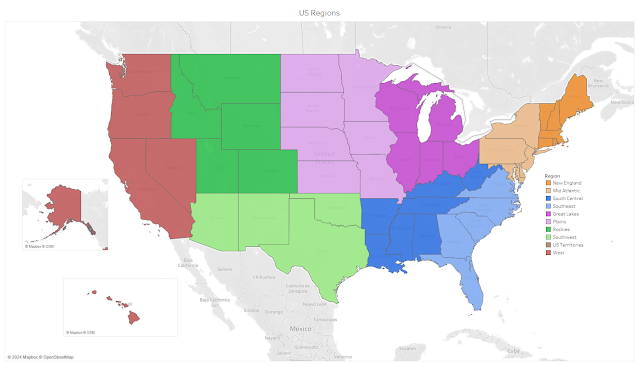
    First, let’s take a look at the shape of the market to have a place where we can put our feet down.  We’ll start with WICHE data, which I’ve found to be very reliable, but of course imperfect, showing high school graduates over time, with years after 2019 being projections.  For all of these views, I’ve broken things out by my own state regions, colored on this map. (Click it or any image to view larger).

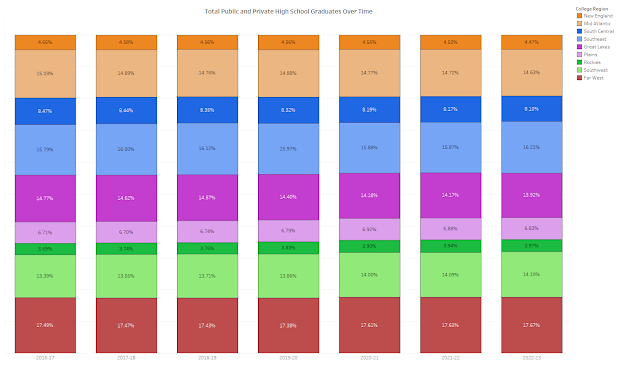
    Here is the breakdown of high school graduates by these regions, showing the percentage of total in each year. Columns total to 100% in each year.

    If you know anything at all about higher education data, you already see a problem as we try to establish some framework: Each state and each region has different college going patterns.  In wealthier states, and states with higher educational attainment among parents, college-going rates are higher.  Within states, there are differences too: About 8% of all college students in the US attend community colleges in California, for instance, and almost all of those students are California residents.

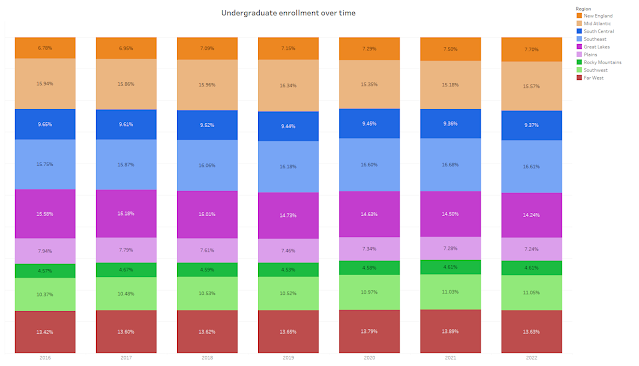
    Now, let’s take a look at undergraduate enrollment over this same period.  Because much of the national discussion is focused on first-time freshmen, I’ve limited this enrollment set to only those traditional, four-year institutions that enroll undergraduates and accept freshmen.  I’ll just call this The Filter Set going forward.

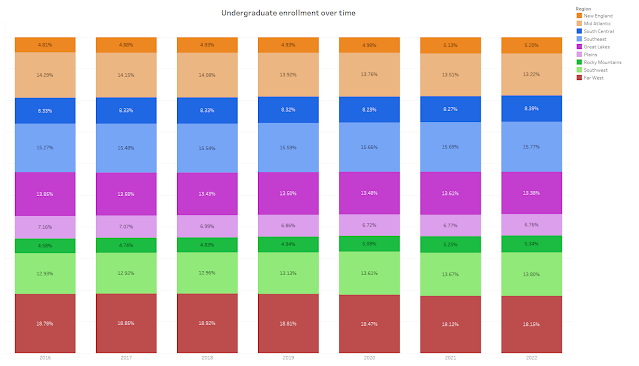
    You’ll probably notice that the patterns are about the same, but you see the effect of the California Community Colleges here: Many more students don’t attend four-year colleges in the state, which makes it different from other parts of the country.  For reference, here is the same visualization showing all undergraduate enrollment in all institutions (not just in The Filter Set).  You’ll note the re-balancing, which is a function of the vast majority of college students going to college close to home.

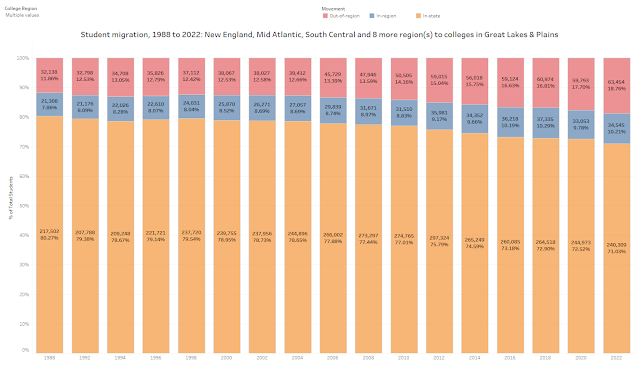
    Here is the historical pattern of first-year student migration, from 1988 to 2022.  As you can see, about seven of ten students stay in their own state for college, which means the number of students who cross state lines is small, making even big swings in those patterns hard to measure and describe as meaningful.  It’s also interesting to note that more students today are more mobile than in the past, for a lot of reasons I won’t go into here, but as always, you can start the finger pointing with Ronald Reagan. 

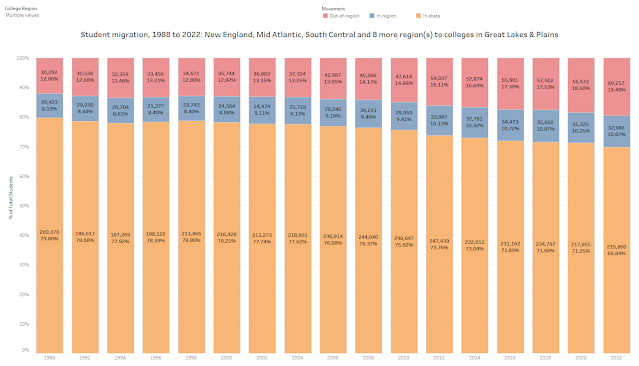
    For the sake of clarity (or confusion) here is the same data for The Filter Set.  Similar pattern, slightly different numbers.  More students cross state lines to attend these institutions with wider draws.

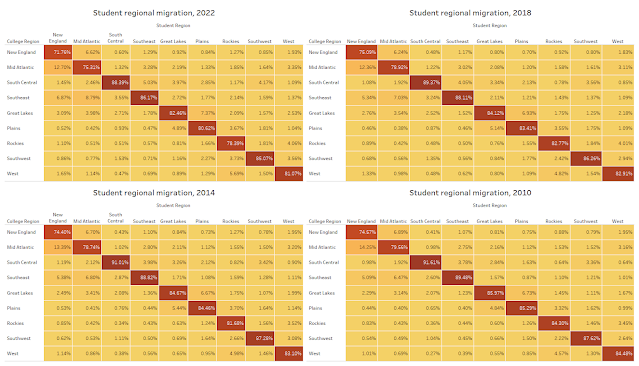
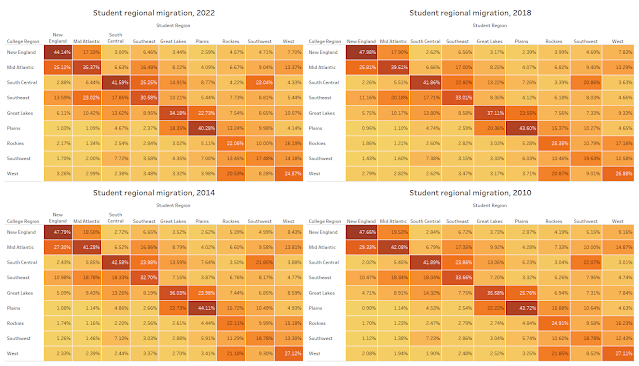
    And if you want to break it out a little bit, here is a view over time of The Filter Set and the migration patterns between regions in 2010, 2014, 2018, and 2022. 

    And this data shows only those students who left their home state and who attended one of the colleges in the Filter Set, to help amplify the migration patterns. 

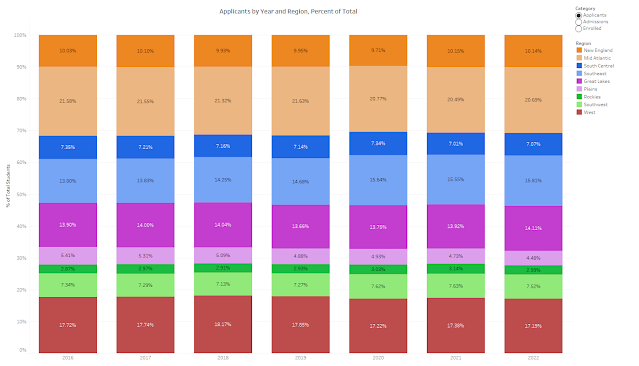
    Over time, the percentage of first-year applications submitted has grown in the Southeast, but not the Southcentral region.  Actually, what’s remarkable about this chart is the consistency over time.

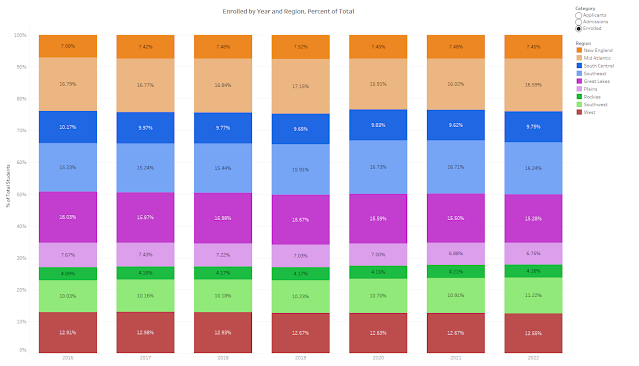
    The breakouts of enrolling first-year students by region?  Also stable and showing similar patterns.

    So, maybe there is a slight trend along the margins of college attendance.  But what’s causing it?  Most social scientists (going out on a limb here) would say it’s probably best when researching a problem like this to dive more deeply than interviews with a dozen students who fit the pattern you’re trying to demonstrate.  What I see in the overall patterns appears to follow population shifts, which is probably the biggest “duh” of all: If population in the Southeast is growing, you’d expect college enrollment to grow as well.  

    But let’s discount that obvious answer for a moment.

    Why would students be applying to more southern locations?  Well, first, they’re easier to get into, in general. 

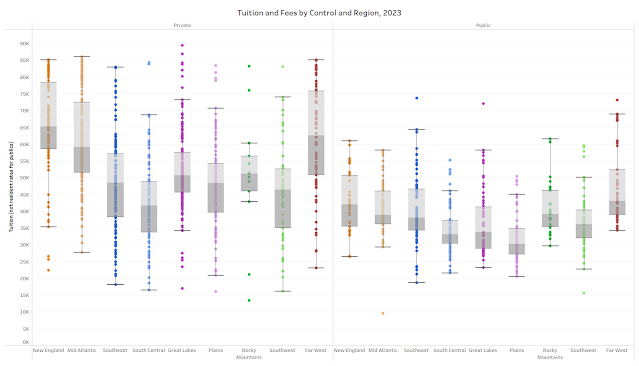
    For another thing, they cost a lot less, on average, based on sticker price.  Each dot represents one college, and the gray boxes cover the middle 50%, with the divider between dark gray and light gray showing the median.  You can see that for both public and (especially) private colleges, tuition seems to be much lower than other places. I’ve not tried to normalize this by Carnegie type or selectivity, to be clear.

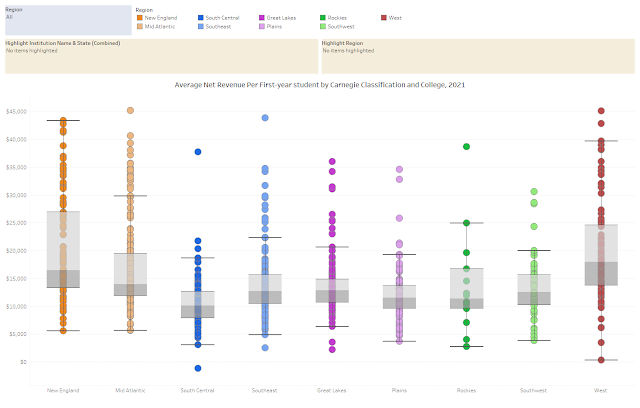
    Private colleges in the south net a lot less cash per freshman, too.  This does not always mean students pay less, but it’s a pretty sure bet in general it costs less after aid to go south as well. (I only calculate this for private institutions because discount rates at publics are fairly meaningless given different tuition levels and state funding models, in case you were wondering.)

    But the publics do a pretty good job of funding nonresidents, too. They recruit hard and roll out the welcome mat for students, especially on price.

    We don’t have 2023 data yet, and we won’t have 2024 data for about another 18 months, at least, so maybe we’ll wake up one morning and find that these small sample size stories are dead-on.  But I seriously doubt it.  For every student fleeing the north because of The Woke, there is probably a student fleeing the less Woke states below the Mason-Dixon Line.

    And yet, we know many–perhaps most–17-year-olds are afflicted with still-undeveloped prefrontal cortices that might keep them from being political, rational, and/or sophisticated when it comes to college choice.

    The answer to the headline?  You probably already knew the answer, didn’t you?  The lesson is that media pundits who look at a little bit of data and talk to a few people to confirm their perspectives often shape the narrative, which gets stuck in the collective consciousness of the American conversation.  It’s not something I can fix.  Maybe you can make a little dent if you share this with people.

    But it’s important, when we see increasing criticism of our institutions, and increased turmoil on campuses, that we–the people who work in higher education–provide the balanced and rational perspective we so often claim to impart to our graduates.

    Source link