Tag: special

  • Podcast: Easter special | Wonkhe

    Podcast: Easter special | Wonkhe

    This week on the podcast it’s our Easter special – and we’re diving into the highlights from The Secret Life of Students, our event that looked at a new vision for the student experience.

    We hear from student officers, sector experts, and campaigners on everything from the myth of the full-time model, to the pressures of placements, to the problems faced by international students. There’s testimony from nursing students, fire from SU officers challenging tokenistic consultation, and reflections on race, identity, and institutional indifference. Plus we zoom out to explore commuter challenges, disabled students, student cities and the global call for student solidarity. Hosted by Jim Dickinson, Associate Editor at Wonkhe.


    Source link

  • FAN Special Dispatch: Photos of Freedom

    FAN Special Dispatch: Photos of Freedom

    The First Amendment is far more than what lawyers and judges do.

    It is what We the People do with our freedom. 

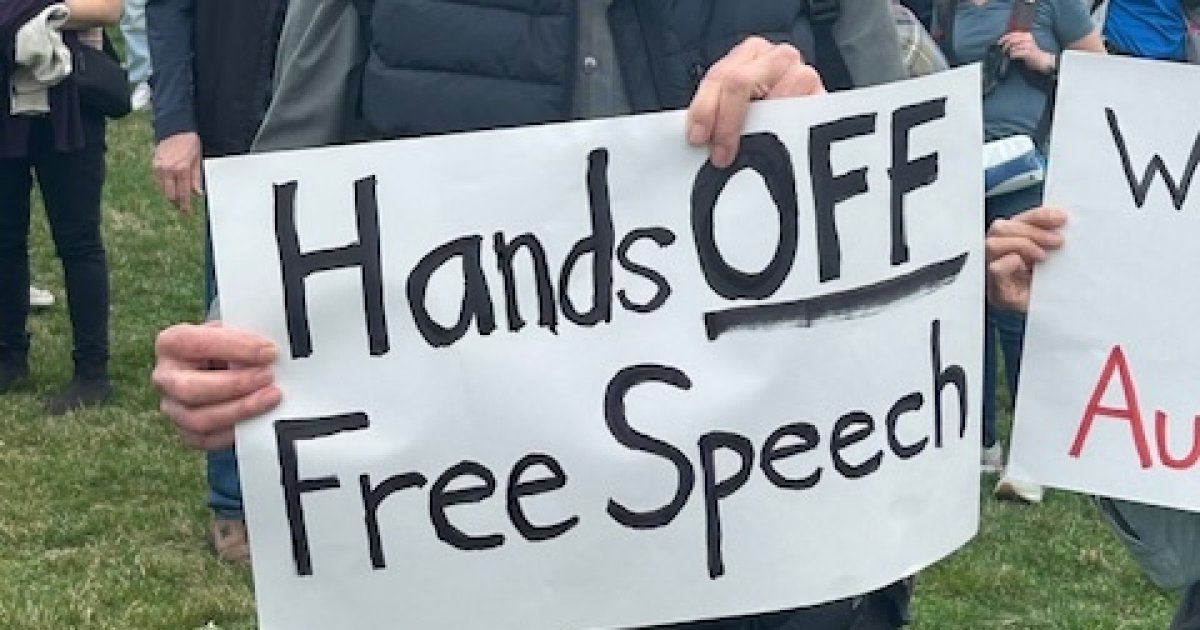
    Whatever the peaceful cause, whenever people speak and assemble to exercise their rights, it is always a healthy sign in a constitutional democracy. To that end, and to underscore yet again the value of dissent, the photos below were taken in Washington, D.C. on Saturday, April 5 in the areas surrounding the Washington Monument, as part of the “Hands Off” campaign.

    — rklc

    Source link

  • In Bid to Close Education Department, President Trump Looks to Rehouse Student Loans, Special Education Programs – The 74

    In Bid to Close Education Department, President Trump Looks to Rehouse Student Loans, Special Education Programs – The 74

    President Donald Trump said Friday that the U.S. Small Business Administration would handle the student loan portfolio for the slated-for-elimination Education Department, and that the Department of Health and Human Services would handle special education services and nutrition programs.

    The announcement — which raises myriad questions over the logistics to carry out these transfers of authority — came a day after Trump signed a sweeping executive order that directs Education Secretary Linda McMahon to “take all necessary steps to facilitate the closure” of the department to the extent she is permitted to by law.

    “I do want to say that I’ve decided that the SBA, the Small Business Administration, headed by Kelly Loeffler — terrific person — will handle all of the student loan portfolio,” Trump said Friday morning.

    The White House did not provide advance notice of the announcement, which Trump made at the opening of an Oval Office appearance with Defense Secretary Pete Hegseth.

    The Education Department manages student loans for millions of Americans, with a portfolio of more than $1.6 trillion, according to the White House.

    In his executive order, Trump said the federal student aid program is “roughly the size of one of the Nation’s largest banks, Wells Fargo,” adding that “although Wells Fargo has more than 200,000 employees, the Department of Education has fewer than 1,500 in its Office of Federal Student Aid.”

    ‘Everything else’ to HHS

    Meanwhile, Trump also said that the Department of Health and Human Services “will be handling special needs and all of the nutrition programs and everything else.”

    It is unclear what nutrition programs Trump was referencing, as the U.S. Department of Agriculture manages school meal and other major nutrition programs.

    One of the Education Department’s core functions includes supporting students with special needs. The department is also tasked with carrying out the federal guarantee of a free public education for children with disabilities Congress approved in the Individuals with Disabilities Education Act, or IDEA.

    Trump added that the transfers will “work out very well.”

    “Those two elements will be taken out of the Department of Education,” he said Friday. “And then all we have to do is get the students to get guidance from the people that love them and cherish them, including their parents, by the way, who will be totally involved in their education, along with the boards and the governors and the states.”

    Trump’s Thursday order also directs McMahon to “return authority over education to the States and local communities while ensuring the effective and uninterrupted delivery of services, programs, and benefits on which Americans rely.”

    SBA, HHS heads welcome extra programs

    Asked for clarification on the announcement, a White House spokesperson on Friday referred States Newsroom to comments from White House press secretary Karoline Leavitt and heads of the Small Business Administration and Health and Human Services Department.

    Leavitt noted the move was consistent with Trump’s promise to return education policy decisions to states.

    “President Trump is doing everything within his executive authority to dismantle the Department of Education and return education back to the states while safeguarding critical functions for students and families such as student loans, special needs programs, and nutrition programs,” Leavitt said. “The President has always said Congress has a role to play in this effort, and we expect them to help the President deliver.”

    Loeffler and HHS Secretary Robert F. Kennedy Jr. said their agencies were prepared to take on the Education Department programs.

    “As the government’s largest guarantor of business loans, the SBA stands ready to deploy its resources and expertise on behalf of America’s taxpayers and students,” Loeffler said.

    Kennedy, on the social media platform X, said his department was “fully prepared to take on the responsibility of supporting individuals with special needs and overseeing nutrition programs that were run by @usedgov.”

    The Education Department directed States Newsroom to McMahon’s remarks on Fox News on Friday, where she said the department was discussing with other federal agencies where its programs may end up, noting she had a “good conversation” with Loeffler and that the two are “going to work on the strategic plan together.” 

    Maine Morning Star is part of States Newsroom, a nonprofit news network supported by grants and a coalition of donors as a 501c(3) public charity. Maine Morning Star maintains editorial independence. Contact Editor Lauren McCauley for questions: [email protected].


    Get stories like these delivered straight to your inbox. Sign up for The 74 Newsletter

    Source link

  • Trump says special education oversight will move to HHS

    Trump says special education oversight will move to HHS

    This audio is auto-generated. Please let us know if you have feedback.

    Federal special education operations, currently spearheaded by the U.S. Department of Education, will move to the U.S. Department of Health and Human Services, President Donald Trump said on Friday.

    “It’s going to be a great situation. I guarantee that in a few years from now… I think that you’re going to have tremendous results,” said Trump, while seated in the Oval Office of the White House. Trump also said he would move federal student loan and school nutrition program oversight from the Education Department to the Small Business Administration.

    Trump did not say when or how the transitions would occur. Additional information from the Education Department about logistics concerning the transfer of responsibilities was not available Friday afternoon.

    U.S. Education Secretary Linda McMahon, in a Fox News interview Friday, said funding for the federal special education law — the Individuals with Disabilities Education Act — was in place before the creation of the Education Department in 1979. McMahon added that before the Education Department was created, special education programming was housed in what was then the U.S. Department of Health, Education and Welfare, “and it managed to work incredibly well.”

    HHS Secretary Robert F. Kennedy, Jr. wrote on the social media platform X on Friday that HHS, “is fully prepared to take on the responsibility” of supporting students with disabilities. He added, “We are committed to ensuring every American has access to the resources they need to thrive. We will make the care of our most vulnerable citizens our highest national priority.”

    The Education Department oversees the distribution of about $15.4 billion for supports to about 8.4 million infants, toddlers, school children and young adults with disabilities. The department’s Office of Special Education and Rehabilatives Services and Office of Special Education Programs also conducts monitoring, provides technical assistance to states and districts, and holds states and districts accountable for compliance to IDEA.

    The president’s comments come a day after he signed an executive order during a White House event directing McMahon to shutter the department to the “maximum extent appropriate.”

    At the Thursday signing of the executive order and during comments on Friday, Trump said the low academic performance of U.S. students required a shakeup at the federal level.

    He and his administration have also cited the desire to reduce federal bureaucracy in order to give more decision-making power to the state and local levels.

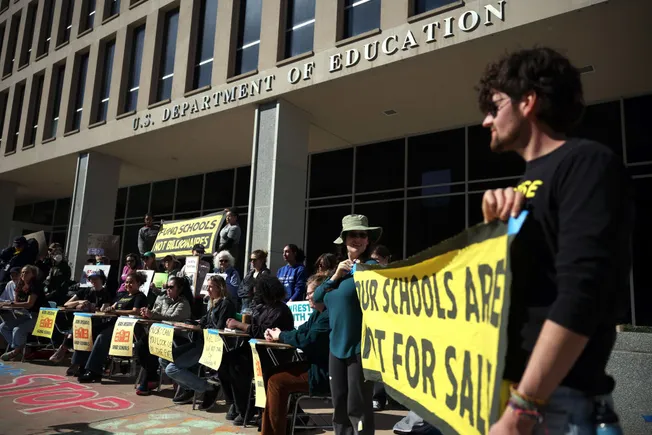
    But public school supporters have vigorously denounced the Trump administration’s moves to dismantle the Education Department, which have already included reducing the workforce by half and canceling research and teacher preparation grants. At least one group — Democracy Forward — says it is planning legal action to stop the department shutdown.

    Chad Rummel, executive director of the Council for Exceptional Children, said in a statement Friday, “IDEA is an education law, not a healthcare law, and belongs at the Department of Education.”

    CEC is a nonprofit for professionals who work in special and gifted education.

    Rummel added, “Moving IDEA programs to HHS would de-emphasize the purpose of IDEA to provide a free and appropriate public education and other critical activities to infants, toddlers, children, and youth with disabilities, and challenge the federal role to provide evidence-based research, personnel preparation, and technical assistance to advance the field of special education.”

    National Parents Union President Keri Rodrigues said in a Friday statement, “This is not a minor bureaucratic reorganization — it is a fundamental redefinition of how our country treats children with disabilities.” The National Parents Union is a 1.7 million membership organization with more than 1,800 affiliated parent organizations in all 50 states, Washington, D.C., and Puerto Rico.

    “We must call this what it is: an effort to dismantle protections, disempower families, and turn education into a battleground for profit-driven insurance corporations,” Rodrigues said. “We will not allow it.”


    Source link

  • 3 ways to break down silos between general and special education

    3 ways to break down silos between general and special education

    This audio is auto-generated. Please let us know if you have feedback.

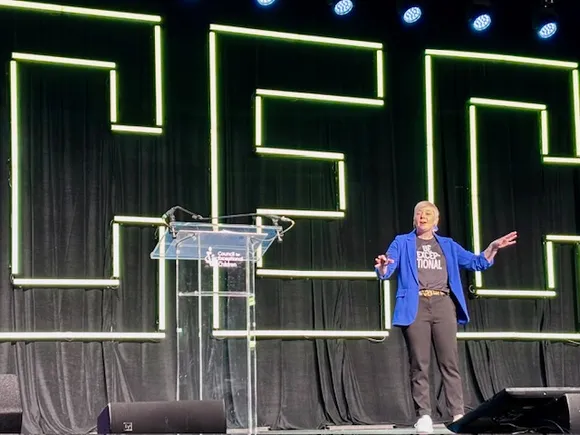
    BALTIMORE — When educators operate with separate goals and don’t engage in authentic collaboration, it creates friction and can ultimately hurt student progress, said Casey Watts, an educator and team leadership expert, in the opening keynote address at the Council for Exceptional Children’s annual convention on Wednesday.

    “I believe that people deserve to be part of collaborative teams that move forward, make an impact together and leave them feeling empowered, inspired and essential,” said Watts, who is also a pre-K-5 instructional coach at Hudson Independent School District in Lufkin, Texas.

    When educators and administrators are siloed, there can be an “us versus them” mentality, she said. “I believe that when we function in silos as educators, we unintentionally create silos in our students.” 

    To dismantle barriers between general and special educators and between teachers and administrators, Watts recommends three core concepts: 

    Have an ‘elevator pitch’

    Maintaining a strong sense of identity and purpose in your work can help eliminate ambiguities and assumptions others have of your role at school, Casey said. This goes for all educators in the school, including special education teachers, general education teachers, counselors, administrators and others.

    To ensure clarity, educators should work on their “elevator pitch,” or a brief summary of their role in the school. “When you create an elevator pitch, what you are essentially doing is pulling people in to become the main character of the story, and you are addressing their pain points, and you’re giving them new narratives for your position, which in essence, is bridging the gaps that exist between us as adults in education,” Watts said.

    In developing their elevator pitches, educators should think about how their role serves others in the school building and the skills they offer to educators and students.

    Engage in authentic collaboration

    Authentic collaboration is easier said than done, Watts said. And some “faux collaborations” can seem promising — such as an offer to share resources and materials — but really don’t break down barriers among educators.

    True collaboration takes courage and vulnerability and can include difficult conversations. It also means using everyone’s strengths and listening to all voices, she said.

    Establishing protocols where each person in the school community is a contributor can help break down silos, Watts said.

    Bring clarity to goals

    When everyone is on the same path, they know where the team is headed and how to get there. But when goals are unclear or the path is uncertain, people can get off track or operate independently, Watts said.

    When that happens, teachers go into their classrooms, close the door and vow to do what’s best for their students. But that can lead to unintentional gaps in student learning.

    “As I work with teams in districts across the nation, I hear so often leaders say ‘our teachers just won’t get on board,’” Watts said. “On the flip side of that, I’m hearing from teachers and staff who are saying the opposite: ‘We just never know what’s going on.’ There are two different narratives at play.”

    A lack of clarity creates unproductive confusion, Watts said. As a result, educators and administrators might lack confidence and feel defeated, frustrated and distrustful, she said.

    Setting out clear goals will boost confidence and capacity in educators, resulting in a collective efficacy, Watts said. That, in turn, will have “a significant impact on student learning,” she said.

    Source link

  • Call for Submissions for Special Edition – “Trends in the Use of Generative Artificial Intelligence for Digital Learning.” (Anthony Picciano)

    Call for Submissions for Special Edition – “Trends in the Use of Generative Artificial Intelligence for Digital Learning.” (Anthony Picciano)


    Dear Commons Community,

    Patsy Moskal and I have decided to be guest editors for Education Sciences for a special edition entitled,

    “Trends in the Use of Generative Artificial Intelligence for Digital Learning.” (See below for a longer description.)

    It is a most timely topic of deep interest to many in the academy. We would love to have you contribute an article for it. Your submission can be research, practitioner, or thought-based. It also does not have to be a long article (4,000-word minimum). Final articles will be due no later than July 1, 2025.

    You can find more details at: https://www.mdpi.com/journal/education/special_issues/6UHTBIOT14#info

    Thank you for your consideration!

    Tony


    Source link

  • Podcast: Visegrad special | Wonkhe

    Podcast: Visegrad special | Wonkhe

    This week on the podcast Jim, Mack and team are on a bus around the Visegrad countries where they’ve been exploring student experience, representation and rights, discounted dorms and a set of countries where students have been leading change.

    Plus Disabled Students UK has its access insights survey out, and we discuss changes to the Renter’s Rights Bill.

    With Katie Jackson, Faculty of Humanities Officer at the University of Manchester SU, Seán Keaney, Academic Officer at University of Limerick Student Life, Gary Hughes, CEO at Durham SU, Mack Marshall, Community and Policy Officer at Wonkhe and presented by Jim Dickinson, Associate Editor at Wonkhe.

    Read more

    On Day -1 of this year’s magical mystery tour around Europe and students, the team come across plenty of protests for democracy, on Day 0 of the tour we find students in the centre of both the past and the future for Hungary, on Day 1 the team put down some roots and build some belonging at camp, on the second evening the team try to work out if they have enough points for a dorm in Slovakia, and on Day 2 the team get community building and pot roasting.

    Source link

  • Podcast special: Writing for Wonkhe

    Podcast special: Writing for Wonkhe

    In this special seasonal edition of the Wonkhe Show, we discuss how you can contribute to the higher education debate by writing for the site.

    Plus we discuss the importance of communicating academic and professional insights to wider audiences, and we take you inside our editorial process – which is all about clear arguments and diverse perspectives.

    With Adam Matthews, Senior Research Fellow at the School of Education at the University of Birmingham, Michael Salmon, News Editor at Wonkhe, David Kernohan, Deputy Editor at Wonkhe and presented by Debbie McVitty, Editor at Wonkhe.

    Higher Education Policy into Practice (Online) PGCert

    Writing for Wonkhe

    Source link

  • Higher education in England needs a special administration regime

    Higher education in England needs a special administration regime

    Extra government funding for the higher education sector in England means the debate about the prospect of an HE provider facing insolvency and a special administration regime has gone away, right?

    Unfortunately not. There is no additional government funding; in fact the additional financial support facilitated by the new Labour government so far is an increase to tuition fees for the next academic year for those students that universities can apply this to. It is estimated that the tuition cost per student is in excess of £14K per year, so the funding gap has not been closed. Add in increased National Insurance contributions and many HE providers will find themselves back where they are right now.

    It is a problem that there is no viable insolvency process for universities. But a special administration regime is not solely about “universities going bust.” In fact, such a regime, based on the existing FE special administration legislation, is much more about providing legal clarity for providers, stakeholders and students, than it is about an insolvency process for universities.

    Managing insolvency and market exit

    The vast majority of HE providers are not companies. This means that there is a lack of clarity as to whether current Companies and Insolvency legislation applies to those providers. For providers, that means that they cannot avail themselves of many insolvency processes that companies can, namely administration, company voluntary arrangements and voluntary liquidation. It is debatable whether they can propose a restructuring plan or be wound up by the court, but a fixed charge holder can appoint receivers over assets.

    Of these processes, the one most likely to assist a provider is administration, as it allows insolvency practitioners to trade an entity to maximise recoveries from creditors, usually through a business and asset sale.

    At best therefore, an HE provider might be able to be wound up by the court or have receivers appointed over its buildings. Neither of these two processes allows continued trading. Unlike administration, neither of these processes provides moratorium protection against creditor enforcement either. They are not therefore conducive to a distressed merger, teach out or transfer of students on an orderly basis.

    Whilst it is unlikely that special administration would enable survival of an institution, due to adverse PR in the market, it would provide a structure for a more orderly market exit, that does not currently exist for most providers.

    Protections for lenders

    In addition to there being no viable insolvency process for the majority of HE providers, there is also no viable enforcement route for secured lenders. That is a bad thing because if secured lenders have no route to recovering their money, then they are not going to be incentivised to lend more into the sector.

    If government funding is insufficient to plug funding gaps, providers will need alternative sources of finance. The most logical starting point is to ask their existing lenders. Yes, giving lenders more enforcement rights could lead to more enforcements, but those high street lenders in the sector are broadly supportive of the sector, and giving lenders the right to do something is empowering and does not necessarily mean that they will action this right.

    Lenders are not courting the negative press that would be generated by enforcing against a provider and most probably forcing a disorderly market exit. They are however looking for a clearer line to recovery, which, in turn, will hopefully result in a clearer line to funding for providers.

    Protections for students

    Students are obviously what HE providers are all about, but, if you are short of sleep and scour the Companies and Insolvency legislation, you will find no mention of them. If an HE provider gets into financial distress, then our advice is that the trustees should act in the best interest of all creditors. Students may well be creditors in respect of claims relating to potential termination of courses and/or having to move to another provider, potentially missing a year and waiting longer to enter the job market.

    However, the duty is to all creditors, not just some, and under the insolvency legislation, students have no better protection than any other creditor. Special administration would change that. The regime in the FE sector specifically provides for a predominant duty to act in the best interest of students and would enable the trustees to put students at the forefront of their minds in a time of financial distress.

    A special administration regime would therefore help trustees focus on the interest of students in a financially distressed situation, aligning them with the purposes of the OfS and charitable objects, where relevant.

    Protections for trustees

    Lastly, and probably most forcefully, a special administration regime would assist trustees of an HE provider in navigating a path for their institution in financial distress. As touched on above, it is not clear, for the vast majority of HE providers, whether the Companies and Insolvency legislation applies.

    It is possible that a university could be wound up by the court as an unregistered company. If it were, then the Companies and Insolvency legislation would apply. In those circumstances, the trustees could be personally liable if they fail to act in the best interest of creditors and/or do not have a reasonable belief that the HE provider could avoid an insolvency process.

    Joining a meeting of trustees to tell them that they could be personally liable, but it is not legally clear, is a very unsatisfactory experience; trust me, this is not a message they want to hear from their advisors.

    A special administration regime, applying the Companies and Insolvency legislation to all HE providers, regardless of their constitution or whether they are incorporated, would allow trustees to have a much clearer idea of the risks that they are taking and the approach that they should follow to protect stakeholders.

    In the event a special administration was to be brought in, we would hope it would not need to be applied to a market exit situation. Its real value, however, is in bringing greater legal clarity for lenders and trustees and more protection for students, in the current financial circumstances that HE providers find themselves in.


    Source link

  • Time Is Running Out: Help Your Employees Navigate the Special PSLF Waiver – CUPA-HR

    Time Is Running Out: Help Your Employees Navigate the Special PSLF Waiver – CUPA-HR

    by CUPA-HR | August 24, 2022

    On Oct. 6, 2021, the U.S. Department of Education announced a change to the Public Service Loan Forgiveness (PSLF) program rules for a limited time as a result of the COVID-19 national emergency. Millions of non-profit and government employees have federal student loans and may now be eligible for loan forgiveness or additional credit through the limited PSLF waiver. But they need to act fast. The special waiver expires October 31, 2022.

    Here are several resources for HR professionals who want to get the word out to employees before the opportunity passes.

    Learn More and Get Tips for Educating Employees

    In June, CUPA-HR hosted the webinar, Helping Employees Understand and Navigate the Public Service Loan Forgiveness (PSLF) Program, where Department of Education representative Ashley Harrington shared details about the program and how HR can help guide employees through the necessary processes to achieve loan forgiveness. The recorded webinar is available for viewing any time.

    Explore the Department of Education’s Employer Toolkit

    The Department of Education’s PSLF waiver toolkit is a comprehensive resource that features a PSLF fact sheet, sample social media posts and email templates HR can use to spread the word to campus employees.

    Direct Employees to the Borrower Site

    For a clear explanation of the program and a simple step-by-step process to determine who is eligible for the program, direct employees to the Federal Student Aid website.


    Source link