Tag: speech

  • Alex Kozinski on JD Vance’s censorship speech — First Amendment News 459

    Alex Kozinski on JD Vance’s censorship speech — First Amendment News 459

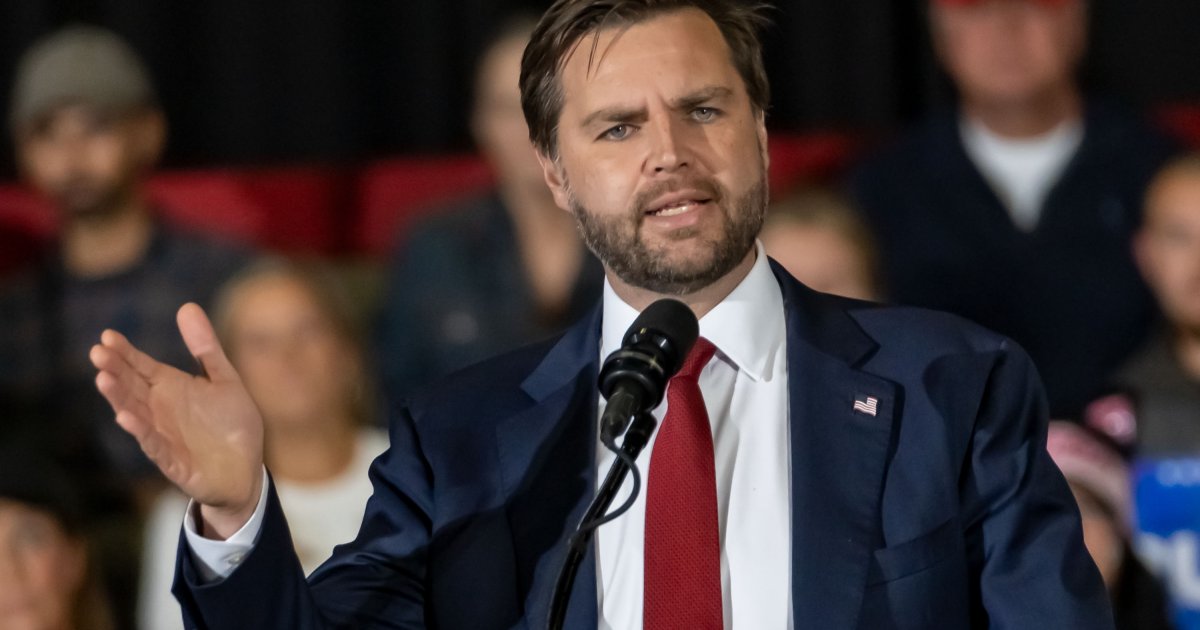
    The Wall Street Journal recently published an op-ed by former Ninth Circuit Judge Alex Kozinski in which he, among other things, praises Vice President JD Vance’s recent speech in Munich about the evils of censorship in Europe — which included references to Kozinski’s birthplace, Romania

    Judge Alex Kozinski

    True to form, the Kozinski article was bold in ways certain to provoke criticism. Below are a few “fair use” excerpts:

    JD Vance’s speech to the Munich Security Conference . . . mentioned the Romanian election twice and held it up as a cautionary tale of what can happen to societies that seek to coerce rather than persuade, suppress rather than debate.

    Could American elections be canceled next? Some states came close in 2024 by attempting to remove from their ballots the candidate who eventually won the presidency. There was no uproar; the Supreme Court had to intervene. . . If enough panic is stirred up, canceling elections isn’t inconceivable.

    Our legacy media have greeted Mr. Vance’s speech largely with disdain and horror. They are wrong. The speech is epic. It reminds Europeans and Americans that the values of the Enlightenment, as captured in our Constitution—not least the right to think, speak and debate freely—are the glue that binds us together. If we don’t defend those values, there isn’t much left worth defending. 

    Related

    Missouri Attorney General Andrew Bailey announced today that the United States District Court for the Western District of Louisiana granted his motion to block top officials in the federal government from continuing to violate the First Amendment rights of millions of Americans. The judge’s ruling is 155 pages long and includes 721 footnotes.

    The judge had harsh words for the federal officials. He noted that this is “the most massive attack against free speech in United States’ history,” that the Biden administration has “blatantly ignored the First Amendment’s right to free speech,” and that the Biden administration “almost exclusively targeted conservative speech.”

    Attorney General Bailey’s motion for preliminary injunction, which he filed with Louisiana Attorney General Jeff Landry, highlighted over 1,400 facts from more than 20,000 pages of evidence exposing the vast censorship enterprise coordinated across multiples [SIC] agencies within the federal government. [reversed on standing grounds in Murthy v. Missouri (2024)] 

    SCOTUS denies review in ‘buffer zone’ abortion clinic protest cases 

    The case is Coalition Life v. City of Carbondale (Paul Clement, counsel for Petitioner). Earlier this week the Court denied review, with Justice Thomas dissenting (and with Justice Alito voting to grant certiorari). In this case, the Justices were invited to reconsider and reverse Hill v. Colorado

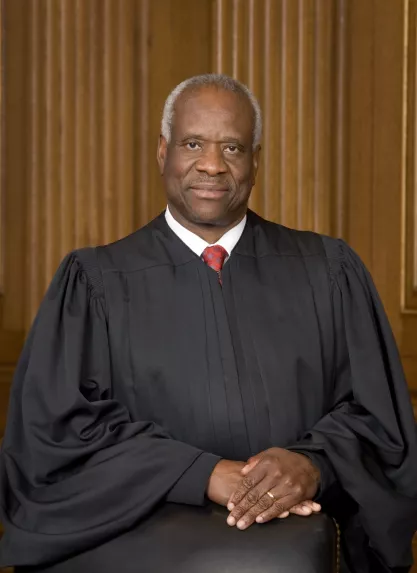
    Clarence Thomas official SCOTUS portrait

    Justice Clarence Thomas

    Below are a few excerpts from Justice Thomas’ dissent:

    It is unclear what, if anything, is left of Hill. As lower courts have aptly observed, Hill is “incompatible” with our more recent First Amendment precedents. Price v. Chicago, 915 F. 3d 1107, 1117 (CA7 2019) (opinion of Sykes, J., joined by Barrett, J.). Start with McCullen v. Coakley, 573 U. S. 464 (2014). There, this Court unanimously held unconstitutional a Massachusetts law that prohibited anyone from entering a 35-foot buffer zone around an abortion facility. Id., at 471– 472, 497. In doing so, the Court determined that the law was content neutral because—rather than targeting certain kinds of speech such as protest, education, and counseling—the law prohibited virtually any speech within the buffer zone. Id., at 479. The Court made clear, however, that the law “would be content based if it required ‘enforcement authorities’ to ‘examine the content of the message’” to determine whether the law applied. Ibid. That position is irreconcilable with Hill, which the Court did not even bother to cite.

    Hill is likewise at odds with Reed v. Town of Gilbert, 576 U. S. 155 (2015). Reed involved a First Amendment challenge to a town’s sign code that regulated various categories of signs based on “the type of information they convey.” Id., at 159. Relying on Hill, the Ninth Circuit concluded that the sign code was content neutral, reasoning that the town “‘did not adopt its regulation of speech because it disagreed with the message conveyed’” and its “‘interests in regulat[ing] temporary signs are unrelated to the content of the sign.’” 576 U. S., at 162. That court then applied a lower level of scrutiny and upheld the code. Ibid. We reversed, holding that a speech regulation is content based—and thus “presumptively unconstitutional”—if it “draws distinctions based on the message a speaker conveys.” Id., at 163.

    Our post-Reed decisions have firmly established Hill’s diminished status. In City of Austin, for example, the majority ran as far as it could from Hill, even though Hill was the one “case that could possibly validate the majority’s aberrant analysis” on the constitutionality of restrictions on bill-board advertising. 596 U. S., at 86, 102 (opinion of THOMAS, J.). The majority nonetheless insisted that any alleged similarity was “a straw man,” rejecting the notion that its opinion had “‘resuscitat[ed]’” Hill, and reminding readers that it did “not cite” the decision at all. 596 U. S., at 76. Our latest word on Hill—expressed in a majority opinion joined by five Members of this Court—is that the decision “distorted [our] First Amendment doctrines.” Dobbs, 597 U. S., at 287, and n. 65. If Hill’s foundation was “deeply shaken” before Dobbs, see Price, 915 F. 3d, at 1119, the Dobbs decision razed it.

    [ . . . ]

    Hill has been seriously undermined, if not completely eroded, and our refusal to provide clarity is an abdication of our judicial duty.

    The Court also denied review in Turco v. City of Englewood, New Jersey (another abortion “buffer zone” case) (Justices Thomas and Alito voted to grant the petition).

    Defendants’ motion to dismiss complaint in Iowa pollster ‘fraud’ case
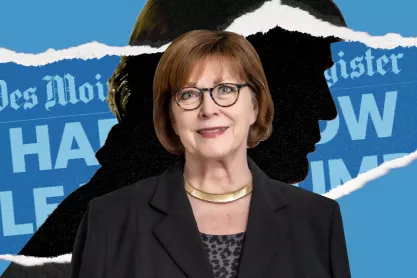
    Iowa pollster Ann Selzer with a Des Moines Register headline and Donald Trump silhouette in the background

    The plaintiffs “can no more sue a newspaper pollster for diverted resources than a farmer could sue a TV weatherman for crop damage due to unexpected frost.”

    Below are a few excerpts from the motion to dismiss in Trump v. Selzer (US Dist. Ct., S. Dist., Iowa, Case 4:24-cv-00449-RGE-WPK: Feb. 21) (Robert Corn-Revere, lead counsel for Defendants):
    FIRE Chief Counsel Bob Corn-Revere

    Robert Corn-Revere, lead counsel for Defendants.

    Introduction 

    Plaintiffs’ claims are barred by the First Amendment and the Court should dismiss them with prejudice. In the United States there is no such thing as a claim for “fraudulent news.” No court in any jurisdiction has ever held such a cause of action might be valid, and few plaintiffs have ever attempted to bring such outlandish claims. Those who have were promptly dismissed. [citations]

    There is good reason for this. History’s judgment repudiated the 1798 Sedition Act which prohibited “false, scandalous and malicious . . . writings against the government of the United States” or its president, and that fraught episode “first crystallized a national awareness of the central meaning of the First Amendment.” N.Y. Times Co. v. Sullivan, 376 U.S. 254, 273 (1964). Since then, courts at all levels have confirmed our “profound national commitment to the principle that debate on public issues should be uninhibited, robust, and wide-open,” id. at 270, holding that speech is presumptively protected unless it falls within one of a few limited and narrowly defined categories. United States v. Stevens, 559 U.S. 460, 468–70 (2010). Those categories do not include a general exception for “false speech,” United States v. Alvarez, 567 U.S. 709, 722 (2012). 

    Plaintiffs seek to illegitimately expand them to include “fake news,” a tag line that may play well for some on the campaign trail but has no place in America’s constitutional jurisprudence. In this regard, civil damages, no less than criminal sanctions, cannot lie against protected speech. Snyder v. Phelps, 562 U.S. 443 (2011); Sullivan, 376 U.S. at 277. 

    Even if such a cause of action existed, the Amended Complaint is fatally flawed on every level: Plaintiffs fail at the threshold to allege any recoverable damages, and do not state plausible claims, either on the law or on the facts as alleged. No court has ever accepted claims like these, and this Court should not be the first. 

    [ . . . ]

    Plaintiffs Illegitimately Seek to Create a New First Amendment Exception. 

    Mr. Trump and his co-plaintiffs assume “false news” falls outside the First Amendment’s protection, but over 200 years of American free speech law and practice prove otherwise. 

    “Authoritative interpretations of the First Amendment guarantees have consistently refused to recognize an exception for any test of truth—whether administered by judges, juries, or administrative officials—and especially one that puts the burden of proving truth on the speaker.” Id. at 271. 

    As the Supreme Court recently explained, “[o]ur constitutional tradition stands against the idea that we need Oceania’s Ministry of Truth.” Alvarez, 567 U.S. at 723. 

    “From 1791 to the present . . . the First Amendment has permitted restrictions upon the content of speech in a few limited areas, and has never include[d] a freedom to disregard these traditional limitations.” Stevens, 559 U.S. at 468 (cleaned up). These “historic and traditional categories long familiar to the bar” include obscenity, child pornography, defamation, fraud, incitement, fighting words, and speech integral to criminal activity. Id. (cleaned up) (collecting cases). Former Justice Souter observed that “[r]eviewing speech regulations under fairly strict categorical rules keeps the starch in the standards for those moments when the daily politics cries loudest for limiting what may be said.” Denver Area Educ. Telecomms. Consortium, Inc. v. FCC, 518 U.S. 727, 774 (1996) (Souter, J., concurring). Consequently, the Court steadfastly resists efforts to increase or expand the boundaries of these categories as “startling and dangerous” and has rejected any “freewheeling authority to declare new categories of speech outside the scope of the First Amendment.” Stevens, 559 U.S. at 470, 472. 

    Plaintiffs try to shoehorn their claims into an existing category by calling the Iowa Poll “fake” and asserting actionable “fraud” occurred. But “in the famous words of Inigo Montoya from the movie The Princess Bride, ‘You keep using that word. I do not think it means what you think it means.’” [citation] As a matter of basic law, Plaintiffs’ allegations about polls and news stories they dislike have nothing to do with fraud. [reference] I.B. They also sprinkle the complaint with loose talk of “election interference,” [citation], although they stop short of including a separate claim on that basis, perhaps out of awareness that “no court has held that a scheme to rig an election itself constitutes money or property fraud.” [citation] 

    Categories of unprotected speech are defined by precise legal tests, and Plaintiffs cannot stretch those boundaries to serve a political narrative. The Supreme Court routinely rejects attempts to broaden those limits based on assertions that the speech at issue is somehow “like” a recognized exception. Seee.g., Stevens, 559 U.S. at 470–71 (Other “descriptions are just that— descriptive. They do not set forth a test that may be applied as a general matter . . . .”); Brown v. Ent. Merchs. Ass’n, 564 U.S. 786, 793–96 (2011) (rejecting “attempt to shoehorn speech about violence into obscenity,” citing a lack of “longstanding tradition in this country” restricting such speech); Hustler Mag., Inc. v. Falwell, 485 U.S. 46, 55–56 (1988) (rejecting bid to leave “outrageous” speech unprotected because it “does not seem to us to be governed by any exception to the . . . First Amendment”); Alvarez, 567 U.S. at 721–22 (“The Government has not demonstrated that false statements . . . should constitute a new category of unprotected speech” based on a “tradition of proscription.”) (quotation omitted). 

    Because the categories are governed by history and tradition, the Plaintiffs could not have chosen a worse candidate for inclusion than “fake news.” America’s first experience with prohibiting false news — the Sedition Act of 1798 — expired under its own terms, and all fines assessed under that misbegotten law were remitted. President Thomas Jefferson denounced it as an unconstitutional “nullity, as absolute and palpable as if Congress had ordered us to fall down and worship a golden image.” Sullivan, 376 U.S. at 272–76. While the Supreme Court never adjudicated the Sedition Act’s attempt to punish “false” writings about public officials, “the attack upon its validity has carried the day in the court of history,” defined “the central meaning of the First Amendment,” id., and conditioned “the fabric of jurisprudence woven across the years.” [citation] 

    Plaintiffs’ quest to punish “fake news” not only ignores this history, it also fumbles the conceptual basis for unprotected speech categories, which the Court first described as speech “of slight social value.” Chaplinsky v. New Hampshire, 315 U.S. 568, 572 (1942). Here, Plaintiffs seek to create a new First Amendment exception for speech that has always received the highest level of constitutional protection — political speech and commentary. In a word, it just doesn’t fit. 

    The Supreme Court has repeatedly reaffirmed that the First Amendment “‘has its fullest and most urgent application’ to speech uttered during a campaign for political office.” Citizens United v. FEC, 558 U.S. 310, 339 (2010) (citation omitted). Speech about the political process is “at the core of our First Amendment freedoms,” Republican Party of Minn. v. White, 536 U.S. 765, 774 (2002), because a “major purpose” of the First Amendment was to protect “free discussion of . . . candidates.” Mills v. Alabama, 384 U.S. 214, 218 (1966). Accordingly, the “First Amendment affords the broadest protection” to “[d]iscussion of public issues and debate on” the political process. McIntyre v. Ohio Elections Comm’n, 514 U.S. 334, 346 (1995) (citation omitted). Political polling is “speech protected by the First Amendment” both because it “requires a discussion between pollster and voter” and the resulting poll itself “is speech.” [citation]

    The First Amendment accords speech in this area wide berth because “erroneous statement[s] [are] inevitable in free debate, and [they] must be protected if the freedoms of expression are to have the breathing space that they need to survive.” Sullivan, 376 U.S. at 271– 72 (cleaned up). Efforts to regulate “truth” in political commentary are thus presumptively unconstitutional and subject to strict scrutiny. [citations] Bottom line, political polls and news reports are not the stuff of which First Amendment exceptions are made. 

    Related

    The Associated Press sues Trump administration 

    The Associated Press sued three Trump administration officials Friday over access to presidential events, citing freedom of speech in asking a federal judge to stop the 10-day blocking of its journalists.

    [ . . . ]

    The AP says its case is about an unconstitutional effort by the White House to control speech — in this case refusing to change its style from the Gulf of Mexico to the “Gulf of America,” as President Donald Trump did last month with an executive order. “The press and all people in the United States have the right to choose their own words and not be retaliated against by the government,” the AP said in its lawsuit, which names White House Chief of Staff Susan Wiles, Deputy Chief of Staff Taylor Budowich and Press Secretary Karoline Leavitt.

    Emergency hearing request and motion in opposition 

    Related

    Executive Watch


    WATCH VIDEO: Trump escalates attacks on the free press

    Forthcoming scholarly article: Lakier & Douek on stalking and the First Amendment

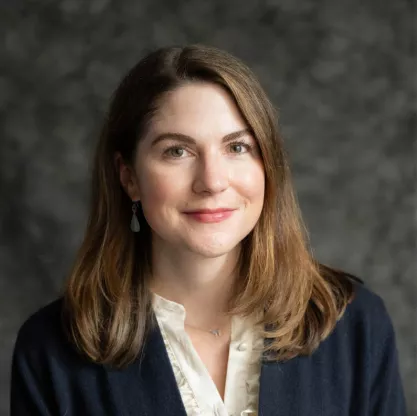
    Professors Genevieve Lakier (left) and Evelyn Douek (right)

    Professors Genevieve Lakier (left) and Evelyn Douek (right)

    In Counterman v. Colorado, the Supreme Court decided an imaginary case. It held that Billy Ray Counterman’s conviction could not stand because it did not meet the First Amendment requirements for prosecutions based on threats. But this is puzzling because Counterman was not in fact convicted for making threats. He was convicted of stalking, under a law that does not require that the defendant threaten anyone in order to be guilty of the crime. 

    This Article argues that the Supreme Court’s confusion about the most basic facts of the case was not an aberration but instead reflects broader pathologies in First Amendment jurisprudence. These pathologies are a consequence of the impoverished view of the First Amendment’s boundaries depicted in the Court’s recent decisions, which suggest that the First Amendment’s doctrinal terrain can be described by a simple list of historically unprotected categories. 

    This thin account of the First Amendment, and the doctrinal distortions it creates, are not inevitable, however. The Article argues for an alternative, more multi-dimensional approach to the question of the First Amendment’s boundaries — one that rests on a richer understanding of the traditions of speech regulation in the United States — and sketches out its implications for the law of stalking and, potentially, many other areas of free speech law. Courts do not need to deny the facts of the cases they adjudicate to craft a First Amendment jurisprudence that is doctrinally coherent, historically informed, and normatively desirable. 

    ‘So to Speak’ podcast: Corn-Revere and London on censorship at home and abroad
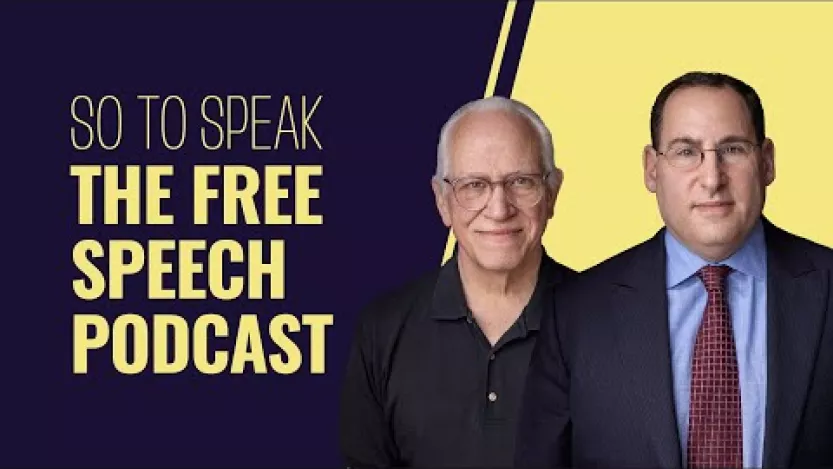

    From JD Vance’s free speech critique of Europe to the Trump administration barring the Associated Press from the Oval Office, free speech news is buzzing. General Counsel Ronnie London and Chief Counsel Bob Corn-Revere unpack the latest developments.

    More in the News

    2024-2025 SCOTUS term: Free expression and related cases

    Cases decided 

    • Villarreal v. Alaniz (Petition granted. Judgment vacated and case remanded for further consideration in light of Gonzalez v. Trevino, 602 U. S. ___ (2024) (per curiam))
    • Murphy v. Schmitt (“The petition for a writ of certiorari is granted. The judgment is vacated, and the case is remanded to the United States Court of Appeals for the Eighth Circuit for further consideration in light of Gonzalez v. Trevino, 602 U. S. ___ (2024) (per curiam).”)
    • TikTok Inc. and ByteDance Ltd v. Garland (The challenged provisions of the Protecting Americans from Foreign Adversary Controlled Applications Act do not violate petitioners’ First Amendment rights.)

    Review granted

    Pending petitions 

    Petitions denied

    Last scheduled FAN

    This article is part of First Amendment News, an editorially independent publication edited by Ronald K. L. Collins and hosted by FIRE as part of our mission to educate the public about First Amendment issues. The opinions expressed are those of the article’s author(s) and may not reflect the opinions of FIRE or Mr. Collins.
    Source link

  • The FTC is overstepping its authority — and threatening free speech online

    The FTC is overstepping its authority — and threatening free speech online

    Federal Trade Commission Chair Andrew Ferguson reached out to followers on X yesterday asking for “public submissions from anyone who has been a victim of tech censorship (banning, demonetization, shadow banning, etc.), from employees of tech platforms.” His post was accompanied by a press release from the FTC and a forum for comments on their website, both making the same requests. 

    This outreach is being conducted, according to Ferguson, “to better understand how technology platforms deny or degrade users’ access to services based on the content of their speech or affiliations, and how this conduct may have violated the law.”

    In reality, the chair is angling to label editorial decisions he doesn’t like “unfair or deceptive trade practices.” But consumer protection law is no talisman against the First Amendment, and the FTC has no power here.

    The simplified formulation of Ferguson’s argument is this: If social media platforms are not adhering to their content policies, or “consistent” (whatever that means) in their enforcement, they are engaging in “false advertising” that harms consumers.

    Calling something censorship doesn’t make it so, and framing content moderation as “unfair or deceptive trade practices” does not magically sidestep the First Amendment. 

    Now, it is true that the FTC can generally act against deceptive marketing. That’s because pure commercial speech — that is, speech which does no more than propose a commercial transaction — possesses “a lesser protection” under the First Amendment than other forms of protected speech. And commercial speech that is false or misleading receives no First Amendment protection at all. But when speech — even in a commercial context — expresses opinions about social policy, government power over that speech gives way to the First Amendment.

    Content policies and moderation decisions made by private social media platforms are inherently subjective editorial judgments. In the vast majority of cases, they convey opinions on social policy as well as what expression they find desirable in their communities. Attempts to control or punish those editorial judgments violate the First Amendment.

    The Supreme Court recently made clear that these subjective decisions enjoy broad First Amendment protection. In Moody v. NetChoice, the Court rebuffed direct attempts by Texas and Florida to regulate content moderation decisions to remediate allegedly “biased” enforcement of platform rules:

    The interest Texas asserts is in changing the balance of speech on the major platforms’ feeds, so that messages now excluded will be included. To describe that interest, the State borrows language from this Court’s First Amendment cases, maintaining that it is preventing “viewpoint discrimination.” Brief for Texas 19; see supra, at 26–27. But the Court uses that language to say what governments cannot do: They cannot prohibit private actors from expressing certain views. When Texas uses that language, it is to say what private actors cannot do: They cannot decide for themselves what views to convey. The innocent-sounding phrase does not redeem the prohibited goal. The reason Texas is regulating the content-moderation policies that the major platforms use for their feeds is to change the speech that will be displayed there. Texas does not like the way those platforms are selecting and moderating content, and wants them to create a different expressive product, communicating different values and priorities. But under the First Amendment, that is a preference Texas may not impose.

    This is no less true when the government attempts to regulate through the backdoor of “consumer protection.”

    To illustrate the problem: Imagine a claim that platforms are engaging in unfair trade practices by removing some “hate speech,” but not speech that aligns with a certain view. What constitutes “hate speech” is entirely subjective. For the FTC to assess whether a “hate speech” policy has been applied “consistently” (or at all), they would have to supplant the platform’s subjective judgment with the government’s own “official” definition of “hate speech” — which, as you can probably already guess, will likely not be the same as anyone else’s. 

    And this illustration is not the product of wild imagination. In fact, FIRE is litigating this very question before the U.S. Court of Appeals for the Second Circuit right now. In Volokh v. James, FIRE is challenging a New York law requiring social media platforms to develop and publish policies for responding to “hateful conduct” and to provide a mechanism for users to complain about the same. Our motion for a preliminary injunction, which the district court granted, argued that the First Amendment prohibits the government from substituting its judgments about what expression should be permitted for a platform’s own:

    Labeling speech as “hateful” requires an inherently subjective judgment, as does determining whether speech serves to “vilify, humiliate, or incite violence.” The Online Hate Speech Act’s definition is inescapably subjective—one site’s reasoned criticism is another’s “vilification”; one site’s parody is another’s “humiliation”—and New York cannot compel social media networks to adopt it. . . . The definition of “hateful,” and the understanding of what speech is “vilifying,” “humiliating,” or “incites violence,” will vary from person to person . . .

    The First Amendment empowers citizens to make these value judgments themselves, because speech that some might consider “hateful” appears in a wide variety of comedy, art, journalism, historical documentation, and commentary on matters of public concern. 

    Ferguson and the FTC’s actions are particularly egregious given the fact that it has been made perfectly — and repeatedly — clear in the past that these kinds of editorial decisions are outside of their authority.

    LAWSUIT: New York can’t target protected online speech by calling it ‘hateful conduct’

    Press Release

    Today, the Foundation for Individual Rights and Expression sued New York Attorney General Letitia James, challenging a new state law that forces websites and apps to address online speech that someone, somewhere finds humiliating or vilifying.


    Read More

    In 2004, the political advocacy groups MoveOn and Common Cause asked the FTC to act against Fox News’ use of the “Fair and Balanced” slogan, arguing that it was false and misleading. Then-FTC Chair Tim Muris appropriately replied, “There is no way to evaluate this petition without evaluating the content of the news at issue. That is a task the First Amendment leaves to the American people, not a government agency.”

    In 2020, the nonprofit advocacy group Prager University argued in a lawsuit that YouTube violated its free speech rights by restricting access to some of its videos and limiting its advertising. They claimed that as a result, the platform’s statements that “everyone deserves to have a voice” and “people should be able to speak freely” constituted deceptive marketing. However, the U.S. Court of Appeals for the Ninth Circuit rejected this claim, holding that the platform’s statements are “impervious to being quantifiable” and, as a result, were non-actionable.

    The bottom line is this: Calling something censorship doesn’t make it so, and framing content moderation as “unfair or deceptive trade practices” does not magically sidestep the First Amendment. And as always, beware — authority claimed while one is in power will still exist when one is not.

    Source link

  • 60 Minutes and Vice President Vance put Europe’s worrying speech restrictions into the spotlight

    60 Minutes and Vice President Vance put Europe’s worrying speech restrictions into the spotlight

    Free speech in Europe is under debate at the moment, and for good reason. For anyone who is concerned about the preservation of free expression on a global scale, the restrictions on speech — including online speech — in countries like the United Kingdom and Germany in recent years have been alarming. 

    I’ve long written about international threats to free expression at FIRE — including in our newsletter, the Free Speech Dispatch — to help Americans better understand the broader state of speech, and how our First Amendment fits into the global stage. The current spotlight on speech restrictions abroad should once again remind us of the value of protecting our rights here at home. 

    Policing the ‘limits’ of Germany’s speech

    A CBS 60 Minutes segment that aired over the weekend is particularly disturbing, both because of the extent to which Germany polices speech and the casual disregard the prosecutors interviewed showed toward freedom of expression. 

    One of the prosecutors, when asked how targets respond to raids — sometimes conducted pre-dawn — of their homes and electronics, said that they are surprised to discover that they have committed a crime. “You have free speech as well, ” Dr. Matthäus Fink said, “but it also has its limits.” 

    Indeed it does, online and off. Just look at how German police and prosecutors have responded to speech that has the potential to offend in recent years. 

    A 64-year-old man is facing charges not just for alleged antisemitic posts, but also for calling a German politician a “professional idiot.” An American writer living in Germany may be sentenced to years in prison for satirically using a swastika to criticize the country’s COVID policies. Berlin police literally cut off the power to a pro-Palestinian conference because of “the potential for hate speech.” Then they shut down a pro-Palestinian protest because they couldn’t be sure if Irish protesters were saying something hateful in a foreign language — better censored than sorry. And what of the arrests of people who share, even unknowingly, a fake quote, because “the accused bears the risk of spreading a false quote without checking it”? Or of the man whose home was raided at dawn for tweeting at a local politician, “You are such a penis”?

    And it’s not only Germany that targets insults of politicians. Just yesterday, news broke that a musician from the band Placebo has been charged with defamation for “contempt of the institutions” after calling Italian Prime Minister Giorgia Meloni a “piece of shit, fascist, racist” during a 2023 music festival.

    Free speech is under threat in Europe, whether it’s online speech, blasphemy, or public protests.

    In case you thought arrests over insults were a fluke, the prosecutors featured by 60 Minutes are here to assure you: That’s the intention, not a byproduct. When interviewer Sharyn Alfonsi asked, “Is it a crime to insult somebody in public?,” all three confirmed it was, with Fink suggesting punishment for online insult could be even more severe “because in internet, it stays there.” Reposts, too, can be criminal. 

    Fink went on to defend prosecutorial action against the man who called a politician a “penis,” suggesting this and similar crass language has “nothing to do with … political discussions or a contribution to a discussion.” The notion that prosecutors should use the power of the state to shape the civility of political discourse should alarm anyone concerned about the state of expression in Germany and online.

    Vance criticizes European leaders’ speech policing

    Last week, Vice President JD Vance gave a much-discussed speech about “shared values” at the Munich Security Conference. In it, Vance took European leadership to task over censorship of conservative and religious speech, particularly in the UK. “Free speech, I fear, is in retreat,” Vance said. 

    The speech prompted pushback from European officials who objected to Vance’s diagnosis. Business Secretary Jonathan Reynolds, for example, said in response to Vance’s discussion of religious speech, “let’s be clear, we don’t have blasphemy laws in the UK.”

    That isn’t so clear at all. 

    In just the past few months alone, the UK managed to have multiple blasphemy controversies. (Not to mention the UK’s many other recent free speech woes covered in FIRE’s Free Speech Dispatch, which are too numerous to discuss in full here.) 

    In November, the Advertising Standards Authority banned comedian Fern Brady from using an advertisement for her stand-up tour that depicted Brady as the Virgin Mary because it could cause “serious offence” to Christians. Then Member of Parliament Tahir Ali called on Prime Minister Keir Starmer to create “measures to prohibit the desecration of all religious texts and the prophets of the Abrahamic religions” — also known as a blasphemy law.

    And early this month, Greater Manchester Police arrested a man “on suspicion of a racially aggravated public order offence” for publicly burning a Quran. An assistant chief constable said police “made a swift arrest at the time and recognise the right people have for freedom of expression, but when this crosses into intimidation to cause harm or distress we will always look to take action when it is reported to us.” 

    Harm? Distress? These concepts are vast enough to fit the entirety of Big Ben. It is, as writer Kenan Malik puts it, “a form of blasphemy restriction but in secular garb.”

    Labour Deputy Prime Minister Angela Rayner is also establishing a council to create an official government definition of Islamophobia. Depending on the council’s ultimate definition, and whether and how it is used by government agencies to respond to Islamophobia, it could implicate UK citizens’ ability to speak freely about important religious issues. (As FIRE has written repeatedly in the context of the International Holocaust Remembrance Alliance’s definition of anti-Semitism in the U.S., codification of these definitions into official policy can risk punishment or chilling of protected speech about political and religious matters.) 

    Outside of the UK, Europe’s restrictions on blasphemy are growing — and show no signs of stopping. Indeed, the Manchester man arrested for burning a Quran did so in response to the Jan. 29 assassination in Sweden of Iraqi refugee Salwan Momika, known for his well-publicized and controversial public Quran burnings. Just after Momika’s killing, a Swedish court found Salwan Najem, another Iraqi refugee who burned Qurans with Momika, guilty of incitement against an ethnic group. Momika faced similar charges, which were only dropped upon his death.

    The United Nations Human Rights Council encourages these kinds of prosecutions, passing a 2023 resolution advising countries to “address, prevent and prosecute acts and advocacy of religious hatred.” Denmark did so, enacting a law criminalizing desecration of holy texts later that year. 

    Vance’s support of speech abroad is undermined by Trump admin’s early censorship efforts

    Free speech is under threat in Europe, whether it’s online speech, blasphemy, or public protests. But it simply isn’t possible to square Vance’s criticism of European censorship with the recent actions of the administration in which he serves.

    In his speech, Vance said “there is a new sheriff in town” and “under Donald Trump’s leadership, we may disagree with your views, but we will fight to defend your right to offer them in the public square.” Vance also objected to “shutting down media.” 

    Has Vance checked in on what the sheriff is doing? 

    The president is directly targeting people for their speech, which frustrates the United States’ ability to credibly — and rightfully — advocate for free speech on the world stage. Take, for example, the White House’s decision last week to indefinitely bar the Associated Press from spaces including the Oval Office and Air Force One over its failure to adopt the government-preferred term “Gulf of America.” Press Secretary Karoline Leavitt confirmed that the White House was punishing what it deems misinformation, saying that “if we feel that there are lies being pushed by outlets in this room, we are going to hold those lies accountable.” In his speech, Vance criticized the Biden administration for “threaten[ing] and bull[ying]” private companies into censoring “so-called misinformation.”

    Vance, however, is aware of the AP decision — and supports it. In response to journalist Mehdi Hasan’s post asking Vance if he’d seen the ban, he wrote yesterday afternoon: “Yes dummy. I think there’s a difference between not giving a reporter a seat in the WH press briefing room and jailing people for dissenting views. The latter is a threat to free speech, the former is not. Hope that helps!”

    That’s rationalizing censorship. 

    He’s right that banning a journalist from press events isn’t the same as imprisoning them. Obviously some punishments are worse than others, but any punishment based on a journalist’s viewpoint is a free speech violation. As my colleague Aaron Terr explained last week, explicitly barring a news outlet on the basis of viewpoint — and its failure to adopt the state’s preferred terminology — is a serious threat to free speech, one Americans should oppose regardless of who is in the Oval Office.

    Vance also said in Munich, “Speaking up and expressing opinions isn’t election interference.” He’s right. There is perhaps no one who needs to hear that message more than President Donald Trump, who praised Vance’s speech but is nevertheless suing Iowa pollster J. Ann Selzer for her polling in the 2024 election — calling it “election interference.” (FIRE represents Selzer.) 

    FIRE’s defense of pollster J. Ann Selzer against Donald Trump’s lawsuit is First Amendment 101

    News

    A polling miss isn’t ‘consumer fraud’ or ‘election interference’ — it’s just a prediction and is protected by the First Amendment.


    Read More

    Another member of the Trump administration, Elon Musk, separately called this weekend for journalists at 60 Minutes to receive “a long prison sentence” for “deliberate deception to interfere with the last election,” referring to the journalists’ editing of an interview with then-Vice President Kamala Harris, not the segment on Germany’s online speech policing. Instead, hours later, he shared a clip of that segment with the caption, “Thank the Lord that America has freedom of speech!”

    Elected officials should press their colleagues around the world to stand by the values of free expression. Vance’s articulation of those rights is necessary. But being effective requires credibility. That’s why FIRE believes our commitment to nonpartisanship, and our dedication to defending the right to speak regardless of preference or popularity, is our most important value. 

    If we undermine these freedoms at home, it’s harder to advocate them abroad to an already skeptical body politic. 

    Source link

  • Love, loyalty, and liberty: ASU alumni unite to defend free speech

    Love, loyalty, and liberty: ASU alumni unite to defend free speech

    Late last year, a group of Arizona State University alumni gathered on the rooftop of the Canopy Hotel — high enough to see the headlights snake through the city of Tempe, but low enough to feel the pounding bass line of Mill Avenue’s nightlife. 

    Though the setting was casual, the conversation was anything but. A simple question had brought them together: What obligations do alumni have to their alma mater? 

    For most graduates, the answer is simple. Come back for Homecoming, buy the sweatshirt, scribble a check when the fundraising office calls. Thanks for your generosity! Click

    But for the assembled Sun Devils — spanning the classes of ’85 to ’24 — their connection to ASU is more than rahrah nostalgia. They feel a duty to protect what made the university worth attending in the first place. 

    And so, that evening, they formed ASU Alumni for Free Speech. Their mission? “To promote and strengthen free expression, academic freedom, and viewpoint diversity, both on campus and throughout the global ASU community.” 

    The group’s inaugural chairman is Joe Pitts, ASU class of ’23 — whose beard, broad shoulders, and sage intellect belie his youth. For him, alumni should be more than mere spectators or “walking check books,” as he puts it, “endlessly giving and expecting little in return.” Instead, they should be invested stakeholders. 

    Pitts says it’s now fashionable to view a college diploma as little more than a fancy receipt. People think, I paid my tuition, endured the required courses, and behold: I’m credentialed! A neat little market transaction — no lingering ties, no ongoing investment.

    But this mindset, Pitts argues, is both morally bankrupt and pragmatically wrong-headed. As a practical matter, he says, “the value of your degree is tied to the reputation of your school — if your alma mater improves over time, your degree becomes more prestigious. If it declines, so does the respect it commands.” 

    And in the cutthroat world of status-signaling and social capital that matters — a lot. 

    ASU alumni have already petitioned the Arizona Board of Regents, urging them to adopt a policy of institutional neutrality, which would prevent the university from taking positions on current political issues and weighing in on the cause-du-jour.

    As a moral matter, “spending four years (or even more) at a university inevitably shapes you in some way,” Pitts says. “And in most cases, it’s for the better — even if we don’t exactly realize it at the time.” Think about it: how many unexpected friendships or serendipitous moments of clarity, insight, rebellion, and revelation do we owe our alma mater? 

    To discard that connection the moment you graduate — to treat it like an expired gym membership — isn’t just ungrateful. It’s a rejection of one’s own formation.

    But beyond these considerations, Pitts insists that what united them on the Canopy Hotel rooftop last year was — love, actually. Not the saccharine, Hallmark kind or the fleeting thrill of a Tinder rendezvous, but the sort of love that drives men to build cathedrals and forge legacies.

    Echoing St. Thomas Aquinas, Pitts says, “We love ASU, and to love is to will the good of the other — not to sit idly by.” And what is the good? It’s a campus where students unapologetically speak their minds; where professors dare to probe the perilous and the provocative; where administrators resist the temptation to do their best Big Brother impression! 

    Fortunately for ASU Alumni for Free Speech, their alma mater is already a national leader when it comes to free speech on campus — though, as Pitts notes, that’s “a damn low bar.”

    ASU ranks 14 out of 251 schools in FIRE’s 2025 College Free Speech Rankings, and has maintained a “green light” rating from FIRE since 2011, meaning its official policies don’t seriously imperil free expression. In 2018, ASU adopted the Chicago principles, committing to the “free, robust, and uninhibited sharing of ideas” on campus.

    The university didn’t stop there. This spring, ASU will launch a Center for Free Speech alongside an annual Free Speech Forum. 

    But despite these credentials, the specter of censorship still lingers at ASU, and the numbers tell the tale:

    • 68% of ASU students believe shouting down a speaker is at least rarely acceptable.
    • 35% believe violence can sometimes be justified to silence speech.
    • 37% self-censor at least once or twice a month. 
    • Over one-third of surveyed ASU faculty admit to self-censorship in their writing.

    And so — like the cavalry cresting the hill — ASU Alumni for Free Speech arrives just in time.

    “When controversy inevitably arises on a campus of 100,000 students,” Pitts argues, “the defense of free expression shouldn’t be left solely to outside organizations or political bodies. Instead, those speaking up should be people who genuinely care about ASU and have its best interests at heart.”

    ASU Alumni for Free Speech aims to be that voice. “In the long run, we want to have a seat at the table,” Pitts explains. “We want to build relationships not just with the ASU administration but also with the Arizona Board of Regents.”

    Along with FIRE, ASU alumni have already petitioned the Arizona Board of Regents, urging them to adopt a policy of institutional neutrality, which would prevent the university from taking positions on current political issues and weighing in on the cause-du-jour.

    SIGN THE PETITION TO ADOPT INSTITUTIONAL NEUTRALITY!

    Pitts and the rest of ASU Alumni for Free Speech are tired of playing cheerleader. They’re here to ensure that ASU flourishes not just today, but for every Sun Devil yet to step onto Palm Walk for the first time.

    “Sometimes that may look like applause,” Pitts says. “Other times, that may look like criticism.” 

    In either case, he insists, it’s an act of love.


    If you’re ready to join ASU Alumni for Free Speech, or if you’re interested in forming a free speech alumni alliance at your alma mater, contact Bobby Ramkissoon at [email protected]. We’ll connect you with like-minded alumni and offer guidance on how to effectively protect free speech and academic freedom for all. 

    Source link

  • The left should reclaim free speech mantle (opinion)

    The left should reclaim free speech mantle (opinion)

    If progressive or even not-so-progressive Jewish students invited comedian Sacha Baron Cohen to their university to perform his riotous parody “In My Country There Is Problem,” with its call-and-pogrom chorus “throw the Jew down the well / so my country can be free,” would Cohen be allowed on campus? If the song were indeed sung, and a few humorless, unthinking listeners were distressed by the lyrics, or at least claimed to be, would the Jewish students face discrimination and harassment charges under the university’s disciplinary code?

    Today, probably. Would they be found responsible for discrimination and harassment based on national origin? Again, probably. And what if a student band wished to parody the parody with a song titled something like, “Throw Chris Rufo Down the Well So My University Can Be Free”? Could the song be sung against the backdrop of students’ sensitivities and the reciprocated rage of today’s young conservative white men?

    In her recently published opinion essay for Inside Higher Ed, Joan W. Scott skewered the Foundation for Individual Rights and Expression and its vice president for campus advocacy, Alex Morey, for condemning the American Association of University Professors. Scott’s criticism of Morey’s criticism goes like this: Morey lambasted AAUP president Todd Wolfson’s expression of “disappointment” over Donald Trump’s re-election, arguing that Wolfson’s explicit partisanship betrays the AAUP’s purported commitment to academic freedom. Scott countered that FIRE is a libertarian wolf donning academic freedom drag. FIRE, explains Scott, is “dedicated to the absolutist principle of individual free speech,” a principle that is “not,” Scott italicizes, synonymous with academic freedom. In turn, Scott elaborates on academic freedom as “individual and collective rights of faculty as they pursue the mission of higher education in a democracy.”

    We agree with Scott that FIRE—with its many right-wing funding sources as Scott lists them—is unlikely to have our backs if and when the federal government comes to shut down diversity, equity and inclusion programs and cultural studies departments on campus (i.e., queer and Black studies). We respect, too, that Scott knows more about the history and purpose of academic freedom than we do.

    And yet, we worry that the line she draws between free speech and academic freedom—the former ideological and libertarian, the latter true and good—cedes too much. Indeed, her distinction hands “free speech” over to the conservative groups championing their anti-educational causes under its banner, and her dismissal of free speech defenses as apologia for racism lets stand, unnuanced, the left-originating but now right-appropriated proposition that combative, controversial speech is necessarily harmful in an egalitarian university environment. It is the quick conversion of (at times highly provocative) political speech into hate speech that allows “from the river to the sea” to be branded as categorically harassing antisemitism—a conversion that would so quickly ban Jews from sending up antisemitism (“throw the Jew down the well”), ban musicians from joking about drowning Rufo or prohibit, for that matter, marginalized groups from reappropriating slurs to divest them of their injurious force.

    In short, we think there is still good reason—several good reasons—for the academic left to defend speech, both as elemental to academic freedom and as a democratic value unto itself.

    We and nearly every colleague we know have stories of students hastily claiming talk—talk of sex, Israel, Palestine and criticism of affirmative action—as intimidating, harassing or discriminating. It seems to us that a robust defense of academic freedom must include healthy skepticism, but not outright cynicism, of the proposition that words injure. Skepticism, not cynicism, because words may hurt people, further subordinate marginalized groups and erode democratic ideals. David Beaver’s and Jason Stanley’s recently published The Politics of Language draws on critical race and feminist theory to show how some speech acts—affective, nondeliberative and/or racist dog whistles—function to polarize and degrade.

    But we also know, especially in the wake of spurious discrimination claims against campus activists and academics protesting Israel’s military campaigns, that conservative stakeholders are weaponizing the idea of words as weapons, alleging atmospheres of harassment to chill political speech—a project, we must concede, that the left paved the way for.

    Indeed, around 2013, as trigger warnings gained traction on college campuses, the right repackaged “free speech” as the inalienable freedom of anyone to speak on any topic without consequence, especially if that consequence is the loss of a platform. Instead of drawing on the left’s history of free speech advocacy, scholars of “identity knowledges” centered attention on the moral wrongness of offensive speech and the intolerability of feeling unsafe. This shift left progressives defending feelings rather than ideas, collapsing political discord with dehumanization—or, as Sarah Schulman argues, conflict with abuse. Now, with free speech reduced to melodrama, even the Christian right claims to protect its constituents against “harm”—whether from critical race theory or drag shows—rendering the issue a conceit of the culture wars.

    In his much-ridiculed op-ed for The New York Times published last year, linguist John McWhorter lamented that he and his students were unable to listen to John Cage’s silent “4:33” during class, as the silence would have been interrupted by the sound of student protests. The irony that McWhorter chided the protesters for impeding his students from appreciating Cage’s invitation to listen to “the surrounding noise” of the environs was not lost on McWhorter’s critics.

    What was not commented on, though, was McWhorter’s contention that if a group of students had been shouting “DEI has got to die” with the same fervor with which they were shouting for Palestine’s self-determination, then the protests “would have lasted roughly five minutes before masses of students shouted them down and drove them off the campus. Chants like that would have been condemned as a grave rupture of civilized exchange, heralded as threatening resegregation and branded as a form of violence.”

    Whether correct or not, McWhorter’s speculation is not baseless. We want to insist, though, that there are left, not just libertarian, grounds to defend, for example, a student protest against DEI initiatives. They include: respecting and celebrating the university as a space of open dialogue and debate; the possibility that you might learn something from someone with whom you disagree; the opportunity to lampoon, parody or otherwise countermand whatever worse-than-foolish statement the opposition is making; the opportunity, as John Stuart Mill taught us, to strengthen your own ideas and arguments alongside and against the ideas of others; and finally, avoiding the inevitable backlash of “the cancel,” whereby censored conservatives rebrand themselves as truth-telling victims of the “woke.”

    Granted, some of these grounds for defending speech tilt more liberal or libertarian than pure left, whatever that means, but we nonetheless maintain that it is self-defeating for us to carry the banner for “academic freedom” while consigning “free speech” to the province of white grievance. This is especially true for those of us teaching queer and critical sexuality studies, where classrooms and related spaces of activism and dialogue are increasingly circumscribed, the harm principle ever more unprincipled. Consider the case of Aneil Rallin, who in 2022 was accused by Soka University of America of teaching “triggering” sexual materials to his students in a course called Writing the Body, and whose case—while taken up by FIRE—was met with little alarm from the academic left.

    It also applies to those of us who still recognize satire, irony and social commentary in an age of breathtaking literalism. In 2011, the Dire Straits song “Money for Nothing” (1985) was temporarily banned from Canadian radio for its use of the f-slur, even though the term was intended as a commentary on working-class homophobia. The drive to censor and demonize without regard for social context has arguably gotten stronger in the years since.

    From the recent historical record, it seems to us that the enforcement of bureaucratic speech restrictions often damages campus culture and democratic norms more than the speech acts themselves. Indeed, the better question than is X speech act harmful is, to crib from Wendy Brown, when—if ever and at what costs—are speech restrictions the remedy for injury?

    Debating DEI programs, myths of meritocracy and so on is the stuff of academic freedom. A speech act like “DEI must die” is provocative, abrasive and worth publicly disparaging, but it is not the same as hate speech. Song parodies will not save us from the dark years ahead for public education, academic freedom and egalitarian pedagogies of all kinds. But our battle preparations demand standing up for, not surrendering, free speech.

    Joseph J. Fischel is an associate professor of women’s, gender and sexuality studies at Yale University.

    Kyler Chittick is a Ph.D. candidate in the Department of Political Science at the University of Alberta.

    Source link

  • Coming soon: ‘Executive Watch’ — Tracking the Trump Administration’s free speech record — First Amendment News 456

    Coming soon: ‘Executive Watch’ — Tracking the Trump Administration’s free speech record — First Amendment News 456

    To lift a line from the songwriter extraordinaire of our era, “the times they are a- changin’.” Indeed, they are — and this is certainly true in our own corner of the world, the world of free speech. 

    For better and worse, Donald Trump and his agents are rearranging the structure of free expression in America. Only a few weeks into his presidency, things are proceeding at a breakneck speed, with a flurry of executive orders flying out the windows of the White House. Even early on, there is a sense that what will follow may well mark one of those pinpoints in our history when that “experiment” of which Holmes spoke is tested. Whatever else happens, it is important that there is some record of these times and what happened in them. To that end, we will soon launch a new segment within FAN called “Executive Watch” to track it all: the President’s orders, the executive agencies’ actions, the activities of the President’s affiliates, and Mr. Trump’s personal undertakings.

    Enter Professor Timothy Zick, the William and Mary Law School Robert & Elizabeth Scott Research Professor and John Marshall Professor of Government and Citizenship. 

    Prof. Timothy Zick

    Zick is the author of five books on the subject: “Speech out of Doors: Preserving First Amendment Liberties in Public Places,” “The Cosmopolitan First Amendment: Protecting Transborder Expressive and Religious Liberties,” “The Dynamic Free Speech Clause: Free Speech and its Relation to Other Constitutional Rights,” “The First Amendment in the Trump Era,” and “Managed Dissent: The Law of Public Protest.” He is also the co-author of a First Amendment casebook, “The First Amendment: Cases and Theory.”

    For all of the above reasons and others, Professor Zick is well suited to undertake the “Executive Watch” bi-monthly feature of First Amendment News. 

    Even at this early stage, this project comes a time when news stories like the following 21 surface with increasing frequency:


    WATCH VIDEO: Trump Calls For Changes To First Amendment, Demands “Mandatory One-Year In Jail” For U.S. Flag Burning.

    By chronicling such information and then analyzing it, the hope is that our readers will have a more informed sense of the state of free speech at a time when so much is in flux. There is the hope that “Executive Watch” will prompt further discussion of that vital freedom that is at the core of constitutional government in America.

    FBI agents file First Amendment class action

    While FBI agents may be at-will employees who can, generally speaking, be fired for “any reason or no reason,” they can’t be fired for an unconstitutional reason, or as punishment for the exercise of their constitutional rights (e.g. he can’t fire all the African-American agents, or all the agents registered as Democrats).

    The Complaint, filed in DC District Court, is posted here. Plaintiffs are “employees of the FBI who worked on Jan. 6 and/or Mar-a-Lago cases, and who have been informed that they are likely to be terminated in the very near future for such activity.” They “intend to represent a class of at least 6,000 current and former FBI agents and employees who participated in some manner in the investigation and prosecution of crimes and abuses of power by Donald Trump, or by those acting at his behest.”

    Knight Institute on need for fact-checking platform

    [Recently] Meta announced changes . . . to its content moderation policies, including that it’s replacing third-party fact checking with a Community Notes model that allows users to publicly flag content they believe to be incorrect or misleading. 

    The following can be attributed to Katherine Glenn Bass, the Knight Institute’s research director:

    Katy Glenn Bass Research Director Knight Institute

    Katy Glenn Bass

    “Mark Zuckerberg’s announcement today is a stark reminder that many of the biggest platforms we use to communicate about issues of public importance are owned by billionaires who are not accountable to us. Apart from the obvious effort to signal political allegiance, the impact of the announced changes will not be clear for some time. But if we have any hope of measuring or understanding what is happening on these platforms, we need strong protections for the independent researchers and journalists who study them, and better mechanisms for ensuring they can access platform data.”

    In 2019, more than 200 researchers signed an open letter in support of the Knight Institute’s efforts to persuade Facebook to amend its terms of service to establish a “safe harbor” for public-interest journalism and research on the platform. Read more about that effort here.

    Shibley on Harvard’s anti-Semitism settlement

    Robert Shibley

    Robert Shibley

    Just one day after President Trump took office, Harvard agreed to settle two lawsuits brought against it by Jewish students that alleged the university ignored “severe and pervasive anti-Semitism on campus” and created “an unbearable educational environment” in the wake of the October 7, 2023, Hamas attack on Israel and the ongoing war in Gaza.

    While the settlement language itself does not appear to be public, a press release filed on the official docket of The Louis D. Brandeis Center for Human Rights Under Law v. President and Fellows of Harvard College included some details. Most notably, Harvard agreed to adopt the International Holocaust Remembrance Alliance’s (IHRA’s) definition of anti-Semitism. FIRE’s worry, shared by many others — including the definition’s primary author — is that, when added to policies used to punish discriminatory harassment on American campuses, the definition is too likely to be used to punish speech that is critical of Israel or its government but that is not motivated in animus against Jews or Israelis.

    FIRE has repeatedly proposed steps to address anti-Semitic discrimination on campus that would safeguard students from harassment while protecting freedom of speech, most recently in our inauguration-day letter to President Trump. Getting this right is important; any proposal that chills or censors protected speech on campus won’t pass constitutional muster at public universities, won’t square with free speech promises at private universities (like Harvard), and won’t effectively address anti-Semitism.

    Nevertheless, attempts to codify the IHRA definition of anti-Semitism into laws or regulations are nothing new. FIRE posted a roundup of the widespread civil libertarian opposition to its codification last year, when Congress considered adopting it as federal law. Among those opponents is the definition’s primary author, Kenneth Stern, who spoke at length with FIRE’s Nico Perrino on our So to Speak podcast about why it’s not the right tool for the job of regulating speech. As Stern wrote back in 2016 for The New York Times: “The definition was intended for data collectors writing reports about anti-Semitism in Europe. It was never supposed to curtail speech on campus. . . . And Jewish students are protected under the law as it now stands.” (Perhaps “as it is now written” would have been more precise; whether colleges follow the law is a different issue.)

    As Stern predicted in that piece:

    If this bill becomes law it is easy to imagine calls for university administrators to stop pro-Palestinian speech. Even if lawsuits alleging Title VI violations fail, students and faculty members will be scared into silence, and administrators will err on the side of suppressing or censuring speech.

    Stern’s prediction is about to receive ground testing at Harvard, and likely at other universities that may follow its lead.

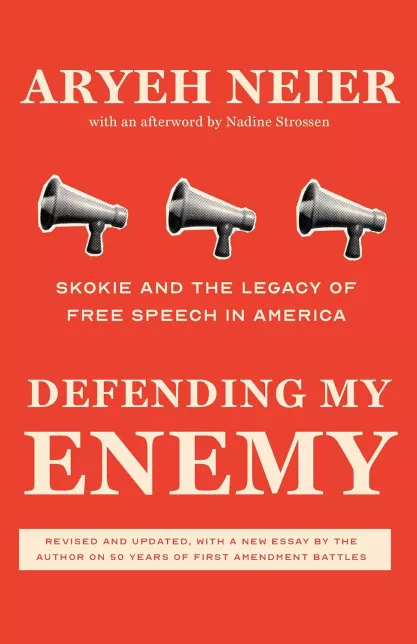
    Forthcoming book: New edition of Neier’s ‘Defending My Enemy’

    A new edition of the most important free speech book of the past half-century, with a new essay by the author on the ensuing fifty years of First Amendment controversies.

    Cover of the book "Defending My Enemy: Skokie and the Legacy of Free Speech in America" by Aryeh Neier

    When Nazis wanted to express their right to free speech in 1977 by marching through Skokie, Illinois — a town with a large population of Holocaust survivors — Aryeh Neier, then the national director of the ACLU and himself a Holocaust survivor — came to the Nazis’ defense. Explaining what many saw as a despicable bridge too far for the First Amendment, Neier spelled out his thoughts about free speech in his 1977 book Defending My Enemy.

    Now, nearly fifty years later, Neier revisits the topic of free speech in a volume that includes his original essay along with an extended new piece addressing some of the most controversial free speech issues of the past half-century. Touching on hot-button First Amendment topics currently in play, the second half of the book includes First Amendment analysis of the “Unite the Right” march in Charlotteville, campus protest over the Israel/Gaza war, book banning, trigger warnings, right-wing hate speech, the heckler’s veto, and the recent attempts by public figures including Donald Trump to overturn the long-standing Sullivan v. The New York Times precedent shielding the media from libel claims.

    Including an afterword by longtime free speech champion Nadine Strossen, Defending My Enemy offers razor-sharp analysis from the man Muck Rack describes as having “a glittering civil liberties résumé.”

    Praise for Defending My Enemy

    “Aryeh Neier’s Defending My Enemy is as relevant today as it was when it was first published. The book is a powerful reminder of why free speech matters—not just for the voices we agree with, but for the voices we abhor. Neier’s story of defending Nazis’ rights to speak in Skokie underscores a timeless truth: If we want to preserve freedom for ourselves, we must be willing to defend it for others, no matter how deeply we disagree. At a time when censorship is on the rise globally, Defending My Enemy stands as a bold and principled call to action. Every advocate of free expression needs to read this book—and more importantly, live its lessons.” — Greg Lukianoff

    Forthcoming scholarly article: ‘Output of machine learning algorithms isn’t entitled to First Amendment protection’

    Stanford Law Review logo

    Machine learning algorithms increasingly mediate our public discourse – from search engines to social media platforms to artificial intelligence companies. And as their influence on online speech swells, so do questions of whether and how the First Amendment may apply to their output. A growing chorus of scholars has expressed doubt over whether the output of machine learning algorithms is truly speech within the meaning of the First Amendment, but none have suggested a workable way to cleanly draw the line between speech and non-speech.

    This Article proposes a way to successfully draw that line based on a principle that we call “speech certainty” – the basic idea that speech is only speech if the speaker knows what he said when he said it. This idea is rooted in the text, history, and purpose of the First Amendment, and built into modern speech doctrines of editorial discretion and expressive conduct. If this bedrock principle has been overlooked, it is because, until now, all speech has been imbued with speech certainty. Articulating its existence was never necessary. But machine learning has changed that. Unlike traditional code, a close look at how machine learning algorithms work reveals that the programmers who create them can never be certain of their output. Because that output lacks speech certainty, it’s not the programmer’s speech.

    Accordingly, this Article contends that the output of machine learning algorithms isn’t entitled to First Amendment protection. With the Supreme Court signaling its intent to address unresolved questions of online speech, we are poised to enter a new era of First Amendment jurisprudence in the coming years. As we do, scholars, practicing attorneys, and judges can no longer ignore how the algorithms underlying online speech actually work – and how they have changed with the advent of machine learning. 

    Without recognizing this paradigm shift in algorithmic speech, we risk sleepwalking into a radical departure from centuries of First Amendment jurisprudence. By failing to distinguish between traditional and machine learning algorithms, current consensus about algorithmic speech suggests that the Constitution should, for the first time in its history, protect speech that a speaker does not know he has said. Speech certainty provides a novel and principled approach to conceptualizing machine learning algorithms under existing First Amendment jurisprudence. 

    Related

    More in the news

    2024-2025 SCOTUS term: Free expression and related cases

    Cases decided 

    • Villarreal v. Alaniz (Petition granted. Judgment vacated and case remanded for further consideration in light of Gonzalez v. Trevino, 602 U. S. ___ (2024) (per curiam))
    • Murphy v. Schmitt (“The petition for a writ of certiorari is granted. The judgment is vacated, and the case is remanded to the United States Court of Appeals for the Eighth Circuit for further consideration in light of Gonzalez v. Trevino, 602 U. S. ___ (2024) (per curiam).”)
    • TikTok Inc. and ByteDance Ltd v. Garland (The challenged provisions of the Protecting Americans from Foreign Adversary Controlled Applications Act do not violate petitioners’ First Amendment rights.)

    Review granted

    Pending petitions

    Petitions denied

    Last scheduled FAN

    FAN 455: “Eight free expression cases pending on SCOTUS docket

    This article is part of First Amendment News, an editorially independent publication edited by Ronald K. L. Collins and hosted by FIRE as part of our mission to educate the public about First Amendment issues. The opinions expressed are those of the article’s author(s) and may not reflect the opinions of FIRE or Mr. Collins.
    Source link

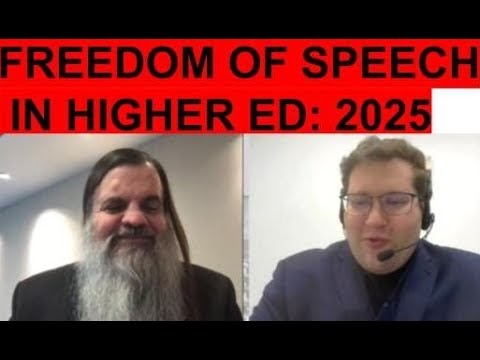
  • Freedom of speech in higher education (Future Trends Forum)

    Freedom of speech in higher education (Future Trends Forum)

     What does academic freedom mean in 2025?

    We will explore this vital question with the help of Jeremy C. Young, the Freedom to Learn program director at PEN America (and excellent 2023 Forum guest).


    Source link

  • Analysis: Harvard’s settlement adopting IHRA anti-Semitism definition a prescription to chill campus speech

    Analysis: Harvard’s settlement adopting IHRA anti-Semitism definition a prescription to chill campus speech

    Just one day after President Trump took office, Harvard agreed to settle two lawsuits brought against it by Jewish students that alleged the university ignored “severe and pervasive anti-Semitism on campus” and created “an unbearable educational environment” in the wake of the October 7, 2023, Hamas attack on Israel and the ongoing war in Gaza. 

    While the settlement language itself does not appear to be public, a press release filed on the official docket of The Louis D. Brandeis Center for Human Rights Under Law v. President and Fellows of Harvard College included some details. Most notably, Harvard agreed to adopt the International Holocaust Remembrance Alliance’s (IHRA’s) definition of anti-Semitism. FIRE’s worry, shared by many others — including the definition’s primary author — is that, when added to policies used to punish discriminatory harassment on American campuses, the definition is too likely to be used to punish speech that is critical of Israel or its government but that is not motivated in animus against Jews or Israelis. 

    FIRE has repeatedly proposed steps to address anti-Semitic discrimination on campus that would safeguard students from harassment while protecting freedom of speech, most recently in our inauguration-day letter to President Trump. Getting this right is important; any proposal that chills or censors protected speech on campus won’t pass constitutional muster at public universities, won’t square with free speech promises at private universities (like Harvard), and won’t effectively address anti-Semitism.

    Nevertheless, attempts to codify the IHRA definition of anti-Semitism into laws or regulations are nothing new. FIRE posted a roundup of the widespread civil libertarian opposition to its codification last year, when Congress considered adopting it as federal law. Among those opponents is the definition’s primary author, Kenneth Stern, who spoke at length with FIRE’s Nico Perrino on our So to Speak podcast about why it’s not the right tool for the job of regulating speech. As Stern wrote back in 2016 for The New York Times: “The definition was intended for data collectors writing reports about anti-Semitism in Europe. It was never supposed to curtail speech on campus … And Jewish students are protected under the law as it now stands.” (Perhaps “as it is now written” would have been more precise; whether colleges follow the law is a different issue.) As Stern predicted in that piece:

    If this bill becomes law it is easy to imagine calls for university administrators to stop pro-Palestinian speech. Even if lawsuits alleging Title VI violations fail, students and faculty members will be scared into silence, and administrators will err on the side of suppressing or censuring speech.

    Stern’s prediction is about to receive ground testing at Harvard, and likely at other universities that may follow its lead.

    Anti-Semitism Awareness Act continues to threaten free speech on campus

    News

    However well-intentioned the Anti-Semitism Awareness Act may be, it remains deeply flawed and a threat to the First Amendment.


    Read More

    At public universities, which are bound by the First Amendment, it’s possible that the test will not last that long. In a case over the definition’s adoption by Texas public institutions by gubernatorial executive order, a federal judge ruled last October that Students for Justice in Palestine was likely to succeed in its claim that policies using the IHRA definition “impose impermissible viewpoint discrimination that chills speech in violation of the First Amendment.” The policies are still in place until the trial, which is scheduled for January of 2026.

    But even if use of the IHRA definition is struck down at public universities, that would not prevent its use at Harvard or hundreds of other private institutions. FIRE’s opposition to the use of the IHRA definition for the purpose of regulating speech is not because we do not believe anti-Semitic harassment is not happening. Obviously, it is. Nor is it because we believe anti-Semitic harassment is not worth attention or not prohibited by civil rights law. Again, it is. Our concern is with the IHRA definition itself and the way campuses across the country are likely to misapply it to further chill speech — and use it as an entering wedge to do the same with speech on every other topic under the sun. If the underlying issue were bigotry against any other group, our concerns would be the same. (And if you are aware of such efforts, please bring them to our attention.)

    The IHRA definition and anti-discrimination law

    At the outset, the adoption of the IHRA definition to define anti-Semitism is itself novel in that laws and rules in the United States generally do not define what acts specifically are racist, sexist, religiously bigoted, or anti-Semitic. They are written from the perspective of prohibiting discrimination against a class of people protected by that law. In the case of Title VI of the Civil Rights Act of 1964, for example, that includes race, color, and national origin. But the law does not go on to say “and here is what is racist” followed by a list of examples or a definition. That is left to judges and fact-finders to determine, taking into account the facts and context of a given case.

    Detailed definitions and examples are much less novel on college campuses, though they have long been problematic. Back in 2007, FIRE took issue with the University of Delaware for a mandatory freshman orientation that (among a massive number of its problems) defined “a racist” as “all white people (i.e., people of European descent) living in the United States, regardless of class, gender, religion, culture, or sexuality.” Sexual harassment is often (too broadly) defined simply as “unwelcome conduct of a sexual nature,” which is unhelpful and overbroad, and then further runs aground on examples like Cal State-Channel Islands’ (our July 2019 Speech Code of the Month) “derogatory posters, cartoons, drawings, symbols, or gestures.” 

    The IHRA definition combines a couple of these problems. Its website explains

    On 26 May 2016, the Plenary in Bucharest decided to:

    Adopt the following non-legally binding working definition of antisemitism:

    “Antisemitism is a certain perception of Jews, which may be expressed as hatred toward Jews. Rhetorical and physical manifestations of antisemitism are directed toward Jewish or non-Jewish individuals and/or their property, toward Jewish community institutions and religious facilities.”

    Let’s look at this with an eye towards enforcement. Did a person accused of discriminatory harassment do so based on having “a certain perception of Jews?” What perception is that? Hatred? Not exactly, as it “may be expressed as hatred towards Jews.” But if it “may be expressed as hatred towards Jews,” it may also not be expressed as hatred towards Jews. That leaves open the possibility that anti-Semitism can be expressed by anything. The definition then moves on to say that it can be directed toward “Jewish or non-Jewish individuals and/or their property.” The group of “Jewish and non-Jewish individuals” includes literally everyone. It is more specific about community institutions and religious facilities, excluding those that are not Jewish.

    The IHRA definition’s flexibility and reach introduce serious problems when the definition is being used as a speech code that can result in the discipline of individuals or the silencing of their speech. 

    Most of the definitional work, then, is left to be done by analogy to the examples, which IHRA makes clear, saying, “To guide IHRA in its work, the following examples may serve as illustrations.” Some of those examples include hard-to-argue-with propositions like “Calling for, aiding, or justifying the killing or harming of Jews in the name of a radical ideology or an extremist view of religion,” or “Accusing Jews as a people of being responsible for real or imagined wrongdoing committed by a single Jewish person or group, or even for acts committed by non-Jews.” But other examples have a much greater potential overlap with political critiques, such as “Drawing comparisons of contemporary Israeli policy to that of the Nazis,” and “Denying the Jewish people their right to self-determination, e.g., by claiming that the existence of a State of Israel is a racist endeavor,” both of which were cited by the judge in the Texas lawsuit mentioned above. Still others are somewhere in between, like “Applying double standards by requiring of it a behavior not expected or demanded of any other democratic nation.”

    To combat anti-Semitism, House bill chips away at free speech

    News

    An amendment before the U.S. House impermissibly threatens the expressive rights of students and faculty across the country.


    Read More

    For the IHRA definition’s intended purpose — to identify anti-Semitism in Europe so that the IHRA may catalog and identify it — the breadth of the examples isn’t too much of a problem. It is common, at FIRE and everywhere else, to ask someone to look for examples of a certain kind of incident by telling them “look for things that look like this.” The sweep of the examples is likely helpful for the IHRA’s intended aim, in that they may capture “edge cases” that don’t strictly fall into the definition but nevertheless seem like part of what it was intended to cover.

    Yet the IHRA definition’s flexibility and reach introduce serious problems when the definition is being used as a speech code that can result in the discipline of individuals or the silencing of their speech. The definition is simply not constructed in a manner that makes for fair and predictable application by different individuals, even if all of those individuals are trying their level best. That’s likely why the IHRA went out of its way to label it both a “non-legally binding” and “working” definition, building into the definition’s very text the recognition that it was neither intended to be used as a regulation nor the final word.

    Having said that, IHRA goes on to couch things even further. Preceding the examples, it writes:

    Manifestations might include the targeting of the state of Israel, conceived as a Jewish collectivity. However, criticism of Israel similar to that leveled against any other country cannot be regarded as antisemitic. Antisemitism frequently charges Jews with conspiring to harm humanity, and it is often used to blame Jews for “why things go wrong.” It is expressed in speech, writing, visual forms and action, and employs sinister stereotypes and negative character traits.

    Contemporary examples of antisemitism in public life, the media, schools, the workplace, and in the religious sphere could, taking into account the overall context, include, but are not limited to: […]

    The bolded phrases are all qualifiers that leave more openings for interpretation — a situation that courts recognize as a problem in the area of free speech because it makes the rule too vague to follow or fairly administer. In Grayned v. City of Rockford, a landmark 1972 case, the Supreme Court explained that a law (or regulation) is unconstitutionally vague when it does not “give a person of ordinary intelligence a reasonable opportunity to know what is prohibited, so that he may act accordingly.” And vagueness is a particular problem when the rule concerns free speech: “[W]here a vague statute abut[s] upon sensitive areas of basic First Amendment freedoms, it operates to inhibit the exercise of [those] freedoms. Uncertain meanings inevitably lead citizens to steer far wider of the unlawful zone … than if the boundaries of the forbidden areas were clearly marked.”

    Harvard is private, so the First Amendment doesn’t directly apply on its campus, but the underlying problem for any institution that claims to be committed to free speech is the same.

    Applying the IHRA definition in practice

    Let’s walk through one example to see how this can play out.

    Accusations that Israel is an “apartheid state” are common on campuses (including at Harvard). Are they anti-Semitic? Many would say yes; the ADL calls labeling Israel as an apartheid state “inaccurate [and] offensive,” and notes it is “often used to delegitimize and denigrate Israel as a whole.” A large majority of Americans may find it unconvincing — only 13% in this April 2023 poll agreed that Israel was “a state with segregation similar to apartheid.” Yet saying that Israel’s Jews are oppressing Palestinians by running an apartheid regime is most certainly criticism “similar to that leveled against” countries like the United StatesIndiaMalaysia, and course the former regime of South Africa (the country from which the term originates), along with many others, past and present. If applying the actual words of the IHRA definition, then, this seems to mean that accusations of Israeli apartheid “cannot be regarded as antisemitic.”

    On the other hand, Israeli apartheid accusations do sound similar to several of the IHRA examples. Is the apartheid accusation “[d]enying the Jewish people their right to self-determination, e.g., by claiming that the existence of a State of Israel is a racist endeavor?” That’s close, but not exactly right; you may think that Israel should exist, but with different policies. Is it “[a]pplying double standards by requiring of it a behavior not expected or demanded of any other democratic nation?” This depends on whose expectations or demands are being considered. And is making the claim while mostly around American Jews rather than Israeli Jews a form of “[h]olding Jews collectively responsible for actions of the state of Israel,” since most of your Jewish listeners are likely to be American, with little influence on what Israel does?

    None of these are easy questions. Regardless of your personal view, you will find reasonable people who disagree on the answers. And that’s exactly why the IHRA’s examples, when used as part of a speech regulation, threaten protected speech.

    Nobody asked the IHRA to come up with a law or rule to define anti-Semitism for purposes of determining what might be discriminatory harassment on American campuses. It’s not the IHRA’s fault that the definition is not right for that purpose.

    Ask yourself: What would you do if put in the position of the fact-finder tasked with using the IHRA definition to determine whether a person had engaged in prohibited discriminatory harassment by constantly banging the drum about “Israeli apartheid?” First, you would look to see if the accused said or did something else that would make the prohibited discriminatory intent — that the real reason for their activity was prejudice, not political disagreement — more obvious. If so, problem solved: you can either ignore the apartheid accusation or feel fairly safe assuming that this particular person did mean it to be anti-Semitic.

    But if there’s no other helpful evidence, you have to make a decision: Do I believe the IHRA definition actually means what it says about how “criticism of Israel similar to that leveled against any other country cannot be regarded as antisemitic?” The rules of grammar and logic dictate one answer. But, you think, “that can’t actually be what the rule means, can it?” You look at the examples and can’t figure it out, so you just pick one meaning and go with it. This isn’t an application of the rule based on the facts before you. It’s essentially a coin-flip, and replacing it with an actual coin-flip would produce an equally accurate outcome.

    More likely, though, you’re on the disciplinary panel because you care about the college community and are determined to try to do what’s best for it. You ask yourself: “Is anyone really that angry about political discrimination in a far-off land, or is it really hostility towards Jews? Might they escalate to physical violence if I let them ‘get away’ with it? Maybe it’s better safe than sorry; after all, this person sounds unpleasant to be around.”

    Either way, you don’t have the information you need to know whether the person is guilty or innocent, because you don’t know what the rule actually forbids. You can speculate about what it means, and you have incentives to find a certain way. But the main thing you have to fall back on is the one thing for which you don’t need any process or information at all: prejudice. Imagine the most likely result with a white student named Stacy. Then a Latino student named Reuben. Then a black student named Denise. Then an Arab student named Mohammed. Are all these cases equally likely to come out the same way? The obvious answer is no.

    That’s the cost of punishing people for breaking rules that are too vague to understand, or too confusing to follow, or that reasonable people can read entirely differently from one another. 

    This is bad practice with any rule, but it’s particularly bad with rules that can affect expression. Vague and incomprehensible rules about income taxes are certainly bad, but people are still likely to work and pay (most of) their taxes. Vague rules about speech means people silence themselves, at least in public, which only encourages resentment and radicalization. 

    Nobody asked the IHRA to come up with a law or rule to define anti-Semitism for purposes of determining what might be discriminatory harassment on American campuses. It’s not the IHRA’s fault that the definition is not right for that purpose. It will be the fault of a school who adopts it when the inevitable injustice results, and quite possibly turns a persuadable political opponent into someone with a racial or religious ax to grind.

    Harvard compounds the problem through hypocrisy

    Harvard’s FAQ attempting to explain how this applies only makes the situation worse.

    A few days after announcing the settlement, Harvard also released a Frequently Asked Questions document about its updated policy. It’s more than 3,500 words long, and refers students to the IHRA definition as well as Harvard’s own (also long) Non-Discrimination and Anti-Bullying Policy. It states that “[d]iscrimination on the basis of the following protected categories, or any other legally protected basis, is unlawful and is prohibited,” with those categories being 

    According to the press release, Harvard agreed to include discrimination against Zionists as a form of punishable discriminatory harassment, apparently independent of whether those Zionists are or are perceived to also be Jewish. The FAQ confirms this, but with a twist — it covers anti-Zionists, too:

    Does conduct that would violate the Non-Discrimination Policy if targeted at Jewish or Israeli individuals also violate the policy if targeted at Zionists?

    Yes, provided that the conduct meets the requirements for discriminatory disparate treatment or discriminatory harassment. The Non-Discrimination Policy includes among its protected categories religion, national origin, shared ancestry or ethnic characteristics, and political beliefs. For many Jewish people, Zionism is a part of their Jewish identity. Conduct that would violate the Non-Discrimination Policy if targeting Jewish or Israeli people can also violate the policy if directed toward Zionists. Examples of such conduct include excluding Zionists from an open event, calling for the death of Zionists, applying a “no Zionist” litmus test for participation in any Harvard activity, using or disseminating tropes, stereotypes, and conspiracies about Zionists (e.g., “Zionists control the media”), or demanding a person who is or is perceived to be Jewish or Israeli to state a position on Israel or Zionism to harass or discriminate.

    Such conduct would need to meet the standards expressed in the Non-Discrimination Policy for discriminatory disparate treatment or discriminatory harassment, as described above.

    Zionists, anti-Zionists, and non-Zionists are all protected against discriminatory disparate treatment and harassment under the policy.

    Does conduct that would violate the Non-Discrimination Policy if targeted at Muslim, Arab, Palestinian individuals also violate the policy if targeted at individuals who support Palestinian rights?

    Yes, parallel to the question and answer above, provided that the conduct meets the requirements for discriminatory disparate treatment or discriminatory harassment. The Non-Discrimination Policy includes among its protected categories religion, national origin, shared ancestry or ethnic characteristics, and political beliefs such as support of Palestinian rights.

    On one hand, this can be seen as solving the problem of appearing to carve out special protections for those with a particular religious or political belief (Zionism is at least one of those and sometimes both) by according the same level of protection to those with the opposing belief. Perhaps this will end up being a net benefit for Jewish or Zionist students who are discriminatorily harassed — if one assumes that Harvard administrators did not already know that Zionism was, if not a religious belief, certainly a political belief. (That seems hard to swallow, but it’s possible.) What Harvard appears to do with this FAQ is simply subsume the settlement into its pre-existing protections against discrimination against people based on their political beliefs.

    And that’s where this all breaks down, because it’s quite possible that there is not a single person on this planet who sincerely believes that Harvard does not engage in disparate treatment of people based on their political beliefs. (Start here and keep on scrolling.)

    It is no exaggeration to say that FIRE would not exist if Harvard didn’t play favorites with regard to politics. Its decades of doing so were a major factor in leading FIRE co-founder Harvey Silverglate (a graduate of Harvard Law who to this day resides in Cambridge, and who often represented Harvard students at its disciplinary hearings) to realize that something had gone terribly wrong on our nation’s college campuses. He would eventually join FIRE’s other co-founder, Alan Charles Kors, to publish The Shadow University back in 1998, and to found what began as the Foundation for Individual Rights in Education the following year. Harvard’s written prohibition against political discrimination was already in place when then-president Claudine Gay stepped on a metaphorical rake regarding anti-Semitism in front of Congress in 2023, starting a chain of events that led to her resignation.

    Simply put, if Harvard was serious about preventing discrimination against Jewish or Zionist students, it already had the ability to do so. Whether based on status or belief, they were certainly protected under Harvard’s existing policies. Harvard just didn’t feel like enforcing those rules for the benefit of those students.

    Nor did Harvard feel like using the correct standard for discriminatory harassment in the educational context — the Davis standard that behavior must be “severe, pervasive, and objectively offensive” (as well as fulfill several other factors) to be punishable discriminatory harassment. FIRE has written exhaustively about the importance of the Davis standard (here’s a primer in two parts on it), and why the constant attempts of schools to water it down by pretending “and” is the same as “or” are dangerous for free expression.

    Groups across ideological spectrum unite in opposing Antisemitism Awareness Act

    News

    The bill, which seeks to codify the IHRA definition of anti-Semitism into law, faces widespread criticism.


    Read More

    Harvard has done exactly that, watering down the Davis standard to require only that to be punishable, offensive behavior merely be severe or pervasive, not both. Here’s the thing: a great deal of activism is meant to be pervasive. Ongoing protests, social media campaigns, distribution of literature, the display of flags and signs, and many other forms of expression can all go on for days, weeks, or months. The messages may well be offensive, even objectively offensive. Requiring that the communication of these messages also reach the level of severity is a fundamental guardrail preventing the use of discriminatory harassment policies to silence protected speech — and Harvard has gone ahead and pulled that guardrail right out.

    Presumably, the plaintiffs are hoping that this settlement will at least focus Harvard’s attention on discrimination against Jewish and Zionist students. This is likely to be true, at least until the heat is off. Given the past couple of years, it’s hard to blame anyone involved in the Israeli-Palestinian controversy for being upset about how campuses have treated them. But the permanent effect of broadening the reach of discriminatory harassment policies so that virtually every cultural, political, or religious disagreement becomes a potential matter for investigation will inevitably be to chill speech on any topic that might be controversial.

    Harvard is likely just fine with that chilling effect, and even more content to know that the more overbroad, vague, and complicated it can make its harassment policies, the more discretion its administrators have to simply do whatever they want. Not only does the vagueness guarantee this outcome, but the FAQ contains plenty of “savings clause” language that gives Harvard the ability to apply the policy arbitrarily. How about this gem:

    Ordinarily, it will not violate the NDAB Policies for members of the Harvard community to make controversial statements in the course of academic work or in scholarship; express disagreement with another person’s political views; or criticize a government’s policy or the political leaders of a country.

    “Ordinarily” it won’t — which means sometimes it will. Can you determine when that might be by reading the policies? No. The answer, then, is “when we say it will.”

    This is not a win for free speech or for anti-discrimination. This is a license for Harvard to go right on doing whatever it wants.

    The double standards are the real problem

    The words “Equal Justice Under Law” are carved on the front of the Supreme Court for a reason. 

    There is little that is more corrosive to a society or community than rules that allow the authorities to treat offenses differently depending on who the alleged victims or offenders might be. This is a common thread in many FIRE cases, but it’s impossible not to notice how clearly it takes front and center in complaints by Jewish or pro-Israel students that they are subjected to treatment that no campus would accept were it aimed at other minority groups.

    The complaint in the Brandeis Center v. Harvard case at issue is just one among many examples. It’s literally the first thing they bring up in the complaint. While Harvard promises to prohibit “[b]ullying, hostile and abusive behavior,” the plaintiffs write:

    [A]s to Harvard’s Jewish and Israeli students, these promises are empty. In recent years, and especially in the last few months, Jewish and Israeli students have been subjected to cruel antisemitic bullying, harassment, and discrimination. And when Harvard is presented with incontrovertible evidence of antisemitic conduct, it ignores and tolerates it. Harvard’s permissive posture towards antisemitism is the opposite of its aggressive enforcement of the same anti-bullying and anti-discrimination policies to protect other minorities.

    FIRE has spoken to enough students at Harvard and other institutions to give us no reason to doubt this is true. While a perennial problem with regard to many issues, the transparent application of double standards has been particularly central to the complaints of Jewish and pro-Israeli students.

    The extent to which this is acutely felt by Jewish and pro-Israeli students is further compounded by the fact that the application of double standards to Jews and/or Israel is widely considered to be a central characteristic of specifically anti-Semitic bigotry. After all, the words “double standards” literally appear in one of the IHRA examples of potential anti-Semitism: “Applying double standards by requiring of [Israel] a behavior not expected or demanded of any other democratic nation.”

    Consider this allegation, taken from the Brandeis Center’s complaint:

    On October 18, 2023, another member of JAFE and the Brandeis Center, Member #4, an Israeli Jew and a student at the Harvard Business School (“HBS”), was walking through campus when he encountered an outdoor anti-Israel protest and decided to video the event, as others were doing. When protestors saw him and identified him as Jewish and/or Israeli, they accosted him. A mob surrounded him, engulfed him with keffiyehs, and chanted “Shame! Shame! Shame!” in his face. The assailants grabbed him, and one hit him in the neck with his forearm, before forcing Member #4 out of Harvard’s quad…. The video of the assault is shocking. But more remarkable perhaps is that Harvard has not taken any action to date to redress both the physical assault and the clear violations of its Anti-Bullying and Anti-Discrimination Policies.

    Assuming this account is anywhere near the truth, it is impossible to imagine this being Harvard’s reaction to, say, a group of white students doing this to an African-American student. Nor is any change to policy required to handle this situation. You don’t even need a discrimination policy to prevent people from shoving others around. If Harvard truly sat on its hands here, that’s because it wanted to.

    The solution to this problem will not come from making people at Harvard more aware of what represents anti-Semitic discrimination, expanding the number of protected classes, or broadening their interpretation in a way that cannot help but scare people away from speaking. It can only be solved when the people in charge are either no longer willing or no longer able to apply noxious double standards in order to advance their own political, religious, or cultural agendas.

    Adopting the IHRA definition of anti-Semitism will chill campus speech. We can hope that it will also help at least a few Harvard students whose episodes of discriminatory harassment might otherwise be ignored, assuming the Harvard administration feels the need to make a show of things. It won’t address the root problem. But it will set Harvard up for plenty of new ones.

    Source link

  • Trump’s threat to deport anti-Israel protesters is an attack on free speech

    Trump’s threat to deport anti-Israel protesters is an attack on free speech

    This article originally appeared in MSNBC on Jan. 31, 2025.


    The campus controversies inflamed by the Oct. 7, 2023, Hamas attack against Israel and Israel’s subsequent war in Gaza have reached a worrying conclusion. Now, with President Donald Trump’s promise to deport those he deems “pro-jihadist” protesters, we’re facing questions not just about which ideas and speech should be allowed on campus, but whether foreign students should be deported for expressing disfavored views.

    On Wednesday, Trump signed an executive order on antisemitism that directs leaders of agencies, including the secretary of homeland security, to familiarize universities with grounds for inadmissibility for foreign nationals “so that such institutions may monitor for and report activities by alien students and staff relevant to those grounds.” Those reports will then lead “to investigations and, if warranted, actions to remove such aliens.”

    This development should worry all Americans, regardless of their position on the Israel-Hamas war.

    The order implies that universities should be monitoring and reporting students for scrutiny by immigration officials, including for speech that is protected by the First Amendment. It follows last week’s executive order threatening denial of entry to foreign nationals, or even deportation of those currently in the country, who “espouse hateful ideology.”

    Free Speech Dispatch

    Page

    The Free Speech Dispatch is a new regular series covering new and continuing censorship trends and challenges around the world. Our goal is to help readers better understand the global context of free expression.


    Read More

    Student visa holders in the U.S. already risk deportation by engaging in criminal activity, and did so long before the enactment of this order. Students who commit crimes — including vandalism, threats or violence — must face consequences, including potential revocation of visas when appropriate.

    The First Amendment does not protect violence, for visitors and citizens alike, and an executive order narrowly confined to targeting illegal acts would not implicate First Amendment rights.

    But a fact sheet released by the White House alongside the executive order goes well beyond criminal grounds for removal of foreign nationals to instead threaten viewpoint-motivated deportations. “To all the resident aliens who joined in the pro-jihadist protests, we put you on notice: come 2025, we will find you, and we will deport you,” Trump said. “I will also quickly cancel the student visas of all Hamas sympathizers on college campuses, which have been infested with radicalism like never before.”

    If that’s what the Trump White House expects agencies to read into its formal orders, this development should worry all Americans, regardless of their position on the Israel-Hamas war.

    Advocates of ideological deportation today should not be surprised to see it used against ideas they support in the future.

    Our nation’s campuses are intended to be places of learning and debate that facilitate a wide range of views, even ones that some consider hateful or offensive.

    This openness, albeit unpleasant or controversial at times, is a defining strength of American higher education. It’s one of the features attractive to students traveling from abroad who may hope to take part in the speech protections Americans have worked so hard to preserve. These are protections that they may very well be denied in their home countries.


    We won’t protect freedom on campus by making it inaccessible to the international students who study there. But, given the warning accompanying the order, international students will now be rightfully afraid that their words — not just their conduct — are under a microscope.

    There are already signs that critics of campus demonstrations expect the administration will expel protesters from the country. In the lead-up to the signing of this latest order, pro-Israel advocates claimed to be in contact with officials in the incoming Trump administration concerning lists of student protesters they hope to see deported. One group, Betar, told the New York Post it’s “using a combination of facial recognition software and ‘relationship database technology’” to identify protest attendees who are foreign nationals.

    Freedom of speech was never meant to be easy.

    At the Foundation for Individual Rights and Expression (FIRE), where I work, we have seen firsthand the many speech-related controversies that have plagued higher education over the decades. In every case, adhering to viewpoint-neutral principles, rather than censorship, has been the proper solution. 

    If we open the door to expelling foreign students who peacefully express ideas out of step with the current administration about the Israeli-Palestinian conflict, we should expect it to swing wider to encompass other viewpoints too. Today it may be alleged “Hamas sympathizers” facing threats of deportation for their political expression. Who could it be in four years? In eight?

    Advocates of ideological deportation today should not be surprised to see it used against ideas they support in the future.

    Why (most) calls for genocide are protected speech

    News

    Creating a “genocide” exception to free speech only opens the door to more speech restrictions and selective enforcement.


    Read More

    In Bridges v. Wixon, the Supreme Court’s 1945 decision rejecting the deportation of Australian immigrant Harry Bridges over alleged Communist Party connections, Justice William Douglas wrote, “Freedom of speech and of press is accorded aliens residing in this country.”

    Later decisions from the court complicate the question. The federal government retains significant authority over those who may enter and stay in the country. But the court’s reasoning in Wixon should provide lasting guidance.

    In his concurring opinion, Justice Frank Murphy stated that he “cannot agree that the framers of the Constitution meant to make such an empty mockery of human freedom” by allowing the government to deport an alien over speech for which it could not imprison him.

    Freedom of speech was never meant to be easy. But it allows us the space we need to work through thorny social and political challenges, even when it’s fraught with friction and discomfort. The United States should preserve this freedom on our campuses — spaces for free learning that set us apart from more authoritarian nations around the world — not make an “empty mockery” of it.

    Source link

  • Analysis: Early flurry of executive orders a mixed bag for free speech

    Analysis: Early flurry of executive orders a mixed bag for free speech

    Since taking office for his second term on Jan. 20, President Trump has issued a flurry of executive orders, including several implicating the First Amendment and freedom of expression. Below, we highlight some of these orders and evaluate the potential ramifications for free speech.

    Executive order on protecting freedom of speech is a good start — but more must be done

    One of the first executive orders the president signed was titled “Restoring Freedom of Speech and Ending Federal Censorship.” This order aims to “secure the right of the American people to engage in constitutionally protected speech” and “ensure that no Federal Government officer, employee, or agent engages in or facilitates any conduct that would unconstitutionally abridge the free speech of any American citizen.” Specifically, the order notes the government has “trampled free speech rights by censoring Americans’ speech on online platforms, often by exerting substantial coercive pressure on third parties, such as social media companies, to moderate, deplatform, or otherwise suppress speech that the Federal Government did not approve.”

    FIRE welcomes this order’s call to end federal government censorship, including that which is hidden from public view. Leaks, court documents, and other disclosures have revealed instances of federal officials pressuring social media companies to limit controversial but constitutionally protected speech on vigorously disputed topics like the origins of Covid-19, the Hunter Biden laptop story, and election integrity.

    We have written repeatedly about the dangers of such government coercion, commonly referred to as “jawboning,” highlighting how this sneaky form of government censorship threatens freedom of expression.

    A pledge by the executive branch to respect the free speech of all Americans is a good first step. But any executive order can be modified or reversed on the say-so of one person — the president. It will take actual legislation — such as FIRE’s model transparency bill — to create mechanisms that statutorily require disclosure and bring to light governmental efforts to strong-arm private social media companies into censoring protected speech. 

    In the meantime, FIRE will monitor the administration’s actions, just as we did during the Biden administration, and hold federal agencies to the standards set forth in the executive order.

    Executive orders targeting DEI programs appear to avoid First Amendment pitfalls — but FIRE will be watching their implementation

    President Trump also signed two executive orders with the aim of dismantling diversity, equity, inclusion, and accessibility programs. The first, signed on Jan. 20 and titled “Ending Radical and Wasteful Government DEI Programs and Preferencing,” calls for “termination of all discriminatory programs, including illegal DEI and ‘diversity, equity, inclusion, and accessibility’ (DEIA) mandates, policies, programs, preferences, and activities in the Federal Government, under whatever name they appear.”

    DEI/DEIA programs and initiatives take many forms. FIRE has no position on the values DEI programs may seek to advance. But our experience defending student and faculty rights on campus demonstrates that DEI administrators and offices have regularly been involved in threats to academic freedom and speech policing, functioning as a way to enforce preferred orthodoxy or ideology. And some DEI initiatives — such as mandatory DEI statements in faculty hiring or student admissions — flatly threaten free expression and academic freedom and should be prohibited. We have previously introduced model legislation designed to eliminate such use of political litmus tests in faculty hiring and student admission decisions.

    FIRE has also seen legislation in which overbroad attempts to curtail DEI mandates threaten the very same speech rights of faculty and students they aim to protect. Overbroad restrictions can improperly limit classroom discussions — as we saw in West Virginia’s recent executive order prohibiting faculty from sharing any material that promotes or encourages certain DEI-related views, while at the same time permitting criticism of those views. This allows institutions to continue ideological litmus tests as long as such tests oppose DEI — which just recreates the same problem.

    Overzealous enforcement could threaten free speech by, for example, indirectly chilling a professor from sharing their positive views of affirmative action policies or leading to investigation of a government grantee for a social media post expressing personal support for DEI initiatives.

    The president’s executive order appears to avoid these issues by targeting only the government’s own speech and initiatives, which it can constitutionally control. For instance, the Office of Management and Budget must provide a list of “Federal grantees who received Federal funding to provide or advance DEI, DEIA, or ‘environmental justice’ programs, services, or activities since January 20, 2021.” This is different from prohibiting any federal grantees from promoting DEI, which would threaten speech. Instead, the order specifically targets federal grants made specifically for the purpose of advancing DEI, and the federal government is free to shut off that funding if it no longer wishes to advance those ideals or views.

    A second DEI-related order, signed on January 21, “Ending Illegal Discrimination and Restoring Merit-Based Opportunity,” aims to eliminate “affirmative action” and “illegal discrimination and illegal preferences” in line with the Supreme Court’s decision in Students for Fair Admissions v. Harvard, which held race-based affirmative action programs in college admissions violated the Fourteenth Amendment. (FIRE takes no position on affirmative action.)

    FIRE releases statement on the use of ‘diversity, equity, and inclusion’ criteria in faculty hiring and evaluation

    News

    FIRE’s statement provides guidance to universities to ensure they respect faculty members’ expressive freedom when seeking to advance DEI.


    Read More

    The order helpfully includes two provisions that make clear it does not reach into the college classroom or infringe upon academic freedom:

    (b) This order does not prevent State or local governments, Federal contractors, or Federally-funded State and local educational agencies or institutions of higher education from engaging in First Amendment-protected speech.

    (c) This order does not prohibit persons teaching at a Federally funded institution of higher education as part of a larger course of academic instruction from advocating for, endorsing, or promoting the unlawful employment or contracting practices prohibited by this order.

    While these orders avoid constitutional pitfalls on their face, implementation should proceed carefully. Overzealous enforcement could threaten free speech by, for example, indirectly chilling a professor from sharing their positive views of affirmative action policies or leading to investigation of a government grantee for a social media post expressing personal support for DEI initiatives.

    Executive order on “gender ideology” invites possible abuse

    This executive order focuses on “[defending] women’s rights and [protecting] freedom of conscience by using clear and accurate language and policies that recognize women are biologically female, and men are biologically male.” The order requires federal government agencies to:

    remove all statements, policies, regulations, forms, communications, or other internal and external messages that promote or otherwise inculcate gender ideology, and shall cease issuing such statements, policies, regulations, forms, communications or other messages. Agency forms that require an individual’s sex shall list male or female, and shall not request gender identity. Agencies shall take all necessary steps, as permitted by law, to end the Federal funding of gender ideology.

    This aspect of the order is limited to the federal government’s own speech. However, there is a risk, similar to that presented by imprecise anti-DEI legislation, that the breadth of such an order could lead to direct or indirect censorship of private actors. The government has the power to control its speech when it is the speaker, such as in a training given to its employees. But its power is much more limited when the speaker is a private citizen.

    Of particular concern is this clause: “Federal funds shall not be used to promote gender ideology. Each agency shall assess grant conditions and grantee preferences and ensure grant funds do not promote gender ideology.”

    While the government can choose to change its own messaging on gender issues, it cannot deny funds to grantees for exercising their own First Amendment rights. Further, the imprecise language could encourage government actors to withhold otherwise available grants from those with opinions that do not align with the views expressed in this executive order — chilling constitutionally protected speech. Grantees who would otherwise espouse views agreeing with “gender ideology” may refrain for fear of losing their government grant, even if they do not use the grant itself to promote “gender ideology.”

    Executive order intended to “protect” Americans from noncitizens who “espouse hateful ideology” is at odds with our culture of free speech

    This executive order makes it federal policy to “protect [American] citizens from aliens who intend to commit terrorist attacks, threaten our national security, espouse hateful ideology, or otherwise exploit the immigration laws for malevolent purposes.” In addition to requiring agencies to ensure their policies for screening aliens align with the executive order, it requires the secretary of state to:

    Recommend any actions necessary to protect the American people from the actions of foreign nationals who have undermined or seek to undermine the fundamental constitutional rights of the American people, including, but not limited to, our Citizens’ rights to freedom of speech and the free exercise of religion protected by the First Amendment, who preach or call for sectarian violence, the overthrow or replacement of the culture on which our constitutional Republic stands, or who provide aid, advocacy, or support for foreign terrorists.

    The federal government has the authority to refuse entry to or deport people who genuinely present a national security threat. But the broad language of this order implies it may also be used to target people already in the U.S. for engaging in speech that is otherwise constitutionally protected. FIRE has previously expressed concern about denials of entry in cases where students and speakers were seemingly barred based on their speech. The ambiguous language of the order, including references to a “replacement of the culture,” suggests an intent to review and potentially punish foreign nationals for speech that would typically be protected.

    To be clear, speech that calls for violence is generally protected by the First Amendment. As we have previously written, calls for genocide or chanting “From the river to the sea,” though listeners may be offended or deeply upset, are generally constitutionally protected. Denying visas or deporting anyone who engages in such speech will create a chilling effect, deterring foreign nationals from participating in lawful protests and demonstrations.

    But just because the government may have the power to deport people for expressing their views, as it does in at least some circumstances, that does not make such deportations a good idea.

    While the driving force behind this executive order is the current Israel-Hamas conflict, there is no reason other than political whim that efforts to punish foreign nationals for their speech would stay confined to one side of that issue, or to the Israeli-Palestinian issue at all. If those targeted for “espousing hateful ideology” are today likely to be those supporting Hamas, a new government could aim such efforts at supporters of Israel’s military efforts in the coming years. Those from other nations experiencing ethnic or religious conflict, from Ukraine to Myanmar to Burkina Faso, could also face adverse immigration decisions for expressing their views.

    Why (most) calls for genocide are protected speech

    News

    Creating a “genocide” exception to free speech only opens the door to more speech restrictions and selective enforcement.


    Read More

    Because this executive order is directed at foreign nationals, the legal First Amendment issues (as distinct from the cultural free speech questions) are complicated. The Supreme Court noted in Bridges v. Wixon that the freedom of speech is accorded to resident aliens, but other precedent upholds immigration consequences based on viewpoint, and immigration officials have targeted foreign nationals for deportation for otherwise-protected speech.

    In the 1904 case United States Ex. Rel. John Turner v. Williams, the Court upheld a law that allowed the deportation of “anarchists.” In the 1954 case Galvan v. Press, the Court upheld a law that allowed the deportation of non-citizens for belonging to the Communist Party. (Interestingly, statutory prohibitions on the naturalization of anarchists and members of the Communist Party still exist.)

    But just because the government may have the power to deport people for expressing their views, as it does in at least some circumstances, that does not make such deportations a good idea. Establishing a system that allows for the routine deportation of foreign nationals based solely on their otherwise protected speech would erode our national commitment to freedom of expression as a uniquely American cultural value.

    FIRE’s Senior Scholar, Global Expression Sarah McLaughlin published a piece at MSNBC exploring President Trump’s Executive Order on anti-Semistism.

    Source link