For decades, America was gripped by college mania, a culturally and structurally manufactured frenzy that elevated higher education to near-mythical importance. Students, families, and society were swept up in the belief that a college degree guaranteed status, financial security, and social validation. This was no mere aspiration; it was a fevered obsession, fueled by marketing, rankings, policy incentives, and social pressure. Today, the spell is breaking, but the demand for credentials persists.
Historically, the term “college mania” dates to the 19th century, when historian Frederick Rudolph used it to describe the fervent founding of colleges in the United States, driven by religious zeal and civic ambition. Over time, the mania evolved. Postwar expansion of higher education through the GI Bill normalized college attendance as a societal expectation. Rankings, elite admissions, and media coverage transformed selective schools into symbols of prestige. By the early 2000s, for-profit colleges exploited the frenzy, aggressively marketing to students while federal and state policy incentivized enrollment growth over meaningful outcomes.
The early 2010s revealed the fragility of this system in what I have described as the College Meltdown: structural dysfunction, declining returns on investment, predatory practices, and neoliberal policy failures exposed the weaknesses behind the hype. At its height, college mania spun students and families into a cycle of aspiration, anxiety, and debt.
Now, even students at the most elite institutions are disengaging. Many do not attend classes, treating lectures as optional, prioritizing networking, internships, or social signaling over actual learning. This demonstrates that the spell of college mania is unraveling: prestige alone no longer guarantees engagement or meaningful educational outcomes. Families are questioning the value of expensive degrees, underemployment is rising, and alternative pathways, including vocational training, apprenticeships, and nontraditional credentials, are gaining recognition.
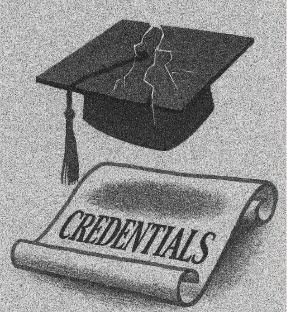
Yet the paradox remains: for many jobs, credentials are still required. Nursing, engineering, teaching, accounting, and countless professional roles cannot be accessed without degrees. The waning mania does not erase the need for qualifications; it simply exposes how much of the cultural obsession — the anxiety, overpaying, and overworking — was socially manufactured rather than inherently necessary for employment. Students are now forced to navigate this tension: pursuing credentials while seeking value, purpose, and meaningful learning beyond the symbol of the degree itself.
The breaking of the spell is not unique to higher education. History demonstrates that manias — economic, social, or cultural — rise and fall. College mania, once fueled by collective belief and systemic reinforcement, is now unraveling under the weight of its contradictions. Institutions must adapt by emphasizing authentic education rather than prestige, while policymakers can prioritize affordability, accountability, and outcomes. Students, in turn, may pursue paths aligned with practical skills, personal growth, and career readiness rather than chasing symbolic credentials alone.
The era of college mania may be ending, but with the spell broken comes an opportunity. Higher education can be reimagined as a system that serves public good, intellectual development, and genuine opportunity, balancing the need for credentials with the pursuit of meaningful education.
Sources:
Frederick Rudolph, The American College and University: A History (1962).
Frank Bruni, Where You Go Is Not Who You’ll Be: An Antidote to the College Admissions Mania (2015).
Dahn Shaulis, Higher Education Inquirer, “College Meltdown and the Manufactured Frenzy” (2011–2025).
Stanford Law Review, Private Universities in the Public Interest (2025).
Higher Education Handbook of Theory & Research, Volume 29 (2024).
Recent reporting on student engagement, class attendance, and labor-market requirements for degrees, 2023–2025.