Tag: Split

  • UNC Campuses Split on Whether Syllabi Are Public Documents

    UNC Campuses Split on Whether Syllabi Are Public Documents

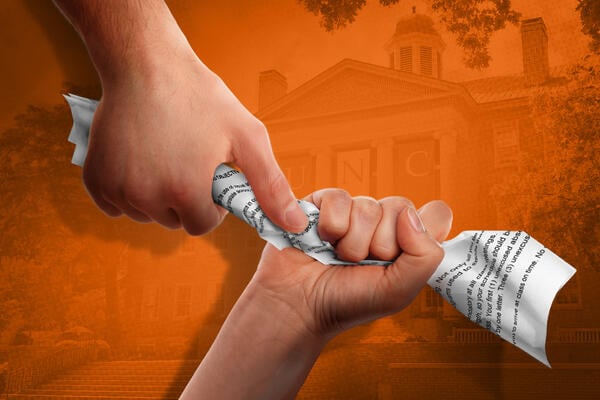
    Photo illustration by Justin Morrison/Inside Higher Ed | Liudmila Chernetska and Davizro/iStock/Getty Images

    As right-wing groups increasingly weaponize Freedom of Information Act requests to expose and dox faculty members who teach about gender, race and diversity, University of North Carolina system campuses are split over whether syllabi and other course materials should be subject to public records requests.

    In July, officials at the University of North Carolina at Chapel Hill determined that the documents are not automatically subject to such requests after the Oversight Project, founded by the conservative think tank the Heritage Foundation, requested that the university hand over any course materials from more than 70 classes that contained one of 30 words or phrases, including “gender identity,” “intersectionality,” “queer” and “sexuality.” Officials ultimately denied the request, writing, “There are no existing or responsive University records subject to disclosure under the North Carolina Public Records Act. Course materials, including but not limited to exams, lectures, assignments and syllabi, are the intellectual property of the preparer.”

    The requested materials are protected by copyright policies, a UNC Chapel Hill spokesperson told Inside Higher Ed. “The university has a longstanding practice of recognizing faculty’s intellectual property rights in course materials and does not reproduce these materials in response to public records requests without first asking for faculty consent,” they wrote in an email.

    But an hour’s drive west, at the University of North Carolina at Greensboro, officials decided just the opposite. Professors were asked to hand over their spring 2025 syllabi in response to a Freedom of Information Act request earlier this fall, said Chuck Bolton, a professor of history at UNC Greensboro and chair of the Faculty Senate. He is among dozens of faculty members who were asked to upload their syllabi into a central database.

    “The Public Records Act is inclusive in its coverage and unless there is an explicit exception, which this is not, it is covered,” UNC Greensboro spokesperson Diana Lawrence said in an email. “As a matter of public policy, transparency should take [precedence] over questions where there is doubt and we do not believe that the Federal Copyright Act provides a specific exemption or preempts what has been passed in state law.”

    Which university is interpreting the law correctly? It’s hard to know, said Hugh Stevens, an attorney who specializes in public records and FOIA law and litigation at the law firm Stevens Martin Vaughn & Tadych. There is no case law specific to this question, and the answer likely depends on how different course materials—from lecture notes to syllabi to course descriptions—are defined under the law.

    “It’s probably a matter of degree,” Stevens said. “Something that you post online for your class to read, it’s pretty hard to say those are not subject to [public records requests]. But on the other hand, the materials that you use to prepare to teach your class, but which are never published to anybody, are certainly, in my view, copyrightable and proprietary.”

    For years, UNC Greensboro put syllabi online as part of an accreditation requirement, said Jeff Jones, a history professor and head of the institution’s American Association of University Professors chapter. After the university’s website was redesigned and accreditation procedures changed, the syllabi were no longer posted.

    The UNC system doesn’t have a policy that specifies how syllabi are treated under open-records laws, leaving the decision up to individual campuses. The policy “does not discuss distribution of course materials” and “essentially covers the basic functions and procedures involved with records requests,” said UNC system spokesperson Andy Wallace.

    But the system does define copyrightable works, which include coursework produced by faculty members, Wallace added.

    Lawrence, the Greensboro spokesperson, did not respond to questions about whether the university’s records request was also from the Oversight Project and whether it has already provided the material. The FOIA request has not been made public, but Bolton, the history professor, believes it’s a narrower request than what UNC Chapel Hill received and that it is focused exclusively on syllabi.

    The opposing interpretations of the law from two universities in the same public system have left faculty confused and worried about their safety as right-wing groups rifle through course materials for any terminology they don’t like, usually related to gender identity, sexuality or race. Faculty members at Texas A&M University, the University of Houston and George Mason University, among others, have been targeted and sometimes threatened on social media for their instruction and teaching materials. Bolton said he knows of several UNC Greensboro faculty members who have been doxed.

    “Faculty have been upset and scared and freaked out about it, because there are people that seem to be [making FOIA requests] because they are trying to create gotcha moments by taking certain things out of context,” he said.

    Michael Palm, an associate professor of media and technology studies and cultural studies at UNC Chapel Hill, said in an email that while many faculty are glad Chapel Hill decided not to release the requested course materials, some expressed frustration about the lack of transparency. “We were disappointed when we learned through news reports that UNC Chapel Hill’s lawyers had decided not to respond to the requests, rather than having that decision communicated to us by administrators,” he said.

    Some professors are also concerned about how long and how vigorously the university will continue to protect faculty. “We are all concerned about the increasing political interference into our classrooms and attempts to quash our academic freedom,” said Erik Gellman, a history professor at Chapel Hill.

    Bolton, at UNC Greensboro, has similar worries.

    “This is a tough time for universities,” he said. “There are a lot of attacks coming from a lot of different directions, and that increases the anxiety and anger on behalf of the faculty, because we know that these kinds of things are not being done just because people want to find out what’s on our syllabus for intellectual reasons. They’re doing it for more nefarious reasons.”


    Source link

  • NJ Governor Hopefuls Split on Forcing School Districts to Merge – The 74

    NJ Governor Hopefuls Split on Forcing School Districts to Merge – The 74


    Get stories like this delivered straight to your inbox. Sign up for The 74 Newsletter

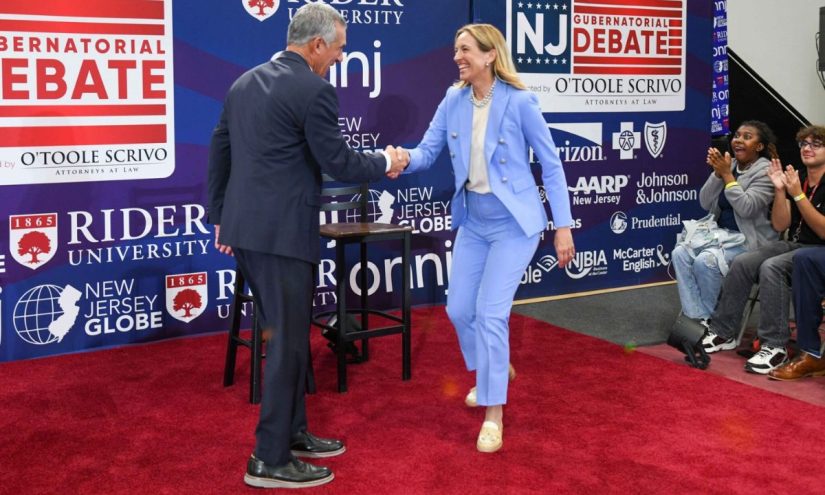
    New Jersey’s gubernatorial candidates both want school districts to consolidate as a cost-saving maneuver, but they differ on whether the state should force districts to merge with their neighbors.

    Rep. Mikie Sherrill, the Democratic gubernatorial nominee, said during Sunday’s gubernatorial debate that she would first incentivize mergers but added that compulsory consolidation was an option.

    “I’d start by offering the carrot to help the areas that want to consolidate, but when there are areas that are not putting enough money into students, into educators, into the buildings, and then they are taking a lot of money in property taxes and from the state level, then we’ll have to start to look at compulsory movements,” Sherrill said.

    Republican Jack Ciattarelli, a former assemblyman, likewise said he would seek to boost incentives and assistance to municipalities and school districts seeking mergers, but he pledged not to force them.

    “I do not believe that our state government should force consolidation. That’s up to the locals,” he said. “But I’ll tell you what, if you do consolidate or you do regionalize, Governor Ciattarelli will help incentivize that to make it easier.”

    Sherrill and Ciattarelli are vying to succeed Gov. Phil Murphy, a Democrat who cannot seek a third term in November.

    Officials have long hailed school consolidation as a means of easing local property taxes by reducing duplicative administrative and facilities costs, but uptake has been slow.

    New Jersey had 590 operating school districts during the 2024-2025 school year, according to state data, down from 599 in the 2020-2021 school year.

    The number of non-operating districts — districts that have a board of education but send all their students to schools in outlying districts — fell from 17 to 16 over that same time period. Sherrill signaled those districts could be the first merged if she wins the governor’s race.

    “We have some school districts who have the whole administrative cost, all of the buildings, and yet they’re not even running a K-12 school system, so we do need to merge some of these school districts,” she said.

    Schools consume a majority of local property taxes — 52% of all those collected in 2024, according to property tax tables published by the Department of Community Affairs — and the more than $15.1 billion in school aid approved in the current state budget accounted for more than a quarter of all spending approved in the annual appropriations bill for the current July-to-June fiscal year. That total includes more than $4 billion in combined special education, transportation, and other categories of aid separate from the state’s school funding formula.

    Ciattarelli suggested school vouchers — which allow property tax dollars to follow a student to a private school, a public school outside their district, or a charter school — could be a fix for ailing districts.

    “When a school system is failing — and there’s some reasonable metrics that tell us whether or not a school system is failing — there’s got to be choice,” he said. “That choice comes in the form of vouchers. That choice comes in the form of charter schools.”

    Because vouchers typically draw from school district funding, they could cause funding to decline at in-district public schools as students seek education elsewhere.

    New Jersey lawmakers have considered compelling school district mergers or shared service agreements, but to date, such mergers have been entirely voluntary.

    Murphy, who has generally favored school mergers, last year said he was “not wild about compulsory” consolidation, cautioning that home rule, a constitutional framework that gives local governments broad authority over the administration of school and other municipal services, could limit forced mergers.

    A law he signed in 2022 created grants for districts to study whether consolidation was feasible, though only a handful of districts have explored such mergers since.

    Cape May City Elementary School and West Cape May Elementary School are the latest to receive grants to explore a merger. Together, the two Cape May County schools have just 241 students.

    New Jersey Monitor is part of States Newsroom, a nonprofit news network supported by grants and a coalition of donors as a 501c(3) public charity. New Jersey Monitor maintains editorial independence. Contact Editor Terrence T. McDonald for questions: [email protected].


    Get stories like these delivered straight to your inbox. Sign up for The 74 Newsletter

    Source link

  • Pediatricians Back COVID Vaccines, in Split From RFK Jr. – The 74

    Pediatricians Back COVID Vaccines, in Split From RFK Jr. – The 74


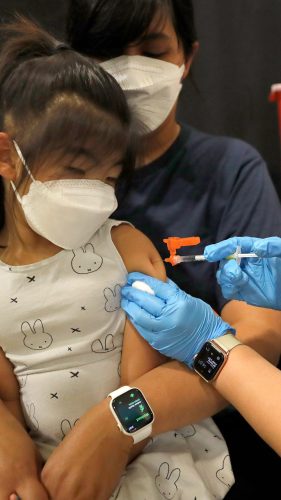
    The American Academy of Pediatrics recommends that children ages 6 to 23 months should receive a COVID-19 vaccine.


    Source link

  • Oklahoma religious charter remains blocked in SCOTUS split

    Oklahoma religious charter remains blocked in SCOTUS split

    This audio is auto-generated. Please let us know if you have feedback.

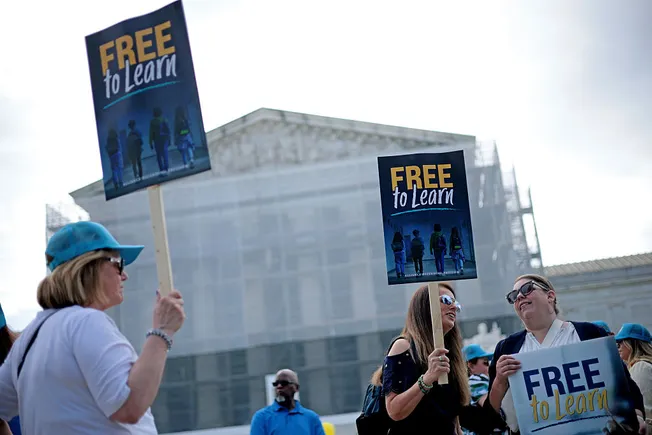
    The nation’s first religious public charter school will not be able to open its doors in Oklahoma after a 4-4 split in the U.S. Supreme Court on Thursday morning upheld the state supreme court’s ruling that blocked the school.

    The high court did not issue written opinions in the case.

    In its June 2024 ruling in St. Isidore of Seville Catholic Virtual School v. Drummond, a six-justice majority of the Oklahoma Supreme Court sided with state Attorney General Genter Drummond, writing that the virtual public charter school’s creation would violate the Oklahoma Constitution and the First Amendment’s Establishment Clause. St. Isidore was originally scheduled to open for the 2024-25 school year.

    Enforcing the St. Isidore Contract would create a slippery slope and what the framers’ warned against — the destruction of Oklahomans’ freedom to practice religion without fear of governmental intervention,” the Oklahoma court’s majority wrote in the decision.

    If the U.S. Supreme Court had ruled in favor of St. Isidore, the high-profile religious liberty case could have opened the door for a wave of other publicly funded religious schools. The split decision, however, leaves no national precedent on the question of whether religious schools can participate in public charter school programs without violating the First Amendment’s Establishment Clause.

    Justice Amy Coney Barrett recused herself from the case.

    St. Isidore is “disappointed” that the decision to block the school’s opening was upheld “without explanation” from the U.S. Supreme Court, said Archbishop of Oklahoma City Rev. Paul Coakley and Bishop of Tulsa Rev. David Konderla, in a joint statement Thursday.

    Given this latest ruling, Coakley and Konderla said they are exploring alternative options to offer a virtual Catholic education “to all persons” in Oklahoma and remain committed to parental choice in education.

    The Oklahoma Statewide Charter School Board, which initially approved St. Isidore’s contract in October 2023, will respect the Supreme Court’s authority following its split decision to uphold the Oklahoma Supreme Court’s ruling, said the board’s Executive Director Rebecca Wilkinson, in a Thursday statement.

    “The split decision of the court affirms this was indeed a complicated matter with a wide spectrum of views on the appropriate relationship between education, public funding, and religious institutions in our state and country,” Wilkinson said. “The Statewide Charter School Board remains committed to upholding our constitutional responsibilities and the highest standards of transparency and excellence. We will move forward in that vein, ensuring our policies and practices reflect both the rule of law and commitment to all students.”

    Drummond said in a Thursday statement that the Supreme Court’s decision is a “resounding victory for religious liberty and for the foundational principles that have guided our nation since its founding.”

    “I have always maintained that we must faithfully uphold the Constitution, even when it requires us to make difficult decisions,” Drummond said. “I will continue upholding the law, protecting our Christian values, and defending religious liberty — regardless of how difficult the battle may be.”

    Oklahoma Superintendent of Public Instruction Ryan Walters spoke out against the Supreme Court’s move, adding in a Thursday statement that he will always oppose “religious discrimination” and that all children in Oklahoma should be free to choose the best school to attend, whether that’s “religious or otherwise.”

    “Allowing the exclusion of religious schools from our charter school program in the name of 19th century religious bigotry is wrong,” Walters said in the statement sent by First Liberty Institute, a nonprofit law firm focused on First Amendment cases on religion.

    Still, it seems likely the issues involving the First Amendment’s religious clauses will eventually return to the U.S. Supreme Court, “perhaps in a case better suited for resolution,” said Thomas Jipping, a senior legal fellow in the Edwin Meese III Center for Legal and Judicial Studies at The Heritage Foundation, a national conservative think tank.

    While it may not be the last time the Supreme Court takes on a case over religious charter schools, “today’s outcome offers clarity for families and educators,” said Starlee Coleman, president and CEO of the National Alliance for Public Charter Schools, in a statement.

    About 8.1% of all public schools are charters. These schools serve 3.7 million enrolled students, of whom two-thirds are from low-income, Black or Latino communities, according to NAPCS.

    Source link