

Tag: Spot

  • Can gifted testing spot potential in young children?

    Can gifted testing spot potential in young children?

    by Sarah Carr, The Hechinger Report
    November 13, 2025

    In New Orleans, a few hundred dollars could once help a family buy a “gifted” designation for their preschooler.

    As an education reporter for the city’s Times-Picayune newspaper several years ago, I discovered that there was a two-tiered system for determining whether 3-year-olds met that mark, which, in New Orleans, entitled them to gifted-only prekindergarten programs at a few of the city’s most highly sought-after public schools.

    Families could sit on a lengthy waitlist and have their children tested at the district central office for free. Or they could pay the money for the private test. In 2008, the year that I wrote about the issue, only a few of the more than 100 children tested at the central office were deemed gifted; but dozens of privately tested kiddos — nearly all of them tested by the same psychologist for $300 — met the benchmark.

    Since working on that story, I’ve been interested in the use of intelligence testing for high-stakes decisions about educational access and opportunity — and the ways that money, insider knowledge and privilege can manipulate that process.

    But I knew less about what the research shows about a broader question: Should gifted-only programming for the youngest students exist at all and, if so, what form should it take? When New York City Mayor-elect Zohran Mamdani announced in October that he would end long-standing gifted programming for kindergartners (while preserving it for the older grades), I reached out to some leading researchers in search of answers to those questions. Read the story.


    More on gifted education

    Hechinger reporter Jill Barshay, who covers education research, has written several stories about different facets of gifted education, which she captured in a column earlier this month.

    In 2020, The Hechinger Report and NBC News produced a three-part series on the ways that gifted education has maintained segregation in American schools and efforts to diversify gifted classes. 

    More early childhood news

    Federal immigration agents pulled an infant teacher out of her classroom at a Chicago child care, pinning her arms behind her — and traumatizing the families who witnessed the incident, report Molly DeVore and Mack Liederman for Block Club Chicago.

    Growing numbers of child care workers are running for elected office, hoping to work directly on behalf of change and more support for a sector that desperately needs it, writes Rebecca Gale for The 74

    Colorado voters approved two sales tax levies to support child care providers and families with young children, reports Ann Schimke with Chalkbeat Colorado.

    Research quick take

    Contrary to perception, there’s little evidence that an increased academic focus in the early elementary years disadvantages boys, write researchers in a new working paper published by Brown University’s Annenberg Institute. The researchers, Megan Kuhfeld and Margaret Burchinal, examined growth in reading and math test scores for a sample of 12 million students at 22,000 schools between 2016 and 2025. They found that boys are surpassing girls in math by the end of elementary school, and that girls maintain an advantage in reading through fifth grade. 

    This story about gifted testing was produced by The Hechinger Report, a nonprofit, independent news organization focused on inequality and innovation in education. Sign up for the Hechinger newsletter.

    This <a target=”_blank” href=”https://hechingerreport.org/how-young-is-too-young-for-gifted-testing/”>article</a> first appeared on <a target=”_blank” href=”https://hechingerreport.org”>The Hechinger Report</a> and is republished here under a <a target=”_blank” href=”https://creativecommons.org/licenses/by-nc-nd/4.0/”>Creative Commons Attribution-NonCommercial-NoDerivatives 4.0 International License</a>.<img src=”https://i0.wp.com/hechingerreport.org/wp-content/uploads/2018/06/cropped-favicon.jpg?fit=150%2C150&amp;ssl=1″ style=”width:1em;height:1em;margin-left:10px;”>

    <img id=”republication-tracker-tool-source” src=”https://hechingerreport.org/?republication-pixel=true&post=113347&amp;ga4=G-03KPHXDF3H” style=”width:1px;height:1px;”><script> PARSELY = { autotrack: false, onload: function() { PARSELY.beacon.trackPageView({ url: “https://hechingerreport.org/how-young-is-too-young-for-gifted-testing/”, urlref: window.location.href }); } } </script> <script id=”parsely-cfg” src=”//cdn.parsely.com/keys/hechingerreport.org/p.js”></script>
    Source link

  • The TRAP Test to Spot AI Deepfakes and How to NOT Be Deceived – Sovorel

    The TRAP Test to Spot AI Deepfakes and How to NOT Be Deceived – Sovorel

    Everyone needs to develop AI Literacy skills in order to use AI properly and increase effectiveness/efficiencies, yet another vital part of AI Literacy is to develop critical thinking and awareness skills to avoid being deceived by synthetic data such as AI created deepfakes. Cyber Magazine, an international news source, expressed the importance of this issue by stating:

    Deepfakes are inevitably becoming more advanced, which is making it harder to spot and stop those that are used with bad intentions. As access to synthetic media technology increases, deepfakes can be used to damage reputations, fabricate evidence and undermine trust.

    With deepfake technology increasingly being used for mal-intent, businesses would do well to ensure that their workforce is fully trained and aware of the risks associated with AI-generated content. (Jackson, 2023)

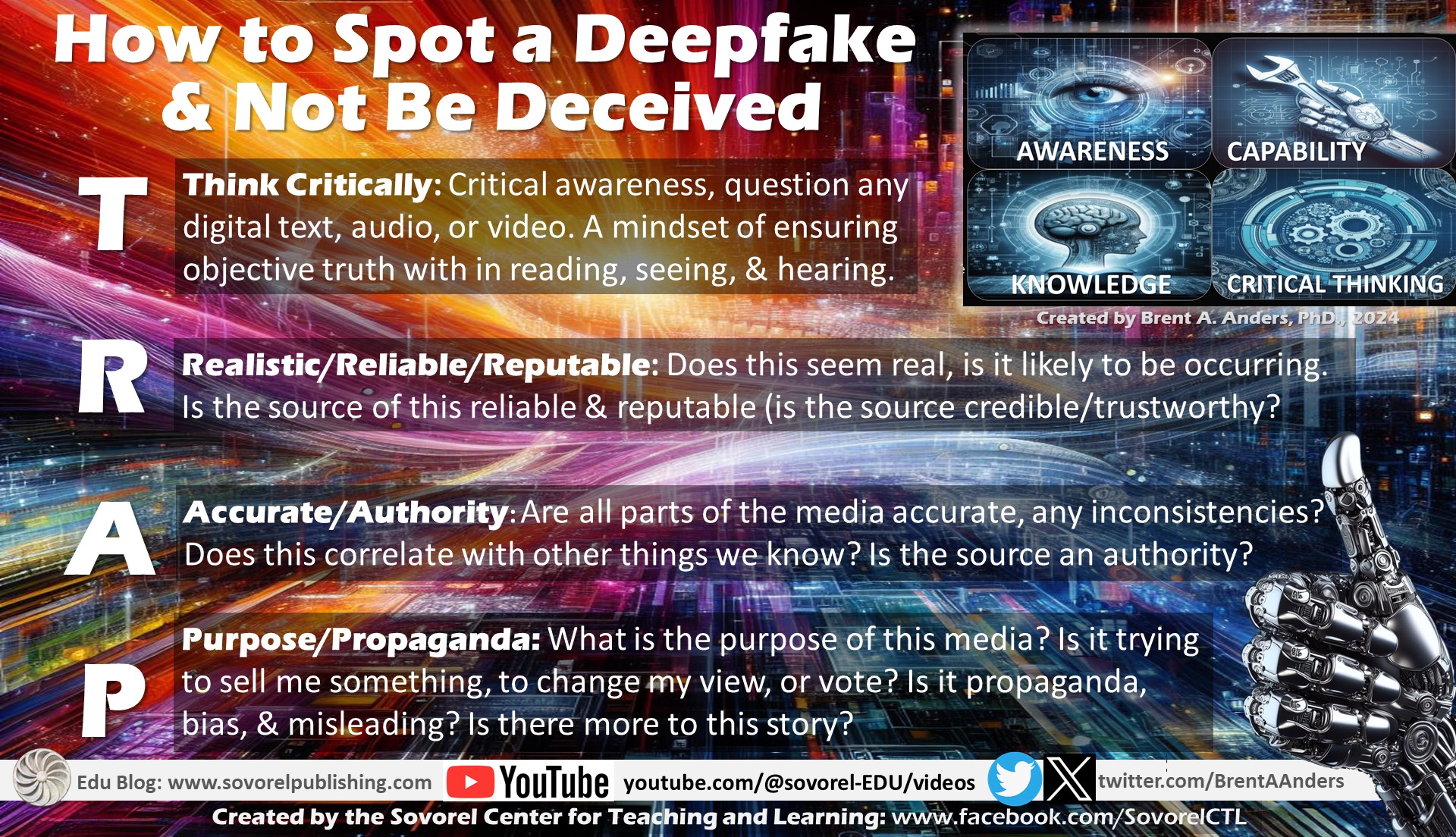
    To address this important issue I have created the TRAP test:

    T: Think Critically. All of us must now have a critical awareness and mindset when using any type of digital media since all digital media can now be easily manipulated and created with generative AI. When encountering any digital text, images, audio, or video we need to realize that it might not be real and it might be trying to manipulate our perception. We need to use the TRAP test to ask further questions to help ensure that we are getting the object truth.

    R: Realistic/Reliable/Reputable: When using digital media or viewing a video, we need to ask ourselves the question “does this seem real and is it likely to occur?” We must also consider whether or not the source of the information is reliable and if it is coming from a reputable source. Is it from an official source, a well known news source, a government agency, or established organization? Always check the source.

    A: Accurate/Authority: Check to see if all parts of the digital media are accurate. As an example, if watching a video, are all parts accurate and consistent. Are there any issues with the eyes, the background, or the light sources? Is it similar and consistent with other videos, images, or text? Additionally, has the media been released or authenticated by an authority? These questions must be verified and answered to help ensure validity and accuracy.

    P: Purpose/Propaganda: When reviewing any digital media we must ask ourselves, “what is the purpose of this media? If the answer is that they are trying to get your money or to sway your vote in an election then you should be extra sure that the information is completely truthful. Ask yourself if the digital information presented is simply just propaganda, full of bias and misleading. Be sure to ask if there is more to the story that you are reading/watching.

    Using the TRAP test and asking these questions will help to prevent everyone from being scammed and/or deceived. Students, faculty, and everyone must develop AI Literacy skills like these.

    All aspect of this defined AI Literacy are important (Anders, 2023), but Awareness and Critical Thinking are key in developing the proper mindset to use the TRAP test. This is something that must be continually developed and used in order to ensure its greatest effectiveness.

    All of us in academia must work to ensure that student and everyone else develop these skills to use AI in the right way and be able to properly spot AI deepfakes and avoid being deceived. Please share this information with colleagues, students, family, and friend; especially the elderly who can at times be even more vulnerable. Together we make a major difference and improve our new world filled with AI.

    A video describing the TRAP test is also available on the Sovorel Educational YouTube channel:

    “How to Spot a Deepfake and NOT Be Deceived” (Anders, 2024)

    Please share your thoughts and comment below:

    References

    Anders, B. (2023). The AI literacy imperative: Empowering instructors & students. Sovorel Publishing.

    Jackson, A. (2023, October 13). The rising tide of deepfakes as AI growth cause concern. Cyber Magazin, Technology: AI. https://cybermagazine.com/technology-and-ai/the-rising-tide-of-deepfakes-as-ai-growth-cause-concern

    Source link