Tag: Standard

  • School facility governance standard aims to improve fairness, boost rental revenue

    School facility governance standard aims to improve fairness, boost rental revenue

    This audio is auto-generated. Please let us know if you have feedback.

    Dive Brief:

    • Facilitron is rolling out what it says is the first U.S. governance standard for community use of public school facilities, the digital facilities rental platform said Sept. 10.
    • The California-based company will debut the framework in San Diego this November at Facilitron University, its annual conference for school district leaders and facility managers.
    • The standard aims to align school facility use with districts’ mission and strategy, reduce legal risk, improve consistency and transparency across district operations, and ensure equitable access for community members and groups, the company says.

    Dive Insight:

    Facilitron provides facility rental and management support for some of the largest school districts in the U.S., including Florida’s Broward County Public Schools, Nevada’s Clark County School District and California’s San Diego Unified School District.

    That broad reach helped the company design a governance framework that goes beyond school boards’ existing model policies to encompass administrative regulations, site manuals, renter terms and audit tools, the company says. It draws on data from more than 15,000 schools, many of which have outdated, inconsistent and unenforceable facility-use policies, “exposing where current systems fail,” according to the company. 

    “Every district on our platform has a data trail that tells a story,” Facilitron Chief Marketing Officer Trent Allen said in an email. “Even when data is missing — because poor policy and enforcement means a lot of facility use never gets documented — you can still see the problems, like a black hole bending light in its direction.”

    Allen said many of those problems have a financial dimension. For example, many districts offer automatic subsidies for registered nonprofits, regardless of the actual public benefit the organization provides — so a national nonprofit with high participation fees gets effectively the same treatment as a grassroots group with a much smaller budget, Allen said.

    Districts’ facility-use policies — and the state statutes enabling them — leave money on the table in other ways, like sweetheart deals for school employees, rates that remain static for years, and ambiguous language that discourages districts from tapping their facilities’ full value. 

    As an example, Allen said, some Tennessee districts interpret a vaguely worded state statute prohibiting “private profit” in school facility use to mean that only nonprofit organizations can rent them, creating a situation where “essentially every use becomes a subsidized use.” That leaves out the possibility that private companies could use the facilities for charitable or other purposes. 

    Additionally, many school boards give school administrators or facilities managers free rein to adjust or waive fees, or approve informal use outside the plain text of board policy, he said.

    The upshot of all this, Allen added, is that larger districts forgo millions in potential revenue annually from facility rentals while creating conditions ripe for favoritism and inequity.

    Once one group gets access under favorable terms, every similar group is usually given the same,” he said. “Suddenly the district is on the hook for hundreds of thousands of dollars. It quickly runs into the millions and it is never budgeted for.”

    Facilitron says its national governance standard pushes back on the status quo by laying out detailed model school board policies and administrative regulations; a “modular policy toolkit” and site-level operations manual; a national terms and conditions template; and a “facility use audit framework,” which the company describes as “a diagnostic tool that reveals cost, risk and underperformance.”

    The national governance standard also includes frequently asked questions, case studies and other resources for school boards.

    “We require annual reporting, including an estimate of total subsidization. We make cost recovery the governing philosophy [and] move away from ‘nonprofit’ as the trigger for discounts, because that’s the wrong proxy for public benefit. And we separate policy into layers — board-level rules, administrative regulations, and site-level guidance — so principals aren’t left to invent their own rules,” Allen said.


    Source link

  • Exploring a new standard for preparing students for the future of work

    Exploring a new standard for preparing students for the future of work

    Key points:

    According to the World Economic Forum’s Future of Jobs Report 2025, nearly 40 percent of workers’ core skills will change in just the next five years. As AI, automation, and global connectivity continue to reshape every industry, today’s students are stepping into a world where lifelong careers in a single field are increasingly rare.

    Rather than following a straight path, the most successful professionals tomorrow will be able to pivot, reinvent, and adapt again and again. That’s why the goal of education must also shift. Instead of preparing students for a fixed destination, we must prepare them to navigate change itself.

    At Rockingham County Schools (RCS), this belief is at the heart of our mission to ensure every student is “choice-ready.” Rather than just asking, “What job will this student have?” we’re asking, “Will they be ready to succeed in whatever path they choose now and 10 years from now?”

    Choice-ready is a mindset, not just a pathway

    Let’s start with a quick analogy: Not long ago, the NBA underwent a major transformation. For decades, basketball was largely a two-point game with teams focused on scoring inside the arc. But over time, the strategy shifted to where it is today: a three-point league, where teams that invest in long-range shooters open up the floor, score more efficiently, and consistently outperform those stuck in old models. The teams that adapted reshaped the game. The ones that didn’t have fallen behind.

    Education is facing a similar moment. If we prepare students for a narrow, outdated version of success that prepares them for one track, one career, or one outcome, we risk leaving them unprepared for a world that rewards agility, range, and innovation.

    At RCS, we take a global approach to education to avoid this. Being “choice-ready” means equipping students with the mindset and flexibility to pursue many possible futures, and a global approach expands that readiness by exposing them to a broader range of competencies and real-world situations. This exposure prepares them to navigate the variety of contexts they will encounter as professionals. Rather than locking them into a specific plan, it helps them develop the ability to shift when industries, interests, and opportunities change.

    The core competencies to embrace this mindset and flexibility include:

    • Creative and analytical thinking, which help solve new problems in new contexts
    • Empathy and collaboration, which are essential for dynamic teams and cross-sector work
    • Confidence and communication, which are built through student-led projects and real-world learning

    RCS also brings students into the conversation. They’re invited to shape their learning environment by giving their input on district policies around AI, cell phone use, and dress codes. This encourages engagement and ownership that helps them build the soft skills and self-direction that today’s workforce demands.

    The 4 E’s: A vision for holistic student readiness and flexibility

    To turn this philosophy into action, we developed a four-part framework to support every student’s readiness:

    1. Enlisted: Prepared for military service
    2. Enrolled: Ready for college or higher education
    3. Educated: Grounded in academic and life skills
    4. Entrepreneur: Equipped to create, innovate, and take initiative

    That fourth “E”–entrepreneur–is unique to RCS and especially powerful. It signals that students can create their opportunities rather than waiting for them. In one standout example, a student who began producing and selling digital sound files online explored both creative and commercial skill sets.

    These categories aren’t silos. A student might enlist, then enroll in college, then start a business. That’s the whole point: Choice-ready students can move fluidly from one path to another as their interests–and the world–evolve.

    The role of global education

    Global education is a framework that prepares students to understand the world, appreciate different perspectives, and engage with real-world issues across local and global contexts. It emphasizes transferable skills—such as adaptability, empathy, and critical thinking—that students need to thrive in an unpredictable future.

    At RCS, global education strengthens student readiness through:

    • Dual language immersion, which gives students a competitive edge in a multilingual, interconnected workforce
    • Cultural exposure, which builds resilience, empathy, and cross-cultural competence
    • Real-world learning, which connects academic content to relevant, global challenges

    These experiences prepare students to shift between roles, industries, and even countries with confidence.

    Redesigning career exploration: Early exposure and real skills

    Because we don’t know what future careers will be, we embed career exploration across K-12 to ensure students develop self-awareness and transferable skills early on.

    One of our best examples is the Paxton Patterson Labs in middle schools, where students explore real-world roles, such as practicing dental procedures on models rather than just watching videos.

    Through our career and technical education and innovation program at the high school level, students can:

    • Earn industry-recognized credentials.
    • Collaborate with local small business owners.
    • Graduate workforce-ready with the option to pursue higher education later.

    For students who need immediate income after graduation, RCS offers meaningful preparation that doesn’t close off future opportunities, keeping those doors open.

    And across the system, RCS tracks success by student engagement and ownership, both indicators that a learner is building confidence, agency, and readiness to adapt. This focus on student engagement and preparing students for the world postgraduation is already paying dividends. During the 2024-25 school year, RCS was able to increase the percentage of students scoring proficient on the ACT by more than 20 points to 44 percent. Additionally, RCS increased both the number of students who took AP exams and the number who received a passing score by 12 points to 48 percent.

    Preparing students for a moving target

    RCS knows that workforce readiness is a moving target. That’s why the district continues to evolve with it. Our ongoing focus areas include:

    • Helping graduates become lifelong learners who can retrain and reskill as needed
    • Raising awareness of AI’s influence on learning, creativity, and work
    • Expanding career exploration opportunities that prioritize transferable, human-centered skills

    We don’t know exactly what the future holds. We do know that students who can adapt, pivot, and move confidently from one career path to another will be the most prepared–because the most important outcome isn’t fitting students into today’s job market but preparing them to create value in tomorrow’s.

    At Rockingham County Schools, that’s what being “choice-ready” really means. It’s not about predicting the future. It’s about preparing students to thrive within it wherever it leads.

    Latest posts by eSchool Media Contributors (see all)

    Source link

  • ASU Online: Where Success Is Accessible and Innovation Is Standard

    ASU Online: Where Success Is Accessible and Innovation Is Standard

    What is your passion? What sparks your curiosity and brings you joy? Whatever it is, Arizona State University (ASU) will help you find it, study it, master it, and turn it into a rewarding career, regardless of your previous educational journey.

    Casey Evans

    Chief Operating Officer, EdPlus at ASU

    For more than 15 years, ASU has offered high-quality programs online taught by the same world-renowned faculty that teach on-campus students, using the same rigorous curriculum. ASU offers more than 300 degree programs online, with over 100,000 graduates now working across nearly every industry, helping to strengthen the university’s reputation for educational excellence and career readiness. ASU graduates are highly recruitable, with ASU ranking No. 2 in the United States among public universities for the employability of its graduates, ahead of UCLA, the University of Michigan, and Purdue University.

    ASU Online combines the exceptional resources and academic excellence of the nation’s most innovative university with a rigorous, world-class online learning experience. Students are supported every step of the way, ensuring they gain the skills and knowledge they need to thrive in their career, no matter where they are in the world.

    “ASU’s rigorous coursework and knowledgeable instructors have been instrumental in preparing me for my career, equipping me with the skills to excel in my field,” said Evelyn M., ’24 BS in speech and hearing science.


    To learn more, visit asuonline.asu.edu


    Source link

  • Setting the Gold Standard for College Recruitment Campaigns

    Setting the Gold Standard for College Recruitment Campaigns

    Marketing messages bombard students from every direction, so capturing their attention—and inspiring them to take action—requires creative that truly stands out. That’s exactly what the RNL creative team delivers, crafting award-winning campaigns that engage, resonate, and drive results across every channel, from digital to direct mail. We work closely with our campus partners to ensure every undergraduate and graduate campaign is both strategic and impactful—proven by the many gold award-winning projects we’re celebrating this year.Here are 11 that took home gold medals—and one Best of Show—at the 40th annual Educational Advertising Awards.

    Illinois College Agribusiness Management |SEO Video (Best of Show)

    Video isn’t just eye-catching—it’s a powerful SEO booster that keeps visitors on the page longer to improve search rankings. For this project, we paired SEO-optimized web copy with a compelling long-form video designed to engage skimmers and drive inquiries. Illinois College’s campus team fully embraced the collaboration, delivering stunning unique footage that brought their story to life. The result? A versatile, high-impact asset that drove a 7,000% increase in web page visits. Watch the video.

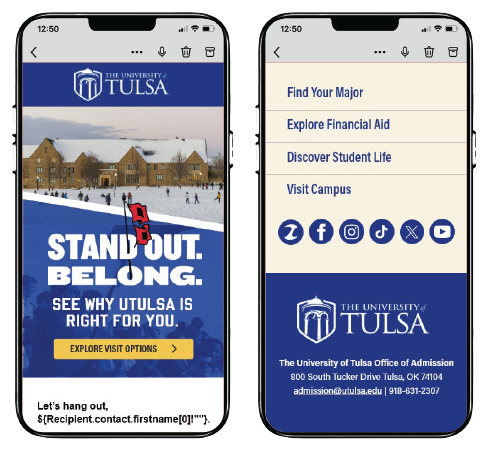
    University of Tulsa | Standout Integrated Search Campaign

    University of Tulsa: Image of ad campaign on cell phoneUniversity of Tulsa: Image of ad campaign on cell phone

    Reaching high school sophomores and juniors means meeting them where they are—in their inboxes, on their feeds, and in their hands. This multi-channel campaign reinforces the University of Tulsa’s bold message: students don’t have to choose between fitting in and standing out. Rich Art Deco design and conversational copy celebrating personal and academic uniqueness helped elevate brand nationwide while encouraging students to find their fit at UTulsa.

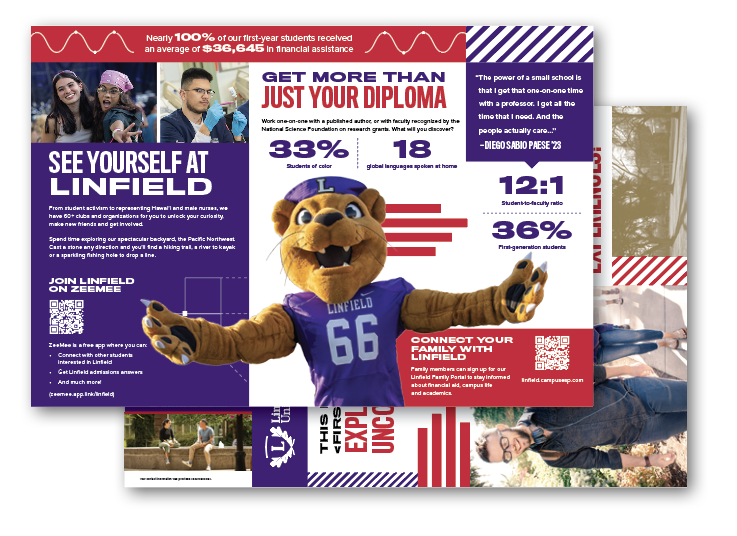
    Linfield University | Personalized Applicant Direct Mail

    Linfield University student postcardLinfield University student postcard

    This eye-catching mailer puts Linfield’s bold purple and cardinal branding front and center, using standout stats and a dynamic design to capture attention. Featuring Mack the Wildcat, it reinforces school spirit while guiding students toward their next step—applying with confidence.

    American Musical and Dramatic Academy | Dream-Making Applicant Mailer

    American Musical and Dramatic Academy mailingAmerican Musical and Dramatic Academy mailing

    Designed to attract aspiring performers to perform, create, and wow at campuses in New York and Los Angeles, this high-energy mailer steals the spotlight with bold visuals and dynamic performance imagery. Filled with upbeat performance industry lingo, it sets the stage for students to step into their future—and apply.

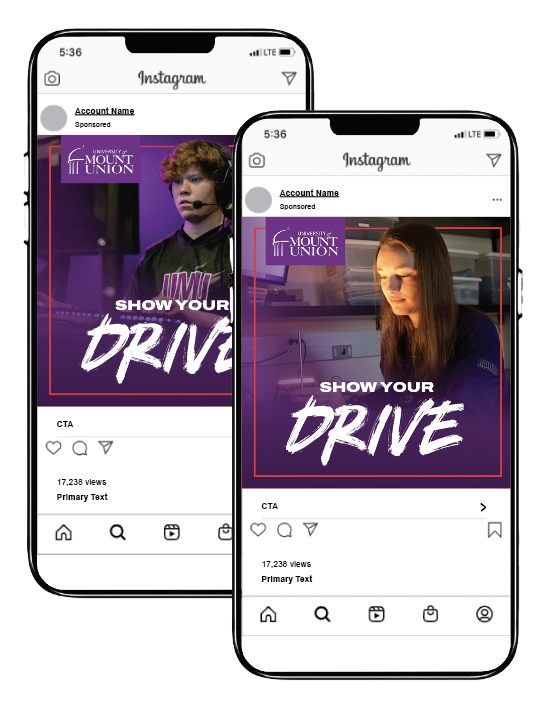
    University of Mount Union | Bold, Strong Instagram Ads

    Mount Union Instagram adsMount Union Instagram ads

    These dynamic search campaign ads put real students front and center, showcasing hands-on learning in action. With bold visuals and empowering copy, the campaign encourages prospects to show up strong, seize opportunities, and own their moment—both in college and beyond.

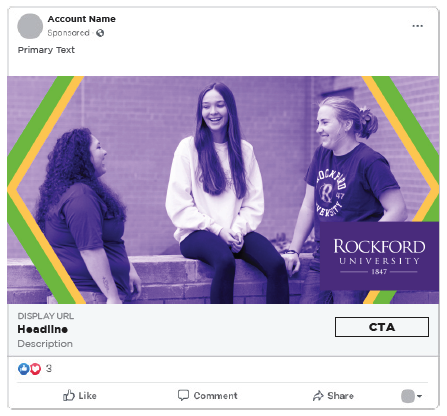
    Rockford University | Feed-Stopping Facebook Ads

    Rockford University Facebook adsRockford University Facebook ads

    These bright branded ads grab attention alongside the question “RU Ready?”, sparking curiosity about the welcoming environment and numerous opportunities at “RockU.” The campaign is designed to stand out in feeds and aims to inspire students to see themselves on campus and take the next step toward getting there.

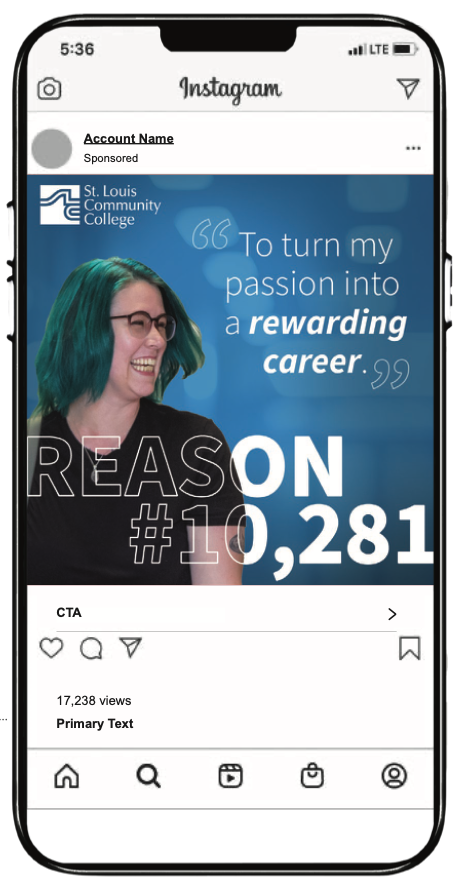
    St. Louis Community College Instagram AdsSt. Louis Community College Instagram Ads

    Featuring proud, hopeful, and joyful students, this campaign highlights reasons students choose STLCC to pursue their dreams. The result? Authentic, inspiring ads that encourage prospects to find their reason at STLCC.

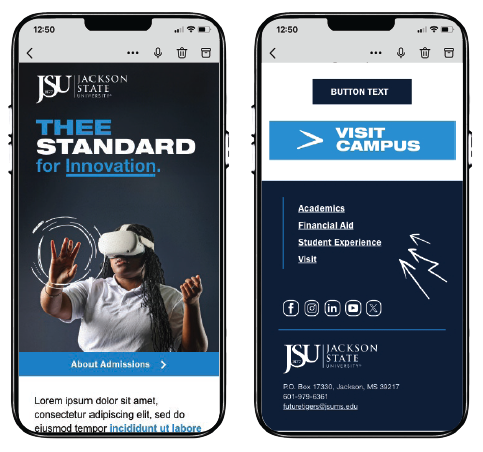
    Jackson State University | THEE Standard for Search Campaigns

    Jackson State University student search campaignJackson State University student search campaign

    Inspired by Jackson State University’s iconic fight song, this email campaign set the tone with bold headers inviting prospects to learn more about THEE standard for research, academics, innovation, and success. Playful illustrations drawn over dynamic student portraits bring energy and spirit to every email, reinforcing why JSU is THEE place to be.

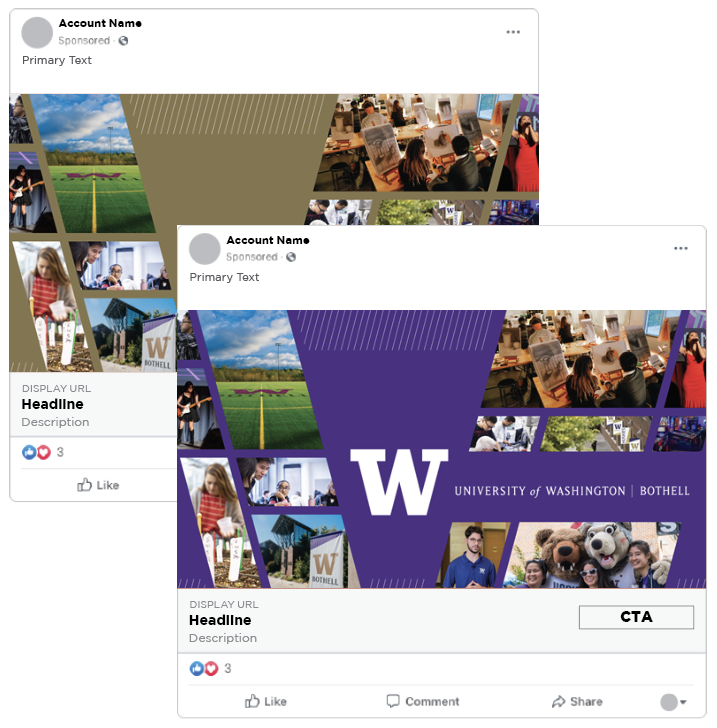
    University of Washington Bothell | Find Your Fit Facebook Ads

    University of Washington Bothell Facebook AdsUniversity of Washington Bothell Facebook Ads

    This dynamic ad brings exciting campus life to the forefront, featuring lively action shots shaped into a bold “W.” Paired with inviting copy, it highlights the University of Washington Bothell’s close-knit community where students find big opportunities, exciting challenges, and lifelong friends.

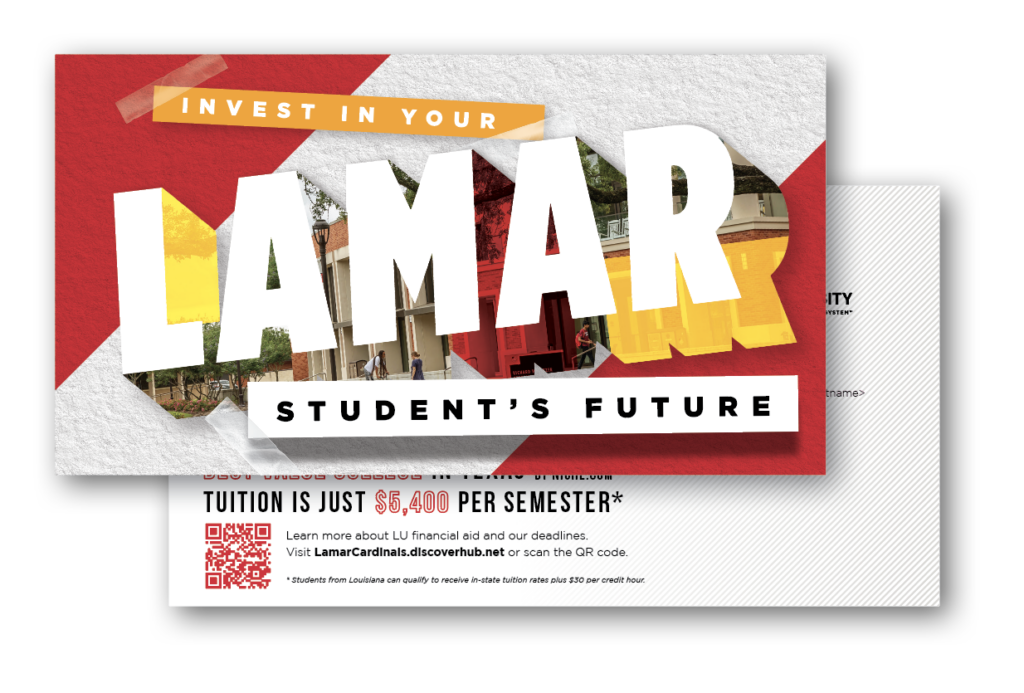
    Lamar University | Parent Postcard

    Lamar University parent postcardLamar University parent postcard

    This gold award-winning postcard spoke directly to parents, highlighting the $20+ million in aid and low tuition that make Lamar University the best-value college in Texas. A clear, compelling message reassures families that a smart investment today means big opportunities for their student’s future.

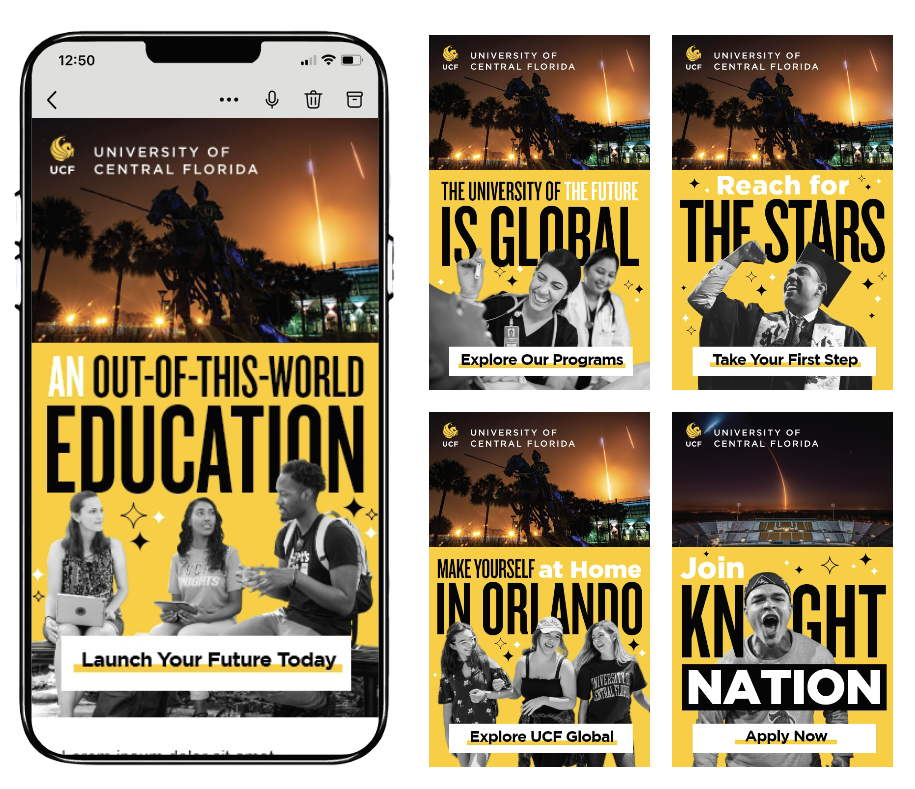
    University of Central Florida | Universe of Opportunity Email Series

    University of Central Florida recruitment emailsUniversity of Central Florida recruitment emails

    With a prime location between NASA, the Space Coast, and Orlando’s endless experiences, UCF Global offers a launchpad for limitless possibilities. This inquiry-to-application email flow features stunning nightscape imagery and star-inspired design elements reinforcing the university’s spirit of exploration and innovation.

    Create your own winning connections with future students 

    Want to turn your marketing into an award-worthy success? RNL’s creative team brings strategic insight, compelling storytelling, and a track record of 100+ awards in five years to every campaign. Whether you’re engaging undergraduate, graduate, or online students, we’ll help you stand out and drive results. Let’s talk—schedule a complimentary consultation today.

    Request consultation

    Source link

  • OSHA Emergency Temporary Standard and CMS Interim Final Rule on Vaccination Requirements Released – CUPA-HR

    OSHA Emergency Temporary Standard and CMS Interim Final Rule on Vaccination Requirements Released – CUPA-HR

    by CUPA-HR | November 4, 2021

    On November 4, the Department of Labor’s Occupational Safety and Health Administration (OSHA) and the Department of Health and Human Services’ Centers for Medicare & Medicaid Services (CMS) issued their highly anticipated Emergency Temporary Standard (ETS) and interim final rule (IFR) setting vaccination requirements for employers with 100 or more employees and healthcare workers, respectively. Under the new policies, covered employers with 100 or more employees, healthcare workers at facilities participating in Medicare or Medicaid, AND federal contractors requiring vaccinations under Executive Order 14042 (EO) will be required to be fully vaccinated — either two doses of Pfizer or Moderna, or one dose of Johnson & Johnson — by January 4, 2022.

    A Fact Sheet announcing the new vaccinations rules provides the following information on the OSHA ETS, CMS IFR and federal contractor vaccination requirements:

    OSHA Emergency Temporary Standard

    In lieu of full vaccination, the OSHA ETS for employers with 100 or more employees (covered employers) also offers the option for unvaccinated employees to produce a verified negative COVID-19 test to employers on at least a weekly basis. OSHA does clarify, however, that the ETS does NOT require employers to provide or pay for tests, but notes that employers may be required to pay for testing due to other laws or collective bargaining agreements.

    The ETS also establishes policies that require covered employers to provide paid time off (PTO) for their employees to get vaccinated and, if needed, sick leave to recover from side effects that keep them from working. Additionally, all covered employers will be required to ensure that unvaccinated employees wear a face mask in the workplace. While the testing and vaccination requirements will begin after January 4, the ETS states that covered employers must be in compliance with the PTO for vaccination and masking for unvaccinated workers requirements by December 5, 2021.

    Importantly, OSHA clarifies in the ETS that the rule will not apply to workplaces already covered by the CMS IFR, as well as the federal contractor vaccination requirement set forth by President Biden’s EO and the Safer Federal Workforce Task Force’s vaccination guidance.

    Healthcare Interim Final Rule

    According to CMS, the IFR requiring full vaccination of healthcare employees applies to employees regardless of whether their positions are clinical or non-clinical and includes employees, students, trainees and volunteers who work at a covered facility that receives federal funding from Medicare or Medicaid. It also includes individuals who provide treatment or other services for the facility under contract or other arrangements. Among the facility types covered by the IFR are hospitals, ambulatory surgery centers, dialysis facilities, home health agencies and long-term care facilities.

    Federal Contractor Vaccination Executive Order

    In an effort to streamline implementation of the vaccination requirements, the Biden administration is also announcing that the deadline for previously issued federal contractor vaccination requirements will be extended to January 4, 2022, setting one deadline across the three different vaccination policies. The vaccine requirement for federal contractor compliance was previously set for December 8, 2021.

    Additionally, as mentioned above, federal contractor employers who may otherwise fall under the OSHA ETS covered employer definition will not be required to follow the rules established under the ETS and must continue compliance with the vaccination guidance and requirements set forth by the EO and Safer Federal Workforce Task Force for federal contractors.

    State and Local Preemption

    Early reports of the rules also state that both the OSHA ETS and CMS IFR make it clear that their requirements “preempt any inconsistent state or local laws, including laws that ban or limit an employer’s authority to require vaccination, masks or testing.” More information is likely to follow.

    Additional information is likely to arise as we learn more from the actual text of the ETS and IFR. CUPA-HR will keep members apprised of all new information.


    Source link

  • White House Reviews OSHA’s COVID-19 Vaccination and Testing Emergency Temporary Standard – CUPA-HR

    White House Reviews OSHA’s COVID-19 Vaccination and Testing Emergency Temporary Standard – CUPA-HR

    by CUPA-HR | October 25, 2021

    On October 12, the U.S. Department of Labor Occupational Safety and Health Administration (OSHA) sent their COVID-19 Vaccination and Testing Emergency Temporary Standard Rulemaking (ETS) to the Office of Information and Regulatory Affairs (OIRA). OIRA is the White House office responsible for reviewing regulations and proposed regulations before they are publicly released.

    The ETS — which has not yet been made public — is expected to require private employers with 100 or more employees to “ensure their workforces are fully vaccinated or show a negative COVID-19 test twice a week” and provide paid time off for obtaining or recovering from the vaccination (additional details regarding what is known about the ETS can be found in this CUPA-HR blog).

    What is an ​Emergency Temporary Standard?

    While most federal agencies are required to provide public notice and seek comment prior to enacting new regulations, OSHA may bypass normal rulemaking and issue an ETS if doing so is necessary to protect workers from a “grave danger.” This allows OSHA to issue the ETS without any feedback from impacted stakeholders and require employers to immediately comply with the ETS upon its publication in the Federal Register.

    ​Office of Information and Regulatory Affairs Review

    OIRA is part of the executive office of the president and is required to review significant regulatory actions — those likely to have an annual effect on the economy of $100 million or more — before they are published in the Federal Register or otherwise issued to the public. As the ETS is determined to be “Economically Significant,” an OIRA review is triggered to ensure that it reflects the goals set forth in President Biden’s COVID-19 Plan and to ensure OSHA has carefully considered the benefits and costs of the ETS before it is issued.

    While draft documents under review are not available for public release, it is OIRA’s policy to meet with interested stakeholders to discuss issues on a rule under review. As of October 22, OIRA has convened 68 meetings with outside stakeholders on the ETS and has scheduled meetings through October 25. While CUPA-HR is aware many more additional pending meeting requests (including our own), OIRA has yet to schedule these, and may not. While OIRA review is limited to 90 days, there is no minimum period of review, and given the urgency associated with the ETS it could be issued as soon as this week.

    CUPA-HR will continue to monitor OIRA’s review process and be sure to inform our membership as soon as OIRA review concludes and OSHA issues the ETS.


    Source link

  • OSHA Provides Details on Upcoming COVID-19 Emergency Temporary Standard – CUPA-HR

    OSHA Provides Details on Upcoming COVID-19 Emergency Temporary Standard – CUPA-HR

    by CUPA-HR | September 14, 2021

    On September 9, President Biden released his COVID-19 Action Plan, which includes a six-pronged plan to combat COVID-19 through increased vaccinations, testing and other strategies. The plan will require employers with 100 or more employees to test nonvaccinated employees on a weekly basis. The White House also announced it will require vaccinations for those working for the federal government, federal contractors and establishments providing healthcare services that accept Medicare and Medicaid.

    The Biden administration is using different agencies to implement and enforce the different requirements. The Occupational Safety and Health Administration (OSHA) will require employers with 100 or more employees to test nonvaccinated employees on a weekly basis through an Emergency Temporary Standard (ETS). While OSHA has yet to release many specifics about the timing and the content of the ETS, the agency did release some information late last week.

    General Timeline of the ETS

    In a call last week with stakeholders, OSHA said it plans to publish the ETS in the Federal Register in the next few weeks, at which time the ETS will become effective immediately in states where OSHA has direct jurisdiction. The 22 states with OSHA-approved State Occupational Safety and Health Plans must adopt the ETS or a standard at least as protective within 30 days of OSHA publishing the ETS in the Federal Register.

    Because the ETS will be effective immediately once published in the Federal Register, stakeholders will not have the opportunity to provide input on the standard prior to its implementation. Instead, stakeholders may comment on the ETS after it is published in the Federal Register. OSHA will use those comments to shape the subsequent final rule that will replace the ETS, which OSHA plans to issue six months after the initial release of the ETS.

    Content and Policies of the ETS

    OSHA also said on the call that it will be working with other federal agencies to ensure the language included in the ETS is consistent with the vaccination mandates imposed on federal contractors through President Biden’s Executive Order. Additionally, OSHA clarified that it will consider the employers’ workforce and not just a single worksite in evaluating employers that meet the 100-employee threshold for coverage. The ETS testing and vaccination requirements are also not likely to extend to remote employees who are physically isolated from coworkers or customers.

    Consistent with the COVID-19 Action Plan, the ETS will also require employers to provide employees with paid time off (PTO) or allow employees to use existing PTO to obtain vaccinations and recover from post-vaccination side effects.

    Finally, OSHA reviewed several issues where it does not currently have an answer, but it intends to address in the ETS. These questions include who pays for the required employee testing and what level of vaccination is required under the ETS (i.e. one shot, two shots or even a booster shot). In addition to these questions, information on the procedures of how employers will verify vaccinations, tests and procedures for handling employees who refuse to get vaccinated or undergo routine testing will likely be addressed in the ETS.

    CUPA-HR will continue to monitor for any information on the upcoming ETS and keep members apprised of any additional policies or requirements likely to be included as OSHA continues to work towards implementation.


    Source link