Tag: States

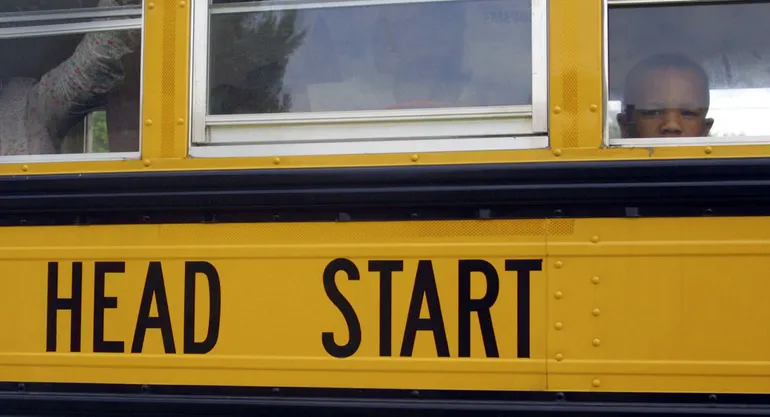
  • 20 states sue over immigration restrictions for Head Start, other programs

    20 states sue over immigration restrictions for Head Start, other programs

    Dive Brief:

    • Twenty states and the District of Columbia sued the Trump administration Monday afternoon, challenging the administration’s decision earlier this month to restrict publicly funded programs — including those related to education — based on immigration status.
    • The lawsuit, led by New York, argues that the restrictions to previously inclusive programs like Head Start will hurt low-income families and lead to the “collapse of some of the nation’s most vital public programs.”
    • Seeking to block the changes in the short and long term, the states allege the U.S. Department of Education and three other federal agencies did not follow the required rulemaking process in issuing new immigration verification requirements.

    Dive Insight:

    In July 10 announcements, the Education Department said it will require immigration status verification for adult education services like dual enrollment and career training programs, while the U.S. Department of Health and Human Services mandated such verification for participation in Head Start programs.

    HHS said at the time that Head Start would be “reserved for American citizens from now on.″ An HHS spokesperson clarified to K-12 Dive on July 10 that children of green card holders will remain eligible for the program and said Head Start agencies will determine eligibility based on the immigration status of the child. Head Start has heretofore been open to any child eligible based on their age or their family’s low-income status, regardless of immigration status.

    However, the lawsuit filed Monday alleges that the policy changes will impact not only undocumented immigrants, but also people holding legal status, such as temporary workers, exchange visitors and those with student visas. The suit was filed in federal district court in the U.S. District Court for the District of Rhode Island.

    The state attorneys general filing the lawsuit also warned that even U.S. citizens and lawful residents could be denied services, since many low-income individuals lack government-issued identification.

    “For decades, states like New York have built health, education, and family support systems that serve anyone in need,” said New York Attorney General Letitia James in a press statement on Monday. “Now, the federal government is pulling that foundation out from under us overnight, jeopardizing cancer screenings, early childhood education, primary care, and so much more.”

    James and the coalition filing the lawsuit said the policies are already “causing significant disruption” as state programs are expected to comply immediately without the infrastructure they say is necessary to do so.

    “Some longstanding providers, including those serving children, pregnant patients, refugees, and other vulnerable populations, will not be able to comply under any timeline and are already facing the risk of closure,” James’ statement said.

    These changes have alarmed civil rights advocates — who say the changes will harm the very low-income children Head Start is intended to serve. The National Head Start Association, which represents Head Start workers, meanwhile, has said the Head Start Act has never required them to check the citizenship or immigration status of children prior to their enrollment in the 60 years of the program’s existence.

    Upon release of the policy change on July 10, the American Civil Liberties Union immediately threatened to expand an existing lawsuit over the Trump administration’s actions vis-a-vis Head Start to include “this new attack on Head Start.” In April, the ACLU filed a lawsuit challenging the administration’s moves to gut Head Start by shuttering half of the regional Office of Head Start offices and laying off much of the federal offices’ staff.

    Plaintiffs in that lawsuit, filed in U.S. District Court in Washington state, include parent groups and the Head Start associations of Washington, Illinois, Pennsylvania and Wisconsin.

    “Implementation of this directive will create fear and confusion for immigrant families about enrolling their children in Head Start regardless of what their legal status may be. This will harm children and destabilize Head Start programs,” said Lori Rifkin, litigation director at the Impact Fund, in a statement on July 10. The Impact Fund, a public interest law group, is representing plaintiffs in the Head Start lawsuit alongside ACLU.

    “If the administration moves forward with publication of this notice, we will take legal action,” RIfkin said at the time.

    The Department of Education has not specified an implementation date for the new restrictions, but has said it “generally” wouldn’t be enforcing them before Aug. 9. HHS said its changes were effective immediately in its July 10 announcement.

    Source link

  • Some States Are Seeking to Deregulate Child Care. Advocates Are Fighting Back – The 74

    Some States Are Seeking to Deregulate Child Care. Advocates Are Fighting Back – The 74


    Join our zero2eight Substack community for more discussion about the latest news in early care and education. Sign up now.

    Content warning: This story includes details of an infant’s death.

    After Democrats passed the American Rescue Plan in 2021, states were flush with federal funding to help prop the child care sector up. But that money is now all gone, and as Republicans in Congress threaten to pass spending cuts that could further shrink state budgets, lawmakers are trying to find solutions to the child care crisis that don’t cost money. 

    Many have proposed changing the mandated ratios that require a certain number of early educators to care for young kids. Nearly a dozen states have considered rolling back child care regulations, including those governing staff-to-child ratios.

    But while these deregulatory bills are common, it’s not a foregone conclusion that they will pass. Advocates in three states have been able to beat back these efforts in the legislative sessions that just wrapped up by mobilizing a wide variety of people to speak up against these proposals and deploying research-backed arguments about child safety and child care supply.

    Eliminating Ratios Entirely 

    Idaho advocates faced down the most extreme bill. In its original form, HB243 would have eliminated all requirements that limit the number of young children an early educator can care for, leaving it up to individual providers. It would have been the first state in the country to take such a step. 

    Advocates had very little time to fight back. The bill got fast tracked; there was less than 24 hours’ notice before the first public hearing on it in the House. “You can’t get child care providers and parents there in that amount of time,” said Christine Tiddens, executive director of Idaho Voices for Children, a nonprofit that advocates for child-focused policies, noting that it requires moving work schedules and getting people to cover shifts. The bill sailed through the House.

    Eventually, Tiddens said, they were able to put parents and providers in front of lawmakers to warn of the negative consequences. One of those parents was Idaho resident Kelly Emry. On June 10, 2024, she got a panicked call from the home-based child care provider where she had just started sending her 11-week-old son Logan. She dashed to the provider’s home and was told he was dead. The coroner’s report later confirmed he died from asphyxiation. According to Emry, the coroner said the provider put him down for a nap between a rolled up blanket and a pillow and left him there for hours. The provider was caring for 11 kids by herself that day, putting her out of compliance with state regulations that, at the time, required at least two staff members. 

    “It was completely preventable, and that’s what’s so hard for me to come to terms with,” Emry said in a podcast interview in January.

    Emry wasn’t the only one who spoke up. Once the bill got to the Senate, advocates packed the hearing and overflow rooms with several hundred people. Among the 40 people who signed up to testify, 38 opposed the bill. Baby Logan’s uncle spoke, as did pediatricians, fire marshals, nurses, the state police, child welfare experts, child care providers and parents. Lawmakers were flooded with thousands of calls and emails from the opposition. Tiddens made sure every senator was sent the podcast interview with Emry.

    The bill passed the Senate committee by a single vote. Advocates decided to try to stop the worst elements, knowing that the bill was likely to pass in some form. They asked a senator who opposed it to “throw a Hail Mary,” Tiddens said. When the bill came to the Senate floor, he asked for unanimous support to pull it and move it into the amending process. He got it. The original elimination of staff-to-child ratios was stripped out; instead, the bill preserved ratios, albeit higher ones than before. Under previous law, Idaho ranked at No. 41 among all states for how high its ratios were; now it has dropped even further to No. 45.

    The victory is “bittersweet,” Tiddens said. She attributes it almost solely to one thing: putting parents, not just businesses and child care providers, in front of lawmakers, which led to the moving account of Logan’s family, still in the midst of raw grief. “How could you listen and not have your heart changed?” Tiddens asked.

    Doubling Family Child Care Ratios

    Advocates in Maryland have fought back against legislation to loosen staff-to-child ratios twice now. Last year, lawmakers introduced a bill to raise the ratios in family child care settings, but it died thanks to “a lot of advocacy,” said Beth Morrow, director of public policy at the Maryland Family Network, a nonprofit focused on child care. As in Idaho, the American Academy of Pediatrics and fire marshals warned about what would happen in the case of emergencies. Children under 2 years old are “not capable of self-preservation,” Morrow pointed out; they might hide when a fire alarm goes off and can’t evacuate on their own. “If there is an emergency you have to be able to get these kids out,” she said.

    The idea returned this year in House Bill 477, this time coupled with looser ratios for center-based care. Family providers are currently allowed to care for eight children but no more than two under the age of 2; the legislation would have doubled that, allowing providers to watch as many as four children under the age of 1. That was a “nonstarter,” Morrow said. It would also have been the first time that these rules were dictated by lawmakers rather than by the Maryland State Department of Education, which would have been barred from changing them in the future. 

    So advocates marshalled research, with the help of national groups including the National Association for the Education of Young Children and Center for Law and Social Policy. They highlighted that there has been no evidence that stricter child care regulations lead to reduced supply. Lawmakers seemed moved by the argument that lower ratios support better health and safety for children.

    During the markup session, the chief sponsor amended the bill by striking the language about higher ratios; instead, the version that passed requires the Department of Education to study child care regulations with an eye toward alleviating barriers for providers.

    Ratio Increases by Another Name

    In Minnesota, lawmakers took a different approach to proposing changes to the number of staff required to care for young children this session. Their legislation avoided mentioning the term “ratios” at all. Instead, the issue was presented as an exemption for in-home child care providers caring for their own children as well. The legislation originally would have exempted as many as three of the providers’ own children from the number they are licensed to watch. “That’s a direct ratio increase, no way around that,” said Clare Sanford, vice president of government and community relations at New Horizon Academy, a child care and preschool provider. “You still have the same number of adults but you’re increasing the number of children that adult is responsible for.”

    In later drafts, the number of children who could be exempted kept being reduced. In the end the legislation didn’t get a standalone vote and the language was left out of the final state budget. The argument that Sanford thinks worked the best was that increasing ratios wouldn’t actually increase child care supply. That’s because, as a brief by NAEYC argues, they will lead to more burnout among providers, which will push them to leave and, in the end, reduce available child care spots.

    The fight is far from over. Advocates in all three states expect lawmakers to try to loosen staff-to-child ratios again next session. Tiddens fears that, although Idaho didn’t eliminate ratios, the idea could spread. “Idaho has often been a frontrunner for harmful legislation,” she said. On the whole, more of these laws have been signed than stopped, said Diane Girouard, state policy senior analyst at ChildCare Aware of America. Ratio deregulation bills pop up “in some states every single year,” she said. “This isn’t just unique to red, conservative states. It has happened in blue states, it has happened in purple states.”

    Advocates who oppose raising these ratios are formulating responses to the child care crisis that preserve safety standards without requiring state funding. In Maryland, for example, Morrow’s organization helped pass a bill that removes legal barriers to opening and operating family child care programs. The hope is that with more solutions on the table to increase child care supply, states won’t look to options that erode safety standards, such as increasing ratios. 

    Tiddens has vowed to fight back. “We’re not going away, and we’re going to show up next session with our own proposal,” she said. Her coalition plans to formulate a bill for next year that “prioritizes child safety at the same time as dealing with the child care shortage,” she said.


    Get stories like these delivered straight to your inbox. Sign up for The 74 Newsletter

    Source link

  • Trump Administration Freezes Education Funds to 23 States, Legal Challenges Follow

    Trump Administration Freezes Education Funds to 23 States, Legal Challenges Follow

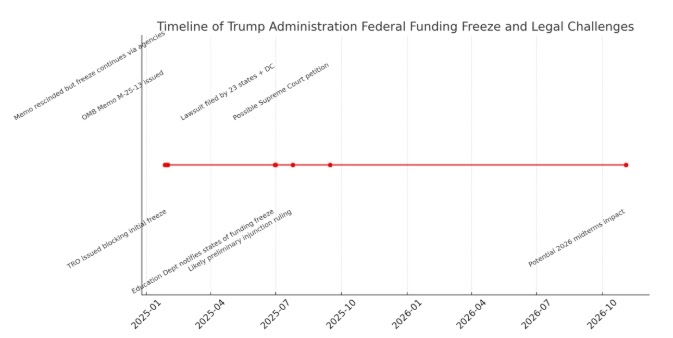
    In a move that has sparked legal action from nearly half the country, the Trump administration has frozen more than $6 billion in education funds to 23 states and the District of Columbia. The decision, issued by the U.S. Department of Education in late June 2025, follows a broader pattern of halted federal support for state and local programs, many of which were previously protected by court rulings.

    The funding pause is linked to the Trump administration’s January 2025 memorandum from the Office of Management and Budget (OMB Memo M-25-13), which directed federal agencies to withhold disbursements from thousands of grant and aid programs. The stated purpose was to align spending with the administration’s priorities, though the policy has been challenged as lacking legal authority. The memo was later rescinded, but its effects have continued through new administrative directives.

    In this latest instance, the Department of Education cited a need to review Title II and Title IV programs under the Elementary and Secondary Education Act (ESEA), including programs for teacher development, after-school enrichment, and English language learners. 

    The decision disproportionately affected Democratic-led states, with California alone facing the loss of $939 million. 

    States impacted include Arizona, California, Colorado, Connecticut, Delaware, Hawaii, Illinois, Maine, Maryland, Massachusetts, Michigan, Minnesota, Nevada, New Jersey, New Mexico, New York, North Carolina, Oregon, Rhode Island, Vermont, Washington, Wisconsin, and the District of Columbia.

    On June 30, attorneys general from those jurisdictions filed suit in Rhode Island, arguing that the Education Department lacks the authority to unilaterally withhold funds that Congress has already appropriated. They assert that the freeze violates both statutory obligations and constitutional principles, including the separation of powers. The lawsuit follows earlier court rulings from January and February in which judges issued temporary restraining orders and preliminary injunctions to stop the administration from freezing other categories of grants. Those cases were largely brought by Democracy Forward, a legal advocacy organization that has played a leading role in contesting the OMB memo.

    Although the administration has defended the funding freeze as a necessary review of federal spending, courts have questioned the legality of such actions. In March, a federal court criticized the lack of statutory basis for the freezes, and Democracy Forward issued a detailed brief outlining the harm to nonprofit programs, environmental projects, and public services. That brief emphasized the breadth of affected programs and the legal overreach involved.

    The broader legal battle continues. While some funding has been restored through court action, the Education Department’s freeze represents a new front in ongoing disputes between the Trump administration and state governments. Plaintiffs argue that withholding these funds sets a precedent that undermines established appropriations and legislative intent. More lawsuits are expected.

    The Trump administration’s freeze on education funding to 23 states opens several legal and political paths, each with different implications depending on how courts and federal agencies proceed. Below are the most likely possibilities based on current legal precedent, federal authority, and political conditions:

    Courts Overturn the Freeze, Funding Restored

    The most immediate and probable outcome is that courts will order the Education Department to restore the frozen funds, as they did earlier this year with other parts of the federal grant freeze. Courts have already found that the administration lacked statutory authority to suspend programs that Congress explicitly funded. If this logic holds, the education freeze will likely be ruled unlawful and states will receive the funds—possibly with retroactive reimbursement for missed payments.

    Partial Restoration, Continued Legal Conflict

    The administration may attempt to restore only some of the funding—especially those programs that have garnered the most public or bipartisan support—while continuing to block others. In this scenario, the courts could issue narrow rulings or temporary injunctions that apply to specific funding streams. This would prolong litigation and administrative uncertainty, potentially pushing the issue into 2026 or the next presidential term.

    Supreme Court Intervention

    If the lower courts issue conflicting rulings or the Trump administration loses significant cases, the Justice Department may seek Supreme Court review. The Court could use this as an opportunity to clarify executive authority over grant disbursement. Depending on the composition of the Court and its interpretation of separation of powers, this could either curtail future executive control over federal spending—or affirm broader authority to “review” or condition funding.

    Legislative Response

    Congress, particularly if Democrats control at least one chamber in 2025-2026, could pass legislation to prohibit similar funding freezes in the future or require automatic disbursement of appropriated funds. However, any such legislation would likely face veto threats or require a veto-proof majority, making this a longer-term fix rather than a short-term remedy.

    Further Administrative Retaliation or Expansion

    If courts delay action or issue narrow rulings, the Trump administration could expand the use of funding freezes to other agencies or sectors, testing the limits of executive control. The precedent set by OMB Memo M-25-13 could be repurposed in other contexts—such as public health, housing, or infrastructure—creating broader instability in federal-state relations.

    Political Mobilization and Fallout

    States may respond by increasing pressure on Congress and federal courts while using the issue as a rallying point in the 2026 midterm elections. Public schools, educators, and parents may amplify the issue if it leads to job losses, school closures, or reduced services. The freeze could become a political liability for the Trump administration, especially in battleground states that rely heavily on federal education support.

    In sum, the most likely near-term result is court-mandated restoration of the withheld funds. But depending on how aggressively the administration continues to test the boundaries of federal authority, the dispute could escalate into a broader constitutional and political conflict over the power to allocate and control federal funds.

    Sources

    Democracy Forward, “Initial Policy Memo on Federal Grant Freezes,” March 12, 2025.

    CBS News, “Democratic states sue Trump administration over halted education funds,” July 1, 2025.

    Reuters, “Trump asks US court to end judicial overreach, allow funding freezes,” February 11, 2025.

    Wikipedia, “2025 United States federal government grant pause.”

    The Daily Beast, “GOP Lawmakers Blast Trump Chief Russell Vought for Freezing Education Money,” July 2025.

    The Guardian, “Nothing like this in American history: the crisis of Trump’s assault on the rule of law,” March 9, 2025.

    Source link

  • The Enshitification of Higher Education in the United States

    The Enshitification of Higher Education in the United States

    Cory Doctorow’s theory of enshitification—originally coined to describe how digital platforms decay over time—perfectly captures the grim evolution of U.S. higher education. Institutions that once positioned themselves as public goods now exist primarily to sustain themselves, extracting revenue, prestige, and labor at the expense of students, faculty, and the broader public.

    In the post–World War II era, higher education in the United States was broadly seen as a driver of social mobility, economic growth, and democratic citizenship. The GI Bill and substantial state funding opened college doors to millions. Tuition at public institutions was minimal or nonexistent. Academic freedom, faculty governance, and research for the common good were foundational ideals.

    By the 1980s, neoliberal policies began to reshape the higher education landscape. Public disinvestment led institutions to rely more heavily on tuition, philanthropy, corporate partnerships, and student debt. Universities became more bureaucratic and brand-conscious. Students were reframed as consumers, and education as a commodity. Faculty positions gave way to underpaid adjunct labor, and Online Program Managers like 2U, Academic Partnerships (aka Risepoint) and Kaplan emerged to monetize digital learning. Marketing budgets ballooned. Classrooms and research labs became secondary to enrollment targets and revenue generation.

    A 2019 Higher Education Inquirer report revealed how elite universities joined the downward spiral. Institutions like Harvard, Yale, and USC outsourced online graduate programs to 2U, employing aggressive recruitment tactics that resembled those of discredited for-profit colleges. Applicants were encouraged to take on excessive debt for degrees with uncertain returns. Whistleblowers likened it to fraud-by-phone—evidence that even the most prestigious universities were embracing an extractive model.

    Doctoral education offers a deeper glimpse into how enshitification has hollowed out academia. Sold as a noble pursuit of truth and a path to secure academic employment, the Ph.D. has become, for many, a journey into economic instability, psychological distress, and underemployment. Only a small percentage of doctoral students land tenure-track jobs. Graduate schools continue to admit far more students than they can responsibly support, while providing little preparation for careers outside academia. Mentorship is often lacking, and financial support is frequently inadequate. Many graduate students rely on food pantries, defer medical care, or take on gig work just to survive. Meanwhile, universities benefit from their labor in teaching and research.

    International graduate students face even steeper challenges. Promised opportunity, they instead encounter a saturated job market, low wages, and immigration precarity. Their labor props up U.S. research and rankings, but their long-term prospects are often bleak.

    The rise of career-transition consultants—like Cheeky Scientist and The Professor Is In—has become a booming cottage industry, a byproduct of the failed academic job pipeline. For most Ph.D.s, what was once considered “alternative academia” is now the only path forward.

    Financial hardship compounds the crisis. Graduate stipends in many programs are far below local living wages, especially in high-cost cities like San Francisco, Boston, or New York. Few programs provide retirement benefits or financial literacy resources. The financial toll of earning a doctorate is often hidden until students are years deep into their programs—and years behind in wealth accumulation.

    Meanwhile, university medical centers—often affiliated with elite institutions—offer a parallel example of institutional enshitification. These hospitals have long histories of exploitation, particularly of poor and minority patients. Even today, these facilities prioritize affluent patients and donors, while relying on precariously employed staff and treating marginalized communities as research subjects. The disparities are systematic and ongoing. The rhetoric of innovation and healing masks a legacy of racial injustice and extractive labor practices.

    Legacy admissions further entrench inequality. While race-conscious admissions have been rolled back, legacy preferences remain largely untouched. They serve to maintain elite networks, ensuring that wealth and access remain intergenerational. These policies not only contradict the rhetoric of meritocracy but also deepen structural inequities in the name of tradition.

    Today, higher education serves itself. Institutions protect billion-dollar endowments, award executive salaries in the millions, expand sports programs and real estate portfolios, and depend on underpaid faculty and indebted students. Campuses are rife with inequality, surveillance of student protest, and performative gestures of inclusion, even as DEI initiatives are gutted by state governments or internal austerity.

    The consequences are clear. Enrollment is declining. Campuses are closing. Faculty are being laid off. Public trust is eroding. And even elite institutions are feeling the strain. Doctorow’s theory suggests that once a system has fully enshittified, collapse becomes inevitable. The College Meltdown is not hypothetical—it’s here.

    And yet, collapse can be a beginning. Higher education must be radically reimagined: public investment, tuition-free education, student debt relief, labor protections, honest admissions policies, and genuine democratic governance. The alternative is more of the same: a system that costs more, delivers less, and cannibalizes its future to feed its prestige economy.


    Selected Sources

    Caterine, Christopher L. Leaving Academia: A Practical Guide. Princeton University Press, 2020.

    Cassuto, Leonard. The Graduate School Mess: What Caused It and How We Can Fix It. Harvard University Press, 2015.

    Kelsky, Karen. The Professor Is In: The Essential Guide to Turning Your Ph.D. into a Job. Three Rivers Press, 2015.

    Roberts, Emily. Personal Finance for Ph.D.s. https://www.pfforphds.com

    Shaulis, Dahn. “2U Expands College Meltdown to Elite Universities.” Higher Education Inquirer, Oct. 4, 2019. https://www.highereducationinquirer.org/2019/10/college-meltdown-expands-to-elite.html

    Shaulis, Dahn. “The Dark Legacy of Elite University Medical Centers.” Higher Education Inquirer, Mar. 13, 2025. https://www.highereducationinquirer.org/2025/03/the-dark-legacy-of-elite-university.html

    Doctorow, Cory. “TikTok’s Enshittification.” Pluralistic.net, Jan. 21, 2023. https://pluralistic.net/2023/01/21/potemkin-ai/

    American Association of University Professors. Annual Report on the Economic Status of the Profession, 2023. https://www.aaup.org

    National Student Clearinghouse Research Center. Current Term Enrollment Estimates, 2024. https://nscresearchcenter.org

    Newfield, Christopher. The Great Mistake: How We Wrecked Public Universities and How We Can Fix Them. Johns Hopkins University Press, 2016.

    Goldrick-Rab, Sara. Paying the Price: College Costs, Financial Aid, and the Betrayal of the American Dream. University of Chicago Press, 2016.

    Roth, Gary. The Educated Underclass: Students and the Promise of Social Mobility. Pluto Press, 2019.

    Teen Vogue. “The Movement Against Legacy Admissions.” Jan. 2, 2025. https://www.teenvogue.com/story/movement-against-legacy-admissions

    The Guardian. “‘Affirmative Action for the Privileged’: Why Democrats Are Fighting Legacy Admissions.” Aug. 11, 2023. https://www.theguardian.com/education/2023/aug/11/college-legacy-admissions-affirmative-action-democrats

    Source link

  • How Colleges and States Can Make Workforce Pell a Reality

    How Colleges and States Can Make Workforce Pell a Reality

    Community colleges secured a massive legislative win earlier this month after more than a decade of advocacy. Workforce Pell, at long last, is en route to become a reality.

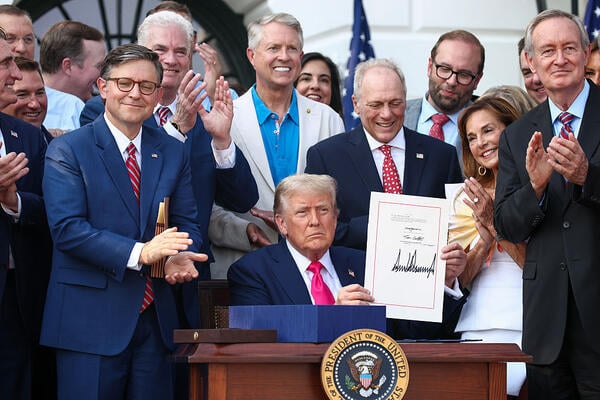
    The One Big Beautiful Bill Act, signed into law July 4, extends Pell Grants to low-income students enrolled in eligible short-term programs, between eight and 15 weeks long. The policy shift is expected to put money in the pockets of hundreds of thousands of students per year to help them afford these quicker, increasingly popular programs—and bring an influx of funds to the institutions that offer them. 

    But realizing those gains will take some time, and with the policy scheduled to get off the ground next summer, some experts are worried a year won’t be long enough to parse the program’s details and ensure a smooth rollout.

    Lawmakers in Congress and colleges have been working toward some form of workforce Pell since former senator Mary Landrieu of Louisiana pushed it forward as a part of the JOBS Act in 2014.

    Since then, multiple attempts to enact the Pell expansion have failed even as the idea gained more bipartisan support. And for a moment in late June, workforce Pell seemed dead in the water when a nonpartisan Senate official, known as the parliamentarian, claimed it violated the rules of the Senate’s reconciliation process. Senators ultimately kept it in their version of the bill but limited the new Pell funds to accredited providers, appeasing the parliamentarian.

    “We’re very thankful to the persistence of our champions in Congress on this legislation from both parties in both chambers, for the commitment they made to this legislation,” said David Baime, senior vice president of government relations at the American Association of Community Colleges, noting that while the bill was partisan, support for this provision has been “bipartisan all down the line.”

    Community college leaders are “extremely enthusiastic” about the policy change after the immense “political effort that’s gone into this,” he added. “We consistently hear reports from our campuses about the importance of finding financing sources for low-income students to participate in these programs.”

    Others, however, feel trepidation, as workforce Pell is on the precipice.

    Wesley Whistle, project director for student success and affordability at New America, a liberal think tank, said for-profit colleges and online program managers, which set up short-term online programs for community colleges and other institutions, have also been eagerly awaiting the policy shift. Despite safeguards built into the legislation, such as job-placement rates, he worries students will still be lured into subpar programs at for-profits or slapdash, mass-produced online programs also eligible for the funds.

    “I hope I’m wrong,” he said. “We’re talking about our most vulnerable students.”

    Despite the bill’s passage, debates over workforce Pell are hardly over. Now, the hard work of planning for implementation begins.

    What Happens Next

    Workforce Pell is slated to take effect next July. But for that to happen, numerous details need to be hashed out by the U.S. Department of Education, states and program providers in the coming months.

    Under the legislation, short-term programs need to meet a set of standards to be eligible for Pell money. And the task of making sure programs meet the qualifications is divvied up between states and the federal government.

    The Education Department is responsible for checking that programs have existed for at least a year, boast completion and job-placement rates of at least 70 percent, and charge tuitions below graduates’ median “value-added earnings,” or the degree to which their income exceeds 150 percent of the federal poverty line three years out of the program.

    State governors must ensure short-term programs prepare students for high-skill, high-wage or in-demand jobs. The resulting credentials also must be “stackable and portable across more than one employer,” unless preparing students for jobs with just one recognized credential. Credentials need to count toward academic credit for a certificate or degree program, as well.

    Still, many questions linger about how workforce Pell will operate—likely to be answered through negotiated rule making, a lengthy process by which the Education Department creates rules and regulations by convening and listening to key stakeholders and experts, as well as public comment.

    “There isn’t a lot of meat on the bones of the outline of what implementation would look like,” said Katie Spiker, chief of federal affairs for the National Skills Coalition, a research and advocacy organization focused on workforce training. “A whole lot of decisions and next steps … that will ultimately decide how impactful and effectively short-term Pell rolls out are still left to be determined.”

    For example, some states already have quality frameworks in place for short-term programs and have spent more than $5 billion subsidizing these programs; it’s unclear how federal workforce Pell will work alongside these existing state-level initiatives. The legislation also doesn’t say who’s involved in deciding how “high-skill, high-wage or in-demand” jobs are defined. Spiker hopes those decisions draw on input from business leaders, education providers and state workforce agencies to make “public workforce and education systems better aligned.”

    Whistle agreed some of the guardrails need ironing out. He was heartened to see a tuition limit based on graduates’ salaries—a new addition since earlier versions of the policy—but he finds aspects of the requirement murky. For example, bachelor’s degree holders qualify for workforce Pell under the law, so he worries their higher salaries could throw off the metric, intended to ensure tuitions are reasonable relative to what graduates will earn. The measure is also based on graduates’ earnings three years down the line, raising questions about how to ensure programs younger than three years don’t rip students off, he said.

    Colleges’ To-Do List

    As the department works through the policymaking process, colleges will also have their own work to do to get workforce Pell ready.

    Higher ed institutions that want to participate will need to collect the data to prove they meet eligibility metrics, said Jennifer Stiddard, senior director of government relations at Jobs for the Future, an organization focused on the intersection between education and the workforce. If they don’t have that data, they’ll need to build up the reporting infrastructure.

    In addition to measuring completion and job-placement rates, “do they think they have the data to prove a program is in demand?” Stiddard said. “Are they going to be able to demonstrate that the program articulates for credit?”

    She expects community college systems in some states will be more ready than others to answer those questions, based on their states’ existing investments in short-term programs. For example, Virginia community colleges already have outcomes data on hand because of the FastForward program, which offers short-term training for jobs locally in high demand, with the state covering much of the cost. Institutions in other states, like Indiana, Iowa, Louisiana, Michigan, North Carolina and Texas, may have a head start, as well, she said. And some colleges that are further behind could decide it’s not worth it.

    Baime, of AACC, said the association plans “to work as closely as we can with the administration to ensure that institutions are able to make their programs eligible as soon as possible.”

    Among community college leaders, “the overwhelming feeling, of course, is positive,” he added, “but there are issues of implementation that need to be ironed out sometime hopefully before next July 1 so we can get this program up and running.”

    An ‘Aggressive’ Timeline

    Some experts guffawed at the yearlong timeline set for implementing workforce Pell.

    Karishma Merchant, associate vice president of policy and advocacy at Jobs for the Future, called the July 2026 deadline “aggressive” but “possible” if the department gets started immediately. (Workforce Pell is just one item on the department’s task list for the next year, and experts are skeptical that the agency can get all the work done.)

    Even if the process could be done in a year, Spiker believes it shouldn’t be. She said a year doesn’t seem like an “effective and reasonable” amount of time to solicit feedback from different stakeholders and disentangle how the program aligns with the patchwork of existing state investments in short-term training.

    “We will be encouraging the department and states to take the time to be able to do a successful implementation that enables short-term Pell to grow over time and to serve more students and more workers, instead of pushing just to meet a relatively arbitrary timeline,” Spiker said.

    She emphasized that the process comes on the heels of drastic staff cuts at the Education Department and a larger plan to dismantle the agency, which so far includes shifting career and technical education and adult basic education programs to the Department of Labor.

    These changes are “taxing already on the agency,” she said, “and then to be spearheading an implementation simultaneous with all of those huge shifts … just makes the path forward even more difficult.”

    Source link

  • Project POTUS 2025 Middle School Winners Announced

    Project POTUS 2025 Middle School Winners Announced

    Indianapolis, IN — Project POTUS, a national middle school history initiative from the Benjamin Harrison Presidential Site, has named winners for this year’s competition. 

    Since the founding of our nation, there have been nearly half a billion American citizens. Of those, over 12,000 of us have served in Congress. Just 115 have become Supreme Court Justices. Only 45 citizens have become President of the United States. There’s something exceptional about each POTUS — good, bad, or otherwise. Project POTUS? challenges students in middle school to research an American president and create a video, 60 seconds or less, representing the POTUS chosen in a way that is creative, supported by good history research, and fun. A Citizen Jury made up of nearly 100 people reviewed all qualifying submissions and selected this year’s winners.

    Grand Jury’s Grand Prize and Spotlight Award Selections  

    Grand Prize Winner ($500 award) 

    • 6th grader Peter Gestwicki from Muncie, Indiana won grand prize for his video about Theodore Roosevelt. Watch his winning video  here.

    Spotlight Award  Winners ($400 award winners) 

    • 8th grader Grace Whitworth from St. Richard’s Episcopal School in Indianapolis, Indiana won for her video about President Thomas Jefferson. Watch her winning video  here.
    • 8th grader Izzy Abraham from Sycamore School in Indianapolis, Indiana for her video about President Calvin Coolidge. Watch his winning video  here.
    • 8th grader Clara Haley from St. Richards Episcopal School in Indianapolis, Indiana for her video about President George W. Bush. Watch his winning video  here
    • 8th graders Delaney Guy and Nora Steinhauser from Cooperative Middle School in Stratham, New Hampshire for their video about President James Polk. Watch their winning video  here.

    37 students throughout the country each won their Presidential Category and received $100 awards. Check out all of their videos  here.

    The 2026 Project POTUS competition begins Election Day, November 4, 2025 and all submissions must be entered by Presidents Day, February 16, 2026. Learn more  here.

    Project POTUS is made possible by the generous support from Russell & Penny Fortune. 

    About the Benjamin Harrison Presidential Site

    The Benjamin Harrison Presidential Site is the former home of the 23rd U.S. President. Now celebrating its 150th anniversary, it is a stunningly restored National Historic Landmark that shares the legacy of Indiana’s only President and First Lady with tens of thousands of people annually through guided tours, educational programs, special events and cultural programs. Rated “Top 5 Stately Presidential Homes You Can Visit” by Architectural Digest, the Harrison’s 10,000 square foot Italianate residence in downtown Indianapolis houses nearly 11,000 curated artifacts spanning more than two centuries of American and presidential history. Recently expanded and restored through a $6 million campaign, the Benjamin Harrison Presidential Site is also consistently ranked a Top 5 Thing To Do in Indianapolis by TripAdvisor. Signature programs and initiatives include: Future Presidents of America; Project POTUS, Candlelight Theatre; Juneteenth Foodways Festival; Wicket World of Croquet; and Off the Record. Founded in 1966 as a private 501c(3) that receives no direct federal support, the Benjamin Harrison Presidential Site is dedicated to increasing public participation in the American system of self-government through the life stories, arts and culture of an American President. Find out more at PresidentBenjaminHarrison.org

    eSchool News Staff
    Latest posts by eSchool News Staff (see all)

    Source link

  • Do states have ‘statutory right’ to Education Department data and guidance?

    Do states have ‘statutory right’ to Education Department data and guidance?

    This audio is auto-generated. Please let us know if you have feedback.

    States suing the U.S. Department of Education over its mass layoffs claim the reduction in force is impacting the agency’s legally required functions, including research and grant distribution. But in documents submitted to the U.S. Supreme Court on Monday, the Education Department said states “have no statutory right to any particular level of government data or guidance.”

    The department is pushing the high court to let its massive RIF go through after being paused by both a federal district judge and the 1st U.S. Circuit Court of Appeals. In court documents, the agency said “it can carry out its statutorily mandated functions with a pared-down staff and that many discretionary functions are better left to the States.”

    Its request to carry through on the RIFs comes even as the agency notified “all impacted employees” on administrative leave in a June 6 email obtained by K-12 Dive that it is “actively assessing how to reintegrate you back to the office in the most seamless way possible” to comply with the court orders. 

    On June 16 — the same day as the agency’s latest Supreme Court filing —  it also emailed RIFed staff for information to help the department in “understanding potential reentry timelines and identifying any accommodations that may be needed.” 

    However, several of the more than 1,300 department employees put on administrative leave in March told K-12 Dive last week that they do not think the agency intends to actually bring them back. This is despite many of the employees having worked on legally required tasks the department has lagged on or trimmed down since the layoffs, as well as the department’s efforts to seemingly comply with the court orders. 

    “While they’re saying we’re coming back, they’re also still appealing the [RIF] process,” said one Education Department employee who is on administrative leave because of the RIF. “It feels like they’re slow-walking it.” 

    Employees ‘in limbo’ as department lags on statutory tasks

    The department is still paying all these employees’ salaries — amounting to millions of dollars — only for them to sit tight. 

    According to an email from American Federation of Government Employees Local 252, the union representing a majority of the laid-off employees, the Education Department is spending at least $7 million in taxpayer dollars per month to workers on leave.

    That amount is, in fact, only for 833 of the 962 laid-off Education Department workers that the union represents and whom it was able to reach for its analysis. Thus, much more than $7 million is actually being spent per month to keep the more than 1,300 laid-off employees on payroll. 

    Since March, the department has spent approximately $21.5 million on just those 833 employees, according to data provided by AFGE Local 252.

    While the Education Department emailed laid-off employees multiple times in the past month to gather information for “reintegration and space planning efforts” on government IDs, retirement plans and devices, among other things, several employees called this a superficial effort to comply with court orders. 

    In the meantime, employees are free to apply to other jobs, start their own organizations, and go on vacation if they so choose, according to employees K-12 Dive spoke with as well as an AFGE Local 252 spokesperson. 

    “We feel like we’re in limbo,” said an employee who has been on administrative leave since March. “They haven’t talked to us.” 

    This employee and the others who spoke to K-12 Dive asked to remain anonymous for fear that identification could negatively affect their employment status or severance terms.

    Condition of Education report falls behind

    This employee would have been working at the National Center for Education Statistics on data related to the Condition of Education Report, which is required by law — and for which the department missed its June 1 deadline “for the first time ever,” according to Sen. Patty Murray, D-Wash. 

    After leaving just a handful of employees in NCES, the department has so far released only a webpage titled “Learn About the New Condition of Education 2025: Part I,” which includes significantly less information than in previous years.

    “Now all we have is a bare-bones ‘highlight’ document with no explanation to Congress or to the public,” Murray said in a June 5 Senate Health, Education, Labor and Pensions Committee hearing. “And that is really unacceptable — students, families, teachers all deserve to see a full report.” 

    In 2024, the report was a 44-page document including new analysis, comparisons with past years, and graphs to visualize the data. It included over 20 indicators grouped by topics from pre-kindergarten through secondary and postsecondary education, labor force outcomes and international comparisons. Individual indicators ranged from school safety issues like active shooter incidents to recovery from the coronavirus pandemic. 
      
    This year, the department said it would be “updating indicators on a rolling basis” due to its “emphasis on timeliness” and would determine “which indicators matter the most.” More than two weeks after its missed June 1 deadline, however, the report still only includes a highlights page with five indicators linking to data tables, many of which had already been released. 

    Meanwhile, Democratic lawmakers have also expressed concerns that the department lagged on its statutory responsibilities to disburse key federal funds, including for Title I-A — which they said took three times as long to distribute than under the last administration. The delay in funding distribution gave states and districts less time to plan for helping underserved students, including those experiencing homelessness, lawmakers said.

    The U.S. Department of Education did not respond to K-12 Dive’s requests for comment on its missed June 1 deadline for the report or on how it will increase government efficiency and cut costs while spending millions on salaries for employees who are not working. 

    Sen. Patty Murray speaks into a microphone

    Senate Appropriations Committee ranking member Sen. Patty Murray, D-Wash., questions McMahon during a hearing about the proposed 15% cut to the Education Department’s budget on Capitol Hill June 3, 2025, in Washington, D.C. The budget was consistent with President Trump’s executive order to wind down the Education Department.

    Chip Somodevilla/Getty Images via Getty Images


    Department says RIF impacts are “speculative”

    However, in its Supreme Court filing on Monday, the department dismissed as “speculative allegations” states’ complaints of disruptions to services as a result of the RIFs.

    The states, in their filing last week seeking to block the RIFs, said that “collection of accurate and reliable data is necessary for numerous statutory functions within the Department that greatly affect the States.” 

    The department relies on this data “to allocate billions of dollars in educational funds among the States under Title I of the Elementary and Secondary Education Act,” the states said in their June 13 response to the administration’s plea to the Supreme Court to let its RIFs take effect. The department has given “no explanation of how such allocation can occur without the collection and analysis of underlying data, or of how the data can be collected or analyzed without staff,” their filing said.

    In its Monday response, the department maintained that it is not required by law to maintain “a particular quality of audit.” The states arguing to maintain the department’s previous staffing levels are trying to “micromanage government staffing based on speculation that the putative quality of statutorily mandated services will decline,” the agency said.

    However, when pressed by Sen. Murray in a budget hearing earlier this month, Education Secretary Linda McMahon said “no” analysis was conducted about how the firings would impact the agency’s functions or how it would continue its statutorily required responsibilities without much of its staff. The department did read “training manuals and things of that nature” prior to the layoffs, she said, and had conversations with “the department.” 

    But several laid-off staffers told K-12 Dive that they were never spoken to about how their responsibilities would continue to be fulfilled after their departure. 

    “They don’t understand what they’ve cut,” an employee said.

    Source link

  • International students “crucial” for US growth, states new report

    International students “crucial” for US growth, states new report

    The study, published by the Institue of International Education (IIE), outlines the importance of expanding international study to the US over the next five years as American universities brace for an impending domestic “enrolment cliff”. 

    “Attracting global talent is crucial to driving the US economy and growth, and maintaining US leadership” IIE’s head of research, evaluation and learning Mirka Martel told The PIE News. 

    Martel, co-author of the Outlook 2030 Brief, highlighted the unique capacity of the US to host more international students, who currently make up just 6% of the overall student population.  

    In comparison, international students comprise a much larger proportion of the total student body in the UK (27%), Australia (31%) and Canada (38%). 

    Notably, 36 US states were identified by IIE with international student populations below the 6% line, with Massachusetts, New York and Washington DC the regions with the highest proportions of international students.  

    Meanwhile, US universities are facing a much reported on domestic enrolment cliff, with government figures showing undergraduate enrolment declining by more than two million between 2010 and 2022. 

    What’s more, projections indicate that the number of high school graduates will peak in 2025 and decline by 13% by 2041, with IIE warning that US colleges and universities will be left with “empty seats” if they do not focus on international enrolments.  

    Despite recent reports of declining student interest in the US driven by the Trump administration’s hostile policies, IIE’s Fall 2024 Snapshot predicted a 3% growth in international student levels in the 2024/15 academic year.  

    Martel said she expected this forecast to hold true, pointing to the “exciting” fall increase in undergraduate rates for the first time since Covid and the continuing increase in Optional Practical Training (OPT) stemming from rising graduate rates over the last three years. 

    Outside the US, the total number of globally mobile students has seen exponential growth in recent years, nearly doubling over the past decade to reach 6.9 mil in 2024.   

    With last year witnessing the largest growth since the pandemic, some expect global mobility to exceed 9 million by 2030, driven by the growth of youthful populations in South Asia and Sub-Saharan Africa.  

    This, the report says, will create “a steady pipeline of students seeking future academic study”, highlighting the case of Nigeria where the country’s universities can only admit one-third of the two million annual applicants due to capacity constraints.  

    Elsewhere in India, domestic institutions have significantly expanded their undergraduate studies, but “there remains a strong interest in pursuing graduate studies abroad,” according to IIE. 

    Attracting global talent is crucial to driving the US economy and growth

    Mirka Martel, IIE

    In 2023/24, the number of international students in the US reached a record level of 1.1 million, which was primarily driven by a surge in OPT rather than new enrolments.  

    IIE’s 2030 Outlook highlights the $50bn contribution of international students to the US in 2024, with California ($6.4bn), New York ($6.3bn) and Massachusetts ($3.9) reaping the highest economic benefits.  

    What’s more, last year international students created nearly 400,000 jobs in the US, with the report highlighting their role in driving innovation in key industries, as more than half of international students in the US graduate from STEM fields.  

    It points to Chamber of Commerce predictions of incoming labour market shortages across healthcare, computer and mathematical sciences, and business and financial operations, with international students with US training well-poised to fill the gaps.  

    Beyond the numbers, “[international students] are a political and economic asset for America,” states the report: broadening perspectives in the classroom and furthering business, cultural, economic and political ties after they return home.  

    Source link

  • States balance supports and discipline to address troubling student behaviors

    States balance supports and discipline to address troubling student behaviors

    This audio is auto-generated. Please let us know if you have feedback.

    In Arkansas, a $7 million program approved last year aims to support students’ mental health by restricting their cellphone use and using telehealth to connect more students to mental health providers.

    In Texas, a multiyear effort to study student mental and behavioral health yielded a host of recommendations, including putting Medicaid funds toward school-based mental health supports and better tracking of interventions.

    And in West Virginia, state education leaders and partnership organizations have amassed a trove of resource documents and built out training to help schools address student mental health challenges.

    All three states are working to proactively to respond to the student mental health crisis that worsened due to the COVID-19 pandemic. 

    All three states are also considering or expected to pass laws allowing schools to implement tougher discipline policies.

    Likewise, many states are tweaking their discipline policies at the same time they are putting more resources toward supporting students’ mental well-being.  

    Although school discipline and mental health supports are mostly addressed at the local level, state leadership is critical for setting expectations for accountability and requiring transparency in disciplinary actions, said Richard Welsh, founding director of the School Discipline Lab, a research center that shares information about school discipline.

    And states are using a variety of measures from proactively providing mental health supports to loosening restrictions for exclusionary discipline, said Welsh, who is also an associate professor of education and public policy at Vanderbilt University. 

    Post pandemic, “we did have an uptick in student misbehavior,” Welsh said. “But I think what also gets missing in that was we also had an uptick in student and teacher needs.” 

    The COVID factor

    Post-COVID, schools have reported a rise in unruly behaviors, including among young students. Some of the behaviors have been violent and have even injured teachers, leading them to turn away from the profession.

    Research published by the American Psychological Association last year found an increase in violence against K-12 educators over the past decade. After COVID restrictions ended in 2022, a survey of 11,814 school staff, including teachers and administrators, found that 2% to 56% of respondents reported physical violence at least once during the year, with rates varying by school staff role and aggressor. 

    Data also shows that student verbal abuse occurring at least once a week on average, doubled from 4.8% in the 2009-10 school year to 9.8% in 2019-20, according to APA.

    Students’ mental health needs increased during and after the pandemic, according to studies. Additional research showed that teachers, administrators and other school staff lacked resources to properly address students’ needs

    Some educators, parents and advocates worry that harsher student discipline policies will undermine evidenced-based practices for decreasing challenging behaviors and keeping students in school. They are also concerned that after several years of expanding positive behavior supports and restorative practices, a focus on stricter discipline policies will disproportionately affect students of color and those with disabilities. 

    The legislative activity at the state level is occurring at the same time President Donald Trump is calling for “reinstating common sense” to school discipline policies. An April executive order calls for the U.S. Department of Education to issue guidance to districts and states regarding their obligations under Title VI to protect students against racial discrimination in relation to the discipline of students. Title VI of the Civil Rights Act prohibits discrimination based on race, color or national origin in federally funded programs. 

    The Trump administration has called for the federal government to enact policies that are “colorblind,” not favoring one race over others.

    The order also directs the Education Department to submit a report by late August on the “status of discriminatory-equity-ideology-based school discipline and behavior modification techniques in American public education.” 

    Welsh predicts that the executive order will lead to more state activity addressing student behavior and a specific focus on the guidelines for administering punitive discipline. 

    Source link

  • Many States Picked Diploma Pathways Over HS Exit Exams. Did Students Benefit? – The 74

    Many States Picked Diploma Pathways Over HS Exit Exams. Did Students Benefit? – The 74


    Get stories like this delivered straight to your inbox. Sign up for The 74 Newsletter

    This story was originally published by Chalkbeat. Sign up for their newsletters at ckbe.at/newsletters

    When 18-year-old Edgar Brito thinks about what he’ll do in the future, mechanical engineering is high on the list.

    The senior at Washington state’s Toppenish High School first considered the career after he joined a STEM group in middle school. In a ninth grade class, he researched the earning potential for a STEM degree (“so much more money”) and the demand for mechanical engineers (“exploding”).

    So Brito took some engineering classes at his high school, became president of his state’s Technology Student Association, and is starting at the University of Washington this fall on a pre-science track.

    Brito’s experience is what state education leaders hoped for when they replaced the high school exit exam with multiple pathways to graduation. When he graduates in June, Brito will have completed several diploma pathways, including ones aimed at preparing for college and building career skills.

    But his experience isn’t necessarily typical. He has friends who have no idea what pathway they’re on — or if they’re on one at all. The requirements could be clearer and advisers could spend more time talking about them with students, he said.

    “Making sure that we know exactly what our pathway is and what it means to be on a pathway would have definitely helped out a lot more students,” Brito said.

    Five years after Washington rolled out its pathways, they appear to have helped more students who aren’t college-bound to graduate, which was part of the goal. But the system has also created new issues and replicated some old ones.

    For the Class of 2023 — the most recent year with available data — around 1 in 5 seniors didn’t have a pathway. That meant they weren’t on track to graduate within four years and at risk of dropping out. Some students relied on pandemic-era waivers that don’t exist anymore. That’s similar to the share of students who didn’t graduate on time in 2019, the final year of the exit exam.

    Asian and white students are much more likely to complete one of the math and English pathways, considered the college-prep route, while Native students, English learners, and students with disabilities are more likely to have no graduation pathway.

    “The implementation of graduation pathways has reinforced that the student groups who are the furthest from educational justice are completing the requirement at lower rates,” state education officials wrote in a 2023 report.

    Across the state, students don’t have equal access to the pathways. Many schools, especially smaller and rural ones, struggle to offer more than a handful of career and technical education classes. Some career pathways train students for low-paying jobs with little opportunity for advancement. Some students get funneled to the military pathway, despite having no aspirations to serve, because the aptitude test is easier to pass. Many teens, like Brito’s friends, find the pathways confusing.

    Washington is not alone. Nearly half of states offer multiple diploma options or graduation pathways. And some, like Indiana, have already taken a second pass at their pathways. Many have struggled to address the same big questions, including what exactly high school is for, and what students should need to do to earn a diploma.

    Now the state board of education is poised to overhaul its graduation requirements again.

    Piling on more ways for students to graduate is not the answer, said Brian Jeffries, the policy director at the Partnership for Learning, an education foundation affiliated with the Washington Roundtable, which is made up of executives from across the state.

    “Let’s better prepare our students to meet the pathways, [rather] than keep creating a smorgasbord or a cafeteria of options, which too often turn into trapdoors,” said Jeffries, who sits on the state task force that’s looking at graduation requirements. Until disadvantaged kids have access to better instruction and more support, he said, “we’re going to keep spinning this wheel.”

    The path to 100 high school graduation pathways

    Back in the early 2000s, many states raised the bar to graduate from high school with the hope it would get more kids to college. As a result, by 2012, half of all states required an exit exam, including Washington state.

    But as student debt soared and some questioned the value of higher education, schools abandoned that college-for-all mentality. Critics of exit exams argued that they blocked too many disadvantaged students from graduating.

    In Washington state’s final year of the exit exam, around 1 in 10 high school seniors didn’t pass the English language arts portion, and 1 in 5 didn’t pass the math test, the Seattle Times reported. The law that nixed the exit exam had broad support from the Washington teachers union, state education officials, and parents. Lawmakers passed it unanimously.

    Just six states require an exit exam now, with New York and Massachusetts dropping their tests this school year.

    But absent an exit exam, states haven’t really reached a consensus on what students should have to do to prove they’re ready to graduate.

    Nationwide, there are now more than 100 ways to graduate from high school, according to a recent report from the Education Strategy Group, a K-12 consulting firm. The myriad options provide flexibility, but “also contribute to the lack of clarity about what it means to earn a diploma,” the report found.

    When the nation’s main K-12 education law, the Every Student Succeeds Act, passed 10 years ago, it tasked schools with getting students ready for college and career. But many states and schools are still trying to figure out how to do the career part well.

    “Part of the challenge, frankly, is that schools are going through a bit of a post-high-stakes-test-based accountability identity crisis,” said Shaun Dougherty, a professor of education and policy at Boston College.

    Michael Petrilli, the president of the Thomas B. Fordham Institute, a conservative think tank, says that’s partly because for all the talk about changing high schools, graduation policies are still fairly restrictive. One reason Washington is revisiting its policies now is because some educators worry the state’s 24-credit requirement fills up students’ schedules, leaving little time for apprenticeships and other hands-on learning.

    Many kids are still “sleepwalking through six or seven class periods a day, mostly through college-prep courses,” Petrilli said, with “maybe a few career-tech electives on the side.”

    “We haven’t really unleashed high schools to do things very differently,” Petrilli said. “If we actually think that career tech is valuable, if we think that college-for-all was a mistake, then we need to be willing to act on it.”

    Diploma pathways can bolster teens’ interest in school

    What’s happening in the Toppenish School District illustrates the potential of the pathways model.

    The district, which serves around 3,700 students in south-central Washington, is able to offer a wide range of career and technical courses, including in growing industries, like health care and agriculture. The career-oriented pathway has helped increase some students’ interest in school.

    “It is very hands-on, and so it’s definitely more engaging,” said Monica Saldivar, Toppenish’s director of career and technical education. The old one-size-fits-all approach had “a negative impact for our students with diverse learning needs, academic challenges, and also language barriers.”

    Just before the state overhauled its graduation requirements, over 81% of Toppenish students graduated within four years. Now over 89% do.

    The improvements have been especially pronounced for English learners and Native students, many of whom live on the Yakama Nation. Since the state introduced pathways, Native student graduation rates have risen from 67% to 88%.

    Since pathways launched, the district has added several career-technical education courses, including advanced welding and classes that prepare students to work as medical transcriptionists or home health care aides. That can require some careful career counseling with students, as those jobs are in high demand but don’t pay well unless students get additional training or schooling and move up the career ladder.

    Still, the expanded offerings have helped some students tailor their post-high school plans.

    Frances Tilley, a Toppenish senior who’s headed to Gonzaga University in the fall, will graduate in June after completing both college-prep and career-oriented pathways.

    The 18-year-old took two of the new sports medicine classes and liked learning about what to do if you have a concussion. (Don’t try to stay awake. “We learned that’s not true,” Tilley said.)

    She followed that up with another health care class that touched on different disciplines. She gravitated toward psychology and now plans to get a master’s in counseling and become a mental health worker.

    Pathways can also help schools expose students to career options earlier.

    Three years ago, Toppenish started offering middle schoolers two-week labs to test drive careers such as marketing, nursing, or culinary arts. By the end of eighth grade, they’ve learned about 10 different careers. Now school counselors use students’ interests to help plot their high school schedules.

    Kaylee Celestino, 16, had long considered becoming a teacher. The Toppenish sophomore often gets “education” as an answer when she takes career quizzes. But the career-exploration labs also piqued her interest in science, and now she could also envision becoming a pediatric nurse. So her course schedule reflects that with advanced biology and college-level chemistry.

    “I just want to help people out,” she said, “like my teachers have helped out me.”

    Staffing, standards, data gaps make pathways challenging

    Staffing career and technical classes is one of the biggest hurdles to doing pathways well.

    Washington makes it easier than other states for professionals to put their work experience toward a teaching license. But many schools still struggle to attract and retain teachers for attractive fields like health services and welding when the private sector beckons.

    “These are lucrative fields,” said Dougherty, who has researched career education programs in several states, including Washington. “It’s hard to convince people to give up that salary to become full-time educators.”

    That creates extra work for schools. Saldivar, for example, meets regularly with regional employers to learn about their workforce needs. That helps inform whether Toppenish should drop or add certain classes, and which teachers to recruit. Saldivar is constantly networking and following up on “so and so may know someone” tips.

    Figuring out how to hold all students to a high standard when they are meeting different criteria to graduate is a challenge, too. Some worry Washington’s pathways are too flexible.

    The state rolled out a new pathway this year that allows students to graduate by completing a project, work-related experience, or community service. Lawmakers wanted to give students a way to show what they know besides taking a class or a test. But students don’t have to work with a teacher at their school, and if they choose to work with an outside mentor, there’s no clear rules for how they should be vetted.

    “Where are they finding these people?” said Jeffries of the Partnership for Learning. “Is their opinion an expert opinion that we could trust, or is this based on vibes?”

    Experts say it’s also important for students to understand what their likely earnings and other outcomes will be depending on which career pathway they follow.

    “We should not be talking about CTE in a very generic way,” said Dan Goldhaber, a professor at the University of Washington who has researched career and technical education teacher preparation in the state. “What the concentration is matters.”

    But Washington state doesn’t yet know how students’ outcomes may vary depending on which career and technical education concentration they chose, Katie Hannig, a spokesperson for Washington’s state education agency, wrote in an email. This is a common problem nationwide.

    The state also doesn’t yet know whether the pathway, or pathways, students completed were connected to their post-high school plan, which they must create to graduate. That hasn’t assuaged concerns that students are completing pathways disconnected from their college and career goals.

    The state expects to get that data in the future, Hannig wrote. Analyzing how diploma pathways affect graduation trends and postsecondary outcomes could help schools target resources and support.

    “Any new policy is a work in progress, but the fundamental core value of this policy is preparing students for their next step after high school graduation,” Hannig wrote. “Washington is proud to be one of those states that have established and continue to refine those pathways.”

    For now, districts like Toppenish are scrambling to coordinate weekly college presentations, field trips to work sites, and military recruiter visits — “a little of everything,” Saldivar said — to hedge their bets.

    Kalyn Belsha is a senior national education reporter based in Chicago. Contact her at [email protected].

    Chalkbeat is a nonprofit news site covering educational change in public schools.


    Get stories like these delivered straight to your inbox. Sign up for The 74 Newsletter

    Source link