Tag: States

  • States try to tackle child care shortages — by lowering standards

    States try to tackle child care shortages — by lowering standards

    When this year’s legislative session launched in Idaho, early childhood experts and advocates were hopeful that the state, which has a shortage of child care, would invest more in early learning programs. Instead, lawmakers proposed what may be the most extreme effort yet to deregulate child care in America: The bill called for eliminating state required staff-to-child ratios altogether, instead allowing child care providers to set their own.

    While the effort was met with fierce opposition in the state, it represents a trend gaining momentum in the country. Rather than investing in the struggling child care industry, more than a dozen states have proposed lowering the minimum age to work with children, easing education and training requirements, and raising group sizes and ratios. (Read my December story on this growing deregulation movement. I investigated such efforts in states including Kansas and Iowa.)

    The deregulation measures come at a time when many early childhood programs face federal funding and staffing cuts. Head Start programs were hit by a federal funding freeze and struggled to draw down payments even after the Trump administration announced Head Start was exempt from the freeze. Then, earlier this month, the Trump administration closed five of the Administration for Children and Families’ (ACF) regional offices and placed staff from those offices on leave, threatening support for Head Start, which is overseen by ACF, as well as programs that receive federal child care subsidies. Last week, USA Today reported that President Donald Trump is considering a budget proposal that would eliminate funding for Head Start altogether.

    At the state level, Idaho lawmakers are not the only ones to propose child care deregulation legislation this year. Minnesota lawmakers also issued similar proposals, including increasing family child care capacity limits and relaxing ratios in rural areas. Another bill in the state proposes lowering the age requirement of assistant teachers from 18 to 16. In Kansas, where a lawmaker proposed hiring 14-year-olds to help in child care classrooms in 2023, a new bill aims to reduce training requirements. An Indiana measure would loosen staff-to-child ratios based on the ratios set in neighboring states, and one in North Carolina would increase maximum group sizes for young children. And in Florida, lawmakers have called for an abbreviated inspection plan for some child care programs.

    While deregulation is more common in red states, there have also been some recent efforts to invest in early learning programs that transcend the red-blue divide. In Georgia, Gov. Brian Kemp proposed an additional $14 million aimed at reducing preschool class sizes and $5.5 million to address issues with the state’s child care subsidy program for lower-income families. Indiana Gov. Mike Braun called for more spending to eliminate the state’s waitlist for child care subsidies. And South Carolina Gov. Henry McMaster proposed $20 million to continue a program that provides wage supplements to child care workers.

    In Idaho, the deregulation legislation was eventually amended to loosen the state-mandated ratios — without eliminating them altogether. It also forbids municipalities from setting more stringent child care regulations than the state, something that was allowed in the past and allowed cities to set a “higher standard” for programs, said Martin Balben, director of strategic initiatives for the Idaho Association for the Education of Young Children.

    “I think municipalities are still kind of reeling with how to confront that reality,” he said. “It remains to be seen how [they] are going to handle their lack of local control in this area moving forward.”

    Experts say while deregulation is nothing new, the recent momentum is troubling. “We absolutely want to make sure that states are not rolling back their health and safety measures,” said Diane Girouard, state policy senior analyst at Child Care Aware of America. “We want to make sure that they’re not compromising children. … There are no quick fixes.”

    Contact staff writer Jackie Mader at 212-678-3562 or [email protected].

    This story about child care services was produced by The Hechinger Report, a nonprofit, independent news organization focused on inequality and innovation in education. Sign up for the Hechinger newsletter.

    The Hechinger Report provides in-depth, fact-based, unbiased reporting on education that is free to all readers. But that doesn’t mean it’s free to produce. Our work keeps educators and the public informed about pressing issues at schools and on campuses throughout the country. We tell the whole story, even when the details are inconvenient. Help us keep doing that.

    Join us today.

    Source link

  • Bettina Apthekar’s Higher Education and Student Rebellion in the United States, 1960-1969–A Bibliography

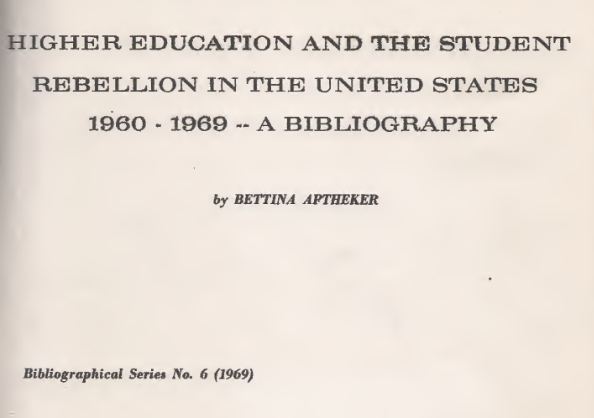
    Bettina Apthekar’s Higher Education and Student Rebellion in the United States, 1960-1969–A Bibliography


    To gain a historical perspective of what is happening today on US campuses, it’s essential to have a knowledge of what has happened before. The uncensored history of US higher education is poorly understood even on US campuses. Thankfully, some of it has been documented and it’s even available online. A case in point is Bettina Apthekar’s Higher Education and Student Rebellion in the United States, 1960-1969–A Bibliography.  This document is a treasure trove of information from the period of civil disobedience that saw some successes, successes that helped expand democracy in higher education and in society. Something we are struggling for again. If you know of other historical documents that are available online, please inform us. We’ll also add it to our list of resources

    Source link

  • States sue to recover ESSER extended spending allowances

    States sue to recover ESSER extended spending allowances

    This audio is auto-generated. Please let us know if you have feedback.

    Dive Brief:

    • Sixteen states and the District of Columbia sued the U.S. Department of Education on Thursday for halting previously approved extended spending timelines for emergency pandemic funding, calling the department’s action “tremendously harmful” to states, school districts, private schools and contractors.
    • The lawsuit, filed in U.S. District Court for the Southern District of New York, called the action “arbitrary and capricious” and said it violated the Administrative Procedure Act. The plaintiffs are seeking an order requiring the Education Department to honor the spending extensions.  
    • The policy pivot is causing states and districts to cancel tutoring services, facility improvement projects, reading interventions, after-school programming and more. District and school staff layoffs are likely if the federal government does not make reimbursement payments, the lawsuit said.

    Dive Insight:

    The Education Department’s March 28 letter canceling the extensions, sent at 5:03 p.m. on a Friday, has “already caused substantial confusion” and financial upheaval regarding late liquidation for Elementary and Secondary School Emergency Relief funds, the plaintiffs said. 

    States, districts, private schools and contractors have already created budgets, hired staff, offered services to families and children and developed operating plans based on pre-approved spending extensions, according to their lawsuit.

    In Arizona, for example, a school district on the Navajo reservation will likely need to lay off teachers and staff to cover costs that were supposed to be paid for by American Rescue Plan-ESSER dollars. That money had been pre-approved by the Education Department for a tutoring service for reading and math instruction and to repair aging buildings. After the Education Department rescinded the spending extensions, the tutoring service and infrastructure project were terminated, the lawsuit said. 

    The Education Department’s one-page March 28 letter, signed by U.S. Secretary of Education Linda McMahon, did offer states an opportunity to continue to extend spending by reapplying for Education Department approvals on a per-contract basis. But McMahon’s letter also said the spending extensions were “not consistent with the Department’s priorities” and that states had failed to meet spending deadlines set out in federal regulations.

    While spending deadlines for all three congressionally approved allocations for K-12 COVID-19 recovery have expired, the Education Department under the Biden administration allowed for a longer spending runway, giving states and districts an extra 14 months to spend down the funds.

    For instance, the spending deadline for ARP-ESSER was Jan. 28, but the late liquidation deadline is March 30, 2026. For funds under the Coronavirus Response and Relief Supplemental Appropriations Act, the original spending deadline was Jan. 29, 2024, but the extended spending deadline was March 28. The spending extension for the Coronavirus Aid, Relief, and Economic Security Act was March 28, 2024.

    In late February, the Education Department told K-12 Dive that about $2.5 billion out of a total $121.9 billion in ARP-ESSER funds remained to be spent by districts in the 41 states, Puerto Rico and the District of Columbia that had received extensions. About $433 million was left to be spent by states under ARP’s Emergency Assistance to Non-Public Schools allocation.

    The lawsuit says several states received approvals from the Education Department for ESSER spending extensions after President Donald Trump’s inauguration on Jan. 20. For example, Illinois said the Education Department approved its request on Jan. 22 to extend spending under ARP-ESSER. The state said it still has $77.2 million left to spend in federal COVID funds for education.

    One state — Oregon — said it submitted a request for late liquidation of EANS funds at 5:02 p.m. on March 28, or one minute before the Education Department letter went out. The state has not received a response. 

    Pennsylvania submitted a spending extension request for EANS funds on Feb. 10 but the Education Department has not responded to the state’s “repeated requests,” according to the lawsuit. About a month earlier, on Jan. 8, the department did grant Pennsylvania an extension for ESSER funds targeting supports for homeless children and youth.

    While there was no hard deadline for states to make late liquidation requests, January 2024 guidance from the Education Department recommended submissions be made prior to Dec. 31, 2024, for ARP funds so there would be minimal disruption to accessing funds.

    Democratic lawmakers in Congress are also calling for the Education Department to reverse its cancellation of ESSER spending extensions, saying the department changed the rules abruptly and has no recognition of the lasting impacts of the pandemic on students and schools.

    Maryland’s Attorney General Anthony Brown, in a Thursday statement, said, “The Trump Administration’s decision to cut this funding has thrown Maryland schools into turmoil and uncertainty and threatens valuable programs that help homeless and low-income students recover from the painful effects of the COVID-19 pandemic.” 

    He added, “This is a breathtakingly heartless action that threatens to change children’s futures for the worse, and our Office will not stand for it.”

    Thursday’s lawsuit was filed by Pennsylvania Gov. Josh Shapiro, a Democrat, and the mostly Democratic state attorneys general of Arizona, California, Delaware, the District of Columbia, Hawaii, Illinois, Maryland, Massachusetts, Maine, Michigan, Minnesota, Nevada, New Jersey, New Mexico, New York and Oregon. All the attorneys general are Democratic, except Hawaii’s, whose office is nonpartisan.

    Source link

  • The military footprint of the United States

    The military footprint of the United States

    The United States is keen to withdraw troops from Afghanistan and end its longest war ever, but the number of American soldiers in the South Asian country is dwarfed by many thousands stationed elsewhere across the globe.

    The 200,000 U.S. troops overseas are testimony to Washington’s persistent international commitment despite deep-seated isolationist impulses reflected in President Donald Trump’s “America First” campaign.

    The costly U.S. military footprint is a legacy of its status as Western leader that America inherited, at times reluctantly, after the two world wars in the last century.

    If Washington ever significantly reduced its network of military bases around the world, it would reflect a major turning point in history and possibly a destabilizing shift in the balance of power.

    The United States, Afghanistan and Taliban insurgents hit a roadblock recently as they tried to implement a face-saving pact leading to the partial withdrawal of American troops in the Asian nation after nearly two decades of hostilities.

    U.S. troops stationed around the world

    The anticipated pullout of about 3,400 of the remaining 12,000 U.S. troops was threatened by continuing violence, a squabble over a prisoner swap and the spread of COVID-19.

    But the American troops in Afghanistan are just the tip of an iceberg. Some 200,000 U.S. troops are stationed in overseas bases across Asia, the Middle East, Europe and Latin America.

    Current lists of U.S. troops overseas by the Defense Manpower Data Center include: 38,000 in Japan, 34,000 in Germany, 24,000 in South Korea, 12,000 in Afghanistan, 12,000 in Italy, 8,000 in Britain, 6,000 in Kuwait, 5,000 in Bahrain, 5,000 in Iraq and 3,000 in Spain.

    Smaller deployments are in Qatar, Turkey, Djibouti, Jordan, United Arab Emirates, Australia, Belgium, Cuba, Romania and El Salvador.

    The overseas deployments are a legacy of global military engagement dating back to the first years of the U.S. republic in the early 19th century.

    A fight against pirates

    U.S. founding fathers were no strangers to warfare. With significant French support, they defeated Britain to win control of the 13 original colonies, but they were soon challenged by pirates.

    “We can trace the roots of overseas conflict back to the skirmishes with the Barbary Pirates in the Jefferson years,” Michael O’Hanlon, a military historian at the Brookings Institution, said in an interview.

    In 1801, Thomas Jefferson, the third U.S. president, sent warships to free U.S. merchant seamen held hostage by North African Barbary Coast pirates.

    Between 1812 and 1814, U.S. troops and warships again sent British forces packing, although the White House was burned.

    “But those skirmishes were not really indicative of any major overseas ambition – just yet,” said O’Hanlon.

    The United States becomes a world leader.

    The next military challenge with standing armies was the U.S. Civil War in the 1860s. Then, a strongly isolationist American public was dragged into two world wars in the 20th century, first in 1917 when the German navy began targeting neutral ships, and then in 1941 when the Japanese bombed the American fleet in Pearl Harbor, Hawaii.

    After the world wars, U.S. isolationists sought to keep America out of foreign conflicts and shrink the size of its standing army. “That stopped,” said O’Hanlon, “with the descent of the Iron Curtain in Europe, the communist takeover in China, the Soviet testing of a nuclear bomb and of course the North Korean attack on South Korea, all in the late 1940s or 1950s.”

    Soon the United States joined the North Atlantic Treaty Organization (NATO) and signed military treaties with Japan, the Philippines, Germany and South Korea, leaving U.S. troops in some cases as a “trip wire” to warn off aggressors that an attack on U.S. or NATO bases would mean war.

    The latest expansion of U.S. military forces overseas is the Pentagon’s Africa Command. It is working with French troops to patrol the Sahara region, where Islamist militants have launched attacks in several former French colonies including Mali, Niger, Burkina Faso, Algeria and Tunisia.

    But a proposal to reduce the U.S. military’s involvement in Africa has stoked fears that militants could end up destabilizing or controlling large parts of the sub-Saharan Sahel.

    The spokesman for U.S. forces in Afghanistan, Col. Sonny Leggett, recently tweeted that despite the risks of the COVID-19 pandemic, the United States will pursue its plan to withdraw troops until 8,600 are left.

    Under the deal signed at the end of February, the U.S. is to cut its forces in Afghanistan to 8,600 service members within 135 days of the deal, and the international coalition backing the United States is to draw down by a commensurate amount, the Hill newspaper reported last month.


    Three questions to consider:

    1. Who were the Barbary pirates?

    2. Why did the United States enter World War One and World War Two?

    3. Why did the United States not revert to form and retreat into an isolationist shell after World War Two?


    Source link

  • Higher Education Inquirer : Rise to power of authoritarian states

    Higher Education Inquirer : Rise to power of authoritarian states

    Structural factors refer to the context that makes the rise to power of an authoritarian state more likely. Authoritarian regimes are unusual in countries that are rich, socially stable and that have a tradition of constitutionally limited, civilian government.  If they do emerge in these sorts of countries, it is usually the result of a crisis, brought about by external factors such as war or international economic crisis.   As usual with history, the history teachers favorite acronym PESC is a good way to go about organizing these structural factors – PESC = the political, economic, social, and cultural conditions that encourage authoritarian rule. 


    Source link

  • Trump wants to privatise education in United States (Times Radio)

    Trump wants to privatise education in United States (Times Radio)

    He will reduce the US educational establishment to a gigantic private school system, which means that large chunks of it will collapse. Except for Catholic parish schools, private day schools last maybe 25 years at their best, and that’s after a bunch of name changes or changes in location thanks to ownership changes. Trump is dooming the poorest states to shutting down huge numbers of public schools, because they will not find buyers. This situation is madness.

    ReplyDelete

    Source link

  • Three States Weigh Changes to Presidential Search Processes

    Three States Weigh Changes to Presidential Search Processes

    Three states are considering changes to how public universities hire presidents via legislation to provide more, and in the case of Utah, less transparency in executive searches.

    Florida, Utah and Washington are all weighing changes, driven by state legislators in response to recent presidential searches. In the case of Florida, the move comes after the state, known for broad open records laws, revised presidential search processes in recent years in ways that narrowed transparency, which was followed by an influx of hires connected to conservative politics.

    Evergreen State legislators have proposed the changes following closed-door presidential searches at both the University of Washington and Washington State University, which they argue lacked adequate transparency because finalists were not named during the process. (However, they’ve backed off an initial bill to require universities to name finalists.)

    In Utah, lawmakers have crafted legislation to limit information on presidential searches. Current state law requires public universities to release the name of three to five finalists for presidential positions, but that could change with only a single finalist unveiled at the end of the search.

    The legislative proposals reflect a broader debate over how much transparency should be built into presidential searches and the politics of hiring processes.

    Florida’s Proposed Reversal

    The Florida Legislature passed a bill in 2022 that allowed institutions to keep the identity of applicants secret until a university identified three finalists. The change marked an about-face from prior practices, in which lists of applicants were released as part of presidential searches.

    Although the law passed in 2022 charged universities with naming three finalists, in practice it has often meant that institutions only release the name of one applicant at the end of the process. And since the passage of that legislation, Florida has tapped numerous Republican lawmakers to lead public universities, including former Nebraska U.S. senator Ben Sasse at the University of Florida, who stepped down after less than 18 months amid questions about his spending.

    Since Sasse’s exit, critics have alleged UF’s board missed or ignored multiple red flags.

    Governing boards have hired numerous other Republican former lawmakers to lead institutions since 2022. Recent hires include Adam Hasner at Florida Atlantic University, Jeanette Nuñez at Florida International University (who stepped down as lieutenant governor to take the job), Richard Corcoran at New College of Florida, Fred Hawkins at South Florida State College, Mel Ponder at Northwest Florida State College and Torey Alston at Broward College.

    In a statement on why she filed the bill to open search processes, Florida representative Michelle Salzman, a Republican, wrote that the legislation would ensure “our higher education institutions are governed in a transparent and ethical manner, with the best interests of our students and taxpayers as the guiding principle.”

    To Judith Wilde, a research professor at George Mason University who studies presidential searches and contracts, the bill seems like backlash to Republican governor Ron DeSantis, who many critics allege has used a heavy hand in installing GOP officials as college presidents.

    “They are definitely moving away from the more secretive and controlled processes that they’ve been under for the last few years. I’d say that is because so many people now are tired and upset with DeSantis putting in place his personal choices and how badly that has worked out,” Wilde said.

    Last year, the Florida Board of Governors also gave itself more authority over presidential searches, adopting a policy that requires its chair to approve a list of finalists before candidates are submitted to individual governing boards. That would go away under proposed legislation.

    The Florida Board of Governors did not respond to an inquiry about its position on the bill.

    Washington Backtracks

    Washington lawmakers initially proposed changes to how presidential searches are conducted with a bill that would require public universities to name “up to four priority candidates” for the job. But lawmakers backed off that idea, submitting a substitute bill that would expand voting rights for students and faculty on presidential searches, but not require finalists to be named.

    University of Washington officials had expressed concern about the initial proposed legislation, arguing that UW could lose highly qualified candidates if they can’t keep names confidential.

    “It’s important to understand that sitting presidents or chancellors participate in these processes at considerable professional risk. There may be reputational damage up to termination, even if their candidacy is unsuccessful, should their present employers learn that they are pursuing other employment,” Blaine Tamaki, chair of UW’s Board of Regents, wrote in a statement.

    A UW spokesperson also pointed to fallout in 2020 in the University of Alaska system when then-president Jim Johnsen stepped down after he emerged as the sole finalist to lead the University of Wisconsin system. Johnsen withdrew from the Wisconsin search after criticism that the process lacked transparency. He then resigned from the Alaska presidency mere weeks later.

    (Johnsen’s tenure at Alaska was heavily scrutinized while he was there, however, and many students and faculty members expressed relief that he planned to leave for another job, which Wilde suggested was more of a factor in his abrupt exit than his candidacy for the Wisconsin position.)

    Washington State University had also expressed concerns about the initial bill.

    “Specifically, we were apprehensive about losing strong candidates who would be unwilling to make their names public before a selection was announced,” a Washington State spokesperson wrote to Inside Higher Ed by email. “There is a very real concern for some candidates that they would lose their effectiveness at their home institutions if it became public that they were exploring employment opportunities elsewhere. This is particularly true for sitting presidents.”

    Washington State has expressed support for the new bill.

    Opacity in Utah?

    State Senator Chris Wilson, the Utah Republican who sponsored the bill to overhaul presidential searches, has argued the law needs to be changed so public universities don’t lose quality candidates who are unwilling to go through a process that exposes their identity.

    The Utah legislation seems at least partly inspired by Elizabeth Cantwell exiting the presidency at Utah State University last month to take the top job at Washington State.

    Wilson has pointed to Cantwell departing for Washington State as an example of why the bill is needed. Last month, in a House Education Committee meeting, Wilson stressed the need for confidentiality in searches and argued, “There’s no way the president of Utah State University would have applied for the presidency of Washington State if it wasn’t a private process.”

    Utah commissioner of higher education Geoff Landward has cast doubt on the notion that public universities in the state have lost applicants due to current processes.

    “I can confidently say that we have not had a single search wherein we were talking to very high-quality candidates who essentially said that they would be interested and willing to apply, were it not for the fact that the final three candidates would have to be public because that would put their current employment in peril unnecessarily,” Landward told lawmakers in February.

    But, he added, “This is a question of who did we not get to consider?”

    Wilde is skeptical of Utah’s proposal. She points to an example at Montana State University in 2019 when President Waded Cruzado informed the board that she was being recruited for another job. In response, the board gave Cruzado a $150,000 pay raise to entice her to stay—and it worked.

    “Just because they’re in the job market doesn’t necessarily mean that they want to leave the university,” Wilde said. “And if they’re doing a good job, make the effort to keep them.”

    Source link

  • States File Lawsuit Challenging Education Department Cuts

    States File Lawsuit Challenging Education Department Cuts

    Twenty Democratic state attorneys general filed a lawsuit Thursday against the Trump administration for its massive job cuts at the Education Department, seeking to block what they say is “an effective dismantling” of the department. 

    The suit argues that by eliminating half the staff, the department is essentially abdicating its responsibility to deliver statutorily mandated programs, like federal student aid and civil rights investigations—many of which also affect state programs. 

    “This massive reduction in force is equivalent to incapacitating key, statutorily-mandated functions of the Department, causing immense damage to Plaintiff States and their educational systems,” the suit reads.

    The plaintiffs include Arizona, California, Colorado, Connecticut, Delaware, the District of Columbia, Hawaii, Illinois, Maine, Maryland, Massachusetts, Michigan, Minnesota, Nevada, New Jersey, New York, Oregon, Vermont, Washington and Wisconsin.

    The lawsuit is at least the eighth to be filed against the Trump administration over its education policies in the past month. Follow Inside Higher Ed’s Trump Lawsuit Tracker for updates on the case.

    Source link

  • 6 recommendations for AI in classrooms

    6 recommendations for AI in classrooms

    Key points:

    As states move forward with efforts to adopt artificial intelligence, the nonprofit Southern Regional Education Board’s Commission on AI in Education has released its first six recommendations for schools and postsecondary institutions.

    Because of its broad membership, regional breadth, early creation and size, SREB President Stephen L. Pruitt said the commission is poised to produce critical recommendations that will inform not only Southern education decision makers but those throughout the nation.

    “AI is fundamentally changing the classroom and workplace,” Pruitt said. “With that in mind, this commission is working to ensure they make recommendations that are strategic, practical and thoughtful.”

    The commission is set to meet for another year and plans to release a second set of recommendations soon. Here are the first six:

    Policy recommendation #1: Establish state AI networks
    States should establish statewide artificial intelligence networks so people, groups and agencies can connect, communicate, collaborate and coordinate AI efforts across each state. These statewide networks could eventually form a regional group of statewide AI network representatives who could gather regularly to share challenges and successes.

    Policy recommendation #2: Develop targeted AI guidance
    States should develop and maintain targeted guidance for distinct groups using, integrating or supporting the use of AI in education. States should include, for example, elementary students, middle school students, high school students, postsecondary students, teachers, administrators, postsecondary faculty and administrators and parents.

    Policy recommendation #3: Provide high-quality professional development
    State K-12 and postsecondary agencies should provide leadership by working with local districts and institutions to develop plans to provide and incentivize high-quality professional development for AI. The plans should aim to enhance student learning.

    Policy recommendation #4: Integrate into standards & curricula
    States should integrate into statewide K-12 standards and curricula the AI knowledge and skills students need to prepare them for success in the workforce.

    Policy recommendation #5: Assess local capacity and needs
    States should develop and conduct AI needs assessments across their states to determine the capacity of local districts, schools and postsecondary institutions to integrate AI successfully. These should be designed to help states determine which institution, district or school needs state support, what type of support and at what level. 

    Policy recommendation #6: Develop resource allocation plans
    States should develop detailed resource allocation plans for AI implementation in schools, school districts and institutions of postsecondary education to ensure that the implementation of AI is successful and sustainable.
    These plans should inform state fiscal notes related to education and AI.

    The 60-plus member commission was established in February of 2024. Members include policymakers and education and business leaders throughout the 16-state SREB region.

    For more information about the commission please see the following links:

    Latest posts by eSchool Media Contributors (see all)

    Source link

  • States are stepping up to protect and deliver for borrowers. (Student Borrower Protection Center)

    States are stepping up to protect and deliver for borrowers. (Student Borrower Protection Center)

    Attacks at the federal level on working families make state and local work like this all the more necessary. States can and must step up to create more protections for borrowers!

    Keep calm and TAKE ACTION, 

    Amy Czulada

    Outreach & Advocacy Manager

    Student Borrower Protection Center

    Source link