Tag: status

  • Which colleges gained R1 status under the revamped Carnegie Classifications?

    Which colleges gained R1 status under the revamped Carnegie Classifications?

    This audio is auto-generated. Please let us know if you have feedback.

    The American Council on Education on Thursday released the latest list of research college designations under the revamped Carnegie Classifications, labeling 187 institutions as Research 1 institutions. 

    The coveted R1 designation is given to universities with the highest levels of research activity. The number of colleges designated as R1 institutions in 2025 rose 28% compared with the last time the list was released, in 2022. 

    The updated list of research institutions is the first that ACE and the Carnegie Foundation for the Advancement of Teaching have released since they updated their methodology for the classifications. The new methodology was created in part to simplify a previously complex formula that left institutions fearful about losing their status. 

    “We hope this more modernized version of Carnegie Classifications will answer more questions in a more sophisticated way about institutions and their position in the ecosystem and will allow decisions to be made much more precisely by philanthropists, by governments, and by students and families,” Ted Mitchell, president of ACE, told Higher Ed Dive.

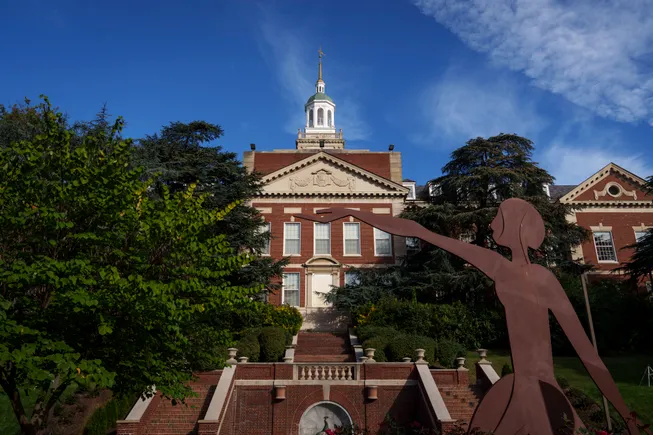
    Thirty-two institutions moved from the second-highest research level in 2022 — commonly called Research 2, or R2 — to the R1 designation. That group includes Howard University, a historically Black college in Washington, D.C. The private college — which announced a record $122 million in research grants and contracts in 2022 — is the only HCBU with the designation. 

    Other colleges that moved from R2 to R1 include public institutions like the University of Idaho, University of North Dakota, University of Rhode Island, University of Vermont and the University of Wyoming, along with private colleges like Lehigh University, in Pennsylvania, and American University, in Washington, D.C. 

    Just one institution dropped from R1 to R2 status — the University of Alabama in Huntsville. 

    For universities to achieve R1 status under the new methodology, they must spend an average of $50 million on research and development each year and award 70 or more research doctorates. 

    R2 institutions need to spend an average of $5 million per year on research and award 20 or more research doctorates. 

    Previously, the methodology was more complex. In order to keep the R1 and R2 groups of equal size, classifiers determined the line between the two designations with each cycle. They also looked at 10 different variables to determine R1 status. 

    “The previous methodology was opaque and I think led institutions to spend more time trying to figure out what the methodology actually was, perhaps distracting them from more important work,” said Timothy Knowles, president of the Carnegie Foundation. “Institutions that are close to the bar will just be much clearer about what they have to do to get over the bar.”

    The latest crop of R1 institutions have each spent $748.4 million on research and development on average annually from fiscal 2021 to fiscal 2023. During that same period, they have annually awarded an average of 297 research doctorates. 

    Texas led the list of states with the most R1 institutions, with 16. California and New York followed closely behind with 14 and 12 institutions, respectively. 

    The 139 R2 institutions on this latest list each spent an average of $55.17 million annually over three years on research and development — just beating the threshold for R1 status. However, they produced an average of only 49 research doctorates per year. 

    This year also marks the first time the classifications have included a new designation: RCU, or research colleges and universities. The new category is meant to recognize institutions that regularly conduct research but don’t confer doctoral degrees. These colleges only need to spend more than an average of $2.5 million annually on research to be recognized as RCUs. 

    This year, 215 colleges and universities have reached that status. Many are master’s- and baccalaureate-level institutions. And some are four-year colleges with a “special focus,” such as medical schools and centers. 

    Two tribal colleges have also reached RCU status: Diné College, in Arizona, and Northwest Indian College, in Washington.

    Source link

  • National College Players Association Files Charges Seeking Employee Status for Student-Athletes – CUPA-HR

    National College Players Association Files Charges Seeking Employee Status for Student-Athletes – CUPA-HR

    by CUPA-HR | February 17, 2022

    On February 8, the National College Players Association (NCPA), an advocacy association for college athletes, filed unfair labor practice charges with the National Labor Relations Board (NLRB) against the University of Southern California, the University of California, Los Angeles (UCLA), the Pac-12 Conference and the National Collegiate Athletic Association (NCAA).

    The charges allege that the employers have violated the National Labor Relations Act (NLRA) by “repeatedly misclassifying employees as ‘student-athlete’ nonemployees” and “by maintaining unlawful rules and policies in its handbook, including restricting communications with third parties.” The charges mark the launch of the NCPA’s #JforJustice campaign and aim “to affirm college athlete employee status for every [Football Bowl Subdivision (FBS)] football player and Division I basketball player at every public and private university in the nation,” per an NCPA statement.

    This is the latest development regarding issues surrounding employment status of student-athletes since NLRB General Counsel Abruzzo issued a memorandum last September stating her position that student-athletes are employees under the NLRA and are therefore afforded all statutory protections as prescribed under the law. In that memo, Abruzzo stated that it was her intent to “educate the public, especially Players at Academic Institutions, colleges and universities, athletic conferences and the NCAA” about her position in future appropriate cases.

    The NCPA charges potentially provide Abruzzo with a case she can present to the NLRB to consider granting collective bargaining rights to college athletes. In 2015, the last time the NLRB considered the issue, it declined to assert jurisdiction over Northwestern football players, as doing so “would not promote labor stability [because the] board does not have jurisdiction over state-run colleges and universities” that make up the majority of the FBS. The NCPA charge seeks to overcome this jurisdictional obstacle by including the privately-held Pac-12 and NCAA as joint employers of UCLA’s athletes — a theory of liability Abruzzo said she would consider applying in appropriate circumstances.

    Now that the charges have been filed, an NLRB regional director will review the case and determine whether formal action should be taken and presented to an administrative law judge, which would preside over a trial and issue a decision that could ultimately be taken up by the five-member board.

    CUPA-HR will be paying close attention to this case and provide members updates as it progresses.


    Source link

  • NLRB General Counsel Releases Memo on Employee Status for Student Athletes – CUPA-HR

    NLRB General Counsel Releases Memo on Employee Status for Student Athletes – CUPA-HR

    by CUPA-HR | September 29, 2021

    On September 29, National Labor Relations Board (NLRB) General Counsel Jennifer Abruzzo released a memorandum stating her position that student athletes (or “Players at Academic Institutions,” as she refers to them in the memo) are employees under the National Labor Relations Act (NLRA) and are afforded all statutory protections as prescribed under the law. Abruzzo declares, “The broad language of Section 2(3) of the [NLRA], the policies underlying the NLRA, Board law, and the common law fully support the conclusion that certain Players at Academic Institutions are statutory employees, who have the right to act collectively to improve their terms and conditions of employment.”

    Abruzzo also states that misclassifying such individuals as non-employees and leading them to believe they are not afforded protections under the NLRA has a “chilling effect” on Section 7 activity. She said she would consider this misclassification an independent violation of Section 8(a)(1) of the NLRA. Abruzzo further stated that the intent of the memo is to “educate the public, especially Players at Academic Institutions, colleges and universities, athletic conferences, and the NCAA” about her position in future appropriate cases.

    The memo revives issues surrounding employment status of student athletes that the NLRB has previously ruled on. In March 2014, the NLRB’s Regional Director in Chicago ruled that Northwestern players receiving football scholarships are employees and have a right to organize under the NLRA. In August 2015, the NLRB released a unanimous decision dismissing the representation petition filed by a group of Northwestern football players seeking to unionize. In doing so, however, the board’s decision did not definitively resolve the issue of whether college athletes are employees and have a protected right to unionize under the NLRA. After considering arguments of both parties in the case and various amici, including CUPA-HR, the board declined to assert jurisdiction on the issue, stating that “asserting jurisdiction would not promote labor stability [because the] Board does not have jurisdiction over state-run colleges and universities, which constitute” the vast majority of the teams. The board noted, however, its “decision is narrowly focused to apply only to the players in this case and does not preclude reconsideration of this issue in the future.” Another issue in the Northwestern decision was the board’s lack of jurisdiction over “walk-on” players who do not receive scholarships. It remains to be seen how Abruzzo will overcome in future cases the two jurisdictional obstacles identified in Northwestern.

    CUPA-HR will keep members apprised of NLRB actions and cases that may prompt the agency to rule on the issue regarding student athlete employment status.


    Source link