Tag: steps

  • Labour takes steps to bring higher education and local skills closer together

    Labour takes steps to bring higher education and local skills closer together

    The post-16 white paper promised to strengthen statutory guidance on local skills improvement plans (LSIPs), including “clearer expectations on higher education providers to engage” and a move to make the plans cover skills all the way up to level 8.

    This greater roles for universities in LSIPs was gestured at in Skills England’s ministerial guidance, and even announced by Labour in opposition.

    Now, the revised guidance has been published – and the push for higher education providers to play a more central role has indeed materialised.

    This is a local shop

    LSIPs were introduced in the Skills and Post-16 Education Act under the last government as employer-owned priorities and actions around skills needs and the provision of technical education in a designated local area of England. Some 38 different plans were approved by the Secretary of State in summer 2023, with annual progress reports following – you can find them all on this page if you don’t mind navigating through some confusingly designed websites.

    That legislation also introduced mechanisms to assess how well education providers were contributing to the plans – for example, accountability agreements for further education colleges. For higher education institutions, the only mention of accountability in the old guidance was an enjoinder to make a note of activity related to LSIP priorities in strategic plans. The previous government framing around LSIPs was notably quiet on the role of higher education, as we’ve noted before – which is not to say that many HE institutions didn’t get involved, to greater or lesser extents (the progress reports linked above demonstrate this, though in a non-systematic way).

    LSIPs cover a three-year period, so a new round in summer 2026 is Labour’s big chance to reshape them in its preferred fashion. Today’s guidance is to be used for an LSIP draft submitted by the end of March, and – pending government approval – the new plans will be published in or around June next year.

    The areas covered by LSIPs, and the corresponding employer representative bodies (ERBs), have also been shifting – today we get the latest areas confirmed, now sensibly contiguous with local authority areas. An additional wrinkle that Labour announced in last year’s devolution white paper is for so-called strategic authorities (“mayoral and non-mayoral combined authorities, combined county authorities, and the Greater London Authority”) to take joint ownership of LSIPs, along with ERBs. Eventually everywhere will be in a strategic authority – one day – but today’s guidance is in many places split depending on whether the LSIP is or is not in a more devolved part of England.

    Best laid plans

    LSIPs are a complicated undertaking at the best of times – as the government puts it, they “unite employers, strategic authorities, higher education, further education and independent training providers and wider stakeholders in solving skills challenges together.” Their effectiveness in really driving change remains unproven but – in theory – they respond to calls for a skills system that is planned at a local rather than central government level (or one that is not planned at all).

    The new guidance confirms just quite how complex an endeavour putting a plan together has become. New LSIPs will need to join up with the industrial strategy and its sector plans, “as far as they relate to industries within the local area.” This will also create synergies (or cross-purposes) with the new local growth plans for mayoral authorities announced at the spending review, which focus on economic development, and the Local Get Britain Working Plans (GBWPs) which are supposed to be looking at “broader causes of economic inactivity.”

    The guidance references a need for a read-across to the clean energy jobs plan (the LSIPs legislation placed a requirement on the plans to consider the environment), but this presumably will equally apply all the other forthcoming workforce strategies – now renamed as jobs plans, keep up – that different sectors are being obliged to come up with for purposes of linking migration and skills.

    And in perhaps the most notable shift of all, the new Labour version of the LSIP is instructed to pay heed to the post-16 white paper, and specifically the new prime ministerial targets for participation in higher-level learning. This is even presented as the first bullet point in the list of what the Secretary of State will take into account in the approval process. Reading between the lines, it looks like the government will be wanting plans which are relatively bullish on the growth of provision, including – but not only – at levels 4 and 5.

    Skills England is tasked with monitoring and oversight, as well as providing copious data to inform the plans’ development.

    Get HE in

    As set out in the new guidance at least, each LSIP will function as a little microcosm of the more coherent and cooperative education and skills landscape that Labour is swinging for in its white paper vision. Whether the plans can really drive these reforms, or simply reflect their framing, is another question – but there’s similar language about asking both further and higher education providers to lean in and

    work together in support of the ambitions set out in their respective LSIP, creating a more coherent post-16 education system with better pathways and opportunities to progress from entry up to higher level skills, enabled by the Lifelong Learning Entitlement.

    As mentioned, LSIPs will now be required to run the full gamut of technical education from entry level up to level 8, having previously been limited to level 6 provision as a cut-off. Asking employers and local areas to think about postgraduate-level skills needs is a bit of a watershed moment, even if the government itself seems to have only limited appetite for much policy change, and it will be fascinating to see what comes of it.

    Perhaps it’s the paucity of much proper government support for the higher education sector in recent years which leads me to celebrate this, but the language in the guidance around higher education’s fit within local systems feels spot on, in terms of how the sector would like itself to be understood:

    Higher education providers (HEPs) are focal points for higher level technical skills, research and innovation. The differences in mission, specialisms and strategic objectives between different types of institutions mean that HEPs can add unique value to local skill systems in a variety of ways, including through industry partnerships, research-led innovation, and national and international development initiatives; as well as feeding in higher education specific intelligence, such as graduate outcomes or skills pipeline data, to complement and add to further education and employer data.

    What getting stuck in looks like

    Both HE and FE providers will be expected to play a role in LSIP governance. Core elements of the new plans will need to include details of how both types of providers have been engaged in shaping the priorities and actions, as well as identifying challenges, and set out how they will support implementation and review progress.

    The potential actions included within LSIPs are varied, but it’s anticipated that they will speak to both improving the local skills “offer” – including changes that higher and further education providers can make to better align provision with the skills needs of the area and to simplify access – and to raise awareness of existing provision, helping both employers and learners to better understand what’s available.

    On the latter, there’s a nice moment where the guidance makes a genuinely sensible suggestion:

    Where engagement between higher education providers and LSIPs has not previously taken place, ERBs (and Strategic Authorities) may find engaging with the heads of careers and employability (who tend to work on skills development and measuring skills impact) a useful starting point.

    Higher education institutions will be “expected” (more on that later) to help ERBs and local government structures help map higher technical skills needs, share information about what they currently offer, and reflect on how their provision can be more responsive. And help with evaluation, and use their subject expertise and industry links to help develop the technical skills of staff elsewhere. And employ their national and international reach to gather best practice. It’s almost as if universities are teeming hives of resource and capable people, rather than ivory towers intent on remaining aloof from their local areas.

    Plus there’s an expectation for collaboration with further education and with other higher education providers to, “where appropriate”,

    create a more strategically planned response to skills needs, leading to improved local and regional coverage and coordination.

    It all sounds very nice if it works – and it all helps to flesh out the how of the white paper’s grand but largely un-operationalised ideas.

    Who’s accountable then?

    In its promises to give universities a “seat at the table” in LSIPs, it sounded like there was the possibility of Labour introducing a degree of accountability for higher education institutions, in the same way that applies to further education colleges (both through accountability agreements with DfE, and in a growing emphasis on local skills in Ofsted inspections). Research from the Association of Colleges has previously highlighted universities’ lack of formal accountability within the LSIP system as a mild bone of contention among stakeholders.

    This hasn’t happened – as far as accountability applies to higher education institutions’ role in the plans, it will remain limited to an expectation that activity is recorded in strategic or business plans, as was previously the case. There is now also encouragement for HEIs to “publicly communicate their role in the LSIP in other ways.” What we do get much more of is an emphasis on those responsible for the plans to seek out and involve the higher education sector.

    We therefore run up against the same issues that dog Labour’s HE agenda elsewhere – there might be an attractive vision of collaboration and coherence, which all things being equal the sector would be well-disposed towards, but at a time of maximum turmoil and with incentives pointing in other directions, can it really gel? Otherwise put: is dedicating enormous resource, goodwill and strategic direction to local needs a prudent choice for institutions battling to survive, or would they be better off focusing on recruiting every single last international student they can get their hands on for the rest of the Parliament? To which we might also add that the retrenchment in higher education civic work that seems to be taking place in some areas has likely already damaged some of the required structures and led to the loss of needed expertise.

    It’s a similar story elsewhere in the system: local government structures have never been more stretched, devolution-related reforms are still in their infancy, and while employer groupings may be well-placed to say what skills they would like more of, are they really effective stewards of fiendishly complicated local projects involving multiple actors and spotty data?

    A set of 39 well thought through and carefully monitored LSIPs at the heart of a responsive ecosystem of employers, HE and FE, and local government – each with one eye on the industrial strategy, and another on an area’s own specific character – would do wonders for Labour’s education and skills agenda. But the conditions need to be in place for it to emerge, and right now it feels like quite the reach.

    Source link

  • 3 Steps for Re-Enrolling Adult Learners (opinion)

    3 Steps for Re-Enrolling Adult Learners (opinion)

    About 3.8 million new high school graduates are expected to enroll in higher education next fall. The number of former students with some college credits but no credential is, at nearly 38 million working-age American adults, 10 times larger. If institutions could re-engage just 1 percent of the some college, no credential (SCNC) learners, they would net nearly 400,000 additional enrollments.

    Stopped-out learners represent an enormous market—and colleges should be competing for them. But these former students and other adult learners require much different approaches from a postsecondary institution than do 18-year-olds straight out of high school. Here are three simple actions institutions can take to connect with adult learners and put them on a more direct path to enroll.

    Start With Your Own Stopped-Out Students

    The fiercely competitive market for adult students is dominated by national online universities that pump millions of dollars each year into sophisticated marketing campaigns. That makes it difficult for traditional colleges to make inroads with adult learners. But traditional institutions have a leg up on one subset of adult learners: their own former students.

    These students know their institutions. They might remember some classmates, professors or classes they took. And they probably still live nearby—if not in the same community, then in the same state.

    Institutions unsure about enrolling these students should look at the examples set by other nearby and national colleges that are successfully re-enrolling their own stop-outs. More likely than not, they’re emphasizing what they can do specifically for adult learners and offering a rapid and simplified admissions process. Successful institutions also apply credit for prior learning before a learner re-enrolls and can tell incoming students exactly how long a program will take and how much it costs. Institutions that can convince their former students to re-enroll can increase the odds of attracting other adults with no connection to the institution.

    Make It Easier for Former Students to Enroll

    Colleges should configure the re-enrollment process to address the particular situations of stopped-out students. That means colleges should map the start-to-finish re-enrollment process for stopped-out students just like they have for their first-time, first-year students, and then streamline it to meet the needs of returning adult learners. One key place to begin is identifying the academic, financial or procedural barriers that prevent adult learners from re-enrolling and then communicating options for remediation.

    Before students begin classes, institutions should be ready to illustrate the most direct pathway for students to complete a credential, one that accommodates the complicated lives of time-crunched adult learners and leads to a postgraduation job in a high-demand, high-paying field. Institutions should clarify pathways and credit requirements for learners looking to change from their original major.

    Institutions should also consider devoting a section of their website to their own stopped-out students. That webpage should contain detailed re-enrollment information tailored to the specific needs and support services that can assist with the transition back to college.

    Assist Them Financially

    Here’s a quiz for institutions: How does your tuition discount rate for re-enrolling students compare to that for first-time students? Chances are, it’s extremely low relative to other enrollment segments.

    Unlike first-time, first-year students, adult learners are financially independent and must squeeze college expenses into already tight household budgets. Even a small increase in the discount rate for returning learners can increase the likelihood that they’ll re-enroll. Even better, calling it an “academic scholarship” confers prestige on the recipient and can give a stopped-out student the boost they need to come back strong.

    If stopped-out students have outstanding balances from their previous enrollment, consider reducing or waiving those unpaid fees to eliminate one more barrier to re-enrollment. For institutions that spend millions of dollars annually to recruit and retain traditional-age students, small-dollar investments in adult learners can pay big enrollment dividends.

    Adult learners and stopped-out students are no longer a niche population in the higher education ecosystem, and the data suggests that they’re a worthwhile investment for institutions concerned about evolving demographics, enrollment cliffs and their precarious bottom lines. If institutions can reconnect with their own stopped-out students, make it easier for them to enroll and provide some financial assistance, they can begin to bring back more of these learners and stand a little taller in the crowded higher education marketplace.

    Scott Lomas is the chief strategy officer for ReUp Education.

    Source link

  • The Office for Students steps on to shaky ground in an attempt to regulate academic standards

    The Office for Students steps on to shaky ground in an attempt to regulate academic standards

    The funny thing about the story about today’s intervention by the Office for Students is that it is not really about grade inflation, or degree algorithms.

    I mean, it is on one level: we get three investigation reports on providers related to registration condition B4, and an accompanying “lessons learned” report that focuses on degree algorithms.

    But the central question is about academic standards – how they are upheld, and what role an arm of the government has in upholding them.

    And it is about whether OfS has the ability to state that three providers are at “increased risk” of breaching a condition of registration on the scant evidence of grade inflation presented.

    And it is certainly about whether OfS is actually able to dictate (or even strongly hint at its revealed preferences on) the way degrees are awarded at individual providers, or the way academic standards are upheld.

    If you are looking for the rule book

    Paragraph 335N(b) of the OfS Regulatory Framework is the sum total of the advice it has offered before today to the sector on degree algorithms.

    The design of the calculations that take in a collection of module marks (each assessed carefully against criteria set out in the module handbook, and cross-checked against the understanding of what expectations of students should be offered by an academic from another university) into an award of a degree at a given classification is a potential area of concern:

    where a provider has changed its degree classification algorithm, or other aspects of its academic regulations, such that students are likely to receive a higher classification than previous students without an increase in their level of achievement.

    These circumstances could potentially be a breach of condition of registration B4, which relates to “Assessment and Awards” – specifically condition B4.2(c), which requires that:

    academic regulations are designed to ensure that relevant awards are credible;

    Or B4.2(e), which requires that:

    relevant awards granted to students are credible at the point of being granted and when compared to those granted previously

    The current version of condition B4 came into force in May 2022.

    In the mighty list of things that OfS needs to have regard to that we know and love (section 2 of the 2017 Higher Education and Research Act), we learn that OfS has to pay mind to “the need to protect the institutional autonomy of English higher education providers” – and, in the way it regulates that it should be:

    Transparent, accountable, proportionate, and consistent and […] targeted only at cases where action is needed

    Mutant algorithms

    With all this in mind, we look at the way the regulator has acted on this latest intervention on grade inflation.

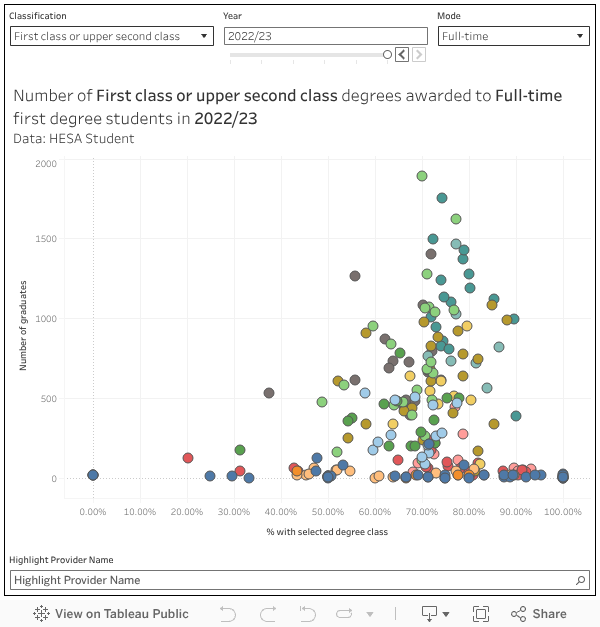
    Historically the approach has been one of assessing “unexplained” (even once, horrifyingly, “unwarranted”) good honours (1 or 2:1) degrees. There’s much more elsewhere on Wonkhe, but in essence OfS came up with its own algorithm – taking into account the degrees awarded in 2010-11 and the varying proportions students in given subject areas, with given A levels and of a given age – that starts from the position that non-traditional students shouldn’t be getting as many good grades as their (three good A level straight from school) peers, and if they did then this was potentially evidence of a problem.

    To quote from annex B (“statistical modelling”) of last year’s release:

    “We interact subject of study, entry qualifications and age with year of graduation to account for changes in awarding […] our model allows us to statistically predict the proportion of graduates awarded a first or an upper second class degree, or a first class degree, accounting for the effects of these explanatory variables.

    When I wrote this up last year I did a plot of the impact each of these variables is expected to have on – the fixed effect coefficient estimates show the increase (or decrease) in the likelihood of a person getting a first or upper second class degree.

    [Full screen]

    One is tempted to wonder whether the bit of OfS that deals with this issue ever speaks to the bit that is determined to drive out awarding gaps based on socio-economic background (which, as we know, very closely correlates with A level results). This is certainly one way of explaining why – if you look at the raw numbers – the people who award more first class and 2:1 degrees are the Russell Group, and at small selective specialist providers.

    [Full screen]

    Based on this model (which for 2023-24 failed to accurately predict fully fifty per cent of the grades awarded) OfS selected – back in 2022(!) – three providers where it felt that the “unexplained” awards had risen surprisingly quickly over a single year.

    What OfS found (and didn’t find)

    Teesside University was not found to have ever been in breach of condition B4 – OfS was unable to identify statistically significant differences in the proportion of “good” honours awarded to a single cohort of students if it applied each of the three algorithms Teesside has used over the past decade or so. There has been – we can unequivocally say – no evidence of artificial grade inflation at Teesside University.

    St Mary’s University, Twickenham and the University of West London were found to have historically been in breach of condition B4. The St Mary’s issue related to an approach that was introduced in 2016-17 and was replaced in 2021-22, in West London the offending practice was introduced in 2015-16 and replaced in 2021-22. In both cases, the replacement was made because of an identified risk of grade inflation. And for each provider a small number of students may have had their final award calculated using the old approach since 2021-22, based on a need to not arbitrarily change an approach that students had already been told about.

    To be clear – there is no evidence that either university has breached condition B4 (not least because condition B4 came into force after the offending algorithms had been replaced). In each instance the provider in question has made changes based on the evidence it has seen that an aspect of the algorithm is not having the desired effect, exactly the way in which assurance processes should (and generally do) work.

    Despite none of the providers in question currently being in breach of B4 all three are now judged to be at an increased risk of breaching condition B4.

    No evidence has been provided as to why these three particular institutions are at an “increased risk” of a breach while others who may use substantially identical approaches to calculating final degree awards (but have not been lucky enough to undergo an OfS inspection on grade inflation) are not. Each is required to conduct a “calibration exercise” – basically a review of their approach to awarding undergraduate degrees of the sort each has already completed (and made changes based on) in recent years.

    Vibes-based regulation

    Alongside these three combined investigation/regulatory decision publications comes a report on Batchelors’ degree classification algorithms. This purports to set out the “lessons learned” from the three reports, but it actually sets up what amounts to a revision to condition B4.

    We recognise that we have not previously published our views relating to the use of algorithms in the awarding of degrees. We look forward to positive engagement with the sector about the contents of this report. Once the providers we have investigated have completed the actions they have agreed to undertake, we may update it to reflect the findings from those exercises.

    The important word here is “views”. OfS expresses some views on the design of degree algorithms, but it is not the first to do so and there are other equally valid views held by professional bodies, providers, and others – there is a live debate and a substantial academic literature on the topic. Academia is the natural home of this kind of exchange of views, and in the crucible of scholarly debate evidence and logical consistency are winning moves. Having looked at every algorithm he could find, Jim Dickinson covers the debates over algorithm characteristics elsewhere on the site.

    It does feel like these might be views expressed ahead of a change to condition B4 – something that OfS does have the power to do, but would most likely (in terms of good regulatory practice, and the sensitive nature of work related to academic standards managed elsewhere in the UK by providers themselves) be subject to a full consultation. OfS is suggesting that it is likely to find certain practices incompatible with the current B4 requirements – something which amounts to a de facto change in the rules even if it has been done under the guise of guidance.

    Providers are reminded that (as they are already expected to do) they must monitor the accuracy and reliability of current and future degree algorithms – and there is a new reportable event: providers need to tell OfS if they change their algorithm that may result in an increase of “good” honours degrees awarded.

    And – this is the kicker – when they do make these changes, the external calibration they do cannot relate to external examiner judgements. The belief here is that external examiners only ever work at a module level, and don’t have a view over an entire course.

    There is even a caveat – a provider might ask a current or former external examiner to take an external look at their algorithm in a calibration exercise, but the provider shouldn’t rely solely on their views as a “fresh perspective” is needed. This reads back to that rather confusing section of the recent white paper about “assessing the merits of the sector continuing to use the external examiner system” while apparently ignoring the bit around “building the evidence base” and “seeking employers views”.

    Academic judgement

    Historically, all this has been a matter for the sector – academic standards in the UK’s world-leading higher education sector have been set and maintained by academics. As long ago as 2019 the UK Standing Committee for Quality Assessment (now known as the Quality Council for UK Higher Education) published a Statement of Intent on fairness in degree classification.

    It is short, clear and to the point: as was then the fashion in quality assurance circles. Right now we are concerned with paragraph b, which commits providers to protecting the value of their degrees by:

    reviewing and explaining how their process for calculating final classifications, fully reflect student attainment against learning criteria, protect the integrity of classification boundary conventions, and maintain comparability of qualifications in the sector and over time

    That’s pretty uncontroversial, as is the recommended implementation pathway in England: a published “degree outcomes statement” articulating the results of an internal institutional review.

    The idea was that these statements would show the kind of quantitative trends that OfS get interested in, some assurance that these institutional assessment processes meet the reference points, and reflect the expertise and experience of external examiners, and provide a clear and publicly accessible rationale for the degree algorithm. As Jim sets out elsewhere, in the main this has happened – though it hasn’t been an unqualified success.

    To be continued

    The release of this documentation prompts a number of questions, both on the specifics of what is being done and more widely on the way in which this approach does (or does not) constitute good regulatory practice.

    It is fair to ask, for instance, whether OfS has the power to decide that it has concerns about particular degree awarding practices, even where it is unable to point to evidence that these practices are currently having a significant impact on degrees awarded, and to promote a de facto change in interpretation of regulation that will discourage their use.

    Likewise, it seems problematic that OfS believes it has the power to declare that the three providers it investigated are at risk of breaching a condition of registration because they have an approach to awarding degrees that it has decided that it doesn’t like.

    It is concerning that these three providers have been announced as being at higher risk of a breach when other providers with similar practices have not. It is worth asking whether this outcome meets the criteria for transparent, accountable, proportionate, and consistent regulatory practice – and whether it represents action being targeted only at cases where it is demonstrably needed.

    More widely, the power to determine or limit the role and purpose of external examiners in upholding academic standards has not historically been one held by a regulator acting on behalf of the government. The external examiner system is a “sector recognised standard” (in the traditional sense) and generally commands the confidence of registered higher education providers. And it is clearly a matter of institutional autonomy – remember in HERA OfS needs to “have regard to” institutional autonomy over assessment, and it is difficult to square this intervention with that duty.

    And there is the worry about the value and impact of sector consultation – an issue picked up in the Industry and Regulators Committee review of OfS. Should a regulator really be initiating a “dialogue with the sector” when its preferences on the external examiner system are already so clearly stated? And it isn’t just the sector – a consultation needs to ensure that the the views of employers (and other stakeholders, including professional bodies) are reflected in whatever becomes the final decision.

    Much of this may become clear over time – there is surely more to follow in the wider overhaul of assurance, quality, and standards regulation that was heralded in the post-16 white paper. A full consultation will help centre the views of employers, course leaders, graduates, and professional bodies – and the parallel work on bringing the OfS quality functions back into alignment with international standards will clearly also have an impact.

    Source link

  • Canberra steps forward as ‘TAFE university’ – Campus Review

    Canberra steps forward as ‘TAFE university’ – Campus Review

    The University of Canberra will offer shorter courses to students who have completed a TAFE course in a bid to fast track tertiary harmonisation at the institution.

    Please login below to view content or subscribe now.

    Membership Login

    Source link

  • Texas A&M President Steps Down After Political Campaign Targets Academic Freedom

    Texas A&M President Steps Down After Political Campaign Targets Academic Freedom

    Texas A&M University President Dr. Mark A. Welsh III announced his resignation Thursday following intense political pressure from state Republican leaders over a viral confrontation involving gender content in a children’s literature course—the latest in a series of incidents that underscore the mounting challenges facing academic freedom and diversity efforts at public universities across Texas.

    Welsh’s departure came just over a week after state Rep. Brian Harrison amplified a video on social media showing a student confronting Professor Melissa McCoul about course content. Despite initially defending McCoul’s academic freedom, Welsh terminated the professor the following day under pressure from Harrison and Lt. Gov. Dan Patrick.

    The incident represents part of a broader Republican-led campaign to exert political control over university curricula, faculty hiring, and campus speech—efforts that education advocates warn are undermining the foundational principles of higher education.

    Welsh’s tenure, which began in 2023, was marked by repeated clashes with state political leaders over diversity and inclusion initiatives. In January, Gov. Greg Abbott threatened Welsh’s position after the university’s business school planned to participate in a conference aimed at recruiting Black, Hispanic, and Indigenous graduate students. Under pressure, Welsh withdrew the university from the conference entirely.

    The pattern reflects what faculty and higher education experts describe as an escalating assault on academic autonomy.

    Despite strong support from faculty and students, Welsh’s position became untenable under sustained political attack. On last Wednesday, the university’s Executive Committee of Distinguished Professors—composed of 12 faculty members holding the institution’s highest academic honor—sent a letter urging regents to retain Welsh.

    “All members of this Committee write this letter collectively to strongly urge you to retain President Mark Welsh in the wake of recent events,” the faculty letter stated.

    Student leaders also rallied behind Welsh, with dozens of current and former student government representatives praising his “steadfast love and stewardship for our University” and expressing “faith and confidence in his leadership.”

    However, these expressions of campus support proved insufficient against external political pressure.

    Welch’s predecessor, M. Katherine Banks, had resigned following the botched hiring of journalism professor Kathleen McElroy, whose employment offer was undermined after regents expressed concerns about her work on diversity, equity, and inclusion.


    Source link

  • Texas A&M President Steps Down Under Pressure

    Texas A&M President Steps Down Under Pressure

    Texas A&M University president Mark Welsh stepped down abruptly Thursday under mounting pressure from state lawmakers over how he handled a recent incident in which a student clashed with a professor over a lesson on gender identity, prompting him to dismiss the instructor.

    Earlier this month, Welsh fired Melissa McCoul, who taught English, after a student taking her children’s literature class objected to the professor’s statement that there are more than two genders. Welsh also removed two administrators from their duties because they “approved plans to continue teaching course content that was not consistent” with the course’s description, he said.

    The incident prompted fury from state lawmakers, some of whom called on the Texas A&M Board of Regents to terminate Welsh. But on Thursday, system officials announced he had resigned.

    The case also raised serious questions about academic freedom at Texas A&M and prompted pushback from faculty members who argued that McCoul’s termination was unnecessary and unjust. The American Association of University Professors also released a statement arguing that the “firings set a dangerous new precedent for partisan interference in Texas higher education.”

    Welsh’s resignation is effective Friday at 5 p.m., system officials noted in a statement.

    “President Welsh is a man of honor who has led Texas A&M with selfless dedication. We are grateful for his service and contributions,” Texas A&M system chancellor Glenn Hegar, a former GOP lawmaker, said in a statement Thursday. “At the same time, we agree that now is the right moment to make a change and to position Texas A&M for continued excellence in the years ahead.” 

    Others took a victory lap, including Brian Harrison, a Republican lawmaker and Texas A&M alum who has accused the university of funding “leftist [diversity, equity and inclusion] and transgender indoctrination.”

    Last week Harrison posted a video that the student had taken of her confrontation with McCoul, in which the student claims that teaching material related to gender identity and transgender people is illegal and violates one of President Trump’s executive orders, which are not laws. Harrison called for the board to fire Welsh and other senior officials. 

    “WE DID IT! TEXAS A&M PRESIDENT IS OUT!!” Harrison wrote on social media Thursday, adding that “as the first elected official to call for him to be fired, this news is welcome, although overdue.”

    Several other Republican lawmakers also publicly expressed support for firing Welsh.

    Welsh’s resignation comes despite the backing of notable faculty members, such as Texas A&M’s Executive Committee of the University Distinguished Professors, who wrote a letter of support for the president to the Board of Regents ahead of Thursday’s meeting.

    Welsh, a four-star general who served as chief of staff of the U.S. Air Force, was previously dean of the Bush School of Government and Public Service before he was initially tapped as interim president in July 2023 when his predecessor, Kathy Banks, resigned following a hiring scandal. Welsh was named to the job on a permanent basis in December 2023.

    Welsh’s exit now means the last two Texas A&M presidents have been felled by scandal and neither lasted more than two years in the job.

    Texas A&M did not immediately name an interim upon announcing Welsh’s resignation, but system officials noted in a statement that it will appoint someone to the position “in the coming days” and “initiate a national search for a permanent president” following Welsh’s resignation.

    Source link

  • 3 steps to build belonging in the classroom

    3 steps to build belonging in the classroom

    Key points:

    The first few weeks of school are more than a fresh start–they’re a powerful opportunity to lay the foundation for the relationships, habits, and learning that will define the rest of the year. During this time, students begin to decide whether they feel safe, valued, and connected in your classroom.

    The stakes are high. According to the 2023 Youth Risk Behavior Survey, only 55 percent of students reported feeling connected to their school. That gap matters: Research consistently shows that a lack of belonging can harm grades, attendance, and classroom behavior. Conversely, a strong sense of belonging not only boosts academic self-efficacy but also supports physical and mental well-being.

    In my work helping hundreds of districts and schools implement character development and future-ready skills programs, I’ve seen how intentionally fostering belonging from day one sets students–and educators–up for success. Patterns from schools that do this well have emerged, and these practices are worth replicating.

    Here are three proven steps to build belonging right from the start.

    1. Break the ice with purpose

    Icebreakers might sound like old news, but the reality is that they work. Research shows these activities can significantly increase engagement and participation while fostering a greater sense of community. Students often describe improved classroom atmosphere, more willingness to speak up, and deeper peer connections after just a few sessions.

    Some educators may worry that playful activities detract from a serious academic tone. In practice, they do the opposite. By helping students break down communication barriers, icebreakers pave the way for risk-taking, collaboration, and honest reflection–skills essential for deep learning.

    Consider starting with activities that combine movement, play, and social awareness:

    • Quick-think challenges: Build energy and self-awareness by rewarding quick and accurate responses.
    • Collaborative missions: Engage students working toward a shared goal that demands communication and teamwork.
    • Listen + act games: Help students develop adaptability through lighthearted games that involve following changing instructions in real time.

    These activities are more than “fun warm-ups.” They set a tone that learning here will be active, cooperative, and inclusive.

    2. Strengthen executive functioning for individual and collective success

    When we talk about belonging, executive functioning skills–like planning, prioritizing, and self-monitoring–may not be the first thing we think of. Yet they’re deeply connected. Students who can organize their work, set goals, and regulate their emotions are better prepared to contribute positively to the class community.

    Research backs this up. In a study of sixth graders, explicit instruction in executive functioning improved academics, social competence, and self-regulation. For educators, building these skills benefits both the individual and the group.

    Here are a few ways to embed executive functioning into the early weeks:

    • Task prioritization exercise: Help students identify and rank their tasks, building awareness of time and focus.
    • Strengths + goals mapping: Guide students to recognize their strengths and set values-aligned goals, fostering agency.
    • Mindful check-ins: Support holistic well-being by teaching students to name their emotions and practice stress-relief strategies.

    One especially powerful approach is co-creating class norms. When students help define what a supportive, productive classroom looks like, they feel ownership over the space. They’re more invested in maintaining it, more likely to hold each other accountable, and better able to self-regulate toward the group’s shared vision.

    3. Go beyond the first week to build deeper connections

    Icebreakers are a great start, but true belonging comes from sustained, meaningful connection. It’s tempting to think that once names are learned and routines are set, the work is done–but the deeper benefits come from keeping this focus alive alongside academics.

    The payoff is significant. School connectedness has been shown to reduce violence, protect against risky behaviors, and support long-term health and success. In other words, connection is not a “nice to have”–it’s a protective factor with lasting impact.

    Here are some deeper connection strategies:

    • Shared values agreement: Similar to creating class norms, identify the behaviors that promote safety, kindness, and understanding.
    • Story swap: Have students share an experience or interest with a partner, then introduce each other to the class.
    • Promote empathy in action: Teach students to articulate needs, seek clarification, and advocate for themselves and others.

    These activities help students see one another as whole people, capable of compassion and understanding across differences. That human connection creates an environment where everyone can learn more effectively.

    Take it campus-wide

    These strategies aren’t limited to students. Adults on campus benefit from them, too. Professional development can start with icebreakers adapted for adults. Department or PLC meetings can incorporate goal-setting and reflective check-ins. Activities that build empathy and connection among staff help create a healthy, supportive adult culture that models the belonging we want students to experience.

    When teachers feel connected and supported, they are more able to foster the same in their classrooms. That ripple effect–staff to students, students to peers–creates a stronger, more resilient school community.

    Belonging isn’t a single event; it’s a practice. Start the year with purpose, keep connection alive alongside academic goals, and watch how it transforms your classroom and your campus culture. In doing so, you’ll give students more than a positive school year. You’ll give them tools and relationships they can carry for life.

    Latest posts by eSchool Media Contributors (see all)

    Source link

  • 12 Steps for Responding to a Tenure Denial (opinion)

    12 Steps for Responding to a Tenure Denial (opinion)

    I have been denied tenure at my former R-1 institution. Twice. And after being assured yearly, in writing, that I was making appropriate or exceptional progress toward a positive decision based on departmental criteria and standards. Most of you can imagine, and some of you know, how that felt. The inconsistency seemed misleading and a breakdown of the promotion and tenure process, similar to articles in Inside Higher Ed by Colleen Flaherty and in The Chronicle of Higher Education by Michael W. Kraus, Megan Zahneis and Chelsea Long.

    I fought the first decision through formal institutional channels and won, and my institution did a re-review of my dossier from the ground up. In April of this year, I was told that I’d been denied a second time, and I was dismissed at the end of May. However, I could contest the decision processes as a nonemployee. I’m fighting the denial decision (again), and the hearings will begin in the fall.

    My area of specialization is program evaluation, with a focus on graduate education. That means I have seen the good, bad and ugly as higher education institutions discuss criteria and standards about student and faculty performance, curriculum and policy; I have a professional and personal interest in all university processes being fair and defensible for all their constituents. My experience is that the processes are not always fair, and having gone through this process before, I have some advice on the steps you should take to fight the decision. While my advice is necessarily grounded in the context of my experience and my former institution’s procedures, it can be adapted to your own.

    1. Get angry. Talk to your family, friends, colleagues you trust and your dream team of collaborators. Rage about the process and the decision and the decision-makers and the injustice, but get the hot anger out of your system and absolutely do not hurt yourself or anyone else. Let your rage cool so you can use it as energy to fight. You are not powerless, because all university processes and assumptions can be challenged. But know that the odds are heavily stacked against you.
    2. Recognize the fundamental assumption of institutional competence. There is an assumption that the university correctly followed its policies and procedures and therefore reached a defensible decision. Without very specific performance criteria for promotion, it likely won’t matter how many dozens of works you’ve published, how many grants you’ve supported, how many students you’ve helped complete their degrees, how much your skills are in demand from other units or how you’ve (over-) satisfied the criteria against which you were supposed to be judged. The standing assumption is that the university did its due diligence.
    3. Get help. Your institution has a vested interest in making sure its processes are defensible and that you can fight against decisions corrupted by inappropriate processes. Ask for a grievance hearing by the university’s regulatory body or a hearing panel (in my former institution, this group is housed in the University Senate). They should be able to connect you with a tenured faculty advocate to help you develop your process-based argument. To prevent further corruption in the process and avoid possibilities of retaliation, this advocate must be housed in a different college from the one in which the decisions were made.

    You may have the option of using an external lawyer or union representative to argue your case, but if you bring a lawyer, the respondent will bring one, too. Do what you think is best, but know that the standard of evidence in a grievance hearing is different from that in a court of law, and will likely be closer to “likelihood of procedural issues or prejudicial influence” than to “beyond a reasonable doubt.”

    1. Be clear about the relief you’re requesting. Even if a grievance panel rules in your favor, they may be limited in the relief they can offer. It’s unlikely that they can simply overturn the provost’s decision, but they may be able to recommend a re-review of your dossier. It may be helpful to think about the worst-case scenario—if your dossier is sent for re-review by the same people who voted against you the first time—and ask for reasonable, specific protections to make the re-review fair and balanced.

    Be sure to request that the judgment includes a monitoring and compliance aspect. If the panel rules in your favor, the institution needs to ensure that the recommendations are followed. Don’t let assumptions of institutional competence prevent this from happening, and do not take on that responsibility yourself.

    1. Use available templates. The grievance panel likely has a template to help you structure your argument. Use it faithfully, and don’t deviate from the specific information it requests. It will likely start by asking you to form the basis of your argument by quoting verbatim from your institution’s tenure code. Copy and paste this to make it easy for the panel to find information when they hear your case. The panel needs to stay within its institutional authority, and you must convince them immediately that your experience and concerns about the process are within their purview.
    2. Read and re-read your institution’s foundational documents. There are at least three essential documents you must use to support your argument that the process was corrupted: the department or college’s faculty handbook, the regents’ or president’s statement on tenure criteria and ways of contesting decisions, and statements on employee conduct inclusive of reporting requirements for policy violations. You must show how procedural violations significantly contributed to an unjust decision. Examples of such violations could include:
    • Discrimination against personal beliefs and expression, or factors protected by federal/state law (e.g., equal opportunity violations, Title IX violations)
    • Decision-makers’ dismissal of available information about your performance
    • Demonstrable prejudicial mistakes of fact
    • Other factors that cause substantial prejudice
    • Other violations of university policy

    After you have articulated the criteria you are using to contest the decision, you must substantiate each claim with evidence that the violation negatively influenced the final decision. The burden of proof will be on you.

    1. Organize your evidence. Whatever evidence you present must be organized, accessible and easy for the hearing panel to review. It may be helpful—and therapeutic—to start by making a comprehensive timeline of the pertinent events that led to the decision. Include the dates and written summaries of every annual review, the steps you took to address any human resources issues, the outcomes of those steps, leadership transitions, as well as sociopolitical events that directly influenced the department and institution. Your goal is to share with the panel the entirety of your experience at the institution and make the argument that you did the best you could to address any real or perceived performance issues.

    Include the official dossier that was passed through the system as evidence, and use the highlight function of the PDF software to focus on the parts that are most important for your case and that best challenge the assumption of institutional competence. Keep a running list of your documented evidence, which you’ll submit as a set of appendices, and refer to your appendices in the complaint document itself, using quotes cut and pasted directly from your primary sources.

    In the document where you set out your complaint, refer to individual appendices by letter, name and page number, so readers can find information and see your evidence in the original context (e.g., “Appendix C: Committee response to factually inaccurate information introduced in faculty discussion, p. 22–24”). Copying and pasting evidence from primary sources will make it easier to reconcile page numbers in the complaint document later. This process is also helpful if you need to argue that the content of the dossier was misrepresented by decision-makers or that one or more particularly vocal individuals are waging a vendetta against you (e.g., “Appendix E: Unsolicited letter from Professor [X] that engages in conspiracy theories about you, p. 100–125”).

    It is crucial to make the argument that you were treated unfairly and in violation of university policy, and that your treatment was significantly different from that of your colleagues who were under review at the same time or in the immediate past. If, for example, a decision-maker voted against your promotion because of their individual critiques of your work, and those critiques are not consistent with other levels of review or they attack the credibility of the other reviewers, you have an argument for their idiosyncratic interpretation of the promotion criteria. Put that evidence in an appendix and draw attention to it.

    It is also helpful to be able to point to the research of others in your department who used the same scholarly processes but who were not critiqued similarly. This can help you argue differential application of criteria and standards of performance, or that a particular reviewer is applying the standards of research in their discipline to your own, which may be a violation of the tenets of academic freedom (talk to representatives from your institution’s academic freedom committee for more information). This comparison may be essential if you are alleging discrimination or prejudicial treatment that may be based on your personal characteristics.

    1. Do not fear a request for summary judgment. This processual request means that the respondent in your case (usually a high-level decision-maker such as the provost or dean) is using the assumption of institutional competence to ask that the case be dismissed without a formal hearing. The respondent will argue that everything was done correctly, that the decision was justified and that you are simply angry about the decision. The request will likely be formal and the words intimidating, but that may be the point. Read every word so you can respond in writing to each argument, and prepare responses on the assumption that the issues will come up during oral arguments at the official hearing. Sometimes the request for summary judgment will be peppered with prejudicial language that helps reinforce the basis of your complaint. Use their words against them.
    2. Prepare your witnesses. You will want to identify good witnesses who will substantiate your main points, but not people who will repeat their evidence from the same perspective; you do not want to bore the hearing panel. Let your witnesses know who your other witnesses are and you can give them a sense of the questions you will ask them during the hearing. You cannot, however, coach them on how to respond; witnesses must be able to respond to your questions honestly, and their responses must stand up under cross-examination.

    Be sure to list the respondent and decision-makers on your witness list; you don’t want to miss the chance to hold them accountable for the things they’ve written and the decisions they’ve made. Don’t waste time indicting them on their leadership practices. Instead, show how their active and passive behaviors violated policy and prejudiced the review process in violation of the university’s foundational documents.

    1. Make the most of the hearing. You may find that the hearing is a very formal process, that an external lawyer will be present for the institution (not the respondent) to ensure the process unfolds correctly and a court transcriptionist will ensure accurate recording of testimony. The witnesses may be sworn in, and you can count on them being asked questions by the complainant, respondent and the hearing panel. If possible, you should lead the questioning for your witnesses and ask your advocate to lead the questioning of the respondent and their powerful witnesses to minimize the power imbalance.

    The respondent may not have many questions for you, but remember that you have the burden of proof, and they will not want to provide additional opportunities for you to substantiate your claims. If they do open additional areas of critique, be ready to call out the ones that are inconsistent with policy and processes. Expect to be physically and emotionally exhausted at the end of your hearing.

    1. Respond to the decision. When the hearing panel’s decision arrives, expect strong emotions. You may feel vindicated and think that you’ve finally been heard or feel as if you’ve been traumatized again. Even if you win, both are fair responses. If you won on all or some of the issues you raised, you can expect the panel to propose a set of recommendations intended to address those issues, but the process is not yet over.

    The panel may be empowered only to make recommendations to the university president, who has the final say on what happens. The president has the right to overrule the panel, just as they have the right to order compliance with its recommendations. You can write a formal letter to the president about the panel’s recommendations, as can the respondent. If you have concerns about the recommendations, especially if new issues came to light during the hearing, this is your one chance to make those issues known to the ultimate decision-maker.

    Because the grievance hearing may have shown that the process contained problems that have not likely been institutionally addressed, emphasize monitoring and compliance with hope for reconciliation. Don’t expect the president to grant you additional protections beyond what was recommended by the panel, but if the re-review is corrupted, you have documentation showing that you were concerned about making the process fair and transparent and that you did your due diligence.

    1. Go through the promotion and tenure review process again or leave the institution. Going for tenure again means another year of hoping for a positive decision, dreading a negative one and thinking about your next steps. This is a very difficult time, especially if the underlying issues have not been acknowledged or addressed. Do the best you can, and document everything. A counselor will be essential for processing the ongoing experience.

    If your complaint exposed evidence of systematic harassment or prejudicial behavior against you, reach out to the equal opportunity or Title IX offices for support. They have the option of opening formal or informal investigations but may not be likely to do this during a tenure review or re-review because they cannot be seen as influencing the process. They may not be able to act until you have been promoted or have officially lost your job (again), at which point you might wonder why you should reach out. The answer is unsatisfying but simple: You connect with them because you need emotional support and with the hope they can eventually help address the underlying factors that corrupted the process.

    If you didn’t win on the redo, you’ll need to find another job somewhere else. I hope you’ve used this last year to network and apply for opportunities as you balanced the burden of the grievance process on top of your regular commitments of teaching, research and service.

    If you’re looking at going through this process, you have my sympathy, support and encouragement. Going through it has been one of the hardest experiences of my life, but I’m glad I did it, even if I cannot change my former institution; I can only hope that they will not waste my experience by ignoring the issues it exposed. I couldn’t have done it the first time without extraordinary support from people who hate injustice and fear for institutions that do not follow their own rules. As I prepare for the second round, I will continue to look to my former colleagues for support as I try to be strong for myself, my family, my (former) students and others that go through this process.

    Regardless of what the future brings, I did my best to challenge prejudicial and harrowing issues in higher education by opening conversation about them and dragging trauma from the shadows into the light. No matter the ultimate decision, I can walk with my head high.

    John M. LaVelle is a scholar of program evaluation specializing in the academic preparation of program evaluators. He lives in the United States with his family and is cautiously optimistic about the future.

    Source link

  • Howard President Steps Down, Former President Appointed Interim

    Howard President Steps Down, Former President Appointed Interim

    Cheriss May/NurPhoto via Getty Images

    Howard University president Ben Vinson III will step down Aug. 31, two years after assuming the role and two weeks after the start of fall classes, university officials announced Friday. Former Howard president Wayne A. I. Frederick will serve as interim president. 

    “It has been an honor to serve Howard,” Vinson said in a statement. “At this point, I will be taking some time to be with my family and continue my research activities. I look forward to using my experiences as president to continue to serve higher education in the future.” 

    University officials declined to comment about why Vinson is leaving only two years after he took up the helm. During his tenure, the Washington, D.C.–based HBCU became an R-1 research institution and brought on several high-profile faculty, including journalist Nikole Hannah-Jones, author Ta-Nehisi Coates and historian Ibram X. Kendi. The university also hosted Kamala Harris’s election night watch party.

    But the past year has also brought its share of challenges. In May, the Trump administration proposed cutting Howard’s federal funding by $64 million in fiscal year 2026, bringing it back to its 2021 funding level. Over the summer, the administration took heat from students over surprise bills that appeared on their accounts when the university transitioned to a new student financial platform, and some students turned to crowdfunding to pay those bills. 

    “On behalf of the Howard University Board of Trustees, we extend our sincere gratitude to Dr. Vinson for his service and leadership as president,” board chair Leslie Hale said in a statement. “We extend our very best wishes to him in his future endeavors.”

    Frederick, who served as president of Howard from 2014 to 2023, will remain interim president while the board conducts a nationwide search for a permanent replacement.

    Source link

  • 6 steps to transforming parent engagement, one message at a time

    6 steps to transforming parent engagement, one message at a time

    Key points:

    When you open the doors to a brand-new school, you’re not just filling classrooms, you’re building a community from the ground up. In August 2023, I opened our Pre-K through 4th grade school in Charlotte, North Carolina, to alleviate overcrowding at several East Charlotte campuses. As the founding principal, I knew that fostering trust and engagement with families was as essential as hiring great teachers or setting academic goals.

    Many of our students were transitioning from nearby schools, and their families were navigating uncertainty and change. My top priority was to create a strong home-school connection from the very beginning–one rooted in transparency, inclusivity, and consistent communication, where every parent feels like a valued partner in our new school’s success. Since then, we’ve added 5th grade and continue to grow our enrollment as we shape the identity of our school community.

    Up until two years ago, our district was primarily using a legacy platform for our school-to-home communication. It was incredibly limiting, and I didn’t like using it. The district then switched to a new solution, which helped us easily reach out to families (whose children were enrolling at the new elementary school) with real-time alerts and two-way messaging.

    The difference between the two systems was immediately obvious and proved to be a natural transition for me. This allowed us to take a direct, systematic, and friendlier approach to our school-home communications as we implemented the new system.

    Building strong home-school bonds

    Here are the steps we took to ensure a smooth adoption process, and some of the primary ways we use the platform:

    1. Get everyone on board from the start. We used comprehensive outreach with families through flyers, posters, and dedicated communication at open-house events. At the same time, our teachers were easily rostered–a process simplified by a seamless integration with our student information system–and received the necessary training on the platform.
    1. Introduce the new technology as a “familiar tool.” We framed our ParentSquare tool as a “closed social media network” for school-home communication. This eased user adoption and demystified the technology by connecting it to existing social habits. Our staff emphasized that if users could communicate socially online, they could also easily use the platform for school-related interactions.
    1. Promote equity with automatic translation. With a student population that’s about 50 percent Hispanic and with roughly 22 different languages represented across the board, we were very interested in our new platform’s automatic translation capabilities (which currently span more than 190 languages). Having this process automated has vastly reduced the amount of time and number of headaches involved with creating and sharing newsletters and other materials with parents.
    1. Streamline tasks and reduce waste. I encourage staff to create their newsletters in the communications platform versus reverting to PDFs, paper, or other formats for information-sharing. That way, the platform can manage the automatic translation and promote effective engagement with families. This is an equity issue that we have to continue working on both in our school and our district as a whole. It’s about making sure that all parents have access to the same information regardless of their native language.
    1. Centralize proof of delivery. We really like having the communication delivery statistics, which staff can use to confirm message receipt–a crucial feature when parents claim they didn’t receive information. The platform shows when a message was received, providing clear confirmation that traditional paper handouts can’t match. Having one place where all of those communications can be sent, seen, and delivered is extremely helpful.
    1. Manage events and boost engagement. The platform keeps us organized, and we especially like the calendar and post functions (and use both a lot). Being able to sort specific groups is great. We use that feature to plan events like staggered kindergarten entry and separate open houses; it helps us target communications precisely. For a recent fifth-grade promotion ceremony, for example, we managed RSVPs and volunteer sign-ups directly through the communications platform, rather than using an external tool like Sign-Up Genius. 

    Modernizing school-family outreach

    We always want to make it easy for families to receive, consume, and respond to our messages, and our new communications platform helps us achieve that goal. Parents appreciate receiving notifications via email, app, voice, or text–a method we use a lot for sending out reminders. 

    This direct communication is particularly impactful given our diverse student population, with families speaking many different languages. Teachers no longer need third-party translation sites or manual cut-and-paste methods because the platform handles automatic translation seamlessly. It’s helped us foster deeper family engagement and bridge communication gaps we otherwise couldn’t–it’s really amazing to see.

    Latest posts by eSchool Media Contributors (see all)

    Source link